Archive for the ‘High Definition (Blu-ray/HD DVD/4K)’ Category

Blu-ray: The State of Play – May 2013

Saturday, June 8th, 2013

Welcome to another edition of our annual Blu-ray sales analysis, even if this one is slightly late. It’s been more of the same for Blu-ray since the last issue in this series here, and with increasing competition from streaming, and potential future competition from 4K, it’s worth having a look at where Blu-ray is.

The data used in this analysis derives from our weekly updates, based on figures released by Home Media Magazine. Some of the historical figures you’ll see have also been adjusted, due to slight tweaking of the metrics used by HMM to create these sets of data, although the changes have been very subtle and does not change the bigger picture in any way.

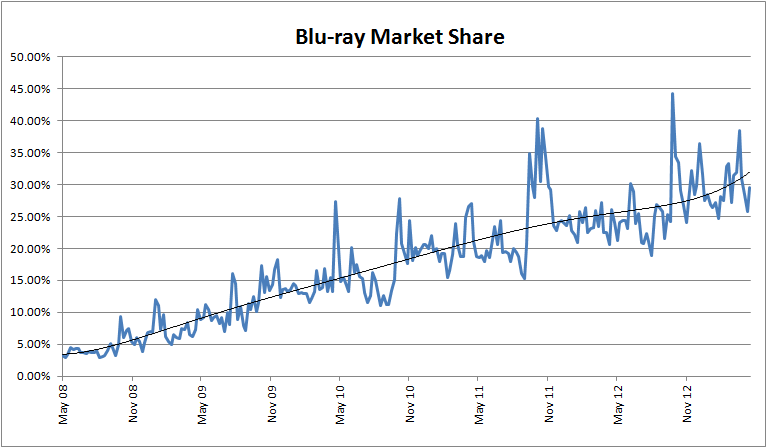
The first set of graphs show Blu-ray market share (Blu-ray and combo market share as a percentage of all disc sales) through the five year period that I have tracked them, with the release milestones pointed out.

Blu-ray Sales Percentage - 4 May 2008 to 20 April 2013 - Click to see larger version

Blu-ray Sales Percentage – 4 May 2008 to 20 April 2013 – Click to see larger version

As the graph is getting perhaps a bit too wide, here’s a condensed version that allows you to see Blu-ray’s market share rise more clearly.

Blu-ray Market Share - 4 May 2008 to 20 April 2013

Blu-ray Market Share – 4 May 2008 to 20 April 2013

We’ve had our fair share of milestone releases in the 52 week period since the last “State of Play” feature. While there’s no Star Wars this time around, we do have The Avengers and The Hobbit, the former responsible for the peak in the graphs above. The new market share record is now 44.23%, beating the 40.22% set by the release of The Lion King back in 2012. The up and down nature of the weekly results show that market share, like revenue, is very much release dependent. A good “A-lister” this week or a Blu-ray exclusive can get market share and revenue rising fast, but a slow week, and it goes down again. But the rising trend is clear, especially in the second graph above. The trendline just breaks above the 30% mark at the end of April 2013, and that’s probably a fair reflection of where Blu-ray market share is, or will be soon enough.

For this latest 52 week period ending 20th April 2013, the average weekly Blu-ray market share figure was 27.57%. This compares to 23.67% from the previous 52 week period. This is in-line with the 4-6% annual increase in market share that Blu-ray has experienced since inception.

It’s worth noting that Blu-ray’s rising market share has as much to do with DVD’s decline as it has to do with actual rise in Blu-ray sales, probably more so. The rise in spending in digital streaming and downloading is one of the major factors in the decline of DVD sales, in addition to the rising popularity of Blu-ray.

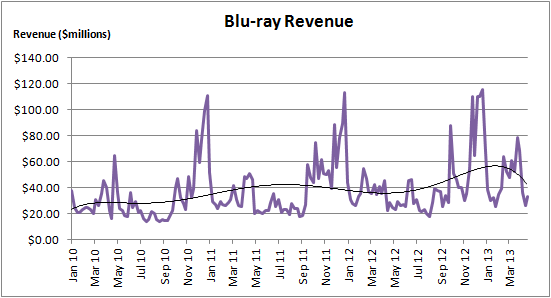
For Blu-ray revenue, the trend is less clear, although I have less data in this regard compared to market share (just under three and a half year’s worth), other than that there is definitely a seasonal trend within the overall trend, peaking unsurprisingly during the holidays sales period.

Blu-ray Revenue Growth - January 2010 to April 2013

Blu-ray Revenue Growth – January 2010 to April 2013

Analyzing the peaks, we’re seeing a gradual rise from year to year, and the trendline reflects this as well. Again, you can see that revenue is both release dependent (when the revenue peaks line up with the market share peaks) and seasonal dependent (when revenue peaks does not line up with market share peaks). Taking averages of these weekly results, this latest 52 week period yielded an average weekly revenue figure of $44.84 million. This compares with $39.44m and $34.05m from the last two 52 week periods, producing a trend that seems to indicate a $5 million rise in average weekly revenue every year.

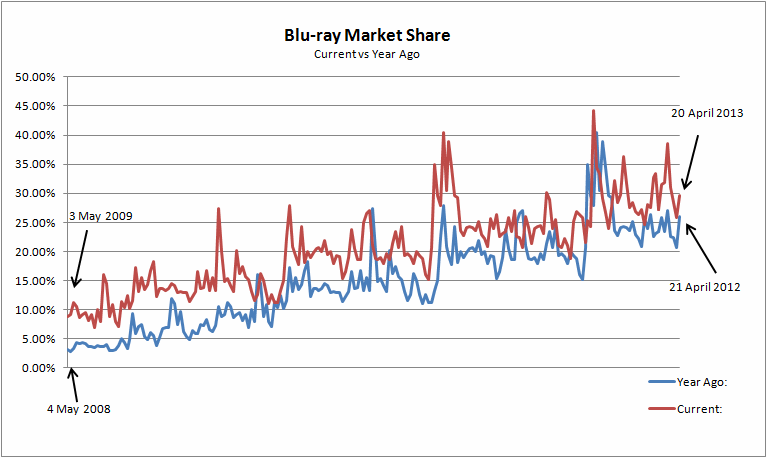
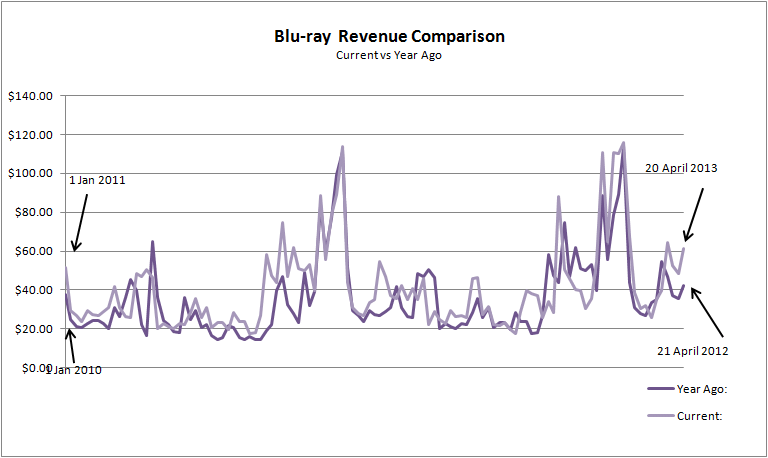
The last two set of graphs shows a comparison of weekly market share figures with the same figure from a year ago, and the same comparison but with revenue figures.

Blu-ray Sales Market Share: 2008/12 versus 2009/13 Comparison

Blu-ray Sales Market Share: 2008/12 versus 2009/13 Comparison

Blu-ray Sales Revenue: 2010/12 versus 2011/13 Comparison

Blu-ray Sales Revenue: 2010/12 versus 2011/13 Comparison

These two graphs are less indicative than the other graphs, but they’re interesting in that they show the seasonal effect in full force – note that the peaks and troughs occur roughly at the same time every year, for both market share and revenue. The more noticeable gap between the year-on-year market share comparison, and the less noticeable gap between the revenue version of the same comparison, again highlights that other factors exists (ie. decline of DVD sales) when taking into account market share.

In conclusion, it’s been another steady year of growth for Blu-ray. It looks as if it will take a while for Blu-ray to become the dominant disc format (dominant as in more than 50% market share on average), but on the whole, the format looks in healthy growth.

Weekly News Roundup (12 May 2013)

Sunday, May 12th, 2013

Happy Mother’s Day! Not sure how I can segue the holiday into a WNR mostly about BitTorrent and streaming, but this and this may help.

[SEGUE COMPLETED]

Let’s start …

Copyright

BitTorrent Inc this week chose to launch a strange attack on Netflix’s claims last week that BitTorrent traffic drops whenever Netflix enters a new market.

It was strange to me because it was clear that Netflix’s Chief Content Officer Ted Sarandos was referring to piracy related BitTorrent traffic (responding to a question about piracy in an interview with Stuff magazine). That BitTorrent Inc chose to counter these claims seemed at first to me like they were inadvertently accepting the association between BitTorrent, the company, and piracy.

Sarandos said last week that “When we launch in a territory the Bittorrent traffic drops as the Netflix traffic grows”. BitTorrent’s VP of marketing Matt Mason this week criticized Sarandos’s statement for linking BitTorrent with piracy. Mason also disputed the relationship between BitTorrent and Netflix traffic, saying the latter was most likely due to a BitTorrent algorithm that reduces traffic flows during peak usage times, including during peak Netflix usage hours.

The first part of the criticism I can understand, although one would have to take Sarandos comments out of context for that confusion to arise, but the second part is a bit curious to say the least. Mason’s explanation seem to be talking about a BitTorrent traffic drop during peak usage hours, but surely whatever traffic pattern changes exists whether Netflix exists in the area or not, and even then, the algorithm will only manage to push traffic to non peak times. There would not be an overall traffic drop over a period of time, which seems to be what Netflix’s Sarandos is suggesting. To me, Sarandos is saying that less stuff gets transferred via BitTorrent once Netflix moves into a new area, and I fail to see how traffic management can lead to less stuff being downloaded. And since Sarandos was talking mainly about piracy related traffic, why is BitTorrent Inc injecting themselves right into the middle of this particular hornet’s nest?

Mason does agree with Sarandos’s suggestion that the best way to fight piracy is by giving people what they want. And if this were true, then piracy related BitTorrent traffic should drop. For Mason to suggest that it hasn’t would require you to completely disassociate piracy with the BitTorrent technology, and that isn’t reality no matter how you may want to spin it.

BitTorrent Logo

What’s in a name? BitTorrent the company, the protocol, or the acts of piracy?

Perhaps Sarandos’s statement was a bit clumsy, in that he chose to condense the phrase “piracy related BitTorrent traffic” to just “BitTorrent traffic”, and also offered nothing to back up his claimed relationship between Netflix and BitTorrent traffic. But it seemed like an off the cuffs kind of comment, that taken into context, shouldn’t really concern the likes of BitTorrent Inc.

It just seemed to me like BitTorrent Inc was budding into a conversation that wasn’t even about them, by loudly proclaiming that the conversation shouldn’t be about them. Mission un-accomplished?

While I understand the frustration of BitTorrent Inc in regards to the far too liberal use of the term BitTorrent (something I’m guilty of too here), which I talked about in the last issue of the WNR, I fear it may be too late at this stage to disassociate BitTorrent with piracy. It’s become a shorthand, rightly or wrongly.

But instead of taking on Netflix over a somewhat lazy use of words, and seemingly agreeing and disagreeing with Netflix’s anti-piracy credentials at the same time, BitTorrent Inc should just keep on pushing the “legal content via BitTorrent” agenda, and continue to support companies like Netflix in their attempt to fight piracy the right way. It’s too late in the game to be this oversensitive about wording.

Along with Netflix, Spotify has probably done the most to stop piracy. But a flaw in the Spotify web player was exploited last week to full effect when a Chrome browser add-on called Downloadify allowed every song in Spotify’s 20 million strong catalog to be downloaded without DRM.

The add-on was promptly removed by Google, and Spotify soon fixed the flaw, but not before more than 16,000 songs were downloaded.

The flaw, which apparently had cached songs being unencrypted, had been there for at least five or six months. I do wonder what it means when it took so long for the flaw to be exploited, and that the Spotify web player was essentially DRM free all this time with not a worry in the world.

Also note that for the hardcore pirates out there, it’s still possible to record what’s being played by Spotify and “rip” it that way. Only those most serious about pirating would probably attempt it though, because, I mean, why bother?

Gaming

As we get closer to the official May 21 launch event for the Xbox 720, codenamed ‘Durango’, and possibly actually named Xbox Infinity, more concrete information about the console is being leaked week by week. This week, we have the story of an internal Microsoft email sent to all employees working on the console that seem to allay fears that the console would feature a much hated ‘always-on’ DRM system.

The leaked email specifically addresses the issue and says that the console will be “tolerant” of today’s Internet connectivity issues, which means that activities such as “playing a Blu-ray disc, watching live TV, and yes playing a single player game” will not be subject to any Internet connection requirements.

Phew.

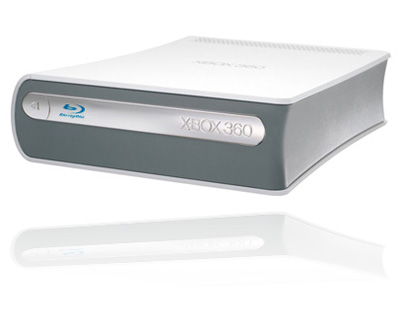
Microsoft Blu-ray Drive

After years of a rumored Blu-ray drive add-on for the Xbox 360, the next Xbox may finally get Blu-ray movie playback

To be honest, I never believed that ‘always-on’ DRM was on the cards. Sure, other leaked documents and rumors talk of an ‘always on, always-connected’ console, but it always sounded more like the description of a quick stand-by mode that also featured support for things like background updates. The truth of the matter is that console piracy isn’t so serious yet that ‘always-on’ DRM will be required at the expense of making gamers angry, certainly not for a new console whose actual copy protection system may take a while to be broken.

As a bonus, the leaked email also seem to confirm not just the use of Blu-ray discs for the Xbox 720, but the inclusion of Blu-ray movie playback, which would be a great upgrade to the Xbox 360’s media playback credentials. Unfortunately, another rumor suggests that this very inclusion is the reason the Xbox 720 will fail to meet its previously predicted 2013 launch date, instead being delayed until 2014 due to Blu-ray licensing troubles. Apparently, Sony has an exclusivity agreement in place for console based Blu-ray playback at the moment.

This could spell trouble for Microsoft, since timing is everything. Microsoft knows, that despite the Red Rings of Death problems with the early Xbox 360, the Xbox platform wouldn’t be anywhere near what it is now if Microsoft hadn’t released the console a year earlier than its competitors.

The same doesn’t look to be true for the Wii U unfortunately. Despite also releasing a year earlier compared to the PS4 and Xbox Infinity, I fear that when the three consoles are compared, the Wii U will look a lot more dated than just a year. I know graphics shouldn’t be that important, but it’s the easiest way to compare multi-platform titles, and the minor improvement that the Wii U has over existing consoles like the PS3 and Xbox 360 means its early release has no positive effect. At its time of release, the Xbox 360 was head and shoulders above the likes of the GameCube and the PS2, and Nintendo needed to do something similar if they really wanted to get back part of the hardcore gaming market.

And the sad part is that poor early sales will destroy any slim chance the Wii U has in going against the PS4 and Xbox Infinity. A low user-base will be enough to convince some developers to skip the Wii U entirely when it comes to developing multi-platform titles, which means a lack of new titles, which means even lower sales. This vicious circle is extremely dangerous, even with Nintendo’s good track record in terms of first-party titles, and the company needs to do everything it can to ensure developers continue to make stuff for the Wii U (even if it means big financial payoffs, a strategy that Sony and Microsoft are no strangers to).

That or dramatically cut prices.

And I think that’s it for the week. See you in seven.

Weekly News Roundup (5 May 2013)

Sunday, May 5th, 2013

A week after the start of my combined Netflix and Hulu Plus experience, it has already changed the way I consume media. So much so that I actually rang up my cable provider this week and reduced my subscription to a cheaper package, since it turns out that apart from live sports, I’ve not watched a single thing on cable since I started my week’s trial. I also realised that there were tons of DVDs and Blu-rays that I probably would have never bought if I had Netflix all this time. Not to say that Netflix has all of the movies I want, far from it, but there were definitely discs that were impulse buys for me, including ones I purchased more than two years ago and have yet to watch, that could have been better enjoyed via Netflix.

Interestingly enough, there are a couple of Netflix related news this week as well. Let’s get started.

Copyright

If there’s one thing that really confuses Hollywood, it’s the distinction between BitTorrent, the transfer protocol, BitTorrent, the company, and the BitTorrent that people refer to when they’re downloading tons of pirated movies and TV shows. To Hollywood, the three are synonymous.

Which is why by following the same reasoning, Hollywood should also declare HTTP to be illegal and “evil”. Because equating the three separate entities/acts above would be like equating HTTP, the transfer protocol, with Mozilla, the company that makes a popular software for the protocol, and the act of downloading pirated movies using HTTP from the web.

Mr Burns

Release the hounds: Hollywood attacks indie studio for making a deal with the “devil”, BitTorrent Inc

So no surprise then when that the Hollywood attack hounds were released the instant indie film studio Cinedigm struck up a marketing deal with BitTorrent Inc to promote its new movie Arthur Newman. Calling the deal “a deal with the devil” and accusing Cinedigm of selling out for a bit of attention for its new Emily Blunt, Colin Firth flick, a studio exec who spoke to The Wrap anonymously also accused BitTorrent Inc for being “in it for themselves” as “they’re not in it for the health of the industry”.

So if a tech company doesn’t do everything for the health of the film industry, then they’re the bad guys? Well, that does explain why Hollywood has declared war on tech companies and the Internet in general.

Hollywood can either continue their war against a file transfer protocol, as silly as that sounds, or they can wake up and realise that, um, they’re IN A WAR WITH A FILE TRANSFER PROTOCOL!!

If people weren’t using BitTorrent to share files quickly and efficiently, they’d be using some other protocol to do it. And if legal content was available via this or other transfer methods, and at a price and package that’s reasonable, people will use it too.

Just like how it’s far easier to find something classic or obscure to watch on Netflix than to scour BitTorrent indexes for hardly seeded torrents. And that’s exactly why Netflix is doing more every second to stop illegal BitTorrent downloads than anonymous Hollywood execs bitching about a bloody transfer protocol.

According to Netflix’s Chief Content Officer Ted Sarandos, whenever Netflix moves into a new territory and its popularity increases, BitTorrent traffic in the same region goes down too. It just goes to show that “good value and legal” can indeed compete with the “free and illegal”, especially if you can improve upon convenience. Whatever you say about the decreasing quality and quantify of Netflix content, for $8 a month, it still represents terrific value, and from a convenience point of view, it is hard to beat (compared to finding an active torrent, waiting for the download, maybe further processing to get it to work on the playback device, and then needing the storage capacity to permanently keep a library of downloads, most of which you’ll probably only ever watch once).

Greg's Movie Collection

You can reduce the size of your disc collection by replacing ‘meh’ movies in your collection with a Netflix subscription

As for the argument between “ownership” and the rental/subscription model of Netflix, as we’ve found out recently, we don’t really own the digital stuff we buy anyway. For most content you will consume, you do it once and then never again. The only reason we “buy” is to ensure that if we want to access it in the future, we have that option. And these needs can be much better served by subscription streaming, especially if your library starts to get awfully big.

The stumbling blocks to the success of streaming at the moment are things like expiring content, content being removed, and the “Balkanisation” of streamable content. The latter means that with increasing competition in the sector, and Hollywood studios starting to see the dollar signs and getting pissed off that Netflix is benefiting too much, starts to pull content from Netflix; or offer different content exclusively to different services to maximize income; or add more time delays and geographical licensing restrictions to content, or even launch their own streaming services. Instead of one place where you can get almost everything, you may then need to have several subscriptions to achieve the same. That’s the unfortunate and greed driven direction we seemed to be headed towards.

On one of these issues at least, Sarandos is working hard to change the status quo. What he wants is “ubiquitous global licencing”, where a single license allows Netflix the right to distribute all around the world. It is what Netflix is doing with its own original content, making it available everywhere, and it’s their attempt to start a new trend that they hope Hollywood will warm to, even if it may take years. I won’t be holding my breath.

In further Netflix news, a new NPD study has revealed that within a year, there will be more streaming player in the US than Blu-ray players. Of all the streaming services, Netflix remains the leader, with 40% of all connected TV users using Netflix, compared to only 17% that use YouTube and 11% that use Hulu Plus.

An interesting new trend also appears to be developing, with dedicated streaming media players like Apple TV or Roku becoming more popular. NPD puts it down to these devices being optimized for streaming content delivery, as opposed to the streaming functions of connected devices like Blu-ray players and TVs, whose implementations are often best described as an “afterthought”.

In a different study, it was found that gamers in the US are spending a quarter of the time streaming videos on their consoles. Devices like game consoles, Blu-ray players and connected TVs are the gateway devices for streaming, and their prevalence in people’s home can explain why streaming is going from strength to strength.

——

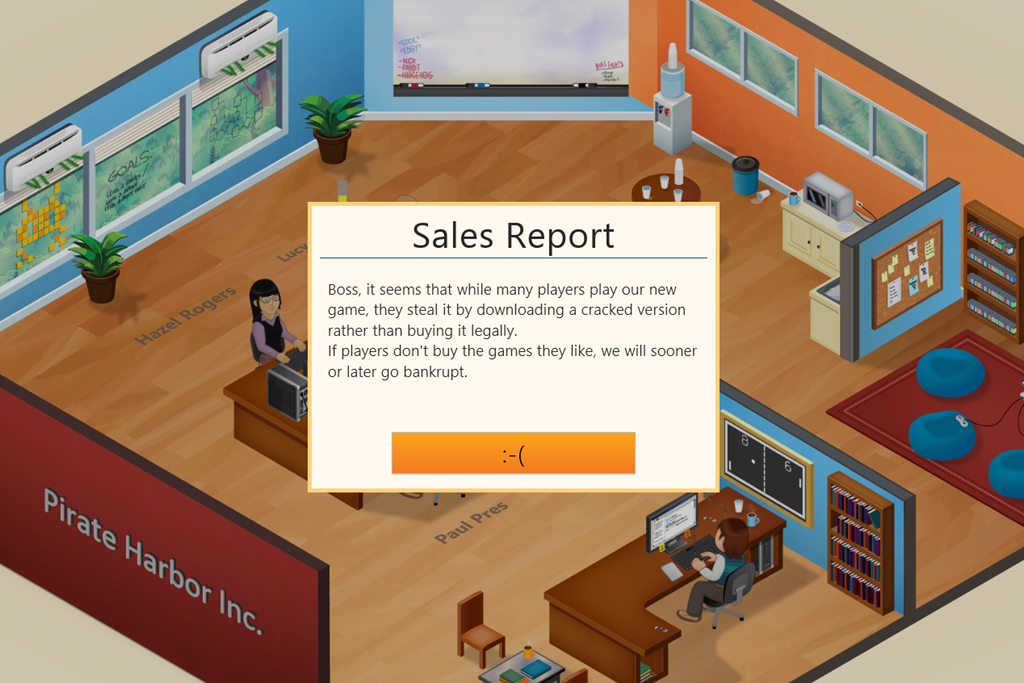
The meta moment of the week goes to the developers of business simulation game ‘Game Dev Tycoon’, for adding a novel anti-piracy feature into their game: pirate the game, and you get piracy inside the game!

Game Dev Tycoon

Pirate the game Game Dev Tycoon, and you get piracy inside the game!

The game tasks the player to create and run their own game development company. Trying to highlight the problem of piracy, one of the makers of the game, Patrick Klug, posted a special “cracked” version of the game on a popular BitTorrent website. Within a day, nearly 94% of all those playing the game were using the pirated version.

But gamers of the pirated version soon started noticing that they would be getting an unfair amount of piracy for the virtual games produced by their virtual game companies, to the point where their companies would go bankrupt. It appears they have just been punked by Klug. Klug says his deliberate release of a crippled “pirated” version of  his game was an attempt to educated pirates, to hold “a mirror in front of them and showing them what piracy can do to game developers”.

A novel approach to anti-piracy, but perhaps an even more novel approach to promoting the game. Had Klug not uploaded the “sabotaged” pirated version, it’s unlikely Game Dev Tycoon would be making the news headlines as it did this week, and even more unlikely for the game to have so many players (even if 94% didn’t pay for it). This is actually more akin to a demo disguised as a pirated version, and there may be something to this approach if Game Dev Tycoon’s sales increase because of this little stunt.

Most funny was the way some pirates reported the problem. One even asked if there was a way to research “DRM” in the game so that the piracy plague could be stopped, while another lamented the fact that far too many people were pirating his virtual creations, not aware of the delicious irony contained within the statement.

I don’t know if Game Dev Tycoon features an option to research DRM in the game or not, but if it does, I hope the game doesn’t actually reward the player for doing it. Doing so would perpetuate the myth that DRM actually stops or reduces piracy, as in most cases, it does not.

What is does is to punish paying customers, while doing very little to hinder the efforts of hardcore pirates and crackers. It may also help publishers and device makers to lock up market share, which just piles on more pain for the paying customer.

So when sci-fi publisher Tor decided to make all of its ebooks DRM free about a year ago, it was a breath of fresh air that the ebook industry needed. Here was an imprint that belongs to publishing behemoth Macmillan ditching the accepted notion that you have to have DRM. The move itself was bold and risky, but made more palatable by the fact that authors and readers, not to mention bloggers and commentators such as myself, were all in full support of the move.

The only doubt left was whether the move would lead to an avalanche of piracy for Tor ebooks, now that they’ve become so easily to share and copy online.

DRM Doesn't Work T-Shirt

DRM doesn’t work, and ebook publisher Tor has the stats to prove it

The resulting piracy wave? Nothing. Nada. Or in Tor’s own words, “no discernible increase in piracy”. The only response have been hugely positive ones from readers and authors, praising Tor for having the guts to do the right thing.

But is anybody really surprised though at the results of this DRM-free experiment? You take something that doesn’t work, and everybody hates, and you just sort of, ah, chuck it away. Chop it off. Smash it to bits. And guess what? You end up with a better product!

People who pirate will still pirate, and the source may now be a DRM-free Tor ebook, but all that’s changed from before was perhaps the trivial step of somebody removing the DRM before sharing. It has perhaps made the life of one pirate distributor easier by a tiny bit, but it would have made no difference to people downloading. Hence “no discernible increase in piracy”.

The only other argument that people could have made against Tor’s move was one of moral hazard. That even if DRM was ineffective, it was a message to people out there that piracy is not being tolerated. The problem with this argument is that people don’t care, and by the time somebody downloads a pirated copy, the DRM would have been long gone and they may never have been aware of its existence in the first place. It’s like those “don’t pirate this movie” messages you only see at the start of legally purchased DVDs, but never on pirated ones (which made the pirated ones a better product for not making you sit through the un-skippable nonsense).

That’s it for the week. Hope you enjoyed this issue of the WNR. I’ll go back to finishing watching Hotel Rwanda and then a couple of episodes of The Shield – all with no discs loading involved. See you next week.

 

Weekly News Roundup (21 April 2013)

Sunday, April 21st, 2013

Plenty to go through in this downer of a week, so let’s not waste any time …

Copyright

Is it still going on? Apparently, yes. Viacom is still suing Google’s YouTube for copyright infringement, despite a 2010 court ruling throwing out the case via a summary judgement in favor of Google/YouTube. That decision was appealed, partially successfully, and the case was directed back to the lower courts. But once again, Judge Louis Stanton has ruled in favor of Google, arguing that YouTube was under the protection of the DMCA’s Safe Harbor provision. And guess what? Viacom is going to appeal this decision too.

It’s all getting quite boring now, to be honest. The two companies are actually working side by side these days, so only Viacom knows what the point of the lawsuit is at the moment. That Viacom is still not letting go is probably more face saving than an actual sense of feeling wronged, and whatever YouTube has done in the past, what it does now (in terms of what users do with the service, and what YouTube does for content holders) is so far removed from what went on before, it’s practically like suing a different website.

Just move on Viacom. Everybody’s bored already, including  the judges, and probably your shareholders as well. Concentrate on actually making content that people want to pay for, instead of blaming everyone else for your woes.

Speaking of things that people actually want to pay for, Netflix’s plan to fight off its old and new subscription-VOD competitors appears to be working, as its original programming has helped the company to gain new subscribers. But it’s Netflix’s old business, the DVD (and Blu-ray) rental one, that is now becoming a risk for the company, an analyst has warned.

Photo of Netflix on iPad

Netflix’s growth is dependent on revenue from its disc based business, but with that shrinking, Netflix may be at risk says analyst

While Netflix has over 29 million streaming subscribers, 64% of the company’s 2013 revenue is still expected to come from disc based subscribers. In other words, disc rentals are funding Netflix’s streaming expansion plans, and with disc revenue expected to continue to fall, it could endanger Netflix’s plan to expand to more locations around the world, as well as fund new original programs.

If anything, it seems Netflix’s current problem stem from the fact that it’s too good for its price of $7.99 per month. Compare to say HBO, who can get away with $15 per month for only a few hit shows, Netflix, now with original programming, offers much more (and an essential babysitting tool for any parent or guardian). The increasing cost of securing rights to shows and movies, and increasing competition from the likes of Amazon and Redbox, all means that Netflix is still over-reliant on its declining disc based business to keep the company profitable and in expansion mode.

Subscription VOD is currently stuck with the low cost model first pioneered by Netflix, but I suspect going forward, there will need to be tweaks to the pricing model. Perhaps we’ll see an introduction to a “premium” subscription tier that includes more fresh and original content than the “basic” $7.99 package, and that may be needed to offset the billions Netflix currently spends on licensing and production.

And who wouldn’t pay another $5 or even $10 per month if it meant they could watch new seasons of shows like House of Cards and Arrested Development?

——

It didn’t incite as much hatred as SOPA, but CISPA may be just as bad, and unfortunately, the US House of Reps passed it with an overwhelming majority on Thursday. The CISPA cybersecurity bill will enable private business to share all your most private information with any government agency that requests it, and allows warrant-less database searches. Emails, photos and even passwords could all be shared with government agencies against your will, and there’s nothing you can do about it – CISPA ensure this.

Typically, supporters of this overreaching bill says that it’s targeting terrorists not ordinary citizens, and Rep. McCaul of Texas drove home this point even more clearly by actually using the terrible events in Boston as justification for CISPA.

But unlike SOPA, there isn’t the united front against CISPA that can work together to kill it off before it becomes law. For one, the likes of Apple, Google and Yahoo are cautiously supporting CISPA, despite opposition from the likes of the EFF and the ACLU. At least this time, the White House seems to be on our side, with President Obama threatening to veto the bill in its current form, and the Senate, having already turned away a previous version of CISPA once before, may have something to say about it too.

Gaming

Sony says they’re not going to make the same mistakes they made with their PS3 launch, and will launch the PS4 at a good price.

A photo of the New Xbox 360

Could a cheaper Xbox 360 keep the console alive when the Xbox 720 and PS4 (also to be cheaper at launch) arrives?

The PS3 was launched at a price that was a lot higher than that of rival consoles at the time (in Australia, the launch price of the 60GB console was close to the $USD 900 mark). This was despite Sony still losing money on each console sold. The reason for the high price was the included Blu-ray drive, and Sony argued that since Blu-ray players were quite expensive at the time, the PS3 actually represented good value for those also looking for a Blu-ray player.

This move paid off by ensuring Blu-ray won the highly tedious HD wars, but the victory came at the cost of lost market share to the likes of Nintendo and Microsoft. It also ensured Sony lost a ton of money for the first few years of the PS3.

But with Blu-ray players worth almost nothing these days (saw one today advertised for $USD 40), there aren’t any reasons why the PS4’s price point should be any higher than that of its rivals.

Although it could still be a lot higher than that of the Xbox 360, as Microsoft may be releasing a $99 version of the console to be launched along with the Xbox 720. It may be a response to the Xbox 720’s lack of backwards compatibility, but it could also be a move on Microsoft’s part to add new customers for the console. It might target those that want it as a cheap media streamer, with the added bonus of heaps of games of all types, from the casual/family to the hardcore. The only thing better than it would be a $99 PS3 (hint, hint)!

The cheap Xbox 360 and the cheaper (on debut) PS4 should help lift video game sales, but for now, things are still stuck in the doldrums. The March 2013 NPD US video game sales data has been released, and Microsoft’s Xbox 360 was top of the consoles with 261,000 units solds, but still down nearly 30% compared to a year ago. I actually want to wait a bit to see if any more data emerges for the Wii U in particular before commenting further on March’s NPD results, so let’s talk about it next week.

And that’s it for this edition of the WNR. See you next week.

Weekly News Roundup (7 April 2013)

Sunday, April 7th, 2013

Maybe it’s the post-Easter lull, or I was just even lazier than usual (“that’s not even possible”, I hear you say), but it’s been a spectacular boring week in terms of news this week. After reading the 86th story on how many people illegally downloaded a Game of Thrones, and in the days after I wrote my piece on it, I mean, really?

So as you’ve guessed, this is going to be a really really short WNR. Not my fault. Not really. Maybe a little.

Before we get to the only story of the week (I know, I know), there were a few notable mentions – stories not good enough to warrant an whole article, but still interesting.

Aliens: Colonial Marines Screenshot

Game cancelled for bad console, or bad game cancelled for console, depends on which way you want to spin it!

First up is the non story about Aliens: Colonial Marines being cancelled on the Wii U. Now, I could have spun into a story about how developers were abandoning the Wii, due to the poor sales figures. But I think it’s really just a case of developer abandoning poorly designed and implemented game. I wish more developers would do that, especially with games based on established franchises, and spare the rest of us the disappointment and frustration that comes from ruining our cherished memories of classics of days gone by.

This article in the WSJ is quite interesting, but has a bout of too-long-didn’t-read about it (to be fair, anything over 140 characters these days are labeled by some as tl;dr, but I do recommend you read this one). It’s about how content industries in the US come up with their controversial calculated losses due to piracy, and the debate surrounding just how much damage web piracy is having on sales. Even the MPAA has backed away from earlier studies that put the estimated cost to the economy at anywhere between millions and billions. I don’t think there’s any doubt that piracy is hurting sales, but how much is the million to billion dollar question. My estimate put losses at $275.5 million per year. It’s true that I pulled that number out of my @$$, but it’s probably no more or less accurate than any other figure out there.

Google DMCA Notice

How long before the Google notice about a DMCA complain is subject to its own DMCA complain?

The ever informative TorrentFreak this week has another wacky story about Google DMCA takedowns, this time a rights holder has asked the actual DMCA takendown notice to be taken down. Whenever Google receives a DMCA takedown request, a copy of it is posted at Chilling Effects, and Google’s search results will usually post a notice with a link to the relevant Chilling Effects page for the notice. But as TorrentFreak notes, it doesn’t take much effort to take the Chilling Effects database of infringing links, and create “one of the largest pirate search engines available” from the data there. So taking down the infringement notice is the logical thing to do, except that this creates another Chilling Effects page, which will need to be taken down again in due time, and on and on we continue until we’re stuck in the deepest level, Limbo.

And now onto the Game of Thrones news I talked about earlier.

Game of Thrones: Giants

Holy crap! GoT Giants!

Despite the best efforts of HBO, by shortening the artificial airing delays for the latest episodes of Game of Thrones outside of the U.S., the first episode of season 3 of the hit show has still managed to break piracy records.

At one point, the most popular torrent for GoT had more than 160,000 peers, and only a day after the show aired, it has already been downloaded more than a million times.

Surprisingly, or perhaps unsurprisingly if you actually live here, Australia was one of the top locations where the show was downloaded illegally. The show’s popularity in Australia isn’t the issue, and with only a 2-hour delay between the U.S. airing and the Australian subscription TV premier, access seems to be less of an issue as well (originally, subscribers had to wait 6 month for new episodes).

But pricing, I think, is still why so many Aussies turn to BitTorrent. Despite the country being a prosperous one by relative terms, the fact that we end up paying many times the price of people in the U.S. or even the U.K., means that many feel that the legal option cannot be considered as a reasonable option. The cheapest way to watch the latest GoT episodes, with “only” a two hour delay, costs at least $USD 63 per month, most likely double what people in the U.S. are made to pay (this gets you basic cable plus the movie channels, one of which shows the latest episode of HBO shows). Those that want to watch via the net, legally, are left with the option of an iTunes season pass at $35 for the HD version of the show, and a hefty 2-day delay for new episodes.

For now though, it seems HBO and the show’s creators, and even Australia’s subscription TV provider, are not pulling their hairs out over the piracy rate. The high piracy rate is a testament to the show’s popularity, and that’s something you can’t buy, and that’s a good thing. In the end, it all comes down to a simple formula: take the number of people who want to watch the show and subtract away the number of people who can actually afford to watch the show. With the first number really high, and the second number low because of cost and accessibility issues, it’s no wonder the piracy rate is so high, here in Australia, and elsewhere. Reducing piracy may end up lowering the first number without actually increasing the second number, which is totally not what you want (as the first one determines things like DVD and Blu-ray sales too).

That’s about it for this shortened edition of the WNR. Short and sweet. Like a Hobbit marinated in honey sauce. Hmm, soft and juicy Hobbitses.