Archive for the ‘High Definition (Blu-ray/HD DVD/4K)’ Category

Weekly News Roundup (11 August 2013)

Sunday, August 11th, 2013

Welcome to the latest edition of the WNR, filled with the copyright, high def and gaming goodness that you know and love. Nothing much new to update from my end. I ordered a Chromecast a few weeks back from Amazon (to ship it to Australia via one of those relay shippers), but alas, the lack of stock is becoming a bit frustrating. I’ve received numerous notices from Amazon about the shipping date, giving me all sorts of different information, so who know when I’ll get one. Not that it’s of that much use to me in Australia, since the built-in Netflix support appears to used hard-wired DNS settings, which rules out geo-unblocker services until the device can be hacked or an easy workaround found (which I’ll definitely write about on streambly if/when it is found). Anyway, the news.

CopyrightNot this again. I guess the Obama administration has run out of things to do, now that it’s commerce department is again trying to revive one of the most controversial parts of the very controversial SOPA bill – to make unauthorized streaming a felony.

Megaupload's Mega Song was blocked on YouTube by UMG

Getting your video removed by YouTube could be the least of your worries, under new plans that could make the offense a felony

If all of this sounds familiar, then it’s because it is. Check out this WNR from November 2011, in which the same issue was discussed due to an independent piece of legislation urging for the same (which was then rolled up into the mega monstrosity that was SOPA and PIPA). The obsession that the creative industries, via their political lackeys, have with the whole streaming/felony thing comes down to the fact that unauthorized reproduction and distribution of copyrighted works is counted as a felony, whereas public performances (such as streaming) is only counted as a misdemeanor. This is the discrepancy that all these various proposals attempt to address, to uniformize (I’ve been assured that this is an actual word) and to unify the differences . I guess it must be an OCD thing.

While I do agree that many of the people posting soul destroying covers of what was once a great song should indeed be locked up, I’m not sure that copyright infringement should be the main reason for doing so. I will also note that this is the same administration that is defending the unauthorized reproduction, distribution and streaming of every conversation that everyone has ever had (where’s my damn copyright protection?), and that these changes may see YouTubers get harsher sentences than the people who destroyed the global financial system.

Technological solutions to piracy don’t usually work well, but when they are capable of causing collateral damage, they become dangerous. That’s what copyright news website TorrentFreak found out this week when their website was blocked by Sky UK’s court mandated piracy filter using a flaw that can allow virtually any website to be blocked.

Apparently, when an already blocked website, such as TV torrent indexer EZTV, changes their DNS settings to point to another IP address (regardless of whether the IP address actually belongs to the website or not), Sky’s system automatically adds the new IP address to the list of blocked addresses. This means that EZTV could in fact add Google’s IP addresses to their DNS, and Sky’s system will block access to Google for its four million customers.

This is what happens when you replace due process with an automated system, a badly programmed one at that. Even the full legal system with its due process is by no means infallible to unjust outcomes, but one where there is zero accountability and legal recourse was always bound to fail, with or without a serious flaw like this one. Technology can improve efficiency if used correctly, but taking legal short cuts is not making the process more efficient, just more flawed.

High Definition

Blu-ray and digital revenue is helping to offset the decline in DVD sales and rental revenue, according to new data released by the DEG. While packaged media sales declined by an alarming 13% in the second quarter of 2013, compared to the same quarter a year ago, overall revenue remained relatively steady.

Netflix Blu-ray Rentals

Netflix’s streaming business is booming, while its disc rental business is in a steady decline

This is largely due to Blu-ray sales again showing double digit growth, 15% in the first six months of 2013 compared to the first half of 2012; and also digital revenue rising by an impressive 24% in the same period (with electronic sellthroughs up an amazing 50%). Subscription based Internet streaming was a particular highlight within the digital umbrella, with spending up 32.13%.

For Blu-ray, sales of new releases was up 19%, compared to only 8% for catalog/classic releases.

Rental revenue continues to decline, by 5.5% for the first half of 2013. So while Netflix streaming was growing by 30%+, its disc rental business was most likely in a relatively steep decline, as subscription rental revenue for the whole industry declined by 21%.

The same data also showed that 5 million new Blu-ray players were sold in the first half of 2013, bringing the total number households with at least one Blu-ray players in the U.S. to 61 million.

In short, Blu-ray, digital good; DVD, rental bad.

Gaming

The Xbox One received a much needed boost, literally, this week as Microsoft officially revealed that the Xbox One’s GPU speed has been upped from 800MHz to 853MHz. This 6.6% performance boost gets the Xbox One’s performance a little bit closer to the PS4, but the PS4 still looks set to easily be the more powerful machine.

Pure GPU shader throughput on the PS4 is still expected to be nearly 40% greater than that of the Xbox One, even after this latest GPU speed bump. And this is despite the Xbox One being $100 dearer than the PS4 at launch, but most of that is due to the inclusion of Kinect 2.0 with every console.

Xbox One Forza 5

Xbox One’s GPU speed increased to close the gap on the PS4

On paper, this seems to give the PS4 a huge advantage when it comes to the game’s visual quality; but in reality, developers of multi-platform games tend to go with the lowest common denominator, as opposed to doing extra work (which costs extra $$$) on one particular platform to leverage its hardware advantage. But as developers become more accustomed to working on both consoles, they might begin to find less resource consuming ways to get the best out of the PS4, and so expect later stage PS4 games to look better than their Xbox One counterparts. And of course, PS4 exclusives will be able to take advantage much earlier on.

I’m 80% certain at this point that I probably won’t buy an Xbox One, not until it’s a bit cheaper at the very least. At the same time, I’m maybe 80% certain that I will own a PS4 before I own an Xbox One. Microsoft’s DRM snafu; the price difference; and the hardware superiority, the latter two being in favor of the PS4, is what is largely responsible for my stance.

That’s it for the week. Hope you enjoyed it. See you next week.
Weekly News Roundup (4 August 2013)

Sunday, August 4th, 2013

A pretty quiet week this one. Not sure why, not that I mind too much. We can get through this one pretty quick, I think.

High Definition

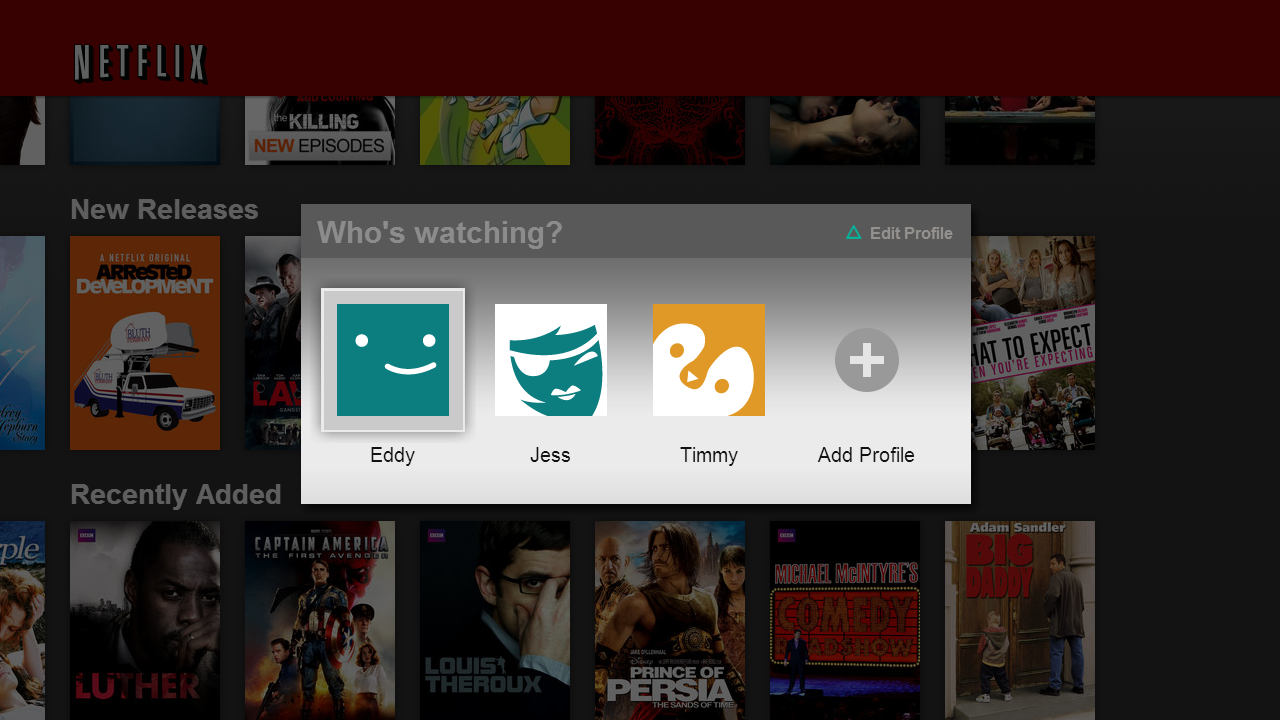
Well it’s about time! Netflix has finally come through with one of the most demanded features – the ability to have individual user accounts. From now on, subscribers will be able to create up to 5 profiles, one for each person that shares the same Netflix account. Each profile will have its own suggestions based on that user’s viewing habits, as well as a separate instant queue and recently watched list. So no more Fireman Sam cartoons in your most excellent instant queue featuring only ultra violent martial arts films.

Netflix Profiles

Netflix profiles is exactly what users have been demanding

You can also connect each profile to your Facebook account, and then the Facebook profile picture will be used to identify the account, but then your friends will all think you’re some kind of weirdo because you’ve managed to watch  72 episodes of Dexter in the span of about 5 days.

As for which apps will support profiles, pretty much all of them will except for the Android and Wii apps (updates for both are coming soon). Although it might take a week or two for the feature to finish rolling out to all the currently supported devices. You can only create profiles on the PS3 app or via the Netflix website at the moment, but the other apps will be able to access any created profiles.

While streaming definitely seems like the way things are headed, the good old optical discs might still have a place if bandwidth hogging applications like 4K become mainstream. And then there’s always the world of archival storage, which might very well be where old storage formats go to die (and where magnetic tape is still king, at least for high capacity storage). So this is why Sony and Panasonic announced this week that they’re joining forces again to develop the next generation optical disc for the long-term storage market, a disc that will hold 300GB of data.

Both companies made it very clear that the format is only intended for the archival storage market, possibly a deliberate effort to not make Blu-ray seem obsolete. But if 4K does take off, and the Internet as a delivery platform can’t do the job even with more advanced codecs, then I wouldn’t bet against this so far unnamed format stepping in and carrying the load, all 300GB of it.

Gaming

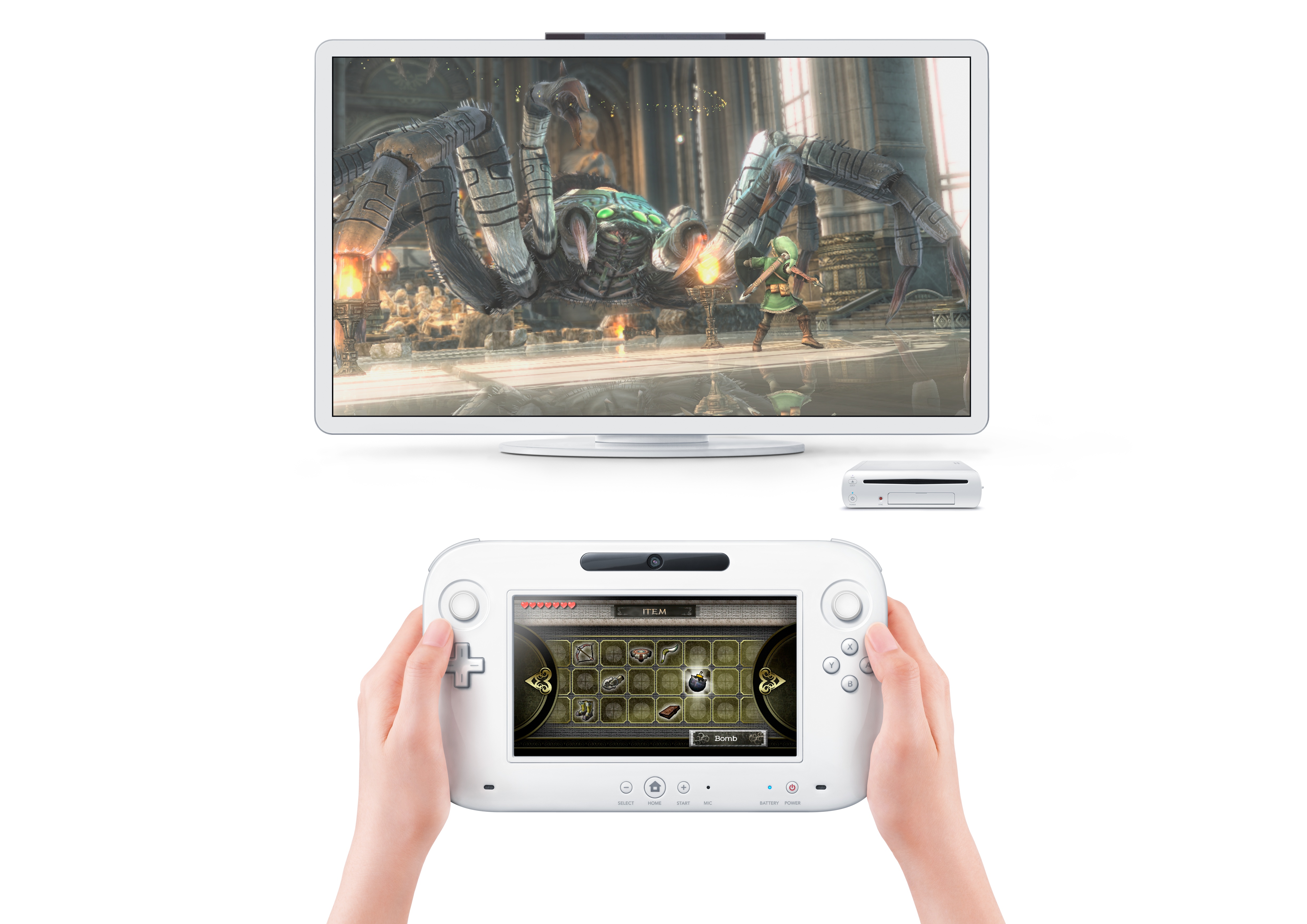
I’m feeling a bit sorry for Nintendo at the moment. The Wii U is a pretty nice console with a good dose of innovation, but a poor games line-up (always a killer when it comes to a new console), and now intense competition from the yet unreleased PS4 and Xbox One means it’s going to be a major uphill struggle for Nintendo’s flagship console. I knew Wii U sales weren’t that good, but without readily available NPD data, all I could do was to guess how bad they really were. But while it’s easy to hide sales data from journalists and bloggers, the financial reporting world is a bit harder to fool, and Nintendo has had to come clean with its Wii U sales figures. Only 160,000 units sold in three month, worldwide, is more than just bad though. As a comparison, the nearly 8 year-old Xbox 360 managed to sell 140,000 units in June alone, and that was only just US sales.

Wii U

Only Zelda (and Mario) can save the Wii U now

Nintendo blames the poor results on the lack of first-party titles, the likes of Mario, Zelda, Donkey Kong and Pikmin, all of which have new Wii U version arriving during the next quarter or two. The problem is that both the PS4 and Xbox One will be launching right in the middle of this release schedule, and I’m not sure even a Mario and Zelda game can save the Wii U at this point. Even if it does, it doesn’t really solve any problems for Nintendo, whose Wii console suffered because it relied too much on first-party releases. The whole point of Nintendo going “hardcore” with the updated Wii U hardware was to get new kinds of gamers on board, along with third-party developers that are good at reaching this particular demographic. But without hardware sales, developers won’t dare to invest in Wii U development. And the longer this goes on, the more outdated and limited the Wii U hardware will be, and you can bet developers will be even less keen to focus on what is essentially last-gen tech.

A huge price cut seems to be the only way to save the Wii U at the moment, to position itself as the budget console against, not the PS4 and Xbox One, but the PS3 and Xbox 360 (which is still very hard, as both of these platforms have a huge library of games that the Wii U does not).

Is the Wii U this generation’s Dreamcast? No idea, but let’s hope Nintendo can ride out the storm better than Sega couldn’t.

And believe it or not, that’s it for the week. Hoping for more next week. Until then, have a great one!

Weekly News Roundup (7 July 2013)

Sunday, July 7th, 2013

Welcome to another WNR. Another fairly quiet week this one, so a nice an short WNR for y’all. I’m still PS3-less, as I switched my Netflix device from the PS3 to my Samsung smart TV. It’s a shame that the Samsung Netflix app isn’t as updated as the one on the PS3, and less usable in my opinion. I’ve also been playing around with switching the Netflix region, a feature that’s part of my Unblock-Us subscription. It’s amazing how much more content you can get access to if you switch regions (currently watching Dexter from scratch on Netflix UK, which isn’t available on Netflix US). For $4.99 Canadian, I’d say it’s a good investment even for those in the US that don’t normally need a geo-unblocker.

On to the WNR.

CopyrightThere was more EA/Maxis DRM drama this week as one of their old games, Darkspore, became unplayable due to DRM server bug. The problem was so bad that Steam was forced to remove the game from sale temporarily.

Darkspore

Darkspore’s DRM related “blackout” shows server based single player games are a bad thing

This latest server bug was eventually fixed, although other bugs, like the infamous 7300x server bug, may remain unfixed forever. That’s the problem with single player games with server connection requirements – even though you may have paid full price for the game, you’re only really getting half of the game, if that. The other half, the server based one, could at any time cease to work, and you’re left with possibly nothing or a very limited experience, even in single player mode. It’s expensive for publishers to keep and maintain game servers, and at some point, the financial cost of maintaining the servers will start to outweigh the cost of keeping gamers happy and you know what happens next.

It would at least be better if these server based single player games are cheaper than “standalone” ones, but normally they’re not.

Overall, it hasn’t been a good week for gaming companies as Ubisoft’s user database was hacked this week. User names, email and hashed passwords were all accessed, prompting Ubisoft to send out emails urging users to reset their passwords. If you were one of the affected users, and you used the same password on other sites, it’s probably a good idea to change those passwords too. This is despite the leaked passwords being stored in an encrypted form, which is difficult (but not impossible), to reverse back to clear form (especially if your password isn’t complex enough).

Luckily, no payment information was stolen, at least according to Ubisoft. There’s also no information as to the motive behind the attack, whether it has anything to do with the game publisher’s previously controversial DRM stance (most likely not though).

It’s quite annoying that every gaming company these days seems to have their own login system. It’s all very inefficient, not just for us users, but for each company having to secure all these user databases (not very well, I might add).

High Definition

Studios are eager to push 4K video as the next evolution of home video, now that the 3D hype has largely died down, and Blu-ray has become more or less mainstream. But behind the main intent of trying to squeeze more money out of consumers lies an equally important intent to introduce new layers of copy protection to the masses. So at the Anti-Piracy and Content Protection Summit in Los Angeles last week, Sony Pictures CTO Spencer Stephens took the opportunity to outline some of the DRM measures he wants to see in 4K’s future, a Dystopian vision of home “entertainment” if there ever was one.

Killzone 4

4K video could be a Trojan Horse for new forms of DRM

Online authentication before each playback, digital watermarked content that includes trackable personally identifiable data of the purchaser/purchase device, a new version of HDCP that limits the length of cables between the player and the display, and unique title-by-title protection that reduces the chance of a single hack or flaw making all content vulnerable in one go.

You’d think Sony would have learned something from the whole PS4 DRM victory, but I suspect what Sony’s consumer electronics people think about DRM, and what their studio/content people think about it, are very different things.

And that was the week, basically. Told you it was quiet. Let’s hope this coming week is a bit more interesting. Talk to you again, same time, same place.

Weekly News Roundup (23 June 2013)

Sunday, June 23rd, 2013

Take the Xbox 360, go back 359 steps to get the Xbox One, but then do a 180, and you get the new Xbox, same as the old Xbox. Kudos to Microsoft for taking the risk in the first place, and then sense to reverse everything. I know some will say that going back to the old and safe is a coward’s way out, but for a company as big as Microsoft where the wheels turn very slowly indeed, I’m surprised they were able to reverse course as quickly and as decisively as they did. Anyway, more on this later, as we start this WNR with the usual copyright news first.

CopyrightThe White House was in full self-praise mode this week as the Obama  administration’s Copyright Czar released the 2013 Joint strategic Plan On Intellectual Property Enforcement (IPEC) report.

The Pirate Bay 3D Ship Model

3D printing piracy is on the White House’s hit list

The report highlighted the various controversial achievements the administration has made on the issue of IP enforcement, including the controversial Operation In Our Sites (which managed to seize a bunch of innocent domains by circumventing due process) and the controversial Megaupload raid (which is looking increasingly fishy as time goes on), and also welcomed new industry-led initiatives such as the controversial ISP six-strikes program and urged for more of the same.

Focusing not only on the past and present, the report also looked into the future and pointed out the areas in which new controversial measures can be deployed. Cloud computing, mobile computing, data storage and especially 3D printing were all singled out as areas that might need an urgent dose of anti-innovation.

3D printing is especially interesting due to the recent news involving the administration’s crackdown on 3D printable guns. Conservative and pro-gun groups were not impressed, as expected, but I wonder what their reactions would have been if people had been able to download and print copyrighted gun designs from the likes of Ruger, Remington and Smith & Wesson? Copyright and protecting the interests of gun makers might just out-trump their believe in the right to bear arms.

High Definition

Blu-ray revenue for 2012 was up 10%, with an even bigger increase in unit sales as the average price of Blu-ray titles dropped to just under $20, a new report shows.

Blu-ray sales and digital delivery helped to offset declines in DVD sales, and helped to produce a 0.25% rise in home entertainment spending in 2012. It doesn’t sound like much, but this was the first time in seven years that an increase, any increase, was recorded.

Reading the report, I also found that I’m in the top 10% of disc buyers, who spent on average $527 on movies in 2012. I spent nearly this much just on Amazon’s Black Friday sales last year, I think.

For more Blu-ray sales stats, have a look at my analysis from a few weeks ago, which indicated a 10% increase in average weekly revenue in the past year, so not too far off.

Gaming

Who says complaining on the Internet doesn’t work? Complaining got iTunes (and the music industry) to remove DRM. Complaining got SimCity buyers a free game that was actually playable and better than SimCity. And this week, complaining got Microsoft to turn the Xbox One into the Xbox 180, completely reversing the controversial DRM changes previously introduced.

Xbox One disc based games will now work in exactly the same fashion as Xbox 360 games (and PS4 games). No more once-every-24 hours Internet connection requirements, no more used game trading restrictions – status quo here we come! The downside of the reversal is that game discs will again be needed every time you play a game, which is a shame.

Xbox One Forza 5

It’s back to the future with the Xbox One – DRM will now be exactly the same as the Xbox 360 after Microsoft backs down

And almost lost in the good news, Microsoft is finally getting rid of regional restrictions, so no more PAL/NTSC nonsense when buying games overseas.

So does this make the Xbox One a contender again? Well to be honest, it always was. But the PS4’s $100 cheaper price tag and the fact that not everyone wants a Kinect, means the advantage is still with the PS4. Just not as big as it was last week. Now that the DRM distraction is over, Microsoft can concentrate on convincing gamers why the Xbox One is better than the PS4, how the built-in Kinect can allow for experiences that won’t be available on the PS4, and the benefits of having a system designed as a centerpiece of your home entertainment needs. Still a steep mountain to climb for Microsoft, but at least it’s no longer Mount Everest. Please vote in our post-Microsoft-DRM-backdown poll here to let me know if you’ve changed your mind on the Xbox One.

And I know people can get carried away with good news like this, but please do not refer to the PS4 or the Xbox One as having “no DRM”. I’ve already seen one article that describes the Xbox One policy change as “no more DRM”, and that’s just not true. There’s always been DRM on game consoles – it’s why you need to insert the disc to play the game even if you’ve already installed the game to your HDD – and they will most likely always be there. For the PS4 and Xbox One to be truly DRM free for gaming, discs should not be required after the initial install, there shouldn’t be any need for online checks, and there should be unlimited installs per disc (as to facilitate sharing, trading, etc…). There’s a better chance of a Halo game for the PS4, or a Uncharted game for the Xbox One, than this DRM-free thing happening unfortunately.

Still, I can’t help but feel a little disappointed in that the Xbox One will now basically be the same as the PS4. Some of the changes were actually good ideas (no more discs, and for the first time, having a system that allows for digital goods to be traded/sold …), but the actual implementation and the PR was just horrible. Had Microsoft stuck to their guns, it would have either revolutionized console gaming, or it would have been the worst fail in the history of gaming. Either of which would have been extremely interesting for someone who writes about these kind of things. Oh well.

And before I move on, I thought this was funny too.

Going back to the previous generation, there are reports that the latest PS3 firmware version 4.45 is bricking consoles. Or rather, the XMB will refuse to show up after the update on selected PS3 models. Sony are aware of the problem, but have yet to release a fix. They’ve temporarily pulled the firmware from the servers, but if for some reason you get prompted for 4.45 update, best to skip it if you want to be completely safe.

Those with already bricked consoles will have to wait for a fix (the latest is that Sony plans to release the fix next Thursday, the 27th), hopefully one that can be done over the Internet via a new update.

Xbox 360 Super Slim

The new Xbox 360 matches the design of the Xbox One

The May NPD report was also out this week. With only Microsoft providing hardware data, and not their usual “percentage of total console sales” figure, not much can be really drawn from the 114,000 Xbox 360’s that were sold in May. Other than the fact that 114,000 really isn’t a very big number at all. For comparison’s sake, 160,000 Xbox 360’s were sold in May 2012.

Even with the low number, the Xbox 360 outsold the PS3 and, the Wii and the Wii U in May in the US. No wonder the other companies no longer release solid hardware numbers.

Lost in the excitement of the Xbox One DRM fail was the news that a new Xbox 360 console, dubbed “Xbox 360 Super Slim” (despite not being any slimmer or smaller than the current Xbox 360), has been released. It’s designed like a baby version of the Xbox One, and could form part of Microsoft’s strategy to turn the 360 into their budget console (which may also be pluggable into the Xbox One’s HDMI input port for pseudo backwards compatibility).

Microsoft will hope the new Xbox 360, even though it doesn’t carry a lower price, will spur sales a bit.

And that’s another week done and dusted. See you next week.

Weekly News Roundup (9 June 2013)

Sunday, June 9th, 2013

Well, I’ve had better weeks. The only thing worse than going to bed straight after watching the Red Wedding, is going to bed after watching the Red Wedding with a mild fever. The dreams. The haunting dreams!

The next two days consisted of me trying to keep “stuff” coming out of two distinctly different orifices on my body, and only successfully preventing one of these scenarios. No Game of Thrones dreams the next night, but for the life of me, I could not remember how to actually fall sleep (and was a bit hazy on the reason for sleeping as well). I knew  it involved filling in a form and the procurement of specific coupons, but nothing I tried worked.

I’m all better now, including the ability to not only sleep and sleep excessively. Which is why I probably should get started on this WNR.

CopyrightProcessor manufacturer ARM fired a new salvo in the DRM arms race (sorry), with the company introducing a new video processor that adds built-in hardware DRM.

Leveraging the company’s existing TrustZone technology, which has been used in the past to protect sensitive transactions, ARM’s new Mali-V500 video processor will feature DRM code that shifts all video processing away from potentially vulnerable software and hardware onto the protected processor itself. This means even the operating system will be excluded from handling video decoding code, allowing the played video to be protected even on rooted systems. The least powerful of the range of V500 processors will still be powerful enough to handle the decoding of 1080p video at 60 FPS.

ARM Chipset

ARM gets DRM – video processor will exclude even the OS from video decoding to secure the video

That’s in theory anyway. TrustZone has proven to be less than secure in the recent past.

For me, as long as the DRM, in software or hardware form, does not interfere with what users want to do with the content, and works in a transparent manner, then I don’t really mind it too much. But if TrustZone prevents “untrusted” video players from handling protected video files, or it breaks interoperability, then this is exactly the kind of consumer unfriendly DRM that will end up hurting sales and promoting piracy in the long run. And another factor that I haven’t considered before is the extra processing power needed to decrypt content, which mean extra power requirements. And that goes for all DRM schemes, most of which adds extra processing to protect content that will ultimately get ripped anyway. I wonder how much electricity is wasted every year by DRM that doesn’t even work. Even if you don’t believe in climate change, that extra electricity usage will definitely be costing you financially, not to mention adding more fuel to the impending “global resource war” fire, the main source of global conflict these days.

See, I told you DRM was destroying the world.

——

For those in the U.S. trying to escape the six-strikes regime by moving to a non participating ISP, Warner Bros. is not letting you get away that easy. Reports have emerged that users on these ISPs have started receiving warning notices warning of up to $150,000 in damages (per infringed title) if they do not get a “legal release” for the low low price of $20 (with free shipping for a limited time).

Apparently, Warner is working with a firm called Digital Rights Corp (DRC), which I have talked about on here before (I think) to locate and contact infringers. Unlike other similar schemes, DRC does not actually try to find out the contact details of the suspected pirate, but rather, sends a DMCA notice (along with the legal release offer) to the ISP for them to process. The ISP then matches an IP address to the subscriber’s information, and forwards the entire notice to the subscribers.

Doing it this way avoids having to go through the courts, which have been less than friendly to these type of actions in recent times. But it also means that WB/DRC cannot actually carry through with their legal threat until they do go through the court system.

High Definition

Two short news items in HD this week. Cyberlink has announced that they’re developing a H.265 codec (or more commonly known as HEVC). I’ve discussed HEVC before, and it’s actually quite an exciting upgrade to H.264, promising the same visual quality for half the bandwidth.

I would guess the main potential application for HEVC would be 4K streaming or broadcast. With 4K viewing requiring new hardware, it’s the perfect time to introduce a new codec as well.

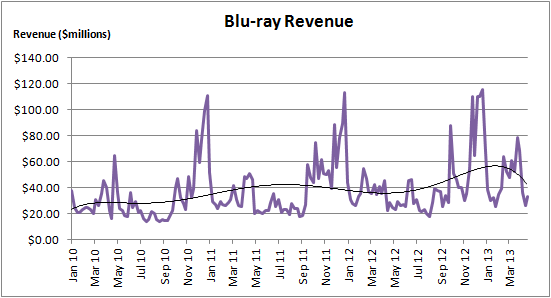
Blu-ray Revenue Growth - January 2010 to April 2013

Blu-ray Revenue Growth – January 2010 to April 2013

Cyberlink estimates their codec will be available to consumers sometime in 2014.

Need a Blu-ray disc that lasts 1,000 years? Enter the M-DISC. The 25GB disc works in any Blu-ray reader, but is able to withstand much more than your typical disc. Even if you don’t need it to last the whole 1,000 years, the extra tough disc means it’s more impervious to harsh environmental conditions that will typically kill normal discs, such as extreme heat, light and humidity. The M-DISC will be available in August from RITEK and Imation resellers.

And finally, don’t forget to read my (slightly late) Blu-ray: The State of Play report, which looks back at the last 12 month of Blu-ray sales data. Spoiler alert: Blu-ray has done pretty well!

Gaming

I guess they couldn’t wait until E3. Neither could anybody else, for that matter. Microsoft has finally revealed details about the changes to game licensing, authentication and even Kinect piracy, for their Xbox One console in a detailed blog post.

I don’t use bullet points a lot in the WNR, but I think for the sake of readability, I shall give it a go. For game licensing, here are the changes:

  • Game licensing moves from disc based to digital based. Your games are stored on the disc you buy, but also in the mythical cloud.
  • This means you can access your game library on any Xbox One console that is connected to the Internet.
  • For your primary console, you or your family members do not need to log in to play games.
  • Up to 10 family members can be attached to your account, and they will all have unlimited access to your entire gaming library, on any Xbox One console (even if the console is not in your home)
Xbox One Forza 5 Game Box

Trading and reselling used Xbox One games is up to the publisher, but rentals won’t be possible any more

For used games:

  • Games can be traded, sold or even gifted to a friend, but only if the publisher allows for it.
  • Trading and selling can be done at the retailer level, again, up to the publisher
  • Gifting can be done to anyone on your friends list (who has been there for at least 30 days), and also only if the publisher allows for it
  • No support for game rentals

So basically, it’s up the publisher what you can and cannot do with your used games, with Microsoft providing the tools to do so. For their part, Microsoft has stated they will not receive any financial compensation for these kind of activities. You will also be unable to rent Xbox One games in the future.

For authentication:

  • Offline gaming is limited to 24 hours (not sure if this is 24 hours of gaming, or 24 hours since the last authentication – probably the latter) on the primary console. For other consoles that have access to your library, offline gaming is limited to a single hour.
  • The restriction only applies to gaming, not Blu-ray or TV or any other function.

And finally, for Kinect privacy (some of the concerns were a bit tinfoil-hatty, if you ask me):

  • You can control what Kinect can see and hear, which means you can turn off things like auto sign-in.
  • Your conversation is not being recorded and uploaded (were people really concerned about this?)
  • When your Xbox One is off, the only command that Kinect is listening for is “Xbox On” (I have a Samsung smart TV that has the same function, when in standby mode), and you can turn this off too if you want (same with the Samsung TV)

So more information, which is good, but perhaps knowing more doesn’t help the fact that there are some fundamental and painful changes. It’s interesting to see Microsoft already shifting the used game restriction responsibility/blame off to publishers, but they’re the enablers in all of this, so they’re not blameless. It does give publisher what they’ve always wanted, a hand in the used game trade, how they will reward Microsoft for giving them this will determine whether this is a huge mistake for Microsoft, or a huge incentive for publishers to prioritize the Xbox One. Of course, if nobody ends up buying a Xbox One, then it won’t really matter how accommodating the platform is to publishers.

As for online authentication, it’s something that has had to happen with the move to digital. But 24 hours doesn’t seem long enough to me, and the 1 hour offline limit on non-primary consoles is pretty bad. I always have my game consoles connected to the Internet, as they’re pretty useless these days if you aren’t connected, so it doesn’t really affect me personally all that much. And I’d much rather a once a day online authentication, than having to find the disc, insert it and wait for it load every time I want to play. Change the 24 hours to 72, and increase the 1 hour limit on non-primary consoles to 24, and it seems much fairer to me.

Microsoft does state that they will listen to further consumer feedback and adjust these policies, but they would say that, wouldn’t they?

Judging by the reaction, gamers are still not happy (or even madder, if that was possible). It is now up to Microsoft to convince gamers that the Xbox One, despite all these restrictions, will offer a better experience. And they can start trying at E3 next week.

That’s it! All done. See you next week.