Archive for the ‘Xbox 360, Xbox One’ Category

Weekly News Roundup (27 June 2010)

Sunday, June 27th, 2010

A combination of a busy week for me personally, and a relatively quiet news week (World Cup related?), means there’s not much going on this week. There is so little this week that there is good justification for not even publishing a WNR this week. Well, not exactly that little going on, but the lazy side of me almost convinced me to skip. Unfortunately for you, I decided in the end to write this edition instead, so you’ll have to put up with even more ranting (given the absence of real news) than usual.

Copyright

Starting with copyright news, I know I just said a paragraph ago that nothing much happened, except something really big did happen during the week, something of a landmark perhaps in the struggle between copyright holders and the Internet.
Viacom Logo

Viacom will be licking their wounds after having their massive lawsuit against YouTube thrown out of court

The big news was of course the judge’s decision to throw out Viacom’s lawsuit against Google’s YouTube. The judge decided that Viacom didn’t really have a case at all, not when YouTube is protected by the “safe harbor” provisions found within the DMCA. Safe harbor provides protection to publishers like YouTube as long as they show an adequate effort in trying to prevent copyright infringement. YouTube has always had a policy of removing copyrighted content if the copyright holders complain, and so the judge thought this was more than adequate. The fact that YouTube revealed Viacom employees may have been secretly uploading copyrighted content for promotional purposes may also have helped YouTube’s case. To be fair, this decision wasn’t a total surprise. Nearly defunct video sharing website Veoh won a similar lawsuit against the Universal Music Group, and that set the precedent to allow YouTube to get this victory this week. What this all means is that the court system now recognises that it may be impossible for mega websites like YouTube to completely prevent unauthorised copyrighted material appearing on their website, but that as long as they have a working policy in place, then the copyright holders should also share the burden of identifying and removing unauthorised content. The copyright holders, as always, want others to do their job because they believe that this problem was created by the Internet and the companies that profit from them, which to be fair, is a valid point. However, the same Internet has also provided many benefits and new opportunities to the same copyright holders, and it’s not anyone else’s fault if they choose not to take advantage.

Of course, Viacom will appeal, and who knows how the next judge will rule, especially in a technology based court case – the decision is very much based on how the judge grasps the technical issues. However, even Viacom must admit that YouTube’s anti-piracy tools are much more advanced than when Viacom first decided to sue, so perhaps part of their objectives has been achieved already, to make YouTube take copyright more seriously. When it comes to copyright, the current YouTube is much more copyright holder friendly, almost too friendly, what with the recent bout of “Downfall Hitler” parody removals. Perhaps this win will allow YouTube to readjust their removal policy to be a bit more balanced.

BPI Logo

Is the BPI planning to sue Google, and if they were, will they still do it after Viacom's court setback?

While Google has just successfully escape one lawsuit (for now), techdirt believe that they may be set up for another one, this time over in the UK by the BPI. They analysed the way the BPI filled DMCA notices, and noticed the odd way in which it was done which reminded them of the way Viacom operated. The plan seems to be to get Google to be responsible for removing pirated content on file hosting networks such as RapidShare, again an attempt by copyright holders to get others to do their hard work. Of course, this was before the Viacom decision was handed down, so even if the BPI had plans to sue Google, they may be reconsidering now.

There seems to be many ways to fight piracy, but nobody has really consulted the public as to what they think will help reduce piracy. PC Advisor ran a poll, and like many similar polls, the results are always interesting. The public mostly understands the wishes of copyright holders to stop piracy, but most of them feel that this can be achieved via better pricing and better services, something I’ve echoed on these pages frequently. Of course, consumers always want to pay less for more, but the digital revolution actually allows for this to happen without hurting bottom lines (and may even help enhance it). Very few people will completely agree with the industry’s current anti-piracy strategy, which ranges from “legal blackmail” (as described by politicians in the UK, in response to actions by groups similar to the US Copyright Group’s mass litigation/pre-trial settlement mailings) to lobbying, or rather, scaring politicians to pass illogical and draconian laws to help the industry protect its income (do any other industries get the same level of support, from all major political parties, as the music and movie industries?)

Vice President Joe Biden

Here's a picture of Vice President Joe Biden thinking hard about how he can be of even more help to his RIAA/MPAA buddies

But when lobbyist speak, the politicians listen, and the Obama administration has been very good friends with the RIAA and MPAA for the first part of their term in office. Vice President Biden, a long time friend of the RIAA, launched the White House’s new anti-piracy crackdown this week. Once again, Biden likened online piracy to actual store theft, and this time even increased the hyperbole by adding physical violence/damage to the equation. “This is theft, clear and simple. It’s smash and grab, no different than a guy walking down Fifth Avenue and smashing the window at Tiffany’s and reaching in and grabbing what’s in the window,” said Biden. Well, I think it’s a bit different to that actually. For the Tiffany’s example, there is actual physical damage (I would say this, in the online world, would equate to server hacking and damage of some kind), plus, what is stolen cannot be replaced without additional cost to the owner of the goods. This is simply not true with digital downloads, because the “original” has not been moved or damaged in any way. If anything, it’s more like someone walking into Tiffany’s, looking at a design for an engagement ring, and then going home and recreating the exact same ring at their own cost. This is also a sort of copyright theft, in that the design of the ring was “stolen”, and you could argue that Tiffany’s lost money due to a lost sale. But as you can see, this is very different to grabbing a brick and smashing up Tiffany’s to steal a ring. It’s hard to tell if Biden said this because he really wanted to help his RIAA/MPAA buddies, or whether he really believes this to be the case. If the latter is correct, then we’re all in big trouble, because paying lip service to your friends in politics is at least common place (although you may say ignorance is common place as well).

The administration’s new initiative did have any real specifics, but hinted at supporting industry attempts to get the ACTA shoved down the throat of citizens around the world, and even offered some kind of support for the controversial actions of the US Copyright Group. You would expect liberal institutions like the ACLU and the EFF to be in agreement with the Obama administration, but both have come out against the actions of the USCG, going as far as filing a friend of the court brief to prevent the USCG lumping thousands of defendants into the same lawsuit. The judge then asked USCG to explain why they did this, and the USCG now has replied to the court saying that the BitTorrent infrastructure is what made them do it. It argues that users of the same swarm upload and download from each other simultaneously while trying to obtain a full copy of the file in question, and so that’s how the defendants are linked. Of course, there’s no evidence that any of the defendants were part of the same swarm at all, and this also highlights one of the often ignored technical points of BitTorrent file sharing – that most users do not upload an entire copy of the file to any other user, only pieces, which when looked at as a piece of data, is completely useless. The technical argument to make here would be that because each users is only contributing a very small part of the pirated file, then perhaps the damages should reflect this as well. And if an user somehow managed to download a full copy of the file without providing any uploads, and thus only break the law in respect to obtaining pirated material, and not “make available” such materials, would their actions be more or less damaging than someone who uploaded hundreds of full copies of the same file? If you buy a pirated DVD from a stall, did you commit the same crime as the stall vendor who produced and sold the pirated DVD? These are all interesting questions I would like to see addressed in a full trial, but that’s something the USCG do not want, apparently.

Samsung 3D Bundle

Where is my damn 3D TV, Samsung?

That’s all the copyright news I had, and there isn’t much going on in terms of Blu-ray, 3D or gaming, certainly not as much as I would have to write about if I had my 3D TV at home, instead of still being on pre-order. Come on Samsung, don’t disappoint me.

There is actually a bit of gaming news that I didn’t post online, and that’s rumours of the Xbox 360 Kinect being priced at $119.95, as opposed to the widely believed price point of $150. The $150 Kinect is already selling quite well, certainly better than the PlayStation Move, so a cheaper Kinect might do even better. I do remember some Microsoft dude hinting that people will be very happy with the eventual Kinect pricing, which I suspect means the official pricing will be lower than what Amazon and others think it is now. If the news is still slow next week, then I will write up something about my thoughts on Move, Kinect and the Wii. It is my opinion that the Wii is actually a big failure *if* you do not count Nintendo’s software contributions to it, and it’s very unlikely Nintendo will help out  Sony and Microsoft to make fun games for the Move/Kinect. Can Sony and Microsoft succeed where Nintendo has failed, to get third party publishers to produce great games that utilize each company’s motion control system, and if they fail in the same was in this regards as Nintendo, can Sony and Microsoft do what Nintendo can do with titles like Wii Sports, Wii Fit and Mario Kart?

That’s all for this week. I warned you there wasn’t much happening didn’t I? Hoping for more stuff next week …


Weekly News Roundup (20 June 2010)

Sunday, June 20th, 2010

The World Cup is taking up a lot more of my time than I had estimated earlier, despite the paucity of good football on show. I was expecting a mid week update for the NPD figures, but NPD are delaying the release of the numbers until later. Technical difficulties are blamed, or may be they were too busy watching the World Cup too. Other may also have been busy with the games, because there isn’t a whole lot of news this week either (again, it could just be because I haven’t been looking as hard).

Copyright

Let’s start with copyright news. Bad news for UK HDTV viewers, as Ofcom officially agrees to the BBC’s demand to add DRM to all upcoming HDTV equipment. The BBC used the same argument as the MPAA when they also wanted DRM to be added to TVs, and guess what, it worked.

The BBC argued that having DRM means they can bring more high value content to people’s screen via free to air TV. Of course, the lack of DRM hasn’t prevented them, and others, from bringing the same high value content before, and the way Ofcom has set out this thing, people with older PVRs (or ones that don’t belong to the Freeview standard) will still be able to record the DRM’d content most likely. So what’s the whole point of this? Basically just like any other DRM scheme, to give copyright holders a false sense of security, which in their opinion, is better than none.

LimeWire Logo

LimeWire is sued again

It’s been a bad time for LimeWire, as they’ve been sued again, just a week after the RIAA claimed that they deserve billions of dollars of damages stemming from LimeWire’s operation. This time, it’s the National Music Publishers’ Association that is doing the suing. The billions in damages that the RIAA want is simply ridiculous. It’s basically saying that the people who downloaded music illegally on LimeWire’s network and zero dollars in the process would have otherwise spent billions of dollars has LimeWire not existed. It’s like saying, using an analogy that the industry just loves, that a car thief would have paid full sticker price for a car if he hadn’t stolen one. At least with the car, there is actual physical loss (the car owner loses something that can’t be replaced without spending more money)  – there is none with digital files, not when the owner can make infinite copies at no cost.

And it seems I’m not the only one that thinks the industry’s estimates for losses are greatly exaggerated, to put it mildly. Experts testifying before the US International Trade Commission are saying exact this. The best quote I’ve found is this one, made by Harvard Professor Fritz Foley: “It seems a bit crazy to me to assume that someone who would pay some low amount for a pirated product would be the type of customer who’d pay some amount that’s six or 10 that amount for a real one.”

The very type of people who would get pirated content at low cost (or for free) is exactly the type of people that probably can’t afford to pay for the legitimate version. This isn’t always true, but with so much content available at varying cost, you’ll have to be a millionaire to be able to afford to pay the cost of stuff that web pirates are downloading for free. And yet, the industry seriously believe that if they can just wipe out piracy completely, then all those people who aren’t paying for stuff will automatically start paying full price for everything. And what are these pirates doing with all these lost billions every year if they’re not spending it on legitimate buys? They must be laughing all the way to the bank where their vast amount of savings are stored, savings that are the result of not having to pay $0.99 for songs.

At the hearing, which was organised by the USITC at the request of the US Senate’s Finance Committee (who are trying to work out how much blame China should get in terms of Intellectual Property damage), some experts even expressed the controversial view that counterfeit goods actually helps the economy by employing people and making it possible for financially challenged people to spend money on stuff, even if it is just a fraction of the retail price. By extension, it will be interesting to find out if web piracy is also contributing to the economy, in terms of advertising, creating product hype and contributing to people spending money on Internet services (this point the copyright holders will agree with, as they have continuously blamed ISPs for profiting from piracy).

Nintendo 3DS

The Nintendo 3DS will play 3D games without glasses, and store games internally

A IEEE working group is trying to create a new DRM standard that at least gives consumers some rights when it comes to managing their own content. The goal is to basically ensure once people purchase digital content with DRM, they are entitled to the same rights as people who purchase something physical. Including the ability to “loan” out your digital content to a friend. So to mirror a non digital physical object (say a VHS tape, if people still remember those things), the  content cannot be duplicated (without quality loss), but can be loaned out as the “ownership license” is temporarily transfered to your friend, but with the risk that your friend might then pass on the “ownership” to others (ie. lose your tape, the bastard), and thus prevent mass distribution/sharing. It all sounds reasonable in principle, but the whole point of digital is that you have more flexibility than physical objects/media, and getting rid of the one of the major advantages of digital content seems kind of self-defeating to me. I still believe that the best way to prevent people from obtaining content illegally is to give them good reasons to pay for content, which includes things such as access to a superior catalog of content, additional services that pirates can’t offer, along with prices that are so reasonable that it makes pirated content look decidedly bad value in comparison.

And that may be what Nintendo is doing with their new 3DS console when it comes to the fight against piracy. Instead of releasing a new DRM scheme (which Nintendo may still do), they are copying some of features of the flash carts that have made piracy so easy. One of the more important features that flash carts provide is the ability to store you games digitally on file, instead of having to carry all your carts with you. A flash cart with a 4GB SD memory ca4rd can carry 50 or even 100 games, without it, you’ll have to carry a small briefcase just to fit in all your game carts. But the 3DS will finally allow you to “install” games to the internal memory, and not only that, you won’t even need the original cart to play the games (unlike the “install to HD” features of PS3/Xbox 360 games. And if Nintendo can create some kind of official homebrew environment, maybe an Apps store type feature, then they relegate flash cart usage to game piracy only, and it makes their case against them that much stronger, and makes their fight against piracy much more effective.

High Definition

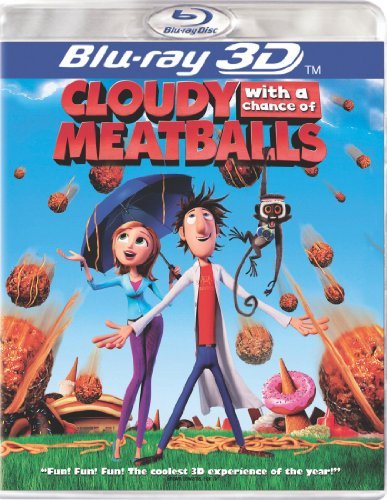
Let’s move onto 3D/HD news. To follow up on last week’s news of Cloudy with a chance of Meatballs being the first general sale Blu-ray 3D title, it’s good to see that the price for this title has already started to drop on Amazon.com

The $36 original price has already dropped to $28, and hopefully it will drop further. And it appears my suspicious were correct in relation to the Monsters vs Aliens Blu-ray 3D, in that the crosstalk/ghosting problem may be a problem of the movie encoding. Early tests with the “Cloudy” 3D on Samsung TVs seems to show much much less ghosting, so the encoding may really be the source of the problem. If so, Samsung needs to get the movie remastered as quickly as possible, because it’s making their 3D TVs look much worse than their competitor’s.

Gaming

Gaming wise, we’ve learned a lot more about Kinect, Move and the 3DS during E3. The 3DS will be able to produce 3D without glasses using the Parallax Barrier method I think, and I’ve updated my 3D Blu-ray – What’s it all about blog post/FAQ with one of more frequently asked questions of recent – why can the 3DS do 3D without glasses when we still have to wear them to watch 3D on TV? The short answer is that the Parallax Barrier technology is just not ready for big screen TVs and home viewing.

Xbox 360 Kinect Lineup

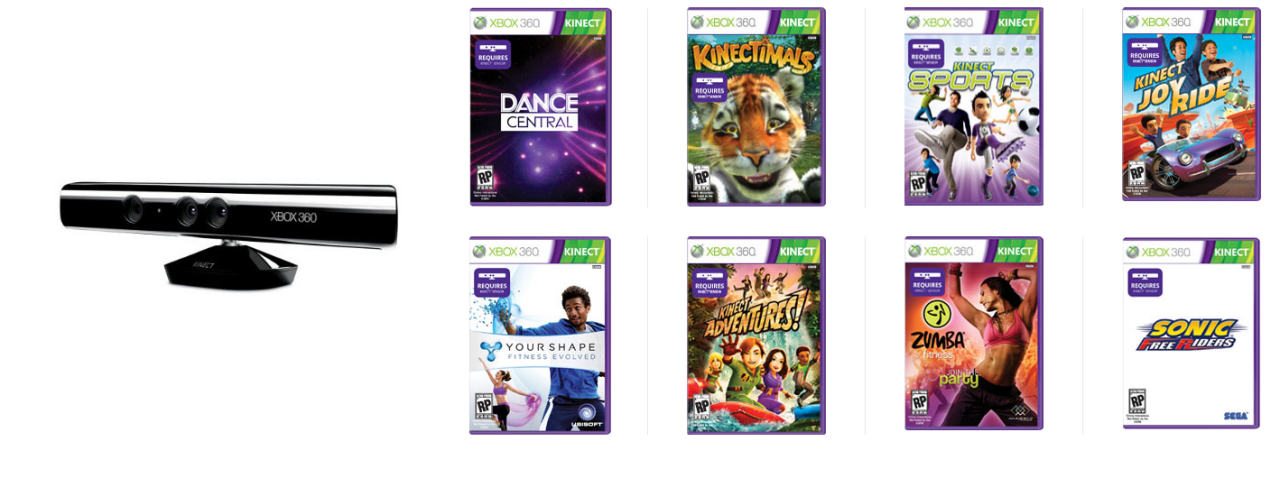
Microsoft unveiled their somewhat uninspiring lineup of Kinect games at E3

As for Kinect, the overall verdict seems to be: impressive hardware, uninspired game line up. And you can probably say the same for the Move as well, apart from the fact that Sony has marketed the product to hardcore gamers, along with casual/family gamers, with some success. It’s interesting watching the Microsoft presentation, where they split the event into two, the first part for hardcore gamers (Metal Gear Solid, a new CoD game, Halo Reach), and the second part was very casual/family oriented. I think we just have to accept that Kinect is not meant for hardcore gamers and move on. I don’t know why some Xbox 360 gamers are complaining about Kinect destroying the 360 as a console for serious gamers – it’s not as if Microsoft or publishers will stop making the games aimed at hardcore gamers just because Kinect is out. It’s best to think of the Xbox 360 as a console that has two personalities, and you can choose which of these personalities you want to identify with.

We did get a Xbox 360 Slim, and that seemed to have gathered more excitement than the Kinect, but mainly because the news came out of nowhere really, and that it’s already shipping as I type. Included is a larger 250GB HDD, built-in Wi-Fi just like the PS3, but with Wireless-N support built in, and well, it’s smaller and Microsoft says its quieter as well.

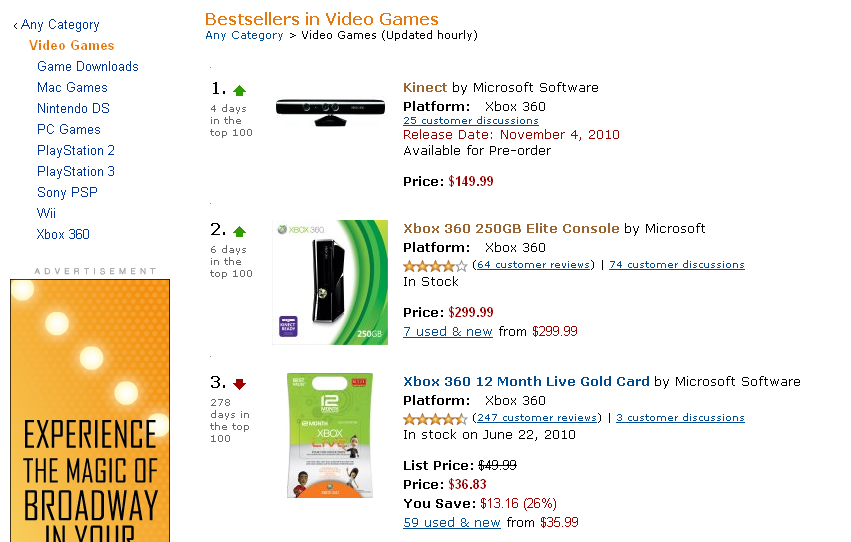
Xbox 360 Kinect and "Slim" are top sellers on Amazon

Xbox 360 Kinect and "Slim" are top sellers on Amazon

While the Kinect pricing hasn’t been officially announced, pretty much everyone thinks its $150. This price is the retailer’s estimate of the final pricing only though, so don’t be surprised if it’s lower (or higher). Amazon already has it up for pre-order (if the price does drop, Amazon will always give only charge you the lowest price during the entire pre-order period), and along with the Xbox 360 Slim, both are top of the sales charts at the moment. Both Kinect and  Move have been in the top 100 for 4 days – Move is currently 49th in the sales charts. And the fact that Move is available 2 month earlier than Kinect, and yet the Kinect is still outselling the Move, bodes well for Microsoft. Perhaps the novelty factor of Kinect is also helping to drive sales, as opposed to the common conception that the Move is basically an upgraded Wii.

The Xbox 360 slim, or rather more accurately, the new Xbox 360 Elite is genuinely doing well though, having been top of the sales chart every since it was put up. June could end up being a very good month for Microsoft in terms of the NPD sales figure. As for me, I’m definitely getting the “Slim”, but probably as part of a Kinect bundle, hoping Microsoft bundles the camera device with the new Elite console at no extra cost. And I know I’ve rubbished and questioned previous rumours of a Blu-ray drive for the Xbox 360, mainly because I think it’s a giant fail if Microsoft released a Blu-ray drive for their  noisy console which just makes for a lousy comparison with the PS3, which can also play games on Blu-ray disc.

The New Xbox 360 Elite

The new Xbox 360 Elite being released this week was a total surprise

For those that think the $149.99 price point for Kinect is too high, you have to consider the fact that this is the price for 4-player simultaneous play. If you want to do 4 players with Move, the minimum cost is $250 ($99 wand + camera bundle, plus 3 more wands at $50 each). Even for 2 players, you will need at least $150 ($99 want + camera bundle + $50 wand), and up to $250 if the game requires two wands for each player. And that’s not even including the Navigator controller (aka the Move Nunchuck) for $30 each, although it’s apparently optional as you can use a standard PS3 controller to perform the same actions (if you don’t mind holding the controller with only one hand). And then you’ll have to find a place to store all of these accessories. Of course, we still wait for Microsoft’s official announcement (in August, at Gamescom), and the final price could very well be $99 (or as I mentioned before, bundled with the Elite for free).

Anyway, that’s enough writing for this week. Got to rest up for watching some World Cup action later on. The boring football does make me feel sleepy, but I guess that’s what the Vuvuzelas are for, to keep people awake!

Weekly News Roundup (13 June 2010)

Sunday, June 13th, 2010

What started as a pretty quiet week in terms of news turned a bit more busy in the last few days. E3, the US Copyright Group, Adobe, Sony all made the news later on in the week, whether it was new rumours, or new downloads, it’s all covered by this week’s Weekly News Roundup. Are you enjoying the World Cup? I’m not a big fan of the Vuvuzelas though, nor drums, bells, whistles, or anything else that makes artificial stadium noise. Cheering, singing, chanting, swearing, and the occasional round of claps, is what it’s all about. Hearing the crowd’s anticipation, nervousness, exhilaration, depression, makes the game a much better spectacle, and I think the players appreciates the interaction with the crowd as well. Vuvuzelas and other artificial noise drowns out all of these, and I think it takes something away from the beautiful game. But it also does drown out the Samsung plasma buzz, so silver lining and all.

Speaking of Samsung plasma TVs, I still haven’t gotten mine yet, so no watching the World Cup in 3D 🙁

Copyright

Starting with copyright news, the Canadian DMCA is still under consultation, but the IFPI, the RIAA’s International wing, has come out attacking the proposed changes as not going “far enough”. You know what, if the RIAA and their axis of evil friends don’t like it, then perhaps there’s something to like about the DMCA.

I think the RIAA’s biggest problem with the bill is that it finally makes CD ripping legal, and format shifting as well (so CD to MP3 => legal). But there’s nothing they can do about that now, since CDs don’t have DRM, a decision the RIAA may forever regret (not that having DRM actually stops piracy or anything, but at least it makes ripping them illegal in the eyes of the law, with the caveat that prosecuting someone for ripping their own CD/DVDs for personal use is likely to end up a futile endeavour).

But it again just highlights the stupidity of making the breaking of DRM illegal (exemptions apart), regardless of the intentions behind the attempted break. If CDs don’t have DRM, does it then make it legal to pirate CDs? Of course not. The music labels still have the same level of legal protection as movie studios when it comes to DVDs that do have DRM. And is DVD DRM preventing DVD ripping or piracy? Of course not. And with DVD (and even Blu-ray) DRM so easy to break, it’s about as useful in stopping piracy as making users read those unskippable copyright notices at the start of the disc. Of course, in the area of placing limits on what users can do with their own stuff, then it’s a huge success. While the some studios and anti-piracy agencies claim they would never sue anyone for breaking DRM for personal purposes, the fact is that if they wanted to, they can. It’s having this level of power and control that made the studios fall in love with DRM in the first place, not its value (or lack of it) in fighting piracy.

Freedom of Speech Censored

Just what is freedom of speech, and what is "making available" pirated downloads?

And just how far can this power grab by studios go? Well, if you live in the Netherlands, then it can go very far indeed. A Dutch court has just ruled that even talking about piracy may be a crime. The case relates to an Usenet community, in which the user “spots” potential downloads. Not by linking or anything, by simply talking about the general location of where downloads are located. Apparently, this is just as bad as linking, which is just as bad as hosting, in the court’s eyes. What’s next? Guilty of copyright infringement for even thinking about illegal downloads? Thought-crime anyone? I think this is another instance of legal authorities not really understanding the way the Internet works. The Internet was designed by the US military as a way for communications to still work even after a massive nuclear attack, and this works by building a “web” of connections, allowing every server to potentially route to every other. And not only is the underlying connection all connected, web pages containing links can also link to potentially every other website in the world, depending on how many links you want to hop to. And then there are search engines like Google, which aims to be able to link to every resource on the Internet. So what does all of this mean? It means that if direct hosting, direct linking, indirect linking and now even indirect discussions are all illegal, then by the way the Internet works, every site can potentially link to the illegal download in question, every router can potentially carry the illegal download to the end user, every search engine can potentially allow users to find the illegal download in question, and so every website on the Internet is illegal. I now finally understand why the CEO of Sony Pictures said that nothing good has come out of the Internet being invented.

The RIAA wants the assets of LimWire and its creator to be frozen, because they want to seek billions in terms of damages. Billions! I think I’ve said this before, but I would really love for the RIAA to prove just how they derive their claimed losses due to piracy, and the only way may very well be for all pirated content providers around the world to stop for a month, just a month, and see how much more money the RIAA makes during this time (if any). Then time this by 12, and then the RIAA will have their annual “loss” figure. Would I be surprised if this figure turns out to be negative, in that the RIAA may make *less* money as people stop listening to their music (illegally, for free) for a month and they lose the free publicity the Internet provides musicians? Not really.

ACLU

The ACLU is joining forces with the EFF to help users fight against mass BitTorrent lawsuits

The rest of the week was dominated by louder and louder condemnations of the way the US Copyright Group is going about its anti-piracy “pre-trial settlement” business. The EFF and ACLU are stepping in and they want a judge in charge of ruling on one of the USCG’s mass subpoenas to dismiss all but one of the subpoenas. They say that the USCG must present evidence that all of the John Does as part of the subpoena have been joined in the same lawsuit for a reason, that they were all part of the same transaction or have some kind of common connection. You see, some groups uses this kind of “subpoena spam” to greatly simplify things for themselves, and may only be using these subpoenas as a way to threaten people to pay up, with no real intentions of going to court. But the ACLU and EFF may very well want a full trial, and if they can get the right decision, then the USCG may have to stop their very lucrative business. If the ACLU/EFF can get in touch with many of those that claim they’re innocent of the acts that the USCG has charged them with, then perhaps winning a trial won’t be too difficult. These kind of mass mailings always catches a few innocents, those that have had their connection hacked, or IP spoofed, but most will pay up to avoid the trouble of going to court, especially when threatened with the possibility of $150,000 in damages that the USCG may seek. And the USCG is targeting more and more movies, with sources claiming that they are watching 300 illegally download films, and if they only record 500 IP addresses for each movie, then that’s 150,000 potential “pre-trial settlement” payments, and even if just 50% of those pay up the minimum amount required by the USCG, then we’re already taking about more than a hundred million dollars in terms of income.

This makes me think that something will be done about the USCG’s actions, but it will be something that’s even worse I think, as the government can use the actions of the USCG to justify things like three-strikes, which they will promise that any new laws will come with safeguards to prevent companies that seek to profit too much from anti-piracy activities without at least giving users some warning first. Three-strikes is better than one strike, after all. If I was the head of the MPAA, I would use groups like the USCG to do all sorts of nasty things and then use this mythical bogeyman as a way to scare people into thinking that something only slightly better, but still very bad (like three-strikes), is the right, better solution. It’s better, but it’s not good (take note Larry David), and it may eventually become worse.

High Definition

Onto HD/3D news. I know in my 3D Blu-ray – What’s it all about? blog post I mentioned the lack of 3D Blu-ray titles for general sale, but it seems I spoke too soon, because Sony are readying their first general release 3D Blu-ray movie to be made available June 22nd. The title is Cloudy With a Chance of Meatballs, and it will be followed shortly by others titles.

Cloudy With a Chance of Meatballs (Blu-ray 3D Version)

You can finally buy a Blu-ray 3D movie, but it's gonna cost you!

This is good news, and more “real 3D” content means it will be easier to benchmark the various 3D TVs so we can find out for sure which current technology, LED/LCD or plasma, is better for 3D, and which particular models are best at it. There’s a big question mark around using Samsung’s exclusive Monster vs Aliens, since some of the ghosting artifacts found when watching the movie may in fact be a problem with the movie encoding, as opposed to Samsung’s 3D technology. But it’s a bit pricey though, at $36 on Amazon, that’s twice as expensive as most other Blu-ray movies. Ouch.

3D notebooks will be everywhere, with Toshiba joining Acer and Asus, amongst others, to release a new 3D enabled notebook. This seems a bit gimmicky for me, even on top of the “gimmickiness” of 3D. 3D requires a big screen and controlled lighting environment for the best enjoyment, and I’m just not sure notebook screens can offer this. Plus, 3D gaming requires a lot of GPU power, and this is something that notebook cannot do, compared to desktops and consoles. But if these machines can be connected to 3D TVs and used as 3D Blu-ray players, then perhaps that’s where they may be useful.

Adobe has finally release version 10.1 of their Flash player. Despite the minor version number change, this one includes a lot of changes, and it took long enough to get from beta to gold as well. The most important new features is GPU assist support, which may make HD YouTube finally playable on certain netbooks and CULV laptops. My first impressions were that CPU usage was down, but playing a 1080p YouTube clip was still more processor intensive than playing a Blu-ray movie via PowerDVD, so hopefully more improvements can be made in this area (but the nature of the Flash plugin will always mean more overhead I suppose).

Blu-ray firmware updates are far too frequent it seems for the average user, many of whom don’t even know what a firmware is. This is one stumbling block for Blu-ray on its path towards mainstream acceptance. DVD players didn’t have this problem, and there’s always an inherent danger in firmware updates, since if the power goes out during the middle of an update, then the player could be fried unless it was well designed to prevent this sort of thing from happening (like some kind of firmware reset function).

Gaming

And finally in gaming, with E3 just around the corner, there’s plenty of rumours about what each of the major companies will be promoting during the show. I’ve collected some of the popular rumours in this post, with ratings on how likely each rumour will turn into fact.

We know Sony will be promoting Move, Microsoft will be promoting Project Natal (or whatever they’re calling it by this time tomorrow), but will the 3DS be the only thing Nintendo has to show? Nothing for the Wii? Nothing like a Wii 2 or Wii HD to steal Move/Natal’s thunder? I find it all hard to believe. Watch this space.

Speaking of the 3DS, some developers that have had a chance to play with the hardware say that it is as powerful as the Xbox 360 and PS3. Now I find this even harder to believe. Can the 3DS give Xbox 360, PS3 like graphics on the lower resolution screen, perhaps, since what will look good at 720p on a big TV, will look similar at much lower resolution on the smaller screen. So perhaps this is what was meant. But graphics has never been what the DS (or any of Nintendo’s other consoles) are about. And 3D without glasses could be fun.

For 3D with glasses, the PS3 now has some 3D games for you to try out, no firmware update required since the required update had already occurred in April, so all you need to do is to update the supported games themselves (if you’ve already purchased them). Some people who have tried it say it’s fantastic, of course I can’t test it for myself because my 3D TV hasn’t arrived yet 🙁

And so we come to the end of yet another Weekly News Roundup. E3, and perhaps another round of NPD figures (for May), will ensure the next issue of the WNR will be fairly gaming dominated, for a change. Have a good one.

Weekly News Roundup (6 June 2010)

Sunday, June 6th, 2010

What started as a way to avoid going through yet another week without doing any work, turned out to be a bit more work than I expected, but it was fun writing down all the things I’ve learned about 3D Blu-ray, and 3D in general, recently. Taking the form of an FAQ, my 3D Blu-ray – What’s it all about? blog posts looks at the basic principles behind 3D displays, and tries to clear up some common misconceptions behind the new technology (like whether you need HDMI 1.4 cables or not, if such a thing even exists). I’m sure I got some of it wrong, since there’s a lot of misinformation floating around. There’s also still quite a lot of stuff that I haven’t addressed, but I think I will save that for a full guide. Whether one should want 3D or not is a valid question, but I suspect with 3D technology relatively cheap to implement for TVs, there will come a time when 3D is a feature that comes with all the top-end TVs, whether you want it or not, and competition will ensure there isn’t a huge price premium to go along with it.

Copyright

Let’s start with the new review, and starting as usual with copyright news. A reader of our newsletter kindly pointed out that I forgot to mention the demise of Newzbin, a Usenet indexer website that was accused of copyright infringement and subsequently shutdown.

Newzbin 2 Logo

The "new" Newzbin is online after being brought down due in early May

The news did totally escape my attention for some reason, but there’s good news for fans of Newzbin, as it has been resurrected just this week. It was actually good timing on my part since when I first posted the story in the forum, the resurrection was just rumoured, but by the end of the week, it had become a reality. Apparently, the source code for the website was “leaked” a couple of weeks ago, and with the domain names transferred to a Seychelles based company, and semi-anonymous announcements of the resurrection by someone known only as Mr White, all the pieces were there for the resurrection. The new site, dubbed Newzbin 2, may even eventually feature more than just Usenet indexing, but extended to cover torrents as well. As for the legal questions surrounding the website, it will still exist, but it’s a question of whether the real owners can be found, or if the web host can be sufficiently threatened to pull the plug on the website.

Speaking of Usenet, it is a very frequently used place to download pirated content, despite all the media attention over BitTorrent. And this is one area that governments are a bit clueless about when it comes to copyright enforcement, with the agencies they’ve set up to monitor three strikes mostly ignoring this part of the online piracy trade. It just shows that whole anti-piracy crusade is nothing more than moral panic designed to make politicians feel like they’re doing something, even though they have no idea what exactly they’re doing, and give away our rights bit by bit to corporations. This trend started with the the US DMCA, and it’s been slowly exported to other countries around the world.

Canada is the latest country to adopt a US style DMCA, with the initial draft of the proposed changes finally released this week. But it’s not all bad news for consumers. The DRM provision that made the US DMCA so controversial is, unfortunately, still in. This means that if content has DRM, you can’t bypass the DRM to make backups (or to even use the damn thing). There are some exemptions, such as for research or parody, which provides at least some semblance of fair use. The changes proposed does finally give a clear legal position on the legality of time-shifting (recording TV shows for later viewing), format-shifting (ripping CDs to MP3s) and backups – all as long as you don’t break the DRM, of course. In other words, consumers have the right to do all the things they’ve been doing before, but if content owners start adding DRM to everything, then they can ensure these rights no longer exist and consumers have no say in the matter. What would have been better, and there is still time to make further changes, is to have an exemption for breaking DRM for the aforementioned fair use scenarios. DRM was always intended to stop piracy, it was and should never be used to prevent fair use, things like format shifting or time shifting. I mean, where is the danger in breaking DRM to make a backup, or to convert the DVD to DivX, as long as you only use the copy for personal use and don’t share the copy with anyone? There is no harm there, and nobody has ever been fined or gone to jail for this type of legal usage. If people want to share content illegally, then they are already breaking the law, and whether they broke DRM or not to do so is beside the point. So in Canada, there will be the situation where people can make unlimited copies of CDs or convert them to MP3 for personal use, yet if they do the same with DVDs, they’re breaking the law. The studios and music labels will point out that they’ve never gone after anyone for breaking DRM for personal use, but that’s also beside the point, since the law says it is illegal. Just because studios haven’t gone after someone for breaking DRM for personal use, doesn’t mean they will never, because if they do, they will win because of the DMCA.

The US Copyright Group

The US Copyright Group is at the center of the "pre-trial settlement" controversy in the US

The US Copyright Group, which sounds like an official organisation, but really is just a law firm that specialises in making money off anti-piracy activities, has been in the news a lot recently. Ars technica provided a rough breakdown of what the US Copyright Group could stand to make this year off these “pre-trial settlements”, and we’re talking about millions and millions of dollars here, so it is big business. While what they do isn’t illegal, there are ethical concerns, and groups like the EFF and ACLU are not happy with these types of actions, actions that others in the past have called “legal blackmail”. And it looks like the EFF and ACLU are stepping up their campaign to challenge this type of activity, and they may be preparing to reject one of these “pre-trial settlement” offers and take the thing to a full trial. This is the last thing groups like the US Copyright Group wants, because one, they could lose and that would set a bad precedent. And two, there’s not profit is a legal battle that could take months to resolve. But it looks like the EFF and ACLU want to prove a point in court, and this could be a very interesting trial indeed. Watch this space.

Somebody else wanting to have a fair trial is the 18-year old admin of a Danish BitTorrent tracker, whose home was searched in January this year, and now faces a legal claim of more than $260,000 by Danish anti-piracy agency, Antipiratgruppen. Antipiratgruppen’s opposition group,  Piratgruppen, has promised to aid 18 year old Jonas Laeborg financially.

And the Ubisoft “always on” DRM continues to make headlines, this week after analyst Michael Pachter publicly came out to support the controversial DRM measure. Those that have read my NPD US games sales analysis blog series will know of Mr Pachter, and this predictions that, well, don’t always pan out. But it seems Pachter felt the need to comment on Ubisoft’s annoying DRM, even though from his statements, it appears he’s not aware of the finer differences between what Ubisoft has done, and what other companies like Steam are doing. I’ll let you read the news story in full from the link, since some of the stuff that’s said is just too ridiculous and embarrassing to repeat on these pages. If there can be such a thing as a war of analyst, then we have the exact opposite opinion from the founder of gamesbrief.com, Nicholas Lovell, who labels Ubisoft’s DRM as “draconian”. He goes to question whether pirates are now having a better gaming experience than legitimate customers, and even suggests the slightly controversial idea of giving games away for free and making money off downloadable content, and using piracy as a way to promote games. Free games would be nice, but I don’t think game publishers even need to go this far. Cheap games is all that’s needed to stop piracy dead in its tracks, to nurture a new generation of paying gamers (much like how iTunes has nurtured a generation of paying music lovers, or basically what Steam is already doing with games). Stop trying to come up with ways to punish pirates, which almost always fails and only ends up punishing paying customers, and instead, try and entice them to go legit. And as for piracy promoting games, I think this already happens to a degree, and many that pirate games do eventually pay for the game, or at least the sequel or something. Companies spend insane amounts of money trying to generate Internet hype, viral marketing and all that, but game companies are getting it for free through piracy. Of course, if the game itself isn’t good, then the news of that spreads quickly as well, and sometimes I think that’s what game companies are really concerned about, that people will find out how bad their product is all without enough people being sucked in to pay full price for it. I think maybe movie studios may feel the same about bad movies being leaked online and thus failing to trick people into paying. The companies that are confident of their products tend not to worry too much about piracy, since they know enough people will buy it anyway.

High Definition

Let’s move onto HD news. I’ve already covered the 3D related HD stuff, so there’s nothing more to add on this front, other than to reiterate my opinion that people who haven’t seen 3D since the red/blue glasses days really should go and check out one of the 3D TV demos that are everywhere right now. It still may not be for you, but some I think will be surprised to find out just how impressive the whole thing is.

On the PC front, we have some interesting developments, and perhaps the emergence of a new form factor – the Blu-ray + SSD drive. Hitachi/LG is releasing a portable Blu-ray reader/DVD writer drive, that also contains a SSD drive. By combining two storage systems in one, it saves space inside today’s already cramped portable computing devices, and offers support for two of the latest storage techniques. The SSD drive can be used as a cache to speed up everyday operations, or use to store system files for almost instant system loading. I’m actually constantly surprised to see top of the range laptops and computer systems, the ones that cost $4000 or more, not including a Blu-ray drive at all. The premium for Blu-ray reader drives, or even writer drives, is so insignificant compared to say the cost of even high speed memory, that it’s just a mystery for me why Blu-ray drives aren’t standard already on *all* system, let alone the top-of-the-line gaming/multimedia systems. And even Sony has been guilty of this on their Vaio range, as I would have thought every Sony product would be including Blu-ray support by now.

Gaming

And finally in gaming, the section I’ve been ignoring recently, there’s still not a lot of news. But E3 is just around the corner, and the flood of news will follow short after. For this week though, there is only the news that Japanese PS3 owners will get the 3D gaming patch in the next few days – whether PS3 owners in other countries will get it or not, I have no idead.

Xbox 360 with Natal Camera

Project Natal, now white a white coloured camera accessory, needs E3 to be a total success

It’s good timing too, because some people already have their hands on 3D TVs, but without a lack of content, the PS3 3D games might just fill the void. And for those too cheap to pay for the games, there’s even a demo version of Motorstorm 2 that will have a 3D mode. However, there is still no firm date for 3D Blu-ray support, other than the now standard “before the end of the year” line from Sony.

As for E3, I guess I could still wait until next week to spill my thoughts on the whole Move/Natal thing, but I might just say it here. Microsoft is being very secretive regarding its Natal announcement, which makes me suspect that they’ve got something big lined up. With all due respect to Move, Sony has already said and demo’d quite a lot of the technology and games already, and with the “similarities” between it and the Wii, E3 probably won’t hold too many Move related surprises. But with Project Natal, we don’t know the  pricing, or even the final product name, or any other games other than Ricochet, so there’s a lot of work Microsoft needs to do at E3. It could be make or break time for Project Natal, and I think Microsoft realises this, hence all the secrecy, as if they’re saving everything all at the same time for a truly “shock and awe” unveil. Cynics, and fanboys of the other platforms, will say that the secrecy is because Microsoft knows Project Natal is a big fail that won’t really work, and is more laggy than a thing that has a large amount of lag. But those that have had recent plays with the technology, with the updated Ricochet mainly, have only good things to say about it, and this suggest to me Microsoft is confident it will work, but it wants maximum impact at E3. The fact that MTV is going to air the E3 Project Natal launch event is further evidence of this strategy. And with the World Cup, maybe will there be some kind of football/soccer based game demonstration in there. The caveat here is that I’m often wrong about these things, so I could be wronger than a thing that is very wrong indeed.

I don’t think Move is a game changer for the gaming industry, or even for the PS3, but Project Natal has the potential. And for the same reason, it could also fail miserably and take the Xbox 360 with it, so the next few weeks will tell us a lot about the outcome of the current gen console war.

I think that’s all I have for this week. Have a good one.

Game Consoles – April 2010 NPD Sales Figure Analysis

Monday, May 17th, 2010

It’s that time of the month again, and NPD has released the April 2010 US video games sales figures for this little blog to analyse. March was a big month for the PS3, and all eyes are on the Sony console to see if it can repeat the stellar performance in April. NPD itself has a few changes, in that they are no longer counting PS2 sales (perhaps Sony should take the hint and formally declare it end of line), and they are also not providing all the figures for the top 10 game sales, which makes analysis a little bit more difficult. The figures are from NPD, a marketing research firm that releases games console sale data every month.

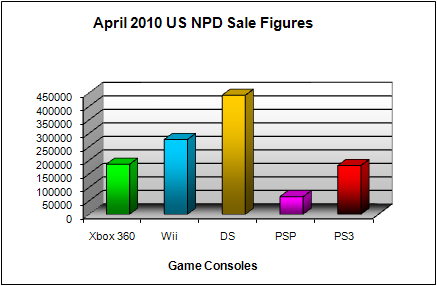
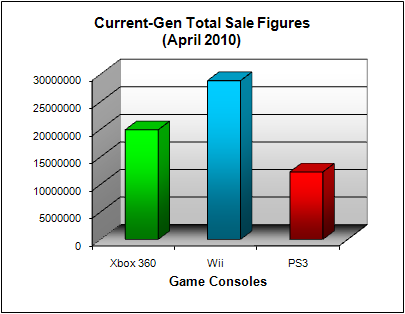
The figures for US sales in April 2010 are below, ranked in order of number of sales (April 2009 figures also shown, including percentage change):

  • DS: 440,800 (Total: 41.7 million; April 2009: 1,040,000 – down 58%)
  • Wii: 277,200 (Total: 28.8 million; April 2009: 340,000 – down 18%)
  • Xbox 360: 185,400 (Total: 19.9 million; April 2009: 175,000 – up 6%)
  • PS3: 180,800 (Total: 12.3 million; April 2009: 127,000 – up 42%)
  • PSP: 65,500 (Total: 17.3 million; April 2009: 116,000 – down 44%)
NPD April 2010 Game Console US Sales Figures

NPD April 2010 Game Console US Sales Figures

NPD Game Console Total US Sales Figures (as of April 2010)

NPD Game Console Total US Sales Figures (as of April 2010)

My prediction from last month was:

I think the PS3 will outsell the Wii in April. This is based on the strong software numbers for March, plus the stock shortage issue being resolved finally which will give the PS3 a bump in sales. While there’s no new major PS3 exclusive in April, Super Street Fighter IV will be available, and based on the non Super version of the fighting game, the PS3 version should outsell the Xbox 360 version as well. Tom Clancy’s Splinter Cell Conviction, which is a console only exclusive for the Xbox 360 (there’s also a PC version), should do well, and God of War III should still be charting. So another good month for the PS3, with better hardware numbers, but probably slightly lesser software domination, for April.

What I failed to take into account was the Easter sales effect, and with Easter sales event coming in March this year, as opposed to April of last year, this accounts for quite a bit, but not all, of the sales drops recorded for April (compared to March). The double whammy is that while the Easter sales event happened in March, the Easter holiday period occurred in April, and so sales were further subdued as a result. And therefore, none of the consoles sold better in April than in March. The PS3 did not outsell the Wii. The PS3 didn’t even outsell the Xbox 360, but only losing to it narrowly. The game predictions were pretty much spot on, but with overall sales down 26% compared to April 2009 (21% of it attributed to Easter, probably), everything sold in fewer numbers.

The PS3 stock shortage appears to be continuing, at least when looking at Amazon. So this is perhaps one of the reasons why the PS3 isn’t dominating as it should based on recent game releases. This stock shortage has been going on far longer than it should have – I don’t know what the reasons are, but it can’t be helping Sony. PS3 sales still grew by 42% compared to the same month last year, but April 2009 was a bad month for the console, as it had the dubious record of being outsold by the PS2 during that particular month. What is more worrying for Sony is the PS2 and PSP. As mentioned earlier, the NPD has stopped tracking PS2 numbers, giving Sony a hint as to the future of the last-gen console. Perhaps it’s time Sony finally retires this ageing console, so they can concentrate all efforts on the PS3. They certainly won’t be concentrating efforts on the PSP, which has recorded yet another month of dismal sales. Recording what is the worst set of results since release, the PSP is seriously out of ideas, being outsold by the DS by almost a 7:1 margin this month, the total units sold gap between the DS and PSP has grown from 15.6 million units in April 2009 to 24.4 million just a year later.

The Xbox 360 continued to outsell the PS3, and continues to grow in a year-to-year comparison, a modest 6% increased compared to April 2009. If Sony is hoping to close the gap between the Xbox 360 and the PS3 total units sold in the US, then they’re doing about it the wrong way in regards to managing the stock shortage, and if anything, the gap has grown wider in recent month. And if Sony is hoping the PlayStation Move will help the PS3, then they have to hope Project Natal flops for the Microsoft console. E3, which will occur around this time next month, will give us a strong hint as to whether Move or Natal will dominate holiday sales based on the reception both demos get at the expo. But as long as the Xbox 360 is outselling the PS3, even if only by a small margin, Microsoft can’t be too unhappy with the results.

For Nintendo, the picture isn’t great this month. The DS recorded a huge 58% drop in sales compared to the same time last year, and even if you take into account the Easter effect, there’s still a drop in sales. The Wii continues to drop in sales, down 18% compared to last year. The Wii’s sales decline can be traced to April 2009, when it started to show signs of weakness. But the DS is still outselling the PSP easily, and the Wii is still outselling both the PS3 and Xbox 360 relatively easily, so it’s not time to panic yet for Nintendo. But they need something up their sleeves for the Wii if they want to continue to dominate after both Sony and Nintendo release their motion control systems.

On to software sales now. The month’s most popular title was Tom Clancy’s Splinter Cell: Conviction for the Xbox 360, outselling the number two title, which was also last month’s number two title, Pokemon SoulSilver, by more than a 2:1 margin. Conviction was a console exclusive for the 360. God of War III slipped to 5th place after last month’s monster 1st place finish. And as expected, Super Street Fighter IV on the PS3 outsold the Xbox 360 version, by a 1.3-to-1 margin – the previous Street Fighter game also sold more on the PS3 than on the Xbox 360. The usual Wii titles are in the mix, New Super Mario Bros, Wii Sports Resort and Wii Fit Plus, and also Just Dance, which refuses to go away. The other Xbox 360 title in 7th place was Battlefield: Bad Company 2, which outsold the PS3 version by around a 1.6-to-1 margin. Note that NPD did not provide figures for Wii Fit Plus this month, but knowing the sales numbers for the titles just above and below it, we can estimate sales at between 144,000 units and 166,000 units. For the sake of compiling market share percentage figures, sales for Wii Fit Plus can be  estimated to be 155,000, and if using this figure, the Wii games had 32.5% of the top 10 with 4 entries, closely followed by the Xbox 360 games on 31.2% for just two titles. The PS3 had two titles in the top 10, with 15.5% of the top 10 units sold. The two Pokemon DS titles accounted for the rest. It was interesting to note that both Final Fantasy versions not only disappeared from the top 10, they disappeared from the top 20 as well.

Here’s the complete list of the top 10 software sales:

  1. Tom Clancy’s Splinter Cell: Conviction (Xbox 360, Ubisoft) – 486,100
  2. Pokemon SoulSilver (DS, Nintendo) – 242,900
  3. New Super Mario Bros. Wii (Wii, Nintendo) – 200,300
  4. Pokemon HeartGold (DS, Nintendo) – 192,600
  5. God of War III (PS3, Sony) – 180,300
  6. Wii Sports Resort (Wii, Nintendo) – 179,000
  7. Battlefield: Bad Company 2 (Xbox 360, EA) – 166,000
  8. Wii Fit Plus w/Balance Board (Wii, Nintendo) – 155,000 (estimated)
  9. Just Dance (Wii, Ubisoft) – 144,000
  10. Super Street Fighter IV (PS3, Capcom) – 143,000

Prediction time. The PS3 shortage continues, and so it will still do poorly in sales I think, and probably outsold by the Xbox 360 with the hardware sales order remaining the same as this month. On the software front, the Xbox 360 version of Red Dead Redemption should be the top seller, with the PS3 version closely behind. Alan Wake, the much hyped Xbox 360 exclusive, should be in the top 10 as well. There might be room for the PS3 exclusive 3D Dot Game Heroes as well. Along with the usual Wii titles, the new Super Mario Galaxy 2 should rank in the top 10 as well. Overall sales should pick up compared to April, but probably still down year on year at least for the hardware figures.

See you next month.