Archive for the ‘Xbox 360, Xbox One’ Category

Game Consoles – July 2010 NPD Sales Figure Analysis

Saturday, August 14th, 2010

July figures are now available from NPD for US video game sales, and there are a couple of surprises, although probably only one good surprise for one company in particular. June figures showed some year on year improvement by the likes of the Wii, Xbox 360 and PS3, which offset the bad news about the decline for the DS and the worrying figures for the PSP. July is traditionally not as good a month as June, so all eyes will on which consoles can do the business this month, and which are in serious trouble. The figures are from NPD, a marketing research firm that releases games console sale data every month.

The figures for US sales in July 2010 are below, ranked in order of number of sales (July 2009 figures also shown, including percentage change):

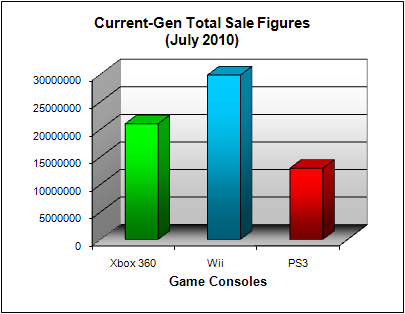
  • Xbox 360: 443,500 (Total: 21 million; July 2009: 202,900 – up 119%)
  • DS: 398,400 (Total: 43 million; July 2009: 538,900 – down 26%)
  • Wii: 253,900  (Total: 29.8 million; July 2009: 252,900 – up 0.4%)
  • PS3: 214,500 (Total: 12.9 million; July 2009: 121,800 – up 76%)
  • PSP: 84,000 (Total: 17.4 million; July 2009: 122,800 – down 32%)
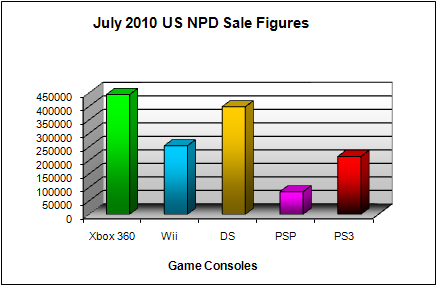
NPD July 2010 Game Console US Sales Figures
NPD July 2010 Game Console US Sales Figures

NPD Game Console Total US Sales Figures (as of July 2010)

NPD Game Console Total US Sales Figures (as of July 2010)

My prediction from last month was:

Time to make a prediction. The new Xbox 360 Elite fever continues, and there’s a good chance it will outsell the Wii (and PS3) yet again. So my guess is that the order of the hardware sales will remain the same for July, but with hardware sales generally down a bit compared to June as historically has been the case. As for games, Super Mario Galaxy 2 to rule in the absence of any real quality new releases. NCAA Football 11 should make the top 10, the Xbox 360 version outselling the PS3 version. How can I forget Crackdown 2, the sequel to the very first Xbox 360 game I ever owned. It should do well, but topping the chart? I don’t know about that (it’s already 39th in the sales charts on Amazon, and that doesn’t look like a rank that belongs to a number one title).

I was I was close to the mark, but I just couldn’t see the Xbox 360 outselling the DS, not just the Wii, but that’s exactly what happened. Although the Xbox 360’s number one was earned with much help from decreasing DS sales, but when most consoles saw month to month drop in sales, the results were still remarkable. As for games, I think what I predicted mostly came true, but otherwise it was a slow month for game sales.

The Xbox 360, thanks to the new “Slim” or we’ll just refer to it as the Xbox 360 250GB, has done wonders for Xbox 360 sales, but that’s really not a surprise. The DSi, PS3 Slim all helped to post what proved fairly temporary sales increases, and the 250GB model may run out of steam next month. But of course, Microsoft has the new Arcade replacing 4GB, matte “Slim” version out in August, and so that might help keep hardware sales up. And then in September, Halo Reach is released, and a Halo title will always help push hardware sales, so it looks good for Microsoft until Kinect hits the market. Whether Kinect will prove a hit or not, that’s still too early to say, but early signs are encouraging.

For Nintendo though, decline in DS sales and an almost negligible year on year growth for the Wii is starting to look a bit worrying. Of course, with the 3DS on the horizon, Nintendo won’t be too concerned with the year on year comparison (which saw a 26% drop in sales), last year’s figure boosted by the DSi. The Wii numbers are slightly more worrying, since the numbers are starting to look like one for a console that’s running out of ideas. Price cuts can help, but with Sony and Microsoft’s own motion gaming systems on the way, the Wii looks quite last-gen in the face of the competition.

For Sony’s systems, the PS3 is still getting a healthy year on year result every month, but remember that the PS3 was doing extremely poorly this time last year (although next month’s figures for 2009 should start to reflect the Slim and price cut’s effects, at least partially), and large growth means nothing if you’re comparing it to a poor period. But compared to the Xbox 360 or the Wii, it still isn’t doing what it is capable of, and despite the poor Wii numbers this month, the PS3 numbers were still lower. And this is with the stock issues cleared up. The PS3 numbers for July 2010 are actually lower than the PS3 numbers for July 2008 (225,000), and that’s not a great sign despite price drops, new form factor, and many many more games being released since that time. The PSP, well, the less said about that the better. Pretty soon, the NPD will have to remove the PSP numbers just like they did with the PS2 numbers, because frankly, it’s just not competitive with the DS, even with the poorer than usual DS sales numbers.

Let’s move onto software. As expected, the two versions of NCAA Football 11 for the Xbox 360 and PS3 topped the sales charts, but the gap between the two console versions has narrowed considerable compared to last year. NCAA Football 11 sold slightly less than NCAA Football 10 on the Xbox 360, but the same comparison saw more PS3 sales. While the Xbox 360 holds a 1.6:1 sales ratio to the PS3, in terms of hardware, the software margin seems to be much closer. The Xbox 360 exclusive Crackdown 2 managed to get third place, while Super Mario Galaxy 2 is still the best selling Wii title for the month (New Super Mario Bros. was the only other Wii title in the top 10, at 9th). The DS version of Lego Harry Potter Year 1 – 4 managed to grab 5th place. For the Xbox 360, there were two more titles in the top 10, Red Dead Redemption (the PS3 version has dropped out of the top 10 for this title), and an oldie, but goodie, Call of Duty: MW2. Dragon Quest IX: Sentinels of the Starry Skies for the DS was the remaining title in the top 10, at 8th.

Here’s the complete list of the top 10 software sales:

  1. NCAA Football 11 (Xbox 360, EA) – 368,000
  2. NCAA Football 11 (PS3, EA) – 298,000
  3. Crackdown 2 (Xbox 360, Microsoft) – 208,800
  4. Super Mario Galaxy 2 (Wii, Nintendo) – 193,000
  5. LEGO Harry Potter: Years 1-4 (DS, Warner Bros.) – 141,700
  6. Red Dead Redemption (Xbox 360, Take-Two)
  7. LEGO Harry Potter: Years 1-4 (Wii, Warner Bros.)
  8. Dragon Quest IX: Sentinels of the Starry Skies (DS, Nintendo)
  9. New Super Mario Bros. Wii (Wii, Nintendo)
  10. Call of Duty: Modern Warfare 2 (Xbox 360, Activision)

It’s time to make the usual predictions. Looking at the Amazon charts, the new Xbox 360 4GB isn’t actually doing fantastically, and it’s being outsold by the 250GB. So while most people are predicting that it would be another month where the Xbox 360 rules, I’m not as certain. I think sales will do well, but it might be the case of things being very close, with the new 4GB probably just allowing the Xbox 360 to sneak to top spot. In games, NCAA Football is usually followed by Madden NFL, the 11th version, and that will always do well. But otherwise, it’s another slow month before the busy holiday period begins, so the top 10 should look pretty familiar.

See you next month.

Weekly News Roundup (25 July 2010)

Sunday, July 25th, 2010

Hello. I’ve finally completed moving house, by completed, I of course mean that there’s still tons of stuff that needs to be moved over. But this is the first WNR at the new place. But the roundup must go on, as they say, despite aching limbs and a sleep deprived brain. One good thing about the move was that I was finally able to test Blu-ray 3D playback via PowerDVD 10 Mark II to my Samsung 3D plasma. More on that later.

Copyright

Let’s start with copyright news. The US Copyright Group is in the news again this week as they step up their campaign targeting thousands of web users accused of downloading pirated movies.

The latest development sees the USCG hiring the services of smaller law firms signalling the next phase of their plans – going to court. It was always understood that firms like the USCG would avoid going to court whenever possible, since the costs are higher and so are the risk (of losing, and hence, setting a precedent that could hurt future business). But it appears the USCG is pressing ahead anyway, no doubt going after those that are easy to beat in court. It may also be their way of showing that they do intend to go to court, a criticism that critics have used in the past to attack similar actions, and if they can get a few easy victories under their belt, maybe a high profile one, then this can be used to scare more people  into paying up. And as for working with the EFF to draft a user friendlier notice to send to suspected pirates, it seems the two sides just can’t get along and both may have to go and see the judge again to see how they can get things moving. This isn’t the biggest surprise in the world, as one side wants to make the notices are serious as possible to get people to pay up, while the other want the notice to be informative enough to allow people to defend themselves – it was always difficult, if not impossible, to meet both objectives.

The Last Vegas Review-Journal

The Last Vegas Review-Journal is suing those that use its articles without permission

While the USCG aren’t winning friends with web users, ISPs and rights groups, they are making friends in other media circles, and at least one law firm is now copying their strategy, except going after those who pirate newspaper articles, rather than movies. Suing hundreds of websites and blogs is Las Vegas based Righthaven, representing the owners of the Las Vegas Review-Journal. While most newspapers use DMCA takedown notices to get their full articles removed from forums and blogs, there is no money that can be made by taking this approach. But if the threat of a lawsuit, and the request for a pre-trial settlement works for the USCG on movie downloaders, then the thinking is that website owners will do the same as well, even when the offending content was posted by one of its users, not the website itself. The recent Viacom versus YouTube action showed that user generated websites do have protection from the safe harbor provisions under the DMCA, as long as they have a clear anti copyright infringement policy in place and enforces this policy consistently. So one might think this would apply to forums where users have posted full articles against forum rules, or blogs where users have made the same post in the comments. But the fear of an expensive lawsuit means that many will simply pay the settlement fee to avoid the trouble, although others are willing to challenge the claims in court. If this model works, expect all other newspaper owners to follow suit, as most of them are struggling to keep profits from dropping in what many calls a dying industry.

UPC

Irish ISP UPC is going to court to fight three-strikes

Moving to Europe now, it appears ISPs in many countries are not happy at their respective government’s three-strikes policies, and are going to court to fight it. Three-Strikes, or similar laws, may appear to be aimed at users who download pirated content, but it is in fact aimed at ISPs, making them responsible for monitoring and “sentencing”, for want of a better word, their own subscribers. The cost of the operation will have to be absorbed by the ISP, and mistaken identifies or other errors could even see the ISPs sued. The ISPs argue that since the music labels and movie studios are the one that will supposedly benefit from piracy being reduced, they’re the ones that should play a more active role in enforcing three-strikes. The content owners, however, will argue that they’re the victims in this and that ISPs should just pass on the cost to subscribers. The big question is if this wasn’t about the Internet, would government, who are normally clueless about Cyberspace, be so willing to give in to the demands of copyright holders? If people were committing copyright infringement via the telelphone, let’s say something silly like reading out loud books or newspaper articles to the person on the other end, should the telephone company then be tasked with spying on users’ conversations so they can put a stop to this illegal practice? Should the government then help to make spying legal and part of the copyright laws? ISPs are nothing more than utility companies, like the gas, electricity or telephone companies, and making them responsible for what their subscribers do with the service just doesn’t seem right. And if there are any technical advantage that make ISP level “spying” easier, then it would still be unfair to make ISPs bare the entire cost of the operation. It’s forcing one industry, and tax payer money,  to protect another industry’s revenue stream for no reason other than it’s the easy thing to do.

The Swedish Pirate Party wants to do something about ISP snooping though, and they are planning to launch their “Pirate ISP”, which will ensure no data about users if kept, so that their privacy is protected. The idea is nice, but I can already see the lawsuits and search, arrest warranty being typed up, probably before the ISP is even launched.

And when Hollywood is finished getting the government and ISPs to do their bidding, for free, they will turn their targets on those that try to innovate too much. Because innovation could eventually lead content being published without having to be controlled by publishers, and that spells bad news for revenue. Google TV is next in Hollywood’s cross-hairs it seems, as the new proposed system which aims to present a common interface for viewing media, online and offline, on TVs may just be too innovative for Hollywood’s liking. In their submission to the FTC, Hollywood studios claims that Google TV could potentially allow users to interact with both legal and illegal media, in the same interface, and that’s will encourage users to all become pirates. Instead of seeing how such an innovation could revolutionize the way people buy content on the Internet, and instead of supporting Google, a company with a history of knowing how to get money out of the Internet and its users, they yet again focus on the piracy issue and the issue alone. Just like how music labels refused to work with digital music retailers and instead focused on more and more complicated layers of DRM, and then having the likes of Apple iTunes swallow up a huge chunk of Internet related profit that otherwise would have gone to the labels, Hollywood appears to be making the same mistake.

UltraViolet DRM

DECE has a new name and logo: it's now UltraViolet, but it's still an new, annoying DRM

Instead, their solutions is, you guessed it, more DRM. Hollywood’s new fairer DRM scheme, supported by pretty much all the studios expect Disney (who have their own proprietary system in the works), is now called UltraViolet. How is it friendlier? Well, it plans to make DRM protected files more portable, working in more players and systems, but it still has the stench of DRM all over it, and thus, all the same usual problems: lack of universal compatibility, the need for online authentication, and don’t expect the files to work forever as there is no guarantee whatsoever that any DRM system will be kept supported and updated (at high cost by the DRM operators) forever. The IEEE is also working on their own “fairer” DRM, which will make digital files more like physical objects, in that ownership can be transferred, so sharing something with a friend could mean that you lose the ability to use the file forever if your friend do not return ownership back to you. The scheme, called P1817, could even work in conjunction with the monster that is UltraViolet, to make everything a bit fairer you see. The funny thing is that by acknowledging the need to make things fairer, content owners have just acknowledged that DRM, at least in past forms, have not been fair to users. I would go one step further and say that DRM is always unfair to users, so if you want them to accept it, make sure you give them back something in return. Whether’s that lower prices, better services, or even just less hoops to jump through, it is needed. Content owners should not take users for granted, as they may just go elsewhere (and if there’s no legal alternative, guess where they will be, and have been, heading to?)

High Definition

In HD/3D news, as mentioned in the introduction, I managed to get PowerDVD 10 Ultra 3D with the Mark II patch to play a Blu-ray 3D movie and have it display as proper 3D on my new Samsung 3D plasma TV.

It took a bit of work trying to get it to work, but I’ve posted the instructions here for those that want to give it a go. The 3D effects are great, even if you’re not getting full 1080p resolution, but that will only be possible when updated drivers are available for my ATI Radeon HD card. For now, it means I can play Blu-ray 3D movies in 3D without a standalone Blu-ray 3D player (although my free bonus one, part of a promotion Samsung were running here in Australia, should be on its way from Samsung, hopefully arriving before the PS3 gets its Blu-ray 3D update).

BDXL Logo

And sticking with the theme of logos ... BDXL won't play on existing Blu-ray players

But while I wait for my Blu-ray 3D player to arrive, it may already be obsolete, thanks to the idea of “upgradeable hardware” introduced by the Blu-ray format. The idea says that, like software, there may be a new version out every year and you would need to pay to get the new version, if you want the latest features. We’ve already had Profile 1.0, 1.1 and 2.0 players, and I guess Blu-ray 3D counts as 2.5 or something. And when BDXL movie discs arrive (if they arrive), then we’ll all need new players again (4.0, since 3.0 is already taken by the fairly unused Blu-ray audio format). It’s nice having 128GB capacity, but not so nice when I have to yet again upgrade my Blu-ray player, despite how cheap players have become. Even the always versatile PS3 won’t be able to support BDXL, since the only thing that the PS3 can’t update through software, the Blu-ray drive itself, will need to be updated. And soon after Blu-ray 4.0, we’ll have Super-Blu-ray 1.0, with Sony promising a 1TB disc using an even more powerful laser. Downloads, streaming, storage lockers … if only everyone had the bandwidth to make download a Blu-ray quality movie a matter of minutes, rather than hours (or weeks, in certain Internet backwaters,  like Australia), then we could get rid of the disc altogether, or burn our own discs by only replacing the optical drive in your computer, as opposed to an entire standalone player. It’s bad for the environment, bad for our wallets, and it’s just annoying.

But at least one thing to do with Blu-ray is going disc-less. Netflix streaming on the PS3 will finally work without a Blu-ray disc, and it only took a year after Netflix was first available on the PS3, and several after the Netflix was originally launched on the Xbox 360 (which had disc-less streaming from the get go). Better late than never, I suppose.

Gaming

And finally in the ever rarer gaming section, Microsoft has finally revealed the official Kinect pricing. Which is exactly the same as the unofficial pricing all the retailers have been using for months.

The only surprise, and a good one, is that the $149.99 price includes a free game, Kinect Adventures. But it was Microsoft’s other announcement which were a bit more interesting, like the new “Arcade”, the Xbox 360 4GB, which is basically the same piece of hardware as the new “Slim” Xbox 360 250GB, except without the 250GB HDD of course. The price for this new console is $199, but if you buy it with Kinect in a bundle, it will be $299, so that’s another $50 off Kinect’s pricing if you buy it with the new console. Some will say that this attempt to compete with the Wii is doomed to failure, because the Wii will be much cheaper. But the Xbox 360 doesn’t need to be the same price as the Wii, since it’s a much better console (certainly plays more types of games than the Wii, in HD too). There’s no Xbox 360 250GB Kinect bundle, which is a shame because that’s the one I would like to buy. Kinect pre-orders on Amazon jumped back to the top 5 after the pricing announcement on Wednesday, but has since dropped down to 21. The Move bundle is at 49th.

And that’s the news I have for this week. Sorry about the rushed nature of this WNR, what with all the mistakes and mindless rambling, moving house takes a lot out of a person. You didn’t notice any differences? That’s good then. What do you mean “it’s same crap as usual”? Huh? Anyway, here’s to a less crappy WNR next week.

Game Consoles – June 2010 NPD Sales Figure Analysis

Saturday, July 17th, 2010

Well that was a short break. Thanks to the May figures being released late, and the June figures being released on time, we have a new NPD video game analysis for you only two weeks from the last one. May wasn’t anything to write home about in terms of sales, despite Red Dead Redemption and Super Mario Galaxy 2. June had some interesting developments, namely the mid month release of the new Xbox 360 Elite, you know the new slim version (even though Microsoft don’t ever use the term “slim”). The PS3 stock shortage issue seems to have cleared up, and Sony even managed to create a 250GB bundle early in June. So with all these happenings in mind, the hardware sales race heated up in June and it will be interesting to see if the stock shortage issue, which has been holding back PS3 sales, will finally allow the console, the “original” Slim if you will, to beat the “new” Xbox 360 slim. The figures are from NPD, a marketing research firm that releases games console sale data every month.

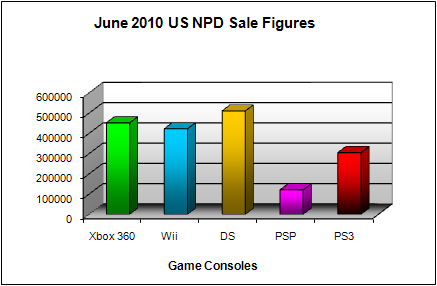
The figures for US sales in June 2010 are below, ranked in order of number of sales (June 2009 figures also shown, including percentage change):

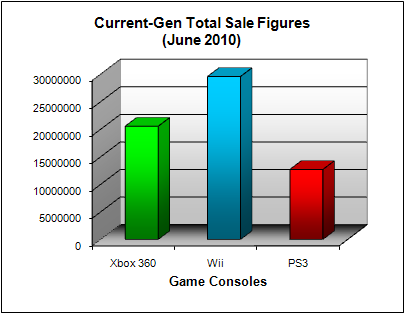
  • DS: 510,700 (Total: 42.6 million; June 2009: 766,500 – down 33%)
  • Xbox 360: 451,700 (Total: 20.6 million; June 2009: 240,600 – up 88%)
  • Wii: 422,500 (Total: 29.6 million; June 2009: 361,700 – up 17%)
  • PS3: 304,800 (Total: 12.7 million; June 2009: 164,700 – up 85%)
  • PSP: 121,000 (Total: 17.4 million; June 2009: 163,500 – down 26%)
NPD June 2010 Game Console US Sales Figures

NPD June 2010 Game Console US Sales Figures

NPD Game Console Total US Sales Figures (as of June 2010)

NPD Game Console Total US Sales Figures (as of June 2010)

My prediction from last month was:

It’s time to make my usual predictions. With the PS3 stock shortage crisis over, PS3 sales should rise. The Xbox 360 would otherwise have been relegated to third place amongst the home consoles, but the new “slim” Elite may save the day, and maybe even sell enough to keep it above the PS3. I keep on expecting either the PS3 or Xbox 360 to outsell the Wii, but it hasn’t happened very often, and June is probably the same, although it has a greater chance than previous months. Not a huge month for new game releases though, so RDR may remain in the charts, with Super Mario Galaxy keeping up sales and possibly stealing a march on the RDR games.

So pretty spot on I would say, not hard though considering I only wrote the above two weeks ago. PS3 sales did improve, actually 97% better than in May, and very likely thanks to the end of the PS3 stock shortage crisis of 2010. Although I still don’t understand why the stock shortage had to occur in the first place. It seems to have cost the PS3 several months of beating the Xbox 360, and just as the stock issue cleared up, in comes a new Xbox 360 that again outsells it. And outsell the PS3 the new Xbox 360 did. And it even outsold the Wii, which I had semi-predicted above I suppose. Overall, it was an impressive 132% increase compared to last month, and the best non Holiday sales period for the console in some time. And even now, the new Xbox 360 SKU is still in the top 10, which is good news for Microsoft I guess. In fact, all hardware numbers were up compared to May, and historically, this has been the case in June. And software was almost exactly as I had predicted – a slow month still dominated by last month’s new releases.

Speaking more on the PS3, it seems the stock shortage was responsible for low sales, as once it cleared up, sales are way up. But I think a lot of the momentum from the release of the PS3 Slim has been lost in the last few month, and I don’t know who is to blame for it. It could be be because Sony underestimated the demand for the Slim (and the demand after the price cut) back in 2009, and sold all their future inventory during that time, and they’ve only been able to get supply to meet demand some 6 months into 2010. That’s the most believable scenario, but it still seems strange. Anyway, with stock no longer an issue. the PS3 is “expected” to outsell the Xbox 360 and maybe even the Wii, but that won’t happen until the excitement over the new Xbox 360 “slim” Elite dies down, probably just in time for Sony to launch Move. For Sony’s other console in the NPD data, the PSP, the news is less good. While it was up against the dismal May numbers, it’s still down 26% from a year ago, not as bad as recent results, but still bad. A PSP2 with some more innovation is what Sony needs right now.

For the Xbox 360, it was a very good month. The whole release process has been very well engineered by Microsoft. From the almost surprise announcement of the new form factor itself, to the really surprising announcement that it will ship within a week of the announcement, and the well designed nature of the new console (testing shows that it’s even more durable than the PS3 Slim), and the result is that it’s the second most popular console, the first most popular home based console, of June 2010. Let’s just hope Microsoft have plenty of stock of the new console, and won’t make the same mistake as Sony with their stock issues. And with news of a new Xbox 360 Arcade “slim” on the horizon, the momentum could carry the Xbox 360 all the way until Kinect is released, and that’s probably what Microsoft are counting on. I said at the start of 2010 that the Xbox 360 had to hold on to the lead it has over the PS3 until Project Natal, as it was known back then, was ready and Microsoft has done this and some extra. Of course, the PS3 stock did help Microsoft in this regard.

The Wii had another month of year to year growth, but that’s like comparing a poor month to a really really bad one. Well, not exactly, since it’s hard to say just what constitutes a good month or bad month. Compared to the PS2 lifecycle, the Wii is still doing very well. It’s only doing badly compared to itself two years ago, but Wii sales were never going to hold steady at those levels. So Nintendo will look at the year on year growth as a positive, not to mention the still healthy software sales (see below). The DS suffered another month of year on year sales drop, but this is like comparing a good month to a really really great one. When the 3Ds is released, Nintendo have another “great” month, I expect.

For software, not a great month for new releases as I had “predicted”. So we have lots of titles from last month still in the top 10. Interestingly, the only two new entries in the top 10 were all Wii titles, and both were third-party games. This is exactly what the Wii needs, for third party publishers to get a bite of the lucrative Wii trade, instead of always relying on Nintendo to come up with the goods. In fact, there are three non Nintendo produced Wii titles in the top 10 this month, although the best selling one was still a Nintendo production – Super Mario Galaxy 2. The continued success of Just Dance for the Wii actually bodes well for Microsoft I think, because Kinect will be able to do these types of games without breaking a sweat (unlike the people that are actually playing the game in question). Red Dead Redemption for the Xbox 360 held on to top spot this month, as did both of the UFC 2010 games. 6 of the top 10 were Wii titles, with two for Xbox 360 and two for the PS3. As usual, only sales figures for the top 5 are provided, and figures for the two new Wii titles are provided by Nintendo separately (hopefully Microsoft and Sony will catch on and also start releasing figures for the ones that don’t have it in the top 10).

Here’s the complete list of the top 10 software sales:

  1. Red Dead Redemption (Xbox 360, Take-Two) – 582,900
  2. Super Mario Galaxy 2 (Wii, Nintendo) – 548,400
  3. Red Dead Redemption (PS3, Take-Two) – 380,300
  4. New Super Mario Bros. Wii (Wii, Nintendo) – 200,900
  5. Just Dance (Wii, Ubisoft) – 174,800
  6. Wii Fit Plus w/Balance Board (Wii, Nintendo)
  7. Toy Story 3 (Wii, Disney) – 164,000
  8. UFC 2010: Undisputed (Xbox 360, THQ)
  9. LEGO Harry Potter: Years 1-4 (Wii, Warner Bros.) – 136,000
  10. UFC 2010: Undisputed (PS3, THQ)

Time to make a prediction. The new Xbox 360 Elite fever continues, and there’s a good chance it will outsell the Wii (and PS3) yet again. So my guess is that the order of the hardware sales will remain the same for July, but with hardware sales generally down a bit compared to June as historically has been the case. As for games, Super Mario Galaxy 2 to rule in the absence of any real quality new releases. NCAA Football 11 should make the top 10, the Xbox 360 version outselling the PS3 version. How can I forget Crackdown 2, the sequel to the very first Xbox 360 game I ever owned. It should do well, but topping the chart? I don’t know about that (it’s already 39th in the sales charts on Amazon, and that doesn’t look like a rank that belongs to a number one title).

See you next month.

Weekly News Roundup (4 July 2010)

Sunday, July 4th, 2010

It’s been a busy week on my end. The first piece of good news is that my Samsung 3D TV finally arrived, and it was delivered to me on Wednesday. I haven’t had much time to play around with it, but early impressions are very good indeed. Not sure I’m a huge fan of the 3D though, I’ve always felt it was a bit gimmicky, but I’m only buying the TV for the 2D – the 3D is a nice bonus that will keep me entertained for a bit and allow me to experiment with a few things (like perhaps providing some 3D trailers for you all to download in the near future). I also got a bit of work done, to my surprise. The much delayed NPD US video games sales figures for May were finally made available, and my analysis of it is here. No big surprises, but the video game industry is not immune to economic conditions, and so is still suffering. June will be interesting because the Xbox 360 “Slim” went on sale in the middle of the month, and we have the E3 hype as well. And in terms of other news, there were a few as well, so let’s get started (and finish quickly, so I can go play with my new TV).

Copyright

Let’s start with the copyright news. A couple of weeks ago, the judge in the isoHunt copyright cased allowed the MPAA to submit keywords that would be censored on the BitTorrent search engine, but now the founder of isoHunt, Gary Fung, says that instead of trying to stop piracy, it’s now bordering on censorship, or at least an attempt to completely cripple isoHunt, even for the legal stuff.

Mininova.org Pageview Ranking (Alexa.com)

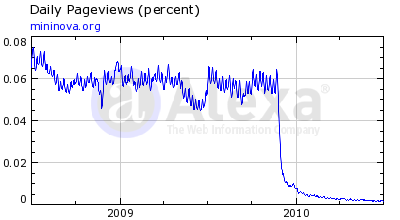
Alexa's pageview ranking for Mininova shows that it's not easy for torrent sites to go legit

Part of Fung’s argument is that very keywords include common words such as “21” or “Dad”, as these are words used in movie titles. If you had a list of every movie title, then surely that would cover so many words as to make the search engine completely non effective. A more logical and fair way to do it would be to remove common words from the list of “banned” words, and to only block phrases, as opposed to just words (so “Born on the Fourth of July” would get blocked, but the keywords “Born”, “Fourth” and “July” aren’t blocked). But this decision was never about logic or fairness. It’s interesting to analyse the decision again given the recent YouTube ruling. Of course, YouTube’s main purposes contains a lot more “fair use” than say a Torrent download website, but the important aspect of the YouTube ruling was the copyright holders are partially responsible to locate and remove infringing content (after all, only they can decide what’s infringing, and what’s not), and putting it all on the website operator is not fair. So if isoHunt had a policy where they block out the obvious pirated torrents, and then add a function to allow studios to request removals of others, then that would be enough. Of course, whether isoHunt would still be viable as a commercial operation, without pirated content, is up for debate. Mininova was never the same after it removed all of its infringing content, but it’s still a relatively big website, although that may fade due to incoming links being removed and stuff.

US Immigration and Customs Enforcement Badge

ICE Officers raids and seize assets from nine websites suspected of offering pirated content

Following last week’s announcement of a crackdown on online piracy,  US Immigration and Customs (ICE) has acted quickly this week to close down and seize the assets of nine websites suspected of offering pirated content for online streaming. It’s good to see the government reacting so quickly to a current ‘crisis’, as opposed to say waiting days and weeks to get a response through. Like Katrina and BP’s Gulf of Mexico disaster. It’s good to know where the US government’s priorities are in these dangerous times, what with Hollywood studios on the verge of bankruptcy and everything. The other crime wave affecting the US right now is of course college students downloading films. And this is why Congress in 2008 passed the Higher Educational Opportunity Act which, amongst other things, forced educational institutions to join the fight against online piracy, or face the risk of losing federal student aid. This act has now come into effect. So if US colleges don’t spend their own money and time stopping students from downloading The (new) Karate Kid, then they’ll lose funding and will have to close down. Sounds like a fair compromise to me, risking education of the next generation to prevent them from downloading MP3s. It’s definitely fair to the music labels and movie studios, who don’t have to move an inch now and can get colleges to do their anti-piracy work for them, all for the price of a few lobbyists.

This week was also when the judge overseeing one of the US Copyright Group’s mass lawsuits was to decide on a challenge from the ACLU/EFF as to the legality of putting so many defendants in the same lawsuit. Unfortunately, the US Copyright Group won their motion, although the ACLU/EFF also had a few victories of their own. So the judge has decided it is okay to put a bunch of people together, most of whom have never communicated directly or indirectly with each other, in the same lawsuit. But the USCG must now also work wit the ACLU/EFF to draft a warning notice (to forward to people listed in the lawsuit), and this is where the ACLU/EFF will ensure that the notice contains plain English and perhaps contain language that doesn’t  scare people into paying for the pre-trial settlement, if they really do believe they’re innocent. The judge also ruled on Time Warner Cable’s motion to quash the subpoenas, as it violated a previous agreement with the USCG to limit the number of requests per month. The judge ruled just shy of a complete quashing, but did rule that the agreement was valid and that the USCG must limit request to 28 per month, which should really slow down USCG’s efforts (although they’ll probably just pick IP addresses from other ISPs to “sue”).

High Definition

Onto HD (3D) news (I really should update the “section graphics” to your left, or above if you’re reading the newsletter, to include 3D). For those hoping Blu-ray would arrive soon on the Apple range of hardware, well, your wish is unlikely to be answered.

Still no Blu-ray on Apple Macs ... not if Jobs has anything to say on the issue

Apple boss Steve Jobs has once again, this time in an email, showed his disdain for the Blu-ray format, predicting it will be beaten by digital downloads and streaming services. He compared Blu-ray to all those “failed” HD audio formats, none of which has managed to replace CDs, let alone MP3 and other digital formats that has replaced CDs. As you may recall, he previously called Blu-ray a “bag of hurt”, due to the licensing requirements of the format. When the person communicating with Jobs stressed that Blu-ray does have uses in data and video archiving, Jobs was quick to point out that streaming and digital rentals means that you don’t need massive amounts of local storage for movies. And I guess for data archiving, with the price of external HDDs dropping so quickly, these offer good portability, and excellent value for money, compared to Blu-ray discs, you have to say. Even USB drives are approaching capacities beyond that of your typical dual-layer Blu-ray, which may explain why the Blu-ray people have added BDXL and larger capacity discs to the specifications (unfortunately, they’re not backwards compatible, so new burning hardware is needed to take advantage – a disadvantage that USB drives don’t have).

I could have put the next piece of news under gaming, but it’s probably more relevant here. The much rumoured Hulu subscription service is now a reality, and it’s coming to a whole host of devices, including the PS3, Xbox 360, and TV and Blu-ray players from Samsung, Vizio and Sony. PS3 owners will be amongst the first to get it, with the $9.99 monthly cost possibly on top of the PlayStation Plus service cost (rumoured only). Xbox 360 owners may be the last to get it however, but don’t fret, the best Hulu experience may yet be on the 360, as Hulu are working to make the service Kinect compatible (so gesture, voice commands to control the Hulu interface). All of this means nothing to me because Hulu isn’t “available” in Australia, even though I have a Samsung TV and soon will have a Samsung 3D Blu-ray player (free by redemption), both of which are capable of supporting Hulu.

And a further blow to Adobe this week as adult website Digital Playground announced that they may choose HTML5 over Flash. It seems a lot of websites now have to make the choice, because supporting both may be expensive, and Google’s WebM/VP8 now means websites don’t have to sacrifice quality (too much) if they choose the HTML5 codec.

Gaming

And finally, in gaming, a new PS3 firmware is available. Firmware 4.0 adds Facebook support and support for the new subscription based PlayStation Plus platform. After criticizing Xbox for asking users to pay for Xbox Live Gold, it seems Sony finally saw the light and decided to have a go at their own premium platform.

Luckily, multiplayer gaming is still free, as are many other features, but as speculated above, some of the premium features like Hulu may require the Plus platform.

A brief look at Amazon shows that Kinect is still selling better than Move. But the latest news is that Kinect may only offer two player simultaneous play, even if it does support tracking of up to 6 players. What this means is that up to 6 players can “join” the game, but 4 will have to wait their turn at any one time, while two can play. The limited angle of the camera lens may be responsible, as well as the hardware requirements of processing too many people at the same time. This would appear to make the Wii or Move the platform of choice for 2+ player motion gaming, but the PS3 only supports 7 connected devices, including any other controllers or wireless devices, so 4 player simultaneous play with both Move and Navigator (“remote” and “nunchuck”) is not possible either. Plus it would also cost quite a bit to get it going. Of course, there’s still no actual official confirmation, the information on hand is from leaked specifications which may or may not be final. But since none of the demos so far has been for four players, and the limited angle of any camera system, I suspect this to be true.

And that’s the news for this week. More for you next week I should hope. Until then, have a good one.

Oh, almost forgot to mention that today, 4th of July, is a very special day indeed. Yes, it is the birthday of Digital Digest, in its 11th year. I don’t plan on making a big deal of it like last year, so much so that I’ve nearly forgotten!

Game Consoles – May 2010 NPD Sales Figure Analysis

Friday, July 2nd, 2010

Slightly later than usual, due to NPD releasing their figures later, but better late than never. Or is it. With Awful April out of the way, everyone was keen to find out whether the next month be Merry or Miserable May. Once again, NPD is not providing PS2 sales numbers and only the top 5 game sales have sales figures. The figures are from NPD, a marketing research firm that releases games console sale data every month.

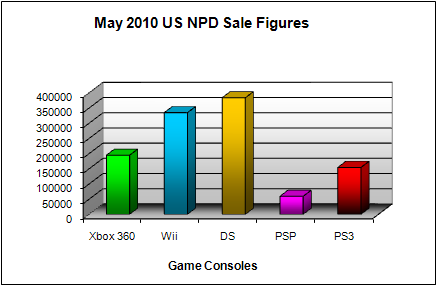
The figures for US sales in May 2010 are below, ranked in order of number of sales (May 2009 figures also shown, including percentage change):

  • DS: 383,700 (Total: 42.1 million; May 2009: 633,500 – down 39%)
  • Wii: 334,800 (Total: 29.2 million; May 2009: 289,500 – up 16%)
  • Xbox 360: 194,600 (Total: 20.1 million; May 2009: 175,000 – up 11%)
  • PS3: 154,500 (Total: 12.4 million; May 2009: 131,000 – up 18%)
  • PSP: 59,400 (Total: 17.3 million; May 2009: 100,400 – down 41%)
NPD May 2010 Game Console US Sales Figures

NPD May 2010 Game Console US Sales Figures

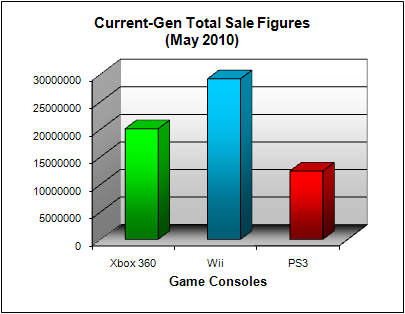
NPD Game Console Total US Sales Figures (as of May 2010)

NPD Game Console Total US Sales Figures (as of May 2010)

My prediction from last month was:

The PS3 shortage continues, and so it will still do poorly in sales I think, and probably outsold by the Xbox 360 with the hardware sales order remaining the same as this month. On the software front, the Xbox 360 version of Red Dead Redemption should be the top seller, with the PS3 version closely behind. Alan Wake, the much hyped Xbox 360 exclusive, should be in the top 10 as well. There might be room for the PS3 exclusive 3D Dot Game Heroes as well. Along with the usual Wii titles, the new Super Mario Galaxy 2 should rank in the top 10 as well. Overall sales should pick up compared to April, but probably still down year on year at least for the hardware figures.

I think most of what I posted came true, which is a rarity indeed. The PS3 stock shortage did hinder sales to the point where even growth compared to the same time last year was muted, although still comfortably up. I don’t know what’s the issue with Sony’s PS3 production, but the problem appears to have been sold for June already. Perhaps they were saving stock for an expected bump in sales in June, due to E3 and the announcement of Move, but who knows. For Sony’s other console (the one that still matters to the NPD), the PSP, sales are not doing too well, once again a 40+% drop in sales against a year before. The PSP really hasn’t decided what it wants to be, unlike the DS which has firmly established itself as the portable console of choice for an ever younger audience (of both genders, importantly). With iPhones, iPads and all sorts of portable devices, the traditional gaming demographic (young males) may be finding a dedicated console a bit of an overkill. Nintendo was wise to market the DS to anyone but the traditional gaming demographic.

The Xbox 360 continues to do well, once again outselling the same month last year, and outselling the PS3, which is all you can ask for really. The E3 surprise announcement of the new “slim” Elite and the subsequent almost immediate release means June was probably a good month for the Xbox 360, the new console having secured top of the sales charts for the last week or so at least on Amazon. The early pre-order numbers for Kinect is promising, certainly gathering a bit more interest on Amazon than the PlayStation Move, but these figures mean nothing right now – only when both add-ons get closer to their release date, will we then be able to see just which will be the most popular, and which will help generate console and software sales.

For Nintendo, a year-on-year growth for the Wii is rare these days, and so it was a good month. Unfortunately, DS sales dropped rather alarmingly again, that’s 58% and now 39% drops in sales, but this was up against the release of the DSi last year, and so it’s somewhat understandable. Nintendo will hope the 3DS will be the next must have console.

Speaking of Move, Kinect and the 3DS, I’ve just put up a poll asking which of these interest you the most – you can vote in it here.

Onto software sales now. As expected, Red Dead Redemption was top, with the Xbox 360 version not quite outselling the PS3 version by 2:1, but the days where the number of Xbox 360 consoles sold had a 2:1 margin over the PS3 are also gone as well (it’s now 1.62 to 1, which stacks up quite neatly to RDR’s 1.66 to 1 sales ratio for the Xbox 360 version). And as I noted last month, Super Mario Galaxy 2 also ranked in the top 10, at a high 3rd place too, just a few thousand units shy of 2nd place. This was one of three Wii titles in the top 10, the other two being the usuals (Wii Fit Plus and New Super Mario Bros.). The Xbox 360 did one better with 4 titles in the top 10, the exclusive Alan Wake as expected (but did poorly than I think what Microsoft would have wanted for such a hyped up game). The PS3 had two titles, including RDR and the multi-platform UFC 2010: Undisputed, which went close to outselling the Xbox 360 version of the same game. But without full figures for all the top 10 software sales, there’s no other analysis that I can provide, such as overall market share, but it would be safe to say that the Xbox 360 led the way, with the Wii in second place, and the PS3 in third.

Here’s the complete list of the top 10 software sales:

  1. Red Dead Redemption (Xbox 360, Take-Two) – 945,900
  2. Red Dead Redemption (PS3, Take-Two) – 567,100
  3. Super Mario Galaxy 2 (Wii, Nintendo) – 563,900
  4. UFC 2010: Undisputed (Xbox 360, THQ) – 221,200
  5. UFC 2010: Undisputed (PS3, THQ) – 192,300
  6. Wii Fit Plus w/Balance Board (Wii, Nintendo)
  7. New Super Mario Bros. Wii (Wii, Nintendo)
  8. Alan Wake (Xbox 360, Microsoft)
  9. Pokemon SoulSilver (DS, Nintendo)
  10. Skate 3 (Xbox 360, EA)

It’s time to make my usual predictions. With the PS3 stock shortage crisis over, PS3 sales should rise. The Xbox 360 would otherwise have been relegated to third place amongst the home consoles, but the new “slim” Elite may save the day, and maybe even sell enough to keep it above the PS3. I keep on expecting either the PS3 or Xbox 360 to outsell the Wii, but it hasn’t happened very often, and June is probably the same, although it has a greater chance than previous months. Not a huge month for new game releases though, so RDR may remain in the charts, with Super Mario Galaxy keeping up sales and possibly stealing a march on the RDR games.

See you next month (or sooner, if NPD don’t again delay the stats).