Archive for the ‘Xbox 360, Xbox One’ Category

Game Consoles – October 2011 NPD Sales Figure Analysis

Tuesday, November 15th, 2011

Welcome to the October 2011 edition of our regular NPD US video game sales analysis. In this feature, we look at video game sales, both hardware and software, for the month of October 2011 based on data collected by the NPD. As we approach the holiday period, some big name releases are and will be coming out, and a lot will be riding on a successful holiday period, especially due to the otherwise subdued year in sales that 2011 has been. Nintendo will hope for a good holiday period for the Wii, the last major holiday period for the console that traditionally does great during this time. Sony will hope that the PS3 can at least keep up pace with the Xbox 360 following the recent price cut in the US, even as global sales are catching up if not caught up already for the only console on the market with Blu-ray capabilities. For Microsoft, the holiday period is about maintaining and extending their sales lead in 2011. And so, October becomes an important month, made more so by the release of the mega-hit Battlefield 3.

As NPD no longer releases full hardware sales figures, this feature is reliant on the game companies, namely Microsoft, Nintendo and Sony, to release their set of figures and based on “statement math” (that is, arithmetically calculate missing figures based on statements made). For October 2011, these are the statements made by the gaming companies:

  • Nintendo reveals the Wii sold nearly 250,000 units, more than 250,000 3DS consoles, and nearly 180,000 DS (via PR email)
  • Microsoft revealed 393,000 Xbox 360 hardware units sold, with 44% of the home based console market share (source)
  • Sony did not reveal any hardware figures

With only a rough estimate for the Wii numbers, it’s hard to come up with an exact figure for the PS3, but assuming Nintendo’s “nearly 250,000” is much closer than 250,000 than 240,000, then combined with the Microsoft released data (if 393,000 is 44%, then 100% is  893,182, and taking out the Wii and 360 numbers from this), we get roughly 250,000 units for PS3 sales.

And so the figures for US sales in October 2011 are below, ranked in order of number of sales (October 2010 figures also shown, including percentage change):

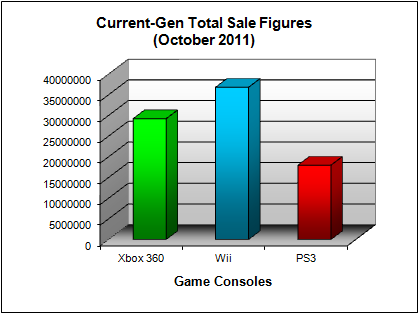
  • Xbox 360: 393,000 (Total: 29.2 million; October 2010: 325,000 – up 21%)
  • PS3: 250,000 (Total: 18 million; October 2010: 250,000 – no change)
  • Wii: 250,000 (Total: 36.8 million; October 2010: 232,000 – up 8%)
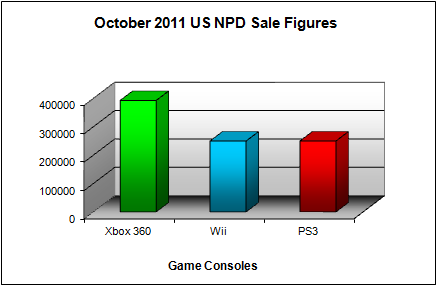
NPD October 2011 Game Console US Sales Figures
NPD October 2011 Game Console US Sales Figures

NPD Game Console Total US Sales Figures (as of October 2011)

NPD Game Console Total US Sales Figures (as of October 2011)

My prediction from last month was:

I think the hardware situation will remain largely the same. Games wise, Batman: Arkham City and Battlefield 3 go head to head, with Forza 4 on the Xbox 360 possible making the top 10 as well as a platform exclusive.

Fairly close to the reality, I suppose, although the strength in which Battlefield 3 sold probably surprised everyone, despite the hype suggesting it was always going to do well. And the only other “surprise” is the PS3 numbers, and how close it came to actually selling fewer units than the Wii (and it may have done so too, since our “statement maths” above isn’t too accurate based on roundings and precision errors).

Starting with the healthiest number, the Xbox 360 had another amazing month, as not only did it managed to easily beat the other two consoles, it also managed year-on-year growth compared to October 2010 – no mean feat considering we had the “Slim”, price cut and Kinect to give sales a bump, and nothing like that this year. But 21% growth is nothing to be scoffed at, and it’s clear that, at least in the US, the Xbox 360 is the dominant console of this generation, despite Wii still having quite a large lead at the moment (but if you look at the number of active players, the number of hit games, the online multiplayer scene, the multimedia hub features – the Wii is not in the same league as the Xbox 360). Global Xbox 360 sales, while still leading the PS3 probably at this point, may give up its lead sometime soon, but if you have to pick a clear winner for this generation, then based on the growth of the platform and the long term effects on the next generation and beyond, the Xbox 360 is a clear winner.

The PS3 is by no means a loser, and if Sony keep to their word of a 10-year product life for the console (and Microsoft follow Nintendo’s lead and release a new console before then), then the PS3 might still end up being the best selling console of this generation, at least in global sales. But compared to the last generation, in which the PS2 outsold the Xbox by more than a 6-to-1 margin (and outsold Nintendo’s GameCube by even more), then you can’t but feel that while PS3 may eventually “win”, the victory is somewhat hollow when you consider the decline from the totally dominating position the PlayStation platform was in the last gen. Of course, this kind of dominance would never really be long lasting (just ask Sega, or Nintendo before the Wii), but the company’s lack of focus on online gaming, too much focus on Blu-ray and the subsequent delay to the release of the console, the relative developer unfriendly platform (which was always going to be to Microsoft, a software company’s, advantage), the lack of attention to family/social gaming (the Wii sucks, but here’s Move, our version of it), and various setbacks including the recent PSN hack, were all mistakes that could have been prevented or at least mitigated. So coming into the holiday period, with sales flat compared to the same month last year, and battling the Wii to be a distant second place, it’s not where Sony wanted to be (they had hoped most PS2 owners would have upgraded to a PS3 by now, but instead, the Xbox 360 and the Wii stepped in to fill the “hardcore” and “family fun” void).

The Wii, for what it was, and what it has achieved, is also a huge success. Sure, most Wii consoles are now gathering dust somewhere (guilty as charged), but for a slightly enhanced version of the GameCube with a new innovative control system, it has done amazingly well. But much of it has been at the expense of losing all hardcore gamers to the other platforms, a situation Nintendo wants to address with the graphically powerful Wii U (because hardcore gamers keep playing, and keep buying games, not so much casual gamers who get distracted easily as soon as a new tablet or smartphone hits the market). If the Wii was about getting Nintendo back in the game, and a game where they were close to “going the way of Sega” in the last gen (the Xbox sold more units than the GameCube, despite it being a clunky first effort by a company that has never done console gaming, compared to the pro that is Nintendo).

Don’t know why this analysis has turned into a “look back at” type of deal, considering this generation still has a long way to go, but it just felt appropriate for some reason, as this may be the last holiday period where these 3 consoles compete in.

Let’s move on to game sales. Battlefield 3 broke all records (before MW3 will do the same this/next month), which is no surprise. BF3 fever affected me personally as well, having played and be completely pwned in the beta, I was out for more punishment and so bought a copy of the PC version. In fact, I was so caught up in the fever, I actually bought two copies (long story)! With 10 million copies shipped (as in to retailer, with 5 million of these actually “sold”), it’s a success. Batman: Arkham City, in any other month, would have been the clear winner, oh well. Again highlighting the dominance of the Xbox 360 in the US, two platform exclusive titles, the newly released Forza 4 and last month’s Gears of War 3, were in the top 10, a difficult proposition for single platform releases, as they were up against all platforms combined sales figures for the multi-platform games. Also interesting is that Just Dance 3 managed a top 10 entry, despite not being available on the PS3 until December. Ubisoft hasn’t said why the PS3 version is delayed, but I’m sure Microsoft will notch it up as a victory for Kinect over the Move. Here’s the full software sales chart for October (new releases for October 2011 in bold):

  1. Battlefield 3 (EA, Xbox 360, PS3, PC)
  2. Batman: Arkham City (Warner Bros, Xbox 360, PS3)
  3. NBA 2K12 (Take-Two Interactive, Xbox 360, PS3, PS2, PSP, Wii, PC)
  4. Rage (Bethesda, Xbox 360, PS3, PC)
  5. Just Dance 3 (Ubisoft, Wii, Xbox 360)
  6. Dark Souls (Namco, PS3, Xbox 360)
  7. Madden NFL 12 (EA, Xbox 360, PS3, Wii, PS2, PSP)
  8. Forza Motorsport 4 (Microsoft, Xbox 360)
  9. Gears of War 3 (Microsoft, Xbox 360)
  10. FIFA 12 (EA, Xbox 360, PS3, Wii, PS2, PSP, 3DS)

Time to make my usual prediction. It’s the holiday period proper, sales will be way up, and Modern Warfare 3 will help in this regard as it breaks all records. The Xbox 360, the preferred platform of MW3 and also with a new Halo game being released, will be the clear winner yet again, but it will be interesting to see if the Wii can have one last good holiday period, and there’s a new Zelda game too, so that always helps. The PS3 does have Uncharted 3 though. If I have to guess, I would say the PS3 will beat the Wii. The top games will be the ones I’ve already mentioned, plus Skyrim.

See you next month.

Weekly News Roundup (13 November 2011)

Sunday, November 13th, 2011

Welcome to another edition of the WNR. Coming up with an introduction to the WNR is actually the hardest part of writing it, and I just cannot get my brain to come up with anything this week. I guess I would mention that the NPD stats for US video game sales in October has just been released, but I haven’t written up the analysis yet, so that’s that. Better get on with it then.

Copyright

Let’s start with the copyright news, we start with the music industry lobby’s full attack on opposition to the Stop Online Piracy Act (SOPA).

The controversial SOPA, if passed, will give the music industry, amongst others, to avoid pesky things such as actual evidence when it comes to forcing the likes of PayPal or Mastercard from cutting off service to websites that the industry sees as a threat, as long as they can come up with some sort of explanation that the site is primarily involved in piracy. In fact, they don’t even have to do that. As long as the website is merely suspected of potentially wanting to hide their infringement activities, then SOPA will allow the rightsholders to intervene, even if at that point, it’s not even clear, let alone established by a court of law, that any infringement has even occurred. So potentially, all the industry have to say is that “I don’t like the look of that website”, and they can deal a potential death blow to that website. So no wonder opposition is coming in from all directions.

Wikileaks Logo

Remember how PayPal and others screwed Wikileaks? The RIAA wants the same, but for every website, not just Wikileaks.

But RIAA says that all of this nothing more by hyperbole, and that the music industry needs these changes to survive. Survive from mass piracy, or survive the move from CD albums sales towards digital tracks, they don’t say of course, but SOPA could very well be used to destroy innovation by an industry that’s obviously not looking towards the future. Imagine a new start-up that offers a brand new service that hurts the existing business model of the music industry, the RIAA can use SOPA to fire off an infringement notice to say the financial providers of the start-up website. Trying to avoid trouble, the financial providers cease support for the website, and the website dies a quick death. Sure, the owners of the website can sue the financial providers, but that would require money, which at that point, the start-up probably doesn’t have much of. This may very be an extreme, but no law should give so much power to one side, against the other, and to replace civil court matters with agreements and dealings behind closed doors by private corporations. And with the economy the way it is, the country can ill afford to allow old business interests to kill off new innovations, that are really at the forefront of job creation.

And the RIAA have been busy not only defending “their” SOPA bill, but also attacking the old DMCA, which if you can remember, was their work as well. Apparently, the “safe harbor” provision that was added to protect online businesses is working too well and actually offering protection to online businesses, which the RIAA says was not the intention behind the provision at all. They blame it all on judicial branch of the government, the branch that’s the hardest to corrupt via lobbyist money, for interpreting “safe habor” wrongly. In particular, they want ISPs and websites to be the judge, jury and executioner and to take proactive action against infringing content, what they call “red flags”, which is a very vague notion of “you’ll know (it’s piracy) when you see it”. Except these types of actions will open up ISPs and web businesses to potential lawsuits for removing the wrong content, and it’s difficult to judge what is right and what is wrong when you don’t even know what content belongs to whom, without the rights holders getting involved. The RIAA says this shouldn’t be a problem, and it isn’t, for them! It seems web piracy is the gravest problem facing the music industry, and at the same time, it’s a problem that the industry shouldn’t have to do anything about – because the government, tax payers, web businesses should be doing all the work, taking all the risks, while the rights holders  receives all the theoretical and perceived benefits.

Google DMCA Notice

Google says a lot of DMCA complaints are invalid, and most are being used to attack competitors

But then maybe it’s a good thing, because whenever the rights holders are given carte blanche rights to remove infringing content on the Internet, they tend to abuse those rights. Google revealed a few years ago that a third of all DMCA complains filed with the company were invalid, and the latest example is Warner Bros. abusing Hotfile’s infringing file removal tool. Despite being sued for promoting piracy, Hotfile actually had one of the stronger anti-piracy tools for rights holders, allowing them to basically delete any hosted files they want without any real limitations. Unfortunately, WB, when given access to the tool, abused it by deleting content that didn’t belong to them and even open source software, and this is not just Hotfile’s allegation – WB this week admitted to pretty much all of it as part of legal proceedings between the company. Once again highlighting why automated, technical solutions to piracy filtering doesn’t work, WB admitted that their piracy filters removed content that only shared a partial name to the content they were trying to remove. And doing a simple file name check implies WB definitely didn’t download the files and check whether it actually contained infringing content or not. WB also admitted to deleting a popular, open source downloading tool that they obviously had no rights to, and they justified it because the tool helped to speed up downloads, and of course, all downloads equals piracy in the eyes of Warner. And WB admitted to all of this “collateral damage”, and it seems they’re not too fussed about it either, as they’re still asking the judge to throw out Hotfile’s lawsuit against the studio for the allegation that the studio abused the DMCA, which Warner appears to have just confirmed.

Over to Europe and two ISP, and The Pirate Bay, related cases that could have implications everywhere else. With UK courts giving the okay for ISPs to start blocking websites for anti-piracy reasons, the BPI, UK’s branch of the RIAA, wasted no time in asking the same ISP, BT, to start blocking The Pirate Bay. Calling The Pirate Bay a “huge scam” (I would argue against that, since a website that has the word “pirate” in its title and domain name is not trying to fool anyone as to what the website is about), the BPI fearmongering engine went into overdrive. If you visit The Pirate Bay, apparently, your computer will get infected with viruses, trojans and herpes, your identity will be stolen, and you may even see “inappropriate content”. The BPI wasn’t clear what “inappropriate” meant, but since BPI specifically asked BT to use their child porn filter to filter out The Pirate Bay, the implicit suggestion is probably pretty clear. And of course, given the economy today, the talking point of “they toor ur jobs” was bought up, against suggesting that piracy destroys jobs, while creating none (and yet, the industry says ISPs, web businesses and individuals are making too much money off piracy).

The other story was in Dutch-land, where BREIN is at it again, this time asking two ISPs to also block The Pirate Bay. But the ISP, having already won a preliminary court case against this very matter, say that the proposed blocking method, by IP address and DNS, won’t work and may actually kill their network.

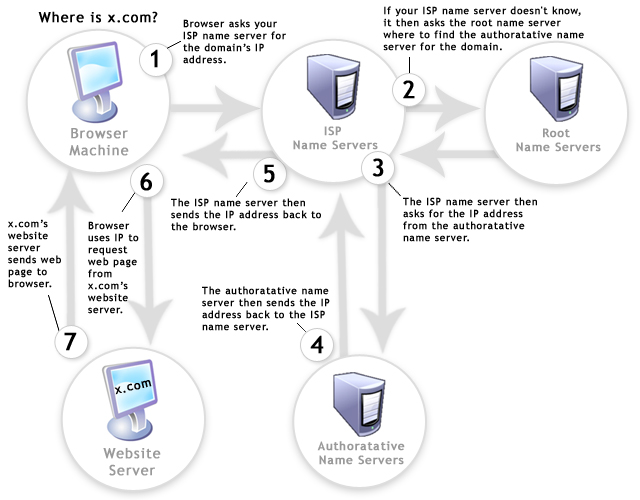
How DNS Works

How DNS Works

But before we get into the details, a little background info may be needed here. The way the web works, each server has one or more IP addresses assigned to it, and the server software can present the right website for you based on the IP address (sometimes, a single IP address can host several websites, and the server software can tell which site to serve up via the domain name you used to get to the IP address). Domain names are matched to IP addresses via Domain Name System  (DNS), which is basically thousands upon thousands of servers world wide that stores a constantly updated database of domain name to IP address translations (as well as mail server information, and all sorts of stuff). When the website owner starts a new website or changes the IP addresses, he/she changes his primary DNS server’s information, and that change is propagated to every other server on the Internet to ensure all data is synced. If data is not synced, and this does happen, then you may see different websites depending on which DNS server you connected to.

So back to the BREIN case. They want both an IP address/range ban, and also a DNS filter put into place so that if subscribers of these ISPs type in The Pirate Bay domain name, the DNS server would not return the right results. The first one is problematic because, to avoid filters, TPB could change IP addresses every couple of days, and this means the ISPs have to constantly track the IP addresses. And because IP addresses can be recycled/re-assigned, they may end up blocking the wrong website if they’re not quick enough with their detection, thus opening themselves up to lawsuits. The DNS filter method, which is also the one being proposed in the US by Protect IP and one that has come under much attack by anyone who knows how the Internet works, breaks the Domain Name System by destroying the sync between DNS servers, and slow down or stop the propagation of DNS changes, which will cripple the entire Internet. Net neutrality, which the FCC fought for and lost, would become law under PROTECT IP, as each ISP will now be able to tell you which websites you can and cannot visit, and may even redirect one domain name to another website (for example, thepiratebay.org ends up going to mpaa.org). But for the two Dutch ISPs, Ziggo and Xs4all, the immediate problem with both IP and DNS filtering is the effect on their own networks, with the constant changes requiring network reboots that can bring down the entire network. But BREIN doesn’t really care, and I’m just going to copy/paste what I wrote earlier, “because the government, tax payers, web businesses should be doing all the work, taking all the risks, while the rights holders receives all the theoretical and perceived benefits.”

Game publishers, especially PC game publishers, like to complain a lot about piracy, but it always seemed odd to me that they never actually listen to the people that may know a thing or two about what makes consumers buy games – the retailers! Steam, in particularly, has been talking a lot about DRM and pricing (maybe less talk, and more action on security would have helped … I kid). And this week, it’s Good Old Game’s turn to diss DRM. Nothing we haven’t heard already though, DRM only affects legitimate paying customers, it doesn’t stop piracy … all the usual things you’ve read on here. But it seems publishers have it in their head that they need to make it as hard as possible for the pirates by using DRM, which kind of makes sense, but “hard” is a relative thing and it’s mostly quite easy for the piracy groups to crack DRM. The other ways is to tie in non-intrusive DRM with value-added services, such as in-game browsing, chatting, cloud saves, and achievements, which is what Steam has done with success. A lot of success it seems, as GOG also revealed that even for games published by their own company, Steam sells many more copies than on the official GOG service, 5 times as many and 20 times more than all the other digital distributors combined. But even with their power, publishers still hold a lot of power over Steam, particularly in terms of pricing (and regional pricing), so the next time you complain about something being too expensive on Steam or the overseas version of the store carrying cheaper prices, the publishers are to blame, not Steam, which has time and time again presented evidence that cheap games => more revenue.

GamingSkipping HD/3D, and moving quickly onto gaming, mainly because the next story is also about Steam, and it’s not a good one for the company. Steam was hacked over the last week, at first it was only the forum, but it seems the hackers have got into the main Steam database as well and accessed, possibly not downloaded, the database including user details, hashed/salted passwords and even encrypted credit card numbers.

Obviously, getting hacked isn’t good, but with Steam relying on a third party forum software (vBulletin), it was always going to be a risk. But the emerging details seems to show that the database was at least somewhat secured, with both hashed/salted passwords and encrypted credit card numbers. The former simply means that the password, unlike with the PSN database, was not stored as plain text and stored as a hash, a supposedly unique representation of the password, but unlike encryption, it’s one way and (theoretically) cannot be reversed. A salt was also used to make the hashing much harder to reverse back to plain text, if at all possible. And the CC number encryption, assuming it was strong enough, should prevent hackers getting any meaningful data, which is probably why they didn’t bother to download the database.

Steam Guard

The much-maligned Steam Guard may have limited the damage hackers could have done to Steam

And if you use Steam’s Steam Guard service (I know, the one everyone hates), your account should be even more secure as the hackers would need access to your email account to access your Steam account. Not that it isn’t possible, because if you used the same password for both Steam and your Steam associated email account, then that’s how a hacker might get in, in the small chance that they could reverse the password hash (quite easy if you’re using a dictionary word, I’m told). So if you value your Steam account, and we currently have a poll asking you how many games you have on Steam, then it might be wise to change your password, remove any stored credit card numbers on the Steam system (just enter it every time instead of saving it, if you’re like me and likes to shop online, you’ve got it memorized anyway), and maybe have a bit more respect for Steam Guard. Just a bit more, mind.

And, we’re already over the word limit, but I would just like to offer a preview of the October US video game sales analysis. The Xbox 360 won again, Wii sold nearly 150,000 units less than the 360, and Sony refused to divulge any data again, but from statement maths, the PS3 either just narrowly beat the Wii, or was actually slightly behind, not great going into the holiday period. Battlefield 3 killed everything other game like a level 43 camper against a team of rushing noobs, with a record 10 million copies shipped on all formats (but Modern Warfare 3 might have something about this next month). The full analysis will be upped in the next day or so.

Alright, that’s enough words from me. See you next week.

Weekly News Roundup (16 October 2011)

Sunday, October 16th, 2011

Welcome to yet another edition of the WNR. Another rather quiet week news wise, so this would otherwise be a short WNR, except I might spend a bit of time talking about the latest NPD results later on in the gaming section.

Copyright

We start with copyright news as we usually do, and we start with a quite unusual story, one that I still don’t really know what to make of.

PC gaming piracy is a big problem, I think everyone can at least acknowledge this fact (whether ever more intrusive DRM is the solution to the problem, I think, is where the debate is at the moment), but if the goal of anti-piracy is to increase revenue, and intrusive DRM doesn’t seem to be producing, why not try something else?

Vigilant Defender Questionnaire

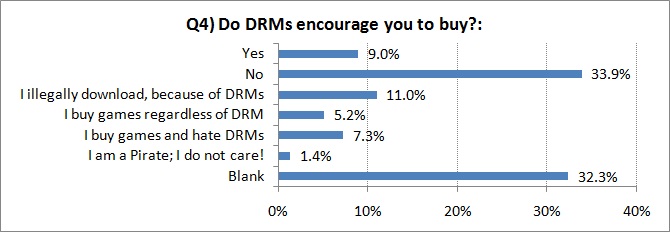
A sample result from the Vigilant Defender questionnaire, which shows that DRM not only does not really help encourage pirates to buy games, it may even drive them to pirate in the first place

Except, I probably wouldn’t try what startup anti-piracy firm, Vigilant Defender, has tried – to actually help the spread of pirated content. Yes, you heard right, the first step in Vigilant Defender’s experiment is to actually help seed a leaked beta version of the hit game, Deus Ex Human Revolution. The second step is slightly tricky, as the version of the beta they seeded was slightly modified to drop out of the game after the first few levels, and direct users to an online questionnaire, in which they were asked questions about why they decided to pirate the game. While data collection is essential to solving the piracy problem, especially given the industry’s often biased “research” on the matter, the key question asked of gamers was “what would you be willing to pay for this game”. Not only will the answer to this particular question prove useful in finding out just why people pirate, and what price point can influence the same people to go legit, Vigilant took this one step further and proceeded to offer downloaders the opportunity to buy the full game at a price determined by average answer to this particular question. And amazingly, 8% of all those who downloaded the modified leaked beta actually went on to buy the game, at the user voted average price of $24.99 (half of the retail price) and that’s actually quite a high rate of return for games, especially when the target demographic is often described by the industry as “criminals” and “freeloaders”.

In my opinion, what Vigilant Defender tried to do was very clever, even if they went about it perhaps in too much of a roundabout way. What they’re actually advocating is a system where users vote for the price they want to play, and where pirated versions of games actually become demos of sorts. The gaming industry may not want to believe it, but a lot of gamers do use pirated games as an extended demo, and many, I’m not saying all (or even anything close to a majority), to end up buying the full version if they like the game. Game publishers, on the other than, would rather prefer people buy games they don’t like by making sure they can’t test it fully before they buy it, and perhaps that’s how it used to work before Internet piracy became ubiquitous, this kind of business model no longer works. But on the other hand, by offering downloaders cheaper version of games, it’s perhaps encouraging downloads, and this kind of distribution model would be a hard sell for game publishers. But there’s definitely something here, and perhaps a little bit of tweaking could bring us a new distribution model that takes advantage of P2P networks such as BitTorrent to not only distribute the games, but to promote them. Imagine if games came with a thin layer of unobtrusive DRM that simply nagged users to buy the game from time to time, a DRM so not annoying that release groups don’t even bother to have it (so it remains in the pirated versions floating around the net). Users would then be given an offer to “upgrade” their pirated version to the full legit version for a discounted price, but the caveat is that their save games/profiles would no longer be compatible with the full version unless they pay the full price, or some kind of incentive that still makes buying games at full price an attractive proposition. And if you want pirates to help you sell games, then let them join some kind of commission based affiliate program, where for each downloader that “upgrades”, the seeder would get a small commission for their “help”.

The even easier alternative is to lower game prices and improve services for legitimate customers, so that piracy becomes more trouble than its worth.

For Vigilant Defender though, they have a slight problem on their hands at the moment since this Deux Ex experiment was not actually approved by the publishers of the game, Square Enix, which could land the anti-piracy company in a bit of bother with anti-piracy laws.

Bad news for Australians lately on the copyright front. Only a couple of weeks ago, we got our first taste of mass copyright lawsuits, and this week, our government signalled changes to our existing copyright law which would make it even easier for mass copyright lawsuits to happen. Namely, the Attorney-General wants to make it easier for rights holders (or agents of them) to match IP addresses to real identifies, by “streamlining” the legal process. In other words, due process has to go out the window to make Hollywood and the RIAA happy. Even the idea of a ‘graduated response’ system was mentioned, at a conference sponsored by the copyright lobby, of course. Still, there were some other proposed changes that were positive, such as extending “safe harbour” to protect more types of Internet businesses, rather than just ISPs – search engines like Google and Bing will benefit the most with this proposed change. But as long as politicians still continue to believe that a single IP address is evidence enough of a “crime”, and that the “crime” itself is costing the creative industries insane amounts of money and jobs, then politicians will always be on the side of the copyright lobby, made more likely by the uneven spreading around of lobbying cash from both sides of the issue.

High Definition

In HD/3D news, this week could prove an important one for advocates of managed copy, who want legal alternatives to “ripping”. UltraViolet has been talked about quite a lot, and this week, we finally get our first taste of this “in the cloud” based managed copy system. Unfortunately, the taste is not quite palatable.

Green Lantern UltraViolet via Flixster

UltraViolet from Warner Bros. is being distributed via Flixster, and it isn't a very convenient user experience

Warner Bros. released Horrible Bosses and Green Lantern with UltraViolet digital copy included, but the way Warner has decided to deploy UltraViolet is the biggest problem at the moment. The current WB process requires users to enter in a 12-digit redemption code online, which in itself is annoying, and then users will have to sign up to Flixster, and then install the Flixster app on the device they wish to view the UltraViolet copy. And it’s all wrapped up in various layers of DRM, as you would expect.

And as WB owns Flixster, and to add to the problem, when other studios release their version of UltraViolet, they will use their own distribution network. So right now, if you asked me on which devices an UltraViolet digital copy works on, I can’t tell you, because it will depend on each studio, and this is absolutely the wrong way to go about it. For UltraViolet to be viable, I think it really has to either tie in with iTunes, NetFlix, Amazon or one of the existing players in video distribution, or all the studios have to come together and come up with a single distribution method, with all of the major devices supported (the iDevices, Android system, game consoles and Blu-ray players, at least). And then, streamline the process so it’s as simple as scanning a QR code, or just a matter of inserting the UltraViolet Blu-ray or DVD into a UV compatible player – none of this 12 digit code nonsense, or having to figure out each studio’s UltraViolet system and having to have an account for each.

A two parter Sony related story, the first part goes here in the HD section I suppose. Sony has had to issue a massive recall/repair for 1.6 million LCD TVs they produced since 2008, apparently due to a fire risk in a faulty component. It’s not exactly what the company needs at the moment, but the “good” news so far is that there haven’t been any reports of actual injuries, and that the damage so far has been restricted to the TV set itself.

GamingLess costly for Sony, financial wise, but perhaps more costly in terms of image is the news that a further 93,000 Sony online network accounts have been “hacked”, in the latest security breach.

Fortunately for Sony, the breach which led to hackers gaining access to 93,000 accounts on the Sony Entertainment Network (SEN), PlayStation Network (PSN) and Sony Online Entertainment (SOE) networks appears to have originated elsewhere. According to Sony, hackers managed to source the email/password combinations for an unspecified (non Sony) online service, and proceeded to use the same login combination to try their luck on the PSN, and managed to get access to the 93,000 accounts. Sony have disabled 33,000 SOE accounts, while have forced password changes for the rest. Sony says that credit card info was not accessed during this attack, but personal information may have been.

While Sony is right that the data breach occurred elsewhere, the security issue here still lies with Sony, because allowing hackers to launch this type of massive attack can easily be prevented. Simply limiting failed login attempts from any individual IP address or range, which is standard practice, could have prevented the 93,000 accounts from being accessed. And some kind of “CAPTCHA” system, or human verification, would have prevented the hacker’s bot based login attempts. Both of these are common techniques used to prevent dictionary based attacks. And once again, it took Sony days to spot the unusual activity on their networks, when it really should be a matter of hours if not minutes.

NPD Game Console Total US Sales Figures (as of September 2011)

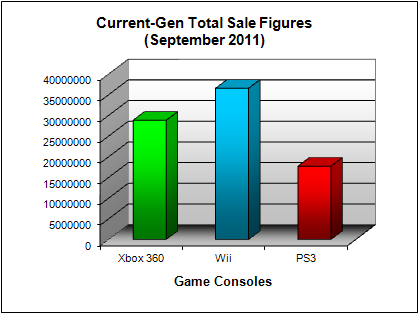
Life to date Xbox 360 sales in the US (in green) is catching up to Wii sales (in blue), but the PS3 (red) languishes in third place

But while Sony’s security problems have been highlighted recently, it doesn’t seem to have seriously affected the fortunes of the PS3, as price, as always, seems to be the main driving factor behind sales. So Sony’s $50 price cut to the PS3 in the middle of August has seen PS3 sales rise, although as the September 2011 NPD US video games sales analysis shows, the rise was not big enough to really endanger the Xbox 360’s position as the best selling console in the US. The gap has closed, however, between the PS3 and the Xbox 360, while the gap between the Wii and every other console seems to be widening. If the gap remains as big as it was during September, the Xbox 360 is set to overtake the Wii as the best selling home based console of this generation (in the US) within 39 month – but it will be well after the Wii U is introduced, so that’s what Nintendo are holding on to at the moment.

Alright, that’s enough for this week I think. Hopefully more of a newsworthy week this next one, and I have a feeling it will. Have a good one.

Game Consoles – September 2011 NPD Sales Figure Analysis

Saturday, October 15th, 2011

Welcome to the September 2011 edition of our regular NPD US video game sales analysis, by my calculation, the 53rd edition of this feature. In this feature, we look at video game sales, both hardware and software, for the month of September 2011 based on data collected by the NPD. The PS3 price cut took place half way through August, but in the September data, we now having a full month worth of PS3 sales at the now $50 lower price point, so we can finally see if it was able to beat the Xbox 360, which it might have done in August if the price cut had taken place a bit earlier. But the Xbox 360 has an ace up its sleeve this month, as we see a new version of one of its major exclusive franchises, Gears of War. Read on to find out who wins September.

As NPD no longer releases full hardware sales figures, this feature is reliant on the game companies, namely Microsoft, Nintendo and Sony, to release their set of figures and based on “statement math” (that is, arithmetically calculate missing figures based on statements made). For September 2011, these are the statements made by the gaming companies:

  • Nintendo reveals the Wii sold 240,000 units, with 260,000 3DS consoles, and 145,000 DS (via PR email)
  • Microsoft revealed 438,000 Xbox 360 hardware units sold, with 42% of the home based console market share (source)
  • Sony did not reveal exact figures, but said that the PS3 hardware sale increase 20% year-on-year (Sony statement, via Senior Director of Corporate Communications at SCEA, Patrick Seybold)

Unfortunately for this month, Microsoft and Sony’s statements do conflict with each other a bit. Using Microsoft’s statement, PS3 sales can be deduced to be 364,857 units, but according to Sony’s own statement, the figure is more like 374,400 (20% more than September 2010’s 312,000). Obviously, there are rounding errors from all the company’s statements, so giving Sony the benefit of the doubt, we’ll presume the PS3 sales figure for September 2011 is the higher 374,400.

And so the figures for US sales in September 2011 are below, ranked in order of number of sales (September 2010 figures also shown, including percentage change):

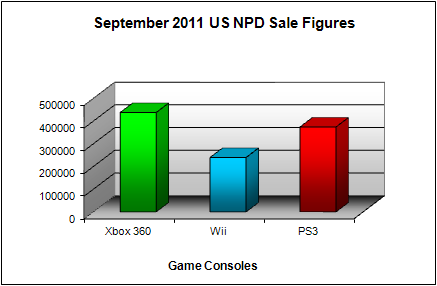
  • Xbox 360: 438,000 (Total: 28.8 million; September 2010: 483,989 – down 9.5%)
  • PS3: 374,400 (Total: 17.7 million; September 2010: 312,000 – up 20%)
  • Wii: 240,000 (Total: 36.6 million; September 2010: 254,000 – down 5.5%)
NPD September 2011 Game Console US Sales Figures

NPD September 2011 Game Console US Sales Figures

NPD Game Console Total US Sales Figures (as of September 2011)

NPD Game Console Total US Sales Figures (as of September 2011)

My prediction from last month was:

I think the Xbox 360 will still come out as the top selling console for September 2011, mainly due to ‘Gear of War 3′, but the PS3 will definitely come closer than it did this month, and with ‘Resistance 3′, it too might benefit from a platform exclusive. The Wii will be third. Games wise, ‘Gear of War 3′ looks set to be a top seller, despite being a platform exclusive release. ‘Resistance 3′, on the other hand, doesn’t look to have the same effect, although it will still sell well. Combined platforms sales may even push ‘Dead Island’ to the top of the charts.

I got the hardware ordering spot on, although it really wasn’t that hard to predict what was going to happen. The PS3 did get closer to the Xbox 360 sales, but it’s clear now that the 360 is now the dominant console in the US, and not even a PS3 price cut can affect its status it seems (unless that price cut was a more substantial $100, for example). For the game predictions, Madden was actually the top selling title, followed by Gears of War 3. And ‘Dead Island’ did manage to put its way high up in the charts, in 3rd place. Resistance 3, on the other hand, only finished 7th, not the worst result, but the average critical response to the game may have had some effect.

So the Xbox 360 continues its winning streak, by not only becoming the dominant home based console, but it’s also the best selling console for September, period. Looking at the life to date sales numbers, the Xbox 360 continues to pull ahead of the PS3, and continues to get closer to the Wii, to the point where the difference between the Wii and 360 numbers is actually less now than the difference between the 360 and PS3 numbers. Because of the Xbox 360’s dominance with multi-platform releases in North America, namely that if the same game is on multiple platforms, the Xbox 360 version is usually the most popular, the hit releases planned for the next few month starting with Batman: Arkham City and Battlefield 3 next month, and MW3 and Elder Scrolls V: Skyrim in November, will all benefit the Xbox 360 more. The it appears that the 360’s exclusives, such as Halo and Gears of War, appear to be far more popular than the PS3’s line up, including ‘Resistance’ this month.

But you cannot say the PS3 performed badly for September – after all, it was the only console to see year-on-year growth, but just like how the other consoles found it difficult to compete with the PS2 in the last generation, the PS3 is having a hard time trying to catch up to the Xbox 360 (and Wii, for the early parts anyway) in this generation (although the gap between the consoles is much less pronounced than the last generation). Taking off my fanboy hat for a moment, the truth is that both the PS3 and Xbox 360 are excellent game consoles with excellent game line ups and fantastic multimedia capabilities. Each console has their own pros and cons, and thanks to the Xbox 360’s head-start, the Wii’s (then) innovative control system, and the PS3’s Blu-ray drive, we now have a much more balanced set of competitors, and that can only be good for gamers, who should consider themselves lucky to be able to enjoy so many great games in the last few years.

The Wii, right now, is the only loser, but it’s not something Nintendo are unaware of, and the Wii-U will set to address many of the shortcomings of the Wii console, but also maintain Nintendo’s reputation for producing fun, family based games.

For game sales, Madden’s delay from August to September allowed it to rule the roost for the month, but Gears of War 3 would be considered the best selling Xbox 360 game for the month, the Madden ranking includes all platform sales. Dead Island was the only original franchise in the top 10, and it did well to come in 3rd, but it also shows that, unlike movies, gaming sequels are actually welcomed by gamers, and usually are huge improvements on the original, not just an opportunity to cash-in (take note Hollywood). FIFA’s high ranking highlights the growing popularity of “soccer” games, beating NHL 11, something it didn’t do last year this time. And a 10th place for Warhammer 40,000: Space Marine is a good result for the franchise. Electronic Arts are the real winners, with 3 of the top 10 titles belonging to them, and the all important first place too. Here’s the full software sales chart for September:

  1. Madden NFL 12 (EA, Xbox 360, PS3, Wii, PS2, PSP)
  2. Gears of War 3 (Microsoft, Xbox 360)
  3. Dead Island (Deep Silver, Xbox 360, PS3, PC)
  4. FIFA 12 (EA, Xbox 360, PS3, Wii, PS2, PSP, 3DS)
  5. NHL 12 (EA, Xbox 360, PS3)
  6. Deus Ex: Human Revolution (Square Enix, Xbox 360, PS3, PC)
  7. Resistance 3 (Sony, PS3)
  8. Lego Star Wars III: The Clone Wars (LucasArts, Wii, NDS, Xbox 360, 3DS, PS3, PSP, PC)
  9. Call of Duty: Black Ops (Activision Blizzard, Xbox 360, PS3, Wii, NDS,PC)
  10. Warhammer 40,000: Space Marine (THQ, Xbox 360, PS3, PC)

Time to make my usual prediction. I think the hardware situation will remain largely the same. Games wise, Batman: Arkham City and Battlefield 3 go head to head, with Forza 4 on the Xbox 360 possible making the top 10 as well as a platform exclusive.

See you next month.

Weekly News Roundup (18 September 2011)

Sunday, September 18th, 2011

The NPD analysis for August 2011 was written up by me during the week, and you can read it here. My (possibly flawed) maths predicts that the PS3, thanks to the $50 price cut, would have nearly matched or even exceeded the Xbox 360 unit sales figure, had the $50 price cut arrived earlier in August (and if the sales increase effect has been consistent throughout August). At $250, the PS3 is great value, considering it’s a competent Internet enabled media hub and Blu-ray player. The only problem is that Internet enabled media hubs and Blu-ray players (sometimes the same device) are not too expensive these days, and a lot of TVs have them built-in. So really, game consoles should be judged on their merits as game consoles, and I have to say both the Xbox 360 and PS3 are equal in these regards. So there’s really no real urgency to have a Blu-ray add-on drive for the Xbox 360, even though I had a dream last night they were already available to buy in the shops.

Copyright

Let’s not waste any time and start with the copyright news. I spent Tuesday writing a news article, which could really have been a blog entry by itself, debunking the series of pro-copyright stories I was seeing in our local News Corp controlled media, all based on a press release from the Intellectual Property Awareness Foundation (IPAF), a foundation I’ve never heard of before.

Turns out, the IPAF’s board has includes from a News Corp controlled company, Foxtel, which just happens to have a virtual monopoly on the subscription TV market (the MPAA is also on the IPAF board). Said monopoly would be seriously hurt if the market was opened up via the Australian government’s proposed high speed fibre network (NBN), which via multi-casting, would force Foxtel to actually compete. Which is why The Australian, a News Corp newspaper, has been running anti-NBN stories almost every day for the past year or so. The piracy issues comes via a recent story which tried to link the NBN to increases in piracy (fast Internet = torrentz, lol), which may be the case. But piracy is also competing with subscription TV, which despite the high fees (USD$50 per month for the most basic subscription), still carries tons of ads and worse, new release movies and TV shows aren’t even part of the standard package (you’d have to pay up to USD$120 a month to access new movies and TV shows, and then, only selected shows – HBO shows like True Blood are delayed by weeks if not month, despite subscribers having to pay for the privilege – as I said, monopoly).

Three Strikes

The MPAA backed IPAF may be using misleading stats to suggest ISP intervention would solve the piracy problem, while another interpretation of the same data shows the reverse

And so when the IPAF claims that via a survey of some 1,600 Australians,  72% would stop net piracy if their ISPs started to send warnings against infringing activity, the so called “strikes” of a “three-strike” system. This seem to suggest that “three-strikes”, or graduated response, would be quite a success in Australia. The problem is that similar surveys in the UK and France, one is considering three-strikes, while the other has already adopted it, show that the actual percentage of affected users is in the range of 4% to 6%, nothing like the 72% the IPAF is claiming. And so when you look closely at the data, it seems the IPAF’s conclusion is extremely flawed, if not the polar opposite to what is actually being claimed. This is because while 28% did say they would not stop pirating stuff on the Internet if their ISPs started warning them, only 22% of the same group of people actually say they had ever used file sharing tools for piracy. While the 22% is not the entire number for all types of Internet piracy, as it does not include direct downloads, streaming, but file sharing tools like BitTorrent clients are the only tools that ISPs can monitor, and so it is the relevant number to look at. But it seems, from the survey data, that the 22% of people who used file sharing to pirate things before ISP intervention, would actually increase to 28% after ISP intervention (the 28% that are firmly saying they won’t stop pirating after ISP intervention).

Of course, this would be the wrong conclusion to draw from the data, just as it would be wrong for the IPAF to claim that 72% would stop pirating due to ISP intervention, because 78% aren’t even using piracy methods that could be tracked by ISPs, or have ever pirated anything at all. This is because 28% that say ISP intervention won’t stop their pirating behaviours may not be the same 22% that were pirating before – the survey can be interpreted in many different ways without knowing the overlap between the data points. The only piece of survey data that would actually have been useful – that is out of the 22% using file sharing tools for piracy, how many would actually stops after ISP intervention – is missing. Is it missing because this was a flawed survey, or is it missing deliberately because the data points didn’t match the conclusion that the IPAF had wanted when they commissioned the study, nobody really knows.

But the only conclusion you can really draw is that ISP intervention would not be the cure-all that the industry thinks, or at least want others, to believe it is. So that’s two debunks in two week, after last week’s MPAA info-graphic claiming pirates would spend an extra $1,000 if they were forced to stop pirating. An important point I missed in regards to last week’s debunk is that, when the MPAA claims $xxx billions lost to the US economy due to piracy, is it really lost? Or are people just spending it on other things, things they cannot pirate as easily as say a movie or a MP3 or a software package? And if they indeed spent that “extra” $1,000 on things like groceries, and other living expenses, or even other entertainment products such as eating out at a restaurant or new furniture, then nothing, absolutely nothing, is lost to the US economy. And even in the extreme case where they put the extra $1,000 in the bank, then that money eventually gets put back into the economy anyway via the bank’s investments. And so the “$58b loss to the US economy due to copyright theft” only makes sense if the American people are somehow hiding the $58b they’ve saved via piracy under their mattresses, with no present or future intention to actually spend the money. And for all the problems with the US economy at present, the average citizen having too much employment, earning too much money and not spending it, in my opinion, is not a problem.

And so I feel that the financial implications of the Internet piracy problem has been exaggerated. While there is definitely a financial impact from piracy, make no mistake about it, there’s also an impact on the economy, probably a greater one, from an industry that refuses to adopt to the new way of doing business on the Internet. And unfortunately, some of the new ways of doing business, the ways that consumers have chosen, are not as profitable as before (at least not as profitable to the same companies as before). Take music, for example. Album sales have been the mainstay of the music industry for years, and accounts for a large majority of their revenue. But now, in the MP3 age, track sales are what it’s all about, and naturally, the music industry will have to accept lower profits. And a large part of the new revenue streams are going to different companies too, Apple for one gets money for both hardware and downloads. And instead of accepting the new reality, and trying harder to get people to spend more money buying more tracks (a difficult task, because think of all the albums you’ve purchased, and how many tracks from these albums that you never actually wanted to pay for), they’ve laid the blame on piracy, and spent huge amounts of money trying to solve the piracy problem, through technically insane ideas such as DRM, and through political lobbying. The movie industry are in better shape because selling, renting movies, whether done via tape, disc or downloads, is basically still the same thing. Revenue may take a hit because people do expect cheaper and cheaper offerings (and because movies and TV shows are more expensive to make these days, and not necessarily better for it), but there’s also the potential there to extra more money from people by making them consume more, as the consumption process is much easier than before (you don’t even have to get up from your couch to buy/rent a movie, if you have the right set up). But, unfortunately, the movie industry is also blaming piracy for all their problems (despite earning record profits year after year).

And so they’ve paying vast sums of money to agencies such as the Dutch BREIN to fight piracy cases in court, and to lobby others to “get in line” when it comes to piracy issues. BREIN’s latest campaign sees them urging payment providers such as PayPal to do more on web piracy, including seizing funds for websites that BREIN says are conducting in copyright infringement. The thing is, if BREIN has a court order, I’m sure payment providers such as PayPal would be more than willing to oblige, but is BREIN really saying that in the absence of a court order, that PayPal should still take action, just because BREIN has a “bad feeling” about the website? This seems to be the case, because BREIN also wants PayPal to help identify the operators of “bad” websites – if they don’t even know who is running the website, and where these people are located, I seriously doubt they can convince a court to issue an order to freeze funds. Basically, it’s the same old tactic of shifting responsibility to more and more companies, as if there’s one thing agencies such as BREIN hates more than piracy, it’s actually having to work hard to stop piracy.

Jeremy Hunt

UK's Culture Secretary Jeremy Hunt says ISPs, search engines, advertisers and payment providers are all responsible for net piracy

But at least BREIN are paid to do and say the things they do and say, but when politicians come out with the same sort of rubbish, then it’s much more worrying (but to be fair, they may also be paid by the industry to do and say the things they’re doing and saying).  This week, the UK’s Culture Secretary Jeremy Hunt, that’s Hunt with an H, delivered a speech at the Royal Television Festival in which he also repeated some of the same statements (threats?), that BREIN has been talking about, saying that payment providers, and advertisers, should do more to stop web piracy. Hunt labelled piracy “a direct assault on the freedoms and rights of creators of content to be rewarded fairly”, and suggested that the only solution would be to launch a direct assault on the freedoms and rights of all citizens, as he wants to “streamline” the legal process in regards to copyright infringement, another way of saying that due process should be curbed to make it easier for people to be prosecuted for copyright theft. Hunt also thinks that search engines and ISPs should filter and block content, but only at the say so of the court, although Hunt did suggest that even websites that merely “promote unlawful distribution of content” could be targeted as well.

Staying in Europe, we have the story that the EU has extended music copyright from 50 years to 70 years, meaning that recordings made in 1961 whose copyright would expire this year, would now get a reprieve until 2031. Which unfortunately means I have to mention Cliff Richard in the WNR for the first, and hopefully, the last time. This is because Sir Richard is actually the man leading the fight to allow musicians to live off their past successes just a bit longer, and probably an appropriate representative to these kinds of artists. To be fair, this isn’t really much of a problem, because it’s not easy to live off something you did 50 years ago, and if the only thing stopping you from continuing to do it for another 20 years  is some arbitrary limit, then maybe the artists do have a point. The problem is with the more obscure works, where there’s no more financial benefit in said work to remain copyright protected, then there’s a real danger of the work being lost forever, simply because there’s also no financial benefit to preserving the masters in good condition by the recording label. The record labels won’t release the songs, won’t spend money to preserve, and artists cannot get the copyright back on their own work. The new EU law changes does allow artists to renegotiate copyright on such works after 50 years, but many works fall into this situation a lot sooner than 50 years.

We also have more development in the Hotfile lawsuit. Typical with these kind of lawsuits, the defendants will usually launch a counter suit in order to try and get the other side to back down on certain demands, and Hotfile have just done this, although it seems they do have a few legitimate gripes with the way Warner Bros. “abused” their anti-piracy tool. It seems that Hotfile did have a working anti-piracy system, in which rights holders can get a ‘Special Rightsholder Account’ that allows them to delete shared files independently of Hotfile. A Warner Bros. rep was given such an account, but instead of deleting the identified infringing content, even files that Warner did not hold rights to, all because the name of the file was similar to a work that did belong to Warner Bros. Also interesting was that WB actually approached Hotfile to set up an affiliate relationship, in which removed files would be linked to a Warner Bros. online store. And Hotfile alleges that, due to this financial incentive on Warner’s behalf, they removed a popular open source file and replaced it with a link to their online store. I don’t think Hotfile will get anywhere, and even if they win, it won’t negate the fact that they’re probably going to be punished severely by the court for their “promotion” of piracy related activities (giving money to people who upload the most popular files, seems not such a great idea considering the common knowledge that the most popular files are probably one of the 2 P’s – porn or pirated. Or both). But it’s interesting to see that Hotfile at least had a working relationship with some rights holders, and the tools for removing infringing content has been in place all this time.

Not much a happening in HD/3D, and I’m already a bit over my word limit, so let’s skip it and move onto …

Gaming

… gaming. And nothing much happening here either, other than what I’ve already covered about the NPD stats. There was one interesting news story, but one that only affects Australian gamers, for now. Microsoft has saw the need to discount the Xbox 360 here in Australia, by only AUD$ 50, compared to the PS3’s AUD$150 discount.

But shops are already selling both consoles way below their recommended retail prices, and if the internal Microsoft data reveals that the PS3 is starting to outsell the Xbox 360, I suspect we’ll see the price cut extended to other regions as well. The only reason why I don’t think Microsoft will cut prices in the US is that they do have enough games lined up to ensure the Xbox 360 probably wins this holiday period, so any discount now would worsen the inventory situation, which always flares up at this time anyway. The only thing worse than not being able to sell enough consoles due to low demand, is to not be able to sell any consoles because you don’t have enough stock due to high demand.

My brain, my eyes, my fingers all hurt, so it must be time to stop writing for this week. See you in seven.