Archive for the ‘Xbox 360, Xbox One’ Category

Weekly News Roundup (17 February 2013)

Sunday, February 17th, 2013

A belated Happy Chinese New Year of the Snake. I was born in the year of the Monkey, and they say only the Monkey can handle Snakes, so all your Snakes better behave yourselves. Those born in the Year of the Snake should also wear something red on them at all times to deflect bad luck, preferably something given to them rather than something they’ve bought themselves.

In this first WNR for the Year of the Snake (technically not true), there are quite a few news items to go through, so let’s get started.

Copyright

Joining the list of people who really shouldn’t be downloading pirated videos may be FBI employees, caught downloading hit TV shows such as Homeland and Dexter. They join employees from Hollywood studios, the DoJ, congressional offices, national parliaments, anti-piracy lobbyists and many other places where they’re pretty sensitive about this whole Internet piracy things.

And even if they weren’t downloading at work, something most people would probably not do, many are probably downloading in the privacy of their own homes.

While this highlights how widespread the “problem” of piracy is, to me, this isn’t actually reason to take harsher action against it. I liken this Piracy Plague® to jaywalking, something that almost everyone does (while knowing they probably shouldn’t), and that they do get in trouble if they’re caught doing it, but in the grand scheme of things, it’s not exactly a high priority for law enforcement (even though jaywalking, unlike pirated downloads, can lead to a life and death situations, so it’s actually more serious than piracy will ever be). I guess the difference is that there is no such thing as an anti-jaywalking lobby group (Car Manufacturers of America? ), so nobody cares.

The other major difference being that there is no monetary loss involved, although that’s debatable with piracy as well.

But there also exist a difference in solving these two problems. If it is identified that people are jaywalking in particular area, and it’s leading to a public safety issue, I would hope there’s an effort to find out why people are jaywalking excessively in this area, but not in others. Perhaps the lack of pedestrian crossings could be the issue. But for piracy, there’s strong pressure against finding out why it happens, with the focus is instead on labeling people who download as criminals, and leveling penalties against them. So instead of adding a pedestrian crossing to fix the problem, the focus would instead be on an ad campaign linking jaywalking to terrorism or something like that, and then setting up a hidden police presence around the corner and fining those that get caught, all the while ignoring the real cause of the “infringement”.

SoShare Logo

SoShare promises to combine the best of cyberlocker storage with BitTorrent technology. It might run into some legal headwind, mind you …

But soon there may be a new and better way for these FBI agents to get their Homeland fix. BitTorrent Inc has launched a new cyberlocker storage service that promises unlimited uploads, and unlimited transfer limits, and uses BitTorrent technology to speed up downloads. The new service, SoShare, has just been made live as a public beta test, and only requires a browser plug-in in order to utilize the BitTorrent based enhancements.

SoShare works by allowing the the uploader and downloaders to use their own bandwidth to help other downloaders speed up their downloads, much like how BitTorrent works. A master copy of the file is also store on SoShare’s servers to allow downloading to continue even if the original uploader is not online.

So with BitTorrent coming to the under pressure cyberlocker scene, the most immediate question that comes to mind, at least for me, is the copyright question. A quick look at SoShare’s copyright policy shows all the typical DMCA related information, but as SoShare does store a copy of the uploaded file, therein lies the danger from a copyright point of view. SoShare will have to be extra responsive to DMCA takedown requests to protect themselves. So far, the service is offered for free, with no monetization and no financial incentives for uploaders, which should also offer some additional protection if the service is ever accused of “incentivizing” illegal uploads.

But for downloaders, SoShare downloading may be a better bet privacy wise than BitTorrent downloads. While not much is known about how exactly the service works, one would hope it does not easily make public the details of all connections to the download swarm like BitTorrent naturally does.

——

In other news, The Pirate Bay is threatening to sue an anti-piracy group for copyright infringement. And no, I did not mix up the subjects in the preceding sentence.

Fake Pirate Bay

This “fake” Pirate Bay, set up by an anti-piracy agency, may be infringing on the copyright of the real Pirate Bay

This all started when Finnish anti-piracy group CIAPC launched a spoof website that imitates the look and feel of The Pirate Bay, in a perhaps misguided attempt to educate the masses about the legal alternatives to piracy. The problem though is that the website wasn’t so much an imitation, but a downright like for like copy in many instances, included the CSS file, which was virtually identical to the one used by the real Pirate Bay. So much for educating others to respect copyright!

This blatant theft, which is against The Pirate Bay’s usage policies, has prompted The Pirate Bay to consider taking legal action against CIAPC, if the group does not “move on”, not just from the spoof website campaign, but from copyright enforcement in general. With The Pirate Bay generally supporting a copy-free ideal, their threat definitely did have the feel of a “not sure if serious” vibe to it. Look here, I for one would love to report on ironic lawsuits, just as long as TPB people do indeed make clear that irony is a clear intent (unlike a certain Mr. David).

Regardless, the CIAPC does deserves everything bad that happens to them, as these are the same people, if you can remember, that raided the home of a 9 year-old and snatched away her Winnie the Pooh laptop for the heinous act of downloading a song.

And in ominous news of the week, the W3C has asked the HTML Working Group to consider adding native DRM support to HTML, to placate the likes of Netflix, BBC, Google and Microsoft. These majors are hoping for a native HTML 5 solution to web video streaming, but that can only happen if DRM is present. To be fair, the requirement for DRM does not come directly from these companies, but from the overly paranoid content producers that supply these companies with content. No DRM, no content.

Gaming

The January NPD US video game sales report has been released, and it’s grim reading for Nintendo’s new flagship console, the Wii U. As per the course, Microsoft’s Xbox 360 remained the best selling console for the month, with 281,000 units sold. This is actually up on January 2012, but only because of the 5-week and 4-week reporting difference between the two Januarys.

With Sony not providing any hardware sale details, but based on the Xbox 360’s “44 percent share of current-generation console sales” figure, that would most likely put the PS3 at around 200,000 units sold, and the Wii at slightly more than half of this.

Which makes the Wii U’s 57,000 (a figure that comes from sources that have access to more detailed NPD reports) rather pathetic. As a comparison, the original Wii sold 435,000 units at the same time in its release cycle, and that was with stock shortage constraints in place. The Wii U, being widely available in stores, is already looking like a flop given the dramatic fall-off from the early sales figures. Still, it’s probably too soon to tell if the Wii U is dead in the water, but unless Nintendo have some killer must-have games and apps out in the next few month, it’s not looking good at all.

Xbox 360 Kinect vs PlayStation Move

Kinect beat Move because of Sony’s “stumbling failure”, more so than anything Microsoft did, according to engineer who designed the original Xbox

With such dismal numbers for the Wii U, and the Xbox 360 selling 5 times as many units, it almost feels churlish to talk about this next story. With 76 million units sold, and one in three of them having a Kinect camera connected (albeit perhaps not used … based on personal experience), and with 46 million members connected online, can the Xbox 360 and the Xbox platform really be considered a failure? Apparently it can be, according to one of the engineers that started this whole Xbox project, Nat Brown.

Brown describes the last couple of year’s development of the Xbox platform as “painful to watch”, mainly because the console will lose the “living room war” to the likes of Apple and Google, unless “somebody with a brain” starts running things.

Nat notes the biggest problem with the Xbox platform is one, indie development, and two, a good user experience. It’s worth noting that both of these areas are where the likes of iOS and Android shine, and Nat says that what Microsoft is doing simply isn’t good enough.

And Nat has a great point. Android development can be started with almost zero cost, and apps can be published for not much more. iOS development is a bit more expensive due to Apple’s more stringent requirements regarding coding environments (ie. Mac only), but it’s still well within reach for most semi-professional coders and cashed up enthusiasts. But more importantly, apps published on both platforms are given plenty of opportunities to be found and are actively promoted. On the other hand, Nat says Microsoft offers indie developers very little help in terms of accessibility, support and promotion, which has alienated “a generation of loyal kids and teens to making games” (not just kids and teens, but also 30-something guys with too much free time on their hands).

Nat’s other big gripe with Xbox is the user experience, the inconsistent nature of it all, and how counter-intuitive it can be given today’s more casual user base. Anyone who has tried to access the initially heavily promoted Kinect Fun Labs on the new Xbox 360 dashboard will certainly agree with this point – the fact that someone had to write a guide on how to access it shows how the UI has failed.

But to be fair to the Xbox 360, none of the other consoles are doing much better, a point Nat concedes as he also says that Microsoft’s recent successes have been due to the “stumbling failure” of Sony and Nintendo (Kinect vs PS Move, and the Wii in general). Might as well add the Wii U to that list of “stumbling failures” too, I suppose.

And with that, we come to the end of this week’s WNR. Hope you’ve enjoyed reading it more than I enjoyed writing it (well, given that I didn’t enjoy writing it, it’s kind of a low bar). See you next week.


Weekly News Roundup (3 February 2013)

Sunday, February 3rd, 2013

A rather more normal week this week, although still very quiet. Not a bad thing really, coming when I’ve started obsessively watching the entire 8 seasons of ’24’ back to back on Amazon Prime. I have to say that I much prefer this method of watching than compared to buying the DVD or Blu-ray – the act of putting in a disc and waiting it to load has become a turn off for me, and I suspect it’s one of those things we’ll look back fondly one day but at the same time, wonder why we put up with it for so long.

Anyway, let’s get started.

Copyright

Barely a week has gone by since Mega’s launch, and the takedown requests have already flooded in. More than 150 have been processed so far covering at least 250 files, and all have been dealt with quickly, and if Mega’s operators have learned their lessons, they will continue to get through them as quickly as possible.

Mega Search Engines

Just some of the pirated downloads available on Mega, searchable a third party search engine

Maintaining the protection offered by “safe harbor” is a very important cog in Mega’s plans to stay out of legal trouble (the other being the new encryption feature to help maintain the haze of “I have no idea what’s going on, honestly”), so I do expect them to do everything in their power to get this part up to scratch, and maybe even some extra voluntary stuff to prove that they’re serious. Of course, this won’t actually stop those seeking to use Mega for their piracy upload and download needs, just like YouTube cannot really stop every piece of pirated video from being uploaded and viewed.

What’s slightly trickier will be the introduction (or re-introduction) of third-party search engines for Mega, with one already claiming to host links to thousands of pirated downloads. Sure, these aren’t under the control of Mega themselves, but they do help to focus a spotlight on the darker nature of the website. But if I was in charge of copyright enforcement, sites like these can actually be of use, allowing you to quickly spot the popular downloads and then nip them in the bud before they get too popular (I would also do everything in my power to ensure there’s only one dominant search engine, so as to make this process a bit easier). As part of Mega’s “extra voluntary stuff”, they may also want to visit sites like these and voluntary remove content before waiting for the inevitable takedown notice, just to show that they are indeed serious (I believe this was RapidShare’s strategy, before they went all crazy and went with an approach that’s best described as self-harm).

High Definition

When it comes to buying movies and TV shows, people are still mostly opting for disc over digital, a new NPD study has found. While digital distribution now accounts for 12% of the revenue pie (which does not include streaming VOD revenue), Blu-ray and DVD combined easily accounted for another 61% in 2012.

The dominance of discs was actually down compared to 2011 (form 64% to 61%), but that was largely due to the 7% decline in the average price of a Blu-ray title.

Internet based transactional VOD was dominated by iTunes, but Amazon, VUDU and Xbox 360 Video’s combined market share, for the first time, overtook Apple’s juggernaut.

For disc rentals, Redbox’s narrow lead in 2011 has grown considerably in 2012, now 14 percentage points ahead of by-mail subscription based rentals with 46% market share. Brick-and-mortar store rentals continue to hold on, with 22% market share.

What I found the most interesting in the report though was the watching habits of SVOD and electronic sell-through viewers. 80% and 90%, respectively, of all content watched for these two types of transactions were for TV episodic content. My years-late ’24’ binge viewing doesn’t sound too crazy now at all.

Gaming

Nintendo has had to re-adjust its expectations for Wii U sales downwards after the console failed to meet the projected sales figures for the period until the end of March.

Analysts have blamed the relative high price of the console, compared to the company’s original Wii offering, as well as current “previous generation” offerings such as the Xbox 360 and the PS3 (both of whom have a greater library of games). But Nintendo is adamant that the solution does not lie in a price cut so soon after the debut of the console, but with delivering better games and also waiting for the public to be more educated about the potential of the console.

Wii U Boxes

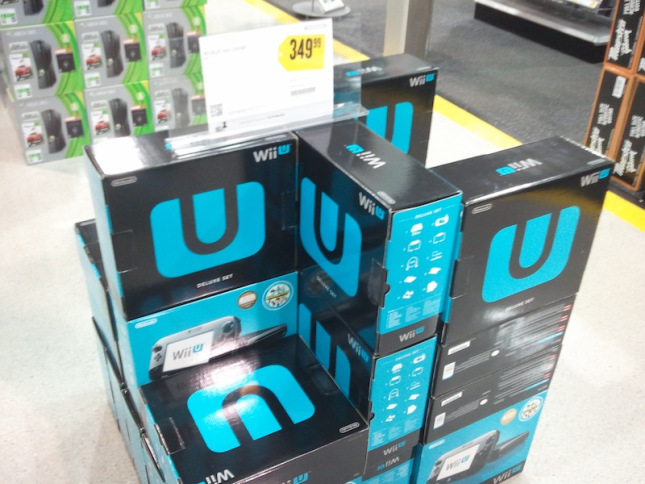
Wii U, unlike the Wii when it was first available, doesn’t seem to be suffering from any stock issues

Mario and Zelda games will help, of course, but the Wii U is competing against smartphone and tablet based casual gaming, as well as the traditional gaming sector dominated by the Xbox 360 and the PS3, so it will be a difficult mountain to climb for Nintendo. Is the Wii U *that* much better for games like Call of Duty and GTA than the Xbox 360/PS3, and we already know it’s not as ubiquitous as smart devices nor can it compete in terms of game prices. So there’s very little that makes the Wii U a must-have console, in my opinion. Once the PS4 and Xbox 720, both looks headed for official reveals this year, arrive with better graphics and who know what else, the Wii U may then already start to look outdated, despite its young age.

A first world problem it may be, but having too many devices that have overlapping functionalities  all vying for the very limited number of connections your TV may have, can be problematic. So choosing a game console is more about choosing an ecosystem these days, one that you can live within and do all you want to do – for example, offline gaming, online gaming, disc playback, video streaming – without having to resort to other devices. Just not sure the Wii U is dominant in any of these areas, to be honest.

Well, we’ve reached the end of this rather short WNR. But as I always say, it’s quality, not quantity. And if you can’t do either, then just finish it as quickly as you can so you can go and watch ’24’.

Weekly News Roundup (13 January 2013)

Sunday, January 13th, 2013

It’s back to work for most people, which sucks, but at least there does seem to be news again. Yeah, that’s just what you need after your first week back at work, a long and ranty WNR to read!

I’ll try to keep this as painless as possible, so let’s not waste more time.

Copyright

A new study has proved what most of us suspected anyway, that DMCA take-downs, and even closing down the likes of Megapload won’t really do much in terms of reducing the availability of pirated downloads from cyberlocker sites.

The problem, according to the study, is that the moment you remove one upload, many others pop up in its place. And even removing entire file hosting websites, either through censorship, domain seizures or a well coordinated international law enforcement action like with the Megaupload shutdown, won’t work because new sites will just pop up the next day. In fact, the closure of Megaupload may have had a detrimental effect on efforts to curb cyberlocker piracy, because it has fragmented the upload scene to the point where uploaders are uploading to multiple cyberlocker sites to avoid any one being taken down. It’s like blowing up a big asteroid headed for earth, only for it to fragment into thousands of smaller and still dangerous pieces still coming at you.

In other words, the cat-and-mouse game between pirates and those seeking to reduce pirated uploads is being truly, fundamentally and comprehensively won by the mice. Not surprising when the ratio is probably something like 17,374 mice to every cat, mind you.

Rapidshare logo

RapidShare is forcing its users to go legit with transfer caps, which has only managed to force some of its users to transfer to competing services

So what’s the solution? RapidShare’s solution to keep pirated content off its network is to implement a transfer cap system that went into effect in late November. Since then, RapidShare’s pageview traffic appears to have dropped by more than a third, although it has no doubt led to probably an even greater reduction in the amount of pirated content on the network. But all this means is that piracy was shifted to other sites.

For those file hosting providers that are not self-policing, the study suggests that perhaps going after payment providers that some of the more blatantly pro-piracy cyberlockers may be more effective, but the best way the study concludes, as it always has been, is to innovate. Instead of trying to reduce piracy, reduce the demand for piracy by introducing good value, innovative services that people actually want to use. An obvious solution that the content industry seems totally oblivious to.

Innovation can be expensive and prone to disaster though. But part of the reason why the content industries don’t seem to innovate as much as, say, the IT industry, in my opinion, is that the content industries (especially the music and movie mobs) seem to enjoy special protection through copyright legislation. This means they have very little incentive to do anything new when there’s already legislation there to protect your ageing business model, and plenty of opportunity to pay for new legislation. This is the kind of thing borne out of the initial desire to “protect” capitalism by some misguided notion that this means giving corporations whatever they want, the kind of thing which actually leads away from the free market capitalism model that the politicians creating these kind of laws actually believe in.

This was something raised by Republican Study Committee (RSC) staffer Derek Khanna in his copyright memo, now simply referred to as that “sensible” one. You know the one that was canned almost instantly after it was published by the RSC, and possibly the catalyst behind the  firing of Derek. This week, Derek, now out of a job, was able to speak  for the first time about the entire ordeal.

Derek Khanna

Derek Khanna, the RSC staffer fired after writing a sensible memo on copyright, speaks out on his ordeal

The RSC canned the memo because it claimed that insufficient review had gone into the memo before it was published, but according to Derek, there was nothing out of the ordinary for the process that went into getting his memo published. If anything, it received more feedback than what is deemed necessary.

What was surprising to Derek, but hopefully not to readers of the WNR, was the backlash the memo received from the content industries. All Derek had wanted was to start a debate, but it seems that’s the last thing movie studios and record labels, long since a protected species under the guardianship of the political structure in Washington, wanted.

As for the firing, Derek was unable to speak candidly about it for obvious reasons, but according to the The Washington Examiner, Tennessee congresswoman Rep. Marsha Blackburn, who has close ties to the record industry due to her district’s geographical location in the suburbs of Nashville, was somewhat instrumental in kicking Derek out of the RSC. So for now, the record industry (and the movie industry) remains a protected species, but one that has had its instincts dulled to the point where it isn’t able to live unassisted in the wild, not with competing species the likes of Apple, Amazon, Netflix and Spotify all flourishing on their own abilities. This is not a sustainable situation, in my opinion.

High Definition

If you had to sum up this year’s CES using using 5 unique letters and a single number, then OLED and 4K is all you need. The 4K hype seems to be gathering pace especially quickly.

Almost all of the major TV manufactures announced both OLED TVs and 4K TVs (or TVs with both), even though in my opinion, OLED is going to be the one that makes the most immediate impact. Boring old 1080p OLED TVs can tap into the vast amount of existing HD content and improve them immediately, but the lack of native 4K content should keep 4K away from the mainstream for a while yet.

Samsung Curve OLED TV

OLED might make the more immediate impact between it and 4K, as exhibitors at this year’s CES show off their OLED TVs, including this curved one

Sony has seen the content problem, and devised their own solutions of sorts – “Mastered in 4K” Blu-ray movies. Soon, Sony will release movies mastered from pristine 4K transfers (which isn’t actually something that hasn’t been done before, by many other studios, eg. Jaws) with extra focus on quality through the use of extra bitrate (those old enough will remember Sony’s similar attempt with Superbit DVDs). These Blu-ray titles, when upscaled and displayed on 4K TVs, is said to present a “near 4K” picture, which is actually kind of cynical when you think about it. That you can fluff around with a, no doubt super looking, 1080p stream and make people believe it’s “near 4K” probably says more about the lack of perceivable difference 4K TV is going to make, especially if one isn’t sitting within touching distance of the screen, or aren’t in possession of a 85″ monster. It’s also questionable whether simply throwing bits at an AVC/VC-1 encoding will actually dramatically improve the picture, diminished returns and all that.

Well at the very least it’s better than Sony’s current solution to the lack of 4K content problem, notably “loaning” 4K TV owners with hard-drives pre-loaded with selected 4K content. Their upcoming online 4K video distribution service does sound a bit more promising though.

The truth of the matter is, due to the limited nature of the human perception system in relation to small details, 4K TVs aren’t going to be the game changer that HDTV was, not unless you go above a certain size (at which point the pixel spacing problem may rear its ugly head). OLED’s superb and vibrant colours and deep deep blacks will give you a much bigger “wow factor”, even with existing 1080p content of which there’s a plentiful supply of. Now combine OLED and 4K, and you may have something that’s really really tempting, as long as you can stomach the astronomical price tag, that is.

Gaming

The December US NPD numbers are out, and once again, the Xbox 360 was on top. This is despite the global situation being reversed, with Sony’s PS3 just having managed  to outsell the Xbox 360 in the worldwide race, despite the Xbox 360 having had a year’s head start. But the situation in the US is actually getting worse for the PS3, with Microsoft happily promoting the fact that its Xbox 360, which sold 1.4 million units in December, sold more than twice as many units as the unnamed next best non-portable console, which had to be the PS3 because the Wii and Wii U sold nowhere near 700,000 units (475,000 and 460,000 units respectively for the Wiis).

The Xbox 360’s 1.4 million units, while impressive, still represented a 17% decline compared to December from a year ago. Still, the decline was smaller than in recent months.

Overall, 2012 was a disappointing year for the gaming industry revenue wise, at least compared to 2011. The age of the current generation of consoles is a major factor, but the lack of new game releases, 29% less than 2011, also contributed to a very lackluster year. On average though, each SKU generated 8% more unit sales and 11% more revenue, so there’s definitely some silver lining in this cloud.

Well, that’s that for the first real news week of 2013. See you next week.

R.I.P Aaron Swartz

Weekly News Roundup (16 December 2012)

Sunday, December 16th, 2012

Welcome to the third last WNR for 2012, or if you’re a believer in the Mayan calendar termination theory, THE LAST WNR EVER! The 22nd of December is going to be a disappointing day for a lot of people no matter what happens, but I’ll be out there celebrating “The World Didn’t End” day, if in fact the world did not end.

Very light news wise this week, but I do have a legitimate and medical excuse this time. For about half of the week, I was suffering from a pretty bad case of migraines, which still hasn’t fully recovered. I’ve had it maybe once or twice before, but it was usually cured by a good night’s sleep, but this one has been really persistent. The headache I can stand, but it’s the nausea that gets you. It does make you realise all the things you’ve previously taken for granted, like being able to scroll a webpage without wanting to hurl into a bucket. Having had to work with a pounding headache, light sensitivity and nausea, I will never complain about working in normal health ever again … well until the next time I get bored of work, at least.

Copyright

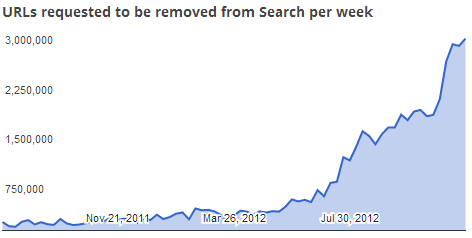
Starting with copyright news, not that we have much of anything else anyway, those keeping tabs on Google’s publicly available DMCA stats will have noticed the exponential rise in the number of takedown requests over the last couple of months, something that Google has noticed too.

Google DMCA Stats

The number of DMCA takedown requests that Google receives has increased by tenfold in the last 6 month

In fact, DMCA requests are up tenfold from just six months ago, from 1.2 million per month back in July, to 12 million in just the last 30 days. The dramatic rise in request has Google worried. Not just that it takes an enormous effort to process 12 million requests and counting, but also of the effect this has on the free flow of information, especially when relating to false positives. Google for the most part tries to identify URLs that shouldn’t really be removed, but as Digital Digest found out earlier in the year, the system is by no means fool proof. That a company hired by Warner Bros. to recently locate and submit DMCA requests tried to remove an IMDb entry for one of the studio’s movies, along with many legitimate trailer and promotional links, shows that even content creators have something to lose when it comes to the way DMCA request work at the moment.

For once though, the MPAA agrees with Google that the current regime isn’t working. The only problem is that the MPAA thinks the collateral damage the current DMCA processing method should be made more deadly by introducing domain-level bans. Instead of banning each page individually, the MPAA would love nothing more than to be able to ban an entire domain name. And I’m sure I know which domains the MPAA already has in mind.

The obvious problems with this aside (I just hope they don’t ban IMDb.com, because it’s actually quite a useful little website for all involved), the real problem is that this kind of corporate controlled censorship doesn’t actually work to stop people from visiting these websites, let alone stop piracy, let alone help movie studios to make more money. Most of these websites don’t even rely on search engines for the majority of their traffic, so it’s all a bit pointless.

But since when has big content’s anti-piracy methods been anything but pointless?

Which is probably why the most successful anti-piracy initiative devised for the music industry has been something that the music industry fought hard against: Spotify. This week, the founder of Spotify Daniel Ek revealed his main motivation in coming up with Spotify, and it in fact was related to piracy. Ek wanted to create something that would defeat piracy by being better than it, and in the end, it took a lot of convincing for the music industry to actually sign up.

With Spotify now having 5 million paying subscribers worldwide, and more than half a billion dollars in revenue being generated for the music industry where previously there was none, it has to be considered a great success. I’m actually listening to Spotify while I’m writing this WNR, so even if my free ad-supported account doesn’t generate a lot of revenue for artists and labels, it’s more revenue than what would be generated by piracy.

Gaming

NPD this week released November’s US video game sales figures, the first set that includes the newly released Wii U. With Nintendo a little bit more forthcoming with their hardware sales stats, it was almost enough to grant us a full set of hardware sales figures (but Sony’s Scroogeness when it comes to PS3 sales data prevented this, sadly). So much so that I thought about doing a full NPD analysis just like in the good old days, but I ended up settling for a news article and a little bit more of an analysis right here.

The Wii U’s launch, at least in the US, looks like a success, but can also be classified as a failure, depending on where you stand. While raw sales figures (425,000 sold in the first week) were down compared to the Wii launch (475,000 sold), the pricier Wii U meant that Nintendo made more money from slightly fewer unit sales as a result. So in this respect, it was a good launch.

ZombieU on Wii U

The Nintendo Wii U should try and emulate the Xbox 360’s success in combining casual and hardcore gaming, with a good price, multimedia capabilities, and a great online community

But if you consider the fact that the Wii was coming off a largely unsuccessful Gamecube, the Wii U is coming off the ubiquitous Wii. With backward compatibility support, both in software and hardware, the natural upgrade path from the Wii to the Wii U is natural, but the sales figure so far suggests that perhaps it isn’t a natural choice for most to upgrade. On the other hand, the Wii was, by standards back then, a much more innovative console with a bigger “wow factor” than the Wii U , so perhaps it’s not a fair comparison to compare the two consoles after all.

I think this holiday period has come a little too early for the console in order for us to be able to tell whether it will be a gift-giver’s favourite just like the Wii was (or still is). Next year’s holiday period will be crucial for the console, so Nintendo has a lot of work to do between now and then to “sell” their console to the perhaps more skeptical public.

This year’s gift-giver’s favourite is the Xbox 360 though, having sold 1.26 million consoles, almost twice as popular as the next most popular console. The Xbox 360 currently has a great mix of good gaming, pricing, multimedia and online support, and it’s a formula that Nintendo will want to emulate with the Wii U.

You can tell us what you think of the Wii U by voting in this poll.

On that note, thus ends this latest installment of the WNR. See you in a week. Hopefully.

Weekly News Roundup (25 November 2012)

Monday, November 26th, 2012

So despite saying that I’ve no interest in the Black Friday Blu-ray sales over at Amazon US and UK, some $400 later, I think I might have been wrong. I still maintain that the actual “lightning deals” put out by Amazon US this year has been fairly tame, with most of my buys coming via normal discounting. The Amazon UK sales were better, with some proper lightning discount (picked up the Prometheus to Alien evolution boxset, currently listed for $190 for pre-order on Amazon US, for only $43), and the Men In Black Trilogy. Plenty of stuff to tie me over well into the new year.

I didn’t just waste all of my time shopping for Blu-ray bargains. I actually did find some news this week!

Copyright

Should we really be surprised that the target of the latest anti-piracy police raid happens to be a 9-year-old Finnish girl? I don’t think so, because time and time again, anti-piracy agencies have shown that nothing is sacred in their pursuit of nasty, horrible web pirates.

Winnie the Pooh Laptop

The nerve center of a major piracy operation, according to the Finnish anti-piracy agency CIAPC

For the trouble of downloading a music album that did not work anyway, and for doing the right thing the very next day by buying the album in question, the reward is a police raid early in the morning, and the Winnie the Pooh laptop of the 9-year-old girl being confiscated for evidence. All because the father refused to pay a 600 euro “fine” and sign a non-disclosure agreement so the money grabbing remains a secret.

Normally, parents cannot be held liable for the actions of their children, but the shortcuts being taken by Finland’s copyright laws means that the Internet connection account holder, the father, would be liable for all authorized and unauthorized uses of the connection. Another shortcut? No need to prove anything, beyond a flimsy IP address, before police can search and seize (just what they expect to find on the laptop, a year after the fact, who knows). And that a legal copy of the album has already been purchased does not seem to matter, despite a loss of a sale being the most damaging thing a download can do (without considering the upload component, which may have been mere kBs in size, assuming the original download was even real or completed).

The worst part is that these anti-piracy agencies are so entrenched in their zealous believes (that what they’re doing is right and just), that they simply walk into controversies like this time and time again, with no shame at all.

The Department of Justice and the U.S. Immigration and Customs Enforcement’s (ICE) war on Internet piracy, through  “Operation In Our Sites”, has also been controversial to say the least. Not only has it not had any real effect on the web piracy problem, it did manage to seize domain names that is really shouldn’t have seized, mistakes that were magnified by the total lack of due process (which meant that the illegally taken domain names weren’t returned to its rightful owner until a full year after the seizure).

Unfortunately, there’s broad political support for this course of action, thanks to the liberal spraying of lobbying cash around in Congress and the Senate. But broad support does not equal unanimous support, and one congresswoman is trying to give website owners some extra protection against what she calls a new form of censorship (when domain seizures are accompanied by a total lack of due process). Rep. Zoe Lofgren (D-Calif.) is seeking help from reddit in writing a new bill to allow website owners advanced warning and the ability to mount a defence before any seizures occurs.

It’s exactly this kind of common sense bill that will no doubt be blocked by the usual suspects.

Derek Khanna

Derek Khanna, the RSC staffer thrown under the bus for having a sensible view on copyright

Across the isle, some Republicans haven’t been resting on their laurels either, although others may wish that they had. The Republican Study Committee (RSC), a caucus for conservative republicans, released an extremely sensible memo questioning the three major myths of copyright. One that copyright was created to help content creators monetize their works (actually, it was created for the greater public good, to encourage innovation and productivity), that copyright equals free-market capitalism (when it’s actually a government mandated entitlement system), and that the current copyright regime is working well to encourage productivity and innovation (when the reality is that copyright law is often used to smother innovation, and by legislating the protection of not only the right to earn revenue but the amount of revenue itself, this may lead to “rent-seeking” behaviour).

But just as the Internet woke up to probably the most sensible copyright statement made by any major party in who knows how long, the memo was unceremoniously pulled from the RSC website, and completely disavowed. Apparently, it had not been properly “reviewed” prior to publishing, and did not represent all opinions present within the RSC. Rumours of lobbyists (ie. the RIAA/MPAA) interfering persists, and really, would you be surprised?

Some have commented that this may be the Republican’s revenge for Hollywood’s pro Obama views, but while Hollywood stars, with the odd chair yelling exception, are all very much progressive-leaning, the industry itself has its money fairly evenly spread between the major parties, taking a leaf from the Wall Street playbook (or vice versa). But revenge or otherwise, what the memo represented was good, sound conservative principles, which in the light of day, doesn’t veer far away from the progressive view on the issue, even if the rationale may be very different. And this symbolizes exactly why US politics is so f***ed up at the moment, that both sides of politics can embrace the same point of view, and that it still can be easily dismissed because special interest has money invested.

High Definition

In Blu-ray news, Warner Archive Collection’s 2,000+ strong library of made to order titles will now start featuring Blu-ray titles, starting with just two this week. The collection features fairly rare and low demand titles that are made on demand, using recordable DVDs (and now Blu-ray discs) to fulfill each order. Discs are reasonably priced, usually under $20, with the two new Blu-ray movies (Gypsy and Deathtrap) being currently priced at $19.95.

To be honest, I had not been aware of Warner’s manufactured-on-demand store before, and it’s certainly an interesting take on the “video-on-demand” model. I do wonder whether the cost of producing new HD transfers for the Blu-ray films will be made back by sales, which I assume won’t be in huge numbers.

Gaming

With the Wii U release out of the way, time to shift the focus back on the Xbox 720 and the PS4. The latest Xbox 720 rumours still continue to re-iterate the same ones that have been making the rounds, including the obligatory Blu-ray drive, Kinect 2.0 and more CPU cores that you can shake a stick at.

Xbox World Jan 2013 Issue

The January 2013 issue of Xbox World has the latest Xbox 720 rumours, including a mock-up of what it could look like

The augmented reality glasses rumour isn’t new either, but they’ve been repeated again in this Xbox World magazine article, which is said to have been compiled by interviewing many “industry experts”. Somewhat new is the introduction of a toushscreen controller à la the Wii U controller, although with Microsoft actually having a tablet device of their own, perhaps integration is the wiser route to take.

Almost as quick as the Xbox 720 gets a Blu-ray drive, it’s set to lose it, and with it all support for optical media, when a “slim” version of the console is released 2 years into its life-cycle (which begins Christmas 2013, by the way). The “slim” will rely solely on streamed and downloaded games, the streaming perhaps coming from Microsoft’s own OnLive-like service, after the company had showed earlier interest in acquiring the gaming-on-demand service.

For CPU fans, the Xbox 720 may have a 4 hardware core CPU, each with 4 logical cores, for some serious 16-score gaming action.

Take what you read with a pinch, perhaps even a tbsp, of salt.

That’s it for the week. Time for me to take a rest and find a way to pay for the $400 worth of new Blu-rays that I really shouldn’t have bought. See you next week.