
Archive for the ‘Gaming’ Category

Weekly News Roundup (21 August 2011)

Sunday, August 21st, 2011

Another relatively quiet week, but I did manage to get the NPD analysis done, for July 2011 sales, and you can view it here. Sorry for the lack of news, but I and the others that contribute news can only write about what’s there, and there wasn’t much there this week.

CopyrightBut quantity isn’t everything, so let’s start with some interesting copyright news. In the MPAA’s eyes, anyone that says anything positive about online piracy is as guilty as those that download movies, steal cars and shoplift stuff.

And even when they’re not being positive about piracy, but merely pointing out the observation that, given the current economic conditions, piracy may become a more socially acceptable activity, the MPAA has to go into full attack mode and silence anyone, this time, it’s GigaOM’s co-editor Janko Roettgers, that dares to present the idea that a lot people who pirate movies are just ordinary citizens. For you see, the MPAA has to portray pirates as “scum”, people that are not like good, decent, voting folks, first to portray web piracy as a serious crime that needs the government and industry’s full attention, and also to ensure the politicians they’re financially lubricating are not scared into passing laws that may affect a huge percentage of their electorate.

Download a Car

If you could download a car, there would be no more car thefts

The problem for the MPAA though is that, they’ve made similar observations in the past, including by their former boss, Dan Glickman, who correctly noted that “the current economic crisis makes this problem [piracy] much more serious than before” a couple of years ago. This time, the MPAA published an opposing piece, also on GigaOM (which came under some criticism for allowing the MPAA to do this, but it’s free speech, and it should be allowed, no matter how much we disagree with the opinion presented). But once again, we have the MPAA’s (represented by Alex Swartsel) comparing web piracy to shoplifting. But as I explained in the forum, web piracy and shoplifting cannot really be compared at all. Shoplifting means a physical loss for the store owners, as well as a potential lost sales, but not from the shoplifter, but from not being able to sell the item that is no longer there. For digital piracy, there is no such “loss” for the “store owner”, as pirates are only taking away a copy of the item that’s on sale, not the actual item itself. The only potential loss is in lost sales, but only if the pirate would have purchased the item anyway (you know, that old argument). Stores in London are complaining about their goods being looted, but I’m sure they’re not worried about the same looters not coming back to the stores and not buying their stuff because they’ve managed to get it for free.

And many of the actual lost sales from piracy are mainly because the consumer is unable to obtain the item, either in a timely manner, or in the format they want. DRM and release windows have seriously hampered the ability of the average consumer to purchase and enjoy content. And this is a point that the CEO of one of the New Zealand’s largest ISPs, TelstraClear, is pointing out. Allan Freeth goes one step further and actually attacks any laws protecting rights owners as legislation that artificially props up their business model, one that is obviously not working as well as before, if not failing completely. Freeth even cites surveys that TelstraClear conducted, asking its users why they pirate stuff, and one answer that kept on coming up was that people often had to wait days, weeks and even months to watch the same content people in the US already had access to (and then free access online via catch-up services like Hulu). This is something that I can sympathize with, living in Australia, where we’re also treated badly in terms of release Windows. Even the “fast tracked” shows are often a week or two behind the US airing schedule, and in this day and age of “instant”, that might as well be an eternity. Freeth also said that pricing as an issue, and if people can’t afford to consume your content, then don’t blame them for seeking free alternatives.

There was a development in the Viacom-v-YouTube lawsuit this week as well, as one of the major partners of Viacom in this case has withdrawn from it, after agreeing to a private settlement with YouTube owner Google. The National Music Publishers’ Association (NMPA) will no longer be part of the Viacom appeal, and Google in return, will allow music publishers (those that help song writers publish their works, as opposed to recording studios that publish recordings of these same works) to participate in their revenue sharing program, something the NMPA cites wasn’t possible before. It’s a win for Google, and it signals problems for the Viacom appeal, especially if they continue to lose partners this way.

And in DRM news, Ubisoft has backtracked and now promises not to implement “always-on DRM” in their upcoming game, Driver: San Francisco. This is only weeks after Ubisoft claimed “always-on DRM” was a huge success, despite the measure only hurting paying gamers that get their game cut off if their Internet connection decides to flake out a bit (which is an unavoidable phenomenon). I guess it wasn’t such a big success after all, or at least not enough of a success for Ubisoft to justify the lost sales from the huge public backlash. But while always-on is not longer an requirement for the latest game in the Driver series, online authentication at game launch is still very much on the cards. I’m not a huge fan of any DRM, but authenticate at launch is fine by me, as long as there’s a true offline mode (but this doesn’t seem to be the case for Driver).

Not much news in 3D/HD, so let’s skip it and move quickly onto …

Gaming

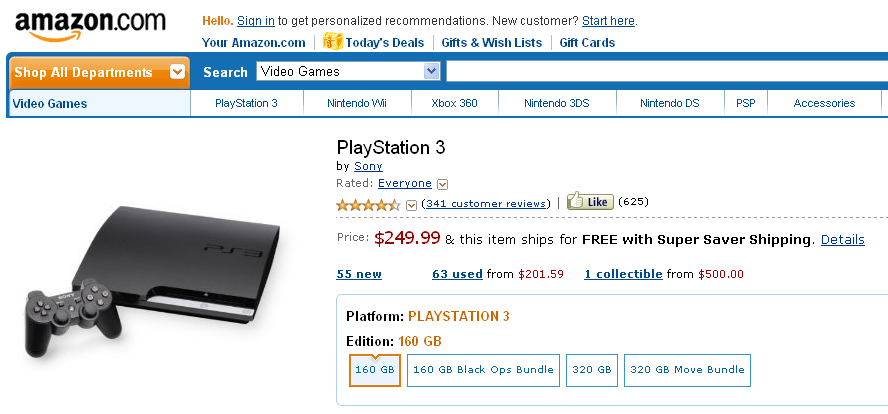
… gaming. And the big story of the week was Sony announcing a price cut for the PS3. It’s only $50, but this could be a significant factor in sales over the coming months, leading up to Christmas. And this is probably the right move at the right time, because as you can see in my NPD analysis, the PS3 is now in a distant third place amongst the home based consoles in the US at least.
PS3 Price Cut

The PS3 price cut has already helped PS3 sales on Amazon increase by more than 400%

The price cut seems to be happening elsewhere in the world as well, where it has to be said that the PS3 isn’t doing too badly at all. Australia sees one of the bigger price cuts, $AUD 150, which is about $USD 145, but even with this huge cut, our PS3 is still more expensive than the US PS3 (so you can imagine how overpriced it used to be). Still, I’ve seen some stores starting to sell the 160GB version for just under $300, which is better, but still $60 more than the US pricing.

And that brings us to the end of yet another very short WNR. But it means I’ve allowed you to have more time to do other things, so really, you should be grateful. See you in 7.
Game Consoles – July 2011 NPD Sales Figure Analysis

Wednesday, August 17th, 2011

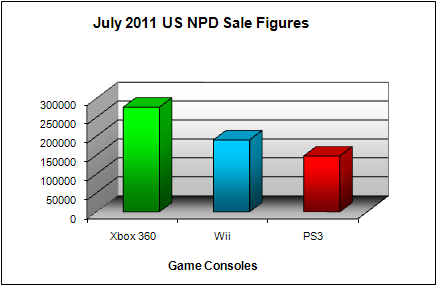
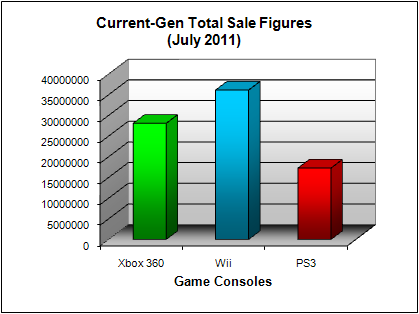
Welcome to the July 2011 edition of the NPD US video game sales analysis. For July, only Microsoft provided actual figures for hardware sales, stating 277,000 units of the Xbox 360 was sold, and that their console accounted for 45% of the home based console market share. Later on, Wedbush Securities analyst Michael Pachter revealed that Wii sales had dropped 25% compared to the same month last year. With these three facts, we can then deduce the PS3 sales figures, for which Sony has yet again remained silent on. For those that are new to this, this analysis looks at US video games sales figures compiled by NPD, unreleased by NPD due to pressure from the gaming companies, but then leaked by various sources, including gaming companies, if/when it suits them.

The figures for US sales in July 2011 are below, ranked in order of number of sales (July 2010 figures also shown, including percentage change):

  • Xbox 360: 277,000 (Total: 28.1 million; July 2010: 443,500 – down 38%)
  • Wii: 190,500 (non official estimate) (Total: 36.1 million; July 2010: 253,900 – down 25%)
  • PS3: 148,000 (non official estimate) (Total: 17.3 million; July 2010: 214,500 – down 31%)
NPD July 2011 Game Console US Sales Figures

NPD July 2011 Game Console US Sales Figures

NPD Game Console Total US Sales Figures (as of July 2011)

NPD Game Console Total US Sales Figures (as of July 2011)

My prediction from last month was:

I think the Xbox 360 will experience its first year-on-year decline in ages, but still comfortably stay at the top of the home based console hardware sales charts, leaving the Wii and PS3 to fight it out for second and third place, and I think the Wii might be better positioned to win for some reason. It’s NCAA Football season again, so it will be the top seller, but otherwise, not a huge month for games again.

An almost perfect prediction, a rare event indeed. The Xbox 360 did experience its first major year-on-year decline, and it actually was the biggest fall out of the three home based consoles, but despite this, it still managed to comfortably be the best selling home console for July 2011, which is on record as the worst performing month since October 2006. And as I had predicted, the Wii won the fight against the PS3 for second place, but in full honestly, both of these consoles performed horribly, adding to the misery that is July. And new hit games were far a few between in July, and so game sales slumped as well.

As expected, the Xbox 360 saw its first major year-on-year decline since 2009 (I think). It is expected because this time last year, the new Xbox 360 “Slim” had just been released, and the sales surge from this event actually managed to give the console a 119% lift in sales compared to July 2009. So obviously, with no new consoles in July 2011, year-on-year sales dropped as a result, and I suspect this will continue for a few more month. The Xbox 360 was still the best selling home based console, with a massive 45% of the home based console market share for July – that it sold almost twice as many units as the PS3 is testament to its growing dominance.

Despite a price drop, the Wii languished in a distant second place, dropping 25% in sales from the same month last year (which was even compared to July 2009). There’s not much positive things one can say about the Wii, and coupled with alarmingly decreasing DS/3DS sales (prompting Nintendo to drop prices on the 3Ds only a couple of month after release), Nintendo will hope there are no delays to the release plans of the Wii U.

As for the PS3, this appears to be the worst month since July 2009, with a 30% sales drop compared to last year. And unlike the Xbox 360, the PS3 really has no excuses. There’s still growth between 2009 and 2011 (of around 20.5%, compared to the Xbox 360’s 36.5%), but this is comparing the pre-Slim and pre-price cut PS3, with the current one. Which is probably why Sony has just announced a price cut for the PS3, which should allow sales to surge a bit.

So overall a pretty bad month for video games, but with the economy the way it is and with most of the consoles many years into its release cycle, it’s probably not unexpected. For games, it’s been a quiet month as well, with NCAA Football dominating as it usually does at this time of the year. Just Dance 2 for the Wii continues to show off its staying power in the top 10, this time coming 5th. Here’s the full software sales chart for July:

  1. NCAA Football (Take 2, Xbox 360, PS3)
  2. Cars 2 (Disney, NDS, Wii, Xbox 360, PS3, PC)
  3. Call of Duty: Black Ops (Activision Blizzard, Xbox 360, PS3, Wii, NDS,PC)
  4. Lego Pirates of the Caribbean (Disney, Wii, Xbox 360, NDS, PS3, 3DS, PSP, PC)
  5. Just Dance 2 (Ubisoft, Wii)
  6. Major League Baseball 2K11 (Take 2, Xbox 360, Wii, NDS, PS3, PS2, PSP, PC)
  7. Zumba Fitness (Majesco, Wii, Xbox 360, PS3)
  8. Fallout: New Vegas (Bethesda, Wii, Xbox 360, PS3)
  9. New Super Mario Bros. (Nintendo, NDS)
  10. Mortal Kombat (Warner Bros., Xbox 360, PS3)

Prediction time. With the PS3 price drop coming in just a few days ago, this is just the sort of major event that makes predictions extremely difficult. There’s no doubt in my mind that the PS3 won’t come last again (Wii has the third spot amongst the home based consoles locked up), but the main question is can the PS3 outsell the Xbox 360? The price cut being only $50, and with no new console coming with the price cut like two years ago, maybe it will just come short, but it will be a close run race that’s for sure. For games, again, there’s nothing really of note. Usually at this time of the year, Madden NFL dominates, but with the Madden NFL 12 coming at the end of August, it may not have enough time to make such a major impact this time, although it will probably still be the best seller based on pre-orders alone. No More Heroes: Heroes’ Paradise for the PS3 and Deus Ex: Human Revolution seems to be the only two other notable releases in August.

See you next month.

Weekly News Roundup (14 August 2011)

Sunday, August 14th, 2011

Another pretty quiet news week, and once again, NPD has “released” stats for US video game sales in July 2011. More on the later though, let’s get through the small number of interesting news items this week in this relatively short WNR.

CopyrightIn copyright news, a couple of weeks ago, the story of a 70-year-old grandma being “caught” downloading video porn by a copyright law firm made the headlines.

Wi-Fi Security

If you have a Wi-Fi connection, you need to use WPA2 encryption

This week, a blind man is accused of doing the same. In a scenario that is likely to be repeated over and over again, the man, only known as Doe 2057, suspected that the Wi-Fi router his wife set up might not have been secured, which possibly led to neighbours abusing the connection to download Japanese porn, despite the man living in a “very upscale building”. Before we get to the rights and wrongs of copyright law firms, people really need to be more careful with their Wi-Fi routers. By not securing it, anyone could connect and use up your Internet bandwidth, and that’s actually a best case scenario. Worst case, they would have access to your network, and hence any file shared on the network. The same also applies to routers that use the default password (or no password). And I think router makers have to take some responsibility as well, as far too many routers ship with factory settings that do not have security turned on or use the easily broken WEP protocol – it makes them easy to install, a bit more compatible with older wireless devices, but a little bit of hand-holding in the set up software wouldn’t make the process that much more difficult either.

But with nobody taking any responsibility, the large majority of consumers ignorant of the need to secure their routers, copyright law firms are taking advantage of biased copyright laws. It’s certainly opportunistic, you have to say. The problem is that to actually fight the charges, as Doe 2057 found out, it’s usually more expensive than just paying the on average $2,500 settlement fee. And the copyright law firms know this, and have exploited it beautifully. It was also revealed this week that the number of people being “sued” this way, in the United States lone, has reached over 200,000, according to stats being kept by TorrentFreak. That’s half a billion dollar worth of settlement fees, but assuming not everyone pays up, it’s still a 8 figure amount that many law firms would be delighted to take in over the course of several years. If you ever get caught, you should definitely check out EFF’s page on mass copyright lawsuits, and learn about your options.

A new study seems to show that good games are pirated more, which might sound like common sense to you and me, but nevertheless the study “confirms” it as fact. Except it sort of doesn’t. The TorrentFreak article on this study has more details, including the top 10 list of most pirated games, there are a few cases, such as the awful TRON Evolution game, that still managed to be popular with pirates, despite being unpopular with critics. Similarly, the fairly average and not all all popular (sales wise) ‘Two Worlds II’ managed to get into the top 10, and the hugely popular Starcraft II wasn’t the most pirated game (Fallout: New Vegas was, which is fair enough I suppose). I would actually like to see a study that tries to find a correlation between game sales, piracy rates and the quality of the game. What I would like to know is that if high quality games have a higher or lower ratio of pirated copies versus paid for copies. And then take into consideration things like the exclusive online features of the game (eg. Starcraft II’s Battle.net support), as well as any DRM employed (eg. Ubisoft games). I think the results may be very interesting.

Speaking of DRM, Walmart is pulling out of the digital music business according to leaked memos, and this has implications for those that purchased DRM’d music from them prior to 2007 (before they went DRM-free). Luckily, Walmart seems to be doing the right thing and will keep the DRM servers online (they learned the hard way about turning off DRM authentication, back in 2008 when they tried it and met with strong public condemnation). But how long will they do it? Indefinitely? At some point, Walmart will decide unilaterally that it no longer needs to maintain DRM authentication, and all those “purchases” would be made invalid. The sensible thing for Walmart seems to be to transfer the DRM’d songs to DRM-free version, which should not really be that difficult, but I suppose it means extra licensing costs. It again highlights the problem with DRM, not only for consumers, but for content providers having to get locked in to a proprietary system for an undefined number of years.

High Definition

In Blu-ray/3D news, I posted a 3-in-1 news story just yesterday on developments in the 3D world.

The first of the three is not really that interesting, a story about 3D glasses vending machines outside of selected cinemas in California. The fact that people may pay $70 for a pair of passive 3D glasses out of a vending machine, in this economy, just seemed funny to me.

Samsung 3D active shutter glasses

A standard for 3D glasses could help end consumer confusion and lead to cheaper glasses, but will it help 3D uptake?

The second story is slightly more interesting, but let’s talk about the third one first, which is about AT&T’s U-verse no longer carrying the ESPN 3D channel, due to low consumer demand. The blame is either with lack of 3D devices being sold, or lack of interest, and both could be true. The thing is, 3D is a gimmick, and one that perhaps you might want to give it a go from time to time, but the majority of TV watching will be in 2D.

Back to that second story, and this one is about a new standard for active 3D glasses being formed by Panasonic, Sony and Samsung, three of the biggest manufacturers of 3D. Panasonic hinted at this quite a while ago, especially when it found that Samsung’s active 3D glasses can actually workon Panasonic sets, but only if you wear them upside down, the ridiculousness of this probably prompted a rethink by these manufacturers. They also plan to address a major problem with home based active glasses, in that they’re mostly based on infra-red or RF signals, both of which are susceptible to interference, and in the case of IR, line of sight issues. Hopefully, with a standard in place, and other manufacturers signing up, the cost of 3D glasses can decrease over time.

Gaming

And finally in gaming, as mentioned earlier, the July NPD figures have been released. Microsoft, as usual, were the first to provide actual hardware sales figures, not surprisingly because their Xbox 360 was the best selling home based console yet again. They also made it interesting by announcing the market share figures, at 45%, which meant that as long as one Nintendo or  Sony release figures for the Wii or PS3, then we would know the sales number for the other (based on a simple calculation).

Unfortunately, neither companies came out with any figures, and it was left to Analyst Michael Pachter to come up with the good, via a sneaky reference to the Wii’s year-on-year result. So once I get all the maths done, I should have the NPD analysis up.

Alright, another short-ish WNR, but if there’s no interesting news, then there’s no interesting news, it’s not as if I can make it up or anything. Or maybe I can?

See you next week.

Weekly News Roundup (7 August 2011)

Sunday, August 7th, 2011

A pretty light week in term of news, and since I’m running a bit behind, let’s see if I can wrap this one up quickly.

CopyrightStarting as usual with the copyright news, we start with the MPAA’s win against Zediva, as the judge in the case handed down a preliminary injunction against the “innovative” video rental service.

Zediva Promo

Zediva is a great deal for consumers, but it can only do it by using loop holes that Hollywood is trying to close

A little background info. Zediva’s service works by allowing you to rent physical discs, but instead of sending the disc to you like what Netflix would do, they do what Netflix’s other service does, by offering you a streaming version of the same movie. Zediva then reserves the disc you “rented”, and removes it from circulation. Or basically as Zediva puts it, you rent the disc, and they play it for you over the Internet (imagine a DVD player with a really really long cable). Why did Zediva do this? They did this – and this is where I think Zediva’s downfall will be – to avoid having to pay licensing fees for streaming content.

You see, the problem is that Zediva’s motivations, it seems to me, are born out of trying to avoid paying these licensing fees and release restrictions, and make more money than they would otherwise. If this is Zediva’s real motivation, then good luck to them, but I don’t think they have a snowball’s chance in hell with their case. And in the judge’s summary of the ruling, it’s made quite clear that the judge sees real problems with Zediva’s argument, and that if Zediva was allowed to continue operating, it could harm the existing video-on-demand industry, Netflix included.

Now, it could be debated that what Zediva is doing actually does not hurt Hollywood if you compare it to traditional disc rental, but that it does hurt Hollywood studios when compared to what they can make from streaming deals, and even Zediva won’t deny this, as after all, their business model is to save on licencing costs. This then leads to the debate as to why streaming should cost more than traditional rentals, why Hollywood should choose to not only “tax” new innovative distribution methods, but to place artificial limits (like a 30-day embargo to help increase disc rental income), when these help to fight piracy. But that’s their business decision, and they may be right or wrong, but that’s not for Zediva to decide. So people get pissed off with Redbox waiting times for new releases, or the somewhat hysterical reaction to the Netflix price increases (best encapsulated in this video), and it might hurt Hollywood more to be too greedy when it comes to streaming licensing fees and release schedules, if people do decide to “screw it” and use BitTorrent.

Pron magazine/website Perfect 10 is making legal headlines again this week, twice actually, as they launch yet another lawsuit against yet another online company, this time Megaupload. As you may or may not know, Perfect 10 has in the past sued Microsoft, Google, Amazon, the middle of these three recorded a win against Perfect 10 this week in which the Ninth Circuit court rejected Perfect 10’s appeal over an earlier decision favouring the search giant. But while courts are reluctant to rule about top tech companies that have been Perfect 10’s target before, they may be more favourable to ruling in Perfect 10’s favour against Megaupload, especially since the MPAA’s case against similar file hosting provider, Hotfile, seems to be going okay. So I wouldn’t be surprised if this turns out to be Perfect 10’s first victory, but it all depends on how frequently their content has been uploaded by users of Megaupload, and if it’s not frequent at all, why Perfect 10 didn’t file DMCA notices to get those content removed, instead of launching a lawsuit (“to make more money” is not an excuse the court would accept, I think).

Diablo III

Diablo III will use 'always-on' DRM, but not for anti-piracy, says Blizzard

Good will amongst gamers is something every game developer needs, and up until this week, Blizzard, the makers of the addictive World of Warcraft and Starcraft series,  probably thought that the had enough good will stored in the bank to pull a nasty surprise. But, as Blizzard will admit, they might have miscalculated. What happened was that Blizzard announced the next episode in another one of their addictive franchises, Diablo III, would have “always-on” DRM, meaning gamers won’t be able to play the game offline, even for a couple of seconds. So Blizzard decided to do a Ubi, and as I talked about last week, nobody likes Ubi DRM. The funny thing was that Blizzard probably never intended to do this as a form of anti-piracy, but only as an anti-cheating feature. This may very well be true, but Blizzard could have avoided this whole controversy (and still used “always-on” DRM) by including an offline mode, much like how Test Drive Unlimited 2 does it (offline and online progress are recoded separately). The statements made by Blizzard immediately after the backlash began didn’t help either – executive vice president of game design Rob Pardo’s statement about there being other games to play when people are offline, for example on long plane trips, was the most ill-conceived of them all (yes, “other games” that people will buy instead of your games).

So it’s a lesson for Blizzard and any other company that chooses to use draconian DRM, for whatever reason – beware of the backlash, which might ultimately hurt revenue more than a couple of extra pirated copies would have (or the cost of adding an offline play mode).

High Definition

In Blu-ray/3D news, exciting news, sort of, although it’s technically neither HD nor 3D (not yet anyway).

I’ve been talking up UltraViolet for a while now, and it’s not like me really to voice my support for anything Hollywood comes up with, especially if it’s wrapped up in all sorts of DRM, which UltraViolet will no doubt be. But for me, UV is a huge shift in the way we “buy” movies, and it comes just at the right time when cloud storage is all the rage.

UV, simply puts, turns buying a movie into really buying a movie. The idea is that, instead of buying a movie on each platform, on disc, then on iTunes,  then another version for your Android device … instead of doing this, you buy the license to watch the movie, and then you get access to all the versions via the cloud, for all of your popular devices. It’s like Digital Copy, except it’s all done in the cloud. So when you buy a Blu-ray movie at Walmart, you can instantly get the movie to play on your Android phone, as long as you have a good Internet connection. And at home, instead of finding and popping the disc in or pre-ripping it to your media player, you can just fire up your TV’s UV app, and watch all your purchased movies from the cloud.

Flixster for iOS

Flixster is already available on a variety of mobile devices, and so, it's the natural fit for delivering and managing UltraViolet

The big news this week in regards to UV is the first announcement of UV compatible movies, as Warner Bros. announced both Bad Bosses and Green Lantern will feature UV support. I’m not surprised at all WB is one of the first companies to announced UV support, as they’ve always been quite open to new formats, having supported VCD in Asia, and HD DVD before they decided not to. And WB’s recent acquisition of Flixster is starting to make sense as well, as it seems Flixster is the app that WB plans to use to allow users to manage and watch UV content. As Flixster is already available on a wide variety of mobile devices, it’s an easy decision for WB to use it for UV.

What was more interesting was that WB also announced that it would even be possible for users to bring in their old DVDs to retailers, and have them “enable” access to the UV version of the movie. I don’t know how this will work, or whether there might be a way to do it without having to go to the store, but it does sound interesting. And as mentioned earlier, I really hope TV and console manufacturers embrace UV as well, as this would allow me to digitally stream my movie collection without ripping (also need studios and ISPs to work out some kind of deal to offer free bandwidth for watching UV movies).

In related news, Time Warner owned HBO plans to make available console versions of the HBO Go app, which is great news for those that are actually in the regions that can access HBO Go, which sadly does not seem to include Australia (we miss out on Hulu as well … boo!). The announcement also mentioned other “connected devices”, which sounds a bit vague, but hopefully will include things like Blu-ray players and TVs, for easy peasy catch-up viewing.

Gaming

And finally in gaming, Sony has, as expected really, announced a strong degree of integration between their upcoming portable console, the PlayStation Vita, and the PS3.

This will include the ability to use the Vita as a controller for the PS3 (so allowing the touch surface, gyroscope, microphone, camera … all to be used to control PS3 games), plus the PS3 can also send graphics data to the Vita to display. Sounds familiar? It should, because this is exactly how the Wii U controller would work.

PlayStation Vita

PS Vita will offer Wii U like features, much earlier than Nintendo's console

With the Vita coming to the US probably early next year, and the Wii U much later than that, it’s a shot across the bow for Nintendo, if not directly at them. The only issue is the price. At the expected price of $249, and add the $299 cost of the PS3, yes, you might have a system that rivals some of the innovative parts of the Wii U, but might be more expensive, and not have as good  graphics as the Wii U (which must surely be an ironic situation for both Sony and Nintendo). But then again, the Vita can be used as a standalone gaming console far far away from the Wii U (the Wii U controller also allows independent play, but only within close proximity to the main Wii U console). So a Vita + PS3 combination could in fact replace the Wii U + DS combination, and if that’s true (and if graphics quality is discounted as a factor), then Sony becomes the better value proposition. And a PS3 price drop, or a PS3 + Vita bundle, may help.  Of course, Nintendo knows how to make fun games, and Sony struggles at times, and this could be the deciding factor.

For the Xbox 360, they’re going in a totally different direction, which could work for and against them. But Microsoft has demonstrated Windows Phone integration with Kinect and the Xbox 360, so they’re planning something similar too – and it will be even better value for those already with Windows Phones.

So we come to the end of another WNR. Hope you enjoyed this issue, and see you next week.

Weekly News Roundup (31 July 2011)

Sunday, July 31st, 2011

Hope the past week has treated you well? Me, same as usual, and not getting that much work done despite feeling like I’ve done a lot of work (yeah, one of those weeks). I did re-organize the forum a bit (and yes, we do have a forum, it seems to be a fact that’s not commonly known going by the forum’s visitor stats), tried to reduce the number of forums, and re-focus some of the discussions. And so if you ever have a digital video authoring, conversion, editing or encoding problem, or want to post your opinions on some of the news articles mentioned in the WNR (there should be a thread for each news item linked to here in the “Latest News” forum), then feel free to pop over and I’ll be there to say hi.

A couple of interesting stories to go through this week, so let’s get started before it becomes August.

CopyrightLet’s do something different and start with the copyright news. The world’s unluckiest file sharer, Jammie Thomas-Rasset. Not that being fined $54,000 for downloading 24 song can be considered luck, but when you’re that unlucky, you have to take what you get.

For what seems like the billionth time, Thomas-Rasset has received a new figure representing the damages she needs to pay the RIAA, for daring to do the incredibly nasty act of downloading 24 songs without paying. Once again, a judge had to intervene and overrule an earlier jury decision to award the RIAA $1.5 million, by reducing the damages to “only” $54,000. The judge cited the Constitution and justice as reasons for reducing the unjustifiable 7 figure damages reward. The RIAA has voiced their disapproval at the decision, and it does not surprise me one bit the RIAA seems to have no respect for either the US Constitution or justice. Hopefully, Thomas-Rasset will not make the earlier mistake of trying to appeal the decision, and simply pay the $54,000 (or make some kind of financial arrangement), as her previous attempts at reducing damages has not worked, other than to add to her mounting legal bills. But even if she accepts the terms, the RIAA could still appeal, all the way to the Supreme Court, because reports suggests they’ve already spent at least $3 million on the case, which they hoped would be a deterrent for music pirates (hasn’t really worked), and $54,000 is not much of a deterrent compared to $1.92 million.

BT Logo

UK court forces BT to block access to Newzbin2 at the request of the MPAA

A couple of weeks ago, I brought to your attention the MPA’s (the International arm of the MPAA) UK high court battle with UK ISP BT (holy trinity of acronyms, Batman). The high court has handed down its decision, and it’s one that will have long lasting repercussions. The judge has ruled that BT should help the MPA block Newzbin2 so BT’s subscribers cannot access the website. BT’s arguments that they’re simply an utility, like an electricity provider, did not wash with the judge who ruled that, unlike an electricity company, BT is fully aware of what its subscribers are using its services for, and thus, has the responsibility to turn off supply if the uses are judged to be unlawful. The major problem with this argument is that it assumes just because BT *can* find out what its services are being used for, that it *should* find out and help groups like the MPA monitor usage. It’s like saying the phone company can find out about all you by listening on your conversations, and so because *can*, they *should* (and then should report or tak action against unlawful activities). The second problem with this decision is that, the judge, MPA and even BT are satisfied that Newzbin2 does distribute unauthorized content, based on an earlier high court case, but that case was for the UK operated Newzbin. Nobody has actually bothered to establish the guilt or even the ownership of Newzbin2, and while it might be obvious in this case that both sites are trying to do the same thing, the question is does the MPA need to launch a new lawsuit against, say, The Pirate Bay, or can they use this decision to force all ISPs to block any website they allege is promoting piracy?

But in the world of Internet piracy, mere allegation is “good enough” it seems, and hardly any distinction is made between sites that host, link, embed, or link to links, because if the RIAA/MPAA says you’re bad, then you must be. Staying in the UK, and taking the “allegations equals guilt” model further, a new plan wants search engine results to be classified by a “traffic light” system, where “bad” sites that may be offering pirated content are marked with a red light to warn users not to use these sites. Without getting into the implementation issues of a system that’s supposed to judge and classify billions of web pages, this whole idea assumes that people, the so called “moral majority”, aren’t aware that they’re visiting certain websites and the content there is not legal, and so would be warned away by a simple graphic. I think if people aren’t aware of what they’re downloading, listening to, or watching is legal or not is mainly because they don’t care. You go to YouTube and watch a music video, do you really care that much if it’s an official, authorized upload, or one of the billion mirrors for the same thing. And when people watch on MegaVideo, or download from RapidShare, are they really so clueless that they haven’t worked out that it isn’t legal, and do they really care, especially knowing that these download methods are not being monitored for anti-piracy activities? I guess the only positive of this plan is that it will make finding pirated content a lot easier – simply follow the “red lights”, to get all your piracy fix.

HBO Logo

HBO has been used as a example in a new study that tries to show improving quality best helps to fight piracy

I’ve always said the best way to combat piracy is to increase quality (or at least decrease price so that it fairly reflects the product’s lack of quality). Now, people way smarter than me have written a new study that tries to quantify, what seems to me, is common sense. The new study specifically cites HBO and Valve as examples of where quality improvements have led to reduction in piracy and, most importantly, an increase in revenue. To me, both of these companies are innovative in their approach (HBO Go is very useful, if you’re in the US, and we all know Valve has single-handedly saved the PC gaming industry via the Steam model), and neither has focused their energy on copyright enforcement (take Steam’s DRM approach, for example). The study also reinforces this point, that the companies focused less on copyright enforcement tended to focus more on quality, and as a direct result, has more successfully raised their revenue. The study doesn’t mention Ubisoft’s draconian DRM approach, but I think it would make an interesting study in itself, to map out the full effect of Ubi DRM in regards to piracy rate and revenue, compared to say the success of Valve with their games, and also the Steam model.

But as far Ubisoft is concerned, Ubi DRM is a huge success. I know this because they’ve come out and said it, that Ubi DRM is a huge success. They say it’s a huge success because they have stats that show piracy rates have decreased dramatically for games that uses the “always-on Internet connection required” DRM. And you know what, I don’t doubt that at all. But you can often tell the truth not by what someone says, but by what they don’t say, and Ubisoft didn’t really mention revenue at all, which is strange. Considering that Ubisoft used the phrase “clear reduction in piracy”, you would think there would be a “clear increase in revenue” to follow that statement. But this statement was not made, and so I can only assume that revenue has not risen (and it’s hard to calculate anyway, as how can you compared say the revenue made from one game release to that of another?). The problem is that decreasing piracy does not mean increasing revenue, because pirates have a huge choice of pirated games to play, and if they don’t find one available (because the DRM hasn’t been cracked yet), they’ll just play another (even the most avid pirate gamer can’t possibly play all the pirated games out there). And this assumes Ubi DRM is hard to crack, which is not true any more. And there are also negative forces in play, with excessive DRM causing a drop in revenue as paying gamers, who also have far too many games to choose from, choose games that don’t use Ubi DRM. During the recent Steam Summer sales, I saw countless comments on countless forums where people posted their hesitation in buying Ubisoft games due to Ubi DRM, despite games like Assassin’s Creed 2 being on sales for less than $7 (and only committed in the end because others replied saying Ubisoft have toned down Ubi DRM in older releases). So how much money is Ubisoft losing because of Ubi DRM?

Of course, for truly great must-have games, gamers will put up with ridiculous DRM, but for these types of games, even some of the biggest pirates may come out of the woodworks and make this the one game they do buy. Quality is still very much king.

High Definition

In Blu-ray/3D news, apparently the Windows 7 (and Vista) native Blu-ray burning tool has a huge bug that prevents successful burns, if the compilation size is over a certain size.

ImgBurn

Why bother with the buggy Windows 7 Blu-ray burner when you can simply use the freeware ImgBurn

This comes as a huge surprise to people because, one, they didn’t even know that Windows 7 could burn Blu-ray discs, and two, they didn’t know why anyone would use the native Blu-ray burner, when you’ve got cool free tools like ImgBurn (whose official website is proudly hosted by us).

From analysing the very small amount of information Microsoft released about the bug, it appears the bug could be related to how Microsoft loves using Binary prefix, while storage manufacturers prefer to use SI prefix. With SI prefix, 1 KB is 1000 or 10^3 bytes, while with binary prefix, it takes 1024 bytes, or 2^10. So 25GB with SI prefix is only equal to about5 23.3GB with a binary prefix (to avoid confusion, a new standard was set up to use KiB, MiB and GiB to indicate binary prefix, but hardly anyone uses it, and certainly not Microsoft). So maybe Microsoft’s native Blu-ray burner thought that discs could hold 25GB in Windows notation (or 25GiB), even though Blu-ray only holds 23.3GiB, and so of course the burns would fail is the tool doesn’t warn users that they’re trying to burn over the allowed limit. This seems like a simple fix, so it’s strange that there’s no hotfix, or even a hint of one from Microsoft, for this bug that seems to have been present since Vista SP2 introduced Blu-ray burning support.

Gaming

And in gaming, not much again, except two more stories about Sony. The first one has Sony being sued again over the PSN hack, but this time by their own insurer, as Zurich American tries to get out of having to pay Sony to cover the costs of expected class action lawsuits and settlements related to the hack and outage.

It’s probably just standard procedure for insurance companies, or it could mean that Zurich American really thinks that the class action lawsuits could end up costing Sony a lot, and they want to protect themselves as early as possible. I don’t think even Sony feels they can placate everyone angered by the PSN hack just by giving them a couple of outdated games, despite inFAMOUS being pretty good fun.

The other news relates to Sony’s profit results for fiscal Q1 (April 1st to June 30, covering the entire PSN hack saga), and it’s not great news. PS3 console unit sales dropped by 25% compared to the same quarter last year, although Sony still expects the fiscal year to end in growth of the console. Surprisingly, the PSP was the only Sony console to see a unit sale increase, but that’s probably due to the super discounting that has been going on ($99 for a PSP with God Of War Ghost Of Sparta, is pretty good value here in Australia). And more surprisingly, PS2 sales are still holding up well, almost selling as many units as the PS3 (1.4m compared to the PS3’s 1.8m). It just shows how successful the PS2 was, and how Sony have totally failed to replicate the same success with the PS3. Globally, the PS3 still managed to outsell both the Wii and Xbox 360 (individually, not combined), thanks to strong performances in Japan, but the Xbox 360 was the only console to record growth out of these three.

And that brings us to the end of this WNR. Have a good one.