Archive for the ‘Gaming’ Category

Weekly News Roundup (New Years Day Edition)

Sunday, January 1st, 2012

Happy New Year! Hello from the 2012 side of the world, Australia being one of the first countries to go over to the other side, but you’ll all join me soon enough, whether you like it or not. Having experienced about 18 hours of 2012, I have to say that it has been pretty boring so far. No cataclysmic events yet, but I’ll keep you posted.

I guess it would be customary, at the end of the year, to review the just ended orbit around the sun and summarise the major events. But that would require actually remembering what happened, all year, when I can barely even remember writing last week’s WNR. It should also be a time to look forward to the brand new, still in shrink wraps, year, and make some bold predictions about 2012. But that would require insight and imagination, both of which are in short supply in this 36C (97F) heat.

With the award season upon us soon, I guess I can format this WNR “a look back” in similar fashion, but without spectacular musical numbers, or comedic writing. So basically an award show without any of the interesting bits. Or any actual awards. Sounds like a great idea!

There has been many deserving winners of the prestigious Loser of the Year award, from Sony’s PSN SNAFU, to recent events involving GoDaddy being pwned by Reddit, but there can only be one winner, and of course, it’s Righthaven. The group that helped to redefine the term Copyright Troll has had a horrible year, not only losing court cases, but eventually their shirt (and domain name), as the company is now on the verge of bankruptcy. Will they still be around to compete for next year’s award. Doubtful.

SOPA: winner of our Villain of the Year award

SOPA: winner of our Villain of the Year award

Competition for the always popular Villain of the Year award has been fierce this year, as individuals and companies fight to be total d*cks (hint: not “docks” or “ducks”), in the field of copyright, gaming and beyond. But this year’s award winner is neither an individual, nor a company (and it’s not a duck either). It is, of course, SOPA. The always controversial Stop Online Piracy Act stormed to a clear lead in the voting for the award, at the very last minute I might add. SOPA has managed to unite all against it, be it the conservative Heritage Foundation, Republican as well as Democrats, and even the sworn blood enemies, Reddit and 4chan, and that’s quite an achievement.

The Best Blu-ray of the Year award goes to Harry Potter and the Deathly Hallows, mainly because it was split into two parts and both parts still managed to not only get released in the same year, but both also topped the sales charts. Star Wars just misses out due to a point deduction for George Lucas being a total d*ck (hint: not a duck, named Howard or otherwise).

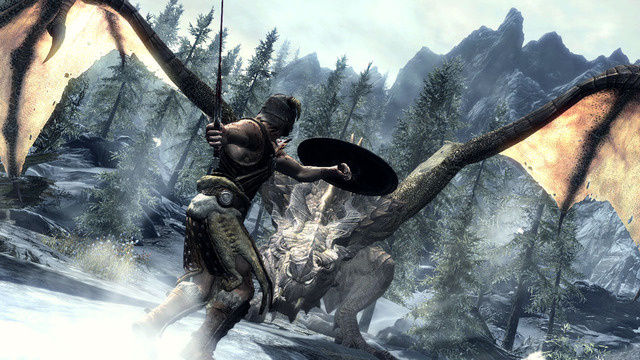
Skyrim

Skyrim wins our Game of the Year award, for wasting time that could have been used to cure diseases and save the planet

The Best Game of the Year should probably go to the best seller, which would be Modern Warfare 3, but that wouldn’t be fair to the game that everyone is talking about. The amazing world of Skyrim has drawn in thousands of gamers, most of whom have spent hours upon hours arrowing people, and assorted creatures, in the knee, and as a result, the game would have been responsible for breaking up thousands upon thousands of relationships if only gamers actually had real life relationships.

And finally, the Hero of the Year award goes to, in a lame effort to appease my readers, You! For helping to fight SOPA and to punish companies for not agreeing that SOPA is the worst thing to happen to the Internet since Rickrolling, for not buying into the Ultraviolet hype that, I have to admit, I was sucked into when I first heard the phrase “your movie library in the cloud”, for putting up with Sony’s PSN outage and that $600 invoice for adult toys that hackers charged to your credit card account when your details were stolen from PSN, for fighting the likes of Rigthhaven and the US Copyright Group and actually winning, and most courageously of all, for keeping on reading the WNR, rant after rant. You’re a deserving winner!

And as you can probably guess by now, it wasn’t exactly a very newsworthy week. The only real notable piece of news was the GoDaddy anti-SOPA boycott, which Digital Digest was proud to join in, having moved 22 domains out from GoDaddy. It would be easy to feel sorry for GoDaddy right now, as there’s almost nothing they can do or say to repair the damage caused by their ill advised support for SOPA in the first place – even their statement of “we oppose SOPA” was attacked by people claiming the company was opposing SOPA for the wrong reasons (not because SOPA is bad, but because GoDaddy was losing money because of supporting SOPA). Namecheap, hosting the Move Your Domain Day event by offering discounted, below cost domain transfers out of GoDaddy, also managed to raise $64,180 for the Electronic Frontier Foundation, $2 for every domain transfer – not bad work for a day, considering how much of a pain moving a domain (especially an active, website hosting one) is.

And that was it for the week really, so I probably shouldn’t babble on any further, especially on a day most of you will be nursing hangovers of varying degrees. So there’s nothing left to do except wish you a great new year, a prosperous one, a safe one, and one that’s heaps better than the awful, awful, 2011. See you next week.

Weekly News Roundup (18 December 2011)

Sunday, December 18th, 2011

As the holiday period truly begins (and by use of the term ‘holiday’, I’m not trying to avoid saying Christmas or in any way take part in the largely fictional “war on Christmas”, rather as a shorthand for saying Christmas and New Year, and I guess having to explain it like this sort of negates the whole shorthand thing, but you can’t be too careful these days) … where as I, um, yes, as the holiday period begins, the news will dry up, and it’s even debatable whether next week’s issue of the WNR is still on or not. Regardless, the week before Christmas is also the last week in which the Copyright Scrooges can manoeuvre to get their beloved SOPA passed in Congress, and so it’s busier than normal.

The US video game sales figures for November was also released during the week, and you can read the full analysis here.

Copyright

Before we talk more about video games, let’s go through the week’s copyright news first. Once again, we see why money and politics shouldn’t really mix, as news that two Congressional staffers largely responsible for drafting SOPA/PIPA have now “managed” to get better jobs at the MPAA and the National Music Publishers’ Association, two copyright lobbying organisations.

While laws prevent these two from coming back and lobbying their former employees (as if that’s even needed), there are the usual Washington loopholes that still allow the two to have influence on Capitol Hill. The MPAA and the NMPA will argue that this is how it’s supposed to work, that the organisations have managed to secure the service of two very capable, and knowledgeable, people who are already familiar with the issues at hand. Everyone else will be made uncomfortable at yet another incident that highlights the incestuous relationship between lobbyists and politicians. While only the MPAA/NMPA and the two new employees will know what the real deal was, the reality is that the two helped to draft bills that (intentionally, or just incidentally) gave their future employers exactly what they wanted, convinced their old bosses to go along with it, and got new, higher paying jobs as a reward. Whether this was just the unintentional consequence of their actions, or something more troubling that involved more coordination between the involved parties, I don’t want to comment, but sometimes just the appearance of something like this is unacceptable for a truly democratic society, or at least it should be.
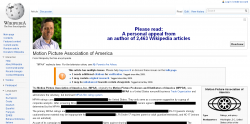
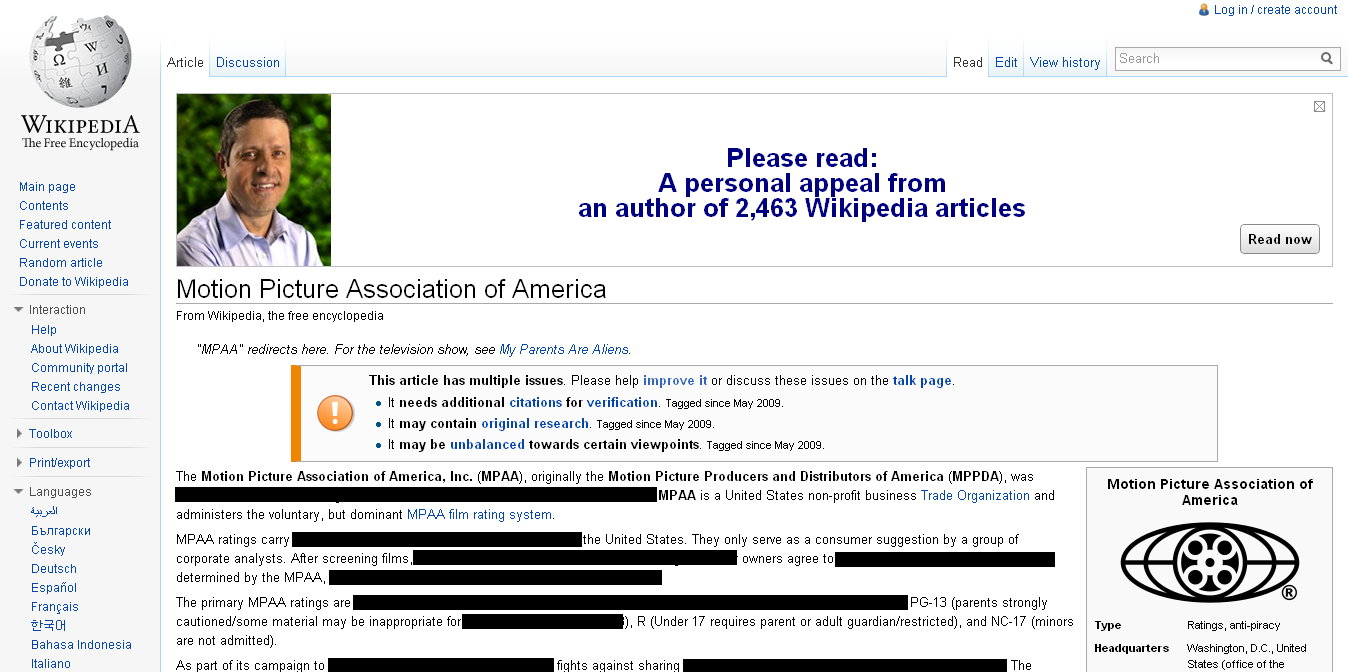
MPAA Wikipedia Page Censored

A mock up of what Wikipedia's anti-SOPA protest could look like, with sections or even entire pages blanked to show the dangers of Internet censorship

With breaking (well, by the WNR’s  standards anyway) news that further discussion of SOPA will have to wait until after the Congressional break, the anti-SOPA movement main gain an important ally before then, with Wikipedia threatening a day of action to protest the controversial copyright bill. The founder of Wikipedia, the man whose photo you see every couple of months on every Wikipedia page, Jimmy Wales, has suggested that Wikipedia might blank all of its pages, for a short period, to demonstrate against SOPA, something the Italian version of the encyclopaedia has already attempted to great success over a local issue. Right now, it’s all just discussions, because, as Wales rightly points out, doing something like this could have a huge impact on the web. I mean, would somebody please think of the children … who have to write school reports, and what the hell would they do without Wikipedia (and the copy/paste function)? Use another online encyclopaedia, or heavens forbid, go to the library?

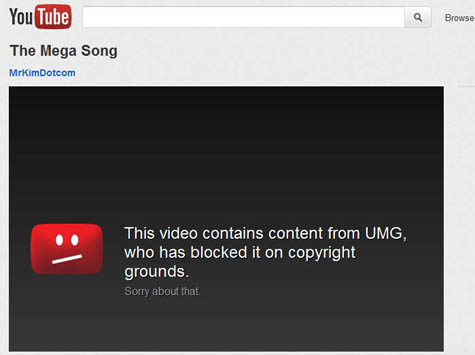
And for the anti-SOPA brigade (for all the work I’ve put into the cause, I must be a lance corporal by now, which ironically is also my rank in BF3 – I’m really really not good at the game), Christmas has come early thanks to Universal Music Group’s Scrooge-tastic act that helped to prove why content holders cannot be trusted with the power to censor the Internet. The story begins with the YouTube upload of Megaupload’s cheesy promotional video, starring some of today’s biggest stars, such as Kim Kardashian, P. Diddy, Will.i.am, Alicia Keys, Kanye West, Snoop Dogg, Chris Brown, and sung by Macy Gray. Using an original song, and with written agreements signed for all the stars, what Megaupload didn’t expect was for Universal Music Group (UMG) to abuse YouTube’s anti-piracy tool, to file an infringement report against the music video and have it censored. But that’s exactly what UMG did, although they now deny they did it for copyright reasons, hinting at some unknown agreement between two private companies (possibly relating to recordings of live performances), YouTube and Universal. Not that this makes it any better, of course, as the end result is that a perfectly legal video that presented views that UMG did not approve of (or rather, they don’t approve of Megaupload, period), and UMG had it taken down, which is the very definition of censorship. And because of an agreement between two other private companies (something SOPA would allow, as content holders can make agreements with financial providers to “kill” websites outside of the legal justice system), the tools/rules designed to handle copyright disputes was “abused” to censor free speech, however cheesy it was. What a wonderful demonstration of what a post-SOPA Internet world could be like.
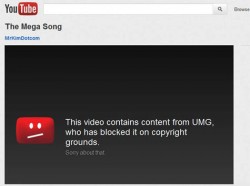
Megaupload's Mega Song was blocked on YouTube by UMG

Megaupload's Mega Song was blocked on YouTube by UMG - innocent mistake, or censorship masquerading as a copyright take-down?

Megaupload was quick to file a lawsuit against UMG, and YouTube eventually did reinstate the video with the explanation that, yes, UMG did abuse its tool: “Our partners do not have the right to take down videos from YouTube unless they own the rights to them or they are live performances controlled through exclusive agreements with their artists, which is why we reinstated it.”

But the Streisand Effect ensures just the YouTube version, which was blocked for quite a while, now has over half a million views, and made #Megaupload a trending tag for a while on Twitter. Nice one UMG. And who knew controversy is such a great way to promote a music video, perhaps it’s something UMG can leverage to its own benefit the next time.

Speaking of promoting videos, very funny comedian Louis CK has done something that traditional media won’t be laughing at – he’s bypassing the normal distribution channels, and releasing his own video for $5, and without DRM. And it’s proven to be somewhat of a success, with CK taking in over $200,000 (profit after cost) in just 4 days. According to CK himself, that’s less than what he would have gotten from a traditional distributor, but he’s happy because more people have managed to get a legal version of his video, and nobody had to endure horrible DRM or annoying marketing (register here, register there, give us all your personal info, and then get spammed in your inbox forever). Some have argued that this is a bad development for media distribution, since by taking out the middle men, that’s fewer people being employed. And that argument has some merit, and I’ve long argued that the whole wholesale/distribution/retail chain will suffer, if it isn’t suffering already, due to the digital revolution. But there are strategies to adapt, but those too slow, too paranoid or too stubborn to change, that is the companies that insist on charging digital downloads at the same price as retail boxed version, and those that insist on DRM, will not survive this revolution. And the more they try to hold on to the dying model, the more artists will release themselves from the clutches of traditional media and do it their own way – the truth is that nobody wants to do it alone, unless they have to, and through DRM, bad pricing, and incessant marketing and all the things they’ve done to alienate consumers, traditional media are forcing artists to go it alone.

For now, Louis CK’s video is still selling, despite widespread piracy (not that DRM would have lessened it or anything), and Louis urges everyone to keep buying, as so he “can have shitloads of money”.

And buying, as opposed to torrenting, might also help you avoid public embarrassment, as a new website has been launched to try and embarrass torrenters by listing their IP address and the stuff they’ve downloaded, even the videos of the naughty kind. While downloading from a public tracker does have this risk, those with dynamic IPs may not care too much, still, I don’t think I can support any service that publishes data like this. It would be like if a website, say Google, decided to public its web logs, of which IP address searched for what and when, and that has huge privacy implications. Just because this website is seeking to expose illegal behaviour, doesn’t mean it isn’t a privacy violation.

With that said, it was funny that the website would be used to put anti-piracy groups under pressure, as opposed to the people who actually pirate. This is because the website allows you to search for any IP address, including say the IP address of movie studios, or anti-piracy lobbyists, or even the anti-piracy domain seizing Department of Homeland Security. It certainly was interesting to see staff at NBC-Universal downloading the excellent Game of Thrones, perhaps proving that network TV does know a good series when they see one, even if they don’t actually know (or dare) to reproduce it for their own networks. How about someone at Fox downloading Super 8, produced by another studio? Or the RIAA downloading the latest Kanye West album?

Of course, the right argument is that you cannot really hold the RIAA responsible just because one of their IP addresses was used to illegally download something. It could be by an employee, an ex-employee, a visitor who managed to get access to a network connection, or as some have already claimed, be an unlikely case of IP spoofing. And as long as the RIAA has an appropriate anti-piracy policy, and enforces it, then they shouldn’t be held responsible for the actions of individuals. But since the RIAA don’t think any of this applies to, say Google or ISPs, and that they need to pass tough legislation to punish these organisations, I can only conclude that, yes, the RIAA is guilty of copyright infringement, possibly on a massive scale, and they should be punished accordingly.

Gaming

Not much happening in 3D/HD, so let’s skip to gaming. The NPD sales figures for November presented no big surprises in the Xbox 360 outselling everything else, and I think it’s safe to say that it is currently the dominant console in the US, for this generation.

To be fair (or unfair), the PS3 is really the only loser in this generation, in the US or elsewhere, despite PS3 sales doing pretty well worldwide. I say this not to incite fanboy-on-fanboy violence, although that would be an effective way to cull their numbers, but simply because neither Nintendo nor Microsoft could have predicted their respective successes in this generation, which has come largely at the expense of the PlayStation brand. The fact that the PS3 will likely never outsell the PS2 is disappointing given the huge advantage the brand had over the offerings by Nintendo and Microsoft in the last generation, plus the advantage of also being a Blu-ray player (the DVD player in the PS2 being partially responsible for the unit’s success).

It was also interesting to see Modern Warfare 3 break all sales records, despite a struggling economy, wide spread piracy and everything. I’ve only secured my (PC) version recently, and only because it was below retail pricing, so pricing is important as ever. One issue that’s becoming more and more important is regional pricing, especially on Steam for non US buyers. Here in Australia, we get ripped off due to publishers (not Steam) setting higher prices than compared to say the US or the UK. This has led to others using VPNs to buy games from overseas (with the high risk of getting their Steam account banned), or buying from Russian based CD-key sites. It’s a lot of trouble for people to have to go through just so they can hand money to game publishers, and it’s easy to see why some might see piracy as a legitimate source for games, until prices drop to more reasonable levels. The globalised price competition is one of the downsides of a globalised marketplace for sellers, but they benefit from being able to access more markets and more customers than ever, and digital distribution strips away almost all of the manufacturing cost from things, so it should all even out in the end. But only if reasonable pricing policies are put in place, one that is fair to countries like Australia, and can also compete against piracy ($80 vs free is not competition, but $30 to make the guilt go away, plus access online services without fear of having an illegitimate key, might be).

I think that’s enough for this week. See you next week (maybe).

Game Consoles – November 2011 NPD Sales Figure Analysis

Tuesday, December 13th, 2011

Welcome to the November 2011 edition of our regular NPD US video game sales analysis. In this feature, we look at video game sales, both hardware and software, for the month of November 2011 based on data collected by the NPD. The holiday period truly begins at November, with the Black Friday sales, it comes an important indicator as to how each game console will do during the entire Holiday period. Last year, the Xbox 360 narrowly beat a resurgent Wii, while the PS3 languished in a distant third. Will this year be any different, and will the best selling game in the history of video games, Modern Warfare 3, help hardware sales? Read on the find out.

As NPD no longer releases full hardware sales figures, this feature is reliant on the game companies, namely Microsoft, Nintendo and Sony, to release their set of figures and based on “statement math” (that is, arithmetically calculate missing figures based on statements made). For November 2011, these are the statements made by the gaming companies:

  • Nintendo reveals the Wii sold 860,000 units, with “more than 795,000” 3DS consoles, and “more than 350,000” units of DS (via PR email)
  • Microsoft revealed 1.7 million Xbox 360 hardware units sold, with 49% of the home based console market share (source)
  • Sony said that the PS3 hardware saw a “70% increase” in sales (via Patrick Seybold, Sr. Direcrtor of Corporate Communications at SCEA)

Luckily, all the statement maths added up this month, since from Microsoft and Nintendo’s statements, we can deduce the PS3 numbers to be around 900,000, and that falls into line with Sony’s “70% increase” statement (increase compared to the same time last year).

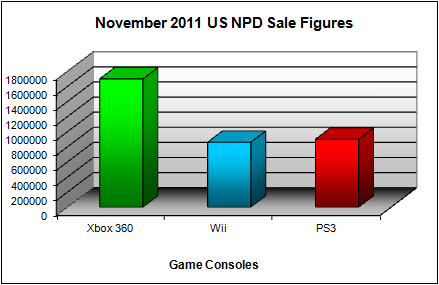
And so the figures for US sales in November 2011 are below, ranked in order of number of sales (November 2010 figures also shown, including percentage change):

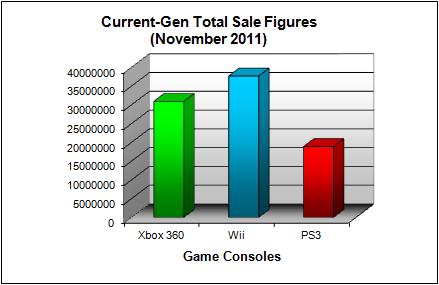
  • Xbox 360: 1,700,000 (Total: 30.9 million; November 2010: 1,370,000 – up 24%)
  • PS3: 900,000 (Total: 18.9 million; November 2010: 530,000 – up 70%)
  • Wii: 860,000 (Total: 37.7 million; November 2010: 1,270,000 – down 32%)
NPD November 2011 Game Console US Sales Figures

NPD November 2011 Game Console US Sales Figures

NPD Game Console Total US Sales Figures (as of November 2011)

NPD Game Console Total US Sales Figures (as of November 2011)

My prediction from last month was:

It’s the holiday period proper, sales will be way up, and Modern Warfare 3 will help in this regard as it breaks all records. The Xbox 360, the preferred platform of MW3 and also with a new Halo game being released, will be the clear winner yet again, but it will be interesting to see if the Wii can have one last good holiday period, and there’s a new Zelda game too, so that always helps. The PS3 does have Uncharted 3 though. If I have to guess, I would say the PS3 will beat the Wii. The top games will be the ones I’ve already mentioned, plus Skyrim.

I think the above paragraph actually sums up November quite well.

The Xbox 360 was easily the clear winner, but the margin of victory was larger than most has expected. Most expected the Xbox 360 to be the best selling console, but with only moderate growth compared to the same month last year, the first holiday period for Kinect and the new “slim” Xbox 360. But Microsoft surprised everyone with a series of key price cuts, bundles, and sales, and just like how the Wii’s second holiday period was even better than the first thanks to its status as a “must-have” family gift, perhaps the Kinect is doing the same for Microsoft this time round. In any case, a 24% increase in sales compared to last November is nothing to be scoffed at, especially when last November was an amazing 67% up compared to the previous November. Here in Australia, Microsoft has also been super aggressive in discounting the Xbox 360, to prices that are practically half that of just a few months ago, and the Kinect bundle also seeing huge discounts at selected retailers. If this is the same strategy employed in other countries as well, then the Xbox 360 should have a great holiday period, and not just in the US (perhaps this is Microsoft’s response to PS3 sales that have nearly or already caught up to the 360 global sales numbers).

The PS3 also had a great November, although nowhere near as good as the Xbox 360, with the 360 almost selling twice as many units. The 70% increase compared to last November looks spectacular, but one has to take into account that last November, the PS3 sold fewer units than in 2009 (25% down actually). Compared to 2009, PS3 sales are up around 26%, so at the very least, last year’s trend has been reversed with the key price cut that came in the middle of the year. Sony also promoted the fact that PS3 software sales are up 30%, and that, more so than hardware numbers, is what Sony really likes to see (although hardware numbers obviously do help to raise the software numbers, and that’s more of a case now than the first few years of the PS3, when many used it as a cheap way to get a Blu-ray player).

It looks like 2010 was the last great holiday period for the Wii. While sales are not bad this year, they’re nowhere near the million+ figures from yesteryear. And this will be the last holiday period for the Wii as Nintendo’s lead console anyway, with the Wii U set to play a key role this time next year. Still, to label the Wii as a “loser” or “dead” is doing the console a disservice, since it still nearly outsell the PS3, and nobody it calling it a “dead” console.

On to software. As expected, MW3 completely dominated the sales charts, with incredibly, 9 million units of the game selling on all platforms, with over a billion dollars in sales. Battlefield 3 fell to 3rd place as a result, but it’s still the best selling Battlefield game in the series. Skyrim, the game many are already calling game of the year, managed to get second place and that’s probably quite impressive for a game in this genre, and certainly in the Elder Scrolls series, where it’s only taken a month for the latest installment to sell without half a million of the last installment’s lifetime sales number. Assassin’s Creed: Revelations, Saints Row: The Third contributed to the strong software line-up for November, making it the best November on record, despite recent trend suggesting that wouldn’t have been the case. For platform exclusives, Uncharted 3 did extremely well to get up to 7th place with 700,000 units sold, ahead of the new Zelda game at 600,000. Super Mario Land 3D and Halo: Combat Evolved Anniversary didn’t make the combined platforms top 10, but would have easily made the top 10 separated by SKU. Here’s the full software sales chart for November (new releases for November 2011 in bold):

  1. Call of Duty: Modern Warfare 3 (Activision, Xbox 360, PS3, Wii, PC)
  2. Elder Scrolls V: Skyrim (Bethesda, Xbox 360, PS3, PC)
  3. Battlefield 3 (EA, Xbox 360, PS3, PC)
  4. Assassin’s Creed: Revelations (Ubisoft, Xbox 360, PS3, PC)
  5. Just Dance 3 (Ubisoft, Wii, Xbox 360)
  6. Madden NFL 12 (EA, Xbox 360, PS3, Wii, PS2, PSP)
  7. Uncharted 3: Drake’s Deception (Sony, PS3)
  8. Saints Row: The Third (THQ, Xbox 360, PS3, PC)
  9. The Legend of Zelda: Skyward Sword (Nintendo, Wii)
  10. Batman: Arkham City (Warner Bros, Xbox 360, PS3)

My prediction for December? Same hardware ordering, and a software chart that looks very similar to this month’s, so there’s nothing much to add to that really.

Except for the obligatory, “see you next month”!

Weekly News Roundup (4 December 2011)

Sunday, December 4th, 2011

We’re in the final stretch of 2011 now, so soon, I will have to mentally note to write 2012 instead of 2011 whenever I need to write a date. Plus there’s the whole world ending thing. A few interesting news items to go through, so let’s get started.

Copyright

There can’t be a copyright section without discussing SOPA, and while the Internet public once again showed how awesome they are on American Censorship Day, what with the 80,000+ phone calls made to Congress, the fight is still very much on.

And that’s the message Mozilla has been reminding people of this week, as they’re hoping for another day of action next Tuesday, and want people to commit to calling their Senators to oppose the senate version of SOPA, the PROTECT IP Act (PIPA). Like SOPA, PIPA aims to do the same things, by making tax payers responsible for protecting the outdated business model of the music and entertainment industries, and sacrificing the stability and safety of the Internet to do it. I don’t like to discourage people from taking part, but I think we all know down in our hearts that these attempts will be futile, as Washington politicians are driven by their pursuit of corporate campaign donations, and have long since stopped fulfilling their duties to the people who actually put them in office (by voting, not buy paying for campaign ads). But it’s the only option we have, and it’s one we must exercise.

Rep Lamar Smith (R-TX)

Rep Lamar Smith (R-TX) compares download a movie from the Internet to child pornography

What I find most disturbing about SOPA/PIPA, or maybe just predictable, is not that the RIAA/MPAA are pushing for it, but the others supporters. The involvement of the US Chamber of Commerce, in particular, because their M.O. has been to be the public face for corporations to behind. In this case, I think Big Pharma are involved, and they’re more interested in the counterfeiting part of SOPA. Counterfeit drugs should be stopped, as they’re either dangerous, or they do violate the earning rights of pharmaceutical companies, or both. But what Big Pharma may really be trying to achieve with SOPA is to block cheap, but perfectly legal (at least in other countries), alternative drugs. In the end, it always boil down to money. To greed. The fact that is SOPA/PIPA is passed, and the US government will be able to seize domain names of websites that are “dedicated” to selling cheap drugs for those who can’t afford it, and to force search engines to filter out results to these websites, is probably why Big Pharma are involved, why Pfizer was one of only 6 groups asked to testify at the SOPA hearings. We can also see Big Pharm’s involvement via their political lap dogs, and one of the co-sponsors of the bill, Rep. Lamar Smith of Texas has perhaps revealed too much this week in a written rebuttal of criticism of his beloved SOPA bill. Completely dismissing concerns about censorship and freedom of speech (it’s not a core issue for our supposed democratically elected politicians these days), what interested me the most was how Smith chided Google for actively promoting “rogue foreign pharmacies that sold counterfeit and illegal drugs to U.S. patients”, and Smith has a history of introducing or supporting bills that would benefit Big Pharma.

Smith, like many other clueless politicians before him, also once again linked web piracy to child pornography. “Like online piracy, child pornography is a billion-dollar business operated online. It is also illegal. That’s why law enforcement officials are authorized to block access to child-porn sites,” Smith wrote in support of introducing new laws to block online piracy. I find this statement quite incredible really. Does Lamar Smith of Texas think that the only reason law enforcement take action against child-porn sites is because it’s a “billion-dollar business”? I think there are other issues involved, which Smith appears to not care about at all, such as the actual welfare of the exploited children perhaps? And any time a politicians tries to link web piracy to child porn, it doesn’t elevate the seriousness of web piracy, it only serves to devalue the serious of child exploitation. So unless Rep. Smith really thinks that child porn is no more serious than college students downloading the latest Harold & Kumar movie, he should retract his statement, or face being accused of downplaying the seriousness of a truly heinous crime.

But while the moral opposition to SOPA/PIPA is well justified, and the technical opposition that has mainly focussed on the dangers of messing with DNS is also quite valid, one aspect overlooked is that, like most plans to stop piracy, SOPA/PIPA may just not work, particularly the highly controversial search engine filtering part! TechDirt dug up some stats that showed websites that will be prime targets for SOPA/PIPA, like The Pirate Bay, only rely on search engines for a small part of their overall traffic. So even if Google introduced a block to remove all results from all suspected piracy websites, the majority of web pirates would not be affected. And blocking the large sites on Google will just encourage many more smaller sites to take their place, to fill up the holes in the search rankings for terms that carry lots of traffic. And stopping thousands and thousands of smaller websites is going to be a lot harder than stopping a single The Pirate Bay (and we know rights holders don’t want to do the work, so they’re not going to track down each domain name and fill in the right forms to get Google to remove them), and this fragmentation will actually make web piracy easier. And this is actually the preferred scenario – the likely scenario is that malware sites will probably move in, and all those piracy newbs that don’t know the domain name of the The Pirate Bay or don’t know that you can type it directly into your browser, will get redirected to malware sites and billions will be lost as a result (see, I can make up monetary loss figures too).

And the DNS/IP filtering, as I’ve explained before, can be easily bypassed as well by people who don’t mind putting in the extra work, and I’m never surprised at things people are willing to do for free stuff (I mean, just figuring out how to use BitTorrent, including port redirections and stuff, is much harder than switching to a non filtered DNS). And the group responsible for “defeating” Google’s anti-piracy auto-suggest filter is back, as MAFIAA Fire releases a new add-on for Firefox called The Pirate Bay Dancing, which aims to circumvent blocking and filtering by randomly using one of thousands of proxy servers. It promises to work with any blocked site, even ones that are banned for political reasons, in countries that the US is now trying to emulate.

And it is all about the money. RIAA and MPAA money, and money from corporations in general, have corrupted the American political system, but the same money corrupts the copyright system too, it seems. This follows a breaking scandal in the Netherlands where, ironically, an anti-piracy firm stole the music it used in those anti-piracy ads you find at the start of DVDs, and it follows the plight of the poor artist trying to recoup what he’s owed, only to come face to face with the corrupt copyright business. The composer, Melchior Rietveldt, was given a “deal” in which he would have to give 33% of his royalties to the boss of a royalty collection agency, or face the possibility of not getting any money back. So you have anti-piracy firms performing commercial piracy, and you have copyright licensing firms doing backdoor deals and pocketing the real artist’s money for themselves.

Gaming

Skipping ahead to gaming, but still within the topic of copyright, we have Sony revealing details about the memory card for its upcoming PlayStation Vita portable console, and once again, it’s exactly what you would expect from a company like Sony.

PlayStation Vita

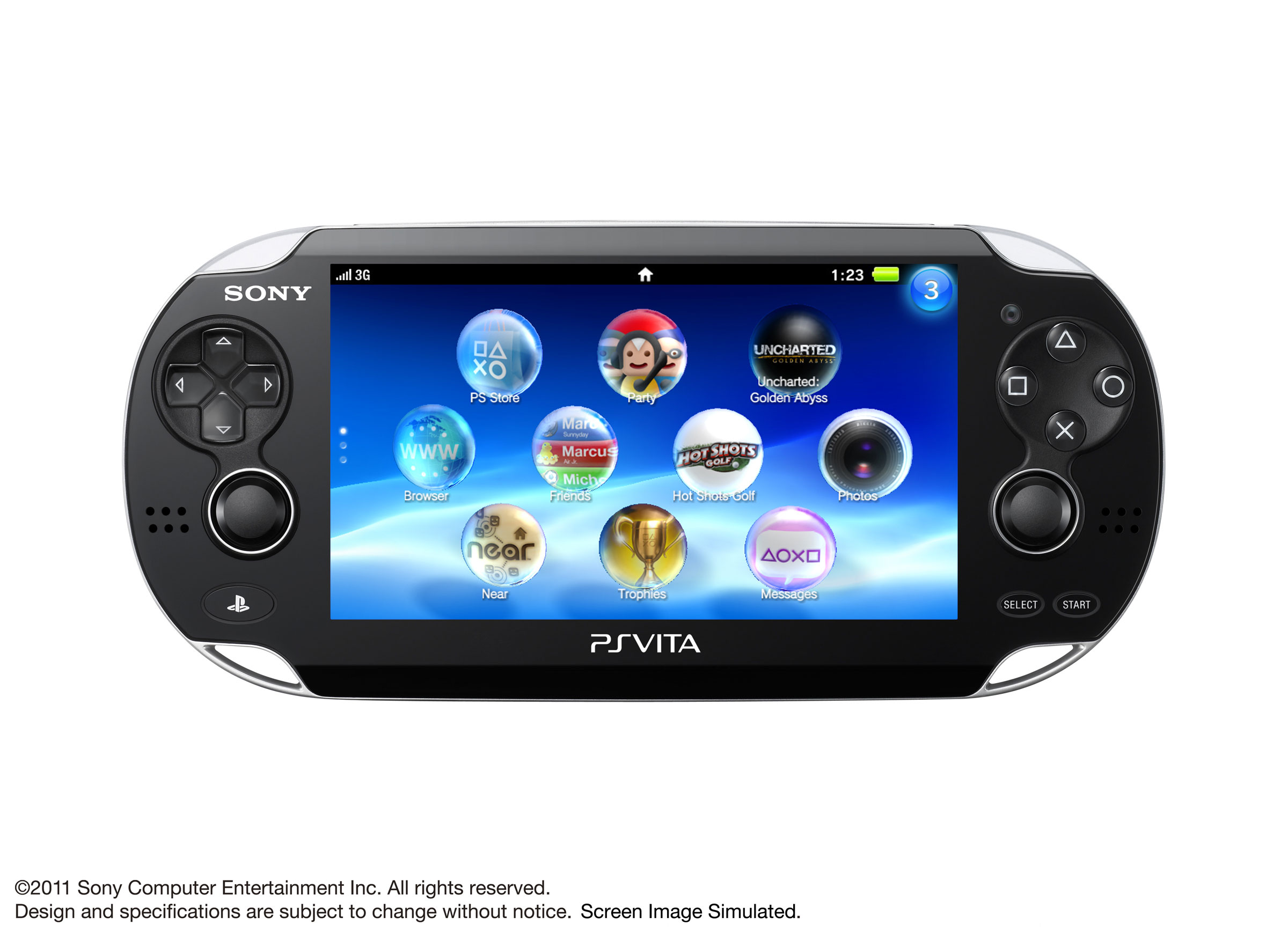
Sony will force gamers to buy new proprietary memory cards for the PS Vita, at $120 for 32GB

The PlayStation Vita’s memory cards will be yet again another Sony proprietary format, and if that wasn’t bad enough, it’s a new proprietary format that only works with the Vita – even Sony’s own proprietary MemoryStick format was apparently not good enough. Sony says this has been for performance reasons, and that may be partly true, but everyone knows that security is the real concern here (if performance was such a big problem, then why not dictate that only class 10 high speed SD cards can be used, and perhaps even run a speed test on cards before they’re allowed to be used on the Vita). By making the Vita memory card a proprietary format stuffed with DRM, and removing compatibility for the card to be used as a mass storage device (so that the card can only be accessed via Sony’s proprietary software), Sony hopes that hackers can’t use the memory card as a platform to launch a hack into the system, to avoid what did happen with the PSP.

But Sony’s actions may have the opposite effect, as hackers will see this new system that appears to be harder to hack, and see it as a challenge. But if there’s a way to use something, there’s a way to hack it to do something else, and I don’t think this will change regardless of how difficult you make it for legitimate gamers, now forced to pay a premium for Sony’s memory cards ($120 for 32GB).

Following up last week’s story about game retailers such as Steam and Good Old Games urging publishers to compete with pirates on service, not just on price, I have my own personal story this week with just how difficult paying customers have it compared to pirates. I purchased the game Sins of a Solar Empire a while back, it’s a game that doesn’t have DRM and I thought I would show my support (but mainly because it was on sale – pricing is still very important, more on that later). I had played the game a while back, but that was on XP, and now that I wanted to get the game running on Windows 7. While the game is DRM free, the full purchase process involves buying from Stardock’s Impulse platform, which has recently been sold to GameStop, registering within Impulse to download the game – Impulse was not required when I originally installed the game in XP, as it was only needed for updates. The Impulse platform is an app like Steam, that allows you to purchase, download and organize your game collection. Unfortunately, the serial code for the game I had would not register on Impulse, and searching the web, this appears to be a common problem. The only solution is to email Impulse tech support, and that’s what I did. But the problem is that it left me with a game that I purchased, that I wanted to play right now, and I’m unable to as a paying customer. So instead, I did what many would have done in my position – I downloaded a pirated version of the game, from a file hosting/sharing website without having to commit any illegal “uploads”, so I could play it right away. It took Impulse tech support 3 days to answer my query, which was to provide a new serial that would register.

Duke Nukem Forever PC Screenshot

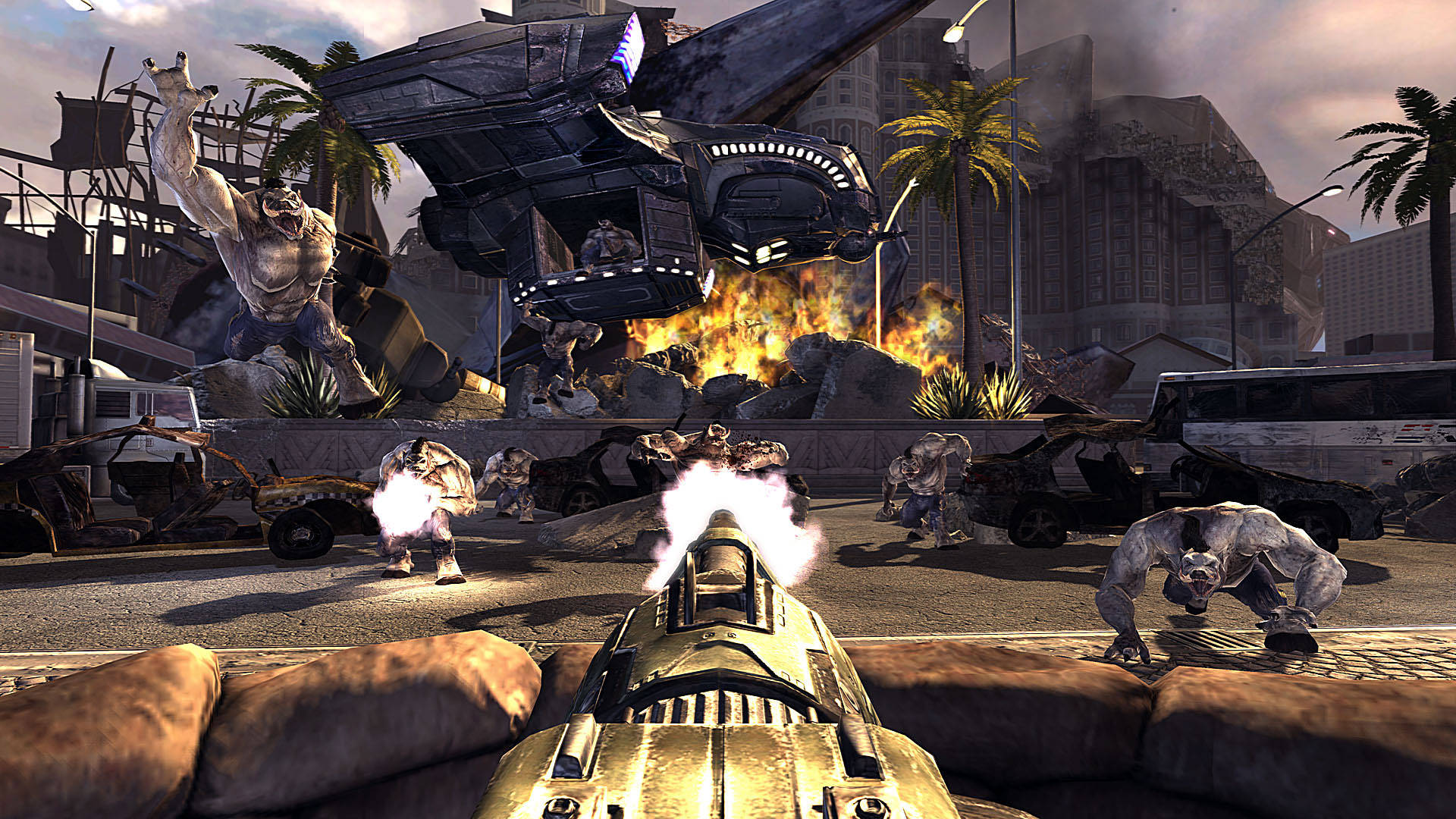
Crappy games, like Duke Nukem Forever, is still popular with game buyers because it's been heavily discounted

And pricing, I have to say, plays a big part in game purchases. And I’m not talking about must-have games, but rather, the games that you might think you’re interested in, but not so much that you would want to pay full prices for. Right now, piracy seems to be the most popular way to get these types of games, but for me, the various Steam sales have become the better alternative. I’ve bought a lot of games just because they’re cheap, and for $5, you can’t really go wrong. It’s this type of thinking and impulse buy that could drive the PC gaming market, and also prevent piracy (or monetize piracy, as downloaders “legalize” their pirated copies by buying a legit one on the cheap). I understand that you can’t release new games at this low price point, but for games that have received less than positive reviews, the price drop should happen much more quickly than it does right now (to be fair, some publishers have already started embracing this principle – badly received games are often now purchased up despite the bad reviews if the price is right – that’s money the publisher otherwise wouldn’t have had, or wouldn’t even deserve for publishing a bad game).

Alright, enough ranting for this week – gotta save something for next week. See you then.

Weekly News Roundup (27 November 2011)

Sunday, November 27th, 2011
Steam Autumn Sale

Steam's Autumn Sale is on, and if you're like me, then credit card (or PayPal account) will take a pounding as a result - and to make things worse, Steam's holiday sale is just around the corner!

Hope you’ve had a nice week, perhaps even a night Black Friday deals week. If you’re like me, then your wallet has taken a pounding, despite the Blu-ray and game deals being not all that great so far. The Amazon US/UK Black Friday Blu-ray sales, especially the spotlight/lightning sale items, have been generally disappoint though, not that it has stopped me buying a dozen or two Blu-ray’s, mostly from the BF general sales categories. Steam’s Autumn Sale is a bit more interesting, still has one more day to run, but the titles I really want haven’t really come up yet (snatched up Portal 2 and Orcs Must Die so far). Speaking of Steam and bargains, would you like some free Steam games? If so, and if you have luck with competitions and stuff, then you should try Steam Gifts, which is now open to sign-ups (no more invitations). The way it works is that you periodically get “points” which you can use to enter competitions for games gifted by other users, and if you’re lucky, then you can get lots of free games (I’m not so lucky, 0 win out of 33 entries so far). Most competitions have a couple of hundred to a few thousand entries, so it’s not easy, but it’s probably easier than most other competitions, plus it’s all free. Just realised that it’s actually counter-productive for me to tell you about Steam Gifts, since more people will make it harder for me to win – so, if you can, forget what I just wrote, and whatever you do, *don’t* sign up. Thanks.

Copyright

Continuing on from last week’s anti-SOPA stories, remember when Nancy Pelosi tweeted in support of opposition to SOPA. It seems an important endorsement of a growing movement, and as a progressive politician, it seems like the right thing to support.

Unfortunately though, it seems Pelosi is yet another politician in the pockets of the movie industry, as the “backflip”, or what Washington politicians call a “clarification” came soon after the tweet, declaring Pelosi’s continued support for the film industry’s fight against web piracy, blah blah blah. And people wonder why Congress only has a 9% approval rating, or why if it suits some lobbying agenda, that even tomato paste on pizzas can be declared a vegetable, made more ridiculous by the fact that tomatoes are a fruit.

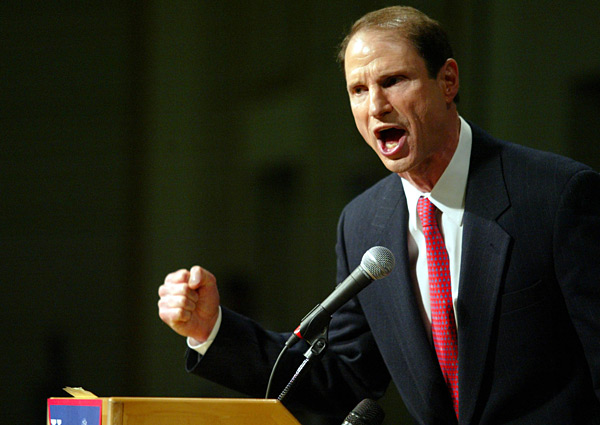
But one politician sticking to true convictions is Senator Ron Wyden of Oregon. He as the only senator to stand up PROTECT IP when it pass through the Senate’s own judiciary committee, and he did it by placing a hold on the bill, delaying the vote until 60 other senators get together to vote the hold down. PROTECT IP, if you don’t know, is SOPA’s uglier older brother, and both try to do the same thing – make the government responsible for the copyright enforcement of the movie and music industry, at tax payer expense, by destroying due process and possibly the entire Internet.

Senator Ron Wyden

Senator Ron Wyden is fighting the good fight to preserve the Internet and your freedoms

Unfortunately, Senator Wyden concedes that the 60 votes needed may not be far away, and he is now going to use a more common tactic to delay the voting – a filibuster! Not only that, he’s asking those opposed to PROTECT IP (and SOPA) to submit their names to stopcensorship.org, and Senator Wyden will read out people’s names during the filibuster. It’s a nice touch, and I hope there are enough names submitted for Senator Wyden to have enough to read during his filibuster. If only all politicians were like Senator Wyden, and actually stood up for the public’s interest, as opposed to that of corporations, the US and the world would not be in the state it is.

For those that think there’s too much hyperbole when it comes to the threats attached to SOPA and PROTECT IP, that these aren’t really that dangerous and “normal” people won’t get affected by it, then if you want examples what governments that are too copyright-friendly can get up to, then here’s a story from Denmark. Like what SOPA and PROTECT IP will allow the US government to do, Denmark banned The Pirate Bay, and now, a blogger who simply posted instructions on bypassing the block has had his home searched, and could face up to 5 years in prison. You see, in order to allow for the enforcement of website bans, the government has also had to ban tools and techniques that bypass the ban, something that’s in SOPA as well. But many of tools that bypass website blocks are industry standard tools, and the techniques are fairly straight forward and are used for other things as well (such as trying to stay anonymous online), and  just as the EFF warned the other week, something that’s not thought out like SOPA could make a whole host of perfectly legal, and extremely useful tools and techniques for engineers and Internet businesses, illegal.

And so 19-year old law student Halfdan Timm found himself facing arrest by police at his school if he did not cooperate with a search of his flat, and police ransacked through everything, including his roommate’s room, and even through his dirty laundry. All of this was based on a “hunch” by the film industry’s anti-piracy agency in the country, and this could very well happen to more people in the US if SOPA or PROTECT IP passes.

Google Auto-Suggest

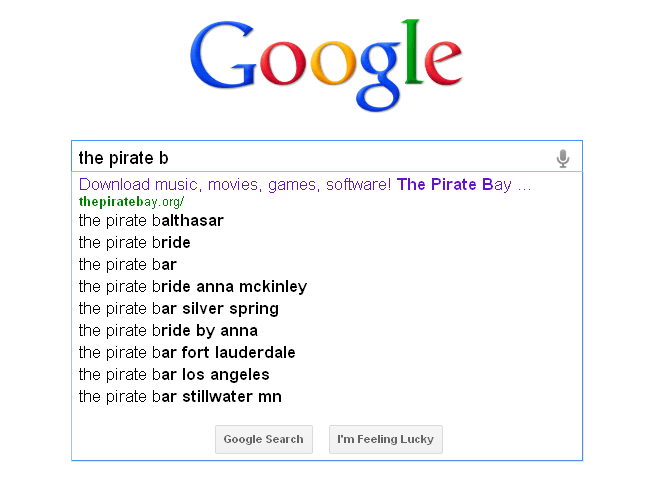
Ironically, while "the pirate bay" related terms are removed from the suggestion list, the actual domain name is still the top linked recommendation due to its number one position on the search ranks

And while Google was doing its best to put some at least some kind of resistance to SOPA at the Congressional hearings, they’re again walking the tight rope between giving the film/music industry what it wants, and ensuring their own interests (and that of web searchers) are not compromised. So this week, Google added more “piracy related” keywords to its auto-suggest/complete blacklist, now including the term “the pirate bay”, “isohunt”, “fileserve” and basically all the major file-sharing websites. When a keyword is black listed, it will no longer come up as a suggested or auto-completed keyword in Google search, but the search result is not affected. But as I said when Google first introduced this “do no evil” feature back at the start of the year, it won’t really appease the rights holders, because what they’ve wanted from the start was for Google to actually filter the results (and SOPA/PROTECT IP will give them that). Google’s policy of appeasement was never going to work, and I think they should just stick to their guns and don’t accept blame for what people are searching for.

With SOPA/PROTECT IP, and the government intervening in copyright cases, the future of mass copyright lawsuits will become even more uncertain. Most of damage to their cause is being done by Righthaven these days, with their scattergun approach and their ability to pick the absolute worse people to sue (plus the whole suing people for newspaper articles repostings, is just not as “sexy” as suing big bad pirates for downloading illegal movies). Probably their worst target so far has been Democratic Underground, a progressive political forum where they simply love to be in this kind of fight, and choosing people *not* willing to put up a fight is exactly what mass copyright, pre-trial settlement fee extracting lawsuits are all about. Anyway, this week, Stephens Media, the backers of Righthaven and also their only major client left, conceded that Democratic Underground had fair use rights to use a five-sentence reposting of a Las- Vegas Review-Journal article. The admittance to fair use rights is actually kind of a biggie, since the other cases Righthaven lost have been mostly on procedural issues (the question whether Righthaven even had the right to sue on behalf of Stephens Media). A five-sentence posting, to me, is definitely fair use, as if it isn’t then even just posting a link with a headline for an article may become the target of a lawsuit in the future, and that’s just counter-productive for all involved. If anything, a 5-sentence excerpt is really free advertising for the newspaper, as people, if interested in the story, will click on the accompanying link to read more, while those not too interested will get the gist of the article without wasting the bandwidth of the newspaper website – a win win, really. So I have no idea why Righthaven even sued in the first place, it was a loser from the get go.

And with Righthaven dying a slow death, the Australian version of mass copyright lawsuits seems to have hit a snag before it has even started, with the VP of Movie Rights Group leaving the company, and the website for the firm going down. It’s definitely been quiet the last couple of weeks, ever since the first stories surfaced of MRG’s attempt to sue thousands. We’ve only really heard from ISPs about what they intend to do, but nothing much from MRG. And since Australian law is different from US law, perhaps MRG has hit some hurdles in their attempt to get customer data, or to approach them with settlement offers based on the threat of statutory and punitive damages. Nobody will shed any tears if MRG does disappear into the wilderness.

GamingTechnically still a copyright story, but I wanted to give a bit more variety to this WNR, so into the gaming section it goes.

Ubisoft may withdraw from the PC market, says senior company employees, due to piracy. Or not. The confusion comes from Ubisoft creative director Stanislas Mettra, and his rather angry rant at “bitching” PC gamers, although he later retracted his statements saying that as English wasn’t his first language, he probably meant something else when using the term “bitching”. But I’m sure he wasn’t trying to say that all PC gamers were female dogs, although that would explain why nobody is paying for anything (dogs don’t have pockets to put their wallets in, you see). But Ubisoft producer Sébastien Arnoult didn’t retract his statement that “95% of our consumers” are pirates (and consume as in play the game, as opposed “consumer” in the normal sense of the word), and saying that is the reason why Ghost Recon: Future Soldier will not be getting a PC version.

Ubisoft Logo

Ubisoft may stop making PC games because of piracy

Ubisoft’s own “bitching” about piracy is really getting stupid now, and it looks like they’re more than willing to shoot themselves in the foot once more by ditching the PC market. But to be fair, their stupid DRM probably already drove away their last remaining loyal PC gamers, so they really have nothing much left to lose.

But it’s ironic that two game retailers, Steam and Good Old Gaming, both came out to attack Ubisoft’s stance, and both are companies that have been very successful selling PC games even when everyone else was saying that the market is completely dead due to piracy. Steam’s Gabe Newell says that piracy is more of a service issue than a pricing issue, and that’s definitely true. He again points to markets like Russia which had been abandoned by companies like Ubisoft due to high piracy rates, but by abandoning the market and not producing a regional version of the game (with the right language), it left gamers with only a single choice – piracy. By providing faster regionalisation and better services, Russian is now Steam’s second largest market in Europe. Trevor Longino from Good Old Gaming agrees, because he sees piracy as an easier way to get and play games than the current loopholes that publishers want paying customers to jump through, via creating multiple accounts, and offline and online validation.

But I think pricing is definitely also an issue. Steam themselves have pointed to higher total revenue when games are priced significantly lower. With digital distribution, there’s no actual cost increase associated with selling more copies, the only extra cost comes from tech support and perhaps support for online features. Publishers don’t pay much attention to tech support anyway, so it’s not as if more gamers would strain their (lack of) service too much. And online features can have their own marketplaces, where gamers can buy additional items, and so more gamers equals more revenue normally. And this is why free-to-play seems to be a new business model, and even Ubisoft is getting in on the act with Ghost Recon Online.

But I think there’s a good balance between free-to-play, and “pre-paid” games that also have purchasable optional online content, and done in a better way than DLCs that add nothing to the game experience, which sadly is the case far too often these days.

My finger hurts, so it tells me it’s probably time to stop typing. See you next week.