Archive for the ‘Gaming’ Category

Weekly News Roundup (19 August 2012)

Sunday, August 19th, 2012

Welcome to another edition of the WNR. NPD “released” its July 2012 sales stats for US video game sales, but unfortunately, only Microsoft again chose to divulge its hardware sales stats. So no July NPD analysis, which is a shame, but there wasn’t any real surprises anyway. I’ll talk a bit about it in the gaming section below.

Another pretty full news week, so let’s get started …

Copyright

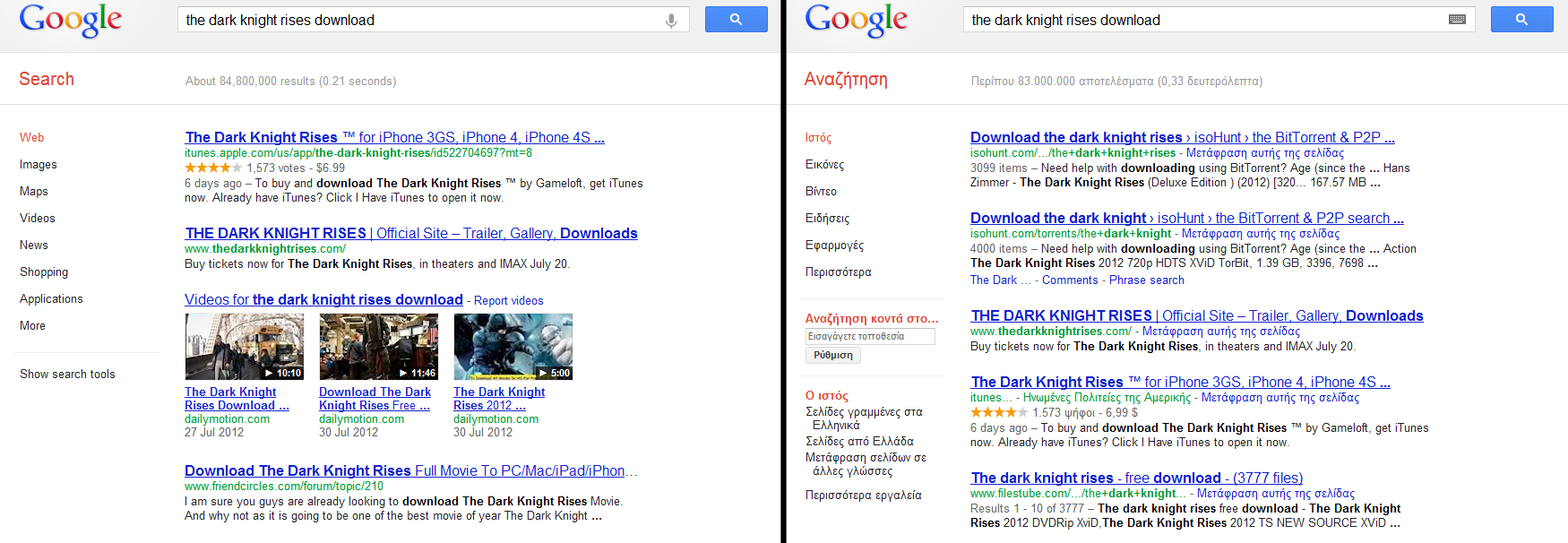
So much for “do no evil”. Google gave in to the demands of the MPAA and the RIAA this week by signalling it is ready to start self-censoring its own results to reduce the visibility of alleged piracy websites. Without going as far as removing suspected websites, Google will start demoting any website that receives an unspecified number of DMCA notices.
Google DMCA Demote

Google has started demoting websites that receive too many DMCA notices, the image on the left shows the demoted rankings, while the image on the right (for the yet unchanged Greek version of Google) shows the previous rankings

It’s own YouTube website, and “major brands” will apparently be exempt from this new rule (webmasters have long suspected there’s one rule for the web top 100, and another rule for the rest), but the rest will now have to live in fear of the system, which is already being massive abused by those seeking an unfair advantage (57% of all filed notices, according to a Google report from 2006), and made even more attractive as a “black hat” weapon of choice now that the entire domains of competitors can be demoted. Since Google started releasing DMCA stats, the number of DMCA notifications has risen from about a million per month, to now over 4!

Except none of this will work to stop piracy, because people aren’t turning into pirates just because they see some links to The Pirate Bay on Google. I don’t know if it’s naivety, a head in sand attitude, or a deliberate attempt to muddy the waters, but the idea that good, people are being fooled and misled into downloading pirated content online is, to put it simply, hogwash. People pirate and they do it willingly, and knowingly. And they spent a lot of effort learning and honing their piracy skills. They will most likely alredy have go-to places to get their piracy fix, or custom search engines that does more work separating the wheat from the chaff, so the idea that they’re all relying on Google to find the S01E08 of The Newsroom is simply a fantasy.

But despite Google’s proactive steps in reducing piracy, the MPAA/RIAA still wants more. In a joint submission to the US Copyright Czar, the MPAA and the RIAA have called on the government to do even more in the CRusade Against Piracy (CRAP™), including going all “Megaupload” on websites like The Pirate Bay. Basically a wish-list and a preview of what the copyright landscape could be like if the MPAA/RIAA get their way, the submission also talks about increasing criminal sentences for copyright offences, including making the unauthorised streaming of videos a felony.

Showing that they’ve not quite given up on SOPA/PIPA, the submission also calls for tighter control of domain names, including those outside of the jurisdiction of the US government. The groups also say that the government needs to go out and threaten private businesses like domain name registrars, search engines, and advertising agencies and get them to fall in line with the MPAA/RIAA’s vision of copyright enforcement. So it’s simply not good enough for Google to only demote websites that have yet to be proven, in a court of law at least, of doing anything wrong – no, the MPAA/RIAA says search engines like Google must “delist rogue sites”. Note the use of the term “rogue”, the same type of language that’s also being used to describes countries like North Korea and Iran, and I don’t think this is a coincidence either.

Feeding into the paranoia and hysterics that aims to paint college kids downloading movies as something much more serious, the MPAA/RIAA also strategically brings “organized crime” and “gangs” into the equation in this submission. But as far as I know, Tony Soprano purchased his copy of The Godfather, and it may be just me, but I just can’t imagine the Crips and the Bloods getting into the torrent search engine business.

High Definition

The wait is finally over. The kind people at Fox studios have finally allowed their customers to buy Avatar on Blu-ray 3D, for a price that isn’t a ridiculous 3 figure number.

Fox’s deal with Panasonic, where the electronic giant has exclusive rights to distribute the Blu-ray 3D version of Avatar with the 3D electronics, was one of the more controversial movie deals in recent times. Coming just at a time when Blu-ray 3D needed a launch title that could only come from the most acclaimed and most financially successful 3D movie of all time, the exclusivity deal meant that the format lacked a killer title available in stores that would have helped the format’s early adoption. As such, Blu-ray 3D hasn’t taken off in the way that electronic manufacturers and movie studios had hoped.
Avatar 3D Blu-ray Panasonic Exclusive

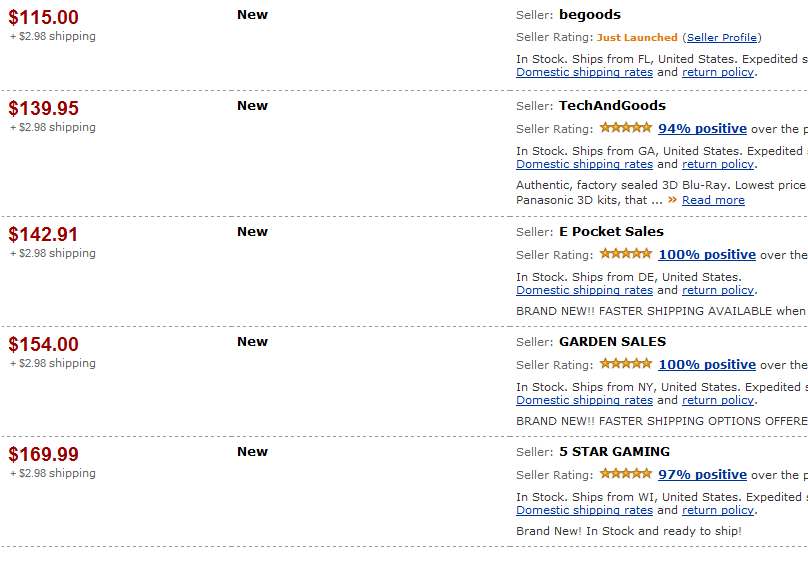
The Panasonic exclusive version of Avatar on Blu-ray 3D is still fetching 3 figures on eBay and Amazon, but the retail version will be available in October

With that said though, while people aren’t using 3D as much as studios would have liked, they’re still buying them because the price premium of 3D over 2D ranges between inconsequential and non-existent. Try and find a top of the range 2D TV that isn’t also 3D, and you’ll struggle. And when there’s only a $20 difference between a 2D Blu-ray player and its 3D equivalent, consumers don’t really have to make any hard choices.

Still, the retail release of Avatar on Blu-ray 3D should help the format break all kinds of records when the disc is released in October. The price is a bit higher than your average Blu-ray movie, $28 at Amazon, but it’s definitely better than paying $128 for it on eBay, right?

But don’t bet on this Blu-ray 3D Limited Collector’s edition to be the most definitive 3D version of the film to arrive on disc. The fact that this release might not even feature the extended cut means that Fox is already planning a quadruple dip of the film sometime in the near future.

Even for the 2D version, it’s only a matter of time before we see the 4K or whatever version of the film on possibly a new disc format, or if bandwidth issues are resolved, via streaming or download. Projects like Australia’s NBN and Google Fiber will aim to fix for the bandwidth issue once and for all with the move to fibre optics, which has almost an unlimited capacity to carry TB/s and beyond, but another solution is to increase the efficiency of the delivery codec. Which is why it was interesting to read about the news of a new format being officially approved by the Moving Picture Experts Group (MPEG), which promises to provide the same visual quality as H.264 with only half of the bandwidth needed.

H.264 is already super efficient, so it’s hard to believe that something could come along and double that efficiency, but HEVC, or H.265, aims to do just that through more computational intensive algorithms. Mobile applications would probably benefit the most from H.265/HEVC, due to their inherent bandwidth limitations, although faster (and more power hungry) devices may be needed to decode the video.

The other main beneficiary from a more efficient codec would be the web streaming industry, finally allowing the likes of Netflix to do true Blu-ray quality streams on connections less than 20 Mbps.

For other applications, 4K is an obvious candidate, but 4K only really benefits super large screens (say 80″ or above), and it’s an overkill for anything smaller. And if staying at 2K or 1080p resolution, the increased efficiency of H.265/HEVC may allow for same bitrate, but higher quality encodes, although you’ll get diminishing returns on any quality improvement for Blu-ray encodes, many of which are already visually flawless to the average viewer.

Gaming

Blizzard’s Battle.net has become, perhaps, one of the most tempting targets for hackers in recent times. Not only does the company hold a heck of a lot of data for a heck of a lot of people, Blizzard also holds tons of financial information for all those subscribers to WoW, and all those buyers/sellers on Diablo III’s Auction House. And the company’s stance towards “always-on” DRM for D3 meant that anyone who pokes holes in their security will instantly receive a lot of “web cred” for their efforts.

Blizzard Security Notice

Blizzard was hacked last week, with a ton of user information stolen in the process.

So unsurprisingly, Battle.net was hacked this week, with a heck of a lot of data being stolen in the process, including emails, (encrypted) passwords, security questions/answers, and even data related to the mobile authenticator that’s supposed to prevent hackers from getting into your account. The scale of the breach is actually quite spectacular, with the email addresses of every Battle.net account (except for those in China – probably on different servers) being leaked, and pretty much all accounts on the North American servers being compromised further.

Just the other week, Blizzard was boasting about how effective “always-on” DRM has been in preventing piracy, which has meant the company has made record amounts of money selling the hit game. It’s a shame that they didn’t invest enough of their loot (using it in the Diablo III sense) in protecting their users, but when you treat your customers as criminals by forcing draconian DRM on them, their rights were never that important to start with.

And as mentioned in the intro, the July NPD report was released, with the Xbox 360 once again riding high among the home based consoles, selling 203,000 units. But it was still 26.7% down compared to the same month last year, although the other home based consoles probably didn’t fare much better (the Wii in particular). The holiday sales period is coming up soon, and with the Wii U out around that time, it will be interesting to see if the Xbox 360 and PS3 will make a comeback, or take a further hit, when sales ramp up for this period.

But a price discount could do wonders for the two ageing consoles, especially when up against the compartively pricey Wii U.

That’s that for the week. See you in seven!
Weekly News Roundup (5 August 2012)

Sunday, August 5th, 2012

Hope you’ve been enjoying the Olympics. Hasn’t been such a great one for those watching here in down under though, don’t know what’s wrong, but you know *something* is definitely wrong when New Zealand manages to get more gold than you do. I haven’t really been watching though, not really my thing as I’ve mentioned before. Too much commitment given the time differences, and I’ve got to get my body ready for a grueling season of English football watching once the Olympics are finished.

Without further ado, whatever this “ado” substance is, let’s get started with the weekly news roundup.

Copyright

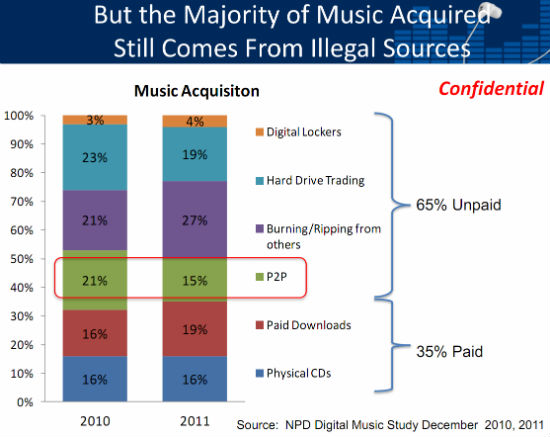
Much is made of the impact the Internet piracy has had on the music industry, the creative industry that is perhaps suffering the most from the “piracy scourge”, but it appears the music industry has been keeping a big secret from everyone: that online downloads do not appear to be the major source of pirated music!

NPD Digital Music Study

Online piracy is not the main source of illegal music files, according to research referenced by the RIAA

In fact, 70% of all pirated music are sourced from offline methods, according to newly leaked data from NPD courtesy of an RIAA report. And despite all the hoopla surrounding the closure of Megaupload, all digital lockers combined only contributed to 6% of illegal music sources. Instead, traditional CD ripping/burning and hard-drive trading still rule the roost when it comes to illegal music sharing. Of course, music found in traded hard-drives may have come from online source in the first place, but it appears most people’s first port of call for pirated music is their friends and families, not the Internet.

This set of data was marked confidential, and probably for good reason. If the public were made aware the actual contributions online piracy made to the pirated music scene, they might label the industry’s efforts against online music piracy as disproportional and inappropriate, and far from the rise of the Internet piracy being the downfall of the industry, there might be other factors that are in play. It’s almost as if the industry is using Internet piracy as a catch-all excuse for all of their woes, but I’m sure those in the music business have more class and honor than that.

One of the most disproportional responses to the online piracy problem has been the introduction of “graduated response”, or more commonly known as “three-strikes”, regimes – the most notorious one being the French “Hadopi” regime. Hadopi was a pet project for former President Sarkozy, but the newly elected socialist government of France appears to be less keen to continue on with the program. New cultural minister Aurelie Filipetti says Hadopi is too expensive (12 million euros per year) for the results it has obtained so far (still awaiting the first actual disconnection I believe, with 340 out of the millions of monitored users awaiting “sentencing” after being caught out for 3 times), and that it has failed in its goal to help promote legal alternatives.

And even if Hadopi had produced bannings, Filipetti says that this kind of punishment appears to be “disproportionate” compared to the seriousness of the crime.

I firmly believe the success of programs like Hadopi should to be judged not on how many people it bans or even how many people have stopped pirating because of it – it should only be judged on the basis of whether it has helped to increase revenue for the creative industries. If revenue has not increased as a result of three-strikes and other anti-piracy measures, then these measures have no real value other than being an affront to personal privacy. The failure of these programs to produce the required financial gains will also poke serious holes in the industry’s figures regarding losses due to piracy, and it would prove that not all acts of piracy would have otherwise generated a sale had piracy been prevented.

——

Uplay 2.0.4 Update

Users are advised to updated Uplay to version 2.0.4 or newer, to prevent Ubisoft’s infamous DRM and online platform from acting like a rootkit

Another week, another Ubi DRM controversy. Following the Steam Summer Sale disaster a few weeks ago where Ubisoft’s Uplay online and DRM service failed to accommodate the surge in game buyers, this week, Uplay is caught up in its own Sony style rootkit scandal.

The Uplay installer comes with a browser plug-in that’s automatically installed. But when curious Google engineer and Ubisoft game buyer Tavis Ormandy examined the plug-in further, he found that the plug-in not only allowed Uplay games to be launched, it allowed *everything* to be launched from a browser window. This is bad news because this could allow, for example, malicious websites to use the plug-in to launch anything and effectively take control of your computer. Unintentionally, Uplay had become the very definition of a rootkit.

Ubisoft was quick to release an update that fixed this vulnerability, so if you have Uplay on your system, then you’re advised to update Uplay as soon as possible, and do it with your browser closed as to allow the update to occur For now, there have been no reports of actual damages of unauthorised access by hackers via the Uplay plug-in, but if there are, I’m sure lawsuits will be launched promptly.

——

A few weeks ago, I wrote about a new study which alleges a music industry led anti-innovation crusade against Internet start-ups following the legal victory against Napster. In the study, it is alleged that most of the money earned from successful lawsuits went on to fund other lawsuits, in a sort of Ponzi Scheme that ran and ran until the money expectedly ran out. Artists and rightsholders, those the music industry points to as the real victims of piracy, apparently saw little of the “loot”. It seems nothing much has changed when it comes to the modus operandi of the industry, as it’s been revealed this week that even in the event record labels manage to recover the damages they won from The Pirate Bay lawsuit (some half a million euros worth), they will again refuse to share it with the “real victims”.

Not that there’s anything to share yet or perhaps ever, as new legal documents state pretty clearly that authorities have had little success and little hope of ever recovering the full amount of damages, as unsurprisingly enough, the individuals named in the lawsuits had little asset to seize (so much for the financial gain angle that Big Content says is behind most piracy operations).

If any money is recovered, the legal document says seized funds will be put to use to sue others, just like in the post Napster days. The difference being that, thanks to the industry’s efforts, piracy has become much more resilient than in the days of Napster or even LimeWire. The good news for the industry (sort of) is that legal downloads are also more prevalent. Although due to the industry’s obsession with piracy and their anti-innovation crusade, the lack of investment in innovation and forward thinking has allowed an opening for tech companies like Apple and Amazon to come in and take a huge chunk of the distribution cash cow.

High Definition

And it seems to very same trend is being repeated with the movie industry (I guess no lessons were learnt).

The major studio’s beloved Blu-ray format continues to grow solidly, even with the holiday release season, which traditionally provides a big jolt to spur growth in market share, still yet to arrive. Even with Blu-ray movie prices continuing to drop, revenue has also been increasing, suggesting unit sales are up significantly. Some of Blu-ray’s growth has come at the expense of DVDs, as expected, but it appears that digital distribution is the main reason why DVD revenue continues to fall, and digital has been the real success story of the last couple of years.

Amazon Prime Instant Video - New Additions

With more and more titles being added every couple of weeks, Amazon Prime Instant Video is fast becoming a major player in the subscription streaming scene currently dominated by Netflix – both there’s plenty for everyone it seems – revenue are up 430% in a year!

New figures released by DEG, The Digital Entertainment Group, shows remarkable growth for all things digital. While revenue from transactional VOD services (where each request for a video is a separate payment/transaction – basically services like Vudu and the non Prime version of Amazon Instant Video) was only up modestly, some 11.6% (comparable to the rise in Blu-ray spending of 13.3%), the real growth has been in subscription VOD services like Netflix (and the Prime version of Amazon Instant Video).

An amazing 430% growth was recorded, made more amazing by the fact that this isn’t just some paper growth, but actual revenue exceeded $1.1 billion just for the first 6 month of 2012. Subscription VOD now accounts for 13% of all home video spending!

Actual Blu-ray revenue wasn’t made available by DEG (only that total physical disc spending was $3.7 billion), but data from other sources such as Home Media Research puts Blu-ray spending at just under $892 million for the first 25 weeks of the year. This means that in all likelihood, spending on subscription VOD services have now overtaken Blu-ray spending for the first time ever (this time last year, subscription VOD spending was only $208 million).

Not that I want to make this somewhat apples and oranges comparison – both delivery platforms are aimed at quite different demographics, and at the moment (due to lack of high quality HD content on streaming services), neither are really competing with each other. But once ultra speed broadband services, such as the recently priced Google Fiber are more prevalent, this could change again. For me, VOD streaming is a game changer, much more so than Blu-ray. It seems subscription VOD has the ability to not only cannibalize DVDs, but possibly rental too, and if the bandwidth issue can be solved, it can take on Blu-ray as well.

Here in Australia, the government is investing in the next-generation fibre broadband for 93% of all premises, providing up to 100 Mbps residential services at first with the capability of supporting Google Fibre like 1 Gbps speeds in the near future. It’s a fantastic and visionary project, but unfortunately, political games will most likely see the project scrapped before it’s completely finished. But in the off chance that it is completed, the ability for most homes in Australia to stream one or more Blu-ray quality streams without saturating the entire connection would most likely see the convenience of streaming win over the humble optical disc. One can dream, at least.

Speaking of dreaming, it’s fast approaching midnight and it’s probably time to call it a day on this edition of the WNR. Hope you enjoyed reading it. See you next week.

Weekly News Roundup (29 July 2012)

Sunday, July 29th, 2012

So the Olympics are under way. Didn’t watch the opening ceremony myself, not really my type of thing really, but by all accounts, it was pretty good. It’s even better in 3D apparently, but 3D is not my type of thing either. If either or both are just your type of thing, then you’ll be in for a treat, and there’s nothing like a major sports event to help sell a load of TVs, this time, 3D TVs in particular. But by all accounts, the 3D hype has been steadily dying, and it definitely hasn’t turned out to be the “must-have” tech that TV makers envisaged.

Let’s get this WNR started …

Copyright

Having skirted the issue of whether the “always-on” Internet requirement for hit game Diablo III was for anti-piracy, anti-cheating/hacking, or was a genuine attempt to make a better game with better features, the makers of the game, Blizzard, this week finally admitted that the controversial “feature” is, at least partially, for anti-piracy. For the rest of us, this merely confirms what we thought all along.

Diablo 3 - Error 37

Anti-piracy is in fact one of the reasons why Blizzard chose to use always-on DRM for its game, Diablo III

For anti-DRM activists though, the worst thing about Blizzard’s DRM is that it actually works. Not so much as a way to stop cheating or hacking, but it has worked to help delay efforts to pirate the game, and that has contributed to the record sales figures the game has recorded. While the disastrous launch of the game, and subsequent gamer complaints (such as lag, even when playing a single player game), will have hurt the company, at the end of the day, it’s the bottom line that counts and Diablo III is a huge success whichever way you look at it. Of course, what works for Diablo III may or may not work for other games. Diablo III was a highly anticipated game, a decade in waiting, and so when you get gamers *that* desperate, *and* when you do produce a good game when looking beyond the DRM, it seems gamers are more than willing to jump through dozens of DRM encumbered hoops and still call the game great. Try and do that to, say, a new gaming IP, a less anticipated sequel, and then fail to actually produce a good game, then gamers *will* vote with their wallet. It seems for now, DRM is not so much a deal breaker, but it does add to the game’s list of existing negatives. Add those negatives together and if the positives don’t outweigh them, then you’re in trouble!

Japanese DVD Ripping Magazine

A DVD ripping magazine for sale in Japan has seen four journalists behind it arrested thanks to Japan’s tough new copyright laws

Now I’ve never wanted to live in Japan – too crowded and busy for my liking – but there’s now even less reason for me to want to move there, because it seems I won’t last too long in the land of the rising sun before I’m arrested for crimes against copyright. After the Japanese parliament passed laws that could see people watching the wrong YouTube video go to prison for 2 year’s time, this week, police arrested four journalists for the heinous act of writing and selling a magazine. A magazine that did feature guides about DVD ripping and a cover disc that included some commonly available DVD ripping tools, but nevertheless, just a magazine. This is also the same set of new laws sees most Linux distributions getting banned in the country, as most include the libdvdcss library, used to allow DVD playback, but can also be used for DVD ripping. It’s almost as if companies like Sony were given powers to write the country’s copyright laws, and along with Germany as you’ll read about below, both countries are doing their best to show us what a pro-copyright dystopic future lies in wait for the rest of us, if rights holders get exactly what they want.

And if you happen to own a smartphone in this future, then apparently, you’re a no good stinking thief of a pirate. At least that’s what a group representing German rights holders think, because it’s demanding a piracy tax on any and all storage mediums, including the memory built into your smartphone or tablet. The group, ZPUe, wants tech vendors to pay them €36 ($USD 43) per smartphone sold, and it wants retroactive payment dated back to 2008. It also wants €9 for external HDDs bigger than 1TB.

You can tell this has nothing to do with protecting the rights of content holders, and all having to do with a big money grab (made possible thanks to biased copyright laws), because it seems ZPUe is not calculating these “damages” based on the size of the storage and how people use that storage, but just the average price of the devices themselves. Otherwise a 16GB or 32GB iPhone should not attract 4 times as much “tax” as a 2TB HDD, and with the popularity of iTunes, I suspect the majority of iPhone users don’t even pirate music or movies. It’s also a blatant attempt at double taxing by charging for every copy of the same song or movie stored on different devices – someone who stores pirated songs on their external HDD and then transfers them to their iPhone will effectively get taxed twice.

I don’t know what’s going on in Germany, but it appears the country’s copyright laws are truly f*@ked up. There have been reports of people being forced to pay thousands for an unsubstantiated claim of infringement, GEMA, their music royalty collection agency, banning official music videos on YouTube from being watchable in Germany (with users having to rely on proxies servers in China, the land of Internet freedom, in order to view content on YouTube that’s legal everywhere else), threatening legal action against kindergartens and schools for using modern music for singalongs (GEMA again), and recently, hiking up music broadcast rates by up to 2000% for nightclubs and restaurants (again, GEMA).

Speaking of schools, Australia’s National Copyright Unit (NCU) says that schools are paying millions per year in unnecessary copyright fees due to draconian laws that makes school pay for materials that does not even have copyright. With fair use laws being fairly limited here in Australia, teachers and schools are forced to pay copyright fees for everything from printing a web page, to saving a web document, or even asking students to print something at home.

Copyright protects the right of content creators (or licensees) to profit from their works (or that of someone else’s that they’ve licensed), but copyright was also created with the intention of protecting society’s right to access content for its benefit (which is why copyright was made to expire). For me, the latter is far more important than the former, because the argument that people will stop being creative if they can’t make money from their art is, frankly, nonsense. With less emphasis on protecting profits, what we will have though may be less attempts at money grabbing (eg. most Hollywood films), and that can be a detriment to the economy and entertainment, but it’s wrong to say that creativity always have to equal monetisation.

And sometimes monetisation can happen without any real creativity, at least nothing recent or current. Music’s big names including Elton John, Simon Cowell, Roger Daltrey and Pete Townshend have put their names on a letter addressed to British PM David Cameron, lobbying his government to introduce tougher copyright laws  to allow artists to “earn a fair return on their huge investments creating original content”. Apparently, the availability of pirated content online is making people nervous about buying from legitimate places, despite recent studies showing that people who pirate stuff are also the same people who buy legal content (but they do it nervously, perhaps).

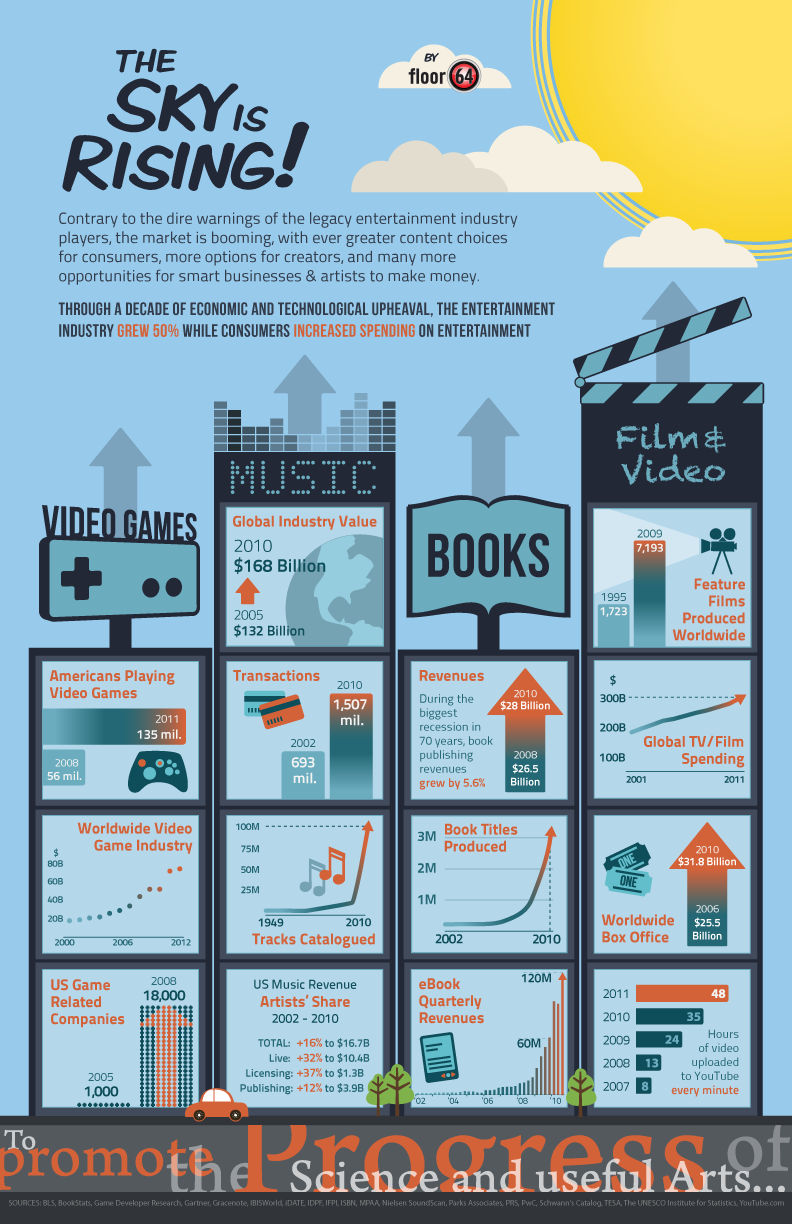
The Sky Is Rising Infographic

Some of Britain’s top musicians wants the government to crack down on copyright abuse to protect creativity, but creativity has been flourishing like never before, online

The stupid argument about piracy undermining buyer confidence aside, it’s interesting to note that the average age of the dozen or so people who signed this letter is 53. When was the last time Elton John, Roger Daltrey and Pete Townshend created anything even worth pirating (the odd remixes aside) – or are they blaming piracy for their increasing irrelevance to the music biz (which still creates new works and new stars at an amazing, almost hard to consume, pace)? Ageing rock stars believe they should continue to receive royalties for their ageing works, but when is enough enough? For an artists who has already made a large profit on their works, isn’t better now to let their works go free, so that it can be shared and re-mixed and re-used for eternity? It seems that, at some point, artists start caring less about what they’ve created, and start caring more about what they’re earning.

For me, the ease at which people can share stuff online, which the creative industries says is the catalyst for the piracy problem, has also been responsible for one of the greatest periods of creativity ever, and there are even studies and reports to prove this.

But again it goes to the definition of creativity, because what’s different about the Internet is that most acts of creativity there are not blatant attempts at monetisation. I think it has to do with the ability to publish, at almost no cost, on the Internet, versus the comparative high cost of traditional publishing – costs that have to be made back via monetisation. The thinking once upon a time was that creativity can only exists if there’s a financial incentive, but the Internet is proving this theory wrong, big time.

Just because Big Content can’t figure out how to make a buck out of it, it doesn’t mean that creativity isn’t flourishing online.

The quality of the created pieces, however, do vary quite a bit. You have well written blogs analysing the latest trends in copyright, HD and gaming. And then you have this one. But it’s free, so it’s probably worth the price of admission.

See you next week!

Weekly News Roundup (22 July 2012)

Sunday, July 22nd, 2012

Welcome to another edition of the WNR. I’m trying out a new way to write the WNR this week, as opposed to leaving everything until the last day, I’m writing a bit every day, mostly after one of the mentioned news articles has just been posted online. The advantages are obvious – having just written a news article, I’m still very fresh on the things I wanted to say but normally wouldn’t be able to in the article itself (the “news” versus “opinion” thing), and it also means less work on Sunday, which is always a good thing. On the other hand, it may mean the different sections, all written at different times, don’t flow as well. Not that they flowed well before, but it might be even worse now!

But then again, I get most of Sunday off, so that’s good enough a reason for me!

While I was plugging away at this WNR during the week, I also had time to write and uploaded the June NPD analysis, for video games sales in the US for that month. The big surprise for me was how far the Wii has fallen, down some 75% in sales compared to two years ago, and how badly the PlayStation Vita is doing (selling less than 100,000 units just a couple of months after its release – even the venerable, but ageing, Nintendo DS sold a lot more units, not to mention the 3DS). I just think Sony has misjudged the market again, and they don’t have killer titles that Nintendo has to attract the wider range of gamers that still rely on a dedicated portable gaming device (ie. not already using a smartphone or tablet to do the same thing). The Vita is a cool gadget, but do people really need another cool gadget?

Onto the roundup proper now …

Copyright

For a long time, Big Content has told us that people who pirate movies and TV shows, the no good thieving cretins, are only doing it because it’s free. But survey after survey shows that, at least in the minds of movie pirates, price is never the biggest issue. And this week, we have yet another such study which puts forward the theory that people are pirating because of service issues, and not one of price.

A new 2,000 user study in Denmark found that the majority of them would love to go legit if the conditions are right, with the conditions being the three C’s: Convenience, Choice and Content (the availability of it). The survey found that for movie downloaders, being able to watch the latest movies without having to jump through DRM hoops or register a billion times, is what makes piracy so attractive. For TV show pirates, having access to the latest shows hours after they originally aired is key. I’ve said it before, and I’ll say it again, for TV shows, a two day wait might as well be a two year one, because nobody is *that* good at avoiding spoilers online. For those in Denmark, and despite having a large percentage of English speakers, I would gather having speedy access to subtitles would also be helpful – the “scene” can get it done within about 2 days, but it being totally possible for official subs to be provided at release time, localisation of legit content often takes weeks and months.

So given the current inadequate levels of service, what can Big Content do to get people back on the straight and narrow? This is where pricing comes into it, according to the study. 72% of those surveyed said that lowering prices will entice them to go legit and ignore the service problems that currently exist. 47% also stated that if content was made available sooner, even the high prices might still make legit downloads and streams attractive.

But for me, the most striking data was the one that showed that 47% of 15 to 20 year olds that buy or rent legit content also pirate, suggesting that you can’t just separate pirates from paying customers into two neat groups. Which is why Hollywood’s attempt to kick pirates off the web might actually hurt them more, as they’re also preventing nearly half of their current online based customers from buying or renting more content. Knife meet nose, face spited.

Unfortunately though, it seems the industry’s propaganda machine is also working well, with three quarters of those surveyed believing that piracy rates are two-thirds higher than they actually are. 75% believed that 25% of all Danes pirated stuff, but the actual rate is closer to 15%.

LimeWire Website Closed

LimeWire was closed down ages ago, but the court battles continue – this time in a rather indirect way with David Alki suing CBS owned CNET for distributing the software

David Alki’s lawsuit against CNET, and its parent CBS, had some developments this week, with both sides claiming victory (as usual). CBS are claiming victory because two of the three claims made by Alki and his coalition of music artists have been summarily dismissed by the judge, while Alki and co. are claiming victory because the third claim has been left in the case. That claim is the one relating to “inducement”, in that Alki claims CNET induced people to download LimeWire and pirate music. The case continues, but it seems the judge is fairly certain CNET had not acted wisely in this whole affair, and so Alki’s team definitely have reason to celebrate.

Why Alki is doing what he’s doing still puzzles me. I’m fairly certain it’s to point out the hypocrisy that exists within large media conglomerates and their attitude towards copyright infringement – remembering that CBS sued Alki’s FilmOn for copyright infringement and won – but I just can’t be sure. Irony doesn’t translate well over the Internet, and it certainly doesn’t translate well from lawsuits. But I do agree with Alki – for a lot of media companies, nothing is sacred, not even copyright, as long its in their own interest. Remember when Sony were putting DRMs on CDs and DVDs, and at the same time, they were one of the major sellers of blank CDs and DVDs that people were using for piracy? Or how movie studio steal ideas and concepts from each other all the time, although not strictly a copyright issue, but not exactly in the spirit of respect for intellectual property that these same companies harp on about when it comes to suing downloaders.

But while I do support Alki’s mission to point out the hypocrisy within, I’m not sure I can actually support the idea that simply having guides and videos about LimeWire (while offering the download) constitutes “inducement”. For most of the time CNET were offering the downloads and content, LimeWire had not been proven in a court as being illegal. And if CNET is guilty, then what about all the other download and guide sites, including this one? Download websites would often have things that promote popular downloads (eg. top 10 lists, spotlights), and would these constitute “inducement” even though, most of the time, it’s done by an algorithm and not a person? Would Google then be guilty of the same thing if they returned the LimeWire website as a top result for the search “music downloads”, for example? What I’m saying is that a decision for Alki and co could have dramatic consequences for the web, and I’m not sure if that’s Alki’s intention, and I definitely don’t think it’s worth it just to get back at CBS.

UPlay

Ubisoft’s UPlay crashed because too many people had purchased their games – a problem the company had not faced before!

UbiDRM is back in the headlines this week, as once again we see why having online authentication for single player games are a bad idea, especially for companies not willing to invest in the infrastructure needed. What had happened was that the annual Steam Summer Sales event, and this particular sale now included a lot of Ubisoft titles that uses their Uplay online system. Uplay is basically Ubisoft’s answer to Steam, with their own added layer of DRM thrown on top (not always the “always-online” type though). With the sudden surge in sales that always happens with Steam sales, and the subsequent surge in the number of users trying to connect to Uplay, the servers crashed as expected.

Lack of planning, lack of redundancy and extra capacity, are all to blame. And the games that use always-online authentication are the worst when it comes to using up server resources, since instead of a connection at the start of each gaming session, we’re talking about one every second. And without an offline mode to occupy gamers while the Uplay servers were down, no surprise that gamers took to the Internet, specifically Ubisoft’s forums, to lodge their complaints.

See, what I don’t get is how Steam are able to handle the traffic of not only the Ubisoft games trying to authenticate, but all the other games as part of the sale, and Ubisoft can’t? I think the main reason is that for Ubisoft, Uplay has not been the highly profitable platform that they might have imagined (due to the “defeat” of piracy, as well as the value-added features), and so they’re unwilling to invest in enough capacity to handle relatively rare situations like this. Whereas the Steam platform is a revenue earner and so ongoing investment in it is a necessity. Uplay and similar platforms may simply be a cost for publishers. But as long as their internal books show the cost of Uplay is less than the estimated losses due to piracy, and with the sterling sales figures of games like Diablo 3, it’s likely we’ll have to put up with these kinds of systems and these kinds of problems in the future.

Gaming

Saddling the crossover between copyright and gaming news, this week, we have an interesting take on the whole DRM debate, but from the other side.

Ever wonder what those suits over at EA or Ubisoft are thinking when they saddle paying gamers with high prices, DRM, first day DLCs, and all the other things that game pirates use to justify their illegal actions? Kotaku wondered too, and so they invited an industry insider from one of the mega-publishers in the gaming scene to take part in an anonymous Q&A session online, and a lot of interesting tidbits were revealed.

Some were fairly obvious, such as the fact that 80% of all game sales happen in the first two month (although I wonder if Steam sales are taken into account). And this is perhaps why game publishers are so anxious to get their game locked down with draconian DRM, even if they know that, eventually, the DRM will be cracked. In fact, the insider, posting under the nick “AnonPublisher”, said as much. “Because they all get hacked sooner or later,” explained AnonPublisher, “If we can push that [the game’s piracy release] out a couple months, then we’ve protected the bulk of our sales”. Except most games get ripped on the same day, if not earlier, than its official release, so it again makes DRM kind of pointless.

Another interesting DRM related point was raised when AnonPublisher explained the industry’s rationale behind DRM, in that it’s not supposed to be used against hardcore and technically minded pirates, but the more average gamer who, in their opinion, will most likely purchase the retail copy if the piracy process can be made a bit harder. “At least that’s the theory,” posted AnonPublisher. While the theory might be sound, the reality is that DRM actually makes legally purchased games harder to purchase and play than pirated games. With piracy groups improving the convenience of game piracy all the time, anyone who knows how to use BitTorrent will probably easily get the pirated game to work. And as a measure of last resort, the “average” gamer can always rely on more technically gifted friends and family members to help them out.

One wonders though that if the industry knows and abides by this theory, then wouldn’t it be a more positive move to make the legitimate experience easier (or better, at least) instead of trying to make piracy harder? Buying and playing a game via Steam, for example, is easier than going to a shop and buying the game, inserting the DVD and installing it, and getting the patches, entering the serial … and that, along with good pricing, is probably why it dominates games sales at the moment (90% of the downloading business, according to AnonPublisher). Having to do all that on Steam, and then install Uplay, patch Uplay, patch the game, and then register, login, type in the serial again, and then finally being able to play a game that requires a constant Internet connection to work, by comparison, is actually making piracy seem a lot easier.

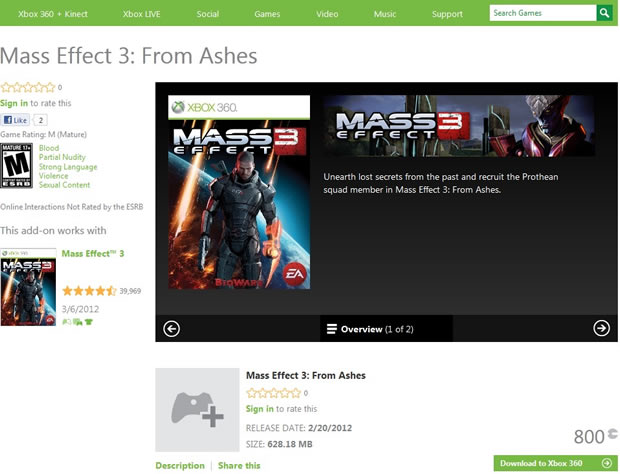
Mass Effect 3 - Day One DLCs

Day One DLCs for games like Mass Effect 3 have frustrated gamers, feeling they’ve paid full retail price for an incomplete game

On the contentious gaming issues of day one DLCs, AnonPublisher was quite forthright. Basically, according to AnonPublisher, as long as day one DLCs make more than it costs to produce, then that will be the formula to determine whether they exist. So for those that hate it – don’t buy it. That’s both mine and AnonPublisher’s advice, BTW.

Another interesting reveal is that profits are a lot thinner on consoles than on generic PCs, and if given a choice, publishers do still want to embrace PCs as their main gaming platform. But gamers are just not buying $60 PC games any more, and so things like free-to-play and MMOs are being tested, or hybrid single player online experiences like the commercially successful Diablo 3. I always did wonder if Microsoft wasn’t invested in the Xbox 360, would they have made more effort to standardize PC gaming – it’s harder without having control over the hardware, but it’s certainly not impossible. But if AnonPublisher is to be believed, Microsoft make more money licensing games for the Xbox 360 than for the PC (including the horrible Games For Windows platform), so there’s no incentive for them to do anything to “save” PC gaming.

And on that note, it brings us to the end of this perhaps rather disjointed WNR. Hope it wasn’t too bad, because I don’t see myself going back to the old way of doing things, not after a nice relaxing Sunday like this one.

Game Consoles – June 2012 NPD Sales Figure Analysis

Tuesday, July 17th, 2012

After a 2 month break, the NPD analysis is back!

As NPD no longer releases full hardware sales figures, this feature is reliant on the game companies, namely Microsoft, Nintendo and Sony, to release their set of figures, and then calculating missing figures based on “statement math” (that is, arithmetically calculate missing figures based on statements made). For June 2012, these are the statements made by the gaming companies:

  • “Nintendo sold more than 400,000 total hardware units in June and saw double-digit growth across each of its product lines compared to May. This includes more than 155,000 Nintendo 3DS systems, more than 150,000 units of the Nintendo DS family of systems and nearly 95,000 Wii consoles,” via Gaming Examiner
  • Microsoft revealed 257,000 Xbox 360 units were sold, with 47% of the home based console market share (source)
  • Sony did not reveal any figures for the PS3

A little bit of “statement maths” tells us that just under 195,000 PS3s were sold.

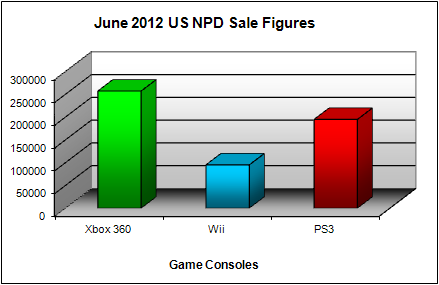
And so the figures for US sales in June 2012 are below, ranked in order of number of sales (June 2011 figures also shown when available, including percentage change – note that totals for the PS3/Wii are now only rough estimates, as exact figures were not available for all months):

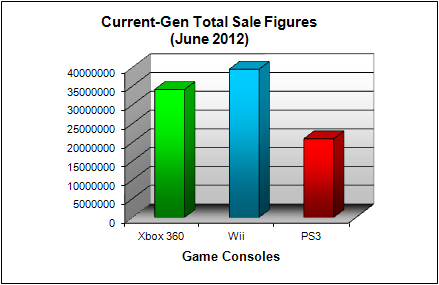
  • Xbox 360: 257,000 (Total: 34.1 million; June 2011: 507,000 – down 49.3%)
  • PS3: 195,000 (Total: ~21 million; June 2011: 276,000 – down 29.3%)
  • Wii: 95,000 (Total: ~39.5 million; June 2011: 273,000 – down 65.2%)
NPD June 2012 Game Console US Sales Figures

NPD June 2012 Game Console US Sales Figures

NPD Game Console Total US Sales Figures (as of June 2012)

NPD Game Console Total US Sales Figures (as of June 2012)

This is the first time I can remember of the Wii numbers dropping below the 100k mark, but the 65% drop from the same time last year was probably not unexpected, considering how close the Wii U is to retail.

While the Xbox 360 continues to “impress” by winning the most popular home based console award, 18 month in a row now, its numbers were down a considerable 49% from the same time last year, which to be honest, was a fantastic month for the console (and the Xbox 360 was the only console then to record a year-on-year growth figure). A bit worrying is that the decline seems to have sped up in the last couple of months too, perhaps as a indirect response to the Wii U, but more so perhaps due to this time last year’s numbers being “above normal”.

The PS3 has the smallest year-on-year decline of all the home based consoles, but that’s not to say that it isn’t struggling itself. It’s still down some 36% compared to 2 years ago (Xbox 360 down 43% for the same period – although that’s comparing now to the then launch of the Xbox 360 Slim – the Wii is down 78%!), and it still doesn’t look like its ever going to beat the Xbox 360 unless the 360 is retired early by Microsoft.

It’s not exactly all doom and gloom, since we’re approaching the end of a cycle even if Microsoft and Sony don’t want to admit it publicly, but I think it’s safe to say that we’ve already seen the best of these three home based consoles, and the only way forward now is downwards for them all.

Numbers have also been made available for the PS Vita, which along with the PSP, only sold a combined 100,000 units. Compare and contrast to the Nintendo DS, which sold 150,000 units, and the 3DS, which sold 155,000 units, and you can see the Vita has been a disappointment for Sony so far. The sales figure also highlights a significant drop compared to the earlier sales figures for Vita, which can’t be a good sign either. I think once again, Sony has misjudged the market. Trying to get on the casual gaming bandwagon, while still offering hardcore gamers an exciting gadget, Sony might have ended up catering to neither market. They don’t have the expertise in making fun and casual games like Nintendo, everyone already has a smartphone or tablet that can do what the Vita does, and the high cost of hardware and software, proprietary formats and DRM, means that the Vita was already at a disadvantage before it was even launched. Still, the holiday period will be decisive and if the Vita can have a good one, and if it can have more linkage to the PS3 and other Sony devices, then it can still carve outs its own niche.

In game sales, it’s not exactly been another great month, with the top selling title on all platforms, Lego Batman 2: DC Super Heores, only selling 450,000 copies or so. Speaking of the Vita, what Sony also doesn’t have is a Pokemon like franchise to exploit like the DS/3DS is able to do this month with Pokemon Conquest, coming in at a high 7th for a single platform release (all other listed in the top 10 are multi-platform games). Here’s the full software sales chart for June (new releases shown in bold):

  1. Lego Batman 2: DC Super Heores (Warner Bros – Xbox 360, Wii, PS3, NDS, 3DS, PSV, PC)
  2. Tom Clancy’s Ghost Recon: Future Soldier (Ubisoft – Xbox 360, PS3, PC)
  3. Diablo 3 (Activision Blizzard – PC)
  4. Max Payne 3 (Take-Two Interactive- Xbox 360, PS3, PC)
  5. NBA 2K12 (Take-Two Interactive – Xbox 360, PS3, PS2, PSP, Wii, PC)
  6. Batman: Arkham City (Warner Bros – Xbox 360, PS3, PC)
  7. Pokemon Conquest (Nintendo – NDS)
  8. Call of Duty: Modern Warfare 3 (Activision – Xbox 360, PS3, Wii, PC)
  9. Battlefield 3 (EA – Xbox 360, PS3, PC)
  10. The Amazing Spider-Man (Activision Blizzard – Xbox 360, PS3, 3DS, NDS, Wii)
I don’t think I’ll bother to make a prediction. Firstly because I don’t think we’ll have enough figures to do an analysis next month, and secondly, the hardware sales order  will be pretty much the same as this month (and will be the case until the Wii U is introduced later this year).
See you next month?