Archive for the ‘NPD Analysis’ Category

Weekly News Roundup (20 May 2012)

Sunday, May 20th, 2012

Welcome to this slightly late edition of the WNR. Normally, I would link to the latest edition of the monthly NPD analysis here for your consumption, but as it turns out, neither Nintendo nor Sony decided to release hardware figures for the month. This means that there’s no NPD analysis for this month, an all too frequent occurrence lately. I’ll try to give you what I have in the gaming section.

Another fairly substantial news week, well in my opinion anyway, so let’s get started.

Copyright

In copyright news, let’s start with the MPAA’s response to the recent well publicized filtering of The Pirate Bay, happening as I type across Europe.

Unsurprisingly, the MPAA backed the recent court decisions around Europe to have The Pirate Bay blocked, and also rather unsurprisingly, spun this form of censorship as being ultimately good for the consumer. The reasoning, they say, is that by removing the threat of websites like The Pirate Bay, it gives the creative community more incentive to not only create, but also to “provide consumers with content when they want it”. Apparently, the mere fact that consumers want it is not enough of a reason for the “creative community” to cater to their needs, but you also need the right environment (although the real creative community, the artists and the like, usually have no power to decide how something is released, a decision that’s usually left to men in suits). This might at least be a point you could argue, but only if filtering actually works.
VHS Tape

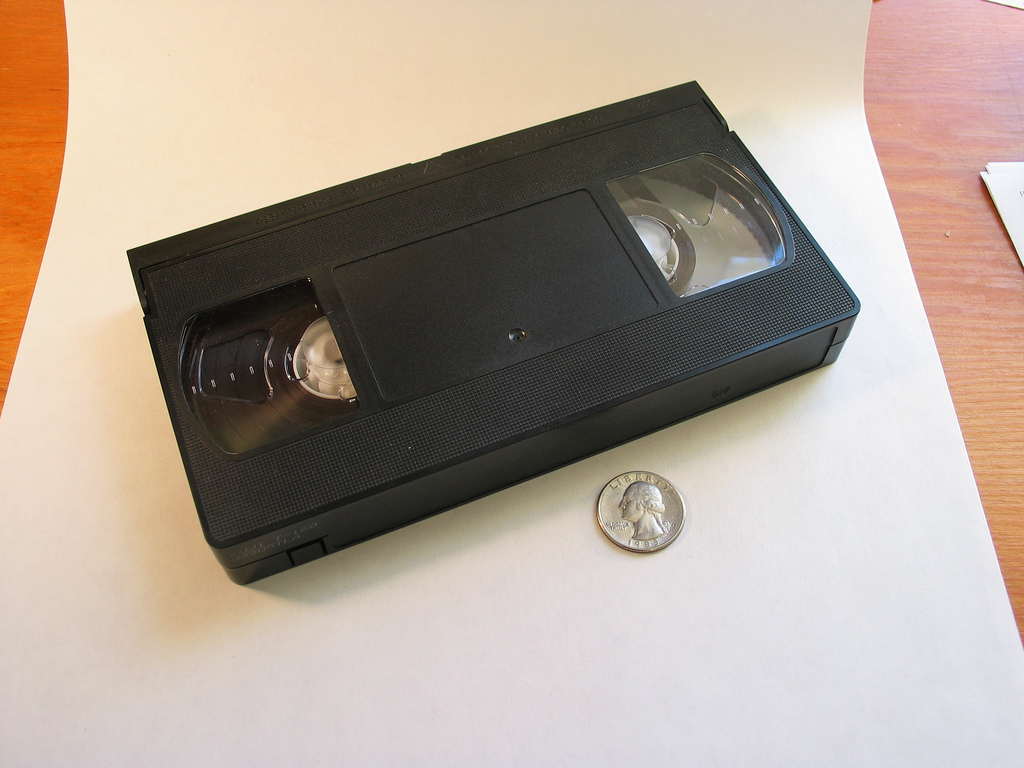
If the MPAA had their way, this VHS tape would have never existed - photo by Jared C. Benedict, Creative Commons License

It’s also rich hearing it from the MPAA, considering their own history with innovations, to suggest that websites like The Pirate Bay are the only reason why they’ve not yet bothered to fulfil the needs of today’s consumers. Remember that these were the guys that were against the VCR, were for region control that barred consumers from getting content “when they want it”, and possibly still pretty angry at the whole Interweb thing. Apple, Netflix, Amazon have done much more to fulfil the consumer’s needs in recent times, and the interesting thing here is that all of these companies are tech companies, not film or music companies.

If anything, it’s BitTorrent and The Pirate Bay that has forced the industry to be more malleable to the demands of consumers. They can no longer afford to fool around with release windows (which are now far shorter than they were a decade ago), with region control (much less common on Blu-rays than compared to DVDs), with price control (note the ever decreasing price of discs), and they’re now forced to support services like Netflix, even if it means making less money. They’ve had to compete with the likes of The Pirate Bay out of necessity, but maybe they’re hoping censorship can allow them to turn back the clock, although  in my opinion – and if you’ll allow me to use another cliche – the genie may already be out of the bottle.

And does piracy really affect revenue that much? A new research paper suggests that pre-release piracy, the worst kind according to the MPAA and RIAA, may actually help sales. The research paper by North Carolina State University’s Robert Hammond suggests that pre-release piracy may actually help album sales. No theory is given as to why this may be the case, but I suspect it’s because piracy has become just another way to advertise. This follow another study a couple of months ago which found no correlation between pre-release movie piracy and US movie ticket sales. Both studies seems to go against industry sponsored studies, and the common believe that, piracy, especially pre-release piracy, is costing the industry billions. But the industry has never really looked at the reasons why people prefer pirated content, instead, choosing to believe it’s simply a case of freeloaders “stealing” because they’re freeloaders.

People pirate because they might not have the money to pursue the legal alternatives; or they never felt it was worth the money and want to try it out for free; or they might feel piracy is more accessible than the legal alternatives; or they just like to get stuff for free, even if they have the money for it. Two of the above scenarios will not lead to any extra revenue, no matter how many websites you block, while one of them is clearly the fault of the content owner. Only the last scenario, probably the least likely (that people who have loads of money are shunning the likes of  iTunes and Blu-rays in favour of manually loading MP3s onto iPhones, and watching blurry movies on their laptops), derives any benefit from blocking out piracy altogether, which in itself is a fantastically unrealistic proposition (although I suspect Hollywood execs are used to the fantastically unrealistic, considering they produce so much of the same crap for our consumption).

Speaking of unrealistic propositions, Microsoft is providing funding to a Russian company working on a way to block BitTorrent downloads. With no details being available about how it works, and little detail about how it actually works in the real world, there’s not much one can actually say about it. Most of these types of blocks works by seeding fake data into streams, and this is not new. BitTorrent is incredibly adept at filtering out the bad and leaving the good, so while it may temporarily make downloads a pain, it won’t do it forever. At the end of the day, BitTorrent is just another file transfer protocol, so the problem with going after the protocol is that you’ll have a new and even more robust protocols to deal with later down the track. If you really want to solve the problem of piracy, you’ve got to go back and examine the reasons why people choose to pirate in the first place (and take note of the people who don’t have a valid legal alternative, due to regional restrictions or release windows, or unrealistic pricing, and maybe offer them a choice).
Diablo 3 - Error 37

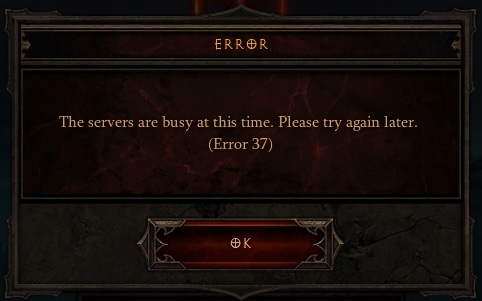
The dreaded Error 37 plagued Diablo III on launch day, as it becomes the highest profile DRM-fail in the history of gaming

A lot of people saw it coming, but as expected, the launch of Diablo III turned into a DRM-tastic disaster for Blizzard this week. One of the most anticipated games of the year (or decade), with one of the most controversial DRM decisions in regards to the single player campaign, and a near simultaneous global launch – a recipe for disaster, unless Blizzard go beyond the call of duty to provide adequate servers for all. Unfortunately, they did not.

Back when Blizzard first announced the controversial DRM, they were keen to stress that it wasn’t piracy related. Rather, it was suppose to be a sort of elaborate anti-cheating system, although that seemed confusing at the time for a game that was always largely a single player experience. But as we now know more about the game, and especially the built-in Auction House system, it’s much more clear why Blizzard went with the “always-on” DRM approach (and they were right, it’s not about piracy, or at least not all about it). In order to ensure the subscription-free Diablo III doesn’t cannibalize Blizzard’s major subscription based property, WoW, and to take the “black market” trade for in-game items in-house, the Auction House system was devised as the solution. But in order for the market place to remain rational, cheating, hacking and other unfair tactics had to be stopped – the always-on DRM is Blizzard’s solution to this. It’s a valid explanation as to why it’s present, and why it may be needed, but having a valid, non anti-piracy related explanation, won’t please diehard fans, who were none too pleased with the Auction House addition in the first place. But Diablo III is the only Diablo game in town, so to speak, so it’s not as if they have a choice if they want their fix of Diablo (disclaimer: I’ve purchased Diablo, even though I should know better).

But for games where it’s easy to make the decision not to bother buying, I’d caution publishers against taking gamers for granted in this way. DRM should either not exist, or it should be invisible, as otherwise, it becomes a liability.

High Definition

Does the world need another physical media based format, even if it is a royalty free, open standard, based one?

Well, whether you think one is needed or not, free software advocate (free as in freedom, not as in beer) Terry Hancock is going to make one. Dubbed “Lib-Ray”, it’s based on a MKV container, using the VP8 video codec, with an HTML5 based menu system, with everything stored on SD media. The name may sound similar, but this is definitely not a Blu-ray challenger (and not intended to be), although it could give independent filmmakers a nice standardized way to distribute a physical copy of their films, without having to pay the likes of Sony, Panasonic and Microsoft for the privilege. It’s not the worst idea in the world, although without real hardware support, the format will have a long and hard struggle for acceptance, even by the indie scene.

Gaming

Very much related to Blu-ray, but also very much a gaming related news item, was a former Microsoft boss’s take on the relative “success” of the Xbox 360, and why it actually happened.

Robbie Bach, the former president of Microsoft’s Entertainment & Devices Division, says that Sony’s ill planned and badly managed transition from the hugely successful PS2 (70% market share) to the expensive, delayed PS3 (30% market share) made it possible for the Xbox brand to triple its market share during the same period. The expense and delay had a lot to do with the inclusion of Blu-ray support for the PS3, although it did help Sony win the HD format wars.

Sony PlayStation 2

The PS2 dominated the video games market with 70% market share, but the transition to the PS3 was problematic for Sony, not just because developers were actively backing a second horse in the race - the Xbox 360

The ease in which developers could develop on the Xbox 360, compared to the PS3, also seems to be a factor (something that even Sony admits), but the same developers also had a vested interest in seeing Sony’s standing knocked down a peg or two – nobody wants to publish in a market with only one big player, and support and investment by publishers like Activision and EA, in Microsoft’s then new console, made it possible for a second major player to emerge, according to Bach. Of course at the time, nobody expected Nintendo to ultimately come up with the most popular console of this generation, but that didn’t really change the strategy for publishers much, as the Wii was never a serious platform revenue wise for them.

As mentioned earlier, lack of NPD hardware stats means our monthly NPD analysis is not going to happen, and so I’ll talk about it in brief here instead.

The Xbox 360 was the most popular home-based console for the month, with 42% market share amongst the home based console, selling 236,000 consoles (down 21% compared to the same month last year). This leaves 326,000 units sold between the other two, and using a similar split as last month for the Wii/PS3, then it’s about 214,500 for the PS3, and 111,500 for the Wii – but the split is probably a bit more even, as the Wii numbers looks too small, and Easter is usually kinder to the cheaper consoles.

Software wise, Prototype 2 dominated, but it looks like it sold less than 236,000 copies on all platforms combined, which is pretty weak for a top selling title. Kinect Star Wars was in second place, decent in terms of ranking, but still weak in terms of actual unit sales probably.

Hopefully, normality resumes for the NPD analysis next month, but we’ll have to wait and see.

And with that, we come to the end of another WNR. Hope you’ve had a good week, hope the next week will be better, and see you again in seven days.
Game Consoles – March 2012 NPD Sales Figure Analysis

Monday, April 16th, 2012

The March 2012 NPD figures are out for US video game sales, and the industry is looking for any signs that indicate things may be on the up again, following a pretty poor January and February period. It is also the first time in 2012 that included the release of an A-list title, Mass Effect 3.

As NPD no longer releases full hardware sales figures, this feature is reliant on the game companies, namely Microsoft, Nintendo and Sony, to release their set of figures and based on “statement math” (that is, arithmetically calculate missing figures based on statements made). For March 2012, these are the statements made by the gaming companies:

  • Nintendo revealed that “nearly” 175,000 Wiis were sold in March (via IGN)
  • Microsoft revealed 371,000 Xbox 360 units were sold, with 42% of the home based console market share (source)
  • Sony did not reveal any figures for the PS3

A little bit of “statement maths” tells us that a little more than 337,000 PS3s were sold.

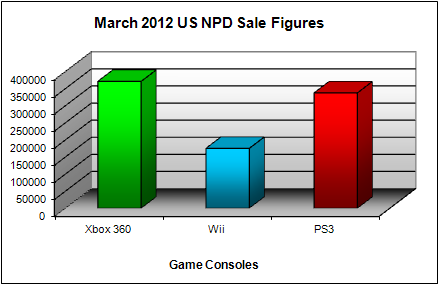
And so the figures for US sales in March 2012 are below, ranked in order of number of sales (March 2011 figures also shown when available, including percentage change):

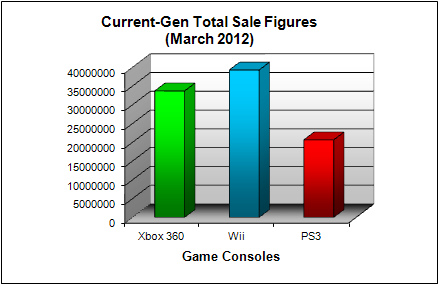
  • Xbox 360: 371,000 (Total: 33.7 million; March 2011: 433,000 – down 14.3%)
  • PS3: 337,000 (Total: 20.7 million; March 2011: N/A)
  • Wii: 175,000 (Total: 39.3 million; March 2011: 290,000 – down 39.7%)
NPD March 2012 Game Console US Sales Figures

NPD March 2012 Game Console US Sales Figures

NPD Game Console Total US Sales Figures (as of March 2012)

NPD Game Console Total US Sales Figures (as of March 2012)

My prediction was:

March is traditionally a slightly slower month than February, so while the year-on-year downward trend may continue, there is the release of an A-list title in Mass Effect 3. The hardware sales order should remain the same.

The release of Mass Effect 3 really didn’t help hardware numbers, and March was, as expected, down compared to February, with the hardware order exactly the same as last month as well.

For the Xbox 360, this marks the 15 months in a row that the console has beaten the Wii and the PS3 as the best selling console for the month – a terrific result, and surprising considering what had happened just before the run began (the Wii had a huge lead for the first couple of years, and the PS3 Slim/price cut seems to have rejuvenated the system – then the Xbox 360 released its own “Slim” version, followed shortly by Kinect, and it has never looked back). Microsoft PR was also keen to point out that “Total retail spend on the Xbox 360 platform in March (hardware, software and accessories) reached $430 million, the most for any console in the U.S. and more than the spend on PS3 and Wii combined” – for all the talk of console numbers and consecutive sales leads, in the end, it’s the income that’s important, and the 360 is doing pretty well. The stellar performance of Mass Effect 3 on the platform was also a talking point, but we’ll cover that later on when we discuss game sales.

For the PS3, March can be seen as a positive one, with the PS3 only selling 34,000 fewer units than the 360 – the gap between the two consoles has narrowed in recent month. The exiting of Wii from the competitive home based console race, making it really a two horsed race, has probably helped the PS3 absorb a few more buyers, and it was the console that appears to have done the best when you do a year-on-year comparison for March. Still, it’s looking unlikely that the PS3 would catch the Xbox 360 in this generation (in the US of course, globally, that’s a different matter), even with the price cut that analysts have been calling for (which Microsoft can easily match). But while there is still some life, not much, but some in Kinect (with Star Wars Kinect just being released, plus Kinect support for Mass Effect 3 and Skyrim), the PlayStation Move appears to be dead in the water for now.

As mentioned above, the Wii is now selling around only half as many units as the PS3, not to mention the Xbox 360, and the final few month of the console as Nintendo’s lead home based platform could be a painful few. Like most Wii owners, Nintendo are now probably very keen to move on to something better. It’s probably a bit too early to provide an eulogy for the platform, as there’s still a good chance it may still end up staying the best selling console of this generation (in the US) if the Xbox 360 can’t make up the 6 million difference between now and when it too is retired.

For games, March was all about Mass Effect 3, and having sold 1.3 million units, it was the clear number one – the next best was Resident Evil: Operation Raccoon City with less than half as many copies sold. ME3 also sold more than twice as many copies as ME2 when it first came out. For Microsoft, a little extra celebration is called for, as ME3 sold 4 times as many copies on the Xbox 360 than on the PS3. The sheer dominance of the Xbox 360 version can most likely be attributed to the first game in the series not being available on the PS3, and the nature of the series itself which allows gamers to continue on using save files from the previous game. Actually, if you look at the table below, you’ll see lots of new releases, but sales still managed to decline 26% compared to a year ago. Here’s the full software sales chart for March (new releases shown in bold):

  1. Mass Effect 3 (EA – Xbox 360, PS3, PC)
  2. Resident Evil: Operation Raccoon City (Capcom – Xbox 360, PS3)
  3. MLB 12: The Show (Sony – PS3, PSV)
  4. NBA 2K12 (Take-Two Interactive, Xbox 360, PS3, PS2, PSP, Wii, PC)
  5. SSX 2012 (EA – Xbox 360, PS3)
  6. Street Fighter X Tekken (Capcom – Xbox 360, PS3)
  7. Mario Party 9 (Nintendo – Wii)
  8. Call of Duty: Modern Warfare 3 (Activision, Xbox 360, PS3, Wii, PC)
  9. Naruto Shippuden: Ultimate Ninja Storm Generations (Namco Bandai – Xbox 360, PS3)
  10. Major League Baseball 2K12 (Take-Two Interactive, Xbox 360, PS3, PS2, PSP, Wii, NDS, PC)

So prediction time. April is traditionally a very slow month, what with the Easter break and everything, so if the industry is looking forward to better results, it will be disappointed. The sales order for the consoles should remain the same. The list of new games being released looks quite lacking indeed, with Kinect Star Wars and The Witcher 2: Assassin of Kings looking like the picks of the bunch on the 360, and hardly any new games of note on the PS3 judging by the current sales charts.

See you next month.

Game Consoles – February 2012 NPD Sales Figure Analysis

Tuesday, March 13th, 2012

The monthly NPD video game sales analysis makes a return this month, after last month’s absence. Today, we look at the US video game sales stats for February 2012, based on figures compiled and “released” by NPD. With January’s rather poor showing, all eyes were on the February results, to see if January was just an aberration, or the start of a new downwards trend. Last February was a great month for game sales, with hardware unit sales up for all consoles compared to a year before – but given the bad January results, nobody is expecting the same this time round.

As NPD no longer releases full hardware sales figures, this feature is reliant on the game companies, namely Microsoft, Nintendo and Sony, to release their set of figures and based on “statement math” (that is, arithmetically calculate missing figures based on statements made). For February 2012, these are the statements made by the gaming companies:

  • Nintendo revealed that 228,000 Wiis were sold in February (via PR email)
  • Microsoft revealed 426,000 Xbox 360 units were sold, with 42% of the home based console market share (source)
  • Sony did not reveal any figures for the PS3

A little bit of “statement maths” tells us that 360,000 PS3s were sold, a good enough result for Sony that I thought they might have wanted to publicize a bit more.

And so the figures for US sales in February 2012 are below, ranked in order of number of sales (February 2011 figures also shown, including percentage change):

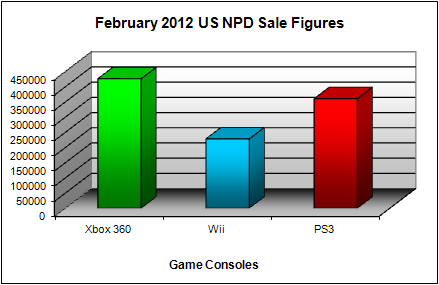
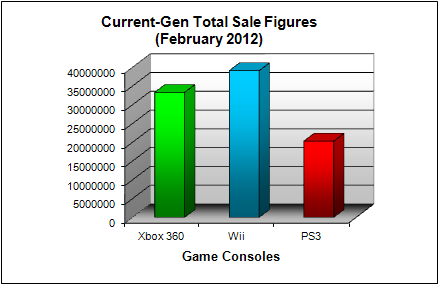
  • Xbox 360: 426,000 (Total: 33.3 million; February 2011: 535,000 – down 20.4%)
  • PS3: 360,000 (Total: 20.3 million; February 2011: 403,000 – down 10.76%)
  • Wii: 228,000 (Total: 39.1 million; February 2011: 454,000 – down 49.8%)
NPD February 2012 Game Console US Sales Figures

NPD February 2012 Game Console US Sales Figures

NPD Game Console Total US Sales Figures (as of February 2012)

NPD Game Console Total US Sales Figures (as of February 2012)

There was no prediction last month, as there wasn’t a full analysis.

While sales of all the consoles were up compared to the dismal January, all consoles continue to sell much less than the same time last year, but for different reasons.

For the Xbox 360, still relatively comfortable as the best selling console of the month, the decline has a lot to do with the dissipating hype over Kinect, and the novelty of the new Xbox 360 form factor, which was still in play last year. With Kinect Star Wars not coming until April (and even then, it doesn’t look as if it will make a huge impact, sales wise), the Kinect unlikely to lift Xbox 360 sales beyond helping it stay ahead of the PS3.

For Sony, the PS3 had the smallest year-on-year decline of the home based consoles, and comprehensively beat the Wii by just over 130,000 units, both facts that I had assumed Sony would have wanted to promote, but they remained oddly silent on PS3 figures, only commenting on the PS Vita, which managed to sell 225,000 units. With nothing really hyping up PS3 sales this time last year, the 10% or so decline might be the one that best show the industry’s overall decline. Whether this is due to market saturation, the end of a generation cycle, economic conditions, it’s all hard to say.

But it’s definitely the end of a cycle for Nintendo’s Wii, and the Wii U can’t come soon en0ugh for the company. A near 50% decline year-on-year is a bad result no matter how you look at it, and in terms of hardware, and innovation, the Wii now looks like a very dated piece of tech. With no multimedia and very little online functions to prop up the console’s usefulness, as is the case with the Xbox 360 and PS3, the Wii was always more prone to the “gathering dust in the closet” effect.

Software wise, it was another slow month as the lack of any A-list releases probably also hurt hardware sales. Final Fantasy XIII-2 was the top selling new release, despite technically being released in January (but counted in the February reporting period). Modern Warfare 3 remained the top seller for the month. The only platform exclusive to make the top 10 below was Sony’s update of Twisted Metal, coming in at 9th. Here’s the full software sales chart for February (new releases for February 2012 in bold):

  1. Call of Duty: Modern Warfare 3 (Activision, Xbox 360, PS3, Wii, PC)
  2. Final Fantasy XIII-2 (Square Enix, Xbox 360, PS3)
  3. UFC Undisputed 3 (THQ, Xbox 360, PS3)
  4. Kingdoms of Amalur: Reckoning (EA, Xbox 360, PS3, PC)
  5. Just Dance 3 (Ubisoft, Wii, Xbox 360)
  6. NBA 2K12 (Take-Two Interactive, Xbox 360, PS3, PS2, PSP, Wii, PC)
  7. Soul Calibur V (Namco, Xbox 360, PS3)
  8. Elder Scrolls V: Skyrim (Bethesda, Xbox 360, PS3, PC)
  9. Twisted Metal 2012 (Sony, PS3)
  10. Battlefield 3 (EA, Xbox 360, PS3, PC)

Time to make a prediction. March is traditionally a slightly slower month than February, so while the year-on-year downward trend may continue, there is the release of an A-list title in Mass Effect 3. The hardware sales order should remain the same.

See you next month.

Weekly News Roundup (19 February 2012)

Sunday, February 19th, 2012

Welcome to the latest edition of the WNR. It’s a shame that the leap day doesn’t fall on a Sunday this year, as it would make an awesome collector’s edition of the WNR – as such, it’s on possibly the most boring day of the week:  Wednesday.

I know I promised the NPD analysis last week, but it turns out there just wasn’t enough data to compile one, thanks to both Nintendo and Sony keeping mum on hardware figures (no doubt because they have crap numbers). Only Microsoft released figures for its Xbox 360 console (the least worst of the bunch). So it seems January 2012’s NPD analysis will have to be replaced with a much shortened version, which you’ll find in the “Gaming” section below.

In terms of news, there were only a couple of interesting ones, and a few late breaking ones that I will cover briefly in this edition, but in more detail in the next. So don’t be surprised at the brevity of this WNR (and it totally didn’t have anything to do with the fact that I’ve now put in 50+ hours in Skyrim).

Copyright

The likes of the MPAA and RIAA have compared web piracy to a lot of things, but I’ve always wondered why they haven’t compared it to some kind of infectious disease, as I think The Piracy Pandemic® has a certain ring to it.

It’s a great comparison not just because the content holder set their hyperbole engine into overdrive by comparing web piracy to something deadly and scary, but also on two other major points. One, just like an infectious disease, piracy spreads quickly, and it does so in poorer countries with greater virulence. And also just like viruses, piracy adapts to any measures you employ to try and stop it, whether it’s a technical measure, or a legal one. The more you try to fight it, the more likely it will mutate into something that’s more resistant.

The latter of these two points was demonstrated, twice, this week. Decentralisation has been a continuing trend in piracy (Megaupload and sites of similar ilk are actually quite a throwback to the early days of piracy, where everything was hosted on centralised HTTP websites), but despite decentralisation being the major driving force behind the creation of BitTorrent, two major centralised components still hold it back from truly being decentralised. The inherent weakness in BitTorrent file sharing is the existence, and the necessity, for centralised trackers and a centralised “indexer” website that catalogues the available downloads, like The Pirate Bay. This website would also host .torrent files, and while these files are small by any standard, the sheer number of them ensures that the total size of the website and database can be quite large. Taking down a tracker can cause downloads to cease to work, as peers would not be able to find each other, and taking down websites like The Pirate Bay would mean that you won’t even able able to find the torrents to get you started. These two weaknesses have often been exploited by content holders, with past lawsuits able to bring down popular trackers, and BitTorrent indexers such as Mininova.

The Pirate Bay Magnet Links

The Pirate Bay will remove .torrent files by the end of this month, encouraging users to use Magnet Links (show above with the little magnet icon) instead

This week, The Pirate Bay announced steps which will mitigate these two risks, although the actual technical measures used to solve these two problems have existed for some time already. The Pirate Bay, at the end of this month, will remove .torrent files for any torrents that has over 10 peers and will use Magnet Links instead. A Magnet Link is simply a web URL, a string of text that once loaded into your BitTorrent Client of choice, will give the client just enough information to be able to download the actual .torrent file from users that are already sharing the torrent. And using the DHT (Distributed Hash Table) technique, Magnet Links don’t need trackers in order to download the .torrent files (and the actual download most likely won’t need trackers as well, thanks also to DHT). But for The Pirate Bay, the best thing about switching to a Magnet Link based website is the fact that they no longer need to host .torrent files (well, not as many as before, anyway), and this allows the hosting, and bandwidth, requirements of The Pirate Bay to be reduced to the point where the entire website can probably fit onto a small USB thumb drive (removing all .torrent files, a user has already demonstrated the ability to reduce The Pirate Bay’s Magnet Link database to only 90MB). This will help more TPB mirrors to be set up, and to allow the website to be moved from host to host more easily, thus making the website more resilient to take-downs. There’s also something quite perverse about being able to “download” the entire Pirate Bay to your hard-drive.

And even in the event of The Pirate Bay finally being taken down, there’s now a plan B. A new BitTorrent client, Tribler, aims to remove the any need for websites like The Pirate Bay, and remove the one last centralised component of the largely decentralised BitTorrent download process. Tribler does this by moving the torrent indexing component into the BitTorrent swarm itself, and allow you can search for torrents right within the client. Even things like reviews, comments, and the obligatory removal of fake torrents, can all be done within the client. Tribler, developed by researchers at Delft University, is also open source, and that makes it more resilient, as if one variant of the client is taken down by authorities, others will pop up almost instantly (and probably with more features). What this essentially means is that BitTorrent, via Tribler, is now unstoppable. Or to put it even more succinctly, and to quote the head of the Tribler project, “The only way to take it down is to take The Internet down.”

Tribler

Tribler - the new BitTorrent client that claims to be unstoppable

Now, just because BitTorrent downloads cannot be stopped, it does not mean that you can’t be forced to stop using BitTorrent, as the major flaw in Tribler is that it still allows authorities, and those seeking to profit from (anti) piracy, to track your IP address. So the next evolution of BitTorrent, in my mind, will be one that allows peers to communicate anonymously – that is, to allow sharing without making the IP addresses public at any point in the process. The external pressure heaped towards downloaders, from law firms such as US Copyright Group, and also the rights holder’s push for graduated response, will no doubt have already pushed clever developers into tackling this very problem, and I don’t expect we’ll have to wait too long for this next evolution. And once it arrives, BitTorrent will be anonymous, unstoppable, and it will spell “game over” for both technical and legal methods to stop the downloading.

This scenario both scares me, and excites me. It scares me because, with no way to stop downloaders, things could get out of hand very quickly. But it also excites me because, without any technical or legal recourse, content holders might finally have admit to the need to compete with piracy, and we may finally see the entire industry put everything behind innovating their way out of the problem. Consumers will be the main beneficiary, and I look forward to new and brilliant ways to consume content, legally. Of course, this should have been the way forward since the first torrent was uploaded, and it would have been easier to compete back then, compared to a time when BitTorrent may have become truly unstoppable.

Going back to the point I made earlier about Megaupload being an outdated way of hosting pirated downloads, the closure of R&B/hip hop blog RnBXclusive this week shows why centralisation is dangerous. But what’s more dangerous is the pattern that’s emerging with law enforcement actions against websites suspected of copyright infringement – the fact that law enforcement agencies appear to be acting as the private police force for the entertainment industry without questioning the one-sided evidence presented to them – evidence that has often not stacked up in court. Time and time again, websites were taken down with the full force of the law, but still managed to be difficult to prosecute, or in the case of the similarly themed DaJaz1 (taken down by US Homeland Security as part of Operation In Our Sites), the case might not even end up in court. This is why due process exists and why it’s needed, for the evidence to be tested in a court of law before guilt is determined, and action is taken.

And to add insult to injury, visitors to rnbxclusive.com were initially threatened with messages that mentioned “an unlimited fine” and “a maximum penalty of up to 10 years” in prison for anyone who simply downloaded some songs from the website. A Big Brother style warning of the “capability to monitor and investigate you” was given an extra dimension of fear, by displaying the visitor’s IP address on the home page (a simple enough thing to do in php, but still scary enough for the less technical minded). These threats have since been removed from the website, no doubt due to complaints about the potentially misleading statements which could get SOCA (UK’s Serious Organised Crime Agency), the organisation that took charge of seizing the website, into trouble. But it’s the kind of hyperbole we’re used to seeing from the entertainment industry, the most likely ghost writers behind the now removed messages.

One of the entertainment industry’s tactic is to portray everyone who does something against their interest as criminals, even if it’s something as simple as ripping your own legally purchased DVD. I reported a couple of months ago on the efforts by public interest group Public Knowledge to make DVD ripping legal. They argued that due to the increasing number of devices that don’t play DVDs, such as tablets and smartphones, consumers need to be given the right to rip their own legally purchased movie discs. The fact that everyone who wants to do it is already doing it, means that making DVD ripping illegal under the DMCA is pointless at best, and at worse, criminalizes an activity that falls under fair use. With PK having made their submission to the US Copyright Office, which reviews submissions for exemptions to existing copyright laws every three years, the MPAA has just responded with quite an absurd argument *for* keeping DVD ripping illegal: it gives consumer more choice!

RealDVD

If Public Knowledge manages to get a DVD ripping exemption from the US Copyright Office, then it's still too late to save innovative software like RealDVD, which was sued into oblivion by the MPAA

What the MPAA is saying is that since consumers don’t have the legal option to rip their own DVDs, then the legal option to get the movie you already paid for, on other devices, is to simply re-purchase the movie again. And again and again. Consumers can “choose” to pay for the same movie on their iPhone, “choose” to pay for the same movie again on Android, and then “choose” to pay for the same movie once more on their PS3, for example.

Far from being a convincing argument, this is precisely PK’s argument for making DVD ripping legal, that consumers shouldn’t be made to fork out money for the same content over and over again, due to a legal measure designed to do something else. This is a perfect example of piracy laws being misused by content holders, for their own financial benefit, to take away a consumer’s rights. The fact that many movies are not even available on legal platforms further destroys the MPAA’s false arguments about “choice”.

I sincerely hope the US Copyright Office does the right thing and extends the exemption for CD ripping to cover DVDs and Blu-rays too. The reason that The US Copyright Office even asks for submission of exemptions is to prevent exactly this sort of thing – short sighted copyright laws that harm fair use and innovation.

The Megaupload case has also had some new developments in the last few days, although nothing that bodes well for Mr DotCom. More charges have been laid, and $50 million in Mega assets have been seized so far. Without insider knowledge, it’s hard to tell if this is an attempt to shore up the fed’s case before going to court, or if it’s some kind of tactic designed to force a favourable settlement. Copyright cases are not always easy to prove, see Viacom vs YouTube, and given the theatrics that has transpired so far, losing the case is not an option for federal prosecutors.

Meanwhile, the Pirate Bay and RIAA have been engaged in verbal warfare, with The Pirate Bay responding to an article by the RIAA that called it “one of the worst of the worst”. More on both of these late breaking stories next week.

Gaming

As mentioned earlier, due to Sony and Nintendo withholding hardware figures for the PS3 and Wii, I don’t have enough data to write up a full NPD analysis, so you’ll have to put up with a simplified version here.

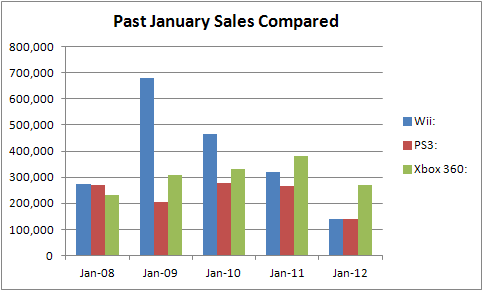
NPD January Comparison

NPD January 2008 to 2012 Compared - things are bad across the board, it seems (January 2012 figures for PS3/Wii estimate only)

Microsoft was the only one brave enough to release data, with the Xbox 360 selling 270,000 units, down 29% from a year ago. Microsoft also mentioned that it held 49% of the current-gen console market. A little maths then tells us that the PS3 and Wii sold a *combined* 281,000 units. With the PS3 and Wii selling in similar numbers usually, that’s around 140,000 units for each, which is way down compared to the previous January’s 319,000 (Wii) and 267,000 (PS3).

These companies can only hope that January was a fluke, and that sales will pick up again.

Game sales were just as bad, with the number one selling title, Modern Warfare 3, only shipping 386,000 units – at the same stage of sales, Black Ops managed 750,000 (although MW3 sold more copies in the preceding months, it’s now flat in terms of sales to Black Ops), and Modern Warfare 2 managed 658,000 during its January period. And considering MW3 was the top seller, it means the other titles in the top 10 were much worse.

Overall, it’s the worst January since 2004.

The results are so bad that analysts are still debating the whys of it, with Wedbush Securities analyst Michael Pachter even questioning the validity of the data.

Maybe people are playing too much Skyrim to have time to buy any new games, just a thought!

And on that sour note, we come to the end of another WNR. Hope you enjoyed it, and see you next week.

Game Consoles – December 2011 NPD Sales Figure Analysis

Saturday, January 14th, 2012

Welcome to the December 2011 edition of our regular NPD US video game sales analysis. In this feature, we look at video game sales, both hardware and software, for the month of December 2011 based on data collected by the NPD. December is traditionally the most important period of the year, where a huge percentage of the entire year’s sales occur. And as a result, there is no month more important than December, and it’s a great way to gauge the general state of the video gaming industry. Last year, the Wii has the holiday time winner, easily beating the Xbox 360, and 12 month is a long time for a game console. Read on the find out if the Wii continued its tradition of holiday success, and whether the industry as a whole had a good holiday period. Or not.

As NPD no longer releases full hardware sales figures, this feature is reliant on the game companies, namely Microsoft, Nintendo and Sony, to release their set of figures and based on “statement math” (that is, arithmetically calculate missing figures based on statements made). For December 2011, these are the statements made by the gaming companies:

  • Nintendo did not reveal any figures for December 2011
  • Microsoft revealed “more than” 1.7 million Xbox 360 hardware units sold, with 46% of the home based console market share (source)
  • Sony did not reveal any figures for December 2011

With only the above information, it becomes impossible to work out the estimated numbers for both the Wii and the PS3. Luckily, analyst Michael Pachter again came to the rescue, via Twitter, stating the Wii sales were in fact 55% down from the same month a year ago. With this piece of crucial information, we are then able to deduce the Wii numbers, and from this and the 46% market share figure quoted by Microsoft, we are then able to estimate the PS3 numbers too.

And so the figures for US sales in December 2011 are below, ranked in order of number of sales (December 2010 figures also shown, including percentage change):

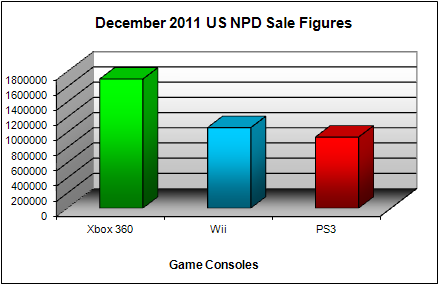
  • Xbox 360: 1,700,000 (Total: 30.9 million; December 2010: 1,860,000 – down 8.6%)
  • Wii: 1,060,000 (Total: 37.7 million; December 2010: 2,360,000 – down 55%)
  • PS3: 936,000 (Total: 18.9 million; December 2010: 1,210,000 – down 22.6%)
NPD December 2011 Game Console US Sales Figures

NPD December 2011 Game Console US Sales Figures

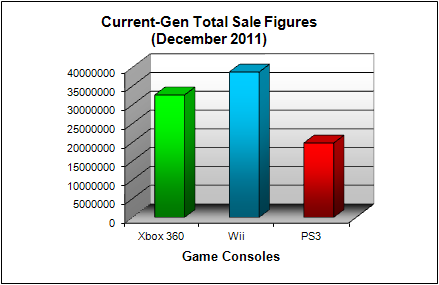
NPD Game Console Total US Sales Figures (as of December 2011)

NPD Game Console Total US Sales Figures (as of December 2011)

My prediction from last month was:

Same hardware ordering, and a software chart that looks very similar to this month’s, so there’s nothing much to add to that really.

While the software chart has a lot of titles that were there in November, the hardware ordering actually changed, with the PS3 dropping back down to third place, after finishing above the Wii last month.

Overall, looking at the figures above, and the “sea of red”, December 2011 has been nothing short of a disastrous month for video game sales, especially compared to last December. As mentioned earlier, a huge percentage of sales occur in December, but this last particular December did not even out do the previous month, when historically, this has almost always been the case. In fact, for hardware sales, the raw numbers were at its lowest since 2005.

Microsoft was probably the “winner”, if you can call it that (more like the smallest loser), with only an 8.6% drop in console sales, and level in sales with November. The NPD pointed to the strength of the Xbox 360 throughout the year, saying that the Xbox 360 platform accounted for nearly 40% of annual physical retail sales, across all categories. Still, if you count November and December together as one period, then 2011 has been good to the Xbox 360, with 3.4 million consoles sold, compared to 3.23 million a year ago. Microsoft probably had hoped the Kinect Star Wars game and console bundle would have made it in time, helping to push the console, and Kinect, to the next level, but the delay to the game means that there were no real A-list Kinect titles for this holiday period (unless you count Kinect Sports 2, and Dance Central 2, as A-list titles).

Despite finishing as the third most popular console, the PS3 was probably in second place overall, when you look at the year-to-year decrease figure, as well as performances across both November and December. Nearly 1.84 million PS3 consoles were sold during November and December, compared to 1.74 million consoles in 2011. So the good news is that, things are not that bad, while the bad news is that, the Xbox 360 appears to be pulling further ahead in the United States, where during the same period, it had almost twice as many sales (and more console sales during the holiday period, means more game sales for the rest of next year, and also means a strengthening multiplayer community, the growth of which relies on people using the same console as their friends).

So the real loser is, once again, Nintendo. The Wii, previously the unstoppable juggernaut during December sales, is no more, and is relegated to a distant second place behind the Xbox 360. For November and December, 1.92 million Wiis were sold, compared to 3.63 million in 2010 – in fact, more Wiis were sold in December of 2010 alone, than November an December of 2011 combined! A 55% year-on-year drop shows that the Wii is no longer the “must-have” video game gift, with some of the sales going to the Xbox 360 (not many, looking at the figures above), and possibly lots of sales going to things like tablets and smartphones, the new home of casual gaming.

And that’s probably the best way to look at things for the video game industry as a whole, for the most recent holiday period. The industry has benefited from the Wii becoming a must-have gift item for the last several holiday periods. Kinect has contributed to the same phenomenon, but it just hasn’t been the same. And with so many other gadgets to distract the holiday shopper, and also the economy, the decline can almost been seen as a return to normal, after a couple of years of extraordinary performance led by the Wii. Maybe the Wii U will bring back the same thing next year, but expectations must be readjusted.

As for software sales, it was also down compared to December 2010. MW3 led the chart again, with Skyrim dropping to third after the resurgence of Just Dance 3. Interestingly, looking at total sales for 2011, the ordering of the top 3 was exactly the same as the December top 3, showing that Call of Duty, and perhaps surprisingly, Just Dance, were the top 2 franchises for 2011. Mario Kart 7 on the 3DS was the only new entry into the top 10 in December. Here’s the full software sales chart for December (new releases for December 2011 in bold):

  1. Call of Duty: Modern Warfare 3 (Activision, Xbox 360, PS3, Wii, PC)
  2. Just Dance 3 (Ubisoft, Wii, Xbox 360)
  3. Elder Scrolls V: Skyrim (Bethesda, Xbox 360, PS3, PC)
  4. Mario Kart 7 (Nintendo, 3DS)
  5. Battlefield 3 (EA, Xbox 360, PS3, PC)
  6. Madden NFL 12 (EA, Xbox 360, PS3, Wii, PS2, PSP)
  7. Assassin’s Creed: Revelations (Ubisoft, Xbox 360, PS3, PC)
  8. NBA 2K12 (Take-Two Interactive, Xbox 360, PS3, PS2, PSP, Wii, PC)
  9. Super Mario 3D Land (Nintendo, 3DS)
  10. Batman: Arkham City (Warner Bros, Xbox 360, PS3)

Predicting January is always difficult, as the post holiday lull will be here, and there would usually be stock issues (although with the low sales this year, maybe this won’t be an issue). I suspect, other than huge drops in console sales figures for all consoles, the PS3 will probably regain 2nd place, with the Xbox 360 still the top selling console. A subdued month as well for software sale.

See you next month.