Archive for the ‘Nintendo Wii, Wii U, Switch’ Category

Game Consoles – October 2009 NPD Sales Figure Analysis

Saturday, November 14th, 2009

We’re nearing the two busiest months of the year in November and December. Last month, we saw the PS3 take top spot thanks to the price cut and the new Slim model. At that time, I questioned the longevity of this bump in sales, whether it was a long term thing thanks to the lowered price, or whether it was a temporary bump due to people upgrading their existing consoles to the Slim. This month’s figures should give us a better idea as to what has occurred. The figures are from NPD, a marketing research firm that releases games console sale data every month.

The figures for US sales in October 2009 are below, ranked in order of number of sales (October 2008 figures also shown, including percentage change):

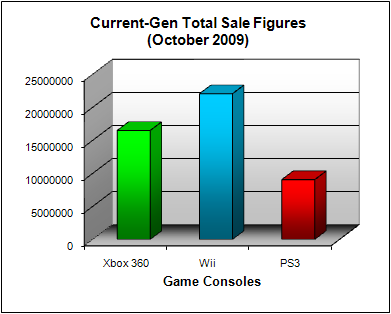
  • Wii: 506,900 (Total: 22.1 million; October 2008: 803,000 – down 37%)
  • DS: 457,600 (Total: 34.4 million; October 2008: 491,000 – down 7%)
  • PS3: 320,600 (Total: 9.1 million; October 2008: 190,000 – up 69%)
  • Xbox 360: 249,700 (Total: 16.5 million; October 2008: 371,000 – down 33%)
  • PSP: 174,600 (Total: 15.9 million; October 2008: 193,000 – down 10%)
  • PS2: 117,800 (Total: 44.7 million; October 2008: 136,000 – down 13%)
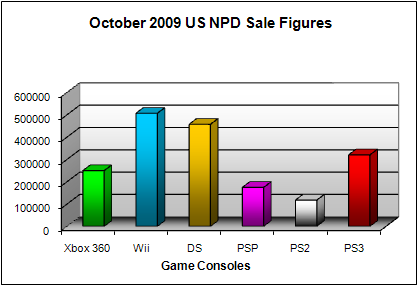
NPD October 2009 Game Console US Sales Figures
NPD October 2009 Game Console US Sales Figures

NPD Game Console Total US Sales Figures (as of October 2009)

NPD Game Console Total US Sales Figures (as of October 2009)

My prediction from last month was:

It’s time to make a prediction of October 2009’s results. For my money, I’ll say that the order of the hardware sales will remain the same, although the Wii numbers will be closer to the PS3 numbers. The PSP Go debuts, but based on an Australian report about the poor sales figures (a couple of hundred sales per week in an entire country, is not the best), the impact of the PSP Go may be muted. Sony will continue to have good month, but this time backed up in software sales as well with Uncharted 2. It might not sell enough to top the number one title, which might be Wii Sports Resort. Wii Fit Plus might take a place in the top half of the charts as well. I expect FIFA 10 to show up in one of more flavors in the top 10. Borderlands might make a showing too.

Some right, some wrong. The biggest surprise, if you can call it that, was that the Wii price cut managed to do enough to unseat the PS3 from the top spot. Part of this was also due to the price cut, Slim induced sales bump not lasting as long as one would expect. This is true of the Xbox 360 price cut as well, and if November wasn’t such a bumper month for sales, it might also be true for the Wii as well next month. My predictions about PSP Go sales being relatively subdued was also correct, with combined PSP sales of both the old and new models actually dropping compared to last month (but dropping less than it would have been had the PSP Go not been released). For my software predictions, I was right about Uncharted 2 doing well for Sony, but wrong about it not taking the number one spot. It did, and quite comfortably. Wii Sports Resort failed to keep its sales up, and was beaten in the end by Wii Fit Plus. FIFA 10 did show up, albeit in last place, but Borderlands did well on the Xbox 360 at least.

So let’s take a look at the PS3 numbers first. After a great month in which it took top spot amongst the home consoles for the first time since I’ve started analyzing the figures, it quickly felled back down again, but at least it managed to beat the Xbox 360. We’ll still need a couple of months to see if the price cut has any long term effects, but one thing is for certain, that last month’s bump for the PS3 had parts of it which were very temporary in nature. I would expect a price cut to be more long term, and the introduction of a new model to be more short term (due to the number of people who upgrade, which only occurs once), and so one can conclude that what made the PS3 the number one selling home based console in September was down to a fairly even combination of both events (price cut and new model), but that the temporary has started wearing off for October. Certainly those that expected the PS3 to be selling over the Wii from last month onwards were a bit too optimistic in their predictions, perhaps. In any case, Sony can still be extremely happy with the results, as the PS3 recorded what was the only year-on-year sales increase of all the consoles (more on that later).

The Wii’s sales bump is welcome news for Nintendo in what has been a fairly miserable year, especially in the last quarter. The price cut, while occurring in the last month, seems to have had the full effect in October as the Wii was the only console to record growth compared to September. But the overall picture is still not a happy one for Nintendo, as the year-on-year sale of the Wii saw a huge 37% drop, the largest of any console. Part of this was due to how incredibly the Wii was selling this time last year, way above any expectations. The other part is the slow decline in Wii sales that has occurred over 2009. At least the DS is still doing relatively well, keeping a firm grip on the number one spot and only recording a small year-on-year drop.

The Xbox 360 figures are again not looking great for Microsoft. A huge year-on-year drop breaks the trend for 2009, in which the Xbox 360 was pretty much the only console to record year-on-year growth (or negligible losses in a couple of months). This suggest the PS3 price cut has really hurt the Xbox 360 where it counts, and the fortunes have been reversed for the two consoles post the PS3 price cut, as the PS3 was the one recording large year-on-year sales drops up until the price cut. With Project Natal not coming until this time next year, later than PS3’s motion controller, which might be able to steal the Natal thunder if it’s properly integrated with the PS3 Eye and with useful software, time is running out for Microsoft to do something. To be fair, it was always a difficult struggle for the Xbox 360 to beat the PS3, and it has outperformed everyone’s expectations up until this point. Price cuts had allowed the Xbox 360 to outperform the PS3, but price cuts are not something that can go on forever, and given similar prices, the PS3 with its Blu-ray functionality and more advanced design will always win. So it may not be a case of the Xbox 360 losing to the PS3, but rather, both consoles finding their rightful place now that the PS3 ridiculous pricing has been removed as a factor. For Microsoft, Natal is a step in the right direction, but the November 2010 release date may just be too late to change things. The only thing that Microsoft has in its arsenal is the larger install base of the Xbox 360 over the PS3 in the US, which should at least mean that it will take some time before the PS3 finds parity, and will still allow them to sell software in good numbers until then. And the better multiplayer platform in Xbox Live over the PlayStation Network, and add to that the larger install base, does still give the Xbox 360 some momentum (the “if my friends are already on the 360, I have to be on it too” principle). Making Xbox Live Gold free is probably the only other weapon left for Microsoft to use.

Looking at sales as a whole, October performed badly compared to September and certainly compared to the same time last year. There might be a recession related thing going on at the moment, or just the lack of really big titles, but the stimulus given by the price drops, or new models being released, seems to be the only things keeping the figures from sliding further down. Things will be on the up in November for sure, but the numbers will be extremely interesting to see if there is a year-on-year growth or decline, and whether how well the PS3 numbers do compared to the Wii (and to a lesser extent, the Xbox 360), both to see if temporary factors were responsible for the Wii’s sales increase this month, and again to confirm the longevity of the PS3 price cut boost.

Moving on to software, things are slightly better, although a year-on-year decline was still the order of the day. The top title was a PS3 title for only the second time since I’ve started keeping track (the previous one was Metal Gear Solid 4 in June 2008). Uncharted 2 was the top selling title in question, and being an exclusive, that’s exactly where it should be. But compared to last month’s number one, which was also a follow-up game in a series and also a platform exclusive (Halo 3: ODST), the sales are still somewhat disappointing (Halo 3: ODST outsold Uncharted 2 by a ratio of nearly 3 to 1). Getting more out of platform exclusives, especially high profile ones such as the Uncharted series, whether that’s through more extensive marketing or other tactics, is something Sony can work on to better its software sales. There was only one other PS3 title in the top 10, NBA 2K10, a multi-platform release. There were only two Wii titles in the top 10, Wii Fit Plus as predicted and Wii Sports Resort, which saw sales drop compared to last month. The rest, apart from one DS title, was all Microsoft. 5 titles in the top 10, and even though the highest placed was only third, it still managed to grab 44.3% of total sales, the third best set of results in 2009. Wii games accounted 25.1% of the top 10, and the PS3 was third once more with 25% of sales.

Here’s the complete list of the top 10 software sales:

  1. Uncharted 2: Among Thieves (PS3, Sony) – 537,000
  2. Wii Fit Plus (Wii, Nintendo) – 441,000
  3. Borderlands (Xbox 360, Take-Two) – 418,000
  4. Wii Sports Resort (Wii, Nintendo) – 314,000
  5. NBA 2K10 (Xbox 360, 2K Sports) – 311,000
  6. Halo 3: ODST (Xbox 360, Microsoft) – 271,000
  7. NBA 2K10 (PS3, 2K Sports) – 213,000
  8. Forza Motorsport 3 (Xbox 360, Microsoft) – 175,000
  9. Kingdom Hearts 358/2 Days (DS, Square Enix) – 169,000
  10. FIFA 10 (Xbox 360, EA Sports) – 156,000

Prediction time. This is a hard one. Sales will go up considerably compared to October, that’s for sure. The DS will be top, the number two spot will be closely fought between the PS3 and Wii, although I’m leaning towards the Wii winning that battle right now. The Xbox 360 is 4th, followed by the other two PlayStation consoles. Call of Duty: Modern Warfare 2 will be the number one selling game, and the controversial game will be a record seller if the hype is anything to go by. The Xbox 360 version of this multi-platform game should be the one occupying the top spot. Other titles that will do well for the Xbox 360 include Assassin’s Creed II and the console platform exclusive Left 4 Dead 2. For the Wii, a new Super Mario Bros game will always be a hit, and it could give CoD: MW2 some competition (although mainly for the PS3 version, one suspect). Dragon Age: Origins, from the same people that gave us Mass Effect, could make the top 10 as well, since I’ve been hearing a lot about this game recently.

See you next month.
Game Consoles – September 2009 NPD Sales Figure Analysis

Tuesday, October 20th, 2009

As 2009 winds down, the video gaming industry is actually just getting started. From now onwards, you will see huge increases in video game sales from month to month, but with the economic situation as it is, comparison with previous years may still point to a disappointing holiday season. But there are other factors at play here, most noticeably Sony’s new PS3 Slim, and the corresponding price cuts for all the home based consoles. So September 2009 is an extremely interesting month where the stats will tell us a lot about whether 2009 can be salvaged, or whether it will remain a disappointing year on the video gaming front. The figures are from NPD, a marketing research firm that releases games console sale data every month.

The figures for US sales in September 2009 are below, ranked in order of number of sales (September 2008 figures also shown, including percentage change):

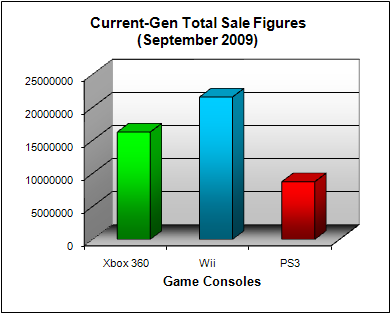
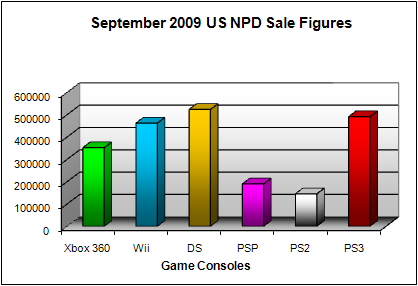
  • DS: 525,200 (Total: 33.8 million; September 2008: 537,000 – down 2%)
  • PS3: 491,800 (Total: 8.7 million; September 2008: 232,000 – up 112%)
  • Wii: 462,800 (Total: 21.6 million; September 2008: 687,000 – down 33%)
  • Xbox 360: 352,600 (Total: 16.3 million; September 2008: 347,000 – up 2%)
  • PSP: 190,400 (Total: 15.7 million; September 2008: 238,000 – down 20%)
  • PS2: 146,000 (Total: 44.6 million; September 2008: 173,000 – down 16%)
  • NPD September 2009 Game Console US Sales Figures

    NPD September 2009 Game Console US Sales Figures

    NPD Game Console Total US Sales Figures (as of September 2009)

    NPD Game Console Total US Sales Figures (as of September 2009)

    My prediction from last month was:

    So for a concrete prediction, I would say the PS3 to outsell the Xbox 360 and the Wii, and the number three being contested between the Xbox 360 and the Wii (too close to call, at this point). The PSP Go is coming in October, so we won’t see the numbers until November. Halo 3: ODST should top the charts next month, followed by Wii Sports Resort. The Beatles game should sell well too, although the Wii SKU may outsell the PS3/Xbox 360 ones.  At least one SKU of Batman: AA should still chart, although whether it’s the Xbox 360 or the PS3 version is too close to call at the moment as well (Xbox 360 users will be fully occupied by Halo 3: ODST to think about buying other games, I feel).

    Mostly right, a couple of minor mistakes. As predicted and expected, the PS3 managed to beat the Wii to second place, but it wasn’t enough to unseat the DS as the number one selling game console. I predicted that the Wii and Xbox 360 would be neck and neck, which wasn’t the case, but when I made the prediction, Nintendo had not yet announced the Wii price cut which helped it to at least hold on to third place. The software predictions are mostly correct, even down to the uncertainty as to which platform for Batman: AA was going to win (it was the PS3, beating the Xbox 360 version that finished just outside of the top 10). The Wii version of The Beatles: Rock Band did not outsell the Xbox 360 version though.

    So the big news of course are the PS3 numbers, which are simply put, head and shoulders, and a couple of body length, above last month pre-price cut/Slim numbers. There is a seasonal bump from August to September – one can work out just how much by looking at the PSP/PS2 numbers, which weren’t affected by new models or price cuts – this seasonal bump turns out to be around 35%.  Now taking this into account, the PS3 numbers are still about a 100% improvement compared to last month, and this is the amount that the Slim and price cut contributed. Now, how much of it was Slim based, and how much of it was price cut based, is impossible to tell with the numbers I have. The PS3 numbers are also a 112% improvement upon last year’s numbers, which is quite amazing. However, the jump in sales may only be a temporary spike, and it will be useful  to see next month’s numbers before coming to any conclusions. There won’t be a sales drop next month compared to this one, as the holiday season heats up and increases sale naturally, but the question would be how close Wii and Xbox 360 sales are to the PS3, whether the PS3 can hold on to second place or even get first. What is clear though is that the combination of a price cut and a new PS3 model has revived the flagging fortunes of the PS3, although whether this kicks of a period where the PS3 starts to dominate, or whether the Wii and Xbox’s market saturation will prevent this dominance, is a question that can only be answered in a few month’s time.

    The biggest loser, and why total hardware sales are still down compared to the same time last year (despite the positive PS3 numbers), is the Wii. Another month in which the Wii managed to sell less than the same time last year, this time by 33%, is just not good enough for Nintendo. The price cut came a bit late to make a huge difference, so Nintendo will hope that its full effects will be felt next month. But what has driven Wii sales, the novelty factor, is starting to wear off. And it will only get worse as Sony and Microsoft debut their own motion systems, especially Microsoft’s Natal which seems a lot more “next-gen” than either the Wii or the PS3 motion controller.

    Microsoft, now the least popular of the home consoles, may seem like the biggest loser, but if you look closely at this month’s numbers, they still have something to be happy with. While I don’t think the Xbox 360 Elite is priced competitively enough to combat the PS3, and I don’t think the Arcade can battle with the Wii, it’s clear that by having these two price points, Microsoft want to take on both Sony and Nintendo. It’s not working too well. What would have made more sense was to drop the Pro bundle to Arcade prices, get rid of the HDD-less Arcade model, and price the Elite at much less than the PS3 Slim. But you do get the feeling that any price cut is only a temporary measure until Microsoft unveil Natal, which should push it ahead of the PS3 and the Wii in terms of the novelty factor at least. But as I mentioned above, the other numbers, which is basically the software numbers, are quite encouraging actually, obviously helped by the platform exclusive Halo 3: ODST. In fact, 32% of the total video gaming revenue belonged to Microsoft products (hardware, software and accessories) this month, the single most contribution of any console. For the top 10 software, Microsoft dominated with 64.7% of the revenue, the most dominant performance since I started collecting data, even beating the month when Wii Fit was released in which Nintendo dominated with 61% of the top 10. So it’s not all bad news, and the lead they’ve built up over the PS3 over the last few years should allow them to keep their lead for at least another couple of years, and that’s assuming the PS3 performs as well as this month from now on.

    So let’s move onto the software stats. My prediction of Halo 3: ODST and Wii Sports Resort occupying the number 1 and 2 spots respectively was a pretty easy one to make, and it was correct. Halo 3: ODST’s numbers were amazing, making it the 6th best selling SKU launch of all time, very good for a title that was only available on one platform, and an add-on to boot. There was room for 4 more Xbox 360 titles in the top 10. The only slight point of concern was that the PS3 version of Batman: AA outsold the Xbox 360 version, something that rarely happens for multi-platform releases, but the PS3 version did have exclusive content, and as I said last month, the Xbox 360 gamers might have been too busy with ODST to think about Batman: AA. There were only two Wii games in the top 10, gone are the days when Wii Play, Wii Fit and Mario Kart would all make regular appearances. These games have had a good run, but if Wii software sales are to improve, then the platform needs a string of must-have third-party games. Forget about a string, there hasn’t been even a couple of third-party Wii games that can be called “must-have”, so that’s a worrying point for Nintendo. For the PS3, the hardware bump did not translate over to software, with only two titles in the top 10. Madden NFL 10 on the PS3 did well to bridge the gap between it and the Xbox 360 version, but even the Wii version of the Beatles Rock Band game outsold the PS3 version, and so it did not place in the top 10. And as mentioned before, Batman: AA was the other PS3 entry in the top 10, beating the Xbox 360 version which finished 11th (sales figures unknown, but probably just over 200,000, and maybe about 10,000 copies short of the PS3 version). Microsoft’s dominance meant a 64.7% share of the top 10, with the Wii  getting 16.8% (plus 6.7% for the single DS game in the list), and the PS3 on 11.8%.

    Here’s the complete list of the top 10 software sales:

    1. Halo 3: ODST (Xbox 360, Microsoft) – 1,520,000
    2. Wii Sports Resort (Wii, Nintendo) – 442,900
    3. Madden NFL 10 (Xbox 360, EA) – 289,600
    4. Mario & Luigi: Bowser’s Inside Story (DS, Nintendo) – 258,100
    5. The Beatles: Rock Band (Xbox 360, EA) – 254,000
    6. Madden NFL 10 (PS3, EA) – 246,500
    7. Marvel: Ultimate Alliance 2 (Xbox 360, Activision) – 236,000
    8. Batman: Arkham Asylum (PS3, Eidos) – 212,500
    9. Guitar Hero 5 (Xbox 360, Activision) – 210,800
    10. The Beatles: Rock Band (Wi, EA) – 208,600

    It’s time to make a prediction of October 2009’s results. For my money, I’ll say that the order of the hardware sales will remain the same, although the Wii numbers will be closer to the PS3 numbers. The PSP Go debuts, but based on an Australian report about the poor sales figures (a couple of hundred sales per week in an entire country, is not the best), the impact of the PSP Go may be muted. Sony will continue to have good month, but this time backed up in software sales as well with Uncharted 2. It might not sell enough to top the number one title, which might be Wii Sports Resort. Wii Fit Plus might take a place in the top half of the charts as well. I expect FIFA 10 to show up in one of more flavors in the top 10. Borderlands might make a showing too.

    See you next month.

    Weekly News Roundup (18 October 2009)

    Sunday, October 18th, 2009

    It’s been a busy week news wise, so there’s no problem at all filling up the 2,000 odd words required, I mean necessary, for this edition of the Weekly News Roundup. However, as I was feeling quite the stats nerd during the week, I decided to get out the spreadsheet software and then tabulate and graph the Blu-ray sales that I’ve been gathering since May 2008, you know, just for fun. The analysis doesn’t contain too many surprises, but for those who want to know just how much Blu-ray sales have increased, it may be worth a read. Anyway, on to the news, of which there’s quite a few.

    Copyright

    Starting with copyright news, anti-piracy has become a real business, that’s not too surprising. But has the business of fighting piracy become more profitable than actually stopping piracy?

    That’s what one anti-piracy firm thinks, and it even made a presentation showing just how more profitable it can be, for them and content owners alike, to allow piracy to continue and to make money off it by suing people, or threatening to sue them, for copyright infringement. They estimate that a quarter of all people they scare pay the penalty that they’ve arbitrarily set, and each successful claim is worth hundreds of legitimate downloads in terms of profit. This follows a rather candid interview that was given by a similar anti-piracy outfit not too long ago, where they revealed that they’ve put out content on P2P networks to lure people in, and they’ll only go after the people who they can make a good profit from. Stopping piracy, seems to be a distant second objective to making a bundle of cash by exploiting people’s fears about going to court, people’s lack of knowledge of the law, and the anti-piracy crusade that content owners are hell bent on pursuing. And your government is not only allowing it, but probably helping and profiting from it as well. Is this really acceptable?

    Speaking of governments and unacceptable practices, have you heard about the proposed anti-counterfeiting/piracy treaty, that will be discussed in South Korea next month by several leading countries. The plans that could cause your iPod or laptop to be searched at the airport for suspect pirated content, or make file sharing illegal, or use legislation to turn ISPs into copyright cops? You haven’t heard of it? Well, that’s no surprising, because the US government is making sure nobody knows about the proposals until they’ve been passed, citing “national security” reasons. Only a handful of selected individuals were privy to what’s on the agenda, and even they had to sign non-disclosure agreements beforehand. Has counterfeiting and piracy, and not even the kind that takes place on the seas, become such a major issue that it’s being treated in the way as the war against terrorism or the war against drugs, and no public discussion is even allowed on the subject? Incidentally both of the wars I’ve mentioned just now seems to be the never ending types of which winning is all but a distant dream at the moment – a glimpse into the future of the war against downloads perhaps.

    Ringtones is a public performance, just one of the many zany things that the ASCAP claims

    Ringtones are a public performance, just one of the many zany things that the ASCAP claims

    But before the governments can agree on how long to lock people up in Gitmo for downloading the latest Miley Cyrus album or a screener of Zombieland, the RIAA and MPAA have to do things the hard way. One method they’ve tried before is to attack BitTorrent networks, using techniques such as “piece attack” and “connection attack”, both of which designed to frustrate the downloading experience for other users. However, a study has shown that despite the millions of dollars given to anti-piracy firms to implement these methods, they do not work, and at best, they are a minor annoyance to downloads for only a couple of minutes. More millions down the drain, millions that could have been used to give people what they want, which is cheap, accessible music and movies. Instead, they’re doing things like trying to get royalties from ringtones, or to charge people to listen to the 30 second previews on iTunes. This, and many other claims, are being rejected even by the copyright friendly courts, as the ASCAP found out this week. The content owners, and the people who have been profiting from royalties, are doing everything they can to hold on, even asking Congress to make it a law so that they never lose their cash cow. Instead of embracing change, they’re fighting it, and you wonder how long they can go on doing the same thing. The longer that legitimate and comparable alternatives to illegal downloads are not implemented, the more likely that illegal downloads will be accepted as acceptable practice by the general public.

    And many things that have been adopted as common practice, such as recording TV shows to your VCR/DVR or ripping your CDs to MP3, are now considered legal. But they won’t be legal if the Canadian group Access Copyright have anything to do with it, and they propose that any of these acts should carry a fee that goes toward the content owners, or at least the people who profit from giving out licenses, such as Access Copyright. It seems that the copyright debate has gone all the way back to pre Universal vs Betamax times, and the content owners are still trying to fight innovation, even if that particular innovation (the ability to record stuff) is a couple of decades old already.

    Nobody likes the MPAA, not even the studios that it represents

    Nobody likes the MPAA, not even the studios that it represents

    This anti innovation drive has a lot of people angry, and has given agencies such as the MPAA quite a bit of bad PR. So what do they do about it? Instead of calling it “anti-piracy”, anti-piracy is now called “content protection“. Protecting the content from those pesky and annoying people called customers, perhaps, and also protecting profits again innovation. The studios are also unhappy at the MPAA’s approach, calling it not aggressive enough. The shift in strategy will mean that the MPAA will now go after ISPs and network operators, to clamp down on the spread of information from a higher level. Yes, this should make them more popular. And this brings us quite nicely into the iiNet trial, the landmark “studio versus ISP” case that could determine the future of the Internet. It’s the second week of the trial, and you can read the summary in the linked post. Suffice to say, if ISPs are to become copyright cops with the power to kick people off the Internet, then you have to wonder, due to the ever increasing importance of the Internet to people’s way of life (and work), whether this infringes on people’s rights in a democratic society. Finland has just made 1 Mb broadband a basic legal right for anyone who lives in the country, and they will up the speed to 100 Mb by 2015. This seems to be the direction many countries are going towards, making Internet a basic utility just like power or water. But if the Internet is a basic utility, then how does the three-strikes system (or as in the iiNet case the “one-strike” system) affect this basic legal right. Can you be denied water or electricity because you’re a suspected criminal? Can the government deny anyone the ability to make a phone call, and even so, is it something they can enforce at all unless that person is in prison, or under house arrest. And in the end, will any of this actually protect the profits of billion dollar movie and music studios, or will kicking people off this brand new global distribution platform actually hurt profits in the long term. And why is the government doing anything to protect profits of private companies anyway, especially at the tax payer’s expense?

    But let’s end this section on a slightly happier, and sane, note. Danny Boyle, director of Slumdog Millionaire and 28 Days Later says that perhaps the best way to fight piracy is to cut movie prices, because the cinema still has something unique to offer in terms of the viewing experience, compared to a poor quality screener. It’s a crazy suggestion, so it might just work. Or we can just ban the cinema, so nobody can bring a camera into the cinema and record it. Problem solved!

    High Definition

    In high definition news, the CEO of Netflix says that DVDs may be on the way out. But instead of Blu-ray replacing the format, it will actually be streaming. Of course, he’s referring to movie rental, not sale-through, and his director of corporate communications had to soften the statement by saying that growth is positive on all the formats.

    Netflix CEO Reed Hastings based his opinions on the fact that more and more people are opting for the cheapest DVD rental plan, while still keeping the most fully featured streaming option. I think the convenience of streaming, instant access, no need to wait for the disc in the mail and post it back, might be the reason for this shift. But until HD streaming becomes an affordable reality for everyone, which means bandwidth speed and allowance will have to increase, Blu-ray is still the only show in town if you want the best quality HD movies.

    TDK's 100 GB Blu-ray Disc: May not work on current Blu-ray players

    TDK's 100 GB Blu-ray Disc: May not work on current Blu-ray players

    What may be not so good for Blu-ray, or actually Blu-ray owners, is the news that 50+ GB discs may not be compatible with current players. So if the movie studios ever decide to use 100 GB discs, say for TV series box sets, then Blu-ray owners will have to upgrade their Blu-ray players again. And I say again because many have already had to upgrade their profile 1.0 players to 1.1 or 2.0, to access features like PiP and Internet content. Chances are, this won’t ever happen, because it will just hurt the format too much if people are yet again forced to adopt new hardware with new disc drives, which further highlights just how out of date the idea of using discs is in the age of digital distribution. And I don’t think people mind having a bunch of discs in a box set, as I think it actually makes it look like more value.

    China Blue HD, which is HD DVD for China, is being imported into Europe, along with cheap movies. Can’t see the studios being happy about it, since they licensed movies to CBHD for sale in China only, and the cheap player that comes with a dozen free movies may confuse buyers when they’re out there shopping for Blu-ray.

    And for Trekkies or Trekkers, and those who don’t mind a bit of DRM, then this might be for you: A Starfleet badge shaped USB thumb drive with a copy of the latest Star Trek movie on it? How can one resist!

    Gaming

    Not much going on in gaming, as everyone is waiting for the delayed NPD stats (due on Thursday, but has been delayed until Monday). It is expected that the Sony PS3 will jump to first place, from third, for the first time since its launch in 2006. Most expect the Wii to be second, with the Xbox 360 third. Microsoft has already came out with a pre-emptive attack on the numbers, calling it a temporary bump and saying that the 360 will still be the number one selling console for 2009.

    2010 is looking like a decisive year for this generation. Sony has it’s Wii like motion system, but Natal may trump it as the must have casual gaming gadget. Nintendo has been quiet, which makes me suspect they’ve got something up their sleeves.

    The NPD analysis for September 2009 should be posted sometime during the week, so until the next edition of the WNR, I hope you’ve had a good time reading this, have a good week and don’t forget to tip the waiter.

    Weekly News Roundup (27 September 2009)

    Sunday, September 27th, 2009

    With Windows 7 coming in less than a month’s time, it certainly seems like it’s the operating system that Vista should have been, and I think Microsoft are on their way to a very successful launch, despite their horrible marketing campaign. And for those upgrading – and I hope you’re opting for a clean install because that’s the only way to get the best out of Windows 7, performance wise – then this is the perfect opportunity to go to a 64-bit OS if you’re not already using one. The reason is that to go from 32-bit to 64-bit, even within the same OS version, you’ll need a clean install, so you might as well bite the bullet when doing the XP/Vista to 7 upgrade. If you’re already using a 64-bit OS, then please ignore the blog I’ve just written, otherwise it’s well worth a read to find out if 64-bit is for you, or if 32-bit is good enough for now.

    Otherwise, it was a fairly quiet week, with a few stories occupying the headlines to still make it a very interesting week, although most of it was yet again about the issue of copyright.

    Copyright

    Let’s start with the copyright news. There was only really one news item that really caught the attention of people this week. And not even Sir Elton John could push the news out of the headlines, much of it thanks to the reactions to the story on the Internet.

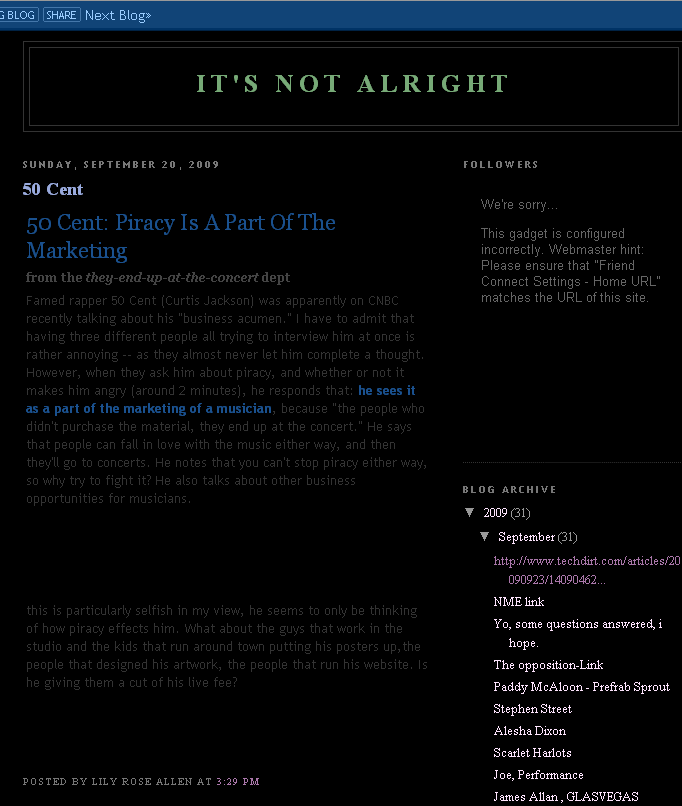
    A screencap of the Google cache of Lily Allen's anti-piracy blog, which has now been closed

    A screencap of the Google cache of Lily Allen's anti-piracy blog, which has now been closed

    Earlier in the week, musician Lily Allen decided to take a stand on the issue of online music piracy. But unlike many others who have come out against the proposed three-strike Internet banning policy, Ms Allen has come out for it, even launching a blog called “It’s Not Alright” to voice her views on piracy. Now there is nothing wrong with someone expressing their views, in fact, that’s what the Internet is for. However, if you do come out with some opinion, especially a controversial one, then make sure you are untouchable when it comes to arguing the facts. Unfortunately, Ms Allen made the mistake of not doing enough vetting into her personal history in regards to piracy, and in netspeak, she has been truly and thoroughly pwned. It turns out that, in publishing her anti-piracy views, that she might have pirated the article of high tech news and discussion website, Techdirt. And not only that, a few days later, it was revealed that Ms Allen was a distributor of pirated music herself, with some self-made mixtape MP3s that was available for download from her website, that featured songs that she (and her record company) did not have the distribution rights to. Oops.

    Some dude said nearly 2000 years ago that “let he who is without sin, cast the first stone”. And if one is to take the moral stance that anyone who has downloaded or shared an illegal MP3 (and that’s a lot of people) is a thief and should be punished harshly, than he, or she, should at the very least ensure that they have not committed the same “crime”. Because the truth is that it’s very easy to commit this crime, it may be because you think you’re not doing anything wrong by not paying for something you never had the intention to pay for in the first place, or perhaps you think sharing songs is a great way to promote the song and the artist and it may lead to you, or the people you shared the song with, to become a fan and start buying. There are legitimate arguments for and against a heavy crackdown on piracy, but as the Lily Allen incident showed us, it’s far too easy to be labeled a pirate just because, earlier in your music career, your appreciation of other artists led you to make a mixtape that somehow ended up online. And as Ms Allen posted on her blog about the mixtapes, “I made those mixtapes 5 years ago, I didn’t have a knowledge of the workings of the music industry back then”. But Ms Allen, under the very legislation that you support, you would be punished for what you claim you did out of ignorance 5 years ago, and guess how many other people might get punished for similar acts if what you support becomes law? And the article you stole from Techdirt, well, that’s copyright protected as well, even if it were just some text on some website you’ve never seen before. So I’m glad Ms Allen spoke out, because she has successfully demonstrated the worst aspect of the three-strikes system, something nobody else could do until it was actually made into law. Ms Allen has since then decided to quit the music business, which could be to her genuine loss of hope in the future of the music business due to continuing losses to piracy, a publicity stunt, a bit of sulky sulk sulk over the whole affair,  or a bit of everything.

    Oh, and Sir Elton John made similar statements but nobody really cared, not when the Lily Allen Show was so interesting.

    UK ISP BT says that policing Internet usage could cost more than simply ignoring the problem

    UK ISP BT says that policing Internet usage could cost more than simply ignoring the problem

    In all of this, it’s sometimes easy to forget that the whole point of the anti-piracy drive, and the three-strikes system, is all just about increasing profits for the music industry (and other industries). Not that there’s anything wrong with this of course, they have the right to take actions to increase their profits. But will the three-strikes actually stop piracy, and what about the cost to implement and maintain such a system. One of UK’s leading ISPs, BT, has came up with some estimates as to the cost of spying on Internet users, and they put the cost at £24 per person, or roughly £365 million per year in the UK. The UK music industry actually only claims £200 million in lost profits due to piracy per year, and as with their estimates, the actual loss is probably less than a quarter of this amount, if that much. The extra cost, the full amount of which will no doubt be passed onto the consumer, will hurt the Internet as access plans become less affordable and some are priced out of being able to connect altogether. This will in turn hurt legal online music sales and promotional efforts. I would be surprised if the music industry actually comes out ahead at all, but for them it’s of little risk since they scream so loudly about the seriousness of online piracy, yet are unwilling to fork out a single cent for a solution that they came up with. Probably the most effective way to actually kill off the three-strikes system is to actually force the music, movie (and other) industries to come up with the cash to implement such a system.

    But the movie studios (or at least movie theaters) are spending on implementing systems that try and stop camcorder pirates. The latest such system uses infrared pulsing lights situated behind the screen that the human eye cannot see, but will be recorded onto camcorder images. This is supposed to deter pirates and purchasers of said pirated content, but they’ve obviously never bothered to download and examine a cam recording of a movie, what with part of the picture being blocked by somebody’s head, and the sound of popcorn chewing louder than the explosions in the movie. I don’t think quality is what people care about when it comes to cam recordings, and so feel free to spend millions upgrading cinemas with this technology, and in the end, some guy who works at the cinema for $10 an hour will still manage to get their hands on the original reel and hand it over to the right people to make a perfect rip.

    So what would drive the copyright holders to spend so much fighting against online piracy, when by reasonable estimations, the loss to online piracy isn’t anywhere near as bad as the copyright holders make out, and that the benefits of the Internet will probably eventually outweigh any effect that piracy has. Many people can see that Internet and digital distribution provides a lot of new opportunities, but why does the industry treat it as a disease that must be eradicated? Well, William Patry, the senior copyright counsel at Google might have found the reason in his new book, Moral Panics and the Copyright Wars. He explains that this isn’t, nor will it be the last, time that copyright holders show mass panic in the face of a new distribution medium, to identify it as the enemy and do all in their powers to stop it, and then only to find out later on that it actually benefits them the most in the long run. It happened with the introduction of radio, television, VCRs, and now, it’s the Internet that’s public enemy number one where copyright is concerned. I guess it is understandable to a degree. To have something so valuable, you will want to protect it, against new things that you don’t fully understand and sometimes that means going too far. I keep on thinking back to the Susan Boyle episode, and wonder if her performance, and the show she performed on, would have been as popular if somebody hadn’t illegally uploaded the clip of the show onto YouTube. Had the copyright holders got to the video before the general public, how much of an adverse effect would that have had on the finances of said copyright holders, I wonder. Not to mention the financial fortunes of one Susan Boyle (although the publicity has had an adverse effect on her personal life, but that’s a whole other problem).

    High Definition

    Onto high def news now. Still not much happening, and that’s true on the release front as well, as the last few weeks (after the Watchmen bump had subsided) has been fairly quiet ones. However, one thing is for certain, and that’s the price drops for Blu-ray happening all over the place, for both hardware and software.

    Blu-ray prices have come down, for example, Crash on Blu-ray is now under $10 on Amazon

    Blu-ray prices have come down, for example, Crash on Blu-ray is now under $10 on Amazon

    I’ve noticed this trend from analyzing the NPD stats, and NPD themselves have also been monitoring the situation and found that average prices have indeed dropped and are getting closer to the pricing of the DVD versions, even compared to just a few months ago. And from looking at the price history info on our own Amazon Blu-ray Price Index section, you can see the trend quite clearly. New releases, which used to be priced at just below $28 on Amazon, are now almost always under $24, with older releases previously hardly ever discounted, sometimes now falling to under $10. And whenever there has been a discount for older titles, it will usually shoot to the top of the charts. It’s good new for consumers and good news for the Blu-ray format, but probably not great news for the backers of the format, who have envisaged a premium format to combat ever lowering DVD prices. It hasn’t totally failed in this respect, as DVD prices are falling faster and so Blu-ray has at least slow downed the bleeding, but I think it’s time studios start to think about ways to sell more copies of the movies, rather than to make more money per copy.

    Gaming

    Not much happening in gaming as it’s still a couple of weeks away from official sales figures for September, which should tell us how well the PS3 Slim is doing, and whether the discount to the Xbox 360 Elite has worked or not. The Wii price drop has been confirmed as well, but it comes too late in September to really have an effect on the month’s sales figures. But the fact that Nintendo is doing it may suggest they’ve had a look at the September sales figures and weren’t really happy with what they saw. And there is also news of a further $50 rebate offer for the Xbox 360 Elite, which suggests that Microsoft weren’t that happy with what they saw as well.

    That’s it for now, have a great week, and see you in about 168 hours time.

    Weekly News Roundup (20 September 2009)

    Sunday, September 20th, 2009

    Welcome back to another edition of the WNR. How was your week? I spent the week doing odd things, to be honest, I can’t really remember all that much about it, except I did waste a bit of time on Monopoly City Streets, except the cheaters on there makes it annoying for the rest of the players. It’s a good distraction, but I wish they’d put more thought into the rules before launching the game. Onto the news then.

    Copyright

    In Copyright news, subtitle download sites are now under the spotlight in Israel, or rather, the people who upload subtitles to these sites are the ones being targeted. Three individuals have been sued for uploading subtitles to the site Qsubs, and have been ordered to pay $240,000 in damages each, and to further humiliate them, made to publicly apologise for uploading them.

    Subtitle files are really just text files, but they are protected by copyright. But unlike things like film scripts (which a few places offer downloads for) which have legitimate use, subtitle files are mostly for use with pirated video files. For the files you make from your own DVDs, well, you can rip your own subtitles in most cases (technically breaking the DMCA or similar legislation), although legitimate use does exist when certain editions of the DVD do not have the subtitles you need, and since region control prohibits you from buying the other editions, using downloaded subtitles are the only way (although you may have to perform additional processing on said subtitle files because it all syncs up). Then there’s the issue that some US DVDs only have closed caption, which is not available in many other countries, and so if you have such a DVD, and you have convert it to XviD, you’ll need to source subtitle files for it from other editions. But these are pretty rare uses for downloaded subtitles, and in any case, copyright still exists for the ripped files. But suing individuals, while leaving the upload site alone, seems like a bit of a strange move.

    Veoh wins their legal battle with Universal Music, which should make YouTube happy

    Veoh wins their legal battle with Universal Music, which should make YouTube happy

    And unexpected as it may be, there was a win in court for Veoh in their legal battle again Universal Music. Universal had sued Veoh for copyright abuse, due to music videos being uploaded by users of the video sharing website. YouTube came under a similar suit from Viacom. But the decision, which Universal will seek an appeal on, means that Veoh cannot be held fully responsible for the actions of its users, as long as it takes appropriate action in trying to combat copyright theft. Just like YouTube, Veoh has the ability for copyright holders to seek removal of content, and they have removed content deemed unauthorized on a regular basis, and this was enough for the judge to declare that Veoh has done enough not be to held responsible for those other uploads that it has failed to remove. After all, the responsibility of stopping copyright theft should be shared between copyright owners and websites like Veoh and YouTube, the copyright holders cannot simply demand that these websites, which deals with thousands of videos per day, to do all the work to protect their own content. And it certainly shouldn’t be considered “reasonable” for these websites to censor each and every piece of user generate content, as if this is true, then websites like Twitter and Facebook would have to be. As long as websites show they are making a genuine effort, I think, that should be enough. In any case, the legal boffins at YouTube should be delighted at the ruling, although Universal’s appeal may reverse the decision in due time.

    Speaking of appeals, the service provider that was forced to disconnect The Pirate Bay via legal action initiated by the MPAA is appealing the decision. They had to disconnect TPB because the judge ruled that the service provider, which provided network services to the web host of The Pirate Bay, is liable for the content being made available using its services. This is a big ruling, and a very messy one, as these service providers may service an entire city or even country, and for them to be made liable for everything that is being hosted, essentially puts them out of business, and an end to the Internet. I keep on going back to this analogy, but again, this is like the phone company being made liable for the actions of criminals that are using their phone services. Except, this time, it’s not even the phone company we’re talking about, it’s the company that helped to lay the undersea cables that the phone company uses, being sued for someone using the phone to scam people. In real life, neither the phone company nor the cable layers would get sued (and if they do, they’ll win without question), but when it comes to the Internet, the largely clueless legal establishment are handing out rulings left and right that have huge repercussions that they are not close to being aware of. If the government should be taking any action on Internet piracy, it should be to establish clear guidelines as to jurisdiction, responsibility, and all those other legal definitions that make the legal system work, not to do the MPAA’s dirty work and denying it’s own citizens their right to communicate by kicking them off the Internet.

    French president Nicolas Sarkozy, friend of the RIAA/MPAA

    French president Nicolas Sarkozy, friend of the RIAA/MPAA

    And it’s a shame, because the French government has just successfully licked clean the bottom of the RIAA/MPAA’s shoes by passing their version of the three-strikes rule, although not exactly what the music and movie studios wanted (they didn’t want that pesky thing called due process), it is still a extremely harsh piece of legislation which hopefully will be appealed. The legislation will even fine or ban anyone who lets other use their connection to download pirated content, and jail time could even be handed out for serious offenders. So if you pirated 3 songs, worth a total of $2.97, you might have to spend a year or two in prison for daring to do something so nasty to those poor poor billionaires at the music and movie studios. Jean Valjean would be rolling in his grave if he were in fact a real person and not a fictionalized character, so Victor Hugo will have to be doing the rolling.

    Across the Channel, a group is seeking to add DRM to DTV by adding a piece of encrypted data to broadcasts, which can only be unlocked if you pay them money to buy the license to the decoder. It’s all in the name of stopping piracy of course, and the millions they are set to make in licensing fees is just a nice side effect, honest! Using the piracy bogeyman to scare the bejesus out of the government to force them to put in measures which allows you (or your lawyers) to make a bundle, while inconveniencing legitimate users and not stopping piracy at all – yep, that sounds about right as the MPAA is doing exactly this with the FCC at the moment. If only the rest of the world behaved in the same way as the Japanese, then groups like the MPAA won’t even have to make this effort. They can just bring out the DRM in force and make people use it, which is why all new Japanese phones will now have DRM to prevent playback of anything that it may detect as illegal, including songs and movies you’ve ripped from your own collections. This would also mean that anytime you want to play a song, you’ll have to connect to the Internet to have it checked by the powers that be to ensure you are not in fact a dirty pirate. Japan must be like some kind of utopia for the likes of the RIAA/MPAA, if phone companies can get away with doing something like this without a huge public backlash or government interference.

    High Definition

    In high def news, well, there wasn’t anything of real note to be honest. I could talk about Blu-ray sales numbers, but I’ve already covered them in this thread on a weekly basis. Or maybe talk about how all the studios are talking about bringing 3D movies to the home via Blu-ray, but I’ve talked about that before. Some websites are still talking about the Toshiba Blu-ray thing, which suggest there really isn’t that much happening right now. Things will certainly pick up as we get closer to the holiday period, and there are some big releases lined up for Blu-ray this season. So let’s skip high def news for this week and hope that there’s some news of substance soon.

    Gaming

    And in gaming, as predicted, firmware 3.01 for the PS3 has been released as a hotfix for many of the issues introduced by the disappointing 3.00 firmware. Sony needs to reduce the number of firmware updates and make each update more substantial (and bug free), because things are getting more ridiculous with each new firmware release. And despite having released tons of firmware updates, none of them have been as substantial or welcomed (relatively) as the New Xbox Experience update from Microsoft last year, which proves that quality, not quantity, is what people want.

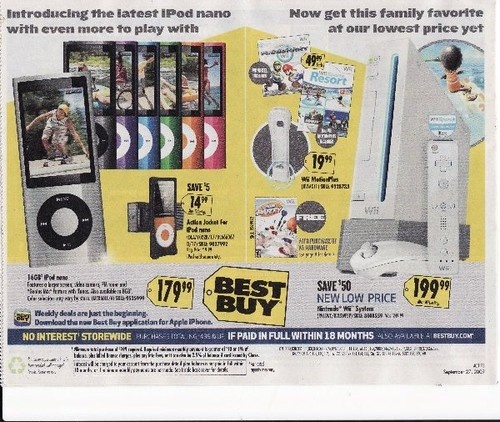
    Proof of the $50 Wii price drop?

    Proof of the $50 Wii price drop?

    And as for the Wii price drop, you can pretty much notch it up as “fact”, following more leaked catalogues (this time from Best Buy) showing the $50 price drop to come in this month. Is it enough to combat the resurgent PS3, and the Xbox 360 price drop? Price, I don’t think, is the Wii’s major problem. I think the novelty factor is wearing off a bit, and it’s going to be even less unique when Sony and Microsoft introduce their own motion systems, especially Microsoft’s controller-free Natal. Time for the Wii to concentrate on it’s core gamers, so a new Zelda game, a new Mario game or some new devices like Wii Fit, might be what’s needed. Wii Sports Resort helped, but more is needed.

    That’s all the news I bothered to “report” on this week. See you next week.