Archive for the ‘Nintendo Wii, Wii U, Switch’ Category

Game Consoles – 2010 NPD Sales Figure Year In Review

Tuesday, February 22nd, 2011

As promised, this is the 2010 year in review for US video games sales, based on figures provided by NPD. Due to the NPD withholding many figures towards the end of 2010, this year in review will be pretty short, with a sole focus on the hardware sales figures.

The total sales figures as estimated by the NPD for 2010 are as follows, listed in the order of best selling console to worst:

  • Wii: 7,069,900
  • Xbox 360: 6,764,089
  • PS3: 4,333,500

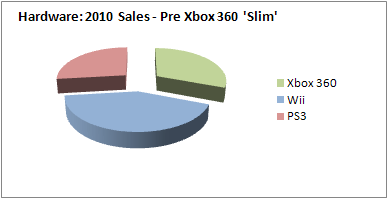
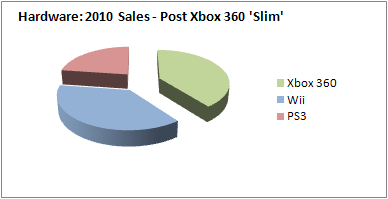
The major even that occurred in 2010 include the release of the Xbox 360 “Slim”, some Wii price cuts, and the release of Sony’s Move and Microsoft Kinect motion gaming add-ons for their respective consoles. Kinect and Move may have had some effect on PS3 and Xbox 360 sales, they occurred too late in the year to really make a huge impact for either console. But by far, the even that had the most impact was the release of the slim version of the Xbox 360, with took the industry by surprise when it was announced at E3. A picture tells a thousand words, or at least a few hundred, and the following graphs best illustrate the effect of the Xbox 360 “Slim” on console sales:

NPD 2010 Hardware Sales - Pre Xbox 360 "Slim"

NPD 2010 Hardware Sales - Pre Xbox 360 "Slim"

NPD 2010 Hardware Sales - Post Xbox 360 "Slim"

NPD 2010 Hardware Sales - Post Xbox 360 "Slim"

As you can see, the “Slim” had a huge effect on Xbox 360 sales, and it affected both PS3 and Wii sales. Before the “slim”, the 30.74% of consoles sold were the Xbox 360 (42.42% for the Wii, 26.84% for the PS3). After the “slim”, it was 39.56% (37.66% for the Wii, 22.78% for the PS3). Which shows that the Xbox 360 gains came more from the decline in sales of the PS3, than the Wii, although that’s simplifying things too much since each console’s gain/decline could be entirely independent from the sales results of the other consoles.

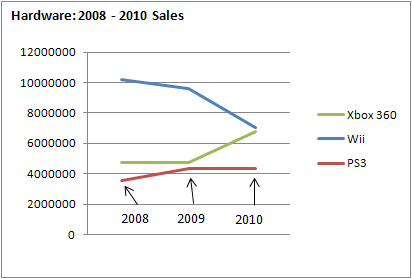
But looking at a single year’s results is too much looking at it in a vacuum – without looking at the past years’ performances, we can’t really see the big picture. And the following graph tries to plot the trend in sales, and why the Wii is in trouble:

Console Sales: 2008 - 2010

Console Sales: 2008 - 2010

The Wii’s steady decline is quite alarming, and shows just how close the Xbox 360 came to outselling the Wii in 2010, and if the early 2011 results are any suggestion, the Xbox 360 is set to become the best selling console in the US in 2011, surpassing the Wii for the first time since the release of Nintendo’s console. PS3 sales mostly remained level from 2009 to 2010, the actual decline in sales is only 1,000 units. The exact percentage changes are as follows (positive indicates growth, negative indicates decline):

  • Xbox 360:
    • From 2008 to 2009: 0.75%
    • From 2009 to 2010: 41.78%
  • Wii:
    • From 2008 to 2009: -5.67%
    • From 2009 to 2010: -26.31%
  • PS3:
    • From 2008 to 2009: 22.3%
    • From 2009 to 2010: -0.02%

The sales bump thanks to the PS3 Slim in 2009, as you can see from the above figure, is only half as big as that gained by the Xbox 360’s “slim”, although the Xbox 360 “slim” had a couple of months more than the PS3 “slim”. But it’s clear that Wii’s decline actually accelerated in 2010.

So what can we conclude from these figures? Nothing that’s not already quite obvious, that the Wii isn’t doing to well, while the Xbox 360 was the real winner of 2010, with the PS3 sales remaining completely flat.

Game Consoles – January 2011 NPD Sales Figure Analysis

Saturday, February 19th, 2011

I know I promised the 2010 year in review post, weeks ago, but rest assured, it’s still coming. I had hoped I would get around to it before the January NPD figures came out, but it looks like I waited too long! In any case, let’s get the January 2011 NPD done before worrying about 2010. Once again, there were enough leaks to present us with enough data to get January’s NPD analysis up. For those that are new to this, this analysis looks at US video games sales figures compiled by NPD.

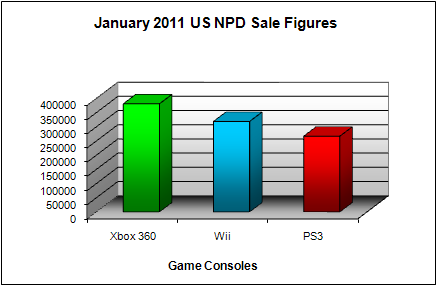
The figures for US sales in January 2011 are below, ranked in order of number of sales (January 2010 figures also shown, including percentage change):

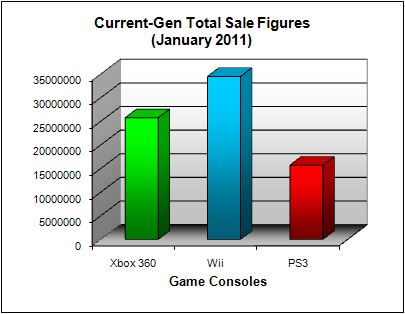
  • Xbox 360: 381,000 (Total: 25.8 million; January 2010: 332,800 – up 14.4%)
  • Wii: 319,000  (Total: 34.5 million; January 2010: 465,800 – down 31.5%)
  • PS3: 267,000 (Total: 15.7 million; January 2010: 276,900 – down 3.6%)
NPD January 2011 Game Console US Sales Figures

NPD January 2011 Game Console US Sales Figures

NPD Game Console Total US Sales Figures (as of January 2011)

NPD Game Console Total US Sales Figures (as of January 2011)

My prediction from last month was:

I loathe to make a prediction for next month, but I think the Xbox 360 will probably gain back the number one spot, and a very familiar top 10 for software as well.

And gained it back it did. In fact, the Xbox 360 even outsold the DS this month, making it the best selling video games console of any kind. It was also the only console to receive a year-on-year sales increase. The software chart does have a few new entries though, and we’ll discuss this later on as per usual.

Obviously, Microsoft are very pleased with the sales result for the first month of 2011, and it bodes well for the console for the rest of the year. With a 14.5% year-on-year increase, it shows that the console is more than just “the one with the least number of lost sales”, and that the Xbox 360’s market share is actually growing. And this has to be largely thanks to Kinect, as there are simply no other explanations for it (the sales bump from the “Slim” should have dissipated by now, and there hasn’t been any recent price cuts either). Of course, Black Ops may be responsible for some of the sales, but Modern Warfare 2 would have been equally responsible for sales this time last year, and so it can be ruled out as a factor for the sales increase. And with strong software sales (combine revenue on the Xbox 360 makes it the top selling platform once again, in the US).

The Wii continues its 30%+ year-on-year decline, which is alarming because the sales decrease does not seem to have slowed compared to the same time last year (January 2010 was down 31% as well compared to January 2009). The rapid and steady decline should encourage Nintendo to consider bringing out the Wii 2 sooner than what they had planned before. It’s still doing relatively okay in terms of software sales, with Just Dance 2 doing enough to actually earn 2nd place in the combined-platforms top 10 (which is difficult to achieve for a single-platform release like Just Dance 2). But even this is slightly alarming, in that for dancing games, the Kinect will most likely offer the better experience in the future (the Michael Jackson Kinect Experience game should tell us whether this theory is true or not). The Wii is a Xbox 360/Kinect price cut away from being totally wiped out, in my opinion, as price is really the only reason why it continues to outsell at least the PS3.

Speaking of the PS3, the recent PS3 hacking issue could be a distraction Sony can do without, because once again, its flagship console came last place in the home console charts (not counting the PS2, which it appears, nobody is counting any more, certainly not the NPD). But on the software front, there are at least a couple of bright spots, Little Big Planet 2 and the console exclusive DC Universe Online.  But instead of bridging the gap between it and the Xbox 360, the gap is actually getting wider, although Sony is definitely doing better in worldwide sales numbers (but the Xbox 360 is showing signs of improvement there as well). It doesn’t exactly help that the PS3 is still the most expensive console around, and even though some of the extra price is justified due to the Blu-ray playback functionality, which has just recently been upgraded for Blu-ray 3D, the ever decreasing cost of standalone players means that it’s becoming harder and harder to justify the PS3’s price premium. At the very least, Sony should be looking for price parity between its console and the Xbox 360.

In software, the top 10 does have a few titles from last month, but there are also a couple of new entries, the most notable being Dead Space 2, Little Big Planet 2, Dance Central and DC Universe Online. Three of these titles were platform exclusive (for consoles anyway), with two of them belong to the PS3. Which is why Sony can’t be too unhappy with the results. The other platform exclusive was Dance Central, a Kinect title, and this is the first Kinect title I think to make it into the top 10 “all-platforms” chart, which is hard for a platform exclusive, and Dance Central is more than just a platform exclusive, since it also requires an optional add-on accessory (if 20% of Xbox 360 owners have Kinect, and the Xbox 360 accounts for 34% of the console market, then it means only 7% of gamers could actually play Dance Central, and that’s not even including PC and portable console gamers). The leaks have also resulted in some actual numbers for software sales, with Black Ops selling 750,000 copies, Dead Space 2 selling 441,000, and Zumba Fitness selling “over 300,000” units. Anyway, here’s the full software sales chart for January:

  1. Call of Duty: Black Ops (Activision Blizzard, Xbox 360, PS3, Wii, PC, DS)
  2. Just Dance 2 (Ubisoft, Wii)
  3. Dead Space 2 (EA, Xbox 360, PS3, PC)
  4. Little Big Planet 2 (Sony, PS3)
  5. Zumba Fitness: Join the Party (Majesco, Wii, Xbox 360, PS3)
  6. NBA 2K11 (Take-Two Interactive, Xbox 360, PS3, Wii, PS2, PSP,PC)
  7. Assassin’s Creed: Brotherhood (Ubisoft, Xbox 360, PS3)
  8. Dance Central (MTV, Xbox 360)
  9. Michael Jackson: The Experience (Ubisoft, Wii, DS, PSP)
  10. DC Universe Online: The Next Legend Is You (Sony, PS3, PC)

So, prediction time. My brain tells me the hardware ordering will be the same, but my heart tells me there could be some surprises. A resurgence for the Wii? Xbox 360 suffering a sales slump after the holidays? PS3 sales up thanks to Killzone 3? Speaking of Killzone 3, it is one of *the* titles for February, while Bulletstorm seems to be selling well right now, along with Marvel vs Capcom 3. And the recent hits will be in the top 10 too.

As for the 2010 review, I will aim to get it up during the week, but again, it’s a busy week for me so I can’t guarantee anything. Actually, I’ve already got all the graphs done and the conclusion is already pretty clear, so it may just be a very short analysis since there’s not a lot of data to play with, especially during the last few months of 2010.

See you soon.

Game Consoles – December 2010 NPD Sales Figure Analysis

Saturday, January 15th, 2011

After an Oceans 11 style heist, a global computer hacking effort, blackmailing and some downright shameless begging, and I am able to bring you this month’s NDP US video games sales stats. Either that, or it was leaked in the same way it’s been leaked in the last few month. December is the busiest month of the year in terms of video game sales, and all eyes on whether the Xbox 360 (and Kinect) can triumph over the Wii, or will the PS3 stage a comeback of epic proportions. Read on to find out! All the figures are collected and calculated by NPD.

The figures for US sales in December 2010 are below, ranked in order of number of sales (December 2009 figures also shown, including percentage change):

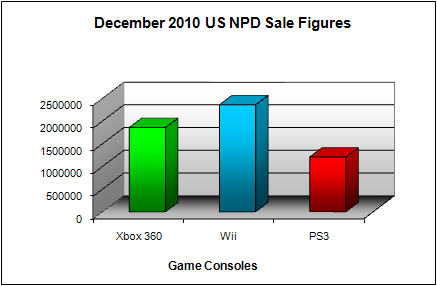
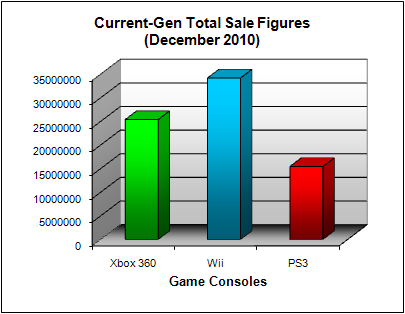
  • Wii: 2,360,000  (Total: 34.2 million; December 2009: 3,810,000 – down 38%)
  • Xbox 360: 1,860,000 (Total: 25.4 million; December 2009: 1,310,000 – up 42%)
  • PS3: 1,210,000 (Total: 15.5 million; December 2009: 1,360,000 – down 11%)
NPD December 2010 Game Console US Sales Figures

NPD December 2010 Game Console US Sales Figures

NPD Game Console Total US Sales Figures (as of December 2010)

NPD Game Console Total US Sales Figures (as of December 2010)

My prediction from last month was:

I’m going to go with the same hardware ordering as this month, although the shortage of Xbox 360 and Kinect stock could affect sales somewhat, with the more plentiful Wii taking advantage. Software wise, a lot of the same titles from the above list will be there, and it will be joined by Epic Mickey, possibly a Kinect title or two (Kinect Sport being the most likely candidate). GT5 will have risen in the rankings too thanks to it having a bit more time to sell more copies.

Well, if you believe Microsoft’s statement, then yes, the Xbox 360 stock shortage did affect US video game sales, and this allowed the Wii to come first in home console sales for the first time since May. The software predictions are more a mixed bag, or rather, I think  I only managed to get the Epic Mickey thing right (GT5 didn’t even make the top 10).

First of all, the Wii’s win this month seems to indicate that there’s still life left in the old motion controlling dog yet. While December was the best month for the Wii since, well, last December, but as you can see above, sales are actually down 38% compared to the year before. This seems in-line with the general percentage decline for Wii sales over the year, but it’s not as bad as it seems because last December was simply an amazing month for the Wii, far above expectations actually. In fact, the Wii in December 2009 was up an amazing 77% compared to December 2008 (which itself was up 59% from 2007), that’s far above normal. And so Wii sales actually grew compared to 2008, not by much, but it’s not bad for a “dead” console as critics (me included) have called it. It just goes to show that the Wii really is still the king when it comes to the holidays.

The Xbox 360’s streak as the top selling home based console ended in December. Microsoft was quick to blame stock shortages, and there definitely were stock related issues with the Kinect accessory. But is Microsoft really saying that, had stock been plentiful, it would have sold at least 500,000 more Xbox 360’s (to only just match the Wii numbers), basically that half a million people that wanted to buy Xbox 360’s couldn’t do so because all the stores had run out? That seems a bit far-fetched to me. In any case though, the Kinect accessory was a top seller, with more than 5 million sold, and 8 million shipped to retailer since its release in November, and I can see it driving console sales over the next few month. But in any case, the 1.86 million Xbox 360’s sold in December represents the best ever month for the console, and it was the only console to record a year-on-year growth (of 42%, which is quite impressive).

The PS3 again was unable to outsell the same month last year, coming in with a 11 percent decline compared to December 2009. It is kind of disappointing in that Move clearly did not help to sell more console, and that while last year’s better sales results were somewhat due to the introduction of the Slim, the price cut, and the higher price of Blu-ray standalones back then (which made the PS3 a good value choice for those also seeking a Blu-ray player – not so this year, considering you can now pick up a brand name player for peanuts), Sony should still have recorded some growth, or at least no decline, this year. Sony was quick to point out that they’ve had a great year with PS3 software sales, up 32% compared to last year, but they were in last place (of the home consoles) last year, and so they had the most to gain from increasing console numbers this year. In fact, from January to October’s estimated figures, the PS3 managed to overtake the Wii in terms of software sales revenue, up to second place, but it was still way behind the Xbox 360 in terms of revenue. In fact, even when you add in PS2 and PSP revenue, the PlayStation brand was still behind that of the Xbox 360, back in October. and while things could change between October and December, if anything, it should help the Xbox 360 (thanks to Black Ops) and the Wii (thanks to Just Dance 2, Donkey Kong, Epic Mickey, and Michael Jackson: The Experience). So in fact, the PS3 could still finish the year in last place in terms of software revenue.

And with that, we move onto software, and as expected, Black Ops retained the top spot for best selling game on all platforms combined (a Call of Duty game top of the charts at Christmas, what a non surprise!). To show that PC gaming is still alive, World of Warcraft: Cataclysm managed 3rd spot, despite selling only on one platform. And while the NPD no longer gives out individual platform sales, from the platform exclusives, we can see that Just Dance did fantastically on the Wii, and so did Donkey Kong Country Returns, Disney Epic Mickey and Michael Jackson: The Experience (while not a platform exclusive, this title wasn’t available for the Xbox 360 nor the PS3). So it’s been a fantastic month for Wii, but I just can’t help but feel that the type of titles selling could eventually point to a Kinect victory (and may also help the Move). Ubisoft’s dominance (Just Dance 2, Michael Jackson: The Experience) here, and Ubisoft’s commitment to Kinect (Ubisoft are the top sellers for third party Kinect games), does suggest a shifting momentum may occur. If Ubisoft doesn’t botch up the Kinect version of the Michael Jackson game, then it could be the game to really make Kinect take off. Anyway, here’s the full software sales chart for December:

  1. Call of Duty: Black Ops (Activision Blizzard, Xbox 360, PS3, Wii, PC, DS)
  2. Just Dance 2 (Ubisoft, Wii)
  3. World of Warcraft: Cataclysm (Activision Blizzard, PC)
  4. Assassin’s Creed: Brotherhood (Ubisoft, Xbox 360, PS3)
  5. Donkey Kong Country Returns (Nintendo, Wii)
  6. Disney Epic Mickey (Disney Interactive Studios, Wii)
  7. Madden NFL 11 (Electronic Arts, Xbox 360, PS3, Wii, PS2, PSP)
  8. Michael Jackson: The Experience (Ubisoft, Wii, DS, PSP)
  9. NBA 2K11 (Take-Two Interactive, Xbox 360, PS3, Wii, PS2, PSP,PC)
  10. Need for Speed: Hot Pursuit (Electronic Arts, PS3, 360, Wii, PC)

I loathe to make a prediction for next month, but I think the Xbox 360 will probably gain back the number one spot, and a very familiar top 10 for software as well.

And I guess with the December numbers available, I should do some kind of year-in-review post, but with the lack of full NPD stats, it’s hard to do a full analysis, so if I do a year-in-review next week, it will probably be pretty short.

Until then …

Weekly News Roundup (12 December 2010)

Sunday, December 12th, 2010

Another pretty quiet week, but with the NPD US November video games sales figures being leaked out in a timely fashion, I was able to get the analysis up. The big surprises were how well the Xbox 360 did (up 68% from the same time last year!), and how poorly the Wii *didn’t* do (up 1% from last year, much better than the usual 30+% decline in previous months). The PS3 continues the trend in recent months of year-on-year declines, which is mostly due to the post Slim/price cut bump from last year, but it’s still somewhat of a concern that the PS3 didn’t even manage to sell half as many units in November as the Wii. And with Kinect being a bigger hit than Move, and with Blu-ray players being dirt cheap these days, Sony may have to re-evaluate pricing to spur sales. Speaking of Kinect, I managed to buy one this week. I haven’t had much time to play with it yet (especially on the PC), but I can see the potential and the appeal (for casual gamers in particular), although the space requirement thing is kind of annoying. Let’s get started with the news roundup.

CopyrightIn copyright news, more bad news for the US Copyright Group, as they had to drop 97% of the unnamed defendants in their “Far Cry” lawsuit.

The judge in the case ruled that due to jurisdiction reasons, most of the defendants had to be removed from the case, and so now, only 140 remain. The USCG has previously said that this wouldn’t hurt their business, as they had always planned to do it this way, but with having to respect jurisdiction and having to file multiple lawsuits all over the place, the USCG’s business case may have been damaged. These mass lawsuits rely on defendants paying up quickly, and so all these extra court procedures may very well be expenses that eventually make these lawsuits unprofitable.

The Drudge Report

The Drudge Report is the latest victim of Righthaven's mass lawsuits

The other famous mass copyright lawsuit law firm at the moment is Righthaven, doing the exact same thing but for posted newspaper articles. Even though they’ve had even less success than USCG, and have had to backtrack a few times when they sued the wrong high profile target, they’re not giving up and have instead picked an even larger target this time – The Drudge Report. Righthaven is suing Matt Drudge and both drudgereport.com and DrudgeReportArchives.com for using images owned by The Denver Post, the latest newspaper to join the Righthaven stables. Righthaven is demanding Matt Drudge hand over these two domain names to them so the serious copyright abuse (of using one single image owned by The Denver Post) can be stopped post haste. According to my own estimates, the drudge.com domain name is worth about $7.8m alone (just the domain name, not the content), so I guess that’s how much Righthaven thinks a single image is worth. Of course, picking on such a high profile target has its own problems, and although it will get Righthaven in the news, it could also backfire if the Drudge Report mount a legal defence instead of just paying the settlement fee, which appears to be the case.

But still, $7.8m for a single image may seem like a lot even when you compare that to the insane damage amounts being handed out for MP3 downloads. The most famous MP3 download case of all, you know the one, has had some development this week too, with Jammie Thomas-Rassett’s lawyers asking the damages, of $62,500 per song, to be reduced to $0 per song. Yep, I can really see the RIAA agreeing to this latest demand. But Thomas-Rassett’s lawyers do have a point in saying that the RIAA has not proved the financial damage being done by their client’s actions, but with the current copyright laws and statutory damages, the RIAA does not need to prove actual damages,which I think is really unfair. I can see the value of statutory and punitive damages in commercial copyright cases, in which sometimes it is difficult to proof actual damages, but when you’re suing students, single mothers and other net users, I just don’t think it is appropriate. And judges don’t think it’s appropriate either, which is why the Thomas-Rassett case is still unresolved in terms of damages. The thing is, if the RIAA is trying to use this case to scare off other downloaders, it’s not exactly working is it? And I think the laws needs to be updated so that a fairer punishment can be handed out. $50 per song, for a song that costs $0.99 to download (but one must also consider uploads in cases such as these), should be more than enough. It certainly shouldn’t be $62,500, and such large amounts should remain for commercial cases only, such as when a TV network broadcasts a song without permission.

Eircom

Eircom has made a deal with the devil, to offer free music streaming for spying on customer downloads

The RIAA’s answer to this is three-strikes, or something like it. Strategically, it makes sense to keep pursuing Thomas-Rassett, keep on getting awarded huge damages, and they too can use it as example of how the current copyright laws do not work. But the change they want will be to their own benefit, so that it would make it easier to sue and suspend downloaders, and lawmakers may just make this dream a reality via Three-Strikes. But before the music industry seeks government cooperation, they’ll do a bit of ISP threatening to get them to adopt Three-Strikes “willingly”, and it appears this strategy is working, at least in Ireland. Eircom has agreed to the Irish music industry’s demand for Three-Strikes, and will begin to ban users from their network after spying on their downloading activities and detecting anything the music industry finds offensive. And to stop the mass exodus of users to other ISPs that don’t spy on their paying customers, Eircom and the music industry has come up with some sweetners, such as unlimited music streaming and cheaper music downloads. Of course, if they really believe that music streaming and discounted music downloads can help people move on from piracy, they should have just offered this, without three-strikes, in the first place.

I’ve talked a lot of nonsense in the copyright section of the WNR in the last couple of years (yes, it really has been that long!). But I think if I had to sum up my opinion on web anti-piracy, it would this: be pragmatic! It’s clear that the technological solutions, namely DRM, has failed. Whether it’s Blu-ray releases like Avatar that come with “enhanced” anti-piracy solutions, or the latest Ubisoft game – the only disruption these new DRM measures usually cause is to legitimate buyers, with pirates still easily able to pirate the content (and without the pesky annoyances brought on by DRM, and so pirates are actually getting a better product thanks to the use of DRM by publishers). One news I found interesting this week was that pirates have found a way to pirate 3D movie screenings at the cinemas, using a special lens on video cameras. If pirates are going to this length to pirate a movie, I just don’t think there are any technical solution to piracy, nothing that can’t be bypassed, hacked or simply ignored.

The legal solutions, like the mass lawsuits or Three-Strikes either have no intention in stopping piracy (only to monetize it), or will only push people towards piracy solutions that cannot be tracked, and that means they don’t work either. So why not be pragmatic, and seek a real solution, instead of band-aids or measures that will only give the industry a false sense of security, and at the same time, cause massive collateral damage in terms of consumer and civil rights.

But the industry is obsessed with doing things the wrong way, and with all the powers granted to them by governments, they are getting more and more belligerent. The MPAA’s latest demand is for Universities to crack down on students downloading movies, or face the possibility of losing federal funding, following the RIAA’s footsteps in making similar threats. But they could only make this threat if they can back up their threat, and unfortunately, they can, via the Higher Education Opportunity Act of 2008. So the RIAA/MPAA have gone to a lot of trouble, a lot of money spent on lobbying, to get the act passed, and this act forces Universities to divert funding away from education, and towards deploying anti-piracy tech, and what has it all achieved? This is what I mean about being pragmatic, because I don’t think this “solution” solves any problems. College students downloading movies may be stopped (or maybe they’ll just use their own personal Internet accounts to do so), but how much money has that made for the RIAA/MPAA? Will these students, many of whom have trouble paying their tuition fees, all suddenly stop downloading pirated content and start paying for everything? And all of this “result” after millions and millions of dollars, was it worth it? And is it really worth it to endanger the education of tomorrow’s workforce so that the RIAA/MPAA can chalk up another “theoretical” victory, which gains them little, if any, actual benefit? It is really worth it?

And to round off the copyright news, LimeWire is shutting down again, but this time, it’s the legal part of LimeWire. It was originally set up to appease the music industry and to transition LimeWire to a legal service, but it looks like it failed to achieve either of its objectives. The service will shut on at the end of the year.

High Definition

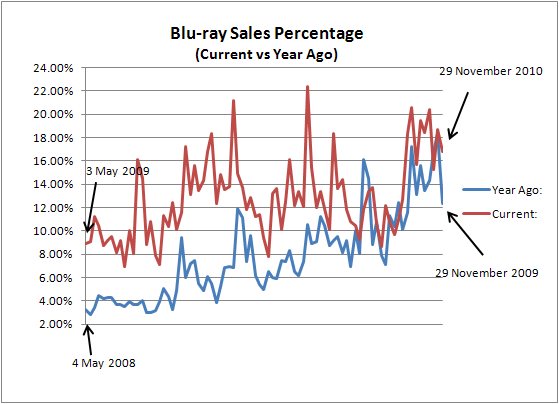
In HD/3D news, not much going on really. I suppose I should cover the fact that Blu-ray has just had its best Black Friday sales yet.

Blu-ray Sales Percentage - Year-on-Year Comparison (As of 29 Nov 2010)

Blu-ray sales growth has slowed this year, but this Black Friday (last entry in graph) was a good one for the HD format

$83 million dollars worth of Blu-ray movies were purchased during the Black Friday sales week. This in itself is not a record, and “only” represented a 20% increase on last year’s Black Friday results, but what was more impressive was the market share, which traditionally favours DVDs during this period (due to aggressive discounting). This year, Blu-ray’s market share was 16.82%, an improvement on last year’s 12.33%. It seems that the aggressive Blu-ray pricing has had an effect.

The next few weeks will generally favour Blu-ray as well, so while Blu-ray growth has slowed a bit, it is at least growing, which cannot be said of DVDs. The economy, Blu-ray, and downloads are all taking market share away from DVDs, so its decline isn’t too surprising either.

And on a personal note, the Blu-ray’s I picked up during Amazon’s Black Friday sales arrived this week. This is why I prefer to shop from Amazon: not only did they upgrade shipping from standard to express at no charge (the item arrived from the US to Australia in only 4 days, and one of those days was a customs delay), they didn’t even make a fuss about it – I only found on when they sent me the “dispatched” email with the shipping details and tracking option, which is normally not available with standard shipping. This contrasts to an experience I had with an Australian online store this week. I purchased Kinect Sports from Big W as part of their online sales at the end of November. My credit card charged immediately. But having not heard anything about the order, and with their online order tracking system down, I emailed customer service. I only received a response a day later, and was told that in fact, my order had not gone through due to an IT problem, and that instead of resolving this and sending out my item, they had simply cancelled it. My credit card has yet to be refunded! And the worst part is that I could have picked this title up for even cheaper just a few days after my original order, but I chose to stick with Big W since I thought, wrongly, that my order had already been processed and dispatched. Was I angry? Well, put it this way, it’s unlikely that I would shop at Big W ever again, online or in store. Not if I have a choice.

Not much to say in gaming, nothing that I haven’t already covered in the NPD analysis anyway, so I’ll skip it for this edition. Although I will add that the NPD analysis focuses on US sales only, and the global picture, especially in Japan, is actually very different, with the PS3 outperforming the Xbox 360 and the Wii quite consistently. Global sales wise, the PS3 has nearly caught up, or has already caught up, to Xbox 360 sales, whereas in the US, the Xbox 360 still has a 1.6:1 advantage over the PS3. But if Kinect is the next big thing, or really just the next Wii, then even global sales may start to reflect the Xbox 360 dominance, because finally, we have a console that can do almost any kind of games – from the hard core, to the casual. The only thing it doesn’t do is Blu-ray, but with standalones so cheap these days, the PS3’s advantage in this area is diminishing, especially since multi-platform games aren’t really taking advantage of the space offered by Blu-ray, and the PS3 version is often worse than the Xbox 360 version, due to the more difficult time devs have with PS3 development.

And this “PS3 is harder to develop for” isn’t just a myth, or can be attributed to lazy programmers. I’ve heard this personally, and constantly, from people working in the industry, and it seems the main issue is the whole hardware architecture of the PS3, which will always makes it more difficult to develop for than the Xbox 360 – even doing the same things on the PS3 takes a lot longer than on the Xbox 360, and so while developers may be able to do more with the PS3, time constraints means that they end up doing less (or just the minimum required to get the game running at the desired FPS). It seems Microsoft, being primarily a software company, did a lot of work to ensure the Xbox 360 was easier to programme for, while Sony, being primarily a hardware company, made a superior piece of kit. So it’s no surprise, really.

Okay, no more writing. Head hurt. Want Fallout gaming. NOW! See you next week.

Game Consoles – November 2010 NPD Sales Figure Analysis

Friday, December 10th, 2010

We are again able to bring you another edition of the NPD sales analysis this month, after rummaging through the garbage of those that have actual access to NDP stats (and also doing a bit of search online). The holidays are here and the sales numbers are huge, but anyone can win this holiday, as Nintendo’s dominance falters, and the Move and Kinect makes their, umm, moves into the market. All the figures are collected and calculated by NPD.

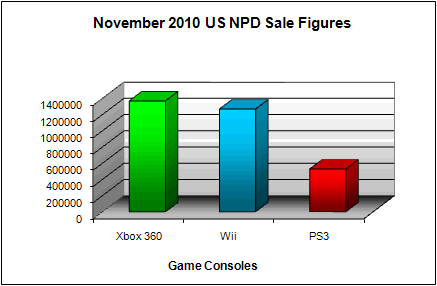
The figures for US sales in November 2010 are below, ranked in order of number of sales (November 2009 figures also shown, including percentage change):

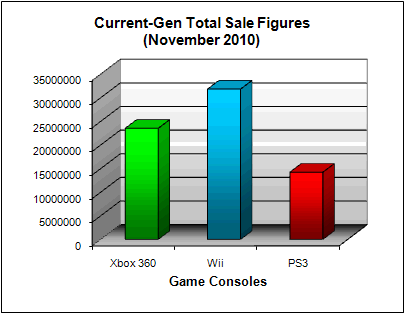
  • Xbox 360: 1,370,000 (Total: 23.5 million; November 2009: 819,500 – up 67%)
  • Wii: 1,270,000  (Total: 31.8 million; November 2009: 1,260,000 – up 1%)
  • PS3: 530,000 (Total: 14.2 million; November 2009: 710,400 – down 25%)
NPD November 2010 Game Console US Sales Figures

NPD November 2010 Game Console US Sales Figures

NPD Game Console Total US Sales Figures (as of November 2010)

NPD Game Console Total US Sales Figures (as of November 2010)

My prediction from last month was:

Prediction? The Xbox 360 to still be the winner thanks to Kinect, with a slight comeback for the Wii, and may even be enough to knock the PS3 off second place and challenge the Xbox 360. Call of Duty: Black Ops will dominate the software charts, again favouring the Xbox 360, with Sony’s long (and I mean long) awaited GT5 doing well too. Other notable releases in a busy month include Donkey Kong Country Returns, Assassin’s Creed: Brotherhood.

First sentence … mostly correct. The Wii did make a comeback, although it was a bit more than just “slight”, and it did challenge the Xbox 360 and overtake the PS3 as the second most popular home based console. Black Ops did dominate the software charts, and again, it helped the Xbox 360 more as more copies were sold on it. GT5 did rank in the top 10, which is getting harder to do based on the new NPD rankings that take rank each title based on *total* sales on all platforms (so single platform exclusives are at a disadvantage), but other platform exclusives apparently did better (more on that later). And all the other titles I mentioned in last month’s prediction were all involved in the top 10.

So, the big news is that the Xbox 360 managed to hold off the Wii’s casual gaming based resurgence for this holiday period. The Wii has always been a strong holiday seller due to the fact that it’s a popular gift item for the holidays, for the casual gaming market. But the Xbox 360 replaced the Wii this year as the most popular home based console. While the lead over the Wii wasn’t too significant, only 100,000 units, by comparison, the Wii sold 400,000 more units  than the Xbox 360 the same period last year so this is a turnaround that Microsoft were hoping for. Pricing wise, the Wii is still cheaper, and the PS3 isn’t too much more expensive considering it also doubles as a Blu-ray player. And software wise, while Black Ops did help the Xbox 360 more so than other consoles, the Modern Warfare 2 did the same and more for the console last year at this time, so that’s probably not where the bump came from. So this leaves the  Kinect factor, and with 2.5 million Kinect units sold in the first 25 days of release (basically from release to the end of November), it’s easy to see where the hardware sales bump came from. Microsoft’s timing has been impeccable this year, a point I’ve mentioned before. But timing Kinect’s release with the start of the holiday shopping period was an extremely good move, ensuring Kinect is fresh on people’s minds as they do their holiday shopping (and the store demos everywhere, and the huge marketing budget, will have also helped shoppers make up their mind). It’s a perfect storm of a new form factor, the number one selling game, plus a new motion controller that has had a faster take up rate than the iPad (and the best selling accessory for the entire year, despite only being out for 25 days), and all three factors resulted in the strong sales numbers for November.

And it’s good to see that Kinect, and the Xbox 360, is carving out their own market, instead of just stealing the Wii’s, because Wii sales are actually up compared to last year.

What isn’t up though is PS3 sales, and just looking at the numbers, one might conclude that the Xbox 360 has actually stolen market share from Sony’s flagship console. Not quite though. PS3 sales are down compared to November 2009, that is true, but this time last year, the PS3 was still enjoying the sales bump from the release of the Slim console (and the price cut), in the same way that the Xbox 360 is also still enjoying its sales bump from its release of the “Slim” version of the console (so don’t be surprised to see November 2011 Xbox 360 sales down compared to November 2010, although that could still be avoided if Kinect is a hit). But it’s clear that the PlayStation Move hasn’t had the same impact on the PS3 as Kinect has had on the Xbox 360, and it seems to have had no effect on Wii sales either. And with ever dropping prices on Blu-ray players, the PS3’s inclusion of Blu-ray playback is less of a drawcard than ever before.

So Nintendo will have been buoyed by the fact that Wii sales were up compared to a year ago, albeit by the smallest of margins. Still, they did get beat by the more expensive Xbox 360, and with Kinect being the biggest threat to the Wii’s control of the motion gaming market, this does not bode well for Nintendo. But with every analyst and their dog believing that the Wii 2 is just around the corner, Nintendo will have an opportunity to stop Kinect before it even gets started, but this assumes the Wii 2 will deliver something for all Wii owners to want to upgrade, and that it delivers something fresh and exciting compared to Kinect.

For software sales, another holiday season and another Call of Duty game being top of the list. 8.4 millions copies of Call of Duty: Black Ops were sold on all platforms, which is simply amazing. It is the best launch month for any title in history, and a large percentage of sales must have gone to the Xbox 360 (possibly more than the 4.2 million copies Modern Warfare 2 shipped on the console, last November). Assassin’s Creed: Brotherhood is another title that would have done better on the Xbox 360 too. For exclusives, Wii and Ubisoft’s Just Dance 2 was the pick of the bunch, managing to beat Fable III in 5th, Donkey Kong Country Returns Wii in 6th and GT5 in 8th. Wii Fit Plus also managed to get into the top 10. The figures for GT5 appears to be quite disappointing for such an eagerly awaited release (with emphasis on the ‘wait’ part of ‘awaited’), but  it was only released at the end of November, with not even a week of sales. Here’s the full chart:

  1. Call of Duty: Black Ops (Activision Blizzard, Xbox 360, PS3, Wii, PC, DS) – 8,400,000
  2. Assassin’s Creed: Brotherhood (Ubisoft, Xbox 360, PS3)
  3. Just Dance 2 (Ubisoft, Wii)
  4. Madden NFL 11 (Electronic Arts, Xbox 360, PS3, Wii, PS2, PSP)
  5. Fable III (Microsoft, Xbox 360)
  6. Donkey Kong Country Returns (Nintendo, Wii)
  7. Need for Speed: Hot Pursuit (Electronic Arts, PS3, 360, Wii, PC)
  8. Gran Turismo 5 (Sony, PS3)
  9. NBA 2K11 (Take-Two Interactive, Xbox 360, PS3, Wii, PS2, PSP,PC)
  10. Wii Fit Plus (Nintendo, Wii)

Time to make a prediction for December. I’m going to go with the same hardware ordering as this month, although the shortage of Xbox 360 and Kinect stock could affect sales somewhat, with the more plentiful Wii taking advantage. Software wise, a lot of the same titles from the above list will be there, and it will be joined by Epic Mickey, possibly a Kinect title or two (Kinect Sport being the most likely candidate). GT5 will have risen in the rankings too thanks to it having a bit more time to sell more copies.

See you next month.