Archive for the ‘Nintendo Wii, Wii U, Switch’ Category

Game Consoles – September 2011 NPD Sales Figure Analysis

Saturday, October 15th, 2011

Welcome to the September 2011 edition of our regular NPD US video game sales analysis, by my calculation, the 53rd edition of this feature. In this feature, we look at video game sales, both hardware and software, for the month of September 2011 based on data collected by the NPD. The PS3 price cut took place half way through August, but in the September data, we now having a full month worth of PS3 sales at the now $50 lower price point, so we can finally see if it was able to beat the Xbox 360, which it might have done in August if the price cut had taken place a bit earlier. But the Xbox 360 has an ace up its sleeve this month, as we see a new version of one of its major exclusive franchises, Gears of War. Read on to find out who wins September.

As NPD no longer releases full hardware sales figures, this feature is reliant on the game companies, namely Microsoft, Nintendo and Sony, to release their set of figures and based on “statement math” (that is, arithmetically calculate missing figures based on statements made). For September 2011, these are the statements made by the gaming companies:

  • Nintendo reveals the Wii sold 240,000 units, with 260,000 3DS consoles, and 145,000 DS (via PR email)
  • Microsoft revealed 438,000 Xbox 360 hardware units sold, with 42% of the home based console market share (source)
  • Sony did not reveal exact figures, but said that the PS3 hardware sale increase 20% year-on-year (Sony statement, via Senior Director of Corporate Communications at SCEA, Patrick Seybold)

Unfortunately for this month, Microsoft and Sony’s statements do conflict with each other a bit. Using Microsoft’s statement, PS3 sales can be deduced to be 364,857 units, but according to Sony’s own statement, the figure is more like 374,400 (20% more than September 2010’s 312,000). Obviously, there are rounding errors from all the company’s statements, so giving Sony the benefit of the doubt, we’ll presume the PS3 sales figure for September 2011 is the higher 374,400.

And so the figures for US sales in September 2011 are below, ranked in order of number of sales (September 2010 figures also shown, including percentage change):

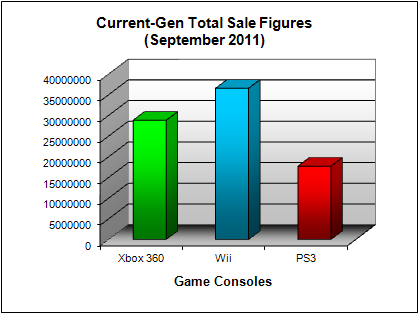
  • Xbox 360: 438,000 (Total: 28.8 million; September 2010: 483,989 – down 9.5%)
  • PS3: 374,400 (Total: 17.7 million; September 2010: 312,000 – up 20%)
  • Wii: 240,000 (Total: 36.6 million; September 2010: 254,000 – down 5.5%)
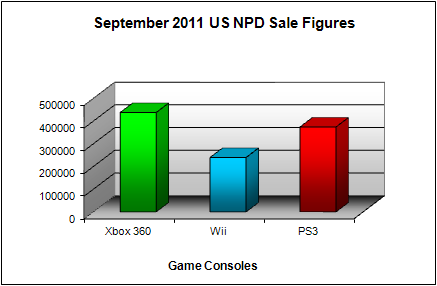
NPD September 2011 Game Console US Sales Figures
NPD September 2011 Game Console US Sales Figures

NPD Game Console Total US Sales Figures (as of September 2011)

NPD Game Console Total US Sales Figures (as of September 2011)

My prediction from last month was:

I think the Xbox 360 will still come out as the top selling console for September 2011, mainly due to ‘Gear of War 3′, but the PS3 will definitely come closer than it did this month, and with ‘Resistance 3′, it too might benefit from a platform exclusive. The Wii will be third. Games wise, ‘Gear of War 3′ looks set to be a top seller, despite being a platform exclusive release. ‘Resistance 3′, on the other hand, doesn’t look to have the same effect, although it will still sell well. Combined platforms sales may even push ‘Dead Island’ to the top of the charts.

I got the hardware ordering spot on, although it really wasn’t that hard to predict what was going to happen. The PS3 did get closer to the Xbox 360 sales, but it’s clear now that the 360 is now the dominant console in the US, and not even a PS3 price cut can affect its status it seems (unless that price cut was a more substantial $100, for example). For the game predictions, Madden was actually the top selling title, followed by Gears of War 3. And ‘Dead Island’ did manage to put its way high up in the charts, in 3rd place. Resistance 3, on the other hand, only finished 7th, not the worst result, but the average critical response to the game may have had some effect.

So the Xbox 360 continues its winning streak, by not only becoming the dominant home based console, but it’s also the best selling console for September, period. Looking at the life to date sales numbers, the Xbox 360 continues to pull ahead of the PS3, and continues to get closer to the Wii, to the point where the difference between the Wii and 360 numbers is actually less now than the difference between the 360 and PS3 numbers. Because of the Xbox 360’s dominance with multi-platform releases in North America, namely that if the same game is on multiple platforms, the Xbox 360 version is usually the most popular, the hit releases planned for the next few month starting with Batman: Arkham City and Battlefield 3 next month, and MW3 and Elder Scrolls V: Skyrim in November, will all benefit the Xbox 360 more. The it appears that the 360’s exclusives, such as Halo and Gears of War, appear to be far more popular than the PS3’s line up, including ‘Resistance’ this month.

But you cannot say the PS3 performed badly for September – after all, it was the only console to see year-on-year growth, but just like how the other consoles found it difficult to compete with the PS2 in the last generation, the PS3 is having a hard time trying to catch up to the Xbox 360 (and Wii, for the early parts anyway) in this generation (although the gap between the consoles is much less pronounced than the last generation). Taking off my fanboy hat for a moment, the truth is that both the PS3 and Xbox 360 are excellent game consoles with excellent game line ups and fantastic multimedia capabilities. Each console has their own pros and cons, and thanks to the Xbox 360’s head-start, the Wii’s (then) innovative control system, and the PS3’s Blu-ray drive, we now have a much more balanced set of competitors, and that can only be good for gamers, who should consider themselves lucky to be able to enjoy so many great games in the last few years.

The Wii, right now, is the only loser, but it’s not something Nintendo are unaware of, and the Wii-U will set to address many of the shortcomings of the Wii console, but also maintain Nintendo’s reputation for producing fun, family based games.

For game sales, Madden’s delay from August to September allowed it to rule the roost for the month, but Gears of War 3 would be considered the best selling Xbox 360 game for the month, the Madden ranking includes all platform sales. Dead Island was the only original franchise in the top 10, and it did well to come in 3rd, but it also shows that, unlike movies, gaming sequels are actually welcomed by gamers, and usually are huge improvements on the original, not just an opportunity to cash-in (take note Hollywood). FIFA’s high ranking highlights the growing popularity of “soccer” games, beating NHL 11, something it didn’t do last year this time. And a 10th place for Warhammer 40,000: Space Marine is a good result for the franchise. Electronic Arts are the real winners, with 3 of the top 10 titles belonging to them, and the all important first place too. Here’s the full software sales chart for September:

  1. Madden NFL 12 (EA, Xbox 360, PS3, Wii, PS2, PSP)
  2. Gears of War 3 (Microsoft, Xbox 360)
  3. Dead Island (Deep Silver, Xbox 360, PS3, PC)
  4. FIFA 12 (EA, Xbox 360, PS3, Wii, PS2, PSP, 3DS)
  5. NHL 12 (EA, Xbox 360, PS3)
  6. Deus Ex: Human Revolution (Square Enix, Xbox 360, PS3, PC)
  7. Resistance 3 (Sony, PS3)
  8. Lego Star Wars III: The Clone Wars (LucasArts, Wii, NDS, Xbox 360, 3DS, PS3, PSP, PC)
  9. Call of Duty: Black Ops (Activision Blizzard, Xbox 360, PS3, Wii, NDS,PC)
  10. Warhammer 40,000: Space Marine (THQ, Xbox 360, PS3, PC)

Time to make my usual prediction. I think the hardware situation will remain largely the same. Games wise, Batman: Arkham City and Battlefield 3 go head to head, with Forza 4 on the Xbox 360 possible making the top 10 as well as a platform exclusive.

See you next month.
Game Consoles – August 2011 NPD Sales Figure Analysis

Tuesday, September 13th, 2011

Welcome to the August 2011 edition of the NPD US Video Game Sales Analysis, where we look at video game sales, both hardware and software, for the month of August 2011 based on data collected by the NPD. Half way through August, Sony surprised the market with a $50 price cut for all of its PS3 models, and so for the first time, we can actually analyze the effect of this price cut and see if it allows Sony’s PS3, languishing in third place amongst the home based consoles, to make a much needed comeback.

As NPD no longer releases full hardware sales figures, this feature is reliant on the game companies, namely Microsoft, Nintendo and Sony, to release their set of figures and based on “statement math” (that is, arithmetically calculate missing figures based on statements made). For August 2011, these are the statements made by the gaming companies:

  • Xbox 360 sold 308,000 units, “maintaining the # 1 console spot in the U.S. for 2011” (source: @majornelson)
  • Xbox 360 holds 43% home based console market share (Microsoft statement)
  • Wii sells “more than 190,000” units (Nintendo press release)
  • Sony blames “inventory restraint” for sales in the first half of August, but “PS3 hardware sales were very strong the last two weeks of the month following the $50 price cut” (Sony statement)

Knowing both the Xbox 360 and Wii hardware numbers, and also knowing that the Xbox 360 held 43% of the home based console market share, the PS3 hardware sale is calculated to be an estimated 218,000 units.

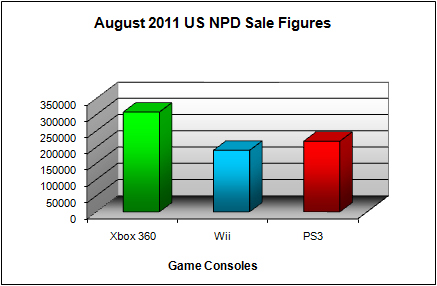
And so the figures for US sales in August 2011 are below, ranked in order of number of sales (August 2010 figures also shown, including percentage change):

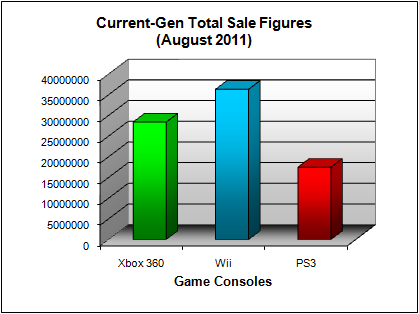
  • Xbox 360: 308,000 (Total: 28.4 million; August 2010: 356,700 – down 14%)
  • PS3: 218,000 (Total: 17.5 million; August 2010: 226,000 – down 4%)
  • Wii: 190,000 (Total: 36.3 million; August 2010: 244,300 – down 22%)
NPD August 2011 Game Console US Sales Figures

NPD August 2011 Game Console US Sales Figures

NPD Game Console Total US Sales Figures (as of August 2011)

NPD Game Console Total US Sales Figures (as of August 2011)

My prediction from last month was:

With the PS3 price drop coming in just a few days ago, this is just the sort of major event that makes predictions extremely difficult. There’s no doubt in my mind that the PS3 won’t come last again (Wii has the third spot amongst the home based consoles locked up), but the main question is can the PS3 outsell the Xbox 360? The price cut being only $50, and with no new console coming with the price cut like two years ago, maybe it will just come short, but it will be a close run race that’s for sure. For games, again, there’s nothing really of note. Usually at this time of the year, Madden NFL dominates, but with the Madden NFL 12 coming at the end of August, it may not have enough time to make such a major impact this time, although it will probably still be the best seller based on pre-orders alone. No More Heroes: Heroes’ Paradise for the PS3 and Deus Ex: Human Revolution seems to be the only two other notable releases in August.

The PS3 didn’t come last, and the Wii did, but this was an easy prediction to make. But it appears I overestimated the effect of the $50 price cut, and with Xbox 360 sales growing compared to July, the race wasn’t a “close run” one at all, with the Xbox 360 still comfortably retaining first place amongst the home based consoles.  For software, Madden NFL 12’s delay meant that it was not even included in August’s stats as it fell outside of the NPD August sales window (August is counted as a 4 week reporting period by the NPD, lasting from the 31st of July to the 27th of August), while of the two notable new releases, Dues Ex: Human Revolution was predictably the top selling title.

Let’s focus first on the PS3 numbers, and just how much of an effect the $50 price cut has had. On the surface, it looks like the effect was minimal, but dig a little deeper, and the sales bump will seem a bit more robust. Since the price cut only occurred half way through August, the first thing we need to do is to establish a marker for pre price cut sales. Generally (and historically) speaking, there is very little difference between July and August sales, but August tends to sell a few more consoles than July. Since nothing dramatic actually occurred for the Xbox 360, and the only effects being negative (due to price drop of PS3, encouraging more gamers to buy the PS3 over the Xbox 360), the rise of 360 units from 35-day reporting period of July to the 28-day reporting period August 0f roughly 11% could indicate “normal” seasonal growth.

Or not. So let’s take half of this number and say that, had the PS3 not had a price cut, it too would have grown 5.5%. This would make PS3 sales roughly 156,000 units for the whole month of August, or 5,571 units per day, had the price drop not occurred. The price cut was announced on the 16th of August, and so leaving the price cut only 12 days to affect the August NPD figures (again due to the premature end of the NPD reporting period at the end of august), with the first 16 days of the month “business as usual”. This means that prior to the price cut, 89,143 PS3 units were sold, leaving 128,587 being sold after the price cut. This means an increase from 5,571 units per day to 10,716 units per day (127,587 divided by the 12 days of the price cut) after the price cut, practically doubling sales as a result. This means that had the PS3 price cut lasted for the whole 28 day reporting period, PS3 sales would be almost exactly 300,000 units, only 8,000 units shy of the Xbox 360. Had I simply assumed that PS3 sales would have stayed completely flat between July and the first 16 days of August, PS3 unit sales may have reached as high as 311,000 units.

September would have told us a lot more about the full effect of the PS3 price cut, but the Xbox 360 exclusive ‘Gears of War 3’ should help Xbox 360 hardware numbers more than any other PS3 release would do for the PS3 hardware numbers. And with similar high profile releases that generally favour the Xbox 360 in the coming month, the bump from the PS3 price cut may just fall short of making the PS3 more popular than the Xbox 360 during this holiday period.

For the Xbox 360, a solid 11% rise from July to August allowed it to sit comfortably as the best selling home based console, but as noted earlier, it could have been different if the PS3 price cut had come earlier. Hardware sales are down some 14% compared to the same month last year, but again, this is mostly due to the “Slim” sales bump back then.

For the Wii though, August was just as bad as July, and it looks like from this point onwards, it will be third place out of three.  The Wii declined the most compared to August 2010 than any of the other consoles, which means that the rumours surrounding the rushing of the Wii U to market, and the “development hell” (source: n4g.com) that ensues, might show Nintendo is more worried about the Wii decline than they’re letting on.

For game sales, August was a disappointing month, due to the lack of new releases, and the delay of Madden NFL 12 to the September reporting period. So Deus Ex: Human Revolution was actually best selling title across all platforms, even though it was only released for 5 days in the August reporting period. The ‘Just Dance’ franchise continues to be the best selling Wii exclusive titles, but in better times, a Nintendo first party title, like Mario Kart (now bundled with consoles) or Wii Play would have been one of the titles. Here’s the full software sales chart for August:

  1. Deus Ex: Human Revolution (Square Enix, Xbox 360, PS3, PC)
  2. NCAA Football (Take 2, Xbox 360, PS3)
  3. Call of Duty: Black Ops (Activision Blizzard, Xbox 360, PS3, Wii, NDS,PC)
  4. Phineas and Ferb: Across the 2nd (Disney, NDS, Wii, PS3)
  5. Cars 2 (Disney, NDS, Wii, Xbox 360, PS3, PC)
  6. Just Dance Summer Party (Ubisoft, Wii)
  7. Just Dance 2 (Ubisoft, Wii)
  8. Lego Pirates of the Caribbean (Disney, Wii, Xbox 360, NDS, PS3, 3DS, PSP, PC)
  9. The Legend of Zelda Ocarina of Time 3D (Nintendo, NDS)
  10. Zumba Fitness (Majesco, Wii, Xbox 360, PS3)

Time to make a prediction. I think the Xbox 360 will still come out as the top selling console for September 2011, mainly due to ‘Gear of War 3’, but the PS3 will definitely come closer than it did this month, and with ‘Resistance 3’, it too might benefit from a platform exclusive. The Wii will be third. Games wise, ‘Gear of War 3’ looks set to be a top seller, despite being a platform exclusive release. ‘Resistance 3’, on the other hand, doesn’t look to have the same effect, although it will still sell well. Combined platforms sales may even push ‘Dead Island’ to the top of the charts.

See you next month.

Game Consoles – July 2011 NPD Sales Figure Analysis

Wednesday, August 17th, 2011

Welcome to the July 2011 edition of the NPD US video game sales analysis. For July, only Microsoft provided actual figures for hardware sales, stating 277,000 units of the Xbox 360 was sold, and that their console accounted for 45% of the home based console market share. Later on, Wedbush Securities analyst Michael Pachter revealed that Wii sales had dropped 25% compared to the same month last year. With these three facts, we can then deduce the PS3 sales figures, for which Sony has yet again remained silent on. For those that are new to this, this analysis looks at US video games sales figures compiled by NPD, unreleased by NPD due to pressure from the gaming companies, but then leaked by various sources, including gaming companies, if/when it suits them.

The figures for US sales in July 2011 are below, ranked in order of number of sales (July 2010 figures also shown, including percentage change):

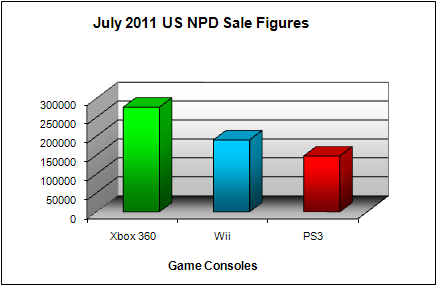
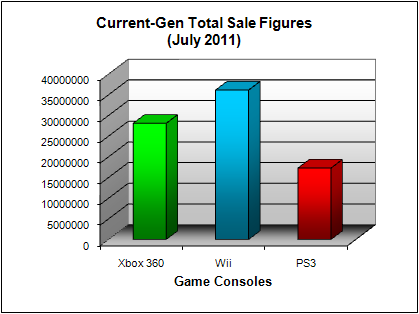
  • Xbox 360: 277,000 (Total: 28.1 million; July 2010: 443,500 – down 38%)
  • Wii: 190,500 (non official estimate) (Total: 36.1 million; July 2010: 253,900 – down 25%)
  • PS3: 148,000 (non official estimate) (Total: 17.3 million; July 2010: 214,500 – down 31%)
NPD July 2011 Game Console US Sales Figures

NPD July 2011 Game Console US Sales Figures

NPD Game Console Total US Sales Figures (as of July 2011)

NPD Game Console Total US Sales Figures (as of July 2011)

My prediction from last month was:

I think the Xbox 360 will experience its first year-on-year decline in ages, but still comfortably stay at the top of the home based console hardware sales charts, leaving the Wii and PS3 to fight it out for second and third place, and I think the Wii might be better positioned to win for some reason. It’s NCAA Football season again, so it will be the top seller, but otherwise, not a huge month for games again.

An almost perfect prediction, a rare event indeed. The Xbox 360 did experience its first major year-on-year decline, and it actually was the biggest fall out of the three home based consoles, but despite this, it still managed to comfortably be the best selling home console for July 2011, which is on record as the worst performing month since October 2006. And as I had predicted, the Wii won the fight against the PS3 for second place, but in full honestly, both of these consoles performed horribly, adding to the misery that is July. And new hit games were far a few between in July, and so game sales slumped as well.

As expected, the Xbox 360 saw its first major year-on-year decline since 2009 (I think). It is expected because this time last year, the new Xbox 360 “Slim” had just been released, and the sales surge from this event actually managed to give the console a 119% lift in sales compared to July 2009. So obviously, with no new consoles in July 2011, year-on-year sales dropped as a result, and I suspect this will continue for a few more month. The Xbox 360 was still the best selling home based console, with a massive 45% of the home based console market share for July – that it sold almost twice as many units as the PS3 is testament to its growing dominance.

Despite a price drop, the Wii languished in a distant second place, dropping 25% in sales from the same month last year (which was even compared to July 2009). There’s not much positive things one can say about the Wii, and coupled with alarmingly decreasing DS/3DS sales (prompting Nintendo to drop prices on the 3Ds only a couple of month after release), Nintendo will hope there are no delays to the release plans of the Wii U.

As for the PS3, this appears to be the worst month since July 2009, with a 30% sales drop compared to last year. And unlike the Xbox 360, the PS3 really has no excuses. There’s still growth between 2009 and 2011 (of around 20.5%, compared to the Xbox 360’s 36.5%), but this is comparing the pre-Slim and pre-price cut PS3, with the current one. Which is probably why Sony has just announced a price cut for the PS3, which should allow sales to surge a bit.

So overall a pretty bad month for video games, but with the economy the way it is and with most of the consoles many years into its release cycle, it’s probably not unexpected. For games, it’s been a quiet month as well, with NCAA Football dominating as it usually does at this time of the year. Just Dance 2 for the Wii continues to show off its staying power in the top 10, this time coming 5th. Here’s the full software sales chart for July:

  1. NCAA Football (Take 2, Xbox 360, PS3)
  2. Cars 2 (Disney, NDS, Wii, Xbox 360, PS3, PC)
  3. Call of Duty: Black Ops (Activision Blizzard, Xbox 360, PS3, Wii, NDS,PC)
  4. Lego Pirates of the Caribbean (Disney, Wii, Xbox 360, NDS, PS3, 3DS, PSP, PC)
  5. Just Dance 2 (Ubisoft, Wii)
  6. Major League Baseball 2K11 (Take 2, Xbox 360, Wii, NDS, PS3, PS2, PSP, PC)
  7. Zumba Fitness (Majesco, Wii, Xbox 360, PS3)
  8. Fallout: New Vegas (Bethesda, Wii, Xbox 360, PS3)
  9. New Super Mario Bros. (Nintendo, NDS)
  10. Mortal Kombat (Warner Bros., Xbox 360, PS3)

Prediction time. With the PS3 price drop coming in just a few days ago, this is just the sort of major event that makes predictions extremely difficult. There’s no doubt in my mind that the PS3 won’t come last again (Wii has the third spot amongst the home based consoles locked up), but the main question is can the PS3 outsell the Xbox 360? The price cut being only $50, and with no new console coming with the price cut like two years ago, maybe it will just come short, but it will be a close run race that’s for sure. For games, again, there’s nothing really of note. Usually at this time of the year, Madden NFL dominates, but with the Madden NFL 12 coming at the end of August, it may not have enough time to make such a major impact this time, although it will probably still be the best seller based on pre-orders alone. No More Heroes: Heroes’ Paradise for the PS3 and Deus Ex: Human Revolution seems to be the only two other notable releases in August.

See you next month.

Weekly News Roundup (7 August 2011)

Sunday, August 7th, 2011

A pretty light week in term of news, and since I’m running a bit behind, let’s see if I can wrap this one up quickly.

CopyrightStarting as usual with the copyright news, we start with the MPAA’s win against Zediva, as the judge in the case handed down a preliminary injunction against the “innovative” video rental service.

Zediva Promo

Zediva is a great deal for consumers, but it can only do it by using loop holes that Hollywood is trying to close

A little background info. Zediva’s service works by allowing you to rent physical discs, but instead of sending the disc to you like what Netflix would do, they do what Netflix’s other service does, by offering you a streaming version of the same movie. Zediva then reserves the disc you “rented”, and removes it from circulation. Or basically as Zediva puts it, you rent the disc, and they play it for you over the Internet (imagine a DVD player with a really really long cable). Why did Zediva do this? They did this – and this is where I think Zediva’s downfall will be – to avoid having to pay licensing fees for streaming content.

You see, the problem is that Zediva’s motivations, it seems to me, are born out of trying to avoid paying these licensing fees and release restrictions, and make more money than they would otherwise. If this is Zediva’s real motivation, then good luck to them, but I don’t think they have a snowball’s chance in hell with their case. And in the judge’s summary of the ruling, it’s made quite clear that the judge sees real problems with Zediva’s argument, and that if Zediva was allowed to continue operating, it could harm the existing video-on-demand industry, Netflix included.

Now, it could be debated that what Zediva is doing actually does not hurt Hollywood if you compare it to traditional disc rental, but that it does hurt Hollywood studios when compared to what they can make from streaming deals, and even Zediva won’t deny this, as after all, their business model is to save on licencing costs. This then leads to the debate as to why streaming should cost more than traditional rentals, why Hollywood should choose to not only “tax” new innovative distribution methods, but to place artificial limits (like a 30-day embargo to help increase disc rental income), when these help to fight piracy. But that’s their business decision, and they may be right or wrong, but that’s not for Zediva to decide. So people get pissed off with Redbox waiting times for new releases, or the somewhat hysterical reaction to the Netflix price increases (best encapsulated in this video), and it might hurt Hollywood more to be too greedy when it comes to streaming licensing fees and release schedules, if people do decide to “screw it” and use BitTorrent.

Pron magazine/website Perfect 10 is making legal headlines again this week, twice actually, as they launch yet another lawsuit against yet another online company, this time Megaupload. As you may or may not know, Perfect 10 has in the past sued Microsoft, Google, Amazon, the middle of these three recorded a win against Perfect 10 this week in which the Ninth Circuit court rejected Perfect 10’s appeal over an earlier decision favouring the search giant. But while courts are reluctant to rule about top tech companies that have been Perfect 10’s target before, they may be more favourable to ruling in Perfect 10’s favour against Megaupload, especially since the MPAA’s case against similar file hosting provider, Hotfile, seems to be going okay. So I wouldn’t be surprised if this turns out to be Perfect 10’s first victory, but it all depends on how frequently their content has been uploaded by users of Megaupload, and if it’s not frequent at all, why Perfect 10 didn’t file DMCA notices to get those content removed, instead of launching a lawsuit (“to make more money” is not an excuse the court would accept, I think).

Diablo III

Diablo III will use 'always-on' DRM, but not for anti-piracy, says Blizzard

Good will amongst gamers is something every game developer needs, and up until this week, Blizzard, the makers of the addictive World of Warcraft and Starcraft series,  probably thought that the had enough good will stored in the bank to pull a nasty surprise. But, as Blizzard will admit, they might have miscalculated. What happened was that Blizzard announced the next episode in another one of their addictive franchises, Diablo III, would have “always-on” DRM, meaning gamers won’t be able to play the game offline, even for a couple of seconds. So Blizzard decided to do a Ubi, and as I talked about last week, nobody likes Ubi DRM. The funny thing was that Blizzard probably never intended to do this as a form of anti-piracy, but only as an anti-cheating feature. This may very well be true, but Blizzard could have avoided this whole controversy (and still used “always-on” DRM) by including an offline mode, much like how Test Drive Unlimited 2 does it (offline and online progress are recoded separately). The statements made by Blizzard immediately after the backlash began didn’t help either – executive vice president of game design Rob Pardo’s statement about there being other games to play when people are offline, for example on long plane trips, was the most ill-conceived of them all (yes, “other games” that people will buy instead of your games).

So it’s a lesson for Blizzard and any other company that chooses to use draconian DRM, for whatever reason – beware of the backlash, which might ultimately hurt revenue more than a couple of extra pirated copies would have (or the cost of adding an offline play mode).

High Definition

In Blu-ray/3D news, exciting news, sort of, although it’s technically neither HD nor 3D (not yet anyway).

I’ve been talking up UltraViolet for a while now, and it’s not like me really to voice my support for anything Hollywood comes up with, especially if it’s wrapped up in all sorts of DRM, which UltraViolet will no doubt be. But for me, UV is a huge shift in the way we “buy” movies, and it comes just at the right time when cloud storage is all the rage.

UV, simply puts, turns buying a movie into really buying a movie. The idea is that, instead of buying a movie on each platform, on disc, then on iTunes,  then another version for your Android device … instead of doing this, you buy the license to watch the movie, and then you get access to all the versions via the cloud, for all of your popular devices. It’s like Digital Copy, except it’s all done in the cloud. So when you buy a Blu-ray movie at Walmart, you can instantly get the movie to play on your Android phone, as long as you have a good Internet connection. And at home, instead of finding and popping the disc in or pre-ripping it to your media player, you can just fire up your TV’s UV app, and watch all your purchased movies from the cloud.

Flixster for iOS

Flixster is already available on a variety of mobile devices, and so, it's the natural fit for delivering and managing UltraViolet

The big news this week in regards to UV is the first announcement of UV compatible movies, as Warner Bros. announced both Bad Bosses and Green Lantern will feature UV support. I’m not surprised at all WB is one of the first companies to announced UV support, as they’ve always been quite open to new formats, having supported VCD in Asia, and HD DVD before they decided not to. And WB’s recent acquisition of Flixster is starting to make sense as well, as it seems Flixster is the app that WB plans to use to allow users to manage and watch UV content. As Flixster is already available on a wide variety of mobile devices, it’s an easy decision for WB to use it for UV.

What was more interesting was that WB also announced that it would even be possible for users to bring in their old DVDs to retailers, and have them “enable” access to the UV version of the movie. I don’t know how this will work, or whether there might be a way to do it without having to go to the store, but it does sound interesting. And as mentioned earlier, I really hope TV and console manufacturers embrace UV as well, as this would allow me to digitally stream my movie collection without ripping (also need studios and ISPs to work out some kind of deal to offer free bandwidth for watching UV movies).

In related news, Time Warner owned HBO plans to make available console versions of the HBO Go app, which is great news for those that are actually in the regions that can access HBO Go, which sadly does not seem to include Australia (we miss out on Hulu as well … boo!). The announcement also mentioned other “connected devices”, which sounds a bit vague, but hopefully will include things like Blu-ray players and TVs, for easy peasy catch-up viewing.

Gaming

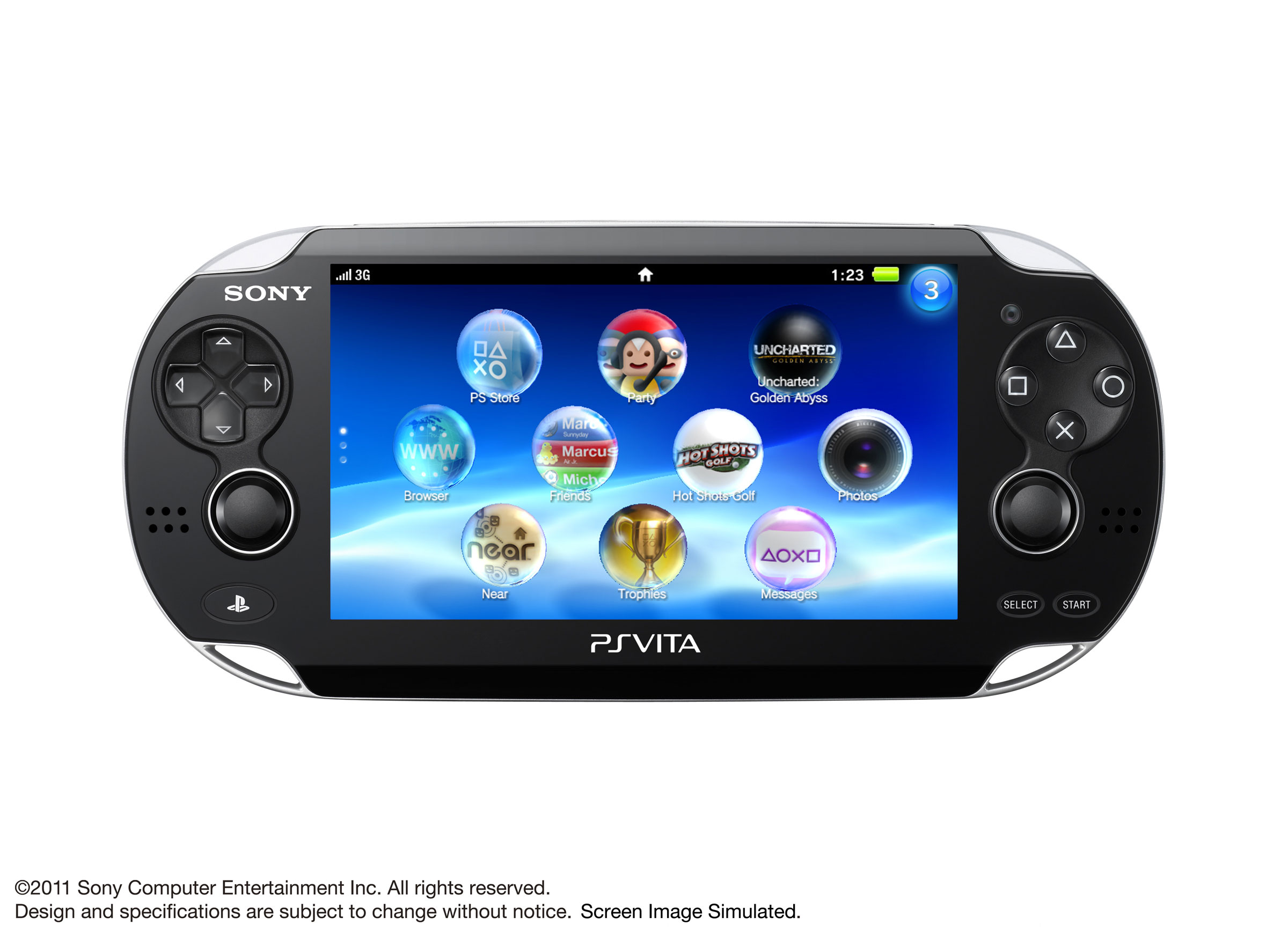
And finally in gaming, Sony has, as expected really, announced a strong degree of integration between their upcoming portable console, the PlayStation Vita, and the PS3.

This will include the ability to use the Vita as a controller for the PS3 (so allowing the touch surface, gyroscope, microphone, camera … all to be used to control PS3 games), plus the PS3 can also send graphics data to the Vita to display. Sounds familiar? It should, because this is exactly how the Wii U controller would work.

PlayStation Vita

PS Vita will offer Wii U like features, much earlier than Nintendo's console

With the Vita coming to the US probably early next year, and the Wii U much later than that, it’s a shot across the bow for Nintendo, if not directly at them. The only issue is the price. At the expected price of $249, and add the $299 cost of the PS3, yes, you might have a system that rivals some of the innovative parts of the Wii U, but might be more expensive, and not have as good  graphics as the Wii U (which must surely be an ironic situation for both Sony and Nintendo). But then again, the Vita can be used as a standalone gaming console far far away from the Wii U (the Wii U controller also allows independent play, but only within close proximity to the main Wii U console). So a Vita + PS3 combination could in fact replace the Wii U + DS combination, and if that’s true (and if graphics quality is discounted as a factor), then Sony becomes the better value proposition. And a PS3 price drop, or a PS3 + Vita bundle, may help.  Of course, Nintendo knows how to make fun games, and Sony struggles at times, and this could be the deciding factor.

For the Xbox 360, they’re going in a totally different direction, which could work for and against them. But Microsoft has demonstrated Windows Phone integration with Kinect and the Xbox 360, so they’re planning something similar too – and it will be even better value for those already with Windows Phones.

So we come to the end of another WNR. Hope you enjoyed this issue, and see you next week.

Game Consoles – June 2011 NPD Sales Figure Analysis

Thursday, July 21st, 2011

Welcome to another monthly edition of the NPD Game Console Sales Analysis, this time analyzing the home based game console hardware and software sales for the month of June 2011. We’re once again one console short of having all the hardware sales statistics, and once again, it’s Sony that’s the lone holdout. But thanks to information released by the other manufacturers, mainly Microsoft, we can still estimate fairly accurately what Sony’s PS3 hardware sales numbers look like, and so the NPD analysis feature can continue for one more month. For those that are new to this, this analysis looks at US video games sales figures compiled by NPD, unreleased by NPD due to pressure from the gaming companies, but then leaked by various sources, including gaming companies, if/when it suits them.

The figures for US sales in June 2011 are below, ranked in order of number of sales (June 2010 figures also shown, including percentage change):

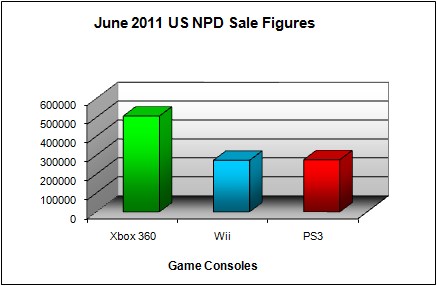
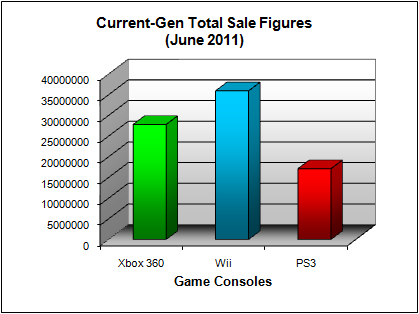
  • Xbox 360: 507,000 (Total: 27.8 million; June 2010: 451,700 – up 12%)
  • PS3: 276,000 (estimated) (Total: 17.1 million; June 2010: 304,800 – down 9%)
  • Wii: 273,000  (Total: 35.9 million; June 2010: 422,500 – down 35%)
NPD June 2011 Game Console US Sales Figures

NPD June 2011 Game Console US Sales Figures

NPD Game Console Total US Sales Figures (as of June 2011)

NPD Game Console Total US Sales Figures (as of June 2011)

My prediction from last month was:

No big changes, so the same hardware ordering as this month. The new top selling games will be Infamous 2 and Duke Nukem Forever (on a side note, ‘Forever’ really is such an apt name for the game considering the development time), but the overall top sellers will be some of the same titles as in May.

If my estimation of PS3 hardware sales is correct, then I was wrong about the ordering of hardware sales, although it was a close run affair between the PS3 and the Wii. Software wise, both Duke Nukem Forever and Infamous 3 made their marks on the top 10, but more on that later.

Starting with the PS3 hardware estimation, I think it’s best I go over the estimation process, which ironically, were mostly based on statements made by Microsoft, since Sony made no mention of their hardware results this month. It all comes from the slightly vague Microsoft statement about having a “48% share of the overall current-generation console market share”. It’s vague because when Microsoft talks about “current-generation”, it’s unclear if they’re referring to all consoles, or just the home based consoles, but it should be the latter, since the former won’t make sense. And Microsoft should also be talking about June only, since for life-time wise, and even 2011-wise, the “48%” market share just doesn’t add up. And armed with the “knowledge”, and knowing both the Xbox 360 and Wii’s hardware stats, it’s then quite easy to estimate the PS3’s hardware sales number for June, which comes to around 276,000. And Microsoft’s other statement about nearly selling twice as many units as their nearest competitor seems to support this number, since any higher, and Microsoft wouldn’t have been able to make the claim without stretching the meaning of the term “nearly”.

At first glance, this seems to be a good result for Sony. PS3 hardware sales are up more than 100,000 units compared to the previous month, and it did beat the Wii, if the numbers are correct. So why didn’t Sony (loudly) pronounce these set of good results, and instead, went all quiet in their press release in regards to the hardware numbers? I can only guess is that there was no year-on-year growth for the PS3 in June, as June 2010 recorded higher sales for the console. If my estimation is correct, this breaks a 4 month trend in which the PS3 has seen year-on-year growth, and perhaps this is what Sony didn’t want to focus on (especially, given the PSN hack, media “hacks” will jump to the conclusion that the breaking of the trend is a direct result of the hacking outage). But more careful analysis shows that June 2010 was a better than usual month for the PS3, which I attributed back then to the clearing up of the PS3 stock shortage problem that hurt sales for the console throughout the first half of 2010 (June 2010 was 85% higher than June 2009). So for the PS3 to not perform as well in June 2011 as in June 2010, is really no big deal, and the decline was mild anyway, nothing like that of say, the Wii.

Which brings us to the Wii. 35% down compared to the same month last year, and nothing really positive can be said of the Wii, other than the fact that, for such a technologically inferior console, it’s done remarkably well and surely has already made Nintendo enough money. And with the Wii U already announced, the Wii’s results will become less and less important for Nintendo as they concentrate on the development of the Wii U.

And last, but certainly not the least, we have the tremendous Xbox 360 numbers. Nearly double that of last month’s results, and the only console yet again to show year-on-year growth. This is made more remarkable by the fact that, this time last year, the new “Slim” model came out, and the sales bump associated with it meant that it was always unlikely that the Xbox 360 would have any sort of year-on-year growth, but here we are. Now, some of this can be attributed to various bundling deals Microsoft had, including the deal where selected PC purchases get a free Xbox 360, and the fact that the “Slim” didn’t go on sale until midway through June 2010. So next month, we could see the first ever year-on-year sales decline for the Xbox 360 in quite  a while (versus last year’s sales bump), although it’s still a shoe-in to win the best selling console of the month award. Regardless, it’s been an impressive year for the Xbox 360, and the “Slim” has been a huge success, since it now makes the Xbox 360 the most balanced console in terms of price, performance (no more RRoD!), and audience (both hardcore and casual/family gamers are well catered for).

Onto software sales, or games. L.A. Noire retains top spot, as the new releases, Duke Nukem Forever and the PS3 exclusive Infamous 2 could not unseat the crime solving game. While Sony was remaining tight lipped about the PS3 hardware numbers, they rightly made a big deal about the performance of Infamous 2, which although third, is still the highest single-platform performer for June. It certainly did better than its predecessor, released in May 2009, and ranked only 5th, even though the chart back then was split based on platform specific releases, not like this month’s chart, which combines all platform sales for the same title as one listing. And releasing an exclusive earlier in the month, as opposed to in the last few days, does help it to climb the ranks. The other notable new entries for this month include the 3DS version of Zelda: Ocarina of Time, and Disney’s Cars 2. Here’s the full software sales chart for June:

  1. L.A Noire (Take 2, Xbox 360, PS3)
  2. Duke Nukem Forever (Take 2, Xbox 360, PS3, PC)
  3. Infamous 2 (Sony, PS3)
  4. Lego Pirates of the Caribbean (Disney, Wii, Xbox 360, NDS, PS3, 3DS, PSP, PC)
  5. Legend of Zelda: Ocarina of Time 3D (Nintendo, 3DS)
  6. Call of Duty: Black Ops (Activision Blizzard, Xbox 360, PS3, Wii, NDS,PC)
  7. NBA 2K11 (Take 2, Xbox 360, PS3, Wii, PS2, PSP, PC)
  8. Mortal Kombat 2011 (Warner Bros. Interactive, PS3, Xbox 360)
  9. Cars 2 (Disney, NDS, Wii, Xbox 360, PS3, PC)
  10. Just Dance 2 (Ubisoft, Wii)

Time to make the usual prediction. As mentioned earlier, I think the Xbox 360 will experience its first year-on-year decline in ages, but still comfortably stay at the top of the home based console hardware sales charts, leaving the Wii and PS3 to fight it out for second and third place, and I think the Wii might be better positioned to win for some reason. It’s NCAA Football season again, so it will be the top seller, but otherwise, not a huge month for games again.

See you next month.