Archive for the ‘Computing’ Category

Weekly News Roundup (15 February 2009)

Sunday, February 15th, 2009

I hope you had a nice Valentine’s Day. I spent mine alone, in a windowless room, eating day old pizza and watching re-runs of Friends. So it was a good day for me too.

Didn’t get to write any blog entries this week because I’ve been cleaning up the innards of the Digital Digest website, adding new functionalities and fixing some problems, but all on the web admin site of things, not the front-end so you won’t notice anything different yet. But it’s all for a purpose, and the sooner I can get these boring things done, the sooner I can start adding some new content and functions to the site. 

As you know, last week I reported on the bushfires here in Victoria, Australia. The full extent of the damage and loss of life wasn’t really known to me at the time I posted the blog, but it has now been revealed as much worse than first feared. Donations are very much needed as many people have lost homes, and those are the lucky ones. The response so far has been fantastic, despite economic harsh times, people are giving more than they can afford and it’s great to see something good come out of a very bad situation.

CopyrightOn with the copyright news, Sweden is well known for being the home of The Pirate Bay and The Pirate Party. But Sweden is no home for pirates, it seems, as piracy rates in Sweden are lower than that of many other countries with much harsher views towards copyright.

While politicians in Washington are trying to get the right economic stimulus package through, there’s always someone trying to squeeze a bit of pro-MPAA agenda into the bill, this time it was Senator Dianne Feinstein. Under the guise of preventing child pornography, the language used by the amendment to the bill was, as experts testify, clearing MPAA produced and with the child pornography bit thrown in for dramatic effect. I don’t know what is worse, that the MPAA compares people who download movies to child abusers, or that they think child pornography is only as serious as movie piracy. And all this beneath the table stuff while Congress is debating serious issues such as how to prevent people from losing their homes and jobs just shows how tasteless the MPAA is, and how politicians are being led by the nose by those with money in Washington.

Apple trying to prevent iPhone jailbreaking with DRM

Apple trying to prevent iPhone jailbreaking with DRM

It’s not often that you find Apple, and the RIAA/MPAA on the same side of anything, but when it comes to DRM for the iPhone, those three are the best of buddies. Apple argues that DRM protects their business model, while the RIAA/MPAA argues that DRM is the best thing since Sliced Bread 2.0 added SecuROM protection that required users to dance a jig before use. Jailbreak on iPhone allows you to install custom apps without going through Apple, and that’s why Apple don’t like people breaking their DRM. It’s not even about piracy in this case, as it’s all about closing down competition and making sure Apple makes money from everything you intend to use the iPhone for. It’s something you expect Microsoft to do, not Apple.

And the EU has just extended copyright protection from 50 years to 95 years, at the behest of the RIAA. Royalty free music helps it to  survive longer culturally because anyone can (and will) use it  – from TV commercials to independent films to even YouTube clips – but extend copyright protection to 95 years, and I can see some music disappearing from society’s consciousness for good, all because money. The RIAA, who represent the studios, argues this is to protect artists, who they rip off quite brutally without remorse. This will just ensures the rip off lasts longer, that’s all.

High Definition

In HD news, the news is that Blu-ray prices have now dropped to DVD levels. This is from looking at Amazon though, so it may not be indicative of the overall market, as Amazon always has lots of Blu-ray deals.

Blu-ray prices have dropped, but do the studios really want that?

Blu-ray prices have dropped, but do the studios really want that?

Looking at the situation here in Australia, I buy DVDs at under $10 mostly ($US 6.50), and special offers take that down even further most times. Obviously I’m not buying the new releases, but wait a couple of months and they’re almost always $15, and then $10 another couple of months later. Blu-ray has dropped in pricing here, but it’s still $25 for old releases, and $35 to $40 for new titles. So for Blu-ray prices to actually drop to DVD levels, then it still has a long way to go and I’m not sure what the point of that would be for the studios. I mean, Blu-ray was invented to make up for losses in DVD due to falling prices, so dropping Blu-ray prices will hurt the studios more than it helps them. In fact, looking at the latest Nielsen VideoScan figures show that, if this supposed drop in price has occurred, than Blu-ray is now doing worse despite there being no barriers left for its total domination. Blu-ray sales have dropped back to pre-Iron Man levels, although that’s largely due to lack of decent releases that titillates the core demographic of the young, male, techno-savvy crowd. I think the movie studios were a bit naive in thinking that consumers would be willing to pay more for something they’ve been paying less and less for ages, despite the upgrade in quality. The sooner the studios realise this, and stop trying to make Blu-ray into the saviour of home video, the sooner we’ll see more reasonable prices and Blu-ray finally replacing DVDs on all levels, not just as a premium alternative. But maybe that’s not what the studios want?

What is clear though is that while the PS3 has been the pick of the Blu-ray players right from the start, it no longer is the most attractive. Lower prices for standalones coupled with Sony’s insistence on not dropping PS3 prices has seen “PS3 as a Blu-ray player” sales drop, which may account for the year-to-year sales drop of 24% in the US for the PS3. Is Sony deliberately sacrificing the PS3 to help standalones? Standalones bring in parts of the demographic the PS3 cannot attract, and I’m sure the CE firms that backed Sony in the HD format war want to see some returns on their investment, as opposed to the PS3 dominating all things Blu-ray. Do I still recommend the PS3 as the Blu-ray player of choice? Yes, but with much more reservations compared to before. If you need more than one of the following: a media hub, game console, good (but not great) quality DVD upscaler, highly responsive Blu-ray player, then the PS3 is a good choice. It may no longer produce the best quality output, nor offer the best price, but it does much more than your usual Blu-ray player, but only if you really need those functionalities. I still like it the most because it’s just so damn fast and responsive – no waiting for button clicks to register, or minute long loading screens, and the Bluetooth remote means I can slouch all the way on the sofa and can control everything without even lifting my arm.  

And in the “well that looks a bit desperate” section for this week, Sony is thinking about releasing hybrid game/movie Blu-ray discs, that feature a Blu-ray movie and the PS3 version of the crappy movie-to-video game conversion all on one disc. I can see Sony releasing this as the sole version for the PS3, meaning if you want to play the PS3 game, you’ll have to also buy the Blu-ray movie in a package that will cost more. This should help inflate the Blu-ray sales figures at the expense of the gaming side of things, which Sony is very good at doing, to gamers frustrations. Is this also Sony’s way of admitting that PS3 games don’t really need the up to 50 GB of space on Blu-ray discs (considering the equally good 360 port only needs 8 GB), and that the only way to fill up the space is by including a movie on it?

Kuro: Still the best on the market, but soon to be discontinued

Kuro: Still the best on the market, but soon to be discontinued

And in the “I thought they were dead” section, S3 is releasing a new graphics chip designed for media PCs and Blu-ray playback. “S3 are still in business?” was my first reaction too. I should probably write a feature on graphics cards for media PCs, but you know, this is something that S3 may have a chance in. These cards don’t need gaming capability, which is what separates the best GPUs from the rest, so as long as they emphasis on output quality, low heat/noise, and quality driver/software packages, then there will be a market for these type of cards.

Panasonic is betting 3D Blu-ray will take off, I hope they’re right, but I have my doubts. Another thing Panasonic might have to prepare for is to take over Pioneer’s plasma division, because Pioneer are pulling out of the game altogether. HDTV enthusiasts will acknowledge the Pioneer Kuro plasma range as being the best HDTVs on the market, and it’s a shame to not being able to see a new series being released. Panny plasmas are okay, maybe even pretty good (and about to get better with the new 09 models), so hopefully they can absorb the (albeit small) demand for being able to own the best damn TVs on the market. I paid $US 7,000 for my Pioneer plasma a bit more than 4 years ago, which is crazy I know, but I don’t regret it one bit and I would still be willing to pay $US 4,000 for another one right now. If I wasn’t broke, that is. LCDs with LED backlights are promising, as are OLED displays, but nothing beats a Kuro plasma right now and nothing will for a little while I suspect.

GamingNot much gaming news this week. The NPD figures for January are out, I know, and I’ll get the analysis up early next week. The figures was again alarming for Sony, as the PS3 was outsold by the 360 again (and the Wii, of course). I’ve already mentioned that year-to-year sales for the PS3 is down 24%, which is not all that bad considering lack of price drops, cheaper Blu-ray standalones, economic conditions and all that, but when 360 sales rose by 25% and Wii sales by nearly 60%, it makes the figures look even worse by comparison. And it’s happened 3 months in a row, and during the busiest time of the year. Some are saying the PS3 peaked in 2008, and it’s now on a slow decline to oblivion, which I don’t really buy. But if you’re not growing, then you’re shrinking and the PS3 market share is shrinking rapidly each and every month that PS3 prices remains high. Software news is even worse for Sony, as not a single PlayStation (2, 3 or portable) title made it to the top 10, with only a single, lonely PlayStation title in the top 20 as well  (Call of Duty: World At War for the PS3) – 8 Xbox 360 titles and 9 Wii titles were present. Oh dear. 

Okay, enough Sony bashing for this week, there’s plenty of time for that next week. Unless the PS3 gets a surprise price drop and outsells everything, then won’t I look stupid? Or simply proved right? There is indeed a very thin line between being right and being stupid. See you next week.

Weekly News Roundup (1 February 2009)

Sunday, February 1st, 2009

It’s been deadly hot here in Melbourne, Australia. Above 40 degrees Celsius (104 degrees Fahrenheit) weather, compounded by the electricity grid melting down, causing the A/C to fail. The Windows “Hibernate” feature became a familiar friend as I turn on the computer to do some work and then had to quickly hibernate to prevent the CPU from blowing up.

Firmware HQ - All your optical drive firmware needs

Firmware HQ - All your optical drive firmware needs

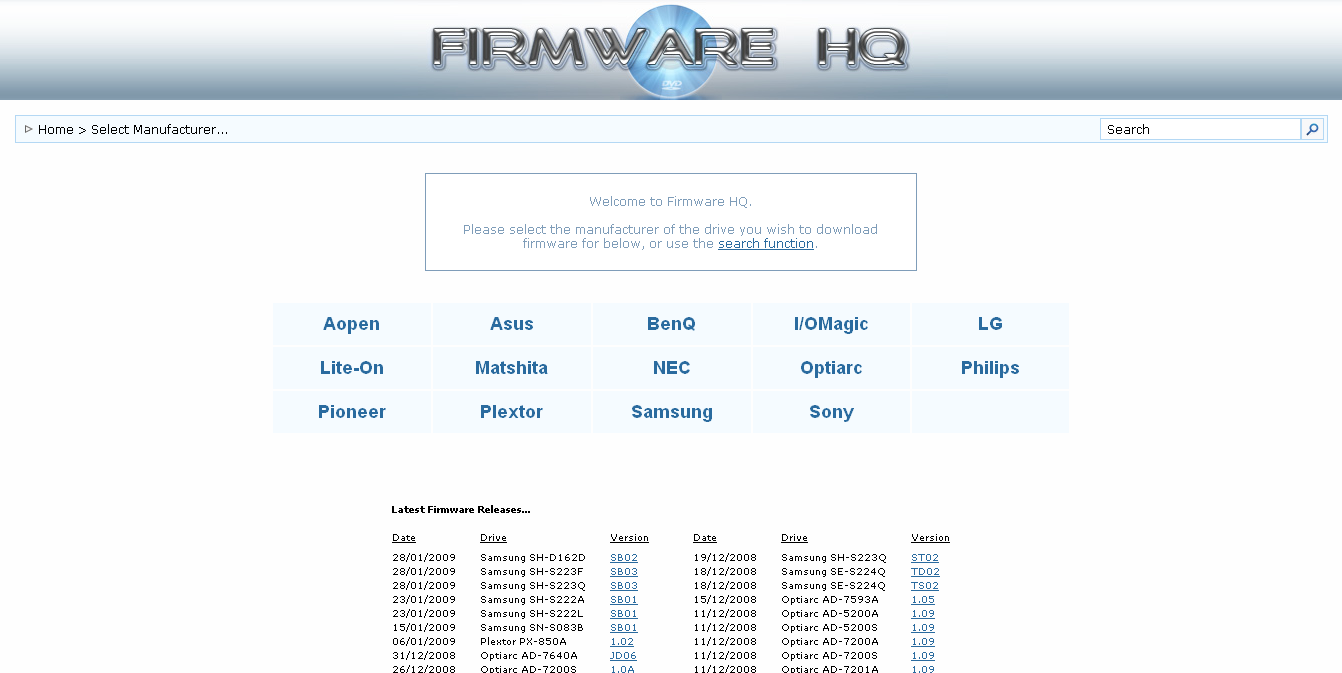
But work is work, and I can finally reveal what I, and many others, have been working on in secret (well, not really) all this time.  Say hello to Firmware HQ, the new firmware download site for your CD, DVD, HD DVD, Blu-ray (and whatever comes next) drives. ImgBurn‘s LIGHTNING UK! came up with the idea and worked on many of the finishing touches, I worked on the php/mysql stuff and Digital Digest is hosting the site (as well as the official forum), ImgBurn beta testers and our forum members worked on getting the data entered in, and many others contributed in many other ways. It’s not a huge website by any means, but it has nearly a thousand firmware files for download, and more will be added as time goes by.

For Digital Digest, this will be the first of many projects over 2009 as we try to expand the website by taking some existing popular content and to expand on them. I can’t say much now, mainly because I don’t know what the hell I’m talking about yet. To be blunt, 2008 was a bit crap in many ways for many people, and while 2009 hasn’t started well with Shingles and whatnot, I’m more determined than ever to get more work done. That is unless another game like Fallout 3 is released, then I might have to take a month off (and yes, I did download Operation Anchorage).

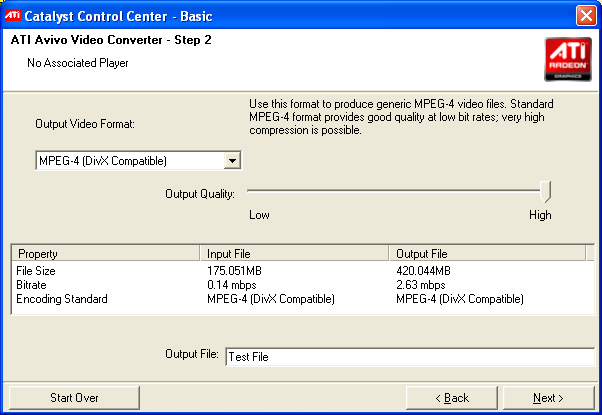
A new version of the ATI Catalyst drivers were released, along with a new version of ATI Video Converter. At first, I thought it has improved support for ATI Stream, ATI’s GPU assisted video encoding engine, but it didn’t turn out that way, in fact, it might have been a bit worse. ATI needs to get their act together to battle Nvidia’s CUDA, and that means proper video encoding acceleration that uses close to 100% of the GPU, not the intermittent 15% that ATI Video Converter current uses. 

Okay, that’s it for … oh wait, I haven’t done the weekly news review yet.

CopyrightAnyway, let’s start with Copyright news. Monty Python video clips were one of the most pirated clips on YouTube, until the Monty Python people decided to take action. Instead of hiring teams of lawyers, they decided to open their own channel on YouTube and offer free high quality video clips of their most popular content. And guess what, sales of Monty Python DVDs are now up 23,000%, all thanks to pirates who pushed content owners into taking action, but not through litigation, but by giving people what they want. How’s that for fighting piracy?

Comcast: "Arresting" the wrong people for piracy "crimes"

Comcast: "Arresting" the wrong people for piracy "crimes"

But those stuck with the idea that litigation or policing action are the only way to prevent piracy are still at it. AT&T and Comcast are now copyright policeman for the RIAA, by spying on their customers, following their every click, and then making judgement on whether what they’re doing is illegal or not, without a judge or jury in sight. And to nobody’s surprise, cases of mistaken identity and perfectly innocent users have been persecuted by Comcast, due to Comcast’s own stupidity it seems. There is a reason why you need judges and juries, and not rely on policeman to make all judgements, especially policeman owned by a private corporation. And to pay for all this, or perhaps as an alternative to policing action, is to label everyone as a pirate and then make them pay for it up front by introducing a piracy tax. I’m actually not totally against the idea provided that the tax is a small amount, maybe $5 a month, and that this allows unlimited downloading of pirated stuff without penalty, as technically, it’s not really piracy if I’ve already “paid” for it. But I’m sure the RIAA/MPAA is looking at $50, rather than $5. 

The DRM approach once again shows the weakness of the system, when purchases become merely rentals that content owners can at anytime revoke your right to them, even if you’ve already paid them time and time again. This time, it’s PC DRM for the game Gears of War, which “expired” along with other games that use the same DRM because the DRM publishers forgot to issue updated certificates for the game. People with pirated versions enjoyed playing their games through this “black-out”, so there’s yet another incentive to “go pirate”.

If “go pirate” is a slogan that you like, then perhaps you might want to consider becoming a fully paid members of the US Piracy Party, which is launching itself in California. 

High DefinitionLet’s get to the high definition news. People who read the WNR knows that you cannot ever accuse me of being biased *towards* Blu-ray. But those who read my weekly Blu-ray sales figure analysis will have seen that I have been pretty kind towards the progress Blu-ray has made, and make no mistakes, it has made progress, especially in the last two month. The progress has largely been made by The Dark Knight (and Iron Man), followed by a series of key catalogue releases by studios previously favouring HD DVD. King Kong, is the latest example. As is Band of Brothers. Bourne Trilogy, sales figures available next week, will be a hit too. These titles have allowed Blu-ray to gain significant market share easily, because hardly anyone is still buying the DVD versions of these films, most already owning them, and this allows the mostly Blu-ray exclusive editions to dominate. For example, 89.62% of all King Kong movie sales were on Blu-ray in the week it was released. And we’ve already established that the people buying Blu-ray movies are early adopters or enthusiasts who don’t care that much about pricing, and so in a very week DVD sales environment, Blu-ray is thriving.

Max Payne, also recently released, is an interesting example. A movie that flopped, but got to the top of the sales charts, ahead of The Dark Knight, on Blu-ray. The connection of the movie being based on a video game, and  Blu-ray relying on a video game console, is not lost. Time to release Super Mario Brothers, Street Fighter and all those awful Uwe Boll movies on Blu-ray? 

Sensio 3D: Now the official 3D standard for the DVD Forum

Sensio 3D: Now the official 3D standard for the DVD Forum

If crap video game adaptation can’t help Blu-ray, then perhaps 3D can. And maybe it can help DVDs too. The DVD Forum has chosen a 3D standard which it will now consider official: Sensio 3D. That may sound like big news, but remember that HD DVD was the official DVD Forum approved HD format, and we all know how that ended. The official 3D standard for Blu-ray is still to be decided, hopefully it will be Sensio 3D as the last thing we need is another format war.

And while not strictly HD news, but the US is nearing a Digital TV only age, with analogue to be cut off. Not everyone is happy of course, but with these type of big changes, you can never please everyone. There was talk of a delay to get more people on-board the digital train, but it looks like to have been defeated in the senate. Come the cut off date, a lot of people are going to be wondering why their TV suddenly stops working. Here in Australia, we’ve already delayed the cut off date by 2 years. This is despite DTV boxes available for the price of a Blu-ray movie these days, and almost all new TV sets having one built in. 

And also not exactly HD, but since we’re getting near to the gaming section below, it’s better if I put it here. Xbox 360 and Netflix’s video streaming deals seems to have paid off, with up to 400,000 new subscribers being predicted for Q1 2009. If this pays off, then the chance of Blu-ray coming to the Xbox 360 has just went from slim to none.

GamingAnd onto gaming. Sony say no again to price cuts, but this time there’s no rubbish line about the PS3 being good value or even too cheap.

No, instead, it was a very honest assessment of the current situation by SCEE’s David Reeves in which it was admitted that while the PS3 is too expensive, Sony cannot afford price cuts because they’re in trouble financially, with losses of more than $2 billion predicted for 2008. Remember that Sony still loses money on each and every PS3 sold, so a cheaper PS3 means more losses pre console, which is compounded by the fact that a cheaper PS3 will sell more. But then again, without a significant hardware presence, Sony will find it hard to make money off the games, which is the real money earner for the industry. So short term pain could equal long term gain, but with jobs on the line, nobody is going to want to take such risks. So overpriced PS3s for the short and medium term it is then, at least according to Reeves.

Operation: Anchorage adds to the Fallout 3 Universe, but only for the PC/Xbox 360

Operation: Anchorage adds to the Fallout 3 Universe, but only for the PC/Xbox 360

New downloadable content for Fallout 3 was released during the week, dubbed “Operation: Anchorage”. Unfortunately for PS3 owners, it is available for the PC and Xbox 360 only. The next DLC will be “The Pitt”, and “Broken Steel” in March. PS3 owners will miss out on all of these DLCs, thanks to a Microsoft exclusive deal, but missing “Broken Steel” would be the biggest blow because this patch will allow after-ending play and upgraded level caps, thus turning Fallout 3 into a whole other beast when it comes to longevity. This is what happens when you don’t have the most number of consoles in the US (and don’t have control over the PC gaming industry like Microsoft has thanks to the DirectX and Games For Windows platforms) – developers will be more likely to sign exclusive deals with the platform that’s most likely able to sell the most copies of their games. Something for Sony to think about I think when they decide to cut prices or not.

As for “Operation: Anchorage”, I’ve nearly finished it having started it only yesterday. It gives the Lone Wanderer a bit more interaction with the Brotherhood Outcasts, and you get to see the world as it was before the nuclear holocaust, albeit one that’s freezing cold and in the middle of a war zone.  It’s not a huge add-on, probably not worth the 800 Microsoft points that it costs, but if you’re like me and a Fallout 3 freak (mutant?), then you’ll buy it without a second thought.

I think that’s all I have for next week. Don’t forget to visit Firmware HQ!

Weekly News Roundup (18 January 2009)

Sunday, January 18th, 2009

Hello again. Yes, I’m still standing from my attack of the Shingles (hmm, title for new George Lucas movie perhaps?), although it was pretty bad earlier in the week. I got considerably better as the week went on, and I even had the energy to write a new guide for the newly released DivX Converter – the guide shows you how to make PS3/Xbox 360 compatible H.264/AAC videos using DivX Converter. It’s not the most feature rich encoding tool you’ll find, but if you need a quick and dirty H.264 encode, then it will do fine. Other than that, it was still a mostly quiet week.

CopyrightOn with copyright news, the makers of RealDVD are still feeling confident that they can beat the MPAA. The trial is set to start next month, and it will prove to be an important one. Real Networks do have a point in that their software actually adds more DRM to DVDs, and does not attempt to remove or circumvent any existing measures. There is a valid point in which the MPAA makes (shocking, I know) in relation to the CSS license, and whether Real are allowed to decode CSS in the way they’re doing, but on the point of copy protection, RealDVD doesn’t make the movie any easier to distribute online – in fact, it makes it harder and I can’t see how the MPAA can argue against this. To be fair, a sticker on the DVD telling me not to copy it is a stronger copy protection method that the weak CSS algorithm.

Only a couple of days until President-Elect Obama becomes President Obama. All eyes on the “change” that is supposed to be coming, and as posted last week, things are not looking great so far from a copyright perspective. However, things seems to be picking up on the Net Neutrality front and we might now get legislation to keep the Internet the way it is, as opposed to give control of it to big media and content owners.

High DefinitionIn High Definition news, the economic crisis hits home this week as Circuit City closes its doors. Living in Australia, I have had no dealings with Circuit City apart from protesting their decision to support the defunct DIVX format (not to be confused with the DivX codec), as opposed to supporting DVD way back in 1998. But it just goes to show that nobody is immune, and Sony are especially exposed to the downturn due to their high costs in promoting both Blu-ray and the PS3.

Circuit City has closed its doors

Circuit City has closed its doors

2008 has certainly been a year to forget for Sony, despite it getting off to a brilliant start. With the format war won, and PS3 sales beating the Xbox 360 back in February, things looked great. But then a couple of things happened (or didn’t happen), and Sony are now seen as one of the major losers of 2008. Blu-ray didn’t pick up as expected after HD DVD failed, and it has only now started to show it can hold its own against DVDs. In gaming, the Xbox 360 price cuts along with the never-ending Wii popularity meant that the only console the PS3 was able to beat was the PS2. And then the financial world collapsed, and all CE firms felt the impact, but especially Sony because they had two extremely expensive projects to support, both also facing serious competition from all over the place. Blu-ray seems to be standing on it’s own right now, although a lot of money is still being spent by Sony to promote it (see the Sony Blu-ray hardware promotions on Amazon.com). The PS3 still needs massive price cuts that will mean more losses for Sony in the short term at least. All they can do now is to keep their head down, take the loss and hope that in the meantime, the alternative media delivery systems and Nintendo/Microsoft haven’t taken control of the market by the time things improve.

Cheaper and cheaper DVDs are causing headaches for studios

Cheaper and cheaper DVDs are causing headaches for studios

The point of Blu-ray was always to prop up dropping DVD profits, but it doesn’t seem to have worked. The latest figures show that Blu-ray and DVD sales combined dropped by 5.5% compared to 2007. This is despite Blu-ray posting a 178% increase in sales, because DVD sales dropped 7.3%. In my follow-up forum post, I broke down the numbers and worked out that for every $1 increase in Blu-ray sales, there’s a $5 drop in DVD sales. The problem is that even though each Blu-ray makes more money, every cent someone spends on Blu-ray automatically means less money spent on DVDs. People are not buying the same movie on both DVD and Blu-ray, and why would they? And while Blu-ray movies are more expensive than DVDs, this does not always translate into more profit, after higher manufacturing costs plus promotional costs are factored in. Another problem is that Blu-ray movie pricing are dropping as well, along with DVDs, and so people are getting more for their money than before – so they’re naturally spending less because one can only physically watch so many movies in a time period. If I can now buy 10 movies a week instead of one due to price drops, then I might not buy 10 movies and spend the same amount of money because I don’t think I can watch 10 movies in a week. And once people get a taste for cheap movies, they are less likely to buy more expensive ones, even if it offers better quality. They’ll just end up spending less and less, and this is exactly what the studios are trying to prevent. The solution? I think they have to make it more convenient to search for and get movies into people’s homes. If that means promoting online purchasing and instant delivery, like how MP3s have taken over from CDs, then so be it. Blu-ray is just too similar to DVDs and while this familiarity is great for getting people to adopt the format, it also means that same problems that DVDs have are not solved. At best, it will buy some time for the industry to come up with a new way of doing things, but as the sales figures show, it’s not really helping much at the moment.

Or instead of going with the new, how about going with the extremely old? Panasonic thinks they’re onto a winner by combining good old VHS with Blu-ray. Seems a bit wrong to me, to be honest, a bit like still including a floppy drive with your latest i7 computer, at least one without a multi-card reader.

GamingAnd finally in gaming, Microsoft says they don’t plan on releasing a new console anytime soon. They can still do a bit to improve the Xbox 360, which can still play games that offer excellent quality visuals, although any recent PC can beat it for graphics these days. Two words Microsoft, ‘cool’ and ‘quiet’ – make these two qualities of the Xbox 360, and you really won’t need to release a new console in the short term.

3D is a big thing at this year’s CES, and Sony promises PS3 3D gaming. But wait, aren’t most PS3 games already 3D (or 4D, as Sony’s PR department claims)? No, these are actual 3D games where you wear those headache inducing glasses. This reminds me of the Asus VR-100 3D gaming system for the PC, and I nearly got one of those back in 1999. I’m all for immersion, but the Wii can do it with a $5 piece of equipment. And no headaches.

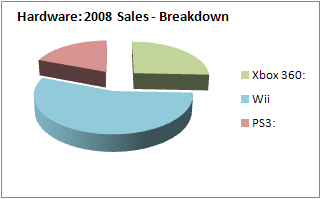
A sneak preview of one of the graphics in my 2008 review: hardware sales numbers

A sneak preview of one of the graphics in my 2008 review: hardware sales numbers

I should have the NPD figures for December 2008 up next week – it’s slightly delayed because I’m also writing the year in review which will feature lots of nice graphs. I probably shouldn’t tell you the conclusion before I publish the article, but I think it’s fairly easy to guess what it is anyway. The Wii is the big winner, obviously. It was twice as popular as the Xbox 360, which itself was almost twice as popular as the PS3. Nintendo is the even bigger winner because the big software hits were theirs (thanks to Super Smash Bros. Brawl, and the usual suspects of Wii Play, Mario Kart and Wii Fit). The Xbox 360 game developers were the other big winners. There was only the single PS3 title in the yearly top 10, and that was the PS3 version of GTA IV which sold 1.4m copies less on the PS3 than on the Xbox 360. Nine out of the twelve monthly number one games were Xbox 360 ones, two were Wiis, and only a single number 1 hit for the PS3 (MGS4).

Okey dokey, that’s it for this week. Hope 2009 has been pleasant for you so far, because it hasn’t really been that great for me thanks to the varicella-zoster virus. Curse you, stupid virii.

ATI Stream GPU assisted video transcoding – meh?

Friday, December 12th, 2008
ATI Stream - does it live up to the hype?

ATI Stream - does it live up to the hype?

ATI has released new drivers that has unlocked what they call ATI Stream accelerated video encoding. Basically, if you have an ATI 46xx or 48xx series card, then the powerful stream processors onboard can now be used for tasks usually reserved for CPUs, such as video encoding. This is basically a late response to Nvidia’s CUDA, which does the same thing.

Included as a separate downloads, the free ATI Avivo Video Converter supports this new type of acceleration, which is very useful because it is the only software that supports it at the moment.

So I decided to test encoding performance in ATI Avivo Video Converter using version 8.11 (no accelerated encoding using ATI Stream) and 8.12 (supports ATI Stream), and to see whether there’s a difference.

First up, not all the encoding profiles support ATI Stream. The iPod, PSP, DVD and DivX ones do (some of others may as well, but I didn’t test all of them), and so I decided to test DVD and DivX encoding (the other two types had similar results).

A bit more details about the test setup:

CPU: Intel E8500
RAM: 4 GB DDR3
GPU: ATI Radeon HD 4850 (512 MB)
OS: Windows XP SP3

The input file:

Type: XviD (AVI)
Length: 21 minutes
Size: 175 MB 

The output profiles used:

DVD: Max bitrate (8 Mbps)
DivX: Max bitrate (2.6 Mbps)

First up is version 8.11, the one without ATI Stream support. Here are the results:

DVD:
Conversion Time: 2:08
CPU Usage: 100%
GPU Usage: 0%

DivX:
Conversion Time: 1:39
CPU Usage: 100%
GPU Usage: 0%

Now for version 8.12 results, where ATI Stream support is now activated:

DVD:
Conversion Time: 2:03
CPU Usage: 100%
GPU Usage: 0 to 15-20%, intermittent 

DivX:
Conversion Time: 1:36
CPU Usage: 100%
GPU Usage: 0 to 15-20%, intermittent

ATI Avivo Video Converter with ATI Stream support - uninspiring

ATI Avivo Video Converter with ATI Stream support - uninspiring

Pretty underwhelming, you have to say. Only a 3 to 4% increase in encoding performance, which is not surprising because the GPU was hardly used during the whole thing. Nvidia’s CUDA takes a different approach, using more GPU, but less CPU, even if the encoding takes a little longer (more on that later). As a first attempt, it’s not great, but at least it shows that ATI is moving in the same direction as Nvidia and future applications from Cyberlink or TMPG Inc (which already supports CUDA acceleration) might yield better results.

As for the ATI Avivo Video Converter, the application is pretty easy to use, but unfortunately, the output quality as well as the profiles provided are fairly poor. And if that’s not bad enough, you are limited to only the selected profiles and with only bitrate as the only adjustable option (and even then, it’s limited to quite low values). The encoding speed, even without acceleration, is pretty quick as a result, about 12 minutes to encode a DVD compliant MPEG-2 file for your typical 120 minute movie. If you don’t care about quality, and want to at least get your GPU to do a little bit of the work, then this might be the tool for you.

For everyone else, it’s best to wait until a proper encoder comes out with ATI Stream support to see how much of a speed improvement there is, especially if it can get 100% of the core working on it.

Blu-ray Year To Date Stats + PC Playback

Saturday, December 6th, 2008

Home Media Magazine last week published year to date sales stats for Blu-ray and DVD. While the year isn’t over yet, they are still worth taking a look at. 

Overall, Blu-ray sales accounted for 4% of the market by disc volume (the number of actual packages sold) for the top 20 titles. If you look at dollar volume (the total amount of money taken in), Blu-ray did a little better at 6.11%, which is not a surprise considering that a typical Blu-ray movie is more expensive than a DVD.

If you look at the growth figures, Blu-ray sales are way up on last year, a 233.23% increase to $USD 410.28 million dollars. DVDs, on the other hand, were down 8.47% at $6,306.01 million, taking into account that the YTD figures are only up to 16th November.

With the above set of figures, it is possible to extrapolate last year’s figures, which are as follows:

  • Blu-ray: $175.91 million (2.5%)
  • DVD: $6,889.56 million (97.5%)

These figures look right to me, as Blu-ray did have a 2.5% market share this time last year (with HD DVD still holding around 1.5%). It looks like Blu-ray has successfully absorbed the HD DVD market share, and still managed to grow about 2%. This may not sound like a lot, but considering that most of Blu-ray’s growth has been in the second half of the year (and in the last quarter of 2008, which is yet to finish), things are looking pretty bright.

But Blu-ray was brought in make up for the ever shrinking DVD profits, and with the above set of figures, it is now possible to see if Blu-ray has managed to do just this for the studios. DVD sales dropped by $583.55 million from 2007 to 2008 (up to 16th November). However, Blu-ray sales have only increased by $234.37 million in the same period. Since these figures do not represent the entire calendar year, so it’s still a bit premature to provide any concrete conclusions at this moment. Blu-ray sales will increase in the one and a half months left in the year, and the DVD sales decrease will lessen – it will only take a little bit of movement on either front for Blu-ray sales to completely cover any losses in DVD sales, and after that, it’s all extra profit. Of course, this does not take into account the amount of money that studios have spent in developing and promoting Blu-ray, but many of these are once off costs.

To conclude, Blu-ray sales have increased beyond simply absorbing the HD DVD market share, and looks set to at the very least cover any decreases in sales for the DVD format, which was the whole point of having a new format. While there’s still a long way to go before one can say that Blu-ray is competing with DVD, it is already supplementing it quite nicely and perhaps that’s the intentions of the studios all along.

As for the second part of this blog post, as you may be aware, I recently purchased a new C2D E8500 powered computer, with an Asus 4850 as the Blu-ray decoding assisting GPU using the latest Catalyst drivers (8.11) in Windows XP. Desktop resolution was set to 1920×1080, the native resolution for Blu-ray (and my LCD monitor). Audio decoding settings in PowerDVD were set to 6 channel output. 

I was interested in CPU usage while playing a H.264 and VC-1 encoded Blu-ray discs, and here are the results.


CPU usage while playing VC-1 encoded Blu-ray in PowerDVD 8 Ultra

CPU usage while playing VC-1 encoded Blu-ray in PowerDVD 8 Ultra

CPU usage while playing H.264 encoded Blu-ray in PowerDVD 8 Ultra

CPU usage while playing H.264 encoded Blu-ray in PowerDVD 8 Ultra

As you can see from the above CPU usage graphs, the CPU usage for both VC-1 and H.264 encodes were at a very reasonable 10% on average. ATi’s Avivo HD is doing an excellent job at assisting Blu-ray decoding. It’s unfortunate that PowerDVD no longer allows HD acceleration to be switched off, as I would be interested to see how the CPU handles decoding by itself. It was also interesting that, since I had Intel SpeedStep turned on, the CPU was in power saving mode during most of the playback (CPU multiplier reduced from 9.5x to 6.0x). With this kind of GPU acceleration, you can get away with using one of Intel or AMD’s budget CPUs and still get perfect Blu-ray playback. More sensible though would be getting a silent cooling GPU, with an equally low power CPU part, to build yourself a near silent home theatre PC system.