The History of Digital Digest Part 1: DVD Digest

July 16th, 2009

While we’re celebrating the 10th Anniversary of Digital Digest, I thought it would be interesting if I wrote a brief history of the site. Some of what I will post will be common knowledge, some will be revealed for the first time.

The very first version of Digital Digest, note the Asus V3400 reference

The very first version of Digital Digest, note the Asus V3400 reference

It is worth noting again that Digital Digest is really a collection of many different websites that I have developed over the last 10 years. The very first of these websites was a Geocities (and Tripod) hosted website called DVDigest. It was still relatively early days for the Internet, and the boom was underway. Free web hosting was all the rage, and Geocities and Tripod were amongst the leaders. You get something like 15 MB of space and some unspecified bandwidth limit, for hosting static HTML pages and images, which was plentiful back then. And when you do go over the bandwidth limit, you can always open another free account – to solve the problem of ever changing URLs, you used redirect services like cjb.net (so you would have something like dvdigest.cjb.net, which would direct to whichever free account that was still active back then). Now, this was a time of venture capitalists going crazy and IPOs popping up all over the place, so in comparison, DVDigest was pretty amateur. Even for the amateurs.

But it was noob time for most people back then, before the word “noob” was even invented. My interests back then, being the nerd that I am, was to go to newsgroups and help people with their DVD playback problems. I was one of the few that jumped on to the doomed VCD bandwagon (having purchased a hardware MPEG-1 decoder card at great cost), and my interests naturally flowed onto this new format called DVD. Playing DVDs on your PC back then is  like trying to play games at 2560×1600 resolution today. With 8xAA and 16x AF. In other words, stutter city was the name of the game. That is unless you had some sort of graphics card that could accelerate DVD playback (or a dedicated hardware MPEG-2 decoder card). The graphics card I had back then was the  Asus V3400, part of Nvidia’s Riva TNT family. Despite the marketing, it did not have DVD acceleration and playback was, well, awful. Software based DVD decoders were still in their early days back then, and it took a great deal of tweaking before you could get acceptable framerates on an Intel Celeron 333a. The experience I gained from helping people play DVDs is what led me to write up a few webpages and open a site called DVDigest, which quickly became DVD Digest because people were a bit confused at the name (and they still are – “Digest” reads as in Reader’s Digest, and not as in “digest food”, BTW).

This went on, and more content was added. There were a few new things coming out back then that were quite exciting (for a nerd like me). Talks of doing the impossible and somehow copying the copy protected DVD to your hard-drive, that is if you had a hard-drive big enough. The very first “ripper”, if I can remember, was all about using PowerDVD’s screen capture facility and capturing everything frame by frame. People might as well have pointed a video camera at their TV for all the good that it did (no sound until further processing!) , but at least the process path was all digital. There as also this thing called DivX ; -) – which allowed you to make high quality videos (even better than VCD!) at maybe only a tenth of the space. It was an exciting time.
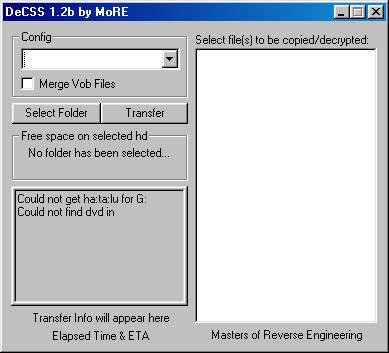
DeCSS: Who knew such a small program could cause so much trouble ...

DeCSS: Who knew such a small program could cause so much trouble ...

It was still late 1999 when I was approached by a company, which shall remain nameless (and actually I can’t remember their name anyway), that offered to help me host my fledgling website, which had already grown too p0pular to be hosted on a 15 MB free webspace deal (shocking, I know). I was to get a part of the advertising money, and they would do all the hosting. They even kindly purchased the domain name dvd-digest.com (don’t bother hurrying over to whois the name, it’s owned by different people now, I think), which was perhaps not as kind as I had believed, naive as I was. All went pretty smoothly until the said company received legal documents which suggested that the rippers I was hosting was not entirely legal. The infamous DVD CCA vs DeCSS case had started. It doesn’t really matter now that the court eventually ruled in favour of the defendants, but I’m sure it was scary for the company that hosted DVD Digest (and owned the domain name to boot). And they took what was in their eyes not only the right action, but the only action, which was to “Shut It Down!”. I was on vacation and away from the Internet at that time (hard to believe that being away from the Internet is actually possible these days, I know) and I did not find out until a week or two after the fact. It wasn’t good news for DVD Digest.

So I had to start from scratch again in the fake new millennium (2000), this time with the domain name digital-digest.com, even though the site was still called DVD Digest back then. And start again I did. The year 2000 was a great one for DVD Digest, despite the soon bursting of the Internet bubble. It was then that I turned what was really a hobby into a business of sorts, and of course, the DVD industry made huge strides in those few years which was helpful for a website that relied on more and more people wondering why they’re only getting 15 FPS from the DVDs on their PCs.

The DVD Digest name continued to be used for many years, with Digital Digest eventually taking over as the official name of the website, but by then there were other sites part of the Digital Digest network called DivX Digest and DVD±R Digest, but that’s a story for part 2 and 3 of The History of Digital Digest.

To be continued in part 2 …

Weekly News Roundup (12 July 2009)

July 12th, 2009

We’ve had a good response to our 10th Anniversary Competition, so if you haven’t entered yet, then don’t forget to get your entry in. There’s still time, the competition closes at the end of the month.

I had a mid-week rant (well,  yesterday actually) about the state of patching for PC games, specifically for Fallout 3. The way developers are using their customers as beta testers is not really helping the struggling PC gaming industry. And certain companies are better than others at fixing bugs, and some even go as far as adding in new features for no extra cost. But others are either shy about releasing patches (Atari’s Test Drive Unlimited comes to mind), or in Fallout 3’s case, releasing patches that cause even more bugs. Anyway, onto the news for the week, while not numerous, but is still interesting.

Copyright

In Copyright news, there’s more clarity in the Pirate Bay sale situation. TPB’s spokesperson has clarified a few points in an interview with TorrentFreak. But it is still unclear which direction the new owners will go, whether they want to strip out the torrents for the pirated content (which defeats the whole purpose of TPB, and of course, makes it worthless), or they plan to keep things the way they are and face any legal problems as they arise. The Pirate Bay founders will now concentrate on the Video Bay project reported here a few weeks ago (the YouTube alternative, but without the copyright filters).

The Swedish Pirate Party is still wallowing in their victory, and they may even get a second MP in the EU Parliament if  Sweden ratifies the Lisbon Treaty. But they already have one MP and Mr. Christian Engström has used his election to highlight the issue of online freedom, and how the copyright industry threatens it. With multi-million dollar amounts being awarded against individuals, and governments acting crazy trying to circumvent their own legal processes to appease the music/movie industry, there ought to be a Pirate Party and Pirate Party MPs in every parliament or congress around the world to keep things in check.

The Thomas-Rasset story (good title for a TV movie) continues and she will seek a new trial. She’s gotten a lot of sympathy from everyone, including one of the artists of the 24 songs she shared. Even the judge of the previous verdict (the one before the last one) overturned it due to the fact that it was excessive, and it wasn’t anywhere near $1.92m. The best PR move that the RIAA can make now is to settle with Ms. Rasset for a reasonable figure, although it might already be a little bit too late for this.

This mans wants to take your Internets away ...

This mans wants to take your Internets away ...

Sarkozy’s Kraozy Internet “3-Strikes” plan was watered down by the French Constitutional Council, but the amended version has been passed in the French senate, controlled by Sarkozy’s party. The current version will still require a judge’s action before any Internet bans can be implemented, which makes the process slightly fairer, but the whole point of the bill is now under threat since it was all about having a speedy (ie. non constitutional) process to ban people from the Internet, and they probably won’t get this if a judge has to be involved at any point. The court will probably decide after a while that it’s just too much work to implement bans to the millions of people who download pirated stuff in France and give up. Hopefully.

On the other side of the Pyrenees, things are much better. A Spanish judge has basically ruled that downloading pirated content does not constitute a crime, since no money can be proved to be lost. As long as the downloader doesn’t go on to sell the content, then no laws have been broken. My interpretation is that the person who originally made the download available, if not doing so for profit, then probably hasn’t broken any laws either. This kind of sane, informed decision that actually makes sense is all so rare these days. More judges (and juries) need to go back to the basics and understand the burden of proof is on the RIAA and MPAA to prove that money has been lost, that the person downloading the pirated material would have otherwise purchased the content based on past habits. Otherwise, all they have proved is that someone who doesn’t buy things continue to not buy things, and so therefore, they lose nothing. And they may actually gain a lot in terms of publicity for their products, which is why the Internet is being used so heavily these days for promotional purposes.

High Definition

Moving on to HD news, Netflix infamously introduced its Blu-ray tax, a reasonable $1 extra per month, for Blu-ray renters. The story now is that the $1 not only covers the extra cost of procuring Blu-ray movies, but that because Blu-ray movies are more easily damaged than their DVD counterparts, this extra fee is also necessary to buy replacement copies.

This comes after several users reported receiving several Blu-ray discs that had cracks in them and were unplayable. Blu-ray discs are supposed to be tougher than their DVD counterparts, mainly due to a harder surface that is more resistant to scratches. This makes them less likely to develop disc reading problems due to scratches, but also makes it harder to fix scratched discs because the standard DVD polishing method won’t work. However, perhaps this harder surface makes Blu-ray discs less flexible than DVDs (they certainly seem thicker, from my experience), and this makes then easier to crack, especially when sent through the post and being abused by renters over time. It’s certainly something worth investigating, and perhaps harder envelopes are needed to protect Blu-ray rentals (and this may mean a hike in the “Blu-ray Tax”).

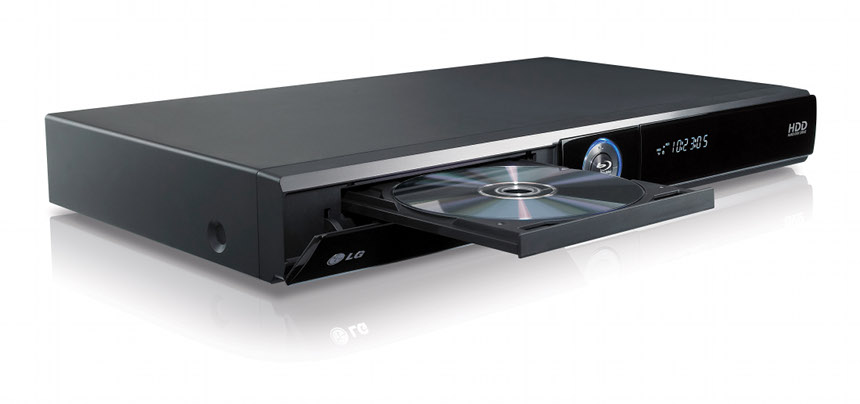
LG HR400 combines a Blu-ray player with DVR ... but will we see something like this in the US?

LG HR400 combines a Blu-ray player with DVR ... but will we see something like this in the US?

LG has released a new Blu-ray player in the UK that has a built in hard-drive for recording free to air (Freeview) TV programs. It is a Blu-ray Profile 2.0 player so it has an Ethernet port, and it uses this to support YouTube playback. DivX playback is also supported. Why highlight this player? Well, it’s just interesting to note that something like this is available first in the UK, and not in the US, and I’ve always wondered why. At first, I thought it might have been due to copyright concerns, and that’s probably true to some extent. Then I remembered the popularity of TiVo and perhaps this is why DVD recorders (with or without built-in HDDs) never took off in the US. But with the switch to Digital TV, and the willingness of companies like LG and Samsung to make hybrid Blu-ray/DVRs, hopefully this will break up the TiVo monopoly a bit. I’m certainly expecting this type of player to be available in Australia, where TiVo only has a small presence and DVD recorders are still relatively popular.

And while BitTorrent is widely recognised by the industry as the enemy of movie theaters, one theater in Norway has demonstrated that BitTorrent might actually help the movie industry. By using this technology to stream movies to show on the big screen, rather than relying on expensive hard copies to be sent to cinemas, 2K resolution movies can be downloaded or streamed for distribution. My feeling is that BitTorrent gets a bad name for its association with pirated material, but the technology it self is not illegal. It is in fact the future of content distribution online, and it is also cost effective as it leverages the downloader’s own connections to ensure the connection of everyone else is of a good speed, and helps to spread the cost of downloads away from the content provider. If Hollywood does come to its senses and decide to sell streaming movies online, then BitTorrent or some similar technology is the way to go.

Sorry, no gaming news this week of note. Lots of noise about Wii MotionPlus and Wii Sports Resort, which will no doubt top the sales charts when the figure come out. The figures for June 2009 should be out this week, and as usual, the full analysis will be posted soon after.

See you next week.

The Patching Game (Fallout 3 Rant)

July 11th, 2009

Another week, something else to rant about. This time, it’s my 2008 game of the year, Fallout 3, the PC version (but it also applies to owners of the console versions too).

Patching. It’s now as integral a part of computing as say the mouse or keyboard. As a software engineer, I understand the complexity behind a software project, and how the final version is never really good enough for public consumption, no matter how thorough your testing procedures are. And that’s especially true with games, because these are complex bits of code, and they rely on a variety of different hardware (Nvidia or ATI, and which GPU series, which sound chip …) and software (which driver version, which DirectX version, which Windows version …). So games do need patches, and it could be several patches before all the major bugs are fixed.

Fixing bugs is one thing though. Introducing new and more annoying bugs with every patch is another. And this is why I’m going to rant about Fallout 3 in this blog entry.

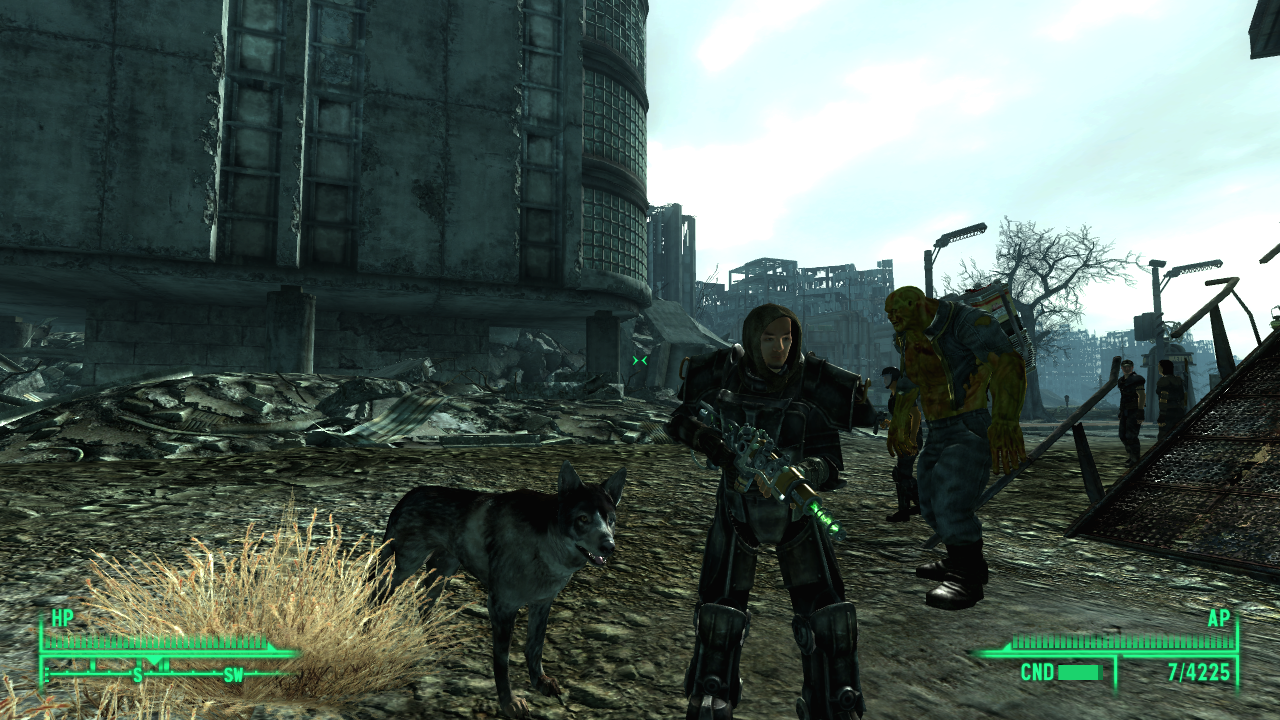
Fallout 3: Actual screenshot from my save game - great game, crap patches

Fallout 3: Actual screenshot from my save game - great game, crap patches

As I mentioned before, Fallout 3 is my 2008 game of the year, and with the DLCs, I think it might even be my 2009 game of the year. But all of this is despite, not because of, the patches that Bethesda Game Studios (the makers of Fallout 3) have released. Nearly all of them have introduced new and more annoying bugs, without fixing long standing ones. And you can’t even skip the patches because Fallout 3 on the PC is tied into Games for Windows Live, and so without the latest patch, you cannot get into your save games (well you can, but you’ll have move a few things around so you can play offline). The latest most annoying bug for me is the closing bug, introduced in the 1.5 patch with the Broken Steel DLC (the latest patch version is 1.6, and it doesn’t fix this issue) where if you quit the game, your computer hangs and you’ll have to restart. Your computer actually doesn’t hang, it’s just that Fallout 3 hangs and you can’t get out of it to shut it down. So I now play in windowed mode, or use Alt-F4 to close the game after getting to the main menu. This kind of workaround shouldn’t be necessary on a game that I’ve already paid nearly $100 for (including 3 DLCs). There are also video/audio codec related issues (nicely related to this website), which can be fixed, although it really should have been handled from a developer’s point of view by ensuring external codecs do not interfere with internal ones used by your game. And don’t even get me started on the Feral Reaver Ghouls that spasm and become invincible. For this, and many other bugs, and to read the rants of many other users, just check out Bethesda’s own Fallout 3 PC issues forum – 68,000 posts and still going strong, unfortunately (and to compare, the PS3 and Xbox 360 issues forum when added together only have 15,000 posts).

The PS3/Xbox 360 versions  aren’t much better, and they are even less lucky because they can’t play in windowed mode as a workaround (although to be fair, they don’t get the shutdown bug), and they can’t use console commands to resurrect NPCs that die for no apparent reason. But they do get random crashes, get stuck in place, and various other little glitches that are easy to fix on the PC (through the aforementioned console commands, for example to teleport yourself to another location if you get stuck in the rock crevasse or something), but impossible to fix on video game consoles.

Anyway, the point of this rant is that while I fully understand the difficulty in developing games these days, but could you at least ensure that patches do not introduce new bugs? For a game like Fallout 3, many people will forgive the developers and use the workarounds because even with the bugs, it’s still a great game. But for any other game, well let’s just say that no wonder so many people pirate games – it really is the only way to ensure that the game actually works on your PC before you pay for it (demos, while great, aren’t the full game and so there are things that won’t show up in it).

My rant is over so to thank you all for reading this crap, I will present some troubleshooting tips for my fellow Fallout 3 PC sufferers, I mean gamers:

  1. Don’t run the game at the highest possible resolution/quality setting. Tone it down a notch (or two) and the game will crash less.
  2. Run the game in offline mode so you won’t have to be stuck with Games for Windows Live and being forced to apply patches. This is not a rant against Games for Windows Live though, because I like the service (although I think it should be optional), particularly the Achivements, which adds to the longevity of games like Fallout 3.
  3. Refer to the Troubleshooting Tips thread on the official forum to get started with the workarounds.
  4. Save often – I now have over 1,500 saves occupying 2.53 GB of space, and I still wish I had saved more often to avoid having to replay areas due to crashes (to save space, you can compress old saves and then delete them – you can get a 70% saving on disk space by compressing the save games, which makes me wonder why the developers didn’t add compression to the save files in the first place).
  5. Your audio chip/card may come with software that gives you all sorts of audio effects, like Dolby Virtual Speakers or whatever – turn all of these off, because audio problems are one of the major sources of crashes for Fallout 3.
  6. While using the console commands may be considered cheating, it isn’t cheating if you fail a mission due to some glitch. Correct the glitch with the console commands, and if ethics aren’t that important to you (I guess that would depend on your Karma rating), then gives yourself a couple of hundred or thousand caps as reward for your patience while you’re in the console.
  7. As mentioned earlier with the exit-crash bug, instead of exiting the game like a normal person, go to the main menu and press Alt-F4 to shut down Fallout 3. And then go into Task Manager to shut down the Fallout3.exe process (otherwise it keeps on running, consuming resources like the full game does). If you’re like me and tend to forget to do this, then play the game in windowed mode (see tip below) and shut down through Task Manager.
  8. Play the game in windowed mode sucks, but it seems to avoid some of the crashes (possibly thanks for the lower forced resolution).
  9. Get a PS3 or Xbox 360.
  10. Get the word out about Bethesda’s Fallout 3 patches and complain – maybe if enough people complain, then at least the serious problems will be fixed. Not that this strategy worked for Oblivion or anything.

Weekly News Roundup (5 July 2009)

July 5th, 2009
Digital Digest is 10 Years Old!

Digital Digest is 10 Years Old!

Digital Digest is 10 years old! The actual birthday was yesterday, and I know it was 4th of July and that’s because I deliberately chose an easy to remember date to make public the very first version of Digital Digest (then known as DVDigest – you can see a screenshot of it here). My original thinking behind Digital Digest was that, as I was very active on newsgroups and forums back then answering people’s questions in regards to DVD playback (mainly focused on the Asus v3400 graphics card), that having a website where I can post all my answers and people can read that would save me time. After 10 years and countless hours of work later, I think my plan might have backfired just a little. Still, it’s been mostly enjoyable and I don’t think I would rather be doing anything else.

Anyway, to celebrate the 10th anniversary, I thought I would set up a competition where you can win some Amazon.com Gift Cards. There are 10 prizes in total (you know, for the 10 years and all), and entry is as simple as giving me your name and email address. No super easy or super hard questions to answer, or secret codes to hunt for on the website. I’ll randomly draw the winners at the end of the month, good luck to all those who enter.

Anyway, onto the news for the week, there’s a bit to cover.

Copyright

Let’s start with the copyright news. The Pirate Bay is still dominating the copyright news this week. There was a big announcement that caused a lot of stir, but it was preceded by some interesting news in regards to a new site that TPB wants to launch.

The new site in question is a YouTube style video sharing site, except there won’t be any copyright filters to contend with. It won’t make big media happy, but YouTube is only YouTube because people share copyright stuff, not in the sense of piracy, but using clips and music in their own videos. If you can really make YouTube 100% copyright compliant, then there won’t be many videos left at all.

The Pirate Bay changes owners: is this the end?

The Pirate Bay changes owners: is this the end?

So good news in that TPB is undeterred by the lawsuits and will continue with their crusade to “free” the Internet of the shackles of excessive copyright control. Then the news broke that The Pirate Bay has been sold to a new company, and that new company wants to focus on legalizing TPB. Confusion reigned, and we still don’t know what’s going on. On one hand, the statements made by the new owners seem to indicate that TPB would go legit, which basically means it’s going to turn into a completely different site, other than the domain name. On the other hand, there were statements made later on that suggested this won’t make much of a difference at all. The backlash was immediate, and not too dissimilar to the one after the Mininova content filter blog post made a couple of months ago. It does seem a bit ungrateful that this tremendously useful resource that people have been using, for free, for so many years and then the minute something changes (and we’re not even sure what the changes mean yet), it becomes torch and pitchfork time. But I guess that’s the nature of the business, in that people expect free stuff and they won’t like it when it’s taken away. Keep a close eye on this story and let’s give the benefit of the doubt to the TPB founders for the time being.

And let’s not forget that the bad guys in all of this is the RIAA, MPAA and all these other copyright groups that refuses to embrace the Internet for what it is, and accept that piracy is part of their business model now, and without it (and without the Internet “hype” effect, they’d be making much less money than they are right now). But it’s yet another victory for the RIAA in their lawsuit against Usenet.com. Well, at least the lawyers are happy, and people who pirate stuff are still pirating stuff, possibly more easily than before. But at least they’re not going after individuals in lawsuits anymore, although the three-strikes rubbish is not that much better. And if more proof was needed that going after individuals doesn’t work, then have a look at a new study by Which? computer magazine in the UK, which managed to easily find 20 users accused of piracy that are apparently innocent. There’s been lots of these kind of falsely accused stories in the past, and because IP addresses are not the best way to track down individuals. IP addresses can be easily faked, and even if they are genuine, it only proves that someone using a particular connection at that time was possibly downloading pirated material, it does not prove that which person did it or whether it was done with permission of the owners of the connection.

But this all assumes that illegal downloads are a bad bad thing, but the reality is that many people have no other alternative than to download, such as downloading TV shows. EngadgetHD looks at the top 10 reasons people download illegal TV shows. From my experience, especially here in Australia, people are almost forced to download because the traditional outlets such as TV stations or DVD are just too slow – some shows are shown years after they were originally broadcast in the US, and some (like The Sopranos) never shown properly at all. And because DVD releases have to be months after TV broadcasts, the shows that are purchased by the TV station but never shown might never make it onto DVD. The situation is a lot better now these days than just a few years ago, and I think online piracy is the reason for this improvement. So piracy is not always a bad thing, if it gives the right people a kick up the butt, for the right reasons. The simplest way to fight against piracy is to make legal alternatives available, that are better and not a total ripoff. Do this, and piracy will slow down. Don’t do it, and people will flock to what’s the best and fastest, which right now is clearly piracy.

High Definition

Let’s move on to HD news now. Oppo has released its new Blu-ray player. It features high-end features such as SACD and DVD-Audio playback, plus the superior video processing for both Blu-ray and DVD upscaling that Oppo is famous for.

Oppo BDP-83: The most fully featured Blu-ray player so far?

Oppo BDP-83: The most fully featured Blu-ray player so far?

Plus, there is the possibility of a region-free firmware (for both Blu-ray and DVD), and it could be the must-have Blu-ray player for the year. Elsewhere, it has all the features most Blu-ray players have, including Profile 2.0 compatibility – there’s not Netflix streaming though. And it’s not that expensive either, not for the amount of features you get. Those with huge DVD collections should really consider getting this player as it will seriously improve the longevity of your DVD collection with the superior upscaling capabilities, while allowing you to sample what Blu-ray can offer. It’s available for under $500 from Amazon right now.

Speaking of Netflix streaming on Blu-ray players, the Examiner looks at whether on demand content is going to replace physical media. I don’t see why both can’t co-exist together, like on the aforementioned Blu-ray player, but certainly on demand content is going to eat into the profit streams of physical media. I think physical media still has a place, for backup, and for those like me that still prefer something solid to represent my movie collection. The situation may be analogous to the one between snail mail  and emails. There was always the talk that email will replace traditional mail, but while the good old letter has suffered, it still has an important place in our new digital world. Just like physical media will have in the world of tomorrow.

Gaming

And finally in gaming, lots of rumours as usual. For the Xbox 360, the latest rumours suggest that the Pro pack is being phased out, and the Elite will become the new “pro”, with a Natal bundle being the new Elite. More rumours of PS3 price cuts, and the rumours regarding the PS3 slim still won’t go away. You can read about all of these rumours here.

Is PS2 compatibility coming to the PS3? Is this the end for the PS2?

Is PS2 compatibility coming to the PS3? Is this the end for the PS2?

The second rumour is about PS2 compatibility coming back to the PS3, either to all existing consoles, or to the PS3 slim. If Sony plans to phase out the PS2, and it’s about time they did, then this makes perfect sense. With software emulation more of a possibility than when the PS3 first launched (where PS2 compatibility required extra, and expensive, hardware), it won’t add to the cost of the PS3, while Sony can even sell the emulation software in the PS Store. Plus, they can then start selling PS2 games in digital form for PS3 owners, just like on the Xbox 360 or Wii. So this is one rumour that might be true, and if Sony isn’t even considering this option, then somebody should smack them in the back of the head.

And is Project Natal racist? The news broke that people with darker skin tones might have trouble playing Natal due to one person’s experience at the E3 demo. It’s an interesting headline, but I don’t think there’s an issue, because surely darker clothing would affect the accuracy of Natal much more than darker skin. A calibration tool might be what Natal needs, and users might have to calibrate the cameras (due to change in lighting) before usage to ensure accuracy is improved.

So that’s it for the week. Ten years, it’s gone by rather quickly I must say. Even this feature, the Weekly News Roundup, is nearly 2 years old (in September), even though it feels like I only started doing this last month. Or maybe it feels this way because I really don’t know what I’m doing, which is probably true. Anyway, see you next week as I incompetently try to produce another edition of the WNR. See you then.

Weekly News Roundup (28 June 2009)

June 28th, 2009

Going to do a very quick WNR this week, as I’m still feeling under the weather. Had to do a bunch of tests at the clinic to see what’s wrong – having things inserted, extracted, and cables plugged in wasn’t a nice experience, but I now know how my DVD player feels. And no, it’s now Swine Flu, although everybody here in Melbourne, Australia seems to have it.

Copyright

In copyright news, more lawsuits, but this time in Ireland, where the record industry representatives are suing two Irish ISPs. It’s heartwarming to know that, despite the bad economy, that at least the lawyers are still finding excellent amounts of work available (at at $765 per hour as well).

Lawsuits, three-strikes, throttling – the industry’s favourite tactics, but not all government agree. The Spanish government’s strong dislike of the three-strikes rule has promoted their music industry to change tactics and abandon the three-strikes system. If only other government were as strong in their beliefs that due process is still something that needs to be protected.

And onto our favourite court case, you must have heard a lot about how The Pirate Bay case has been denied a retrial. This is true, but it is by no means the end of the road for the TPB guys. What happened, and as explained clearly a few weeks ago by Cynthia, our Swedish expert, a higher court has ruled that the judge in the original case was not biased. All this is means is that instead of having the retrial in the original court, the retrial will have to take place in a higher court. There are still a few more couts to go before it is all over. I don’t think we will find out anything definitive in 2009 in any case.

Real says RipGuard and ARccOS are not copy protection systems, and so do no fall under the DMCA

Real says RipGuard and ARccOS are not copy protection systems, and so do no fall under the DMCA

In my second favourite court case, the MPAA has filed new complaints against Real Networks, claiming they lied during the RealDVD trial. It all pertains to patent filings from a couple of years ago in which Real Networks claimed that ARccOS and RipGuard were copy protection systems, even though Real claimed in court they were not. The argument goes that Real thinks neither ArccOS or RipGuard can fully prevent the copying of a disc (only delay the process), and so they are not anti-copying features. The reason why the MPAA may be going after Real on these two additional anti DVD-copying measures, as opposed to CSS, is that Real does have a CSS license and it may be harder to argue that Real has ripped CSS, but in reality, it has left CSS intact in the copied file (and added a few other layers of its own DRM). The verdict is expected soon, but I don’t think Real will win if the argument is already on something as specific as whether ARccOS and RipGuard are copy protection methods – if the argument has been the higher issue of whether studios have the right to prevent usage that does not harm to them, which is the case when people make make digital copies of movies that they own and do not share with anyone else other than those that already have access to the original disc.

The American Society of Composers, Authors and Publishers say that your phone’s ringtone should be considered a public performance and they should receive royalty everything your phone rings. Yeah right.

High Definition

Onto HD news, rumours abound that Toshiba will jump on the Blu-ray bandwagon soon. Is there some truth to this news story, or is this the new “Blu-ray add-on drive coming to the Xbox 360” line of stories that will always pop up from time to time, only to be refuted almost immediately. There does seem to be more truth behind this story as it comes from statements from Toshiba’s President when he was speaking to shareholders. And since Toshiba owns the Cell processor, it would be interesting to see a Toshiba Blu-ray player with high quality DVD upscaling as seen in their HD DVD players, plus ultra-fast response times like the PS3.

The rest of the stories this week were about last week’s story about a poll that showed HD DVD being more popular than Blu-ray, and hardly anybody cares about Blu-ray. There is a reason why I only devoted two sentences to this poll last week, because polls are misleading by themselves, and when you are trying to poll actual ownership stats, rather than relying on hard data, then it’s even less useful. The Blu-ray people’s response is that the poll is unfair because most people think their upscaling DVD player is in fact a HD DVD player, which might be the case, although it’s still the Blu-ray people’s fault for not educating people better on what is real HD and what is upscaled. Start by calling it “Real HD” to differentiate Blu-ray from “Upscaled HD” might be a good marketing idea.

Gaming

And finally in gaming, a new PS3 firmware has been released. Firmware 2.8 doesn’t add anything major, but fixes a few things and improve some others, like a faster XMB, wireless controller auto-assign. Still a lot of people having bricked PS3s after each update, so read up the horror stories on the official PS3 board and see if you are willing to take the risk if your PS3 is already out of warranty.

Okay, the doctors are telling me to take it easy, so that’s what I will do. As if I needed encouragement to be lazy. See you next week, hopefully feeling a little bit better.


About Digital Digest | Help | Privacy | Submissions | Sitemap

© Copyright 1999-2012 Digital Digest. Duplication of links or content is strictly prohibited.