Archive for the ‘Movies’ Category

Weekly News Roundup (6 September 2009)

Sunday, September 6th, 2009

Welcome to another WNR. Hope you’ve had a good week. Me? I’ve had a lousy one, and you might be able to see hints of this in my rantings below, which contains 11.4% more bile than my usual efforts. A good rant is actually a good way to finish off a bad week, I find.

Copyright

Starting with the copyright news, the Canada government is currently in a consultation phase in regards to changes to copyright laws, holding a series of town hall meetings to allow for public input. But this might actually make the copyright lobby look bad, and might make the government think twice about giving away its own citizen’s rights to corporations, and so the all powerful copyright lobby had to take action.

The action includes hiring private security guards and arresting anyone with a different opinion, while changing the format of the town hall meeting as to stack it in their favor. When a Canadian member of parliament (MP), a member of the NDP party, joined students to protest the changes, by handing out flyers informing people of the possibly biased meeting, they were threatened by security guards at the event. And even after the incident, The American Federation of Musicians issued further threats towards the NDP MP, asking her party to penalize her for daring to take part in the democratic process. It also labeled the action of students and the MP, basically involving only handing out flyers, as “disgusting”. Yes, the democratic process can be a bit disgusting at times, especially if it leads to the “wrong” opinion.

DigiProtect: Candid interview gives an inside view on how the anti-piracy industry operates

DigiProtect: Candid interview gives an inside view on how the anti-piracy industry operates

But you wonder why so much time and effort is being spent fighting piracy, when the act of fighting piracy itself is quite profitable. Step forward Digiprotect, a company specializing in tracking down online pirates and suing them on behalf of copyright holders. Companies in the same business as Digiprotect has been accused of various unsavoury acts previously, such as hacking into servers and stealing information, but in an interview, Mr. Hein, the account manager of Digiprotect, revealed some very interesting tidbits on how the anti-piracy industry has matured and now employs a specific business model. Mr. Hein claims, and even I have a hard time believing this to be the case, that they actually lease copyright on certain content from copyright holders, release these content on P2P networks as honey pots to attract potential downloaders, and then catch them in the act. And then they will chose the countries that make suing easier and more profitable, and sue those users. There is even a formula to determine how much money to seek, but it’s not related to actual losses or damages – the amount is set so that it’s not too much to make the judge sympathetic to the defendant, but obviously large enough to make the whole process worthwhile. The whole interview is extremely candid and interesting, so it’s definitely worth a read, but the impression you get out of all this is that it is, in the end, all about profit for companies like Digiprotect. And if governments pass laws to allow for three strike based Internet bans, you can bet that companies like Digiprotect will set to profit, as someone will need to do doing all the hard work of tracking down who the copyright holders deem unsuitable to be connected online.

And ISPs will then have to be the one forking over the money to companies like Digiprotect, the cost of which will then be passed onto the consumer, even those who has never downloaded anything illegal. This is just one of the reasons why UK ISPs have joined forces to oppose the government’s Internet anti-piracy banning plans. In an open letter, the CEOs of some of UK’s largest ISPs have stated their joint opposition to such a plan, due to the cost issue and also due to the fact that they can see innocent customers being caught up in the system and being banned for no good reason. This is not to mention the burden to the tax payer of having a government agency to deal with the thousands upon thousands of Internet banning requests that will flood in. Per week. But the technophobic government, mostly due to their lack of understanding of the issues, will side with the lobby that has the most pull, and Hollywood and the music studios are where the money is. ISPs, and all Internet users, tax payers, will have to the ones to foot the bill so these billion dollar corporations can resist change for a few more years.

Selectable Output Control: MPAA wants it, so you should oppose it

Selectable Output Control: MPAA wants it, so you should oppose it

And if you want further evidence of the fear of digital technology and the industry’s reluctance to move on, all you have to do is to look at the MPAA’s second attempt to add DRM to HDTV. They have asked the FCC again to look into the issue of selectable output for HDTV, to close the so called “analog hole”. The MPAA wants to prevent people recording 1080p TV broadcasts to VHS tape, which I wasn’t aware was such a big issue piracy wise. Do people still use VHS tape? But of course, it’s not just VHS tape, it’s the analog recording of digital content, whether it’s done so on a VCR, your computer’s analog video inputs or on your DVD recorder. But again you must ask, does analog recording from TV lead to a lot of piracy? So much that the MPAA must spend considerable resources to lobby the FCC for changes, especially after it has already failed in their previous attempt not too long ago due to opposition from, um, practically everyone including the former FCC chairman. And the proposed changes, which in essence means DRM for HDTVs, means that everyone will have to upgrade their HDTV equipment again so that they are DRM compatible. The MPAA argues that this is actually a pro-consumer move, because by adding DRM to everything, the content owners will stop being anti-consumer by holding back content for longer periods. Awesome!

High Definition

And on  that note, we move effortlessly to HD news. Cnet has reviewed Oppo’s new Blu-ray player, the BDP-83, and declared it the best Blu-ray player they’ve seen so far. The superior picture quality was as expected, given Oppo’s experience with DVD upscaling and the price tag of the machine, which puts it in the  middle/upper end of the price range for Blu-ray players. The fact that the player supports pretty much every format under the sun (except for HD DVD – more on that later) also helped – DVD-Audio, SACD, and all Blu-ray profiles are supported, as well as DivX, AVCHD playback.

Toshiba's first Blu-ray player available in November

Toshiba's first Blu-ray player available in November

But it’s also the little things that Cnet noted, including a bundling of an HDMI cable that many players neglect. The player also comes in a soft cloth bag, which is a nice touch. Cons include the lack of Wi-Fi, no support for video streaming services and the high price. The problem for people who don’t live in Blu-ray region A is that the player is pretty useless, but there’s ongoing work on region-free firmware and it already works if you don’t mind using an older firmware. That there’s no official region B or region-free version is a big shame, and once again, blame goes towards the few selected greedy studios for forcing region coding upon us.

From one special Blu-ray player, to another, perhaps even more special one. That’s right, Toshiba’s first Blu-ray player, the BDX2000, will soon be available in stores for under $250. It is special of course because this is the first and only Blu-ray player Toshiba has produced so far, and it comes 18 months after the death of their HD DVD format, the failed competitor for Blu-ray. The player itself is nothing special from the information released so far, a pretty standard affair with the only notable feature being SD card support. There’s no NetFlix or Amazon streaming services as per the LG/Samsung/Panasonic players. There’s no mention of DVD upscaling or use of the Cell chip to enhance Blu-ray/DVD playback. And it doesn’t even play HD DVDs, which the press release specifically mentions. I guess that’s forgivable for a first attempt, and we may yet hear more about the video processing features as we get closer to the release date, but one can’t help being slightly underwhelmed. A special discount for HD DVD player owners would be welcomed as well.

Gaming

And in gaming, the focus is still on the PS3 Slim. Users who have got their hands on one have benchmarked it against the PS3 Fat, and found it to be both slower and faster. It was faster in game loading, but slower in other areas such as booting and Blu-ray disc loading. Those using their fat PS3s for Blu-ray only will not need to upgrade, it seems.

To go with the PS3 Slim, firmware version 3.00 was released for the PS3 (all versions) as well, replacing the 2.80 firmware released in June. So far, as with most of the PS3’s firmware releases, the response to the new firmware has been extremely mixed. The usual report of bricked PS3s (or at least the Blu-ray drives), plus problem unique to this version including controller issues, as well as the fact that with such a major version number, almost nothing major was added feature wise, has some PS3 fans fuming. The use of the major version number, possibly more to denote the introduction of the PS3 Slim than anything else, is what I think confused many people, who were expecting a “New Xbox Experience” type update, but instead got version 2.85 instead.

More Xbox 360 rumours, this time for a new 250 GB Xbox 360 with two wireless controllers. But it’s supposed to retail $100 more than the PS3, and I just can’t see it happening.

So that’s another WNR out of the way. Not as much bile as I had imagined when I first started writing, but too much anger, and you become numb as a result. Or something. See you next week.


Weekly News Roundup (30 August 2009)

Sunday, August 30th, 2009

Damn, can’t believe August is nearly over already. Can’t believe it’s nearly 2010, you know the year we make contact, and only three years away from the end of the world in December 2012. And there’s still aren’t any flying cars. Meh. Oh, I did as promised and updated the blog post I wrote two weeks ago about the value of digital entertainment, but this time instead of basing it on pricing/length of the entertainment, I did it on the price per “bit” of digital data. Blu-ray, it seems, is the best value if you want to minimize the cost per byte of data you buy. Once again, digital music is the least value, costing 500 times more than Blu-ray on a bit-by-bit basis.

Copyright

Let’s start with copyright news for this relatively news lite week. The Pirate Bay continues to be attacked by the MPAA, via the Swedish courts. This time, the MPAA has forced the Pirate Bay’s web host’s web host to shut off traffic to TPB, which managed to shut down the torrent listing site for an entire three hours. Millions of dollars spent in legal proceedings don’t give you much, do they?

And as a preview of what could happen if the TPB would go down forever, the temporary downtime of the TPB led to server spikes for the other torrent sites. So unless the MPAA/RIAA go and take down every single torrent website, then people will just move on to the next one. Eventually, someone will open a website in a country that won’t bow down to the MPAA, maybe Antigua or somewhere, and then the MPAA would have finally forced piracy to become fully resilient. Evidence shows this to be the trend, that the more the industry fights against piracy, the harder it becomes to prevent it. Evidence also shows that through more competitive pricing and less DRM, piracy can be reduced.

IsoHunt - the MPAA needs to prove direct infringement, Judge says

IsoHunt - the MPAA needs to prove direct infringement, Judge says

Going to another big trial going on at the moment, the judge in IsoHunt’s trial actually wants the MPAA to prove direct infringement, of which they have presented zero evidence of it so far. The MPAA are of course outraged, that they would actually have to prove direct piracy, because it might be a bit hard to prove that a text file, which is basically what a .torrent file is, can do any damage at all when it comes to piracy. The text file has to be fed to a software program, which interprets the data, connects to the right trackers, and then through the tracker, connect to users to initiate downloads and uploads. Not exactly direct, and nothing other than the original text file is hosted by torrent sites like IsoHunt – everything else is hosted or produced by someone else, and even at the end of this, you still cannot prove piracy unless a complete copy of a file has been uploaded or downloaded, not just chunks of it. A chunk of a file is just digital garbage, and is neither unique nor will it contain any artistic or commercial value, and hence, no copyright abuse. It would be almost as ridiculous as someone copying a couple of word from an AP news article, and then AP going after them for copyright abuse. Oh.

Going to yet another big trial, a Dutch court has ruled that Mininova must remove all infringing torrents within three month, as the Dutch MPAA, BREIN, has won a court case. It’s funny because Mininova was only set up after Suprnova was shutdown, and Mininova, despite the name, is not much larger and much easier to use than Suprnova. I’m looking forward to see what advances Micronova will have when Mininova goes down, if it goes down. And if you can’t stop torrent sites, then you can go after the people who download them. The UK government is planning to have their own three strikes system that will ban anyone suspected of downloading pirated material. All this will do is to put further pressure on the courts, which might need to handle a couple of thousand claims every week. Happening in the UK, this reminds me of what happened over there in the 19th century, where moral outrage ensure every other poor person were sentenced for trivial crimes, and sent to penal colonies all around the world. Just don’t send them to Australia this time please, because we’ve got enough of our own pirates already.

None of this will actually stop people pirating though. As mentioned above, people will just open new torrent sites that will become super popular instantly. And the people who download pirated material will simply switch to encryption technology, which won’t really slow down downloads that much, but will mean it would be next to impossible to monitor what files you are downloading. So the industry can spend millions on lawsuits, the government can spend millions on new legislation and put further pressure on the judicial system, ISPs can be forced to spend millions on monitoring (which will kill off the smaller ISPs), and further millions can be spent on DRM, but what will all this get you? Piracy that can’t be stopped. Well worth the money spent, if you ask me. For people pirating stuff, and people downloading pirated stuff, that is. Eventually, all of this will force piracy to be even more convenient and private, and then at that time, everyone will do it because they know they can’t get caught anymore. Good one, MPAA.

High Definition

Let’s get to HD news. Blu-ray may be gaining popularity in the home theater, but hardly anybody is using it on computers, and the situation is likely to continue well into the 2010’s, according to analysts.

There are a lot of reasons why Blu-ray hasn’t taken off on PCs, the main reason may be because other than movies, there’s nothing else that uses Blu-ray. Games could come on Blu-ray instead of 2 or 3 DVDs, but that will only work if most people have Blu-ray drives, and because games can be installed to people’s huge HDDs, the convenience only comes in at installation time. So instead of swapping out the disc once or twice during the install, Blu-ray can save you the trouble, but after this, you will still only ever need to insert one disc into the drive to play the game, whether it is the first DVD, or the single Blu-ray. It’s not like the transition from CD to DVD, because at that time, some CD games came on as many as 5 discs, and because people’s HDDs were smaller, you had to swap discs during play which was really annoying. And even then, the gaming industry successfully resisted using DVD-ROM for gaming for many years.

BD-RE: Too big for some things, too small for others, and just not as convenient

BD-RE: Too big for some things, too small for others, and just not as convenient

So without BD-ROM applications, then it comes down to Blu-ray recordables (BD-Rs and BD-REs) to offer huge amounts of storage on a single disc. But do people really need these 25 and 50 GB discs? They aren’t big enough to store a full backup of your PC’s content, usually several hundred GBs in size. They may be too big to store the odd file or two, most people use USB drives for that now. So there is probably a use for them for archival purposes, to store content that you don’t want someone to erase, but then again, 25 GB is a lot to store on an easily lost and damaged disc. The fact is between DVDs, USB thumb drives with ever increasing capacity, external HDD redundant arrays, there may be no place for Blu-ray recordables other than for storing HD movies. Imagine if DVDs were only good for making your own DVD movies, would it have become as popular as it is today?

Plasma TVs are dying, and that’s sad thing, because they are still the best quality, and in some cases, the best value screens on today’s market. LCDs, even the newer LED based ones, cannot hold a candle to the quality plasmas can give you. Candle is an appropriate term to use here because it’s the contrast ratio that usually separates the plasma TV with LCD equivalents. And there aren’t any viewing angle issues either with plasmas. But because plasma panels are hard to scale down, they can’t be used as PC monitors or on even smaller devices, and so the LCDs are much more cost effective to produce. And this is why plasma is dying. OLED will come along one day and replace LCDs and plasmas, both in terms of cost and quality, but for now, it remains a rich man’s toy ($2000+ for a 11″ screen? No thanks).

Gaming

And finally in gaming, the reaction to the PS3 Slim is still the focal point of this week’s news. All eyes are on Microsoft to see how they respond, with analysts calling for a Xbox 360 Slim, which Microsoft needs much more than Sony. But Microsoft’s response, or perhaps it was pre-planned all along, is to drop the Pro bundle and reduce the Elite to Pro prices. Something that you would have already heard about back in July, if you read the WNR.

Sales wise, the PS3 Slim should give Sony’s console a much needed boost, particularly in the short term. Remember it won’t be just people who are buying their first PS3, due to the price drop, but there will be many who will buy their second PS3, as another Blu-ray player perhaps. Expect Sony’s console to outsell the Xbox 360 quite handsomely over the next few months, which is good timing on Sony’s part as the holiday season is so close. You won’t get the same effect with the Xbox 360 Elite price reduction, although Natal should see the Xbox 360 remain strong in 2010.

Xbox 360 Slim: Are Microsoft too scared to put out another piece of hardware, after the RRoD fiasco?

Xbox 360 Slim: Are Microsoft too scared to put out another piece of hardware, after the RRoD fiasco?

And I’m glad I’m not the only one who thinks the PS3 Slim doesn’t look as good as one had hoped. Instead of calling it the PS3 Slim, it really should be the PS3 Flat, because it’s as if they’ve taken the old PS3 and basically flattened it, making it actually lengthier in size. And as Examiner.com article mentions, it may be because it’s far too early the product lifecyle to have a slim SKU, as least compared to what happened with the PS2. Sony couldn’t make the PS3 Slim any smaller without having to suffer cost issues again, and in the end, they didn’t make it as small as it should be. I don’t think this is a problem for the Xbox 360 Slim, as the Xbox 360 is a year older and the PS3, and the technology it uses was already a bit out of date at the time it came out, and while incremental improvements have occurred, there’s large scope for miniaturization, which could help to both decrease cost and improve reliability. But I guess Microsoft’s Xbox 360 hardware division are still suffering from PTSD due to the RRoD issue, and they won’t be too keen to put out another piece of hardware. But I won’t be surprised to if the Xbox 360 Slim makes its appearance right around the time Natal comes out.

WordPress tells me I’ve nearly used up this week’s word limit, so I’ll have to stop now. Have a great week, and I’ll be back next week with the same mix of news, ranting, and outright lies.

Weekly News Roundup (23 August 2009)

Sunday, August 23rd, 2009

There are so many sources of home entertainment these days, it’s hard to know what you spend your hard earned money on. I find that I’m now spending more and more on gaming, and less and less on movies (and a bit more on TV DVDs). Despite games costing a lot more than movies (for each game I buy, I can probably buy 4 to 6 cheapo DVD movies, or one and a half, two TV series on DVD), I still feel that games offer better value for money, just by the number of hours I spend on them (and to a lesser extent, TV series). So I wrote a blog that examines that various forms of home entertainment, the number of hours of entertainment each activity provides, and the cost of such – plot them in Excel and draw a graph, and you have the results.  And I was right – gaming is the best value, followed by TV DVDs, although it only applies to good games that you want to put a lot of time into. What may be surprising (or not) is that digital music downloads turn out to be the least good value, costing nearly $20 for each hour of enjoyment (compared to just $2 for a good game, or just less than $3  for a whole season worth of TV on DVD). During the week, I plan to upgrade this blog entry to include cost per MB of data – this is a silly way to look at value, but it should put Blu-ray on top, followed closely by games and with digital music still the least value. The music industry needs to take a closer look and price music accordingly.

Otherwise, it was a pretty quiet week, and not just because I proved my own point by spending large chunks of this week playing GTA IV (so yes, I finished the story missions on the PC version, and I’m only 5% away from a 100% completion score – but I did not let it affect work, honest!). Enough chit chat, let’s get started with the WNR.

Copyright

In Copyright news, Australian ISP iiNet is still frantically fighting the AFACT over allegations that it isn’t taking enough action to combat piracy. ‘Enough’ being the important term in the previous sentence, as iiNet sets out to prove that there is not much more they can do, not when faced with existing laws.

iiNet’s two new lines of defence sees them first claim that the existing Communications Act prohibits them to spy on their customers in order to monitor piracy. The second sees them arguing that since the AFACT has not demanded other ISPs to take similar action, that it is unreasonable to expect iiNet to be the only ISP that needs to take action. I’ve mentioned quite a few times what the copyright holders want ISPs to do is often in breach of privacy laws, although governments around the world are bending over backwards (and sometimes just bending over) to accommodate groups like the MPAA’s efforts to curtail piracy by removing your right to privacy. It all comes down to politicians (and some judges) not really understanding the Internet and what it all means, but the simple fact is that the Internet is now an utility like your telephone service, and is just another form of communication where privacy should be expected. I mention utility because homeowners should now be guaranteed the right to have the Internet, that there should not be any laws in which people are somehow denied essential utilities just because the utility companies don’t like what you’re doing with their services. It would be like your electricity provider shutting down your power just because you might be using electricity do to something illegal – it’s not up the provider to decide whether you should have power or not, it’s up to the judicial system to determine that and to hand out penalties. But governments and judges often see the Internet and the digital revolution as this thing that threatens the very foundations of civilization, and they overreact. In the short term future, when the current digital generation has grown up and are occupying the positions of power, I think they’ll look back at the court cases of today and see just how ridiculous and self damaging the whole thing was – just like how we view McCarthyism today (well, most of us anyway).

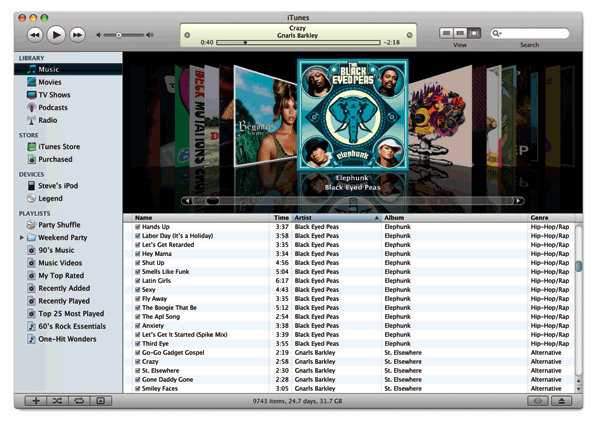
iTunes now account for 25% of all music sales in the US

iTunes now account for 25% of all music sales in the US

Just to prove how the digital revolution has caught the old guard, well, off guard, news broke that 25% of all music in the US are now sold through iTunes. While the majority of music are still sold in CD form through retail stores, 25% means that iTunes is the single biggest source of music sales in the US already. Now, had the music industry being brave enough to embrace digital, they would be the ones operating the big digital music stores, as opposed to making Apple rich. And had it not been the whole DRM debacle, digital music would have gained market share even faster. While it is unfortunate that I cannot say the industry in general has learned the lessons from misuse of DRM, in that most of them still believe DRM has a place, at least some are trying to address the biggest problem that DRM provides consumers – the inability to do what they want, legally, with these files. Marlin is a new DRM scheme that actually promotes sharing amongst family (and some friends), but it does so in a controlled manner where you (and the copyright holders) know exactly who is sharing your file at all times. But Marlin is still a DRM, and while you are now “allowed” within the scope of the DRM to do all the things you could have done with DRM-free files, the framework is still there to restrict your freedoms if and when the powers that be deem time to do so. To paraphrase Wendy Seltzer of the Berkman Center, DRM is like a maze, and while the old DRM was a maze with a single path that you had to follow, Marlin presents many paths, possibly all the paths you might be able to take legally: but it’s still a maze, and one that you have to hand over your rights as a consumer to enter.

Removing copyrighted videos from YouTube could be a thing of the past

Removing copyrighted videos from YouTube could be a thing of the past

Then there are those situations where nobody gets hurt, yet everyone suffers. One of which is YouTube video uploads. How many times has an enthusiastic user uploaded a video he or she has spent hours editing, finding the right background music and clips to include in the video, upload to YouTube and then had the video removed because it violated someone somewhere’s copyright. Or in the pursuit of the next meme or viral video, someone uploads a clip of something they captured from TV or a DVD – the positive effects of a video going viral are so great that companies now spend millions to professionally produce viral videos – but the home user produced video, which costs companies nothing, gets taken down and all that positive energy is lost. Some companies are only starting to get the fact that people using their material isn’t necessarily a bad thing – it used to be the case where only copyright abuse that actually hurt the copyright holders would get prosecuted, but the fear about digital now means any potential, possibly not even real, copyright abuse gets maximum attention, forcing websites like YouTube to take drastic action to filter out all sorts of content, many of which are perfectly legal (like the time when a TV network used a clip of this guy’s home video, and then when the guy uploaded the same video to YouTube, the video got removed due to a complaint from the very same TV network). But there is money to be made in online advertising, and YouTube is now starting to share revenue with content owners, if they decide to allow the “unauthorised” videos to remain online. YouTube gets a bit of the money because they’re hosting the promoting the videos, the uploader doesn’t get his or her ass sued and gets to keep the video online, and the copyright holders make the money. Doesn’t sound like a bad compromise to me, and who knows, maybe someday the copyright holders will start to appreciate all the free promotion they get from uploaders, and give them a free hat or something for their troubles.

High Definition

Onto HD news now. Nothing much happening, expect more analysis and analysis of analysis on the Toshiba move into Blu-ray. I’m going to link to one such analyst that came up with pretty much the same conclusion I did when I first heard the news, that Toshiba is doing this merely to promote their own anti-Blu-ray strategy.

64 GB SD cards already exceed Blu-ray's capacity, at a tiny fraction of the size

64 GB SD cards already exceed Blu-ray's capacity, at a tiny fraction of the size

Well, not so much anti-Blu-ray, as anything-but-Blu-ray, because you can see from the statements Toshiba has made, they still believe that Blu-ray isn’t going to be the one format the rules over all in the early part of this century, and that downloads, streaming and flash memory storage are the future. SD flash cards and USB drives are getting to a point where they equal small hard-drives from just a few years ago, and certainly will beat Blu-ray rewritables in terms of capcity, cost and simplicity. Digital video and still cameras all use SD, most do not use Blu-ray recordables. HDTV PVRs do not use Blu-ray. And even the Blu-ray people don’t want people to use Blu-ray, because it might lead to people making copies of Blu-ray movies through hacking their HDMI cable or something equally absurd. Flash storage is simply more convenient, and there needs to be someway for it to be used for movie distribution before insanely fast Internet connections become the normal to allow us to download a 50GB HD movie in a few minutes. There are many situations where you will still need optical storage, but for everyday use, it is already a bit outdated. Can you imagine using CDs and DVDs in place of your USB drive? No, neither can I.

And going back to what I mentioned above about digital music downloads taking over from CDs, the movement towards pure digital distribution is gaining momentum all the time.

Gaming

And finally in gaming, the big news of the week is of course the PS3 Slim and the PS3 price cut. It shall be known as the week when the collective gaming community yelled out all at the same time the words “finally”, as it heard about the PS3 price cut, and for once, the rumours turned out to be true about the PS3 Slim.

The PS3 Slim is finally here

The PS3 Slim is finally here

My first impressions? That the PS3 Slim didn’t look as good as I thought it would be. I think I got ruined by those fake pics of the silver PS3 Slims that have been around forever – the actual PS3 Slim is a big flat piece of black matte plastic, that looks a bit cheap, to be honest. And while it is definitely slimmer, only about half the height of the PS3 Fat, it’s actually deeper (longer in length) than the old PS3. At the very least, they should have used a glossy finish, and perhaps offer it in some new colours, like white (Wii, Apple) or a sexy red like a sports car. Who knows, maybe they will.

As for the price cut, that’s very much welcomed relief for the ailing PS3 sales, although at this point, sales will need to increase by 100% on current numbers in order to make Microsoft of Nintendo really nervous, much more than the predicted 40 to 60% sales increase.

And what of the response from the other gaming companies? Nintendo remains silent, but Microsoft is rumoured to drop the Xbox 360 Pro package and to price the Xbox 360 Elite at the same price point of $299 ($100 off). Will that work to negate the expected surge in PS3 sales? Probably not, but as someone who is looking to upgrade his Xbox 360 to a new one, it can’t hurt. I would still love to have  an Xbox 360 Slim, or at least an Xbox 360 Cool&Quiet – technology advances should allow Microsoft to do this without increasing costs (and possibly lower them as well), and if they are to stick true to their recently proclaimed 10 year strategy for the Xbox 360, then they need to this sooner rather than later to keep the nearly 4 year old platform alive and viable.

That’s all I have for you this week. More next week!

Movies, TV, Music & Gaming: Which is the best value?

Thursday, August 20th, 2009

I’m currently running a poll to see whether people spend more money on video gaming or movies. So far, the responses suggest that an equal number of people spend more on video gaming to people who spend more on movies, and the rest spend roughly the same.

This got me thinking: What is actually the best value in terms of entertainment gained from the money spent? The music industry has been crying about lost income and all that, but is music still the best value in terms of entertainment, or have people moved on to better (and cheaper) things?

A really non scientific approach to solving this problem would to be take typical prices for the following types of activities, and then estimate roughly the amount of hours each type of entertainment provides, and then work out the P/E ratio. It’s not the Price/Earnings ratio that’s way way too high on the S&P 500 at the moment, P/E in this case stands for Price/Entertainment, which is roughly how much it costs per hour of entertainment. Then to divide the activies more thoroughly, I separate movie DVDs to DVDs of TV series (which I believe should offer better bang for bucks), the same for Blu-ray, and then gaming is separated into good games (like Fallout 3, GTA IV) and the bad ones (Turning Point: Fall of Liberty). And finally, add in music for both iTunes/Amazon download and traditional CD purchases. These are the activities:

  • DVD (movies)
  • DVD (TV series)
  • Blu-ray (movies)
  • Blu-ray (TV series)
  • Gaming (bad game)
  • Gaming (good game)
  • Music (downloads)
  • Music (CDs)

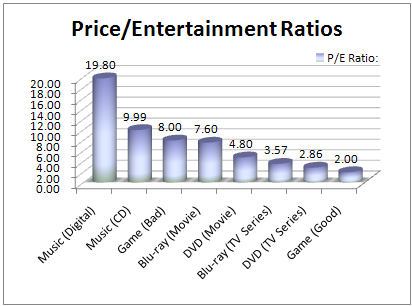
So let’s get straight to the results, and here they are in graph form (the lower the P/E, the better the value):

The Price/Entertainment Ratio Of These Popular Activities

The Price/Entertainment Ratio Of Movies, TV, Music and Gaming

I don’t think the results are all that of a surprise, with perhaps the only real surprise being how poor value music is compared to the other types of entertainment.

A good game, such as Fallout 3, World of Warcraft, GTA IV, will give you hours of enjoyment. Even if you don’t include multiplayer games, which has almost infinite re-playability, single player games and game campaigns still offer hours upon hours of enjoyment (GTA IV easily offers 30+ hours, especially if you do all the side missions – the same with Fallout 3). So a good game is the best value in terms of entertainment, even if games are quite a bit more expensive than your average DVD.

DVDs of TV series are the second best value in terms of entertainment, roughly equal to gaming. Now this figure can vary a lot, since some TV shows are in the 30 minute format, while others are in the hour format. And some shows have long series (20+ episodes), while others are short (10 episode). And the pricing varies too. But taking typical TV series of say 20+ one hour (42 minute) episodes plus extra features at a common price of say $40 on Amazon, then it will still represent very good value in terms of entertainment.

Blu-ray TV series is next, showing that Blu-ray prices have dropped recently to make it actually better value in many cases than movies on DVD, which is the 4th best value source of entertainment. It kind of make sense when you think about it because for $50, you can get maybe 15 hours of TV shows on Blu-ray, while for a fifth of that, you only get about 2 hours worth of movies on DVD. And with movies on Blu-ray a bit more expensive than the DVD version normally, it falls slightly behind movies on DVD in terms of value.

Now we get to the interesting bits. Bad games, such as  those with incredibly short single player campaigns (sometimes as short as 3 to 5 hours, for a quick play through), and no multiplayer. And then there are games that are just so bad, you don’t even want to finish them. These games are quite bad in value, and perhaps explains why gaming piracy is high as bad games outnumber good games by quite an impressive margin.

And speaking of piracy, we now move onto the last and the most expensive form of the listed types of entertainment: music. Music CDs are better value than downloads at the moment, you can usually source a CD for under $10 on Amazon, and this will give you a maximum of 72 minutes, but most are way short of this at around 40 to 50 minutes. $10 for an hour of entertainment is quite expensive in the grand scheme of things, and with almost no interactivity, it’s no wonder that piracy rates are so high. Then we have downloads, which at around $1 per song, is expensive. However, you can choose only the songs you enjoy by downloading them separately, as opposed to having to buy an CD album just because you want one song, so they may not work out to having twice the P/E ratio of CDs. However, $1 for usually just 3 minutes of entertainment doesn’t scream good value for me.

Of course, none of the above includes re-use. A piece of music you like you might listen to it hundreds of times over just a single year. And you might watch your favourite movies as a monthly event. And who hasn’t gone back to an old game just to play it through again (and the multiplayer, of course). There is also the cost to get started, because listening to music is cheap, while getting into Blu-ray or gaming may be much more expensive. And of course, music might mean more to you and may be more memorable than say a video game, and this effect cannot be tabulated and graphed. But based on a price comparison only for a single play-through, it’s clear that gaming and TV on DVDs are still the best value at the moment.

So what was the point of this blog? Not much, but I guess it just goes to show that instead of crying about piracy, the music industry needs to take a closer took and see if there’s a reason why profits are dropping. Maybe moving to a subscription model, or an unlimited downloads model, may be the only way to get those P/E ratios back down to acceptable levels.

Update:

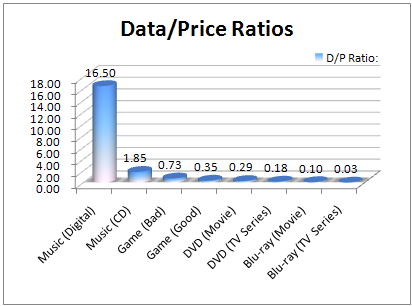
I thought it would be interesting to calculate the best value in a different way. Instead of using the price to determine value, I can use the size of the digital data versus the price per “bit” of data. This is an even sillier way to calculate value, but data size often corresponds to quality (in terms of video and audio, at least). Here’s the graph:

The Data/Price Ratio Of Movies, TV, Music and Gaming

The Data/Price Ratio Of Movies, TV, Music and Gaming

This type of calculation obviously favours Blu-ray, as HD content can be huge in size compared to their SD cousins, but the different in quality and entertainment does not share the same gulf. But DVDs still represents excellent value, as do good games. Here, bad games are also calculated to have good value, which just goes to prove that the number of DVDs that games occupy has nothing to do with how long the game actually last or how long you actually want to play the game. In the grand scheme of things, music CDs, because it uses no compression, doesn’t do too badly. But once again, digital music is way out there in terms of the relationship between pricing and data size. Which is why all-you-can-eat DRM-free music download services are a must to justify continued consumer spending on music – there are a lot of bad music out there, and the only way you can make people pay for it is if they are so cheap, that it’s worth the trouble. At the very least, making ultra high quality lossless downloads should at least increase the data size, the audio quality, if not exactly the amount of entertainment a song download provides.

Weekly News Roundup (16 August 2009)

Sunday, August 16th, 2009

I was going to apologise for this incredibly late WNR, but it turned out that I managed to get it done in time. Combinations of factors led me to believe that I wouldn’t be able to get this issue out in time, mostly due to my throat infection. 2009 hasn’t been a good year for me health wise, has it? The other reason is the odd bouts of electricity blackout that’s been happening around here due to the high winds overnight. Luckily, I have an UPS, and thanks to WordPress’s auto-save feature, at least I haven’t had to re-write passages of this WNR lost during the blackouts.

Some site related bit and pieces before we get to the WNR proper. In cooperation with Womble, I’ve launched a new Womble software sub-forum, in an effort to offer more support for their software. To go along with the new forum, I’ve also written a new guide on how to use Womble MPEG Video Wizard to make basic MPEG video edits. Having using MVW for a while, it’s a very handy piece of software and unlike many other pieces of software I’ve tried, it’s actually pretty quick, no bloat, and very stable.

The July 2009 US video games sales NPD analysis has been posted as well. And in case you’re wondering why being sick allowed me to write a guide *and* a blog post all in one week (I know, this sounds like way too much work compared to what I normally produce in a week), I only became violently ill several hours after posting the analysis. And no, the poor video game sales figures wasn’t the reason why I became sick. Anyway, onto the WNR.

Copyright

Copyright news first. The New Zealand wing of the MPAA has urged the government to side step due process and hand down Internet bans as quickly as they can print out the banning order pre-made using MS Word templates or something even faster. Just another day in our bizzaro world where expediency in protecting billion dollar companies comes before justice and liberty. But then again justice and liberty don’t make monetary contributions to politicians.

The Pirate Party UK is launched, just as the UK government plans to crackdown on piracy

The Pirate Party UK is launched, just as the UK government plans to crackdown on piracy

Not too far away here in Australia, the government, possibly also acting under orders, I mean suggestions, from the music and movie lobby is trying to introduce a bill that will allow ISPs to spy on customers for copyright holders. The government says that’s not what the bill is intended for (it’s for terrorism, just like every law made since 2001), but that makes things even worse because that’s the government basically saying they’re coming up with a law in which they don’t know the full consequences of (or just don’t care). The bill, if passed in December, will make the US DMCA and the French three-strikes system seem restrained, almost anti-copyright, by comparison. The UK government is also planning on it’s own piracy crackdown, to label up to 7 million of it’s own citizens are criminals because they’ve downloaded some pirated stuff (or at least the copyright owners say so, but an IP address is hardly unique nor tamper proof). But at least the UK is getting it’s own Pirate Party, which if the government crackdown continues, could gain popularity very quickly.

Onto this week’s court actions. And there’s been lots happening, all bad news of course. Real Networks, defending it’s RealDVD software which adds more DRM to existing DVDs (but you do get to play it back on your computer without the disc), has suffered the first setback as the judge extended or continued the injuction currently placed on sale of the software. It just means that a full jury verdict will have to be handed down before the future of RealDVD is settled, and that the judge saw that the MPAA had enough evidence to proceed to trial. In the same week,  there was another victory in court again innovation to protect the hardly working DVD DRM, known as CSS. The company at the center of the trial, Kaleidescape, originally won a trial that declared it’s hard-disk based DVD playback system completely legal (the system also plays DVDs without the original disc, and also adds more DRM to prevent unauthorised copying), has now lost an appeal that the DVD CCA bought forth against the original verdict. So that’s basically two products, one software and one hardware, neither of which defeats or circumvents the DVD CSS system, and I would be willing to bet that no one in their right mind has ever used to illegally copy DVDs (because RealDVD is not what people use to rip DVDs on computers, and people who can afford the multi-thousand dollar Kaleidescape system usually buy their movies) – but both may be deemed illegal just because the copyright holders don’t like innovation (or may even be coming up with their own products like managed copy, and these competitors are standing in their way).

And of course, piracy goes on, gains more popularity, while the lawyers, like the ones suing 10,000 South Koreans for sharing pirated porn, get richer. The US DOJ has also made a statement on the obscene $1.92 million damages handed down against a single mother Jammie Thomas-Rasset, saying that in their opinion, it’s perfectly constitutional. This is the same DOJ whose associate deputy attorney general was one of the lawyers representing the RIAA in Thomas-Rasset case, and loaded with many other ex-RIAA lawyers. You would at least understand the music and movie industry’s actions if they were working, but they are not, and may in fact be encouraging more people to pirates music and movies. I’ve always said the best way to combat piracy is to provide legitimate alternatives, and a recent study of UK youngsters seem to back up this opinion. The survey found that people want to pay for music, but only if it doesn’t have DRM, and is based on a subscription based “all you can eat” model, with a monthly fee and unlimited downloads (or some reasonable limits). 85% of those surveyed were willing to pay for this service, and 40% said that they would stop pirating altogether if such a service existed. And yet all we see are more lawsuits aimed at the very same people who are willing to pay, all because copyright holders are afraid of change.

High Definition

In HD news, Toshiba has finally confirmed what has been rumoured for a while, that they will get into the Blu-ray business. It was also unlikely that Toshiba would not produce a Blu-ray player when their target is to gain a foothold in the home electronics market, as well as their active participation in the laptop arena. However, they also (perhaps bitterly) referred to Blu-ray as only a small part of their HD strategy, one that also covers SD (flash memory) distribution and downloads. Toshiba’s first Blu-ray players might be here this year (probably next year though), and I wouldn’t be surprised to see it have both SD playback and streaming capabilities (as well as outstanding DVD upscaling thanks to the Cell powered machines).

Gaming

Not much happening in gaming, except that Sony will probably officially announce a price cut and the new PS3 Slim anytime now. Or not. But if this turns out to be a hoax, then it’s one of the best staged ones I can remember, so I’m putting my money on the rumours being real.

The PS3 Slim could be confirmed by Sony by the time you read this

The PS3 Slim could be confirmed by Sony by the time you read this

If you’ve read my July 2009 NPD analysis, you’ll know how badly Sony is struggling at the moment, with the PS3 barely outselling the PS2, which itself has dropped massively in sales over the last year. While the Wii hasn’t done much better in July either, the Xbox 360 continued strong sales (or rather, not-as-weak-as-the-others sales). So a price cut, and a new SKU, may be exactly what Sony needs and while I don’t really think a new SKU is necessary considering how much more “cooler” the PS3 already is compared to the Xbox 360, the price cut if key here (and if the slim model was the only reason the price cut was possible, then you do wonder why there isn’t a Xbox 360 Slim, as Microsoft needs a cooler console, in more than one sense of the word, than Sony).

The fall in Wii sales may suggest either saturation has been reached, or that a price cut may also be needed for it to remain competitive (it is still the only console to not have had a price cut or more added features since launch).

That’s it for this week. Back to bed rest for me until I recover from this nasty infection. See you next week.