Archive for the ‘High Definition (Blu-ray/HD DVD/4K)’ Category

Weekly News Roundup (21 December 2014)

Sunday, December 21st, 2014

Going for a really short one this week, since I’ve just come back from a full day out and for some reason, this WNR remains unwritten (probably because I’ve not written it).


Copyright

The Pirate Bay

The Pirate Bay may have been sunk, but pirates have not be deterred

So The Pirate Bay remains down, perhaps forever. If it stays down, then it will something that rights holders have wanted for a very long time. Or is it? According to the latest piracy stats, piracy remains eerily steady following TPB closure, with a small drop, and then almost back to where it was immediately.

There may be many reasons why closing the world’s biggest piracy website seems to have had no effect on piracy. The fact that there are many other major torrent sites, like isoHunt and KickassTorrents, still operating normally may have something to do with it. The numerous TPB mirror sites that have been set up since its (temporary?) demise, including one opened by isoHunt (which itself is a re-launch of the shuttered original isoHunt), have also helped to keep torrent traffic high.

And even if the piracy rate drops, there’s no guarantee this will actually lead to any noticeable financial benefits for rights holders. I mean, that’s the point of anti-piracy, right?

——

Keurig 2.0

Sticky tape defeats DRM (and not for the first time either)

A couple of quick story roundups. Remember the DRM protected coffee pod? The DRM has been broken, and anyone can do it with scissors and sticky tape. Apparently, the DRM only consists of a special ink placed on official pods, with the machine featuring an ink reader to authenticate the pods. Cut out the part with the ink from a used official pod, secure it over the ink reader with tape, and now all unofficial third-party pods will work. Doesn’t really get any easier than this, does it?

The next couple of stories are all related to the Sony Pictures hack (what isn’t, these days). We start with leaked information showing the MPAA’s plans to destroy the Internet’s naming back bone, the DNS (Domain Name System). DNS works because every other DNS mirror in the world shares and distributes the same set of data, essentially. The MPAA however wants certain ISPs to start messing around with DNS filtering, which could lead some DNS servers having vastly different data than others, thus breaking how the naming system syncs and refreshes itself all around the world.

This is all part of the MPAA’s plans to revive hugely controversial parts of SOPA, not by legislation, but through other means. These other means are explained by Google in a new blog post, where the search giant (who recently ended all cooperation with the MPAA, again due to information gleamed from the leaked data) accused the MPAA of heading a witch hunt, which included lobbying state attorneys general and building legal cases, against the company.

This particular feud could get nasty.

High Definition

Blu-ray Revenue Growth - January 2010 to December 2014

Blu-ray revenue has hardly grown over the last year, and may have actually declined

I finally took the time to summarise recent Blu-ray sales for my annual(ish) Blu-ray: The State of Play feature, and I was quite surprised at how poorly Blu-ray has done over the last year and a bit. While declining DVD sales are expected, for Blu-ray revenue to decline, that’s infinitely more worrying for the good old physical disc (2014 total sales so far, with a couple of more weeks left, are down 5.8%, or around $115 million. Now, the final couple of weeks for any year (stats for which will be available by the middle of January) are always the biggest, and it isn’t inconceivable that these few weeks will help Blu-ray sales prevent a year-on-year decline, but 2013’s final few weeks were also big (record breaking, in fact).

Even if Blu-ray sales can make a recovery in the last few weeks of 2014, there’s one stat that doesn’t lie. Of the 49 weeks that have been tabulated so far, only 17 of these had a Blu-ray revenue figure that was higher than the same week in 2013. This is the exact opposite situation to last year (for the first 49 weeks), where only 17 weeks recorded a lower revenue figure than the same week from the year before (and the year before had the exact same breakdown).

A poorer new release slate, fewer “first time on Blu-ray” catalog title releases and the rise of digital could all be responsible, but if this is a trend (and it’s a big ‘if’), then this could be the beginning of the end for physical media as we know it.


Gaming

White Xbox One

$50 price cut for the Xbox One has revitalised the console

While Blu-ray is down, the Xbox One is up, at least for November. It appears the stats collected by shopping insights firm Infoscout were right: the Xbox One won Black Friday, and November, not only in the US and also in the UK.

The win comes after aggressive pricing by Microsoft, with discounts starting at $50 and up to $150 for bundles. And this is all after Microsoft dropped the Xbox One bundle price by $100 earlier in the year to match the PS4’s price, when they removed Kinect and changed it to an “accessory” status (as opposed to a mandatory add-on).

It seems that if Microsoft want to get back into the game, keeping the Xbox One cheaper than the PS4 is the way to go. With that said, Sony hasn’t been sitting idle either, with the PS4 getting some fairly aggressive price cuts for the holidays too. All of this is great for gamers of course.

——

That’s it for this slightly abridged version of the WNR. See you next week (maybe, assuming there are stories to cover, which isn’t always true given it’s Christmas and all), and Merry Christmas.

Blu-ray: The State of Play – December 2014

Friday, December 19th, 2014

Welcome to another edition of our annual Blu-ray sales analysis, even if this one is extremely late. My justification is that I wanted to make this more of a year-on-year comparison (so the whole of 2013 vs whole of 2014), as opposed to doing one in May (May being the first month that I’ve been keeping regular stats for Blu-ray sales). So this “State of Play” report is slightly different to ones in the past, and concentrates more on 2014’s results versus that of 2013.

Note that the last couple of weeks for 2014 is still missing, and so an update to this post will be made when these results come in, sometime during the middle of January.

The data used in this analysis derives from our weekly updates, based on figures released by Home Media Magazine. Some of the historical figures you’ll see have also been adjusted, due to slight tweaking of the metrics used by HMM to create these sets of data, although the changes have been very subtle and does not change the bigger picture in any way.

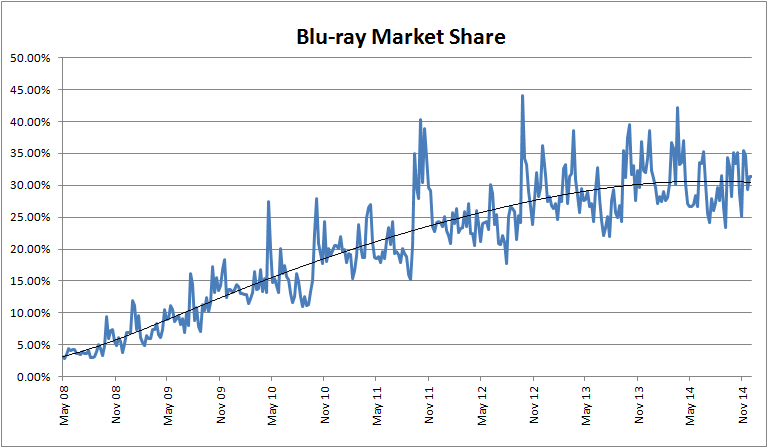
As per usual, this first set of graphs show Blu-ray market share (Blu-ray and combo market share as a percentage of all disc sales) through the six year period that I have tracked them, with the release milestones pointed out.

Blu-ray Sales Percentage - 4 May 2008 to 6 December 2014

Blu-ray Sales Percentage – 4 May 2008 to 6 December 2014 – Click to see larger version

As the graph is getting perhaps a bit too wide, here’s a condensed version that allows you to see Blu-ray’s market share rise more clearly.

Blu-ray Market Share - 4 May 2008 to 6 December 2014

Blu-ray Market Share – 4 May 2008 to 6 December 2014

It’s interesting to look at the most recent additions to the “milestones”, or new releases that had a profound impact on Blu-ray weekly revenue or market share. There were many, but that’s mostly due to the extended period we’re covering in this report, but when you consider that the peak weekly Blu-ray market share has not been broken in all this time, and that the record remains with the week The Avengers was released back in September of 2012 (44.10%, re-adjusted), you can sort of start to come to a conclusion that Blu-ray’s growth has stagnated. The closest week to breaking the record came in the week that Frozen was released (42.16%), undoubtedly the biggest Blu-ray release in the year and a half covered by this analysis. The up and down nature of the weekly results show that market share, like revenue, is very much release dependent. A good “A-lister” this week or a Blu-ray exclusive can get market share and revenue rising fast, but a slow week, and it goes down again. But the rising trend is clear, especially in the second graph above.

We noted in the last State of Play report for the above graph that the “trendline just breaks above the 30% mark at the end of April 2013, and that’s probably a fair reflection of where Blu-ray market share is, or will be soon enough.” Looking at the trendline above, it is still just barely above 30%, although this will edge up a bit when the end of the year’s bumper week’s sales data are added. Amazingly, the average weekly Blu-ray market share figure was exactly 30.00% for the 85 weeks covered by this report, up from the 27.47% (re-adjusted) average weekly market share recorded from the last report period (April 2012 to April 2013). The 4-6% annual increase, seen previously, appears to be slowing down.

In the last report, I stated that:

It’s worth noting that Blu-ray’s rising market share has as much to do with DVD’s decline as it has to do with actual rise in Blu-ray sales, probably more so. The rise in spending in digital streaming and downloading is one of the major factors in the decline of DVD sales, in addition to the rising popularity of Blu-ray.

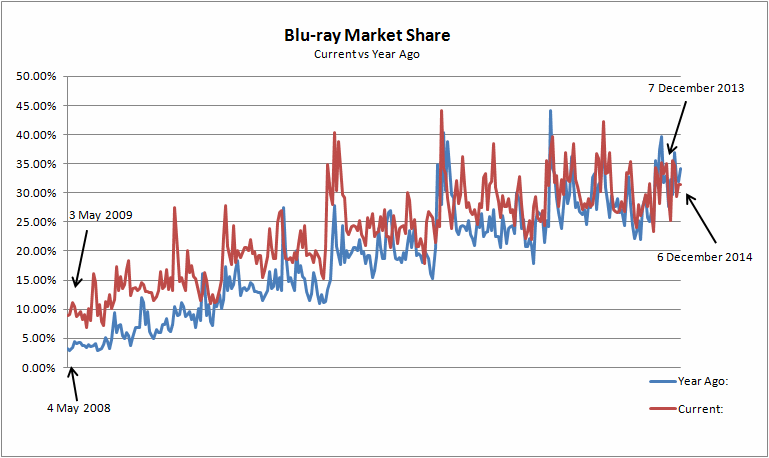
This is still very much true, although as you will slowly realise when you read the rest of this report, the rise of digital may now be having an effect on Blu-ray sales too. Here’s a graph plotting the current weekly market share (red) compared to the same week a year ago (blue):

Blu-ray Sales Market Share: 2008/12 versus 2009/14 Comparison

Blu-ray Sales Market Share: 2008/12 versus 2009/14 Comparison

The gap between the red line and the blue line above shows how much market share has jumped in that week compared to the same week a year ago. You’ll notice that towards the end of the graph, the two lines are getting closer and closer. In fact, the blue line is often above the red line for many of the weeks (ie. Blu-ray weekly market share has actually shrunk compared to a year ago). In other words, the growth in Blu-ray’s market share has slowed and even reversed in some cases. Obviously, this has to do with the caliber of weekly releases, but another take could be that whatever was causing DVD revenue to decline has stopped or slowed, or that the same factor is now causing Blu-ray revenue to decline or to remain steady. I believe digital is the factor here.

Let’s take a closer look at Blu-ray revenue for the same period.

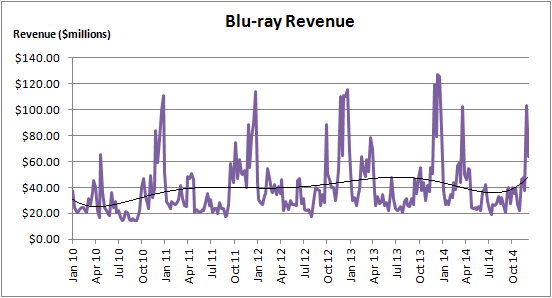
Blu-ray Revenue Growth - January 2010 to December 2014

Blu-ray Revenue Growth – January 2010 to December 2014

The graph above clearly shows that Blu-ray revenue peaks during the holiday sales period (of which we are still missing 2014’s, as obviously, it hasn’t finished yet. But there is a worrying dip between April and October of 2014, a dip that’s slightly lower than the same time from 2013.

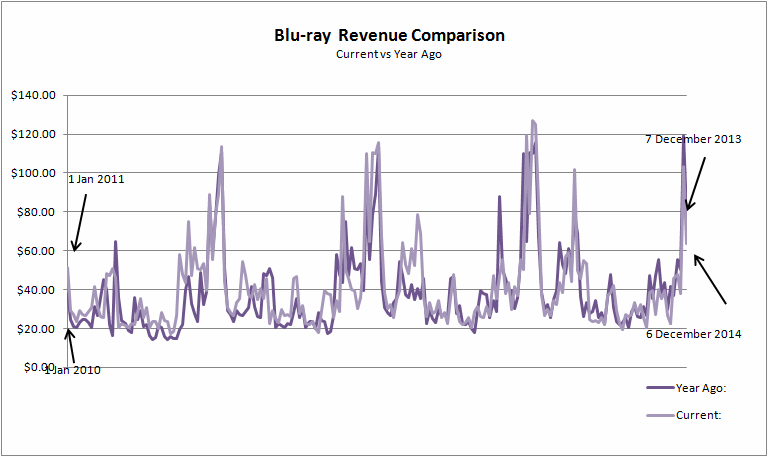
Blu-ray Sales Revenue: 2010/13 versus 2011/14 Comparison

Blu-ray Sales Revenue: 2010/13 versus 2011/14 Comparison

The same trend is visible in the graph above. Just like with the market share graph further above, this comparison graph compares each week’s Blu-ray revenue with that from a year ago. The normal situation should see the lighter purple line always above the darker line (as this indicates Blu-ray revenue growth), but look at the 2014 period on the graph, and you will see quite a few times where the darker line is above the lighter line (indicating Blu-ray revenue has fallen). The overall trend is that Blu-ray revenue growth has stagnated, or even fallen from week-to-week, during 2014.

Now let’s take a closer look at the comparison between calendar 2013 and 2014 (so far).

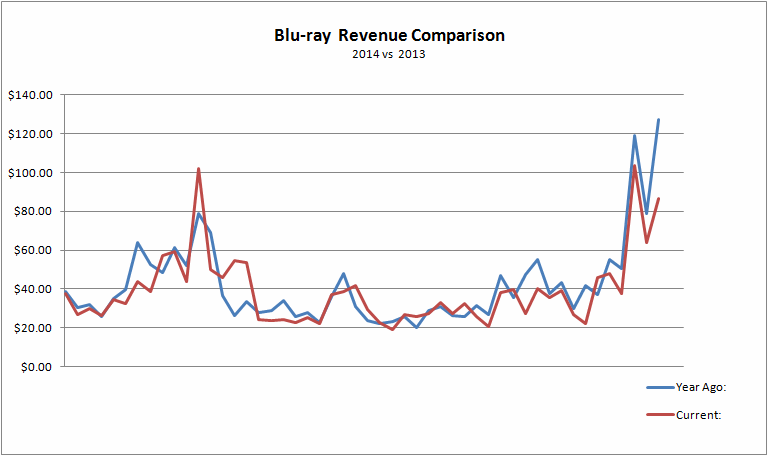
Blu-ray Sales Revenue: 2013 vs 2014 Comparison

Blu-ray Sales Revenue: 2013 vs 2014 Comparison

The relatively poor results in 2014 can be seen much clearer in the above graph, with many weeks in 2014 being lower in revenue than the same weeks in 2013. Obviously each week’s releases ultimately determine market share and revenue, but it’s hard to ignore a trend that has been fairly consistent over an entire year. (Update: the graph above and below have both been updated to include data from the rest of 2014)

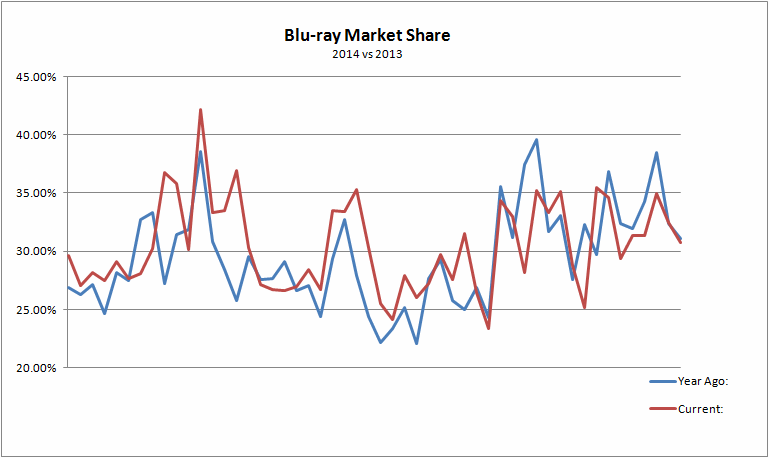
Blu-ray Sales Market Share: 2013 vs 2014 Comparison

Blu-ray Sales Market Share: 2013 vs 2014 Comparison

The same trend is there, but less pronounced for market share, although the problem appears to be worse for the last couple of months (this could be due to a strong release slate during this time in 2013 and/or a weaker release slate for the same period in 2014).

Looking at the raw numbers, this is where things become a lot more clearer. Out of the 52 weeks for 2014, 35 of them had the weekly revenue lower than the same week in 2013. Only 17 weeks recorded a revenue result that was higher than the same week in 2013. The situation is completely reversed when you look at 2012 vs 2013 results, where 35 week had higher revenue compared to 17 weeks with lower. Looking at total sales though, 2014’s Blu-ray sales total has declined compared to 2013, $2.122 billion versus $2.306 billion. This is the first year-on-year decline since Blu-ray’s launch in 2006 (the above information has been updated to include the rest of the weeks for 2014)

Conclusion:

To sum up:

  • Blu-ray market share is growing, but at a much slower rate than the past few years
  • Frozen was the top seller in the last year and a half, but failed to beat the weekly market share record set by The Avengers in 2012
  • Blu-ray revenue has declined from 2013 to 2014.

Although we still have a couple of (big) weeks to go, unless these prove to be exceptional and record breaking, it does look like 2014, at best, would be a year where Blu-ray growth stalled. Blu-ray revenue may even be in decline, but its market share is still growing slightly thanks to DVD’s faster decline.

Update: Now that data for the rest of 2014 is available, Blu-ray revenue did indeed record a year on year decline, the first since the format’s inception. Now, the falling average price of Blu-ray titles will be a contributing factor to the overall revenue decline (so a situation where more discs are sold, but each are cheaper, may exist), but for a format that has marked steady growth year after year, this year’s decline is still very much a notable event.

As for the other reasons for 2014’s lackluster Blu-ray results, most data support the growth of digital as being the catalyst for disc’s fall. Or it could be the releases themselves that are to blame, although a 2014 line-up that includes ‘Frozen’, ‘The Hunger Games: Catching Fire’, ‘Thor: The Dark World’, ‘Maleficent’, ‘The Lego Movie’ and ‘The Hobbit: The Desolation of Smaug’, doesn’t sound like such a poor year. There is no doubt about it – 2014 is the year that Blu-ray went backwards.

Weekly News Roundup (16 November 2014)

Sunday, November 16th, 2014

Just came back from watching Interstellar at the cinema. Say what you want about the plot (holes), but it’s a fascinating look at astrophysics, provides a stark reality check on the fragility of our blue planet, has a killer soundtrack by Hans Zimmer, and gets the “no sound in space” aspect absolutely correct. What else do you want? Speaking of no sound in space, that was one thing that the other space blockbuster of recent times, Gravity, didn’t get quite right. At least not until you watch the “Silent Space” version of the film.

The latest movie session partially explains why this WNR is a bit late compared to normal. But better late than never, right? RIGHT?

Copyright

Spotify

Spotify – don’t compare it to iTunes, but think of it as a “bonus” compared to piracy, and a new form of radio

Spotify’s business model has come under attack recently following the decision by Taylor Swift’s music label to withdraw all of her music from the streaming platform. This week, Spotify’s CEO launched an impassioned defence of the streaming service, and busted some of the myths that the music industry likes to lob towards the popular music discovery platform.

CEO Daniel Ek revealed several interesting facts about Spotify, including the fact that a top performing artist like Taylor Swift could earn anywhere up to $6 million per year from Spotify users streaming her songs. When you consider the total number of listens of her songs, the $6 million may seem like a small amount – and the same number of listens, if “converted” to purchases, would yield a much larger figure – but as Ek points out, this is where the major flaw in the argument (against Spotify) is formed. You see, as Ek argues and I agree, Spotify is not an iTunes. So you cannot compare the number of listens on Spotify with the number of purchases on a digital store like iTunes. Instead, Spotify is the legal alternative to piracy, and the 21st century answer to the radio. Piracy makes no money for artists and labels (yes, not even the “measly” $6 million per year), and so whatever Spotify earns is just a bonus (and this is the only way to look at Spotify’s royalty payments).

As for radio, a huge number of people get to listen to top hits on it for free, and labels are perfectly happy with it because it’s a promotional tool (and like Spotify, it is also supported by ads). The big difference between Spotify and radio though is that radio doesn’t make any money for the artist. As I’m not an expert on the music industry, I cannot confirm the relationship between labels and radio stations, but I suspect that the role of labels in getting music on air, compared to getting a track listed on Spotify, has some significant differences. Differences that may make labels feel they no longer have the type of control they want, or that they are as essential as they once were. Something to think about …

——

WhereToWatch.com

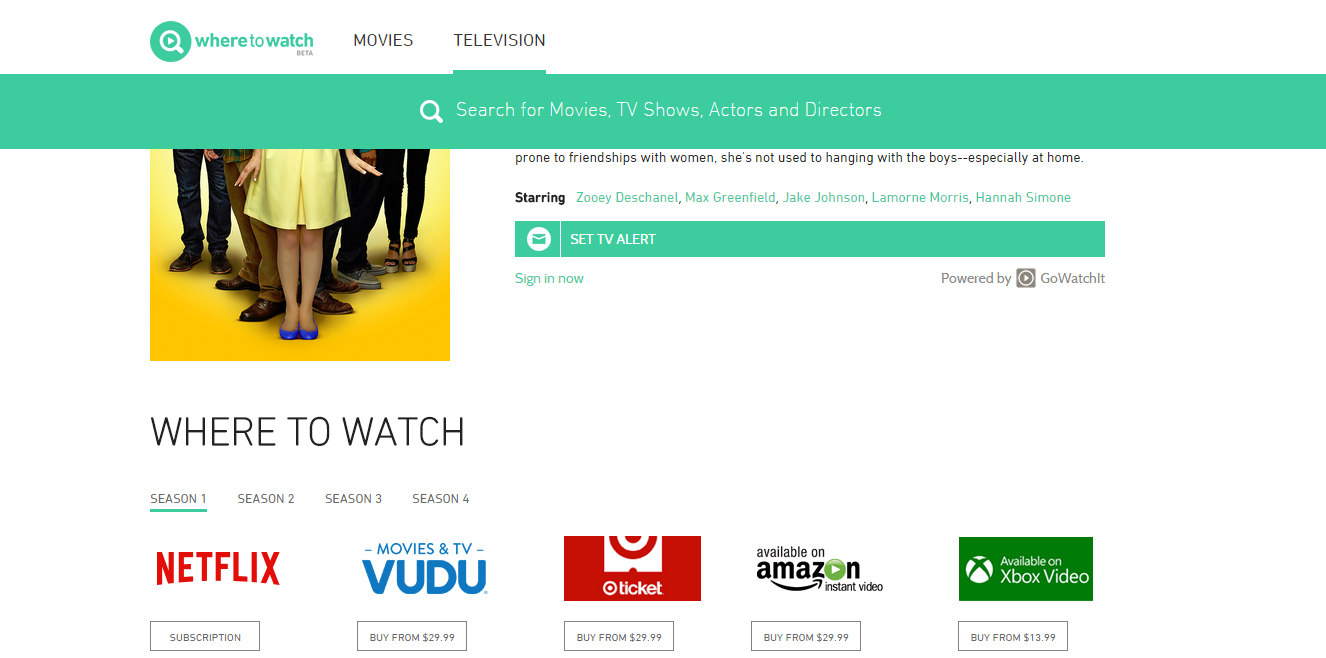
WhereToWatch.com allows you to search Netflix, Hulu and other digital services for the shows and movies you want to watch

Has the MPAA actually done something useful for once? I refer to the newly redesigned WhereToWatch.com website, owned and operated by the MPAA as a way to let people know that piracy isn’t the only option (although when the other options are overpriced proprietary digital options that don’t  have interoperability, maybe it’s not the lack of options, but the lack of viable options, that is the problem here). Whereas the old WhereToWatch website was simply a single page with links to sites like Netflix and Hulu (ie. a pretty much useless site), the new one now allows users to search for any movie or TV show, and then the site will tell you all the legal digital options for said content. TV shows can be searched by season as well, and even movies that are still in theaters are in the database. Users can also set an email alert to get notified whenever new viewing options are added for a title, such as when a title finally makes it onto Netflix.

What’s kind of interesting and useful about the site is that, finally, you now have an “official-ish” search engines for Netflix, Hulu Plus and other digital services (there has been sites like this before, but many have shut down due to lack of official and up-to-date data – I’m assuming this MPAA run website does have deals in place with the relevant digital services to receive accurate data). What is also obvious is that the website is clearly still in beta, and that there are certain annoying quirks that still exists (such as some titles having two Netflix listings, possibly one for the disc rental subscription option, the other for the streaming option – this is why Game of Thrones is listed as being available on Netflix, even though it’s clearly not on Netflix streaming).

But as useful as the site may be for US visitors, there’s no regional versions of the website for other key markets, like the UK or Australia. Legal options have always been plenty for those in the US, but that’s not usually the case elsewhere. The same website made for the Australian market, for example, would produce very different results when people do a search, showing far fewer legal options, or no options at all for many titles.

High Definition

Redbox Kiosk

Discs on the slide: Redbox also starting to lose its shine?

The increasing prevalence of digital viewing options may also be eating into disc sales, according to the latest figures from the DEG: The Digital Entertainment Group. With many digital options now delivering HD (and sometimes 4K) using ever more efficient methods, Blu-ray sales, while still growing, may finally come under some pressure from these digital options. The same digital options that have already taken over a sizable chunk of DVD sales.

In summary, Blu-ray sales are partially offsetting losses from DVD sales, which is down due to the increasing popularity of Blu-ray and also of digital options like Netflix and iTunes. Digital sell-throughs (eg. iTunes) continue to grow, but are still a very small portion of the sales pie. Subscription VOD (eg. Netflix) continues to grow at a fast pace too. Disc rentals continue their slide into oblivion, and not just retail stores like the now defunct Blockbuster, but kiosk based rental (like Redbox) is also starting to fall. Despite these changes, total revenue remains relatively steady thanks to one growing segment offsetting losses from another. Whether this will continue, or will losses grow bigger than gains (or vice versa), it’s hard to tell at the moment.

Gaming

Two DRM related gaming news this week, Sony may be about to get into an incestuous relationship with Microsoft on the DRM front of all things. A Sony job listing is calling for someone familar with Microsoft’s PlayReady DRM to work on projects related to all of the PlayStation consoles, including the PS4.

PC fans eagerly and patiently awaiting their GTA V fix can breathe a sigh of relief, maybe. The PC version of GTA V was rumored earlier in the week to include a new form of DRM (on top of the Steam DRM) called Denuvo. But just a day later, the co-founder of Denuvo refuted the claims that GTA V will feature his company’s DRM. The original “story” was based on a rumor posted on a forum, and by the rather vague listing of Rockstar as being a user of Denuvo. The subsequent story may not be verified either. So I guess we’ll find out on January 27, when the PC version of GTA V, with the most excellent first person mode, is released.

——

That’s it for this week’s edition of the WNR. See you in a week’s time!

Weekly News Roundup (9 November 2014)

Sunday, November 9th, 2014

Am I the only one who got pretty excited about the GTA V first person experience video? GTA V has always been a third person game, but adding a first person mode might elevate the game to a whole new level. I’m not sure the driving elements would be improved by a first person mode, but it would definitely make the shooting parts a whole new experience, and could make it rival other more well known FPS games. One more piece of evidence that the PS4/XB1/PC version of the game is going to be awesome.

Let’s get started with this week’s WNR.

Copyright

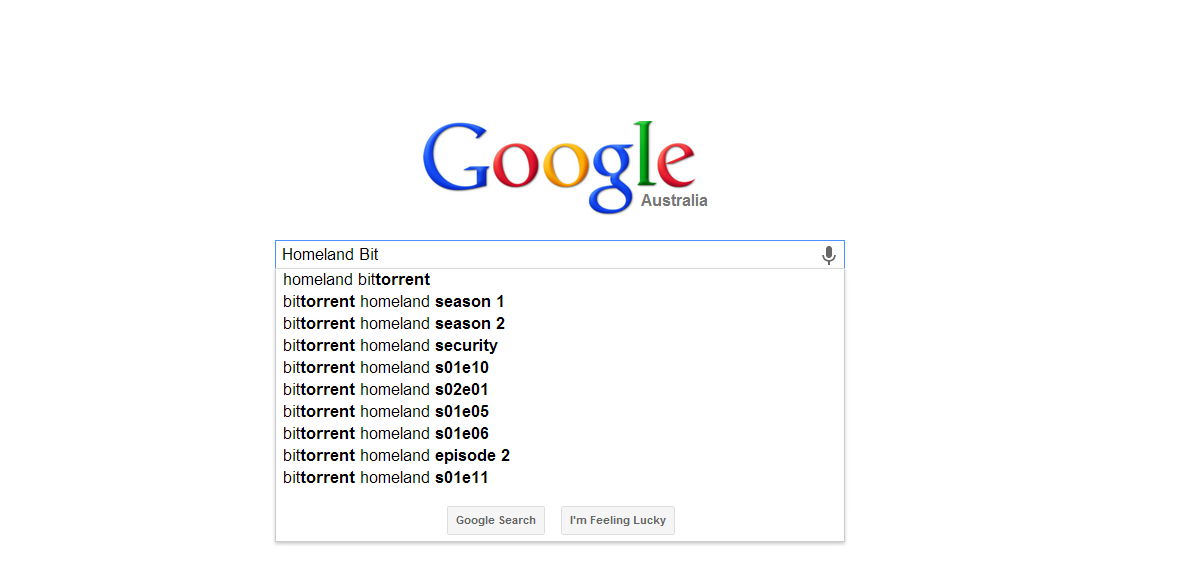
Google Auto-complete BitTorrent

Will Hollywood take on Google by making their own “piracy-free” search engine?

If you can’t change them, erm, beat them? Could movie studios, tired of demanding Google “do the right thing” and start censoring its own search results for other’s commercial interests, start their own search engine instead? Disney’s latest patent seems to suggest so, although patents being what they are, it could all be fairly meaningless. Still, even if the studios had plans to launch their own search engine, who would actually use it? Especially when, based on the patent filings, the search engine will demote not only piracy sites, but also sites that aren’t owned by the studios themselves (including the IMDb and Wikipedia). It all seems a bit silly to me, but again a patent application could just be one of those things that you throw out there in the small chance that one day you might get something back from it, not a sign of any real intent to take on the likes of Google and, erm, Bing, I guess. Okay, I admit, they may have a shot at beating Bing, but you know, still kinda pointless.

——

It’s that time of the year again and the EFF has filed submissions for DMCA exemption, specifically exemptions for certain cases where removing DRM would, under current laws, be illegal. Yet all these cases would still fall under fair use. This conundrum comes via the fact that the DMCA has a specific clause that outlaws all DRM circumvention, regardless of whether it falls under fair use or not. This means the EFF and other groups like it have to apply for exemptions every year (since these exemptions expire), or otherwise the DMCA could be used to strip away consumer fair use rights by corporations intent on controlling everything.

New this year is in-car software and the DRM that comes along with that. If used maliciously, in-car DRM could prevent non authorised repair and modification, thus locking car owners to service centers owned by the car manufacturer or dealer.

Public Knowledge - "Legal DVD Ripping" alternative

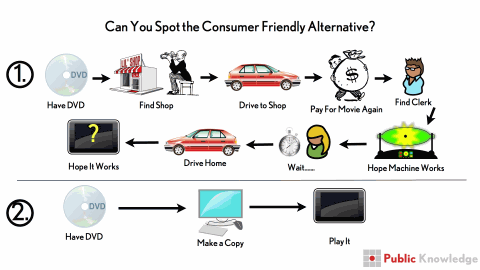
Can the EFF succeed in making DVD and Blu-ray ripping legal?

The EFF also wants gamers to be able to hack old and abandoned games to make them playable, even if it means removing copyright protection. Games that require online interaction, for example, might need to be hacked to point to new unofficial servers to keep the game going, when the publisher has given up on it already.

While these two exemptions might be granted, there are a few submissions that are more pie-in-the-sky. Like the attempt to make DVD and Blu-ray ripping legal, or allowing the DRM of streaming service like Netflix to be circumvented. Don’t think this is going to happen, not if the MPAA has anything to say about it (and they do, via their own submissions).

But you never know, and I wish the EFF luck in their pursuit of (consumer) freedom.

While the EFF’s (and the MPAA’s) actions on changes to the DMCA are mostly public, what’s not so public are the MPAA’s lobbying efforts on lawmakers in Washington. While the law calls on the MPAA and other groups to disclose the general topics of their lobbying efforts, the exact nature and detail of their lobbying efforts do not have to be disclosed. But from the MPAA’s latest lobbying disclosure forms, we can see that they’ve been particularly busy trying talking to politicians on the issues of Net Neutrality and an Internet tax.

While we can’t actually confirm for sure the MPAA’s position on these issues, one can make quite an intelligent guess at just how the MPAA could benefit from these two issues. First for an Internet tax, the benefits are obvious, especially when you consider that the Internet tax is also sometimes known as a piracy tax. Imagine a tax of a dollar on every GB of data you download (regardless of whether the download was legal or not), with most of that money going to rights holders like the MPAA, could be a very easy way to get your claws into the new Net economy without actually having to innovate. All in the name of fighting piracy, of course.

As for Net Neutrality, imagine if ISPs were allowed to throttle down your BitTorrent traffic (or even Netflix), in favour of MPAA approved distribution methods like UltraViolet. Wouldn’t that be nice? And again, all in the name of fighting piracy, of course.

High Definition

Windows 10

Windows 10 will play MKV files and those encoded with HEVC natively

Windows 10 is set to be a lot more HD video friendly thanks to the announcement that it will have native MKV and HEVC support. Windows Media Player in Windows 10 will be able to handle these formats without the need to install third party codecs, which is a win for users, but perhaps more importantly, for the HEVC format (which seems to already have secured its status as the industry standard codec, despite HEVC downloads being relatively rare at the moment).

Those of us who want a little bit more control over just how we play our videos might still rely on codec packs, VLC, MPC-HC and other similar tools, but for many, being able to play a video without having to install anything will be very attractive.

Gaming

Nintendo’s upcoming new 3DS console, schedule to be released in 2015, will still be region-locked. But to be fair, Nintendo did offer a pretty good explanation as to why region-locking is still needed today. In short, it’s more to do with marketing, licensing and localisation. Now, you may not believe this excuse, but Nintendo did offer a glimpse of hope by acknowledging that region-free is good for the consumer, and also be a benefit to themselves. But until the aforementioned problems gets solved, the new 3DS remain region-locked.

The Xbox One is already getting a temporary $50 discount for the holidays, but a permanent discount may also be on the way once Microsoft moves from its APU from a 28nm process to a 20nm one. In other words, once Microsoft can reduce the sizes of its processor, it could also reduce power requirements, which also means reductions to heat management – all of this will eventually lead to a “Xbox One Slim”, which will probably be cheaper to manufacture and be more efficient at the same time.

With that said, Sony will be working on something similar as well. So it bodes well for gamers. Both the PS4 and Xbox One are terrific value already, so cheaper versions will be even better!

——

I think that’s it for this week. See you again soon.

Weekly News Roundup (12 October 2014)

Sunday, October 12th, 2014

Another short one this week, writing just before I head off to the cinemas to watch Gone Girl. I’ve read the book, so ready to be suitably disappointed. Spoiler alert: aliens took her!

Update-from-after-the-movie: Fairly satisfying movie to be honest, true to the book, but perhaps a bit boring if you already know what happens.

Copyright

FBI Anti-Piracy Warning

Don’t download pirate stuff if you want to become the next Agent Mulder

Want to work for the FBI? If you do, then you’d better stop pirating episodes of Game of Thrones. Those applying to become FBI interns have always had to be squeaky clean in terms of drug use and criminal activities, something that seems fairly obvious. But a recently added rule means that those wanting to be a G-Man or G-Woman will also have to prove they’ve never downloaded pirated content, or at least haven’t been caught doing so. Responses from potential applicants are also subject to a lie detector test, and so those that choose to lie about downloading The Sopranos and get caught could find themselves being viewed just as unfavorably by the FBI as Tony S! Or at the very least barred from ever joining the FBI. You’ve been warned.

Another warning, this time for those in the industry using piracy download stats to calculate losses: don’t do it! New research conducted by the APAS Laboratory shows that the way downloaders choose what CAM releases to download is very different to how people choose what movie to go and watch at the cinemas. It seems downloaders of CAM releases simply choose whichever one is most visible, and their choice has very little to do with the movie’s popularity or review ratings, which is traditionally how those paying for a ticket make their choice.

The paper concludes that because of this key difference, it would be very difficult to find any correlation between the number of pirated CAM downloads and potential losses at the box office because of the different method people use to choose a download/movie. It could be that people simply choose to download whatever is available, perhaps even deliberately downloading something they would otherwise not pay for, rather than choosing the one they most want to watch.

This perhaps explains why clamping down on piracy and even reducing the pirate rate doesn’t seem to have much of an effect on the box office!

High Definition

UltraViolet DRM

Will Amazon join the UltraViolet alliance?

UltraViolet and Amazon may be joining forces in a move that will surely shake up the digital video industry. Industry sources say DECE, the group managing UltraViolet and Amazon are in deep discussions over Amazon becoming an UltraViolet provider. What this means that in the future, you may be able to redeem your UltraViolet digital copies on Amazon, and that your existing UV collection may become accessible on Amazon’s instant video platform as well.

This won’t solve the issue where you have to counter-intuitively create two separate accounts, one to manage your UV collection and another to actually watch it, but at least with the latter, you can now use your existing Amazon account. It means that for most people, it will be one less account they have to create and manage, and with Amazon’s reach across devices, it will also make it easier to view your UV collection.

For Hollywood studios, this will be a big step towards their goal of limiting the influence of Apple in the digital video space, this being their main goal behind setting up UltraViolet in the first place.

——

See you next week!