Archive for the ‘Xbox 360, Xbox One’ Category

Game Consoles – September 2010 NPD Sales Figure Analysis

Tuesday, October 19th, 2010

I broke the bad news in the last Weekly News Roundup, that NPD will no longer be releasing unit sales figures publicly, which makes writing this analysis feature ever more difficult. But thanks to leaks, I am still able to present some kind of analysis this week, although with many figures missing. Still, it should be enough to paint a broad picture of the video gaming industry in the US for September 2010. All the figures are collected and calculated by NPD, but the posted figures are leaked by manufacturers and other analysts (the PS3 and Wii figures were released by Wedbush Morgan analyst Michael Pachter). PSP and DS figures were unavailable for this month.

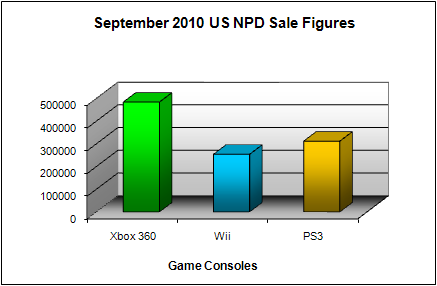
The figures for US sales in September 2010 are below, ranked in order of number of sales (September 2009 figures also shown, including percentage change):

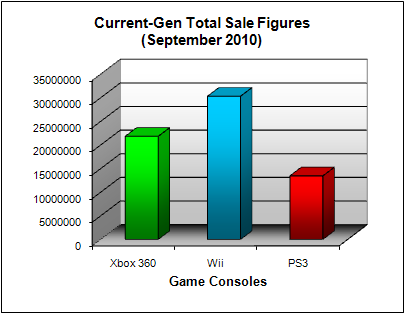
  • Xbox 360: 483,989 (Total: 21.8 million; September 2009: 352,600 – up 37%)
  • PS3: 312,000 (Total: 13.5 million; September 2009: 491,800 – down 37%)
  • Wii: 254,000  (Total: 30.3 million; September 2009: 462,800 – down 45%)
NPD September 2010 Game Console US Sales Figures
NPD September 2010 Game Console US Sales Figures

NPD Game Console Total US Sales Figures (as of September 2010)

NPD Game Console Total US Sales Figures (as of September 2010)

My prediction from last month was:

September = Halo Reach. That’s what next month will be all about. The fact is that, as I type, the top four items in Amazon’s Video Games section are all Halo Reach related (standard, limited, legendary editions, plus the 360 Halo Reach console bundle), just shows how dominant it will be in September’s figures. So expect the Xbox 360 to remain on the top of the console pile hardware wise too, and possibly the best month since, well, the last Halo release. Halo Reach will overshadow Sony’s launch of the Move unfortunately, although it’s doing well to just hang in around 10th, or just outside of it. The Sports Champions bundle should be counted in the software charts (in the same way Wii Fit Plus is in there), so it should be in the top 10 (especially when the top 3 will be condensed into a single entry for Halo Reach). It will be a very interesting month, I feel.

Heh, it really was an interesting month, although I definitely didn’t predict that NPD would stop releasing unit sales figures (although they had threatened to do so on many occasions before). But September was all about Halo Reach, that’s for certain, and thanks to it, Xbox 360 sales were up compared to the same time last year, the only console to record year-on-year growth. Not quite recording breaking sales figures for the Xbox 360, but it was the best month in 2010. And yes, it did overshadow Sony’s PlayStation Move, although it did well enough to help accessories sales to grow, despite Sports Champions either not in the top 10 or not counted as software.

To expand on the Xbox 360 figures, it had year-on-year growth of 37%. The timing of the Slim version of the console, and the console’s exclusive big hitter of the year, Halo Reach, couldn’t have been planned any better. And with Kinect going on sale soon, the next few months could all be about the Xbox 360, unless Sony or Nintendo pulls one out of the hat (ie. price cuts). It’s worth noting that the 37% year-on-year growth is on top of a 2% year-on-year growth experienced for the same month last year, so consistent growth is why the Xbox 360 is now looking pretty healthy indeed.

Many might be shocked to see the huge drop in sales for the PS3, but there is no concern. September 2009 was the first full month that included PS3 Slim and the price cut into the figures, and so comparing a year old SKU to a brand new and (at that time) recently discounted SKU, is not really fair (just like this time next year, the Xbox 360 year-on-year figures would probably show a decline, unless Kinect really takes off, and I mean to like earlier Wii levels).  And this is why I’ve always mentioned a caveat when talking about the huge year-on-year growth figures experienced in the last year, since we were not comparing apples to apples, but rather cheap slims to expensive fats, and that if you look at sales figures from two years ago, sales figures aren’t up by a huge percent normally. Which is why, despite the year-on-year sales drop, the PS3 actually had a good month and was up 34% compared to two years ago (very much comparable to the Xbox 360’s 39%, when comparing the same period). And this is why it took second place, ahead of the Wii. Without detailed stats, I can’t tell much well the Move bundle performed, but the accessories sector grew by 13%, the only sector to grow (both console hardware and software sales were down, 19 and 8 percent respectively), and I would suspect a large part of it is due to the Move. And some of the 34% growth compared to 2008 is probably down to Move, since for last month, the same comparison (August 2010 to August 2008) only yielded a 22% sales growth.

So the news just gets worse for the Nintendo Wii. Down 45% from last year, which at that time was down 33% from 2008 (so from 2010 to 2008, that’s a decline of 64%!). But the Wii still has a 8.5 million hardware lead over the Xbox 360, and so even at the current rate of decline, it will take some effort for the Xbox 360 to take the lead, but not an impossible task if Kinect manages to win over the casual gaming crowd. This, I believe, is the first time both the Xbox 360 and the PS3 has outsold the Wii, and it’s definitely not a good sign, especially this is the first month in which a competitor’s motion gaming system hit the market. The Wii 2 can’t arrive soon enough for Nintendo.

Onto software sales. Without unit sale stats, I can only give you the top 10 ranking, and this ranking is for title based, and does not separate them into individual SKUs or platforms, making the rankings much less useful as a tool to compare the different platforms, less they be platform exclusives. But I do have the sales figure for Halo Reach. The last Halo instalment sold 3.3 million copies, only the third game to do so (the other two were Modern Warfare 2, and Halo 3), and this figure didn’t even include the games that were bundled with special editions of the Xbox 360 console. So despite having more platform exclusives, the PS3 did not completely overwhelm the Xbox 360 in terms of software sales this year, thanks to Xbox 360 exclusives such as Halo series, and well selling multi-platformers like MW2. Here’s the new chart:

  1. Halo: Reach (Microsoft, Xbox 360) – 3,300,000
  2. Madden NFL 11 (Electronic Arts, Xbox 360, PS3, PS2, Wii, PSP)
  3. Dead Rising 2 (Capcom, Xbox 360, PS3, PC)
  4. NHL 11 (Electronic Arts, Xbox 360, PS3)
  5. FIFA Soccer 11 (Electronic Arts, Xbox 360, PS3, PS2, PSP, NDS)
  6. Kingdom Hearts: Birth By Sleep (Square Enix, PSP)
  7. Mafia II (Take-Two, Xbox 360, PS3, PC)
  8. Spider-Man: Shattered Dimensions (Activision Blizzard, PS3, Xbox 360, NDS, Wii)
  9. Metroid: Other M (Nintendo, Wii)
  10. Call Of Duty: Modern Warfare 2 (Activision Blizzard, Xbox 360, PS3, PC)

I loathe to make a prediction, because there might not even be figures next month to check whether I was right or not, but if there are figures, then I expect the Xbox 360 to still hold a sales lead over the PS3, which will outsell the Wii again. The new Fallout game, Fallout New Vegas, should do very well, with more copies being sold for the Xbox 360 (not that we have any way of telling). Fable III, the Xbox 360 exclusive, should also do well and again help the Xbox 360 console sales just like this month’s exclusive. And just checking Amazon right now, the Kinect bundle is in the top 10, which bodes well for the kit when it is released in November.

See you next month (maybe).

Weekly News Roundup (17 October 2010)

Sunday, October 17th, 2010

Let’s start this relatively quiet week with some bad news. It is very likely I will have to cease updating a long running feature here. Sorry to stop all of you from leaping for joy at the demise of the WNR, I’m sorry to say that’s not what I’m posting about. Instead, it’s the NPD US video game sales analysis, in its 38th monthly edition already, but it looks like 39th may very well never arrive. You see, NPD is no longer releasing hardware and software unit sales numbers, and this makes writing an analysis very difficult. Luckily, there may be some data leaks by manufacturers, publishers and other analysts with access to the NPD numbers, and when that happens, an analysis may still be posted. So far for this first month, there does seem to be some leaks, so the 39th NPD analysis may very well be posted early next week.

Anyway, let’s start going over the news in this, as previously mentioned, relatively quiet week.

Copyright

In copyright news, the Irish High Court has dealt a blow to the music industry’s attempts to shift responsibility of online piracy unto ISPs.

The court ruled that provider UPC was not responsible for what users do on its network, as Ireland had not yet implemented the EU directive on copyright. The next step for the music industry is to cry to the government and get them to help stop the nasty ISPs from hurting their billion dollar profits, and I’m sure they’ll find a sympathetic ear. As I’ve mentioned a billion times before, I don’t get the argument of the record and movie industries. If ISP should be made responsible for subscriber downloads, then why not the phone company, as most downloads are still done via good old phone lines and exchanges. What about the companies that maintain the routers and switches for the Internet – illegal traffic has to pass through their hardware eventually, so why not make them responsible too? So it’s only the websites that host torrent files (which don’t directly link to pirated content), the users who upload and download, and ISPs that the music/movie industries hold responsible (maybe Google and other search engines as well), but everybody else gets a free pass? Will hard-drive makers get sued too because they keep on making bigger hard-drives that are used to store pirated files? Where does the buck stop?

This is a question they can never answer, because the industry is passing on responsibility of fighting piracy to others, even though they are the only ones to benefit from any action taken. Governments can be lobbied take some of the responsibility, but other private companies are not just going to sit by idly and let the music/movie industries get away with it. And if the government, via new laws, make ISPs responsible, then what they are effectively doing is subsidizing the very profitable music and movie industries by taking money out of the Internet industry, just because one industry has a better lobbying organisation than the other. But I believe the saviour of the music/movie industry, if they need saving at all, will lie in the Internet domain, and so there’s more reason for them all to work together, giving users more innovative solutions, as opposed to working against each other while fighting the futile fight against piracy, while consumers are the ones hurt by all of this (either the lack of innovation, or financial and legal consequences, even for those that don’t pirate music and movies). But that’s just me.

Media Copyright Group Website

Media Copyright Group is being sued by US Copyright Group for Trademark Infringement

And speaking of companies not working together for the common good, more evidence this week that copyright law firms don’t really respect copyright, as they steal (or allege others of stealing) from each other. The US Copyright Group is suing the Media Copyright Group for stealing their name, even though they have different names. This is after the USCG was caught earlier in the year stealing another copyright law firm’s website design, and even earlier when UK copyright law firm ACS:Law accused of another UK copyright law firm of stealing their mailing templates. But I’m not surprised that these firms are suing for each other, or that some of them don’t respect copyright. Because first of all, and just like the Scorpion and the Frog fable, it’s in their nature to sue anyone and anything. And second of all, they don’t respect copyright because their work means that they don’t need to respect copyright, because it’s all about the money. In fact, these law firms would have no business if piracy was stopped tomorrow, so it’s actually in their interest for piracy to continue. Is it going too far to even suggest that these firms are making money off piracy? Well, all I know is that when home users download a torrent, and subsequently upload portions of it while they’re downloading, they’re not making a profit from the operations, other than saving the money of purchasing the content. Some torrent website may make some money through advertising, but overall, online piracy is one “industry” that’s not really about making a profit – unlike the industries that has sprouted up to combat it.

But if money is to be made from piracy or anti-piracy, then Google wants a piece of it too. Instead of giving in to movie studio demands to take responsibility for sites in its vast index (by this principle, Google may very well be responsible for all the world’s ills at the moment thanks to all the websites it indexes. Except for News Corp sites. So that’s one less evil Google is responsible for, I guess), it has suggested, shock horror, that studios may need to pay a little bit of money to reduce piracy and improve the studio’s bottom line. I’m sure the studios are outraged at the suggestion that they would have to pay for actions that benefit only themselves. Crying to Congress about it may be their only hope!

An update on The Pirate Bay appeals case, it has now concluded and a decision is expected on November 26th. I have deliberately avoided covering this trial because I suspect there is only one outcome, and that the original verdict will be upheld. Or maybe I was just too lazy to keep track of it, I don’t know.

High Definition

Not much happening in HD/3D land, except that Iron Man 2’s stats came out, and while it was impressive, it did not really outsell the likes of Avatar.

Iron Man 2 Blu-ray/DVD Combo

Iron Man 2 sold more copies on Blu-ray than on DVD, well sort of

What the Blu-ray version did manage to do was to get more than 50% of the market share, not the first time this has happened, but the first time for such a high profile release during the first week of release. In other words, when Iron Man 2 became available at retail outlets, most people purchased the Blu-ray or Blu-ray/DVD combo version, as opposed to the DVD only version. While this may suggest that Blu-ray has now replaced DVDs as the dominant format, there are a couple of caveats to this stat. First of all, overall Blu-ray market share is still only around 10% to 15% (it was up to 18% for Iron Man 2 week), mainly because not all titles are release yet on Blu-ray, but largely because people are being very selective when buying Blu-ray editions, as opposed to DVD editions. It’s all about the expected picture/audio quality I suppose.

Another important thing to note is that with the current pricing, it’s very bad value to buy any of the DVD-only editions, especially if one plans to upgrade to Blu-ray any time in the next couple of years. The reason for this is that the Blu-ray single disc version of Iron Man 2 was only priced a single dollar more than the equivalent DVD-only edition. The Blu-ray/DVD combo was even better value, at only $2 more than the 2-disc DVD edition. Now, even if I didn’t have a Blu-ray player, if the pricing differential was so insubstantial, I would never buy the DVD only editions. For $2 more, I can future proof my movie collection right now, and although I miss out temporarily on the extra features on the second DVD if I didn’t have a Blu-ray player, in return, I get two copies of the same movie, as opposed to just one. At the end of the day, even if I didn’t have a Blu-ray player, I still get to enjoy the movie on DVD and I will know that when I get a Blu-ray player, I won’t have to re-buy the movie. Of course, I think what has happened is that people were buying the single disc DVD version, as opposed to the combo version, which works out to be around $8 in savings. Still, when the two disc DVD edition costs more than the cheapest Blu-ray version ($5 more), if this doesn’t convince people to go and get a Blu-ray player, then I don’t know what will. The consumers that aren’t convinced will be difficult to convert into the Blu-ray cult, I think.

But Inception will be released in December, and I think that’s will be the title to beat for 2010.

Sony has announced its range of Google TV supporting TVs and Blu-ray players. It’s basically the tried and failed Internet TV platform, but now with a Google twist to make everything just a bit easier to use. Add the eventual support for the Android marketplace, and it can even become a surprisingly capable gaming platform for simple casual games. This convergence thing, that people, including me, were talking about years and years before, seems to be happening right in front of our eyes. Is a Sony TV with Google TV really just a TV, or a computer that can access the Internet, or a PVR that can record TV shows, or a games console? It only does everything, I suppose … oops, wrong company’s slogan.

Gaming

And finally in gaming, as mentioned above, the lack of NPD stats make the NPD stats analysis feature a bit more difficult to write. But I have some experience in writing much about nothing, so maybe I’ll manage.

But for September’s figures, I think I will still be able to come up with an analysis because of some of the leaked numbers, which suggests the Xbox 360 won the month easily again, while both the Wii and PS3 were actually down compared to a year ago, 45 and 37 percent respectively. The PS3 numbers might surprise a few people, since it has seen huge year-on-year growth recently, but as I mentioned in the last few NPD posts, we’re finally comparing apples with apples, or rather, slims with slims (whereas before, we were comparing the low priced slims with the high priced fats) – and as I have been trying to explain, the recent PS3 sales figures aren’t that impressive at all when you take this into account, and September’s figure prove this point.

Halo Reach

Halo Reach has become one of only three games to sell over 3 million copies in the first release month

The other interesting fact was that Halo Reach sold more than 3.3 million copies, only the third title ever to sell more than 3 million copies in the first month (in the US) – the other two are Modern Warfare 2, and the previous major Halo game, Halo 3. No specific figures were available for the Move, but the accessories sector grew compared to last year, the only one to do so, and this means the Move bundle probably sold well, but not well enough to have dragged the PS3 console sales any higher.

Anyway, I better stop writing before this turns into a fully fledged NPD analysis.

In other gaming news, Sony has a new way to combat the use of the PS Jailbreak device – new games, such as the new Medal of Honor, will come with firmware updates that disable the device, and if you want to play these games, you are forced to install the firmware. A typically heavy handed action by Sony, but it will probably work. Until someone pirates a hacked version of MoH that won’t require the new firmware, that is.

And that’s it for this week. Not a lot of news as I mentioned, but hopefully enough to tide you over until next week. So until then …

Weekly News Roundup (26 September 2010)

Sunday, September 26th, 2010

We’re nearly in the final quarter of the year. 2010 seems to have gone by quickly, hasn’t it? I’ve actually avoided trying to use the “time has gone by quickly hasn’t it” line for most of this year, but since we’re nearly in the final stretch, and I’ve run out of things to say for this intro, so I thought, why not?

Despite my lack of material for the intro, there’s actually quite a bit of news this week, so let’s get started.

Copyright

We’ll start with what was a very busy week for copyright related news. It seems genuine war has broken out, in cyberspace at least, with 4chan/Anonymous’ cyber attacks continuing against targets of opportunity in Operation Payback.

Low Orbit Ion Cannon

The Low Orbit Ion Cannon strikes again. And again. And again.

Since the initial attacks on AiPlex (the company that was the straw that finally broke the camel’s back, when they admitted to attacking BitTorrent websites with DDoS attacks) and the MPAA, has since expanded to the RIAA and UK law firm ACS:Law (infamous for being one of the first law firms to take advantage of  “suing for pre-trial settlement”). It’s unknown how long Operation Payback will last, and how many other targets are part of the attack (you would think the server admins of the US Copyright Group’s website should be very much on edge at the moment). Now there is the legal issue to consider, in that these DDoS attacks may be breaking laws all over the place. But then as one commentator pointed out, many kinds of protests break laws, but when people are pushed so far, then there will always be some kind of reactions. And besides, AiPlex started it first, many will feel. The fact is that corporations, governments and law firms have colluded with each other to take away our rights and to target all of us and label us all criminals, and so the reactions was always coming. And it appears that the attack isn’t only coming from 4chan’s Low Orbit Ion Cannon (LOIC), but that others with access to their own botnets are joining in the attack, and actually contributing more to the attacks than the easily blockable LOIC attacks.

But one unexpected result from Operation Payback came from when ACS:Law relocated their website to a new server to get out from under the attack. The website admins that made the move may have inadvertently left the backup files, used to make the move, on a publicly accessible part of the server, and it wasn’t long before it was downloaded, and distributed, ironically, on the BitTorrent network (first uploaded to The Pirate Bay). Amongst the passwords, source code, were ACS:Law’s email archives, a goldmine of behind of the scenes information on a law firm’s relentless quest to sue downloaders and recoup large amounts of money (and also some personal emails). It has been an absolute disaster for ACS:Law. I haven’t personally gone through all the emails, but this is about the worst thing that could happen for ACS:Law, as all of their dirty little secrets are revealed to the world. From the bragging about just how much money has been made (“May go for a Lambo or Ferrari”, as posted by owner Andrew Crossley when boasting about improved finances), to emails that try to convince copyright holders to sign up by promising big piles of cash at the end of the pre-trial settlement rainbow, to how it is decided when to drop a claim (against 70 year old pensioners) or whether to proceed to the next step (based on “action points”, that chart the progress of a claim). Many websites are still going through the mountain of information and I’m sure more will be uncovered. Website TorrentFreak’s conclusion is that all of the emails seems to be talking about money, none actually about stopping or reducing piracy, and that’s exactly why people take offence at the actions of law firms like ACS:Law and USCG, because for them, this is all about the money. Being a law firm though, I wonder what actions ACS:Law will take to get these very sensitive emails taken down, but so many people have downloaded it now, it will be impossible to stop the spread of information.

XXX Copyrights

I'm still not entirely convinced XXX Copyrights isn't some kind of spoof website

A lot of ACS:Law’s actions were against people downloading pirated porn, like one email which alleged that a married man had downloaded pirated gay porn, which caused untold distress to family members no doubt. The reason these law firms go after these kinds of downloads is because they’re so embarrassing, that nobody wants to fight them, especially in court, although thanks to legal advice freely available online, many are putting up more of a fight than before. In any case, suing for porn still remains more lucrative than suing for mainstream music or movie downloads. And a new firm in the US been created that target only pirated porn. The company, name XXX Copyrights, has already filed 7 lawsuits with more than 5000 individuals probably being named (so far, just John Does). The only thing that surprises me about this development is that it took so long for someone to do exactly this. With the US being such a litigious society, I am actually quite disappointed that this “brilliant” idea originated in Europe. Hang your heads in shame,  Ambulance Chasers of America.

But with porn lawsuits proving to be a good earner, Righthaven’s pursuit of penniless bloggers seems all a bit pointless. And it’s proving more difficult than going after music and movie downloaders too, because the bloggers that copy newspaper articles are not doing so for profit or personal gain, and it seems the courts are a little bit more reluctant to provide summary judgements. There’s also the issue, as argued by blogger Jan Klerks, that newspapers encourage its online readers to share and link to the original article, and so there may be an implied license being granted to bloggers who seek to repost the article, but complete with a link back to the original article. Judge Navarro, presiding over the case, seems to agree that at the very least, these are valid arguments that should be examined in a full trial, and Righthaven’s task of extracting pre-trial settlement fees has just gotten a bit harder because of the Judge’s decision.

We’ll come back to the US in a minute, but let’s first cross the Atlantic and to France, Europe, where citizens will soon start to receive the very first strike of their three-strikes. The government agency responsible for handling three-strikes, Hadopi, will soon start sending out the first warning letters, if it hasn’t done so already. We know this because it has already requested subscriber information from several ISPs, and many have already replied. And once the letters go out, and this whole three-strikes business becomes more real to a lot of people, perhaps there will be some kind of change in people’s attitudes towards movie piracy. Or at least that’s what the government hopes will happen. I’m sure it has originally wanted just the threat of three-strikes to be enough to strike enough fear into people to drop the piracy rate, but the rate actually went up after the introduction of the law, as people moved off BitTorrent and onto other sources of pirated content that Hadopi may have difficulty tracking. And I suspect this latest development will just push more people into services that Hadopi can’t get to, and that’s a bad development for those serious about protecting copyright online.

Wikileaks Logo

Governments may use the ACTA to shut down websites like Wikileaks

But back to the Americas, this time to Mexico, where a group fighting the controversial ACTA treaty has had a meeting with the Mexican government to talk about the treaty negotiations, a meeting which was attended by the MPAA as well. What was strange though was one question the MPAA put forward, in which they asked whether the ACTA would allow “damaging” websites like Wikileaks to be shut down. It was a strange question, but one can only imagine the MPAA asked it because it has plans to shut down quite a few “damaging” websites, including no doubt The Pirate Bay. If the ACTA actually allows government to silence critical voices like Wikileaks, then I really fear for the future of democracy and free speech, and perhaps again highlights how biased copyright laws have become, that government can use it as an excuse to silence dissent.

But even without the ACTA, the government are doing plenty to help out the MPAA. The new proposed “Combating Online Infringement and Counterfeits Act”, introduced in a bi-partisan manner in the US senate, gives law enforcement even more power to combat online piracy. The specifics of the act isn’t important, but it’s just the idea that combating online copyright has now become the responsibility of the Justice Department (aren’t they already quite busy with, like, real crimes and stuff?), as opposed to being the responsibility of copyright holders, turning what is normally a civil matter into a criminal one. It’s basically using tax payer funds to protect the business interests of billion dollar corporations, while disguising the effort as “protecting American jobs”. Every industry provides jobs, even the online piracy industry, so why should music labels and Hollywood get special protection? And before you blame any political party, both of them are quite vocal in their support of these corporations, so we, as the people, as pretty much voiceless. Which is why the Low Orbit Ion Cannon has to do what it has to do …

And more victory for YouTube as it won a case in Spain which mirrors the Viacom judgement handed to them earlier in the year. So copyright holders will have to work a bit harder and actually go after the people who uploaded unauthorised clips, as opposed to the nice, big target of YouTube/Google. Nobody say anti-piracy was easy.

High Definition

Let’s move onto 3D/HD news. The big news for the week was that the PS3 3D Blu-ray firmware has been released, and suddenly, many many more people now have a Blu-ray player capable of playing 3D movies, if and when they are ever released en mass.

So how does the PS3 perform as a 3D Blu-ray player? It does pretty well, but there are some limitations. The biggest one is that you won’t be able to play a 3D Blu-ray movie and also output Dolby TrueHD and DTS HD-MA audio in bitstream mode. The reason is that because the PS3’s HDMI port is not version 1.4, it has to do some software trickery to enabled the output of frame packed 3D content, and this trickery basically means bitstreaming is out. Of course, those with PS3 Fats, like me, don’t have bitstreaming anyway, so nothing lost there. But apparently, the silver lining in this means 3D can work through HDMI 1.3 equipment, such as HDMI splitters and receivers, but I can’t confirm or deny whether this is the case or not.

The other limitation is that when you press the “triangle” button to bring up the PS3 playback options, 3D is disabled/flattened. Standalone 3D Blu-ray players don’t suffer from this, and their overlay menus are sometimes in 3D as well. It’s kind of annoying, but just how many times do people bring up the playback options during playback is debatable.

Otherwise, 3D Blu-ray output is as good as any standalone 3D Blu-ray player, and response times as as quick as ever on the PS3, and I never believed those stories which said the PS3’s powerful cell processor couldn’t handle 3D Blu-ray (and yet the low powered standalones could?).

PS3 Controller

The PS3 3.50 firmware disables support for unlicensed, third party controllers

But 3.50 is apparently more than just about 3D Blu-ray, but not in a good way. The firmware update disables the majority of third party, unauthorized controllers and USB devices, and apparently introduces a few issues with playing back non 3D Blu-ray titles such as Sunshine.

Not much happening in gaming this week, so I’ll skip it. Although I will mention Sony’s attack on Microsoft for having only one genre of exclusive games, most likely a dig at yet another hit on the Xbox 360, Halo Reach, being yet another shooter. But I think Microsoft will probably be the first to agree with Sony’s assessment, since they’re trying to expand their range of experiences with games like Alan Wake, and of course, the whole Kinect platform. Meanwhile, Sony is spending a lot of efforts promoting the Move as a great way to play, you guessed it, shooters.

In any case, Halo Reach will ensure Microsoft wins September again as the most popular console (in the US at least), taking a lot of thunder away from the launch of Move. And this is before Kinect is even close to release, in early November. Although some of the claims being made by Microsoft (and its employees), such as comparing Kinect to the iPad or pulling a random large number out of the air when talking about potential sales, are a bit over the top, if not downright strange.

Anyhoo, that’s the week. Have a good one, and watch out of the LOIC.

Weekly News Roundup (19 September 2010)

Sunday, September 19th, 2010

And so another week is upon us. Not much news this week though, but there was one big breaking story, which we’ll get to soon enough. The PlayStation Move has been released since I last posted, and there’s a bit more on that in the gaming section, although I do plan on writing a short little comparison between the Move and Kinect, or rather, why a direct comparison between the two motion gaming accessories is a bit silly, and that one doesn’t necessarily have to lose in order for the other to win (unfortunately, the Wii loses in either scenario).

Copyright

In copyright news, the big news of the week I alluded to earlier is that HDCP, the copy protection scheme we’ve all learned to love, is dead.

HDMI Cable

HDCP, as found in the HDMI standard, is cracked

It was short lived, we hardly knew thee, but HDCP copy protection has been cracked, with the master key posted on Twitter of all places. People at first were sceptical, but a few days later, we had confirmation from Intel, the company that developed HDCP, that, yes, the posted key was in fact the legitimate master key. So what does the master key do? Well, it the way HDCP works, it allows legitimate source keys (keys for things like Blu-ray players) and sink keys (keys for receiving devices, mainly TVs and monitors) to be generated, and therefore it means that there is no way now to tell the difference between authorised devices, and unauthorised ones, thus killing HDCP as a viable DRM scheme. Well some articles screamed that “Blu-ray copy protection has been killed”, it isn’t quite that simple. Yes, Blu-ray players rely on HDMI and therefore HDCP copy protection, but the disc itself is still protected by several other layers of DRM, including AACS. However, it will now be possible to intercept the HDMI output and get access to the raw digital stream to make copies of the movie, although that will require a bit of hardware ingenuity, although something could be done in software too. Those around when DVD ripping first came onto the scene will remember Power Ripper, the tool that used PowerDVD’s screen capture tool to rip DVDs, frame by frame. Since then, many DRM schemes have protected this sort of ripping by disabling screen capture or encrypting the path from software to screen. But with HDCP out of the way, this kind of ripping may be possible again (and this time, since HDMI carries audio too, the whole stream can be riped). Of course the question is why would anyone want to do this when there are much easier ways to rip Blu-ray movies? But there are also other applications other than ripping, such as allowing movies to still be played via HDMI even when the TV’s HDCP chip has died.

But the most important aspect of this leak of the master key is that it confirms once again relying on technical measures to prevent piracy is an extremely naive strategy. There are people that crack HDCP for fun, and it doesn’t matter if it takes a month, or 5 years, they have the time! Now, Intel has hinted that since the technical protection is all but gone, they may rely on legal protection to keep HDCP viable. After all, it’s worked for DVD’s CSS, which has been cracked since 1999 and yet it’s still widely in use today, largely thanks to the legal protection it, and any DRM scheme (no matter how weak), offers (thanks to the DMCA). But even legal protection won’t stop people doing things that annoys rightsholders, once the technical barriers have been removed. So HDCP will still be around, and all your TVs and Blu-ray players will use it, but once again, you have to ask, what’s the point? Having some crappy DRM in there makes lawsuits simpler, but copyright infringement is copyright infringement, it doesn’t really matter to the court if DRM has been broken once, a hundred times, or that DRM didn’t exist at all. And when the DRM negatively impacts on legitimate customer’s user experience, then one should wonder if this is a fair deal, that legitimate customers have to pay dearly just to give rightsholders a false sense of security (but I guess a false sense of it is better than nothing, which is why companies are still paying a lot of money to license DVD’s CSS).

Technical, legal ways to fight piracy has obviously failed, and continues to demonstrate how it fails every single day, whether it’s HDCP, or France’s Three-Strikes, or multi-million dollar settlements being thrown out of court for being unconstitutional. The common sense approach would then to be to find another way to fight piracy, perhaps a way where rightsholders can get loyal customers to join their battle, no, not by paying out rewards for dobbing your friends and family, but by making sure that paying customers want to stay paying customers because they are treated right. So right that even those that aren’t paying would start to envy those that are paying, and would do so if they could afford it. Whether this means making the whole experience so much easier than going out and obtaining the pirated version, or if it means more exclusive content and experiences that cannot be pirated, or even just making the price so reasonable that, it makes it not worthwhile to pursue pirated content. I firmly believe such a solution is possible, and in the end, everyone will benefit.

4chan Anonymous

4chan DDoS attacks AiPlex and the MPAA, giving (AiPlex at least) a taste of their own medicine

Or you can just launch DDoS attacks on BitTorrent websites. But if you use less than ethical and possibly illegal tactics, then don’t be surprised if the response is of a similar nature. Last week, I mentioned the story of an Indian based anti-piracy firm, AiPlex, who appeared to have owned up to launching DDoS attacks on BitTorrent website. So this week, a group from 4chan, called Anonymous, have decided that the right response is to DDoS AiPlex’s website. And attack they did, bringing the entire website down for hours. And not only that, they decided to attack the MPAA website too, also bringing it down for several hours. Both websites appear to be back up again this afternoon, after having changed IP addresses, but it’s unknown at this point if the attacks will continue (both sites appear to be slowing down again, which could signal the start of a new attack, or just that I have a crappy Internet connection). Now, I don’t think many people will condone DDoS and similar attacks, but that’s exactly why people were shocked to discover that AiPlex had resorted to such actions in the first place.

Over to the UK, Internet users over there will soon have to pay to be spied on by their ISPs, so the profits of record companies and other rightsholders can be protected. The government has announced that ISPs will have to foot 25% of the cost of anti-piracy operations, with the rest of the 75% being the rightsholder’s responsibility. You would think that rightsholders, you know the multi-billion dollar music and movie industries, would be happy with this arrangement, but they’re not. They had wanted ISPs to foot all of the bill, to even pay for the investigation part of the operation, and so wanted to contribute nothing in order to gain all the benefits. I should be surprised, but I’m not, because these are industries that are out there blaming everyone else for problems of their own creation (by that I mean not moving quickly enough to satisfy user needs, so the users found something better, cheaper).

High Definition

Let’s move onto 3D/HD news. The good news is that the PS3 should be able to play 3D Blu-ray movies by this time next week, as apparently the “delayed” 3D Blu-ray firmware is now going to launch on time, on September 21st.

There’s very little detail about the exact implementation, so there’s all sorts of rumours on 3D Blu-ray being a bit more limited on the PS3 than compared to dedicated 3D Blu-ray players. One of the rumours suggest that when 3D is being played, BD-J/Java based menus can’t work at the same time. I find this highly unlikely though, since the PS3 has to still be the most powerful Blu-ray player out there (how many other Blu-ray players can do 1080p 3D rendering?). Another earlier rumour suggests that due to the older version HDMI on the PS3, especially the fat one, that 3D Blu-ray will not be full 1080p. This sounds more likely, but I think Sony has already refuted this suggestion. Anyway, we’ll know more in a few day’s time.

But while the update means the number of 3D Blu-ray players around the world has just jumped up quite a bit instantly, the number of 3D Blu-ray movies, on the other hand, is still barely above double digits. One problem many have noticed is that most of the movies released are tied to hardware, usually 3D TVs, and most are not available for general sale. Sometimes like 60% of the movies released or announced for release so far are this types of exclusives, including the big one, Avatar. And some say this will kill off the 3D Blu-ray format before it begins. I’m not sure I agree. Yes, the exclusive releases are an annoyance, it means many 3D Blu-ray owners, like myself, have access to a very limited number of movies (for me, I only have just the one). However, this is just the effect of the hardware-before-content model that 3D Blu-ray has adopted. And this causes the lack of content means manufacturers are even more protective of whatever content they can get their hands on, so they can make it an exclusive and sell more TVs. The alternative is to have content-before-hardware, but producing a 3D Blu-ray movie is quite costly possibly, as opposed to adding 3D to TVs, which isn’t costing manufacturers much at all (and in fact, they’re making more per TV because of the premium attached to 3D sets). In any case, Warner has just announced they will release 6 more 3D Blu-ray movies to general release for this holidays, including the “faux 3D” Clash of the Titans. Sony have also announced Open Season on 3D Blu-ray as well. But all eyes are on when Avatar is going to get a general release on 3D Blu-ray, and that will be the title to take the format to mainstream, I think.

Gaming

And finally in gaming, the PlayStation Move is out and I thought I should briefly talk about it. Most people are wondering if Move will beat Kinect or the opposite, but really, the battle people should be looking at is whether Move can hurt the Wii, and I think it will.

PS Move Gun

One annoying thing about still using motion controllers is all the accessories you need to buy for it, no matter how cool they look

The similarities between the Move and the Wii makes the Move both harder to market, and easier. Easier because people already know what it’s all about, harder because many thinks it’s just a Wii clone. However, those that have played it (not me though) will almost always say one things: it’s very very accurate. That doesn’t sound as sexy as Kinect’s “look Ma, no controllers” advantage, but super accuracy can give motion gaming a whole new dimension. For traditional gaming, accuracy already makes a huge difference (think controller versus keyboard/mouse for FPS games). With motion gaming, accuracy will draw users more into the action, without them wondering why their real world movement of the controller isn’t being translated into the virtual world. And accuracy means the Move controller can be used for games that are more simulations than just random waving of the wand. And of course, accuracy makes for better player, and allows for more complicated games that require more intricate movement. Now whether this makes for better games, I’m not totally convinced yet, but the potential is there. And by being similar the Wii, but better, the Move positions itself as a potential Wii killer.

Kinect is a totally different animal. It’s a lot riskier, but if it succeeds, then Microsoft will have a truly unique product that offers something completely different to the Wii and Move. And this difference could either make or break Kinect, but I’m already seeing lots of signs where people generally tend to think of Kinect are more innovative, more fun, and these are two very critical factors in determining what’s the must have item for this holiday season. And not having to buy controllers, and the endless list of accessories for them (from steering wheels, to guns, to tennis racquets …), might be a plus for some.

And as I mentioned before, I might just write a blog comparing the two new motion control systems, and also whether the Wii is doomed.

But that’s the news for this week. A bad week for DRM, which in my book, means a good week. I wonder which DRM will get broken next week!

Game Consoles – August 2010 NPD Sales Figure Analysis

Saturday, September 11th, 2010

It’s August already, and we’re quickly approaching the holiday season. This holiday season is even more interesting because we have new motion gaming accessories from both Sony and Microsoft, both wanting to challenge Nintendo’s dominance in the casual gaming market. With the PlayStation Move being released in September, and Kinect in November, the months before is all about building enough momentum and hoping that the new accessories help one console get over the line, in terms of being the most popular console during the holiday season. And unlike last year, there are no signs pointing to a clear winner for this holiday season – any of the home consoles can win it – so it’s even more important to have a good August and September to lead up to the crucial October, November and December months. The figures are from NPD, a marketing research firm that releases games console sale data every month.

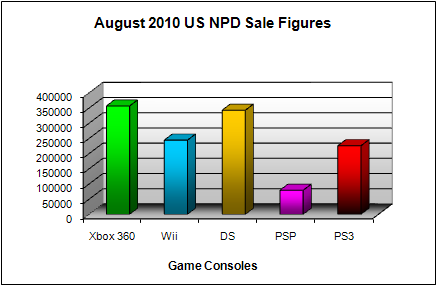
The figures for US sales in August 2010 are below, ranked in order of number of sales (August 2009 figures also shown, including percentage change):

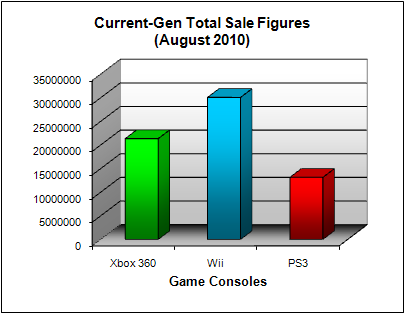
  • Xbox 360: 356,700 (Total: 21.4 million; August 2009: 215,400 – up 66%)
  • DS: 342,700 (Total: 43.3 million; August 2009: 552,900 – down 38%)
  • Wii: 244,300  (Total: 30.1 million; August 2009: 277,400 – down 12%)
  • PS3: 226,000 (Total: 13.2 million; August 2009: 210,000 – up 8%)
  • PSP: 79,400 (Total: 17.5 million; August 2009: 140,300 – down 43%)
NPD August 2010 Game Console US Sales Figures

NPD August 2010 Game Console US Sales Figures

NPD Game Console Total US Sales Figures (as of August 2010)

NPD Game Console Total US Sales Figures (as of August 2010)

My prediction from last month was:

Looking at the Amazon charts, the new Xbox 360 4GB isn’t actually doing fantastically, and it’s being outsold by the 250GB. So while most people are predicting that it would be another month where the Xbox 360 rules, I’m not as certain. I think sales will do well, but it might be the case of things being very close, with the new 4GB probably just allowing the Xbox 360 to sneak to top spot. In games, NCAA Football is usually followed by Madden NFL, the 11th version, and that will always do well. But otherwise, it’s another slow month before the busy holiday period begins, so the top 10 should look pretty familiar.

Well, it was pretty close at the top, but the Xbox 360 still managed to beat the DS by 14,000 units, even as it recorded a month to month drop. And the top two were Madden NFL titles, but that wasn’t hard to predict (although there were some surprises here too, more on that later). And I was right too about it being another slow month, as sales dropped compared to July.

As mentioned above, the Xbox 360 was the most popular console for August, that’s two months in a row, and only the Wii or the DS has ever managed to do this. The new 4GB didn’t help the Xbox 360 record growth compared to July, but it did help to secure first spot. One should not underestimate the importance of these last two month’s victories for the Xbox 360, and of course the new form factor for the Xbox 360, which has finally allowed it to become as “sexy” an item as the PS3, possibly more so depending on who you ask. Plus the increased stability finally allowed Microsoft to put the whole RRoD business behind them. And all in time for Kinect too!

Last month, I mentioned that this month would be important for the PS3. For the first time, we can have a year on year comparison that compared the PS3 Slim to the PS3 Slim (and to the post price-cut PS3 sales figures). Of course, the Slim and price cut was launched in the middle for August last year, so we will have an even better comparison next month. But looking at the PS3 figures, while it still managed a year-on-year growth, but it was only 8%, compare and contrast to the 76% last month. And this could very well mean that PS3 sales would actually drop, year-on-year, next month, although that depends on whether the PS Move shifts any consoles along with it or not (bundles and otherwise). But a drop is not necessarily a bad result, it just means that it’s unfair to compare the post Slim/price cut bump to what is now a normal level of sale for the console. Just like it would be silly to compared  Xbox 360 sales 0f July 2011 with July 2010, due to the post Xbox 360 “Slim” sales bump. And the PS3 was the only console to manage a month to month growth in August, I guess largely thanks to the stock issue finally clearing up completely, so thing are still looking good for the console (and even better overseas, but that’s beyond the scope of this analysis). The less said about the PSP the better.

For Nintendo though, the news remains bad. The Wii is very close to dropping to the third most popular home console (that’s last place, btw), and DS sale has started to drop, perhaps reaching market saturation (although the 3DS will help, a lot, and its only competitor is the PSP, which is doing quite awfully). But with both Microsoft and Sony bringing out their motion gaming devices, it’s not looking good for Nintendo. The low tech nature of the console, which made it an affordable, profit making piece of hardware, and was largely fine for casual games, may finally have caught up with the console – so expect the Wii 2 sooner than later, as the Wii just doesn’t have the longevity of the other two home consoles. And regardless of which camp you’re in, whether you think Kinect will win, or the Move will, what is clear is that both seem better pieces of tech than the Wii. Whether their games will be as good as the best Wii games, remains to be seen, but you can’t argue that both are innovative enough (Kinect with the controller-less interface, Move with its super accuracy) to cause Nintendo concerns, at the very least.

Onto software now. As expected the Xbox 360 and PS3 version of Madden NFL 11 were the top selling titles, in the described order. What some commentators concentrated on was the surprising lack of a gap between the sales figures of the two versions, despite the advantage in hardware units the Xbox 360 enjoys (1.6:1). The actual software advantage was only 1.235:1. But this is actually up on last year’s 1.231:1 ratio. Another multi-platform release was Mafia II, and again the Xbox 360 version outsold the PS3 version, but by how much, we don’t really know because NPD no longer provides sales stats for anything other than the top 5 titles (Mafia II for the PS3 was 7th). Super Mario Galaxy 2 for the Wii was third, and fifth place was occupied by another Super Mario game, New Super Mario Bros. for the DS. The Wii version of New Super Mario Bros. was also in the top 10, with Wii Fit Plus making a return too. For the Xbox 360, Modern Warfare 2 stayed in the top 10 (related to the upcoming Black Ops game, perhaps), and last month’s top title, NCAA Football 11 also remained in the top 10.

Here’s the complete list of the top 10 software sales:

  1. Madden NFL 11 (Xbox 360, EA) – 368,000
  2. Madden NFL 11 (PS3, EA) – 298,000
  3. Super Mario Galaxy 2 (Wii, Nintendo) – 193,000
  4. Mafia II (Xbox 360, Take 2) – 121,600
  5. New Super Mario Bros. DS (DS, Nintendo) – 141,700
  6. New Super Mario Bros. Wii (Wii, Nintendo)
  7. Mafia II (PS3, Take 2)
  8. Call of Duty: Modern Warfare 2 (Xbox 360, Activision)
  9. NCAA Football 11 (Xbox 360, EA)
  10. Wii Fit Plus w/Balance Board (Wii, Nintendo)

Prediction time. September = Halo Reach. That’s what next month will be all about. The fact is that, as I type, the top four items in Amazon’s Video Games section are all Halo Reach related (standard, limited, legendary editions, plus the 360 Halo Reach console bundle), just shows how dominant it will be in September’s figures. So expect the Xbox 360 to remain on the top of the console pile hardware wise too, and possibly the best month since, well, the last Halo release. Halo Reach will overshadow Sony’s launch of the Move unfortunately, although it’s doing well to just hang in around 10th, or just outside of it. The Sports Champions bundle should be counted in the software charts (in the same way Wii Fit Plus is in there), so it should be in the top 10 (especially when the top 3 will be condensed into a single entry for Halo Reach). It will be a very interesting month, I feel.

See you next month.