Archive for the ‘Xbox 360, Xbox One’ Category

Weekly News Roundup (5 December 2010)

Sunday, December 5th, 2010

Damn it. November went by and I didn’t even get to mention that it was the ‘penultimate’ month of 2010. I love to use the word ‘penultimate’, and so you can imagine how disappointed I am. There’s a surprising amount of news this week. Surprising because I still managed to play something like 25 hours of Fallout New Vegas, so I don’t know how I managed to find the will to quit the game and search for news. So let’s get started …

Copyright

… with Copyright news. The cracks are starting to appear in the US Copyright Group’s attempt to monetize anti-piracy, and they’re bringing out the kitchen sink to stop anyone getting into their way.

Document lawyer Graham Syfert is just the latest to try and stop the USCG mass lawsuits, and he did it by producing and selling self-help documents and selling them to those that have been sued. These documents can be used to keep the USCG busy, in the hope that they will eventually drop the case because it’s just not worth the trouble. The documents can be purchased for as little as $9.95, but according to the USCG, it’s costing them thousands. Which is why the USCG has just sued Syfert. Apparently, it’s only okay for the USCG to make money off anti-piracy, and anyone getting in their way is a bad person. Syfert, being a lawyer himself, has fired back claiming that the USCG’s actions are “completely insane”. And if that wasn’t bad enough for the USCG, they are now facing a class action lawsuit filed by one of the defendants of their ‘Far Cry’ case. The class action alleges “fraud, extortion and abuse” on the part of the USCG. I’ve always been told that the US is a particularly litigious country, and so I guess the USCG should have expected something like this to happen. And it’s interesting to note, that apart from some porn lawsuits, there aren’t too many other law firms taking up the anti-piracy settlement business, at least not many that are high profile. Perhaps they’re all waiting around to see what becomes of USCG’s business model, whether it is workable at all. Which is more reason to hope that USCG fails completely to monetize, so it puts an end to this sort of thing. And hopefully with the porn lawsuits, someone will step up and also claim “fraud, extortion and abuse”, particularly the extortion bit, because threatening to make public one’s sexual habits does seem a bit extortionate.

Demonoid.com - No longer .com, now .me

The fallout from the recent Homeland Security domain seizures, and the threat looming from the controversial Combating Online Infringement and Counterfeits Act (COICA), it seems that BitTorrent websites are taking pre-emptive action to protect themselves. Which is why this week, private BitTorrent tracker Demonoid has decided to move away from its .com roots, and instead move to .me, to counter the threat of having their domain seized by US authorities (who have jurisdiction over .com domain names, I suppose). Several private DNS systems have also been set up recently, in case COICA becomes law and thus giving the US government the ability to tamper with the Internet’s domain name system. This fracture into a public (both censored and uncensored) and private Internet is exactly what academics and engineers have warned about when they first heard about COICA. And it also again shows that even with the risk of catastrophic damage to the Internet as we know it, the actual effect of COICA in stopping piracy is negligible, because people can simply switch their DNS to an offshore one, and continue to access all the websites the US government doesn’t want you to look at.
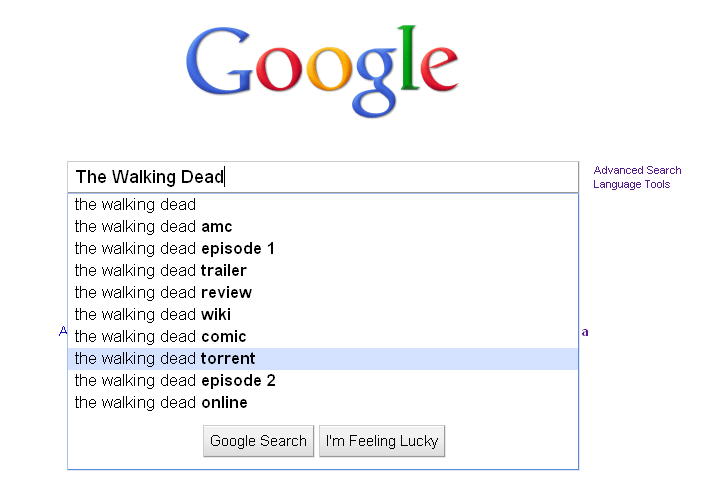
Google Torrent Auto-complete Recommendation

Google will soon remove piracy related terms, like torrent, from auto-complete recommendations

Viacom is eager to get back to court so they can lose again to Google/YouTube, as they filed their appeal against the June decision which say their copyright lawsuit thrown out of court. More money wasted instead of pursuing innovation, but I guess the lawyers will be happy. In totally unrelated news, Google is beefing up its anti-piracy credentials by buying DRM firm Widevine, as well as implementing several features on their websites that will make it about 2.3% harder to find pirated stuff on the Internet. The first major change is to remove piracy related keywords, such as “torrent”, from auto-complete suggestions (so that when you search for “Megamind”, the phrase “Megamind torrent” isn’t a recommended search term, and only maybe shows up if you type the first few letters of “torrent”). This adds keywords such as “torrent”, or maybe even “free download”, to the list of naughty words such as “lesbian” that Google keeps out of the recommendation list. I’m sure this will make the entertainment industry slightly happier, although it makes absolutely no difference to those actually searching for torrents (because, what, if Google doesn’t suggest it, people are going to stop searching for it?). I’m sure the entertainment industry will be a lot happier if Google actually blocked displaying results for bad keywords, but that would be censorship of the worst kind and would go against everything democracy stands for, which just makes the entertainment industry want it even more. And the idea that “torrent” automatically means piracy should be challenged as well, and unless Google’s system is clever enough to distinguish between legal and illegal torrents, then searches like “Windows Vista Service Pack 2 Torrent” will be blocked too from auto-complete recommendations.

And I guess people searching for what about keywords such as “rapidshare”? There are still lots of people searching for “Windows 7 activated rapidshare” (it’s the third post popular recommendation), should that be blocked too? I mention Rapidshare because I wanted to segue into the news about Rapidshare being ordered by a German court to pay eBook publishers a hefty 150,000 Euros fine for not successfully blocking out pirated eBooks from being uploaded and downloaded, as ordered by the court back in February. I guess it’s only fair that Rapidshare do make an effort to block these downloads after a court order and everything, and if every publisher wanted to get their content blocked, then they should also go an get a court order. Of course, filtering is never really foolproof, and so the court should take this into account too. After all, it’s the users of Rapidshare that’s committing the real crime here, and if Rapidshare did their best to prevent it (even if their best does not match up to the content owner’s expectations), then they should not be found guilty. This is basically why Viacom lost its lawsuit against YouTube.

And in this week’s “Oh no, what has Sony done now” section, Sony’s latest SNAFU is to demand music that it doesn’t own to be removed, despite the fact that it was uploaded by an artist belong to a competing studio. This “innocent mistake”, or so Sony claims, even went as far as Sony lawyers writing to Mediafire and getting them to remove the uploaded home demos, although they did eventually write back to say “never mind”. Now this is but one, fairly high profile, mistake. How many other lower profile mistakes have been made by Sony, and other labels and studios in their anti-piracy hunt? And should they not double check that they actually have the legal right to sent off legal threats? But I guess if banks can foreclose houses they don’t even own, anything could happen I suppose.

And Ubisoft is back with another form of annoying DRM, but this time I can see the funny side of it. Those that pirated Ubisoft’s new Michael Jackson game on the DS will find that all of the music have been replaced with annoying vuvuzelas sounds.

High Definition

In HD/3D news, regular readers of my Blu-ray sales analysis (which also includes DVD sales figures) will have noted the year on year decline of DVD sales, which is pretty much the norm for most weeks.

And this drop in DVD sales has many in the industry worried, and many are blaming downloads and streaming content, the legal kind, for it. I guess the term “blame” is perhaps the wrong word to use, because this shift was always coming. Music is mostly sold via digital means these days, and with faster Internet connections and more generous bandwidth quotas, the same will be true of movies. For really high quality stuff, stuff that can’t be downloaded easily, there’s Blu-ray (which has recorded year on year growth). For everything else, downloads and streaming should suffice. And it will really take off once pricing because a bit more reasonable. In the article, there’s a guy from the BBC that says that “long tail” is where the future is. And I think I touched on this in my TV Networks for the 21st Century blog post, basically the future may be one where people pay very little per download, but they download a lot more and from a vast library of titles where every TV show, programme, episode, is available to download 24/7 instantly. This is very much a “long tail” approach, as opposed to the more traditional approach where content owners rely on people downloading the latest and greatest in great numbers, while limiting access to their entire catalogue (mainly due to technical reasons, not exactly intentional). And the reason why DVD/Blu-ray has been a huge success (despite what Hollywood wants you to believe … the home video sell-through market basically didn’t exist before DVDs), that’s to allow people to access their old favourites. And many of Blu-ray’s biggest hits have been classics, not new releases – like all the Disney animated classics, Sound of Music recently, classic TV shows – these all have done just as well, if not better combined, than a single new release. And with digital downloads and streaming, the access could be even greater, especially if delivered in an on-demand fashion. There aren’t any technical hurdles any more to achieving this (at least for SD content), so the only reason why we’re not able to select and watch any episode of The Fresh Prince of Bel-Air or Bewitched is more to do with other reasons (irrational fear of unauthorised copying, and also of fear of losing a grip on their existing, outdated, business model).

Also, I’ve been thinking about the 3D Blu-ray of Avatar and how it’s selling for $400 or more. With no signs of a general release (director James Cameron’s comments about “2 more years” is worrying), I wonder if this exclusive deal may actually do more damage than good. I’m sure Panasonic paid a lot of money for the exclusivity, but I think this move is actually driving people to consider piracy as an alternative to paying $400 for a single movie, and how will this hurt sales when it becomes available via general release? People have purchased 3D TVs in anticipation of Avatar really, and if the general release is not just around the corner, then expect 3D Blu-ray Avatar to be the most pirated Blu-ray movie of all time (even if it takes about a week to download).

Gaming

And finally in gaming, I have bit the bullet and ordered Kinect. I’ve always wanted one to see what it can do, especially when the hardcore games arrive next year (and they will arrive), but in the end, it was all the crazy PC hacks that have been posted in the last couple of weeks. It makes me, as a software developer, want to get my hands on one as quickly as possible just to see what kind of things I can make Kinect do.

Xbox 360 Kinect vs PlayStation Move

Kinect vs Move - the battle of sales figures begins already

But it might be a while before my order arrives, because according to my local (as in Australia) wholesale sources, stock is a huge issue for Kinect at the moment. And a quick search online reveals pretty much the same thing, with most online stores (again, locally) out of stock of the sensor + Kinect adventures pack. This leaves buying Kinect as part of a new Xbox 360 bundle the only option for many. It is also sold out on Amazon.com as I type, with 4.5 stars average rating after 320+ reviews. Microsoft has revealed that 2.5 million Kinect units have been sold to customers in the first 25 days of release, which could have been even better had stock been more plentiful. Sony later countered with their own “sales” figures of 4.1 million since release (a bit more than a full month longer than Kinect), but it was later revealed that this figure is the number of units shipped to retailers, not the actual number sold to customers (cue thousands of web editors updating articles at the same time). Although the demand for the Move means the shipped to retailer and sold to customers number may not be that far apart, some of the 4.1 million units may be reserved (ie. stock held) for yet to commence December sales at the time of Sony’s sales data, and so in any case, the two numbers cannot be compared without more information.

Michael Pachter of Wedbush Securities has revealed, based on access to NPD data, that his predicted “to customers” number for Move is about 2.5 million, the same as Kinect, although over more than double the time frame (since late September for Move, 25 days for Kinect). And of course, every Move controller sold is counted as a single unit, even if purchased by the same household for multiplayer (whereas Kinect has built in 2 player support). Without knowing the pairing rate of Move controllers to PS3s, there’s no real way to compare to Kinect sales numbers. If the pairing rate is 1.5 Move controllers per PS3, for example, and taking into account that the Move has been released for twice as long as Kinect, then even taking the 4.1 million as total sold, Kinect is already twice 1.8 times more popular than Move. If the pairing rate was 2, then Kinect is 2.4 times more popular. If taking Pachter’s estimates of 2.5 million sold through, then Kinect is 3 or 4 times more popular if the pairing rate is 1.5 or 2. If my maths is right. Which it usually isn’t.

And some news outlets are incorrectly stating that the Sony numbers do not include PS Move sales not part of the standalone bundle (with PS Eye) or console bundles. The numbers, from what I can gather, do include it, it just doesn’t include separate PS Eye and Navigation controller sales (the Navigation add-on is useless without the Move wand, and you can almost say the same thing about the PS Eye these days, given how poorly it was selling before Move arrived).

It’s all quite confusing really, and I think Sony should have just kept their mouth shut unless they really did outsell the Kinect, which looks unlikely at this stage. The same wholesale source I mentioned earlier showed that the Move bundle still had plenty of stock, and more online stores had stock of them on my last search.

Okay, enough fanboi baiting for this week. Have a good one.

Weekly News Roundup (28 November 2010)

Sunday, November 28th, 2010

Another week, another WNR. I know it’s easy to get cynical about the Black Friday sales in the US (particularly if, you’re like me, not actually located in the US), just like it may be easy to get caught up in the hype, but if you’re do your research, there are potentially a lot of bargains to pick up without leaving the comfort of your home. Since Blu-ray is a major topic of this website, I’ve posted some of the best Amazon Black Friday Blu-ray deals on this page. Most of the discounts are still available, and there will be more on Monday as well, so it’s a good time to stock up on some Blu-ray movies. The prices are so good that they’re almost HD DVD level! I’ve purchase a dozen of so movies myself as part of this sale, as there are some really good bargains around for the movies that I had planned to buy anyway (and that’s the the trap, is that you end up buying things you didn’t really want or need just because they were cheap). More on this in the HD/Blu-ray section of this WNR, including one confession about how I compromised my principles a bit!

I continue to play through Fallout New Vegas, encountering another quite annoying glitch during the week. This one involved the companion Veronica, and how she become frozen in one spot after a certain mission. And this leads me to recommend one most excellent resource for Fallout games, The Value. It is a Wikia for all the Fallout games, and it gives precious advice on how to overcome glitches. And this is also why I prefer playing Fallout on the PC, because you get access to the console, and this allows you to fix the most stubborn glitches. In any case, I solve the Veronica glitch after reading a tip on The Vault. The glitches in this game almost ruin the game, but it’s actually quite satisfying when you do find a solution or workaround, and it has become part of the Fallout/Bethesda experience really.

Not a huge amount of news by any standard, but still enough to do some ranting, possibly between the 1800 and 2400 word mark, by my best guestimate. So let’s get started.

Copyright

In copyright news, news broke not too long ago that The Pirate Bay founders have lost their appeal in the Swedish courts. This means that, following the original verdict, the founders now face a hefty fine and prison time of up to 10 month.

Prison time for Pirate Bay founders confirmed, at least until further action in the courts

Only three of the original four defendants were part of this trial, the other missed out due to illness, but will be certain to face the exact same result. Despite jail time being handed out, the likes of the MPAA are still not satisfied at the result, claiming that the $6.5 million dollars of damages isn’t anywhere near the $17 million they had wanted. Talk about being greedy! The case will now most likely go to the highest court in Sweden, even if the prosecutors seem to think this case won’t go that far. I can’t be bothered to dig up the previous edition of the WNR where I said that this case won’t be decided until it is examined by the highest court in the country, and I think I also mentioned that I don’t hold much hope that any appeal would yield satisfactory results for the TPB. The cards were stacked against them from the start.

The copyright news this week doesn’t really get much better unfortunately, but there was at least one bright spot when there was at least a sign of common sense on Capitol Hill this week, when US Senator Ron Wyden (D-OR) torpedoed efforts to enact the controversial Combating Online Infringement and Counterfeits Act (COICA) into law. He has placed a hold on it and it won’t be heard before the senate until next year. Unfortunately, I can only see this as a temporary delay, because with so much support for this ridiculous act, it will be made into law and we’ll all have to suffer the consequences. Most support it because they don’t know any better, or have received enough incentive to support it without asking serious questions. And most know there’s no political points being earned by going against the entertainment industry in the US. And that’s partly our fault too, for not pressuring out representatives in government in doing the right thing. But the thing is, unless you’re someone who reads this or similar blogs and websites regularly, you won’t really be aware of the issues, or understand (or care) about them, and it then boils down to an issue of whether people should or shouldn’t “steal” (a dumbed down talking point that the entertainment industry has been pushing), and most people wouldn’t support stealing. Except we know that copying and stealing are two different things entirely, and that even if it is possible to stop piracy (it isn’t), there are certain things that are far more sacred than protecting the dying business model of the entertainment industry. Things like our right to privacy. And freedom of speech. And due process, which systems like ‘Three Strikes’ attempt to short-circuit by assuming guilt and denying people their right of appeal (or to even address the matter in a court of law, like they’re entitled to). And this goes back to what I said a couple of WNRs ago, that we must do more to protect our rights and treat this more than just a matter of being able to “downloading movies and games and stuff”, something that the copyright lobby and their supporters has tried to reduce the arguments to. This is about protecting our democratic rights, which politicians these days are too eager to sacrifice in the name of “protecting” us (whether it’s terrorism, or the perceived and possibly imaginary threat to the economy, due to piracy).

IPRC Seizure Notice

Seized domains now display only this seizure notice from the DoJ, IPRC, and Homeland Security

And so we move on to the news this week that Homeland Security closed down another 80 websites suspected of providing pirated content. The only positive is that due process was followed, that warrants were obtained via the court, but it doesn’t really matter if the process itself is flawed. My biggest problem with this is that I have no idea if any of the websites/domains seized were really illegal, and who determined their status. I don’t trust most judges’ level of technical understanding to pass judgement on technical issues such as this, and perhaps when faced with such overwhelming force (Justice Department, Homeland Security, ICE), and some scaremongering about the consequences of piracy (billions of jobs will be lost!), most will just go along with whatever is in the warrant request. And if one of the 80 websites was truly innocent, what’s the process of appeal, and what kind of compensation would be due if the website was deemed by a court of law as not guilty, compensation for the financial and emotional damages caused by the temporary closure of the website. I mean, this is not like going after drug dealers or counterfeit drugs, there are a lot of complicated issues involved in determining whether a website is guilty or not of copyright infringement, issues that must be addressed in court before any punitive actions can be handed out. And what if the domain really did host illegal stuff, but it was uploaded unknowingly by third parties, or as part of a user-generated section on the website – is if fair that the entire domain is taken offline? It would be like shutting down blogger.com because somebody created an account on there to share pirated MP3s. This scenario could be avoided via a DMCA takedown notice, but these seizures bypass the very laws that were created to avoid situations like this. And this is why COICA is so controversial, in that it gives the US government even greater power to do all of this and more, and on a much larger scale as well, potentially killing off tens of thousands of websites in one fell swoop, and many by “collateral damage”. And this is why anyone who knows and cares about the Internet ought to be against COICA, and many prominent companies and individuals have already spoken out, but all will be silenced by the constant chattering of lobbyists into the ears of those that can decide the fate of COICA. Senator Wyden excepted.

And so the next step would be to even make talking about piracy illegal, which is what the RIAA attempted to do this week, and caused some collateral damage of their own in the process. PCMag.com posted an article after LimeWire was shut down, examining the possible alternatives that are still left. This is a valid discussion, because it points to the fact that even though it took years and millions of dollars to bring down LimeWire, the next LimeWire could pop up in a matter of weeks or could already exist, and thus making the whole process an expensive, and pointless, exercise. And for this, the RIAA and its cohorts sent a letter to PCMag.com’s CEO, attacking the website for daring to suggest alternatives and supporting and encouraging piracy in the process. It then attacked PCMag for simply referring to another article, published by TorrentFreak, regarding LimeWire being resurrected. The problem is that PCMag didn’t write that article, it was PC World, by facts and accuracy does not matter when one is acting the bully like the RIAA and Co. are. PCMag are standing firm by their journalistic principles, and refuse to be silenced and used as a scapegoat in the RIAA’s attempt to blame someone, anyone, for the piracy problem. Anyone except for themselves for sticking with a dying business model, even when alternatives and opportunities were presented, opportunities that were eventually taken by the likes of Apple with iTunes. The only bit of innovation the RIAA and its members have come up with recently has been new ways to sue and intimidate those perceived to be their enemies (the Internet and anyone who uses the Internet), and of course the whole failed DRM experiment.

The Witcher 2 Screenshot

The Witcher 2, to be released next year, will be DRM free

And DRM has been in the news this week too, but in regards to the use of it in the gaming industry. Gamasutra, one of the most respected gaming industry website on the Internet, has had one of its bloggers write an interesting article examining the failure of DRM, and how illegal copying can be prevented. The conclusion seems to be one that I’ve come to as well, in that the solution is to add value to the gaming experience, not to take it away via horrible DRM. Value adding explains the success of Steam, and even though it does use DRM, it is pretty weak stuff, and in fact probably better than buying off the shelve due to the lack of need of a DVD check. The best DRM should prevent casual copying, but should otherwise be invisible to the end user, and if it forces gamers to connect to an online service for authentication, free value added services should be given as compensation (achievements, community, social features …). But even the best, or worst (as in draconian), DRM will not prevent copying by those that really want to copy it, and groups with the skill to hack away, as Ubisoft’s DRM experiment showed recently, and so really, there’s no point to DRM at all. And this is a point shared by at least some game developers, including the developer of The Witcher series, and operators of the classic, DRM-free, gaming website GOG.com. In fact, their CEO and co-founder, Marcin Iwiński, goes on to say that DRM treats customers like criminals. Iwiński believes there’s no need to debate whether their upcoming game, The Witcher 2, should use DRM or not, simply because he believes DRM doesn’t work. And this is why The Witcher 2 will be released DRM-free. Iwiński also criticized the way DRM adds restrictions that the pirated versions are free from, calling it “totally stupid”. He also attacks online based protection, saying that it isn’t fair to people who want to play games when they’re away from a reliable Internet connection. And it’s hard to argue against any of these points really. The industry, when it relies on DRM, is basically trying to sell something that’s not as good as the pirated version even when you don’t consider the price, and then getting mad when it’s not selling well. I mean this is an industry that isn’t even bothering to print manuals any more, and yet it expects us to jump through hoops just to play a badly bugged game that it rushed through testing. But luckily, there are still the smarter companies that are doing more innovative things to stop piracy, things like bundling physical collector’s items that can’t be pirated, building immersive online experiences and communities, being innovative with pricing, and either not using DRM or at least not overdoing it. And then you have companies like Ubisoft.

High Definition

Moving on from the ranting to happier grounds, as mentioned before, I did take part in the Black Friday sales on Amazon, trying to take advantage of the historically favourable AUD/USD exchange rates (not as favourable to be honest this week).

The Lord of the Rings Amazon Purchase

Yes I know I said I won't buy it out of protest, but they were really really cheap!

And yes, I did completely compromise my principles on an issue I’ve ranted about a lot right here. That’s right, I purchased the theatrical Blu-ray version of The Lord of the Rings movies, despite bitching about it for weeks back when it was first released. My rant then was about how the trilogy boxset should have included the extended edition, as opposed to the theatrical edition, and should have at least featured some new extra features and put them on Blu-ray at least even if they weren’t HD (the extra features are actually on DVDs, and probably could have fitted onto a single dual layer Blu-ray, but that would have made the boxset look famished). Also, the first movie had a sub-standard transfer, although some of it was unavoidable it seems (a fact that wasn’t available at the time of my original rant).  In my defence, I didn’t buy the box set, but only the individual movies separately for $7.99 each. And at that price, some of these shortcomings, can be forgiven (certainly better than paying $65 for the boxset anyway). So “I won’t be buying it” really meant “I won’t be buying it unless it’s heavily discounted and I must join in the hype of Black Friday or I will feel left out”.

Well, at least I didn’t pay $400 for a copy of Avatar on 3D Blu-ray.

Gaming

Kinect is in the news again this week, and funnily, it had almost nothing to do with gaming. The news broke last week that only a week after the release of Kinect, it had been hacked, and Microsoft couldn’t have been pleased at the development.

Kinect Manboob Tracker

It's always nice to see technology used in a way to benefit humanity as a whole

Then it turn out that they didn’t really care either way, because the “hack” wasn’t really a hack at all, at least according to Microsoft’s definition of what a hack is. What happened was that somebody wrote open source drivers for Kinect so that it can be used on the PC, and because Microsoft intentionally (or they claim now) left the USB thingy open, Microsoft claims they were always hoping something like this would happen. I’m not sure about that, but Microsoft do have a history of mixing Xbox 360 and PC compatibility (the wired Xbox 360 gamepad works perfectly on the PC, and even the wireless one can be made to work via a dongle). And “unofficial” drivers aren’t new, the Sony Sixaxis controller has a PC driver, and even the Wii-mote has one too.

Anyway, what was more interesting was how people decided to use the open source drivers and write their own PC based Kinect applications. And if you follow the link above, you’ll see videos of object recognition, a Minority Report style web browsing experience using a simple Javascript add-on. And even a man boob tracker (not a typo). It just goes to show that Kinect has serious potential, but only if the right software is there for it. But that’s always the hard part, and the reason why the Wii is struggling now is because, apart from Nintendo, nobody really knows how to makes good games for it.

And I was way off.  I’m already over the 2700 word mark, and so my guestimate wasn’t really close at all. But if you remove the Black Friday and Fallout related waffle, then it just about gets in there. So I probably should stop typing now, wish you all a great week, and type something along the lines of “see you next week”.

See you next week.

Weekly News Roundup (21 November 2010)

Sunday, November 21st, 2010

I managed to get the second edition of the now “neutered” NPD analysis up yesterday. Thanks to timely leaks, I was still able to get the sales figures for the three home based consoles. It was another good month for the Xbox 360, and a really really bad one for the Wii. The momentum in the this-gen format war has definitely shifted away from the Wii, and Nintendo would be wise to release the Wii 2 as soon as possible, but as I noted in the analysis, there may not be much Nintendo can do. I mean, if they come out with a more accurate Wii-mote, then that’s basically the Move. If they ditch the remote altogether, then that’s basically Kinect. And even if they add Blu-ray and HD, then they would only be doing catch up with the other consoles. The only thing in Nintendo’s favour is that they’re good at making family/casual games, so Wii Sports 2 will probably be better than anything Sony, Microsoft and their third party developers can come up with. But Nintendo are good at surprising the market, so I won’t rule them out yet, but it’s not looking great.

In the analysis, I also notice that Fallout New Vegas was the second best selling game (all platforms combined) for October. Just saying, like. The rest of this paragraph talks about FNV, so feel free to skip ahead (and I promise this will be the last time I talk about FNV in this edition of the WNR). I’ve also experienced my first serious glitch with FNV this week, in that I was not able to get Boone’s Bitter Springs mission to start, even after getting the quest and then travelling to the marked point in Bitter Springs. What happened was that I wanted to do the Bitter Springs quests first before starting Boone’s mission (as recommended, since it may be impossible to finish those quests after Boone’s quest), so I had him wait just outside the town while I did those quests. This somehow glitched the quest and it was not possible to proceed with the quest afterwards. I solved it by returning to an earlier save (this is a Bethesda  game, so save often, and keep the save files, don’t overwrite them), travelling *with* Boone to the marked location to advance the quest (to go to “Coyote’s Tail Ridge”), and then left Boone somewhere safe so I can then proceeded to finish the Bitter Springs quests alone, before retrieving Boone again to finish his quest. FNV is great so far, but it’s not as well structured as Fallout 3, especially with the main storyline, but there’s so much more to do in this game (maybe even too much to do – I’m 30 hours in and still have barely discovered a third of all the locations). Still a highly recommended game though, especially for Fallout 3 fans. Anyway, I’ve now got the FNV stuff out of my system, so we can continue with the WNR.

Copyright

Let’s start with the copyright news. We first start with porn downloads, and the lucrative business of suing the downloaders of the pirated versions.

The Chicago Tribune profiles the main man behind the lawsuits, Chicago lawyer John ‘Pirate Slayer’ Steel.  Steel has portrayed himself as the saviour of the porn industry, but really, anybody can see it’s all about the money. And as I’ve mentioned before, suing for porn downloads has the added advantage of further embarrassment, which may force the alleged downloaders to pay up, even if they don’t really think they did it. And then there’s the issue of discrimination, as hinted by the EFF. For many who are not out in the open about their sexual preference, being identified in downloading non mainstream porn may be an extremely terrifying experience, and this kind of “legal blackmail” (not my term, but one that has been used before to describe these kinds of lawsuits) is not helpful, especially with the recent issues with sexual discrimination and bullying. Isn’t this a form of bullying as well, to threaten to make the private (even if illegal) activities of the accused public and demand payment to keep it quiet?

But all will happen is that people will stop BitTorrenting porn and get them via other sources that are not being monitored by these law firms, like the many “Tube” sites or Usenet. And how does this actually help the porn industry, exactly? Of course it won’t, but it will help people and firms like John Steel’s, and that’s what this is all about really.

Steel Law Firm

John Steel's Law Firm in Chicago is heading the "porn lawsuits"

While porn lawsuits may be making big money for the law firms involved, suing bloggers for using only excerpts of newspaper articles may not be. It appears that Righthaven, the law firm leading these types of lawsuits, appears to be facing far too many obstacles in their attempt to make money. First of all, the people they go after are usually bloggers, writers, business people and usually people with opinions that are not easily suppressed via lawsuits, nor are the type that are easily embarrassed. So going after the likes of Democratic Underground (DU), probably the largest political forum for left-leaning Americans, was not really the best idea to begin with. And it appears Righthaven is now in retreat mode, and wants to drop the DU lawsuit if the other side agrees not to pursue legal costs, something that would make their mass lawsuits unprofitable. This comes after they already lost a lawsuit in which they tried to get a Las Vegas Realtor to pay up for using excerpts, a lawsuit they ended up losing. So it hasn’t been smooth sailing for Righthaven, and perhaps in time they’ll realise that it’s just not worth the trouble to sue bloggers, many of whom want nothing less than a full day in court, which would make great material for their blog, not to mention the publicity.

And while this suing for settlement thing is just getting started in the US, it may already be winding up in the UK, after their legal authority has started investigating these practices, with key players facing punishment. At the heart of the issue is the apparent fact that lawyers for the law firm Davenport Lyon (which has since stopped participating in these types of lawsuits) may have knowing proceeded with lawsuits even when they may have been aware that the alleged parties were innocent. This is largely due to the fact that IP addresses can hardly be considered to be conclusive evidence of illegal activities, especially when IP addresses can be shared between many users, at different times of the day. And at best, it identifies which ISP account was used to make the download, it does not identify the individual, or whether the account holder even had knowledge of the act, let alone gave permission. The legal system really needs to examine whether just a single IP address is enough to prove infringement, because remember that I could connect to a BitTorrent swarm for just a single second, and have my IP address recorded, but have I really committed copyright infringement? For just a second? In my opinion, they should at least establish how long it would typically take to download the content in question (say 1 hour for a movie at typical download speeds), and if the identified person’s IP address(es) hasn’t been connected to the swarm for at least this time period, then you cannot say that the person even managed to download the file in question. And via the same system, they can work out how much was uploaded, and count the number of infringements based on these two numbers. Because I don’t think it’s fair that “attempted infringement” is punished in the same way as actual, mass, infringement (if someone stays a seeder for say weeks, compared to someone who attempted to download the file but failed and didn’t upload much in return either).

Senator Patrick Leahy (D-VT) and Senator Orrin Hatch (R-UT)

Bipartisan support in Washington? Yes, but only on the issue of online piracy

But the legal establishment is mostly too clueless to understand these arguments, or just how BitTorrent works. And the same goes for the government as well, and both groups are easily persuaded by lobbyist, if not by the political/financial favours, then at the very least by the scary, Armageddon scenarios that the industry likes to invent (“Hollywood will be bankrupt, millions more unemployed, if we don’t stop college students from downloading Avatar”, for example). And Hollywood relies on this to further their aim of *not* having to evolve their business model. But it appears that not everyone in Hollywood agrees with what the bosses think is the best way for the industry to move forward (by not moving forward). Many seems to believe that innovation is still at the heart of the solution for the piracy problem, and even though I’m not in the industry, I have to agree as well.

Just look at the Netflix and their trouble of getting their Android app. Now, some of it is due to the way the Android system is set up (fragmentation, the lack of a common DRM/security platform), but in the end, the problem comes down to DRM, and the way major studios demand DRM to be in place before Netflix can get an app up for Android. Now, how many people are going to be pirating movies via their Android phone? For one, the video quality provided will be quite poor, sub-DVD standard crap that any decent rip online would better. And who pays for a Netflix streaming service and then pirates videos, when they can skip paying and still pirate movies from the variety of sources. But nevertheless, innovation, which can actually lead to more profits for movie studios in the future and a new way to deliver movies to consumers, is stopped dead in its track. If record labels had gotten their way in regards to DRM and making sure portable devices won’t play non DRM’d music (as to not “encourage piracy”), then they would have ensured failure for the iPod/iPhone, and does that really help anyone? It certainly would have hurt Apple, but lawmakers are more than happy to put up with the ridiculous demands of one industry, even if it means hurting another. So the likes of Netflix, Apple and ISPs have to suffer in order to protect the dying business model of the entertainment industry, and somehow this is fair?

And now the US government (and by that, I mean both sides of politics) is willing to screw up the entire Internet, just so the MPAA can block The Pirate Bay, with the controversial Combating Online Infringement and Counterfeits Act passing unanimously through committee. The MPAA immediately defended the decision, via their usual way of lying and exaggerating about everything. What this means is that the US government can effectively censor websites that the MPAA (and RIAA) deems “bad”, and this could be anything from The Pirate Bay to perhaps an innovative competitor that could become a threat. And this kind of Net censorship destroys the United States’ moral authority on online freedom of speech. That’s far too big a price to pay just to give the MPAA/RIAA a false sense of security, because people will still find a way to download pirated content.

StarCraft II

StarCraft II is one of the most downloaded games of all time, but it also a best seller

And remember, this all assumes that piracy is costing the industry millions and billions every year, and there’s no way to tell what the monetary damage is, because we don’t know what people who pirate a lot of stuff will do if all pirated content is removed. The industry say that these people will *all* start buying things, which is as ridiculous as saying that *all* shoplifters would become customers if we make it impossible for them to steal (and we all know how the MPAA/RIAA likes to use the shoplifting analogy). Perhaps all that will happen is that a very small minority of downloaders will convert to customers (and they will buy much less than they download today), and the rest will simply find something else to occupy their times, with barely an improvement in the bottom line for the industry (and all this achieved at great costs, both financially, and in terms of civil rights). Just look at the best selling game in recent times, StarCraft II. It made huge amounts of money, some 1.5 million copies of the game was sold in the first 48 hours alone. And yet, it is the most pirated game in history! And sales continues to be brisk, with 3 million copies sold by the end of September. Blizzard, the company that made the game, have been extremely happy with the results, and have made little if any noise about the high piracy rate. And despite the game being easy to pirate (although online multiplayer is not available in the pirated versions, again this goes towards innovation and making an online experience that’s just not “piratable”), people are still buying and I suspect many that downloaded the illegal version have “upgraded” to the paid version, bringing more profit to the company. So piracy will probably always exists, not all piracy will automatically convert to sales if piracy is prevented, but piracy can lead to sales if the product/content is good. Only those industries that churn out crap and expect consumers to lap it up will be ultimately hurt most by piracy, and I guess that explains why the entertainment industry is so concerned.

High Definition

In HD news, the stats for the week that Toy Story 3 was released came out, and it wasn’t as good as I had expected (didn’t break any records, for a start), but it was certainly still a great week for Blu-ray – you can read the analysis here.

There was one story which caught my eye, and I’m still not sure if it was a hoax or not, but Best Buy UK offered all the Harry Potter movies on Blu-ray, and a Toshiba Blu-ray player, all for only seven pounds, which works out to be $11 USD. And it wasn’t a typo either. But the condition of sale was rather harsh – you had to have the same legal names as one of the three main characters of the film, Harry Potter of course, Hermione Granger or Ron Weasley. And even if you were unfortunate enough to share their names, you had to be the first 100 to get the offer (although are there really 100 people, even in the UK, named Harry Potter, Hermione Granger or Ron Weasley?)

That’s one interesting sale, but some more mainstream sales will be here this week as part of the US Black Friday sales. I’m on the lookout for some bargains too (mainly focusing on Amazon), and perhaps I’ll post about any deals I find on the blog, or in the deals section. Something like Iron Man 2, Avatar for under $10, and some older titles for under $5, won’t be too much of a surprise.

Gaming

And in gaming, I’ve already talked about the NPD analysis above (as well as rambled on about Fallout New Vegas). I’ve thought more about what I said last week about Kinect, and I still firmly believe that Kinect will be more successful than the Move.

The main reason is all those families who have Wii’s but are now bored with it, and looking for something new. They will look at the Move and say, well, I’ve already got something similar, is it really different enough, even if it is better? Those that want Blu-ray players may go for the PS3 + Move, but others will look at Kinect and feel that this really is something different. And Sony goes on about the Move being for hardcore gamers, but really, that’s not where the money is or has been ever since the Wii was introduced. Microsoft’s plan, on the other hand, seems to be to convert every casual/family Wii owners into a Kinect owner, and if they succeed, then it will enable to comfortably win this generation’s console war. It’s risky, but it might just work.

The people behind the PSJailbreak has a new piece of software, called PSDowngrade, which will be added onto the existing function of the PSJailbreak device. What it does is allow the PS3 firmware to be downgraded to an older version that supports the PSJailbreak device, namely 3.41. So there is a way out for those stuck with the new firmware, which has become a requirement if one wishes to play some of the latest games. It just goes to show how resourceful hackers can be, and that any so called foolproof system will not be for very long.

And that’s all for this week. More next week.

Game Consoles – October 2010 NPD Sales Figure Analysis

Saturday, November 20th, 2010

Welcome to the NPD Sales Figure Analysis, the second edition to not actually have access to the really useful NPD sales figures. But through leaks and whatnot, we have just barely enough to get an analysis out. We you get lemons … All the figures are collected and calculated by NPD.

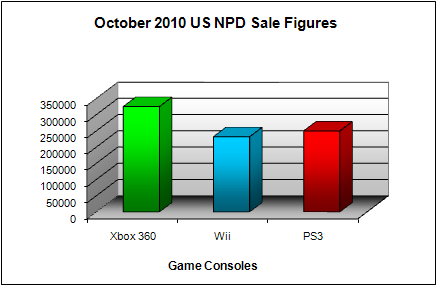
The figures for US sales in October 2010 are below, ranked in order of number of sales (October 2009 figures also shown, including percentage change):

  • Xbox 360: 325,000 (Total: 22.2 million; October 2009: 249,700 – up 30%)
  • PS3: 250,000 (Total: 13.7 million; October 2009: 320,600 – down 22%)
  • Wii: 232,000  (Total: 30.6 million; October 2009: 506,900 – down 54%)
NPD October 2010 Game Console US Sales Figures

NPD October 2010 Game Console US Sales Figures

NPD Game Console Total US Sales Figures (as of October 2010)

NPD Game Console Total US Sales Figures (as of October 2010)

My prediction from last month was:

I loathe to make a prediction, because there might not even be figures next month to check whether I was right or not, but if there are figures, then I expect the Xbox 360 to still hold a sales lead over the PS3, which will outsell the Wii again. The new Fallout game, Fallout New Vegas, should do very well, with more copies being sold for the Xbox 360 (not that we have any way of telling). Fable III, the Xbox 360 exclusive, should also do well and again help the Xbox 360 console sales just like this month’s exclusive.

Lukily, there were just enough leaks this month to check against my prediction, and it seems I was correct in predicting the order of hardware sales at least. The Xbox 360 was again the best selling home console of the month, and the Wii was again the worst. Both Fallout New Vegas and Fable III did well on the Xbox 360, and so as predicted, helped the console sales.

This month makes it 5 months in a row that the Xbox 360 has retained the best selling home console crown. That’s a feat only achieved by the Wii, and it is entirely down to shrewd marketing on Microsoft’s behalf. It all started with the surprise announcement of the Xbox 360 “Slim” back in June, and kept on going with Halo Reach, and now Fable III. And so while everyone predicted this would be the year for the PS3, due to the more numerous exclusives they had, in the end, some carefully timed releases was all Microsoft needed. And with early Kinect figures showing that it’s selling extremely well ahead of the holiday period, possibly beating the Move if the early figures are correct, then this holiday should be a good one for Microsoft. For the hardware numbers, it actually represented a 30% increase compared to the same month last year, the only console to managed to do this. But looking further back, this month’s numbers are actually 12% down compared to the same month in 2009, so the weakening hardware sales is a serious concern for the industry in general. However, if Move or Kinect are  successes, then this may lead to more PS3 and Xbox 360 console sales, as family/casual gamers get in on the act. I would say that the Xbox 360 has more to benefit than the PS3, since the Xbox 360’s image as a console only for hardcore gamers would benefit more from Kinect’s success than the PS3 from Move, as many already use the PS3 for activities other than hardcore gaming (as a Blu-ray player/media hub, mainly). And of course, Kinect is more of a departure, and thus upgrade, from the Wii than the Move, and this may be more attractive to families looking to move on from the Wii (they certainly don’t want more of the same, which the PS3 Move represents, even though this perception is not correct – but for those that also need a Blu-ray player/media hub, the PS3 may be also quite attractive).

But whatever happens, the Wii is the loser in all of this. Nintendo has hinted at the successor to the console once it sells 15 million more units, but at the current rate of sales, it could take years. The holiday period will tell us more about the fate of the Wii, but if it doesn’t at least regain some of the lost sales this year. The Wii is traditionally a strong seller during the holidays, when families are looking for appropriate gifts, but with Move and Kinect, nothing is certain this holiday sales period. And if the Wii doesn’t do well, then expect Nintendo to speed up their plans to introduce the Wii 2. As to what the Wii 2 will include, nobody really knows at the moment. Some say it will have a Blu-ray drive, it will most likely support 1080p HD, but even if that were all true and that the controller is made more accurate than the Move, it still feels like Nintendo is playing catch-up now, instead of leading. Perhaps they will also take a page from Kinect’s playbook and introduce controller-less gaming, but even this is catch-up. So what can the Wii 2 bring that makes it better than the Move or Kinect? For me, I can’t see much that they can do to improve on either of these two systems, but Nintendo are more than capable of surprising the market, so don’t rule them out just yet. In any case, Wii sales were down 54% compared to last year, the decline is actually speeding up compared to recent month. And it’s down a whopping 71% compared to two years ago, when sales apparently peaked.

For Sony, the PS3 continues its post-Slim/price-cut decline, dropping 22% compared to the same time last year. Sony has been trumpeting their software sales this month, saying it’s the only platform to have software growth (50%), but most of that was down to how poorly PS3 games were selling last year. The PS3 actually recorded a modest gain compared to two years ago, the only console to be able to do it, but again, that was mainly down to how poorly it was selling back then. The slim/price-cut put Sony back into the game just when it looked like it might have been game over, but it still isn’t winning. However, positive sale reports for Move, with sales up 15% compared to last month when it was officially launched, may help the console at the expense of the Wii as discussed above. The 15% figure is good because traditionally after launch, sales do drop since the launch month includes all pre-orders as well. However, the Move was only released for half a month in September, whereas the October figures are for a whole month, plus the fact that as we get closer to the holiday period, sales naturally increase. These two factors means we still need to look at the next few months of Move sales before we can declare it a total success, with the most important months being the first few of next year, to see if the Move has staying power.

Let’s move onto software sales, which without the detailed NPD stats we’ve all gotten used to, makes analysis incredibly difficult. We only have figures for the Xbox 360 exclusives, Fable III and Halo Reach, and of course the chart featuring the list of best selling games (based on total sales for all platforms). The last Fable game sold 790,000 copies in the first month, so the 580,000 figure for Fable III can only be considered average. But for the multi-platform releases, like NBA 2K11, Fallout New Vegas and Medal of Honor, you can pretty much expect the Xbox 360 versions to have outsold the PS3 versions. Here’s the chart:

  1. NBA 2K11 (Take-Two Interactive, Xbox 360, PS3, PS2, PSP, Wii, PC)
  2. Fallout: New Vegas (Bethesda Softworks, Xbox 360, PS3, PC)
  3. Medal of Honor (Electronic Arts, Xbox 360, PS3, PC)
  4. Fable III (Microsoft, Xbox 360) – 580,000
  5. Star Wars: The Force Unleashed II (LucasArts, Xbox 360, PS3, WII, PC, NDS)
  6. Halo: Reach (Microsoft, Xbox 360) – 315,000
  7. Just Dance 2 (Ubisoft, Wii)
  8. FIFA Soccer 11 (Electronic Arts, PS3, Xbox 360, Wii, PS2, PSP, NDS, PC)
  9. Madden NFL 11 (Electronic Arts, Xbox 360, PS3, WII, PS2, PSP)
  10. WWE Smackdown vs. Raw 2011 (THQ, PS3, Xbox 360, PS2, WII, PSP)

Prediction? The Xbox 360 to still be the winner thanks to Kinect, with a slight comeback for the Wii, and may even be enough to knock the PS3 off second place and challenge the Xbox 360. Call of Duty: Black Ops will dominate the software charts, again favouring the Xbox 360, with Sony’s long (and I mean long) awaited GT5 doing well too. Other notable releases in a busy month include Donkey Kong Country Returns, Assassin’s Creed: Brotherhood.

See you next month (hopefully).

Weekly News Roundup (7 November 2010)

Sunday, November 7th, 2010

Well, we’ve reached November, the final set, the last quarter, the penultimate inning, the last ten minutes before the start of injury time, and many other sports terms that I have absolutely no idea about. And despite getting near the end of 2010, we still haven’t made contact, and with all the world’s problems today, an alien intervention may not be the worst thing ever, although hopefully not the kind of intervention that recent movies are predicting. The news are a bit more plentiful this week, but by no means a busy week in terms of copyright, HD/3D or gaming, I think mostly due to other more important events taking place in the US at least. But there are still a few things to talk about, so let’s get started.

Copyright

Starting with copyright news, and trying to find some connection to the big news of the week, we have this story about the effect of the the US midterm election results on the issue of copyright, particularly Internet copyright.

John Boehner

The US House of Representatives may have changed hands, but don't expect any changes (not good ones anyway) in respect to digital copyright laws

The conclusion? Probably business as usual. A lot of people are unhappy that the developments in the last two years in terms of Internet copyright has been very much biased towards the content owners, big business, and so some naturally blame the people in power, the Democrats. But I think that’s partially unfair, because if you look at the pro-copyright bills that’s been brought up in Congress, you will find that these bills always receive bi-partisan support. It’s about the only thing in D.C. that the two major parties can agree on, and that to me, is a very sad state of affairs indeed. And with the Republican’s generally pro-business ideology, things will probably get worse in the next two years, not better. But it is also fair to blame Democrats too. If you allow me to go slightly off topic and talk politics for a minute, then I think the blame for the pro-copyright bias is still very much on Democrats, even though both parties support the pro-business, anti-consumer and anti-privacy agendas of the RIAA and MPAA. The reason I blame the Democrats is simply this: they should know better.

I’m not surprised Republicans will eventually support three-strikes, or make it easier for corporations to sue individuals, or otherwise go out of their way to help big business – it’s what their politics are about. However, being the left leaning party, the Democrats ought to stand for principles such as privacy, freedom of speech, and as progressives, they should embrace the Internet and support innovation (they certainly did during the  election campaign that saw Obama and the Democrats use the Internet to great effect in terms of campaigning). The last thing they should be doing is to cosy up to big business, to help them suppress innovation, the way they have done in the last two years. It’s not their M.O, or at least it shouldn’t be. Now I do realise that Hollywood and the Democrats have a great relationship traditionally, but that’s mainly the people who work in Hollywood, the left leaning actors and actresses, and their support of the more progressive aspects of Democrat’s policies. The relationship should definitely not automatically extend to the people who own Hollywood, the multi-national conglomerates like Sony or 20th Fox and the groups that represent them, like the MPAA. For these companies and groups, their sole aim is to protect their ageing business model, even if it comes at the expense of the hard working people in the industry (the writer strike being a prime example). If Obama and the Democrats want to have a serious chance to get back some of the things they lost last Tuesday in two year’s time, they need to go back to their roots, to support policies that their core supports, or at least stand for something. And maybe even that would not be enough, but maybe it will help promote some positive change, or at least put up some kind of fight for those that rely on them to be their voice in government. It’s about principles, stupid.

Cinema Audiences Being Watched

You *are* being watched ... privacy protection loses yet again to piracy protection

One of the principles I mentioned earlier is privacy, which in this day and age, becomes somewhat incompatible with the business goals for big business. In an ‘1984-esque’ development, a new technology has been developed in the UK that allows complex system to watch the watchers (of cinema, that is). Instead of going to the cinemas with your family, having overpaid for everything, the last thing people expect will be that they become some kind of lab experiment, where their every emotions are recorded so that big business can find better ways to get you to pay for stuff. While ‘1984’ was very much about the authoritarian governments, but corporations are just as dangerous, because they now have enough power and money to directly influence governments, if not control them outright. So something like this, which many will object to (if they knew about it), would probably still get the nod in the US because the lobbyist will ensure they get enough support in government to nullify opposition. And because the same system can be used to prevent piracy, then that becomes the perfect Trojan Horse to make it all nice and legal. Terrorists support torrent downloading or something, and so if you’re against spying on cinema-goers, then you’re supporting terrorism. And do you really want to be labelled as a terrorist supporter when you’re up for re-election in a year or two?

But while this technology has been developed in the UK, the newly elected UK government (well, new as in since May), may in fact be changing directions in terms of digital copyright law. Or not. The previous so called left leaning, progressive Labour government, who got UK into two wars against the wishes of the people and general progressive principles (it’s that word again!), was also very pro big business in its support for controversial copyright laws, including the planned introduction of a three-strikes, and widespread spying of people to prevent them from downloading too many MP3s. The more left leaning coalition part of the current government, who are in a coalition with the conservatives (their politics is probably more progressive than the Democrats, by US standards, according to some UK friends), are probably responsible for the review of copyright laws, which will look at things like fair use. Reversing the previous government’s “achievements” may also have played a part in the decision. But I suspect the review will come, some fair use provisions will be added, but it won’t make the laws any better than what’s already law in the US. In fact, the Prime Minister has already signalled that they will be doing the review by looking at the US laws. It may very well be a case of the blind leading (or in this case, following) the blind.

And sorry to get back to politics again, but I must say that the current screwed up state of things is very much to do with us, the electorate, than any government or lobbyist. We allow our freedoms to be curbed in the name of helping big business because we simply do not care enough. Perhaps there are too many other more serious problems to consider, but I would have expected more discontent at government action to give corporations the power to spy on our Internet usage. Yes, the Operation Payback from 4chan/Anonymous is something, but I think in the end, it could backfire and alienate the mainstream. Because many of them, probably most of them don’t download things illegally, and they may even support harsher sanctions against downloaders, pirates, who have been demonized by the RIAA/MPAA through advertising (“They support terrorism and organised crime and are no better than common thieves!”). But it’s the rights of everyone that will be affected when ISPs can legally spy on your downloads (and it won’t end there either). When they came for the pirates, I didn’t speak up because I wasn’t a pirated … etc. Okay, that may be a bit dramatic, but big business have been trying to erode our rights, as citizens and consumers, for years now, but they’ve never faced so much apathy. The EFF and the ACLU can only do so much, if we don’t voice out discontent, in a mainstream fashion.

Jammie Thomas-Rasset

Bad news for Jammie Thomas-Rasset again, another seven figure damage award against her this week for sharing 24 songs

And to present further proof of the struggle we face, not just against big business, but also against our fellow citizens in terms of fighting for fairer copyright laws, a jury (or her peers, apparently) has rewarded Capitol records, a subsidiary of a multi-billion dollar company, $1.5 million against the most famous music pirate of all time, Jammie Thomas-Rasset. This is the third time damages have been awarded against the Native American mother of four, $222,000 originally, then $1.92 million and this week, $1.5 million. Now I understand juries are under instruction to award certain amount of damages based on the law, but if one jury can award “only” $222,000, why would other juries give out seven figure awards? Is there no sympathy for someone who has done something that millions of other American have done, and are doing, every day? It says something when usually the pro-business judges (and they are pro-business, because the copyright laws are pro-business, and judges must make judgements based on the law, however biased it is) are the ones coming out against such extravagant damages being awarded. By giving record labels and movie studios what they want, these juries of our peers are just giving these corporations the ammunition they need to make it legal for them to sacrifice everyone’s privacy for their bottom line, because anything is better than seven figure damages being awarded against individuals, right?

And it’s decisions like this that have emboldened certain law firms in their mass-litigation attempts, the latest and greatest way to make money off of this is to sue for porn downloads, with more than 7000 being sued in the latest case. And there will come a time when there are so many lawsuits, that people will say enough it enough, but then the industry will put forward a better alternative, and that will be the three-strikes, “we spy on you for our own gains”, method. And many freedom loving citizens will eat it up because they will say it’s better than being sued, and since they haven’t done anything illegal on the Internet, it won’t affect them. Except  it will, one day, when they will be spied upon for anything and everything. Because if one corporations can spy on you for their own gains, then another corporations should be allowed to do the same, and then surely it makes sense for governments to spy on you for the nobler aim of law and order too. And it’s ironic that in the end, it may be other corporations that stand up to this in a more meaningful manner than the general public, because what’s good for one industry may very well come at the expense of another, just like three-strikes takes money away from the Internet industry and gives it to the entertainment industry. And this is why we have the good news that UK ISP, BT, have put a stop to at least one law firm’s mass-litigation attempts by deleting subscriber usage histories, histories that the law firm in question, Gallant Macmillan, needed to proceed with their case. And even the recent UK copyright review, mentioned above, was recommended in an indirect way by the owners of Google, who say that the UK’s unfair copyright laws meant that a company like Facebook, Google or YouTube can never have been created in that country. Copyright is hurting innovation, and companies that rely on innovation, even if they’re faceless mega-corporations, will put up a fight for their own self interest. It’s time, that ordinary people like you and me, also put up a fight ourselves, for our own self interest.

High Definition

Moving on to happier pasture, in HD/3D news. I’ve noticed a trend recently whereby studios are releasing more and more Blu-ray exclusives, especially for classic titles (such as Sound of Music, Psycho, The Rocky Horror Picture Show, Apocalypse Now, to name a few).

The Sound of Music Limited Edition Blu-ray Set

Blu-ray exclusive releases of classics, and premium sets, are popular

This is good news for Blu-ray, as it signals studios may be shifting away from DVD altogether. And it’s also good news that these classics are selling well on Blu-ray too, meaning there is definitely a market out there for people who want to watch their favourites classics with audio/video quality that hasn’t before been possible on a home video format. Certainly, a lot of people have home theater set-ups that beat the quality available at the best cinemas at the time these classics were first released, and it’s a real pleasure to be able to enjoy quality movies this way, in the comfort of your own home. If you want an argument for Blu-ray, then this is the best one. Which makes the Lord of the Rings Blu-ray disaster even more disappointing.

Moving on to something completely different, some have already accused Google TV of being fragment on release. I don’t want to go into too much detail on the arguments for and against this, since I’ve already covered it in my forum post, but as someone who has done a little bit of Android development, I have to agree that fragmentation is a big issue, and that the way Google are doing things, it’s making fragmentation a real problem. The freedom that Google gives manufacturers may not be worth whatever benefits that it provides in the short term (more varied range of devices).

But a closed system, like Apple’s, have their own unique set of problems. The latest involved the VLC app for iOS, which may very well be withdrawn from the Apps market due to the issue of copyright. But unlike most copyright disputes, this time, it’s almost the other way around. Instead of arguing that Apple have stolen their copyright, the creators of  VLC are arguing that Apple is imposing too many copyright restrictions on their open source media player. The issue is complicated by the fact that the app wasn’t produced by the creators of VLC, but by a third party (they’re allowed to do it because VLC is open source). But Apple’s apps are limited in that, even for the free ones, they come with licenses that prohibits their sharing (to 5 devices only), which is totally against the open source principle to which the people behind VLC not only believes, but is also bound by law to respect. And this isn’t the first time some open source based app has faced this issue with Apple, with Apple’s previous actions being to remove the app, rather than change their somewhat draconian copyright/DRM attitude. And it will probably be the same with the VLC app, so for those that want it, you should download it ASAP, before it disappears, if it hasn’t already.

Gaming

And finally in gaming, Kinect has been released and it’s doing very well, at least according the Amazon sales charts (currently the 2nd best seller, just behind Call of Duty: Black Ops).

And with two more Kinect titles in the top 10 (Kinect Sport at 5th and Dance Central at 6th), and the Kinect bundle at 8th, it looks to be a very good holiday period for Microsoft (the top selling CoD: Black Ops is also the Xbox 360 version, btw).

Microsoft Kinect

Kinect could be a big success, if it overcomes hurdles such as space requirements and the fact that people look really stupid playing it

Kinect is not perfect. Not even close. And Sony’s Move appears to have many advantages over it (like being more much, much more accurate, and easier to integrate into hardcore games). But what sells well is less about perfection (the Wii wasn’t perfect, neither are top selling devices like the iPhone). It’s more about hype, potential, being different to everything else on the market, and Kinect beats the Move in all of these aspects. Sony producing just a more accurate (and of course, better) version of the Wii, in my opinion, will not work as well as they will hope. And if you just look at the way the PS3 is designed, especially the XMB user interface, it just doesn’t scream “casual gaming”, as much as Microsoft’s cute avatars (stolen shamelessly from Nintendo, but hey, whatever works, right?). And the casual gaming market, is where the big money may be had, especially if you include the new generation of casual, Facebook and mobile phone, gamers.

Of course, for Kinect to be a success, it has to at the very least work adequately. That’s where it may fail, if the requirements for a relatively big space is too much for most families, or that the lack of accuracy makes gaming too random (although it seems to not have worked against the Wii’s initial success), or that it just doesn’t have the right games to take advantage (the most likely scenario for failure). But unlike the Nintendo Wii, Microsoft have always had a great range of third-party titles that take full advantage of the console. And Microsoft will have to rely on these companies to make compelling Kinect games, and avoid Shovelware that characterizes most third-party Wii titles. If publishers take Kinect seriously, Kinect can be a very exciting platform.

And on that note, it’s time to end this week’s WNR. Hope you’ve enjoyed this one a bit better than the absolutely horrible last one, and here’s hoping the next one will be even better (don’t bet on it though).