Archive for the ‘Xbox 360, Xbox One’ Category

Game Consoles – June 2012 NPD Sales Figure Analysis

Tuesday, July 17th, 2012

After a 2 month break, the NPD analysis is back!

As NPD no longer releases full hardware sales figures, this feature is reliant on the game companies, namely Microsoft, Nintendo and Sony, to release their set of figures, and then calculating missing figures based on “statement math” (that is, arithmetically calculate missing figures based on statements made). For June 2012, these are the statements made by the gaming companies:

  • “Nintendo sold more than 400,000 total hardware units in June and saw double-digit growth across each of its product lines compared to May. This includes more than 155,000 Nintendo 3DS systems, more than 150,000 units of the Nintendo DS family of systems and nearly 95,000 Wii consoles,” via Gaming Examiner
  • Microsoft revealed 257,000 Xbox 360 units were sold, with 47% of the home based console market share (source)
  • Sony did not reveal any figures for the PS3

A little bit of “statement maths” tells us that just under 195,000 PS3s were sold.

And so the figures for US sales in June 2012 are below, ranked in order of number of sales (June 2011 figures also shown when available, including percentage change – note that totals for the PS3/Wii are now only rough estimates, as exact figures were not available for all months):

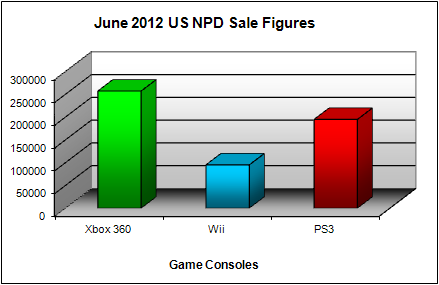
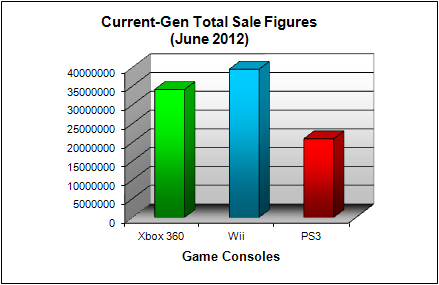
  • Xbox 360: 257,000 (Total: 34.1 million; June 2011: 507,000 – down 49.3%)
  • PS3: 195,000 (Total: ~21 million; June 2011: 276,000 – down 29.3%)
  • Wii: 95,000 (Total: ~39.5 million; June 2011: 273,000 – down 65.2%)
NPD June 2012 Game Console US Sales Figures

NPD June 2012 Game Console US Sales Figures

NPD Game Console Total US Sales Figures (as of June 2012)

NPD Game Console Total US Sales Figures (as of June 2012)

This is the first time I can remember of the Wii numbers dropping below the 100k mark, but the 65% drop from the same time last year was probably not unexpected, considering how close the Wii U is to retail.

While the Xbox 360 continues to “impress” by winning the most popular home based console award, 18 month in a row now, its numbers were down a considerable 49% from the same time last year, which to be honest, was a fantastic month for the console (and the Xbox 360 was the only console then to record a year-on-year growth figure). A bit worrying is that the decline seems to have sped up in the last couple of months too, perhaps as a indirect response to the Wii U, but more so perhaps due to this time last year’s numbers being “above normal”.

The PS3 has the smallest year-on-year decline of all the home based consoles, but that’s not to say that it isn’t struggling itself. It’s still down some 36% compared to 2 years ago (Xbox 360 down 43% for the same period – although that’s comparing now to the then launch of the Xbox 360 Slim – the Wii is down 78%!), and it still doesn’t look like its ever going to beat the Xbox 360 unless the 360 is retired early by Microsoft.

It’s not exactly all doom and gloom, since we’re approaching the end of a cycle even if Microsoft and Sony don’t want to admit it publicly, but I think it’s safe to say that we’ve already seen the best of these three home based consoles, and the only way forward now is downwards for them all.

Numbers have also been made available for the PS Vita, which along with the PSP, only sold a combined 100,000 units. Compare and contrast to the Nintendo DS, which sold 150,000 units, and the 3DS, which sold 155,000 units, and you can see the Vita has been a disappointment for Sony so far. The sales figure also highlights a significant drop compared to the earlier sales figures for Vita, which can’t be a good sign either. I think once again, Sony has misjudged the market. Trying to get on the casual gaming bandwagon, while still offering hardcore gamers an exciting gadget, Sony might have ended up catering to neither market. They don’t have the expertise in making fun and casual games like Nintendo, everyone already has a smartphone or tablet that can do what the Vita does, and the high cost of hardware and software, proprietary formats and DRM, means that the Vita was already at a disadvantage before it was even launched. Still, the holiday period will be decisive and if the Vita can have a good one, and if it can have more linkage to the PS3 and other Sony devices, then it can still carve outs its own niche.

In game sales, it’s not exactly been another great month, with the top selling title on all platforms, Lego Batman 2: DC Super Heores, only selling 450,000 copies or so. Speaking of the Vita, what Sony also doesn’t have is a Pokemon like franchise to exploit like the DS/3DS is able to do this month with Pokemon Conquest, coming in at a high 7th for a single platform release (all other listed in the top 10 are multi-platform games). Here’s the full software sales chart for June (new releases shown in bold):

  1. Lego Batman 2: DC Super Heores (Warner Bros – Xbox 360, Wii, PS3, NDS, 3DS, PSV, PC)
  2. Tom Clancy’s Ghost Recon: Future Soldier (Ubisoft – Xbox 360, PS3, PC)
  3. Diablo 3 (Activision Blizzard – PC)
  4. Max Payne 3 (Take-Two Interactive- Xbox 360, PS3, PC)
  5. NBA 2K12 (Take-Two Interactive – Xbox 360, PS3, PS2, PSP, Wii, PC)
  6. Batman: Arkham City (Warner Bros – Xbox 360, PS3, PC)
  7. Pokemon Conquest (Nintendo – NDS)
  8. Call of Duty: Modern Warfare 3 (Activision – Xbox 360, PS3, Wii, PC)
  9. Battlefield 3 (EA – Xbox 360, PS3, PC)
  10. The Amazing Spider-Man (Activision Blizzard – Xbox 360, PS3, 3DS, NDS, Wii)
I don’t think I’ll bother to make a prediction. Firstly because I don’t think we’ll have enough figures to do an analysis next month, and secondly, the hardware sales order  will be pretty much the same as this month (and will be the case until the Wii U is introduced later this year).
See you next month?

Weekly News Roundup (24 June 2012)

Sunday, June 24th, 2012

Welcome to another edition of the WNR. Whether you had a busy and productive week, or a slow and unfruitful one (or combinations of the aforementioned), I hope that you at least had a good week. I’ve long since believed that being productive does not equal good, and sometimes an unfruitful week can have its own rewards too (like levelling up 6 levels in Diablo 3). News wise, same old same old, really – not much, but still a few interesting ones to poke a stick at. Running kind of late, and far too tired to be doing any sort of writing in be fully honest (didn’t sleep well last night), so let’s get started and let’s get it ended as soon as possible!

Copyright

Could the MPAA and RIAA start suing individuals again? Well, if you refer to the details of the “graduated response” deal they made with US ISPs, then yes, it could happen again.

Of course, just because they could, it doesn’t mean they will. The negative publicity from these lawsuits far outweigh any perceived benefit from going after your single mothers and college students, that is for these cases to become deterrents for others (hasn’t really worked, has it?), and both groups have signalled they’re no longer going in this direction. The language will be there in the agreement because nobody wants any doors to be closed for future potential actions, however remote the chances of these actions occurring are. Still, the agreement does say that ISPs will be providing an awful lot of information about repeat offenders to the likes of the MPAA and RIAA, but when you’re already playing the copyright police and spying on your own paying customers, passing on their personal details to the lawyers of some of the world’s biggest corporations does seem to fit the trend.

Megabox

Could Megabox still be set for a 2012 launch? Megaupload’s Kim DotCom seems to think so!

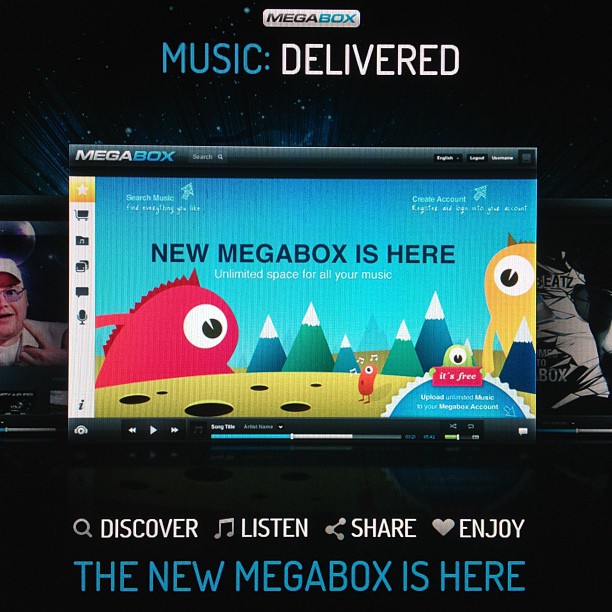
Megaupload’s Kim DotCom (he really does need to change his name if he wants people to take him serious again, in my opinion) got himself on Twitter this week, and the charismatic (former?) billionaire didn’t disappoint. Revealing that he was visited by none other than Apple’s co-founder Steve Wozniak, the more interesting reveal was that Megabox, the new music sales and sharing platform that’s supposed to end the major recording label’s monopoly on music distribution, is not as dead as everyone had thought it was. While providing little detail except for a blurry screenshot, DotCom did post that “It is coming and it will unchain you”. I talked about Megabox back in January after Megaupload was shuttered, but sensibly, everyone had just assumed that the site was dead in the water –  a real coup for the RIAA, intentionally or otherwise. The idea behind Megabox seems solid – artists sell directly to fans without having to go through labels, and as a result, artists get to keep up to 90% of the revenue. The Internet being the best self-publishing platform to have ever been invented, it’s no surprise that traditional publishing will be hurt as people cleverer than me come up new ways for creative people and their work to get noticed without having to hand over most of the revenue. So even if Megabox is dead, something like it will emerge, eventually.

High Definition

Last week, Roku’s CEO said Blu-ray was dead. This week, research released by the NPD shows that Blu-ray players are not dead at all – they’re just not being always used as Blu-ray players!

NPD’s latest research shows that 80% of those who have Blu-ray players connected to the Internet have used their players to download or stream video content. With the number of connected Blu-ray players growing (considering how many of these now come with Wi-Fi built-in, as opposed to being dependent on a well placed Ethernet cable), it appears at first that Net savvy consumers are voting with their remotes and telling content distributors how they want their content. Of course, without detailed stats on how frequently people use streaming service, all we can see is a possible trend (if that), but it’s clear that this Internet streaming thing isn’t just another fad.

The study also found that “only” 64% of connected game consoles were used to access services like Netflix and Hulu, but since it’s probably more likely that a game console is connected to the Internet than a Blu-ray player, this kind of makes sense. What I did find surprising was that only 15% of tablet and smartphone users were viewing movies via the Internet, but I think this figure will rise dramatically once you remove smartphones from the figure (and I suspect none of these figures include YouTube).

Gaming

And finally, in gaming news, a leaked Microsoft document from a couple of years ago could provide some clues as to what the Redmond giant’s next game console could look like.

The leaked document, which has since been removed, supposedly provide details of a presentation made in 2010 about the future of the Xbox gaming system. I’ll leave you to read the full news story to get the gist of it, but suffice to say, Kinect 2 plays a big part, and augmented reality, head/eye controllable glasses are also being considered.

OnLive

Microsoft was considering either acquiring OnLive, or launching their own similar “microconsole” concept

What I found most interesting was the concept of a “dumb console”, with a similar meaning to the more common use of this term, but applied perhaps even more appropriately to game “consoles”. Using a similar technology to OnLive (which apparently Microsoft had wanted to acquire at that time), games are processed “in the cloud” with the A/V being streamed to “microconsoles” that do very little other than process input and output. This way, the console itself does not need to be upgraded, but the content will continue to improve in quality, with all of the heavy lifting done in the cloud. Of course, things like latency, so important for gaming, could be an issue – but OnLive seems to make it work okay, as long as you have a good broadband connection. But the appeal is definitely there – not only are publishers satisfied by forcing gamers to be “always online”, and thus reduce piracy issues, the ability to get next-gen graphics without buying new hardware does seem like a good deal for gamers too (and for gaming companies like Microsoft and Sony, who make most of their money from games, when they’re not losing tons of it on the actual consoles themselves).

Of course, the leaked document might not be real, and even if it is real, it’s quite dated, As we get closer to the actual release date sometime in 2013, the real information will be artfully leaked, and completely accidentally, I’m sure.

Even with this WNR barely getting over the 1000 word mark, it’s still time to call it a day (or night) as we’ve run out of news. See you next week.

Weekly News Roundup (17 June 2012)

Sunday, June 17th, 2012

Hello to you on this a rainy, windy and cold Sunday here in Melbourne, Australia. How’s the week been treating you? Not too badly I hope. Another rather quiet news week, but maybe I was just too busy to pay attention. A little bit from column A, a little bit from column B, I suspect. Well, whatever news I did find, they were quite interesting, so let’s get started.

Copyright

The fallout (not to be confused with another, in my opinion quite fantastic, gaming franchise) from the Diablo 3 DRM choice continues this week, as videos emerged showing an item duplication exploit in Diablo 3 – the kind of thing that always-on DRM, at least according to Blizzard, was supposed to stop.

The video, originating from South Korea, showed a gamer doing the very thing that Blizzard was afraid of – duping items. The exploit was so damaging that Blizzard had to shut off South Korean game servers while a fix was rolled out. Thousands of gamers were also banned for using this and other cheating methods. Duplication hacks can be extremely damaging for Blizzard, while profitable for hackers – Diablo 3 features a real money Auction House where users can sell their hard-earned or not so hard-earned virtual in-game items, and as a result, item duping in D3 becomes just as bad as counterfeit money is in the real economy.

Diablo 3 Auction House

Real money trading of in-game items has made Diablo 3 a tempting target for hackers and scammers

So despite the harsh “always-on” DRM that Blizzard chose to employ for Diablo 3, which the company itself says wasn’t for anti-piracy but for protection against cheaters and hackers, it has not really lived up to expectations. If anything, the inclusion of real money transactions, which necessitates the use of an always-on DRM/access control system, has provided hackers with extra incentive to find exploits and loopholes that they can profit from. For us gamers though, it meant a frustrating (and still frustrating) gaming experience, although some have already started making good money from the Auction House.

And I’m still not convinced that Blizzard couldn’t have created an offline mode for the game. By implementing some kind of local virtual server that the game can connect to, this could provide emulation of an online experience, without the need to actually be online all the time. This may very well be the tact that the piracy community will use to crack the game, so we’ll have to wait and see if they can help out D3 gamers by creating an unofficial offline mode.

But some in the gaming industry are already pointing at Diablo 3’s fantastic sales figures and using that as justification for always-on DRM – at the other end of the spectrum, DRM-free gaming is also booming. And not only that, the “pay what you want” pricing model is also providing to be more than effective too. The latest Humble Indie Bundle (the 5th edition, for those keeping count) has managed to sell within a cat’s whisker of 600,000 bundles, raking in over $5 million in the process. Despite the basic bundle being available for as low as a penny, on average, gamers chose to pay $8.53 for the 4 game (plus 4 bonus games) bundle, proving that, if the price is right, people will pay. More remarkable is the fact that former buyers of the bundle, Steam sale addicts, and indie gaming enthusiasts would mostly already have most of the games on offer (I had 5 of the 8), so even from a shrinking sales pool, this latest bundle has managed to beat all expectations, and has actually earned twice as much as the last bundle.

The Humble Indie Bundle V

The Humble Indie Bundle V has generated more than $5 million in sales, from nearly 600,000 bundles sold

While I’m sure Diablo 3 raked in a lot more money than all the Humble Indie Bundles combined (and then some), then again, none of the games in the Humble bundle took 10 years to materialise either. And all were made with considerably less budget than Blizzard’s latest hit. At the very least, the Humble bundles prove that DRM-free can work, and so can the pay what you want model, even with the availability of both free pirated, and free (well, almost free – a penny) legal ways to get the games.

For those still holding out hope for a way to retrieve their legally uploaded files from Megaupload, especially after last week’s news that the MPAA is not totally against the idea, the news doesn’t look very promising. Responding to a lawsuit filed by an affected Megaupload user, US government prosecutors says that while they were responsible for shutting down Megaupload, they’re no longer responsible for the servers that now holds user files. Copies of the important data have already been made by the government, and as a result, they no longer have “possession” of the original data and can’t grant or deny access to them. It seems the data is now back in the possession of Megaupload’s former web host, Carpathia – data that is costing the company $9,000 a day to host. With the government also against unfreezing Megaupload assets to allow the company to pay Carpathia to keep the data alive (data that could also help Megaupload’s case), the most likely outcome, unless the court intervenes, will see the data completely wiped, and any hope of recovery gone. Before this happens, the government says users can pay Carpathia for access, and then acquire the services of forensic experts (at further cost) to retrieve any data – an unrealistic proposal due to the thousands of dollars this would require. The other “alternative”, the government says, is for users to sue both Carpathia and Megaupload for breach of contract relating to the storage of their files, again, also very unrealistic.

In other words, the government is washing their hands of any responsibility in the matter. They closed down Megaupload and then decide to not give two craps about the resulting collateral damage. But as screwed up as this is, it’s also an important lesson for those that are relying on the “cloud” to store their digital assets. Cloud storage will usually prevent data loss as a result of hardware or software failure, but it won’t stop things like user error (“hmm, that big red button that says “DELETE ALL” looks tempting – I wonder what it does …”), hacked or banned accounts, or as in Megaupload’s case, catastrophic failure. So it’s best to have copies of your files both in online *and* offline locations, or at the very least, at two different cloud providers.

High Definition

Is Blu-ray on the way out? Anthony Wood thinks so. But then again, he’s the CEO of the company that makes Roku, a popular little streaming set-top box, and both Blu-ray, the disc, and Blu-ray players are competitors.

Roku 2 XS

Roku currently provides a level of service that Blu-ray players and Smart TVs cannot provide with their in-built streaming apps, according to Roku’s CEO

So will Blu-ray be obsolete in four year’s time, as Wood predicts? If in four year’s time, most homes can access the Internet at speeds far greater than today’s average, then yes, this could be a possibility. If not, then the most efficient way to deliver the GBs of data needed for each HD movie (and if 4Kx2K become more common, the tens of GBs could grow to hundreds of GBs), might still be found on some kind of physical media, even if isn’t Blu-ray.

Whatever happens though. I for one hopes that ownership, and preferably ownership of something physical, is still reality 4 or 10 years down the track. I’m a huge supporter of cloud based streaming and all that, but I also love being able to hold something in my hands, or display something in my TV room, and I think a lot of movie lovers are like me in this regard.

Gaming

In gaming news, the May NPD results have been released, but once again, only Microsoft took the risk of releasing hardware figures. That’s probably because they won the month again with 40% of the home based console market share, but only 160,000 units sold. That’s a 40% decline compared to the same month last year, and you can see why many in the industry are so worried (and why “some” have stopped releasing detailed hardware figures).

With the next gen consoles from Microsoft and Sony not arriving until 2013 (got a news story on the next Xbox that was too late for publishing for this WNR, so I’ll cover it early next week), and the Wii U only coming at the end of the year, things are unlikely to pick up until then.

I’m still optimistically (but perhaps also foolishly) hoping that someone will leak the hardware data for the Wii or the PS3 in the next few days, and so the NPD monthly feature can resume, but it’s not looking good at the moment. If it doesn’t happen, I’ll get into more details about the May NPD in the next WNR.

Nothing much left to say in this WNR, so let’s call it a day. See you next week.

Weekly News Roundup (10 June 2012)

Monday, June 11th, 2012

Hello to you on this fine (or maybe not so fine) Sunday (may very well be Monday already, depending on how late this WNR gets sent out). A fairly quiet news week again, but like always, we shall persevere. My copy of Diablo III actually did arrive early this week, but I haven’t had much time to play it yet. The one time I did, the server had to go down for maintenance, which meant that my play session was not only cut short, but I also lost unsaved progress. The fact that a server maintenance could stop me playing the single player game doesn’t give me much confidence that, say 5 years from now, people will still be able to play this game without interruption (or even be able to play it at all). If game publishers insist on using “always-on” DRM, the least they could do is to guarantee the number of years that I’ll be able to play the game I purchased – 10 years would be ideal, but I suspect that this would cost quite a lot, and a lot of planning and risk management would be required to allow for this  (eg. obsolete server software/hardware, and how this affects compatibility with the game server software).

Copyright

Once again, we have mainly copyright news. That may sound strange considering E3 and everything, but really, I just couldn’t get that excited over this year’s event, since we already know much about the Wii U, and neither Sony nor Microsoft stepped up to the plate with an official announcement of their next consoles (although it hasn’t stopped the rumours from flying around).

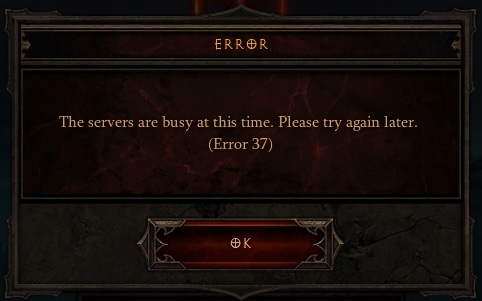
Diablo 3 - Error 37

Diablo 3's dreaded Error 37 has gotten the South Korean branch of Blizzard into trouble with the government

Anyway, copyright stuff. No, wait, back to the game stuff for a sec. Continuing the Diablo 3 theme from the intro, and the outro from last week’s WNR, Blizzard’s South Korean offices were raided by the country’s Fair Trade Commission (FTC) over issues related with Diablo 3’s DRM. Just like gamers in other parts of the world, South Korean gamers were also frustrated by the game’s launch day fiasco, and many went and sought a refund for the game. But the game’s terms and conditions apparently does not allow for refunds, and this is when gamers got the FTC involved. While this actual story is less about the DRM, and more about Blizzard’s refund policy, the issue of whether DRM problems can be counted as a “product fault” will be examined by the investigation.

As I said in the intro, there ought to be some guarantees for games that require server based DRM. An uptime guarantee, say 99% in any given month (which isn’t as impressive as it sounds – 1% of a month is about 7 hours, and that’s still quite a long outage), and a guarantee that the game will be supported for how ever long the game is expected to be played (if the next Diablo sequel is as long coming as this one, then 10 years ought to be just about right). If publishers want to make games into services, rather than products, then it’s reasonable for gamers to expect a certain level of quality of service. I feel though that the $50 gamers pay is no way near enough money to cover long term server support (hence why games like World of Warcraft have monthly fees), so I don’t expect games like Diablo 3 to be playable in 5 year’s time, unless the in-game purchases can keep the servers running. And in the same way, game publishers should understand that this kind of DRM can be very expensive over the long term, and they need to consider whether it’s worth it financially or not.

Last week, the RIAA accused Google of not doing enough on DMCA take-downs, and instead, want the search engine to perma-ban sites like The Pirate Bay, as opposed to having to constantly submit DMCA notices. This week, The Pirate Bay responded by welcoming any blanket bans of torrent indexers, saying that this would actually boost traffic numbers for the world’s most popular indexer. The reasoning is that, as the biggest brand in torrents, TPB would suffer much less from the removal of Google referrals (which they say, at best, only accounts for 10% of their traffic) compared to other torrent sites. Whereas Google often still redirects people to other less well known torrent sites, if Google stopped showing torrent results, this could mean more and more people would simply bypass Google altogether and log straight on to TPB. What’s bad for other indexer (and in a way, Google as well), will ultimately be good for The Pirate Bay, since you have to pretty naive to think that just because Google can’t provide you with torrent results, that people would still stop pirating.

And TPB’s IP address war of attrition continues. With last week’s newly released IP address just added to the banned list, a new IP address has been released – 194.71.107.80 becomes 194.71.107.81 (the old IP address will still continue to work in countries without the censorship). So round 2 begins, and I wonder how many rounds BREIN, the Dutch anti-piracy agency, will last before they start whining again. The TPB has also jumped on the IPv6 bandwagon, meaning those that have migrated over to the new IP address system will have a new way to access TPB, one that’s not blocked (so far) by any filters (as most failed to take into account IPv6). Plus, you can use one of the many IPv6 to IPv4 tunnel services as a pseudo-proxy to bypass the filter too, for example, thepiratebay.se.ipv4.sixxs.org. Just goes to show how pointless these multi-million dollar filtering implementations are, but if they want to play the IP merry go around in the IPv6 domain, then I’m sure TPB will gladly oblige too.

Those caught in the crossfires of the US government’s war on Megaupload, that is those that had used the cloud hosting service legally, may yet get back access to their files, after the MPAA signalled it had no general objections against the idea. However, it did have some specific objections, in that they don’t want anyone involved with Megaupload to be handling any system for (legal) file retrievals, and they also want to ensure only legal content can be downloaded. While probably reasonable requests, how practical meeting them would be is a different question altogether. I can’t see the required time, effort and money being spent to build a system which would allow for this, and the MPAA rightly says that even Megaupload’s user policy doesn’t guarantee continued access to stored files. The lesson here is that while the cloud is a great idea, and it’s made things very convenient, backups stored in multiple locations, ideally offline too, is still as important as ever.

Lane Pryce - Mad Men

Legal options for hit show like Mad Men are very limited here in Australia - and if I was feeling mean, I could post another picture of Lane Pryce that would be a huge spoiler for those who haven't seen the latest episode

And finally, an Australian online survey has found that 1 in 10 have stopped pirating film and TV content, and most say the availability of more legal options was one of the reasons they’ve stopped. There were also some other interesting findings. Only 10% of those surveyed downloaded pirated TV shows and movies on a weekly basis, and out of this group, 72% say they’re doing it because there’s simply no legal alternative available. Being in Australia, this is a fairly accurate reflection of the legal scene, especially for TV based content, and for hit shows like Game of Thrones or Mad Men. Someone here (or there, in the US) is making deals (and profiting greatly from it) that’s ensuring we only get time delayed releases. That may have worked in the past, but in this day and age, even a 24 hour delay might as well be an eternity. Both considering how quickly the same content is available via the illegal channels, as well as the spoiler-ridden and at the same time, ubiquitous, nature of the Internet itself.

Or “there’s no legal option” could simply be an excuse – a convenient one because it’s mostly true, but still believable to use when it isn’t (for example when the content is available on iTunes at extortionate prices, although you could argue about the viability of such an option). I think anti-piracy really has to be about getting rid of these excuses first, by providing legal options (at a price that makes it a viable option), and once you make piracy simply a moral decision and one that’s solely based on the fact that the content is free, then at the very least, the rights holders would have more justification to implement tougher piracy prevention methods (being careful not to create new excuses in the process).

And so we come to the end of another quite short (and late) WNR. Can’t be helped I’m afraid. Well, it can, but that would require too much work (or just work), so no, it can’t be helped. See you next week.

Weekly News Roundup (20 May 2012)

Sunday, May 20th, 2012

Welcome to this slightly late edition of the WNR. Normally, I would link to the latest edition of the monthly NPD analysis here for your consumption, but as it turns out, neither Nintendo nor Sony decided to release hardware figures for the month. This means that there’s no NPD analysis for this month, an all too frequent occurrence lately. I’ll try to give you what I have in the gaming section.

Another fairly substantial news week, well in my opinion anyway, so let’s get started.

Copyright

In copyright news, let’s start with the MPAA’s response to the recent well publicized filtering of The Pirate Bay, happening as I type across Europe.

Unsurprisingly, the MPAA backed the recent court decisions around Europe to have The Pirate Bay blocked, and also rather unsurprisingly, spun this form of censorship as being ultimately good for the consumer. The reasoning, they say, is that by removing the threat of websites like The Pirate Bay, it gives the creative community more incentive to not only create, but also to “provide consumers with content when they want it”. Apparently, the mere fact that consumers want it is not enough of a reason for the “creative community” to cater to their needs, but you also need the right environment (although the real creative community, the artists and the like, usually have no power to decide how something is released, a decision that’s usually left to men in suits). This might at least be a point you could argue, but only if filtering actually works.

VHS Tape

If the MPAA had their way, this VHS tape would have never existed - photo by Jared C. Benedict, Creative Commons License

It’s also rich hearing it from the MPAA, considering their own history with innovations, to suggest that websites like The Pirate Bay are the only reason why they’ve not yet bothered to fulfil the needs of today’s consumers. Remember that these were the guys that were against the VCR, were for region control that barred consumers from getting content “when they want it”, and possibly still pretty angry at the whole Interweb thing. Apple, Netflix, Amazon have done much more to fulfil the consumer’s needs in recent times, and the interesting thing here is that all of these companies are tech companies, not film or music companies.

If anything, it’s BitTorrent and The Pirate Bay that has forced the industry to be more malleable to the demands of consumers. They can no longer afford to fool around with release windows (which are now far shorter than they were a decade ago), with region control (much less common on Blu-rays than compared to DVDs), with price control (note the ever decreasing price of discs), and they’re now forced to support services like Netflix, even if it means making less money. They’ve had to compete with the likes of The Pirate Bay out of necessity, but maybe they’re hoping censorship can allow them to turn back the clock, although  in my opinion – and if you’ll allow me to use another cliche – the genie may already be out of the bottle.

And does piracy really affect revenue that much? A new research paper suggests that pre-release piracy, the worst kind according to the MPAA and RIAA, may actually help sales. The research paper by North Carolina State University’s Robert Hammond suggests that pre-release piracy may actually help album sales. No theory is given as to why this may be the case, but I suspect it’s because piracy has become just another way to advertise. This follow another study a couple of months ago which found no correlation between pre-release movie piracy and US movie ticket sales. Both studies seems to go against industry sponsored studies, and the common believe that, piracy, especially pre-release piracy, is costing the industry billions. But the industry has never really looked at the reasons why people prefer pirated content, instead, choosing to believe it’s simply a case of freeloaders “stealing” because they’re freeloaders.

People pirate because they might not have the money to pursue the legal alternatives; or they never felt it was worth the money and want to try it out for free; or they might feel piracy is more accessible than the legal alternatives; or they just like to get stuff for free, even if they have the money for it. Two of the above scenarios will not lead to any extra revenue, no matter how many websites you block, while one of them is clearly the fault of the content owner. Only the last scenario, probably the least likely (that people who have loads of money are shunning the likes of  iTunes and Blu-rays in favour of manually loading MP3s onto iPhones, and watching blurry movies on their laptops), derives any benefit from blocking out piracy altogether, which in itself is a fantastically unrealistic proposition (although I suspect Hollywood execs are used to the fantastically unrealistic, considering they produce so much of the same crap for our consumption).

Speaking of unrealistic propositions, Microsoft is providing funding to a Russian company working on a way to block BitTorrent downloads. With no details being available about how it works, and little detail about how it actually works in the real world, there’s not much one can actually say about it. Most of these types of blocks works by seeding fake data into streams, and this is not new. BitTorrent is incredibly adept at filtering out the bad and leaving the good, so while it may temporarily make downloads a pain, it won’t do it forever. At the end of the day, BitTorrent is just another file transfer protocol, so the problem with going after the protocol is that you’ll have a new and even more robust protocols to deal with later down the track. If you really want to solve the problem of piracy, you’ve got to go back and examine the reasons why people choose to pirate in the first place (and take note of the people who don’t have a valid legal alternative, due to regional restrictions or release windows, or unrealistic pricing, and maybe offer them a choice).

Diablo 3 - Error 37

The dreaded Error 37 plagued Diablo III on launch day, as it becomes the highest profile DRM-fail in the history of gaming

A lot of people saw it coming, but as expected, the launch of Diablo III turned into a DRM-tastic disaster for Blizzard this week. One of the most anticipated games of the year (or decade), with one of the most controversial DRM decisions in regards to the single player campaign, and a near simultaneous global launch – a recipe for disaster, unless Blizzard go beyond the call of duty to provide adequate servers for all. Unfortunately, they did not.

Back when Blizzard first announced the controversial DRM, they were keen to stress that it wasn’t piracy related. Rather, it was suppose to be a sort of elaborate anti-cheating system, although that seemed confusing at the time for a game that was always largely a single player experience. But as we now know more about the game, and especially the built-in Auction House system, it’s much more clear why Blizzard went with the “always-on” DRM approach (and they were right, it’s not about piracy, or at least not all about it). In order to ensure the subscription-free Diablo III doesn’t cannibalize Blizzard’s major subscription based property, WoW, and to take the “black market” trade for in-game items in-house, the Auction House system was devised as the solution. But in order for the market place to remain rational, cheating, hacking and other unfair tactics had to be stopped – the always-on DRM is Blizzard’s solution to this. It’s a valid explanation as to why it’s present, and why it may be needed, but having a valid, non anti-piracy related explanation, won’t please diehard fans, who were none too pleased with the Auction House addition in the first place. But Diablo III is the only Diablo game in town, so to speak, so it’s not as if they have a choice if they want their fix of Diablo (disclaimer: I’ve purchased Diablo, even though I should know better).

But for games where it’s easy to make the decision not to bother buying, I’d caution publishers against taking gamers for granted in this way. DRM should either not exist, or it should be invisible, as otherwise, it becomes a liability.

High Definition

Does the world need another physical media based format, even if it is a royalty free, open standard, based one?

Well, whether you think one is needed or not, free software advocate (free as in freedom, not as in beer) Terry Hancock is going to make one. Dubbed “Lib-Ray”, it’s based on a MKV container, using the VP8 video codec, with an HTML5 based menu system, with everything stored on SD media. The name may sound similar, but this is definitely not a Blu-ray challenger (and not intended to be), although it could give independent filmmakers a nice standardized way to distribute a physical copy of their films, without having to pay the likes of Sony, Panasonic and Microsoft for the privilege. It’s not the worst idea in the world, although without real hardware support, the format will have a long and hard struggle for acceptance, even by the indie scene.

Gaming

Very much related to Blu-ray, but also very much a gaming related news item, was a former Microsoft boss’s take on the relative “success” of the Xbox 360, and why it actually happened.

Robbie Bach, the former president of Microsoft’s Entertainment & Devices Division, says that Sony’s ill planned and badly managed transition from the hugely successful PS2 (70% market share) to the expensive, delayed PS3 (30% market share) made it possible for the Xbox brand to triple its market share during the same period. The expense and delay had a lot to do with the inclusion of Blu-ray support for the PS3, although it did help Sony win the HD format wars.

Sony PlayStation 2

The PS2 dominated the video games market with 70% market share, but the transition to the PS3 was problematic for Sony, not just because developers were actively backing a second horse in the race - the Xbox 360

The ease in which developers could develop on the Xbox 360, compared to the PS3, also seems to be a factor (something that even Sony admits), but the same developers also had a vested interest in seeing Sony’s standing knocked down a peg or two – nobody wants to publish in a market with only one big player, and support and investment by publishers like Activision and EA, in Microsoft’s then new console, made it possible for a second major player to emerge, according to Bach. Of course at the time, nobody expected Nintendo to ultimately come up with the most popular console of this generation, but that didn’t really change the strategy for publishers much, as the Wii was never a serious platform revenue wise for them.

As mentioned earlier, lack of NPD hardware stats means our monthly NPD analysis is not going to happen, and so I’ll talk about it in brief here instead.

The Xbox 360 was the most popular home-based console for the month, with 42% market share amongst the home based console, selling 236,000 consoles (down 21% compared to the same month last year). This leaves 326,000 units sold between the other two, and using a similar split as last month for the Wii/PS3, then it’s about 214,500 for the PS3, and 111,500 for the Wii – but the split is probably a bit more even, as the Wii numbers looks too small, and Easter is usually kinder to the cheaper consoles.

Software wise, Prototype 2 dominated, but it looks like it sold less than 236,000 copies on all platforms combined, which is pretty weak for a top selling title. Kinect Star Wars was in second place, decent in terms of ranking, but still weak in terms of actual unit sales probably.

Hopefully, normality resumes for the NPD analysis next month, but we’ll have to wait and see.

And with that, we come to the end of another WNR. Hope you’ve had a good week, hope the next week will be better, and see you again in seven days.