Archive for the ‘Gaming’ Category

Weekly News Roundup (27 May 2012)

Sunday, May 27th, 2012

Welcome to another WNR. Hope you’ve had a good week. Nothing else I really wanted to add in the intro, except I’ve been going through the backlog of Blu-ray titles I’ve purchased, but haven’t yet watched. Managed to do both Predator (yes, the edition with the bad transfer that has all the “shiny” skin) and Predator 2 in preparation for Predators (bought the three in a boxset), The Shining, Any Given Sunday, Contagion, and a bit of Star Wars Episode IV (going to watch them in the order 4, 5, 1, 2, 3, 6, as to avoid “spoilers”). An eclectic selection of flicks to be fair, but that’s the way I like it.

Better get the WNR out of the way so I’ll have time to randomly choose another movie to watch tonight.

Copyright

Starting with copyright news, the US Supreme Court has rejected university student and world’s second most famous download pirate Joel Tenenbaum a chance for his case to be heard.

US Supreme Court Building

The US Supreme Court is refusing to hear Joel Tenenbaum's case, but the damages rewarded against the Boston University student will most likely decrease anyway (photo credit: Mark Fischer @ Flickr, Creative Commons)

Tenenbaum wanted his day in highest court of the land to contest the awarding of what he, his lawyers, and even the original trial judge called an “unconstitutional” amount of damages. $675,000 for 30 songs, to be exact. It isn’t exactly a defeat though, because chances are that once the case gets back to the lower courts, the damages will still be reduced, but just not on constitutional grounds. Rather than unconstitutional, $22,500 per song may simply be unjustified for this kind of personal piracy (as the statutory figures being used in these cases were derived on the basis that these sorts of cases would normally be about commercial piracy – nobody had guessed that the RIAA would start suing single mothers and students). And you can tell these figures are unjustified because when you apply it to the RIAA’s own piracy estimates, it would most likely create an amount that exceeds all money in existence (remember when the RIAA’s calculations led to the damages in the LimeWire case to exceed $75 trillion? And that was just for one download service).

Since the original case, the RIAA has distanced itself from suing individuals, mostly because of the bad publicity, and also the fact that it deterred nobody from doing what they’ve always been doing. The MPAA is also going through its own “quiet contemplation” period after the ill-planned SOPA debacle, and MPAA boss Chris Dodd has been trying to soften the image of the lobby group ever since (most likely paving the way for another round of SOPA, or something like it, next year). The latest attempt has Dodd distancing the trade group from labelling video pirates as “thieves”, an analogy that doesn’t stack up no matter how you look at it. If anti-piracy is about education, then labelling most of your students as criminals before the first class even starts is probably a bad idea. This news story inspired me to find and post some classic anti-piracy ad campaigns from days gone by as part of our new and semi-regular “Picture of the Week” feature. The one that labels downloaders as supporters of terrorism will go down as symbolic of our post 9/11 world, but most of them assumes that people are only pirating because they don’t know it’s illegal. I don’t think that’s the case really, I think most people who pirate knows it isn’t 100% kosher (even small children know that getting something for free without paying for it is kind of sketchy), but simply don’t care or find some way to justify it (DRM, high prices, crappy content – Hollywood and the records industry have been really good at providing people with excuses not to pay for their stuff).

The rest of the news stories, all three of them, have to do with three ways being used to combat piracy. Following up on last week’s story about a new anti-BitTorrent technology called Pirate Pay, the Polish arm of security researchers CERT this week identified a new disturbing trend of BitTorrent poisoning that appears to be related to the Russian based anti-piracy technology. They theorize that these attacks, which could be illegal under existing cybersecurity laws, might be related to ongoing anti-piracy efforts, mainly because the target of these attacks have been the very Russian films that Pirate Pay is said to already have had success “protecting”. The legal aspect is certainly interesting and needs further examination I think. Two wrongs don’t make a right, so employing hacking and DDoS techniques for piracy protection doesn’t seem justified to me (and let’s not forget, mere allegations of which started the whole “Anonymous vs the world” war of last year). Still, you would expect that these sorts  of technological solution would only force more resilient sharing protocols to be developed in the future, and this arms race will only end up making piracy even harder to stop.
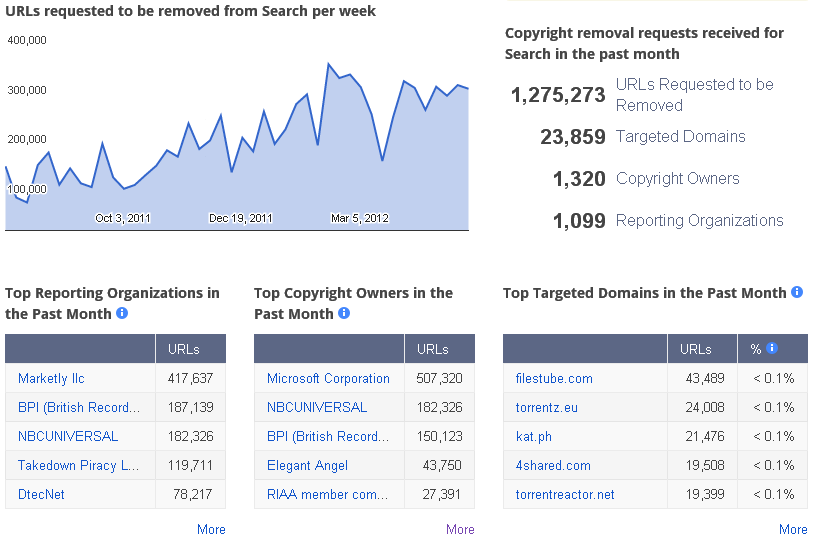
Google DMCA Takedown Stats

So many links taken down, but so many still remain, and more are added every day - is any of it worth the effort?

If you can’t stop the BitTorrent downloads, then another thing to try would be to make finding torrents a bit harder. While those skilled at these kind of things have go-to websites, many others may still rely on good old Google to help them locate what they want. And with Google on a mission to be more transparent, they’ve recently released stats on the DMCA take-down requests they process, and it makes some interesting reading. I’ll leave you to read the whole article, as well as browse the stats, to get the full detail, but the big picture is that Google process a sh*t load of DMCA requests per month, and you may be surprised at who is the most active in this area. I would have expected the movie and TV industries to be spearheading this pointless DMCA crusade, but it’s actually Microsoft, with almost half of the links removed in the last month belonging to the Redmond based firm. But even with over 1.2 million take-downs happening every month, it feels like all of this is just a drop in the ocean compared to what’s actually needed to “wipe out” pirated content links on Google. And with hundreds of thousands, maybe even millions, probably spent every month on filing and processing notices, you can’t really say it has worked very well. I mean, anyone who wants to pirate Microsoft software can still do so easily, and the same with downloading the latest movies, music and games. This whack-a-mole approach clearly isn’t working.

What’s also not working is DRM, the very thing that should have prevented the pirated download from being uploaded in the first place. GOG.com, the purveyors of DRM-free goodies, obvious has a bias when it comes to all things DRM related, but it was very interesting to read about the DRM experience of releasing The Witcher 2 by GOG’s parent company, CD Projekt RED. The Witcher 2 was one of those rare games that was released without DRM, but at the same time, a boxed version that feature SecuROM DRM was also available. So it was interesting to find that the most pirated version was actually the DRM’d version of the game, with the DRM-free and easily shared copy basically left alone. So far from DRM protecting games from piracy, it has somehow managed to encourage piracy.

The theory that the developers  of the game came up with was that because the piracy scene was all about bragging rights, there’s was no challenge to simply re-package a DRM free game and upload it. But the fact of the matter is that even with industry standard DRM in place, the game was pirated, 4.5 million times actually, so you’d have to question what exactly DRM does other than to inconvenience paying customers. And it’s good to hear that CD Projekt RED aren’t worried about the massive number of pirated downloads in any case, because they know it has nothing to do with lost sales. In reality, it has more to do with people demoing the game, and some of those people will buy the game. Eventually.

So that’s three anti-piracy methods: stop the upload, stop the links to the download, and stop the download, and none of them proving effective so far at stopping anything. All the money and effort wasted on anti-piracy stuff would be better used to actually focus on creating quality content, and I bet that will have a greater effect on sales than anything else.

Well, that’s all I got for you this week. More next week!
Weekly News Roundup (20 May 2012)

Sunday, May 20th, 2012

Welcome to this slightly late edition of the WNR. Normally, I would link to the latest edition of the monthly NPD analysis here for your consumption, but as it turns out, neither Nintendo nor Sony decided to release hardware figures for the month. This means that there’s no NPD analysis for this month, an all too frequent occurrence lately. I’ll try to give you what I have in the gaming section.

Another fairly substantial news week, well in my opinion anyway, so let’s get started.

Copyright

In copyright news, let’s start with the MPAA’s response to the recent well publicized filtering of The Pirate Bay, happening as I type across Europe.

Unsurprisingly, the MPAA backed the recent court decisions around Europe to have The Pirate Bay blocked, and also rather unsurprisingly, spun this form of censorship as being ultimately good for the consumer. The reasoning, they say, is that by removing the threat of websites like The Pirate Bay, it gives the creative community more incentive to not only create, but also to “provide consumers with content when they want it”. Apparently, the mere fact that consumers want it is not enough of a reason for the “creative community” to cater to their needs, but you also need the right environment (although the real creative community, the artists and the like, usually have no power to decide how something is released, a decision that’s usually left to men in suits). This might at least be a point you could argue, but only if filtering actually works.

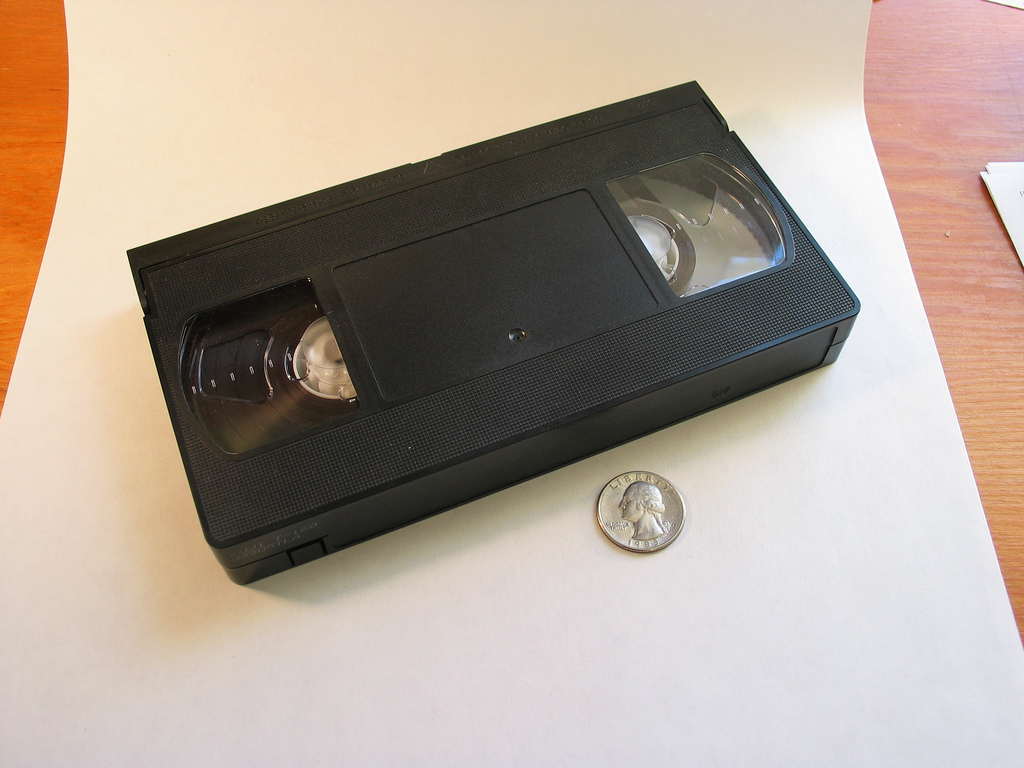
VHS Tape

If the MPAA had their way, this VHS tape would have never existed - photo by Jared C. Benedict, Creative Commons License

It’s also rich hearing it from the MPAA, considering their own history with innovations, to suggest that websites like The Pirate Bay are the only reason why they’ve not yet bothered to fulfil the needs of today’s consumers. Remember that these were the guys that were against the VCR, were for region control that barred consumers from getting content “when they want it”, and possibly still pretty angry at the whole Interweb thing. Apple, Netflix, Amazon have done much more to fulfil the consumer’s needs in recent times, and the interesting thing here is that all of these companies are tech companies, not film or music companies.

If anything, it’s BitTorrent and The Pirate Bay that has forced the industry to be more malleable to the demands of consumers. They can no longer afford to fool around with release windows (which are now far shorter than they were a decade ago), with region control (much less common on Blu-rays than compared to DVDs), with price control (note the ever decreasing price of discs), and they’re now forced to support services like Netflix, even if it means making less money. They’ve had to compete with the likes of The Pirate Bay out of necessity, but maybe they’re hoping censorship can allow them to turn back the clock, although  in my opinion – and if you’ll allow me to use another cliche – the genie may already be out of the bottle.

And does piracy really affect revenue that much? A new research paper suggests that pre-release piracy, the worst kind according to the MPAA and RIAA, may actually help sales. The research paper by North Carolina State University’s Robert Hammond suggests that pre-release piracy may actually help album sales. No theory is given as to why this may be the case, but I suspect it’s because piracy has become just another way to advertise. This follow another study a couple of months ago which found no correlation between pre-release movie piracy and US movie ticket sales. Both studies seems to go against industry sponsored studies, and the common believe that, piracy, especially pre-release piracy, is costing the industry billions. But the industry has never really looked at the reasons why people prefer pirated content, instead, choosing to believe it’s simply a case of freeloaders “stealing” because they’re freeloaders.

People pirate because they might not have the money to pursue the legal alternatives; or they never felt it was worth the money and want to try it out for free; or they might feel piracy is more accessible than the legal alternatives; or they just like to get stuff for free, even if they have the money for it. Two of the above scenarios will not lead to any extra revenue, no matter how many websites you block, while one of them is clearly the fault of the content owner. Only the last scenario, probably the least likely (that people who have loads of money are shunning the likes of  iTunes and Blu-rays in favour of manually loading MP3s onto iPhones, and watching blurry movies on their laptops), derives any benefit from blocking out piracy altogether, which in itself is a fantastically unrealistic proposition (although I suspect Hollywood execs are used to the fantastically unrealistic, considering they produce so much of the same crap for our consumption).

Speaking of unrealistic propositions, Microsoft is providing funding to a Russian company working on a way to block BitTorrent downloads. With no details being available about how it works, and little detail about how it actually works in the real world, there’s not much one can actually say about it. Most of these types of blocks works by seeding fake data into streams, and this is not new. BitTorrent is incredibly adept at filtering out the bad and leaving the good, so while it may temporarily make downloads a pain, it won’t do it forever. At the end of the day, BitTorrent is just another file transfer protocol, so the problem with going after the protocol is that you’ll have a new and even more robust protocols to deal with later down the track. If you really want to solve the problem of piracy, you’ve got to go back and examine the reasons why people choose to pirate in the first place (and take note of the people who don’t have a valid legal alternative, due to regional restrictions or release windows, or unrealistic pricing, and maybe offer them a choice).

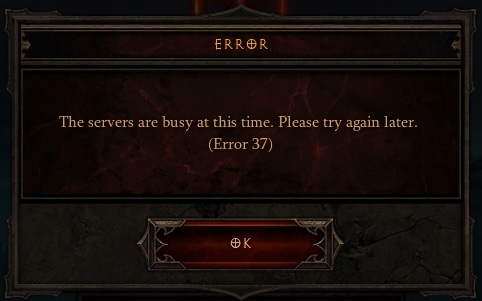
Diablo 3 - Error 37

The dreaded Error 37 plagued Diablo III on launch day, as it becomes the highest profile DRM-fail in the history of gaming

A lot of people saw it coming, but as expected, the launch of Diablo III turned into a DRM-tastic disaster for Blizzard this week. One of the most anticipated games of the year (or decade), with one of the most controversial DRM decisions in regards to the single player campaign, and a near simultaneous global launch – a recipe for disaster, unless Blizzard go beyond the call of duty to provide adequate servers for all. Unfortunately, they did not.

Back when Blizzard first announced the controversial DRM, they were keen to stress that it wasn’t piracy related. Rather, it was suppose to be a sort of elaborate anti-cheating system, although that seemed confusing at the time for a game that was always largely a single player experience. But as we now know more about the game, and especially the built-in Auction House system, it’s much more clear why Blizzard went with the “always-on” DRM approach (and they were right, it’s not about piracy, or at least not all about it). In order to ensure the subscription-free Diablo III doesn’t cannibalize Blizzard’s major subscription based property, WoW, and to take the “black market” trade for in-game items in-house, the Auction House system was devised as the solution. But in order for the market place to remain rational, cheating, hacking and other unfair tactics had to be stopped – the always-on DRM is Blizzard’s solution to this. It’s a valid explanation as to why it’s present, and why it may be needed, but having a valid, non anti-piracy related explanation, won’t please diehard fans, who were none too pleased with the Auction House addition in the first place. But Diablo III is the only Diablo game in town, so to speak, so it’s not as if they have a choice if they want their fix of Diablo (disclaimer: I’ve purchased Diablo, even though I should know better).

But for games where it’s easy to make the decision not to bother buying, I’d caution publishers against taking gamers for granted in this way. DRM should either not exist, or it should be invisible, as otherwise, it becomes a liability.

High Definition

Does the world need another physical media based format, even if it is a royalty free, open standard, based one?

Well, whether you think one is needed or not, free software advocate (free as in freedom, not as in beer) Terry Hancock is going to make one. Dubbed “Lib-Ray”, it’s based on a MKV container, using the VP8 video codec, with an HTML5 based menu system, with everything stored on SD media. The name may sound similar, but this is definitely not a Blu-ray challenger (and not intended to be), although it could give independent filmmakers a nice standardized way to distribute a physical copy of their films, without having to pay the likes of Sony, Panasonic and Microsoft for the privilege. It’s not the worst idea in the world, although without real hardware support, the format will have a long and hard struggle for acceptance, even by the indie scene.

Gaming

Very much related to Blu-ray, but also very much a gaming related news item, was a former Microsoft boss’s take on the relative “success” of the Xbox 360, and why it actually happened.

Robbie Bach, the former president of Microsoft’s Entertainment & Devices Division, says that Sony’s ill planned and badly managed transition from the hugely successful PS2 (70% market share) to the expensive, delayed PS3 (30% market share) made it possible for the Xbox brand to triple its market share during the same period. The expense and delay had a lot to do with the inclusion of Blu-ray support for the PS3, although it did help Sony win the HD format wars.

Sony PlayStation 2

The PS2 dominated the video games market with 70% market share, but the transition to the PS3 was problematic for Sony, not just because developers were actively backing a second horse in the race - the Xbox 360

The ease in which developers could develop on the Xbox 360, compared to the PS3, also seems to be a factor (something that even Sony admits), but the same developers also had a vested interest in seeing Sony’s standing knocked down a peg or two – nobody wants to publish in a market with only one big player, and support and investment by publishers like Activision and EA, in Microsoft’s then new console, made it possible for a second major player to emerge, according to Bach. Of course at the time, nobody expected Nintendo to ultimately come up with the most popular console of this generation, but that didn’t really change the strategy for publishers much, as the Wii was never a serious platform revenue wise for them.

As mentioned earlier, lack of NPD hardware stats means our monthly NPD analysis is not going to happen, and so I’ll talk about it in brief here instead.

The Xbox 360 was the most popular home-based console for the month, with 42% market share amongst the home based console, selling 236,000 consoles (down 21% compared to the same month last year). This leaves 326,000 units sold between the other two, and using a similar split as last month for the Wii/PS3, then it’s about 214,500 for the PS3, and 111,500 for the Wii – but the split is probably a bit more even, as the Wii numbers looks too small, and Easter is usually kinder to the cheaper consoles.

Software wise, Prototype 2 dominated, but it looks like it sold less than 236,000 copies on all platforms combined, which is pretty weak for a top selling title. Kinect Star Wars was in second place, decent in terms of ranking, but still weak in terms of actual unit sales probably.

Hopefully, normality resumes for the NPD analysis next month, but we’ll have to wait and see.

And with that, we come to the end of another WNR. Hope you’ve had a good week, hope the next week will be better, and see you again in seven days.

Game Consoles – March 2012 NPD Sales Figure Analysis

Monday, April 16th, 2012

The March 2012 NPD figures are out for US video game sales, and the industry is looking for any signs that indicate things may be on the up again, following a pretty poor January and February period. It is also the first time in 2012 that included the release of an A-list title, Mass Effect 3.

As NPD no longer releases full hardware sales figures, this feature is reliant on the game companies, namely Microsoft, Nintendo and Sony, to release their set of figures and based on “statement math” (that is, arithmetically calculate missing figures based on statements made). For March 2012, these are the statements made by the gaming companies:

  • Nintendo revealed that “nearly” 175,000 Wiis were sold in March (via IGN)
  • Microsoft revealed 371,000 Xbox 360 units were sold, with 42% of the home based console market share (source)
  • Sony did not reveal any figures for the PS3

A little bit of “statement maths” tells us that a little more than 337,000 PS3s were sold.

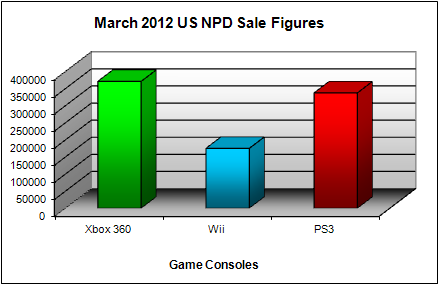
And so the figures for US sales in March 2012 are below, ranked in order of number of sales (March 2011 figures also shown when available, including percentage change):

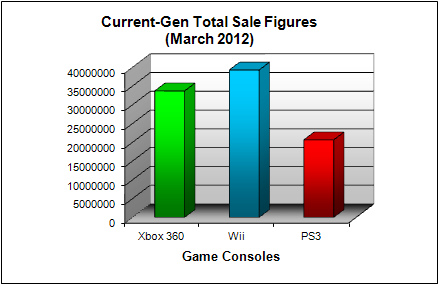
  • Xbox 360: 371,000 (Total: 33.7 million; March 2011: 433,000 – down 14.3%)
  • PS3: 337,000 (Total: 20.7 million; March 2011: N/A)
  • Wii: 175,000 (Total: 39.3 million; March 2011: 290,000 – down 39.7%)
NPD March 2012 Game Console US Sales Figures

NPD March 2012 Game Console US Sales Figures

NPD Game Console Total US Sales Figures (as of March 2012)

NPD Game Console Total US Sales Figures (as of March 2012)

My prediction was:

March is traditionally a slightly slower month than February, so while the year-on-year downward trend may continue, there is the release of an A-list title in Mass Effect 3. The hardware sales order should remain the same.

The release of Mass Effect 3 really didn’t help hardware numbers, and March was, as expected, down compared to February, with the hardware order exactly the same as last month as well.

For the Xbox 360, this marks the 15 months in a row that the console has beaten the Wii and the PS3 as the best selling console for the month – a terrific result, and surprising considering what had happened just before the run began (the Wii had a huge lead for the first couple of years, and the PS3 Slim/price cut seems to have rejuvenated the system – then the Xbox 360 released its own “Slim” version, followed shortly by Kinect, and it has never looked back). Microsoft PR was also keen to point out that “Total retail spend on the Xbox 360 platform in March (hardware, software and accessories) reached $430 million, the most for any console in the U.S. and more than the spend on PS3 and Wii combined” – for all the talk of console numbers and consecutive sales leads, in the end, it’s the income that’s important, and the 360 is doing pretty well. The stellar performance of Mass Effect 3 on the platform was also a talking point, but we’ll cover that later on when we discuss game sales.

For the PS3, March can be seen as a positive one, with the PS3 only selling 34,000 fewer units than the 360 – the gap between the two consoles has narrowed in recent month. The exiting of Wii from the competitive home based console race, making it really a two horsed race, has probably helped the PS3 absorb a few more buyers, and it was the console that appears to have done the best when you do a year-on-year comparison for March. Still, it’s looking unlikely that the PS3 would catch the Xbox 360 in this generation (in the US of course, globally, that’s a different matter), even with the price cut that analysts have been calling for (which Microsoft can easily match). But while there is still some life, not much, but some in Kinect (with Star Wars Kinect just being released, plus Kinect support for Mass Effect 3 and Skyrim), the PlayStation Move appears to be dead in the water for now.

As mentioned above, the Wii is now selling around only half as many units as the PS3, not to mention the Xbox 360, and the final few month of the console as Nintendo’s lead home based platform could be a painful few. Like most Wii owners, Nintendo are now probably very keen to move on to something better. It’s probably a bit too early to provide an eulogy for the platform, as there’s still a good chance it may still end up staying the best selling console of this generation (in the US) if the Xbox 360 can’t make up the 6 million difference between now and when it too is retired.

For games, March was all about Mass Effect 3, and having sold 1.3 million units, it was the clear number one – the next best was Resident Evil: Operation Raccoon City with less than half as many copies sold. ME3 also sold more than twice as many copies as ME2 when it first came out. For Microsoft, a little extra celebration is called for, as ME3 sold 4 times as many copies on the Xbox 360 than on the PS3. The sheer dominance of the Xbox 360 version can most likely be attributed to the first game in the series not being available on the PS3, and the nature of the series itself which allows gamers to continue on using save files from the previous game. Actually, if you look at the table below, you’ll see lots of new releases, but sales still managed to decline 26% compared to a year ago. Here’s the full software sales chart for March (new releases shown in bold):

  1. Mass Effect 3 (EA – Xbox 360, PS3, PC)
  2. Resident Evil: Operation Raccoon City (Capcom – Xbox 360, PS3)
  3. MLB 12: The Show (Sony – PS3, PSV)
  4. NBA 2K12 (Take-Two Interactive, Xbox 360, PS3, PS2, PSP, Wii, PC)
  5. SSX 2012 (EA – Xbox 360, PS3)
  6. Street Fighter X Tekken (Capcom – Xbox 360, PS3)
  7. Mario Party 9 (Nintendo – Wii)
  8. Call of Duty: Modern Warfare 3 (Activision, Xbox 360, PS3, Wii, PC)
  9. Naruto Shippuden: Ultimate Ninja Storm Generations (Namco Bandai – Xbox 360, PS3)
  10. Major League Baseball 2K12 (Take-Two Interactive, Xbox 360, PS3, PS2, PSP, Wii, NDS, PC)

So prediction time. April is traditionally a very slow month, what with the Easter break and everything, so if the industry is looking forward to better results, it will be disappointed. The sales order for the consoles should remain the same. The list of new games being released looks quite lacking indeed, with Kinect Star Wars and The Witcher 2: Assassin of Kings looking like the picks of the bunch on the 360, and hardly any new games of note on the PS3 judging by the current sales charts.

See you next month.

Weekly News Roundup (15 April 2012)

Sunday, April 15th, 2012

Welcome to another edition of the WNR. Not a very busy weeks judging by the number of news stories, so hopefully we can get this done rather quickly. I’ve been busy working on that little update for Digital Digest, which I promise will be launched next week, even if it’s still only half-completed (to be fair, it’s more like 80% completed). And you know I’m serious about meeting this rather artificial deadline by the fact that I didn’t even play that much Skyrim this past week!

One development that came too late in the week to be included was the March NPD results, and I’ll write the full report early next week.

Copyright

Let’s start with the copyright news, starting with the revelation that, even within the MPAA itself, not everyone was convinced that SOPA was the right solution for the web piracy problem.

SOPA Protests

It seems the anti-SOPA/PIPA sentiment was also alive and well within the MPAA itself (photo credits: Alain-Christian @ flickr)

When the anti-SOPA Internet Society hired a former MPAA executive, there was a bit of a controversy as you would expect. This prompted the MPAA’s former chief technology policy officer, Paul Brigner, to come out and explain a few things about his new appointment, including his apparent opposition to SOPA/PIPA. It seems Brigner left the MPAA at least partially because he felt SOPA was not the right solution to the piracy problem, and that SOPA and other “mandated technical solutions” are not “mutually compatible with the health of the Internet”. If the MPAA can’t even convince it’s own tech policy officer of the merits of SOPA, perhaps it really doesn’t have much merit at all.

But you get the feeling that the MPAA will never be fully satisfied until they get the power to not only squash any website it wants, but also to force others (like ISPs, governments) to help them do most of the heavy lifting. They will have ruined the Internet by then of course, probably only to find out that piracy has not only not slowed, but it has shifted to other parts of the Internet that can’t be easily controlled or legislated. And that, without argument, would be a far worse situation than what the one today.

It appears “blowback” invariably happens every time the copyright lobby launches a new crackdown, especially using technological measures. Every DRM has been met with an even stronger anti-DRM. Going after torrent sites have only resulted in more resilient torrenting methods. Which seems to indicate that going after video embedding, the MPAA’s latest manoeuvre, may backfire as well. The MPAA is getting itself involved in a legal showdown that originally only involved an adult entertainment company, Flava Works, and myVidster, a website that allowed people to post and share their video embeds, but  now includes the likes of Google, Facebook, the EFF, and of course, the MPAA. The tech giants saw the original court ruling, which was in favour of Flava Works, as severely flawed, setting a precedent that could have huge repercussions for the entire Internet. The judge in the case failed to make the distinction between linking/embedding, and hosting, something that could make Google Images liable for the copyright infringement of any image in its database for example, or make Facebook sharing a legal minefield. There was also the issue of a “repeat infringer” policy, or Flava Works’ claim that myVidster did not have one, and how it relates to linked/embedded and hosted infringement. It seems to me that the DMCA is rather unclear about what a “repeat infringer” is, and it seems the law leaves service providers and Internet intermediaries to define what it actually means and what kind of policy to implement, even if it is one not to the satisfactory of content holders. And since myVidster did have a working DMCA take-down process, and that it did not host anything, the ruling seems a bit harsh. Also, you have to question why Flava Works went after myVidster, instead of going after the hosts of the actual videos, the dime a dozen porn tube sites. The responsibility cannot keep on flowing downwards until you get to someone that’s easier to sue.

Hotfile

Hotfile's expert says the most downloaded files on their network were two open source files

An anti-MPAA theme seems to be developing this week, since the only other copyright story is also MPAA related. This one has to do with the MPAA’s lawsuit against Hotfile, where the MPAA, using their own expert, argued that 90% of all downloads on Hotfile were infringing content, and that the Hotfile had few, if any, legitimate uses. This week it was revealed that Hotfile’s own expert, Duke University law professor James Boyle, found that this really wasn’t the case at all. Professor Boyle found that in actual fact, the two most downloaded files on Hotfile were actually open source software, with more than 1.5 million downloads between them. And while the “90%” figure wasn’t entirely debunked, and I think it’s hard to argue against the fact that a large percentage of total downloads on file hosting sites like Hotfile and Megaupload are of the infringing nature, I think in terms of the sheer number of different uploads (ie. not taking into account the number of downloads), I suspect there is also a large percentage of non infringing files on these networks (your typical spreadsheet, Word doc, PDF, home videos and other files too large to share via email, that may very well only be downloaded once, but still a key reason why people use file hosting sites).

This really is another grey area in the law. Take an extreme example where 90% of all different files on Hotfile were non infringing, but 90% of all downloads were infringing, then would Hotfile’s non infringing uses make it legal, assuming the website had a working DMCA process? How much is too much, and how much is “enough” when it comes to anti-piracy?

High Definition

I read an interesting article this week on Forbes’ blog, where the headline was “Sony’s Blues Caused By Blu-ray”, a rather controversial title if you ask me.

The actual article, despite the headline, did cover more than just Blu-ray, and it did raise a couple of interesting points. So are Sony’s recent woes caused by Blu-ray? The recent woes being the global layoffs and the lack of profitability, of course, but to blame it on Blu-ray seems a bit counter-intuitive, considering Blu-ray seems to be the only recent success for Sony.

But what the Forbes blog, written by contributor Stephen Pope, was perhaps trying to say is that while Blu-ray is a victory for Sony, it just wasn’t a big enough victory to help the company stay profitable, and that in the end, it may even only a fleeting victory, considering the growing popularity of streaming vs discs.

Sony Blu-ray

Sony's Blu-ray victory may be short lived, as consumers are keen to move onto streaming (photo credits: mroach @ flickr)

I’ve long held the believe that Sony lost its dominance in the gaming sector by allowing the Xbox 360 to be a viable successor to the PS2, due to the one year delay in releasing the PS3 and the high initial cost of the hardware – both factors very much related to the included Blu-ray support. So while the PS3 helped Sony win the HD format wars, it also hindered Sony in keeping their dominance in the gaming arena. Looking at the current range of multi-platform games and the quality difference between the PC/Xbox 360 DVD version of the PS3 Blu-ray version, it seems the Blu-ray disc’s superior capacity has done little to actually benefit the gaming experience. And while the platform exclusives do try and make the best use of Blu-ray, they just aren’t selling enough to make a huge difference compared to the mega multi-platform franchises of Call of Duty or FIFA or GTA.

And streaming certainly does look like the future, if only for the fact that discs and the drives that read them are just not compatible with today’s portable devices. There is also a trend to consume more content (often for less money), and the physical cost and space that discs (and their packaging) requires, puts a limit on this consumption (while raising the price of it – last year, the average price people paid for streaming content was 51 cents, compared to $4.72 for discs). And access, with discs being limited to what you have purchased or what your rental outlet has in stock, just can’t compete with a streaming digital library of hundreds of thousands of titles that will never “run out of copies” (or suffer from bad scratches).

And even in terms of data storage, the 50GB Blu-ray offers, or even the 100+GB of BDXL pales in comparison to the TBs of data people need these days for their digital needs. So you have a multi-TB drive the size of a small book versus shelves full of BDs that you have to take time to burn, label, organize, that actually costs many more times than the drive – even in data storage, Blu-ray may be too little, too late.

So Pope certainly makes a few valid points, although I would say the biggest problem for Sony is that it is neither the design powerhouse that is Apple (Sony is at times too preoccupied with things like copy protection to consider things like ease of use, in my opinion), nor can it compete in the value stakes with the likes of Samsung (a company that’s also doing more on the innovation front than Sony, in my opinion).

Gaming

For gaming, the March NPD was yet another victory for the Xbox 360 (that’s 15 months in a row where the Xbox 360 has been the top selling home based console), although being the best of a bad bunch may not be such a meaningful award.

Also interesting was the news that Mass Effect 3 sold 4 times as many copies on the Xbox 360 than on the PS3 (I’m assuming this is North America only). This is perhaps a special case because the game carries on your saved progress from the last game in the series, not helped by the fact that the original game wasn’t even available on the PS3 (instead, relying on an interactive comic to record the key decision carried over from the first game). Also not helping is the fact that the PS3 is getting itself a rather bad reputation for having inferior multi-platform games, not just on ME3, but also on the other mega franchises such as Skyrim and CoD.

And I guess I also have to mention Skyrim’s upcoming Kinect support for the Xbox 360 version. The preview video looks pretty cool, although it looks like the game will only take advantage of Kinect’s voice support (and so the same features can probably be replicated via the PlayStation Eye’s microphone, if Sony really wanted it to happen by giving Bethesda some financial incentives, or making it really easy programming wise to do so. Some of the new Kinect features are already available via PC mods though, with a normal microphone, or even via the Kinect connected to your PC).

Screaming Fus Ro Dah at your TV is probably the geekiest thing anyone will do this year!

The unrelenting force of my addiction to Skyrim means that, just by mentioning it, I now have the sudden urge to play it for another hour or two. Which of course means we’ve come to the end of this WNR. See you next week.

Weekly News Roundup (8 April 2012)

Sunday, April 8th, 2012

So my pretty half-hearted attempt at an April Fools Day joke did actually fool a few people, although as you’ll read later on in this WNR, that little made up news article might really have been a preview into the future.

It’s been two weeks since my last mention of Skyrim, but rest assured, I’m still playing. 125 hours through, I think I’m about half way through the available quests (but having only completed just 2 of the questlines so far). Well worth the $50 or so I spent on the game (compare that to, say, your typical 2 hour movie on Blu-ray for $20, it’s excellent value).

Now onto the news …

Copyright

Staring with copyright news, I’ve made the point before that, despite conventional logic, decreasing piracy should not be the end goal of anti-piracy – instead, the goal should be to increase revenue.

And I’ve also made the argument that I don’t think all piracy leads to revenue loss – in fact, I think most acts of piracy don’t actually lead to any loss in sales, as these acts are performed by people who really don’t buy a lot of stuff, or don’t have the resources to buy any more.

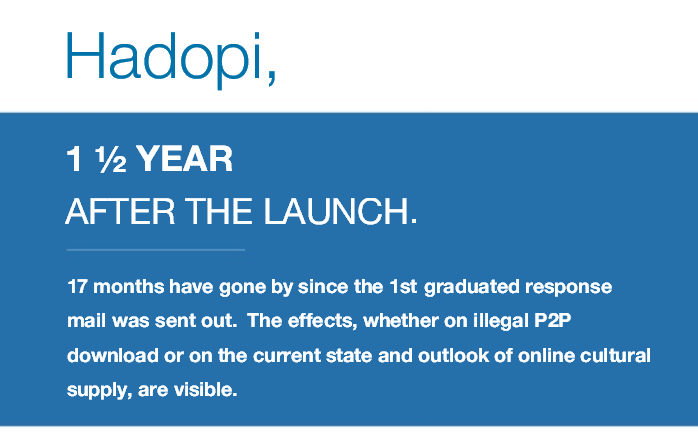
Hadopi Report

France's "Hadopi" three-strikes law seems to have dramatically reduced piracy, without actually increasing revenue

With anti-piracy efforts around the world ramping up, and the closure of several well known (alleged) piracy haunts, it would be extremely interesting to see the full financial impact of this expected piracy reduction, some say by as much as 40% in specific sectors (music, for one, after the closure of LimeWire). And so when Hadpoi, the French agency tasked with managing their “three-strikes” regime, released a report detailing the success of the program, with headline making statements such as “69% reduction” in piracy rates, this might have been just what was needed to see the real relationship between piracy and revenue. But while the report made ever bigger claims about the effect the regime had on piracy, what was sorely missing though were hard evidence of a rise in revenue, which as I’ve noted above, should have been the real goal of the whole exercise.

And while Hadopi might have been coy on the financial side of things, it just happens that most industry financial figures are public and available online. Looking at the French music and movie industry, and their performances in 2011 compared to 2010 (a full year with “three-strikes” in effect), the figures, if interpreted in a silly way, may actually point to the opposite: that piracy may have been helping sales!

The French recorded music industry recorded a contraction of 3.9% in 2011, while the movie industry didn’t fare much better, with revenue down 2.7%. In fact, the music industry’s loss was actually greater than the global average of 3%, possibly significant given that most of these other countries still have laws that are perceived to be much weaker than France’s.  Of course, to come to the conclusion that piracy was helping to fuel sales would be silly, and a mis-use of stats, and I guess it would also be slightly disingenuous to say that the piracy reduction didn’t have a positive effect on revenue. But what is clear is that there isn’t a 1:1 relationship between piracy and revenue loss, certainly not to the extent that the content industries have been trying to tell us.

What may be true is that the ever changing digital scene may have had a greater impact on the fortunes of both industries than the forced habit change of pirates in France. The music industry’s figures did show a dramatic increase in digital download revenue, higher than the global average, and that may be interpreted as a positive effect from “three-strikes”. But on the other hand, the introduction and adoption of new digital services such as Spotify, may actually be the main driving factor behind increasing sales. Similarly, while physical disc sales for the movie industry were down, VOD and other digital services recorded huge growth. So what may be actually happening is that new services are finally giving people, who used to pirate, the convenience (and the price point) they were craving. Unfortunately, most of these services probably earn less for their respective industries than compared to physical sales – sales that these industries had more control over. So innovation appears to be winning the war against piracy (who’d have thunk it?), but by being overly cautious and being overly obsessed with anti-piracy and DRM, the industries that had most to gain from this digital revolution can now only watch from the sidelines as companies like Apple, Amazon and Netflix take over a large part of the distribution process (and as a result, a large portion of the profits too). You snooze, you lose.

Viacom Logo

Viacom is still trying to fight YouTube, despite today's YouTube being totally different to the one it sued

It’s still not too late for them though, as they still control the content. As long as they realise the errors of their ways, and start embracing change, instead of fighting innovation, the content industries can still come out ahead as they have done with every technological transition that they have initially opposed. But that’s probably a little too optimistic, as these industries believe they’re in a fight for their lives, and they won’t quit until it’s probably too late. Take Viacom, who this week won an appeal to have their lawsuit against YouTube re-heard in court. The problem is that the YouTube that Viacom wanted to sue no longer exists, things have moved on piracy wise on the site, partially via threats such as their original lawsuit, but mostly due to changing user habits – and it is now a platform that companies like Viacom should want to be part of. Viacom, for their part, has been making the efforts, signing deals with Google to distribute their content via YouTube and Google Play and such, but you don’t really know if it’s them truly embracing the trend, or doing so reluctantly because everyone else is doing it (but still secretly want things back to the way it was). And if they do want to embrace services like YouTube, then why not just drop a lawsuit that they probably can’t win anyway?

Chris Dodd

MPAA chief Chris Dodd still holds out hope for SOPA/PIPA, and may have to "Bully" some tech companies into line to support future legislation

If the industry could only chill out and become a little bit less paranoid about piracy, perhaps we wouldn’t have the types of limitations, via geo-restriction, timed release windows and DRM, that technology providers have to contend with. And without these limitations, we may finally have a product or service that’s better than piracy, maybe not with a straight price comparison, but would be convenient and non-intrusive enough for people to not bother with torrents. Having access to all episodes of Stargate SG-1 via a $7.99 per month Netflix account, as opposed to downloading all the DVD-rips, for example (and an example that seems to be actually working in practice right now, judging by the relatively small number of leechers for the complete rip of the series on The Pirate Bay). But perhaps this too is far too optimistic, with MPAA’s chairman Chris Dodd this week still holding on to the hope that SOPA and PIPA will eventually pass through Congress (my April Fools Day joke news article aside), suggesting we haven’t seen the end of Hollywood and the record industry’s support for short-sighted and draconian non-solutions to the web piracy problem. Unfortunately, Dodd’s statement itself may not be considered that optimistic, as there are signs in the last few weeks (from the White House and beyond) that support is building again for SOPA like legislation. Meanwhile, the MPAA will certainly try to “Bully” more politicians into supporting it, while making sure this time these supporters won’t backflip just because a million or ten  come out in opposition to any proposed legislation. We all need to get ready for another fight.

Speaking of paranoid, the MPAA’s latest fear is that Megaupload would somehow get access to the data stored on their (former) servers and would somehow re-launch Megaupload, perhaps in another jurisdiction. Considering the fact that the Megaupload guys actually want to avoid prison, I suspect there’s little, if any chance Megaupload could be relaunched. But this latest MPAA manoeuvre will make it harder for users to get back their legitimate files, not that the MPAA cares or anything.

Gaming

In gaming news this week, I wrote a brief round-up of the latest “PS4” and “Xbox 720” rumours, starting with more creative names for both next-gen consoles.

Sony’s next console will have the codename Orbis, while Microsoft has chosen Durango. Orbis and Durango (sounds like two characters from a kid friendly adventure game), seems to have more similarities than differences, with both reported to be using AMD technology to drive both the CPU and GPU.

Not only that, both consoles seem keen to deploy some kind of anti second-hand game system, where each disc is locked to an account, and money needs to be paid (to Sony and Microsoft, who up until now have not been part of the second hand trade) to unlock a disc for another account. The latest rumours even sees Microsoft’s Durango borrow from Ubisoft’s playbook, with a requirement for a constant-on Internet connection (hope it isn’t true, because that would suck).

With neither console scheduled to make an appearance until late 2013, it’s perhaps a bit too early to take any rumours that seriously at this stage. Not that you should take anything I write seriously, April Fools or otherwise.

And on that serious/not serious note, that’s all I have for you this week. It’s not much, but it will have to do until next week. Happy Easter, Passover, and any other religious or non religious holidays that I may or may not be aware of.