Archive for the ‘Gaming’ Category

Weekly News Roundup (19 May 2013)

Sunday, May 19th, 2013

Welcome to another edition of the WNR. I think I’m getting a little bit too excited about the new season of Arrested Development, coming exclusively to Netflix this time next week. I’ve got my unauthorised Netflix subscription up and running ready for the final countdown, preparing myself with a pre-launch binge watching of the previous season that I hope won’t turn out to be a huge mistake, and when May 26 rolls around, I’ll be ready to say “annyong” to all 15 glorious episodes of the new season.

Before I can do that, I’ll have to get through this week’s WNR.

CopyrightSo it’s “Hollyweb” here we come. The W3C this week formally approved the use of the Encrypted Media Extensions (EME) to the HTML5 standard, which opens the door for DRM to be officially infected into HTML5 videos. EME won’t actually handle the DRM itself, but it’s a standardized framework that allows third-party DRM support.

The W3C says this is actually good for the open web because since DRM isn’t going away, the alternative would be an increasingly closed off web reliant upon proprietary systems to DRM’d video delivery (so basically what’s happening now). Even without EMEs, someone will find someway to squeeze DRM into HTML5, but the framework won’t be standardized or open or managed by the W3C. Or worse, DRM’d videos like Netflix would simply move off the open web, and be confined to the “walled gardens” of apps.

Hollywood: Stop DRM in HTML5

It’s Hollyweb, here we come, as HTML5 given the DRM go-ahead

Opponents of the move would point out that Flash and Silverlight, the two main proprietary systems used for DRM’d video delivery right now, are dying a slow death and a DRM-free HTML5 video standard would have forced a rethink on the whole DRM thing, for better or worse. But perhaps the W3C does have a point, in that the current climate would never allow DRM-free copyrighted videos to be distributed by Netflix, Hulu and others. If Flash and Silverlight officially dies or no longer works, and if DRM isn’t a viable option in HTML5, then just like the W3C predicts, we will lose the ability to use Netflix and Hulu and others via the web.

As expected, a lot of anger is being directed at the W3C, and the proponents of EME, Netflix, Google, Microsoft among others. But it’s important to remember that given a choice, none of these groups actually want DRM. Only Big Content is obsessed with DRM, and as long as they’re in the powerful position of being gatekeepers for the content we want, we will always have DRM. Let’s not forget who the enemy is.

And the enemy this week has been busy promoting its vision for Hollyweb, and how if you ignore the problems of DRM, unskippable ads, the arbitrary and fleeting nature of what is and isn’t available, and the sometimes high cost of it all, then there’s no way anyone should ever want to pirate. The MPAA this week launched a new website WheretoWatch.org to promote all the legal alternatives to piracy, providing a summary for most of the online based video services available today. It’s a slight change in tactics for the MPAA in their CRusade Against Piracy (CRAP™), designed to counter the argument that legal alternatives aren’t present.

Except that’s not the argument at all. The argument is that the legal alternatives, while definitely present, aren’t nearly good enough.

The problems? Content, for one. Netflix is probably the best, and certainly the most popular of the legal alternatives, but can you really honestly say that it has all the content that a typical web pirate would be looking for? I would actually say it’s the opposite, in that what Netflix has is all the stuff that pirates aren’t looking for. This isn’t a bad thing though, because due to the way BitTorrent transfers work, the “nobody wants to download” stuff are usually the ones that are quite hard to pirate as there just aren’t enough seeders normally. And sure, Hulu Plus has a lot of recent content, but that brings us to the second issue: ads.
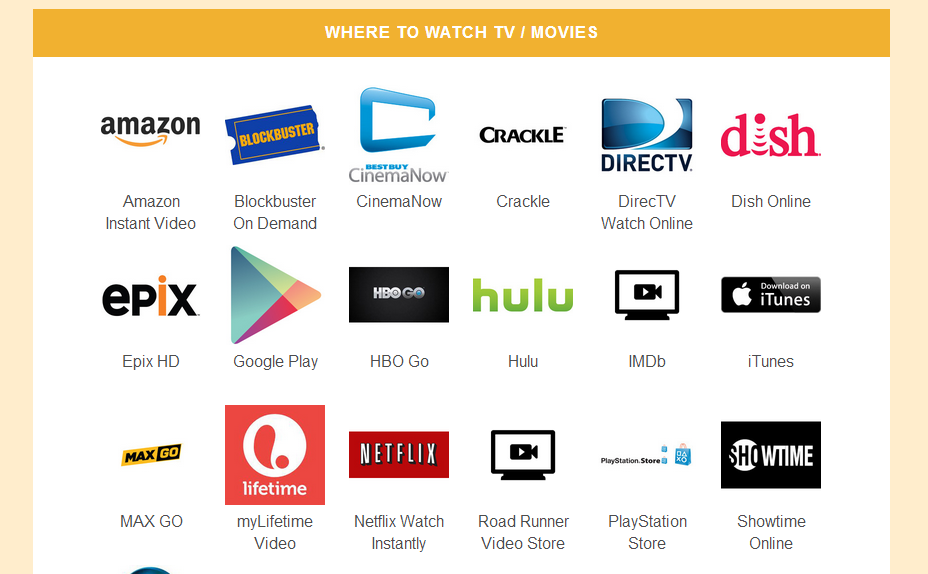
WheretoWatch.org

Plenty of options, but none that will satisfy people like piracy will, even if you don’t consider the pricing discrepancy

Now, advertising is needed, that’s not a question. But when you have to sit through four 30-second unskippable commercial breaks for every 20 odd minutes of content, and when the ads are pretty much just the same set, then it gets boring rather quickly. And this is despite having paid a monthly subscription fee for content you could have recorded on TiVo for free.

And that’s only when the service you want allows you to pay for it in a standalone manner. Try and get HBO Go without a cable HBO subscription, and see how far you get.

For the content that you really want, cost then becomes the biggest obstacle. For example, the HD version of Life of Pi on the Australian iTunes costs $29.99, but you could have purchased the limited edition Blu-ray 3D/Blu-ray/DVD/Digital Copy edition last week for less than $27. Where is the sense in this, and is it Apple’s fault, or the fault of 20th Century Fox, the distributor of the film? The regional price gouging is not new, and even government sponsored investigations into this issue seems to have had no effect on this greedy practice.

But the biggest problem with WheretoWatch.org is the fact that it is almost completely useless for someone, like me, who isn’t in the United States. Almost all of the services listed are US only, and only a couple out of the rest are actually available in Australia (and usually with reduced content). The fact that the MPAA went to all this trouble and still managed to forget anyone who isn’t in the US is precisely the reason why piracy rates outside of the US are much much higher. The MPAA being a US based organisation can be used to excuse the US-centric nature of WheretoWatch.org, but this misses the point that the MPAA are also representatives of the owners and gatekeepers of the content that those of us outside of the US want to watch. I’m sure we would all pirate less in Australia is we had HBO, or Hulu, or Netflix, without having to go down the geo-unblocking route.

The problem with legal access will be a key point in a new proposed reform of France’s copyright laws. With HADOPI three-strikes proving to be entirely ineffective in stopping piracy and hugely unpopular, a new report titled Culture-Acte 2 aims to re-balance copyright law to address the shortcomings of HADOPI. While “three-strikes” will be kept under the recommendations, the report also calls for making films and TV shows to be available on on-demand services far quicker than the current 36-month average. There’s also suggestion of a smartphone/tablet tax of 1%, to help fund the reforms.

In my mind, the current piracy problems are almost entirely due a supply and demand issue. Demand is high, but supply is limited and restricted, all of it intentionally in order to squeeze more out of a particular market. This would normally work to keep prices and revenue high, but once piracy becomes an alternative supplier, one that’s super cheap as well, then the artificial supply limitations and restrictions only end up driving more “customers” to piracy. And due to DRM, lack of interoperability and other issues, the legal product is often inferior to the illegal version, compounding the issue further. There’s also a deep lack of understanding into the preferred method of consumption, with the “all-you-can-eat” nature of the web naturally encouraging consumers to want the same with their video consumption needs, but with the option usually unavailable for the content that people actually want, the new release content.

I’m not sure if the government can or should legislate how the demand should be met by supply, but punishing consumers for wanting something better doesn’t seem like the solution to me.

——

A new study has found that the game industry’s own reported piracy figures may be magnitudes higher than the real piracy rate. Shocking! What a total surprise!! [INSERT SARCASM SMILEY].

The new study by professors at the Aalborg University and the Copenhagen Business School found that while piracy rates were still quite high, 12.6 unique downloaders in a 3 month period, it wasn’t nearly as high as the 10 million downloads per month that the industry has been touting.

The discrepancy is easy to understand though. The industry figures are often released by groups, like the ESA, whose main mission is to publicize the severity of the piracy problem. This kind of self-interest promotes biased conclusions, intentionally or otherwise. This new study aims present the most objective figures so far independent of any industry interests.

It was also interesting to note that the top piracy countries were the likes of Romania, Croatia, Greece, Portugal and Hungary – looking at the availability and price of legal alternatives in these countries may yield further clues as to why so many people choose to pirate games in these countries. Hey, maybe all these countries need is their own version of WheretoPlay.org [ANOTHER SARCASM SMILEY]

Gaming

The April NDP report is out, reporting on US video game sales for the month. As has been the trend recently, the report doesn’t make good reading.

The Xbox 360 was the most popular console yet again, but having only sold 130,000 units (45% down compared to a year ago), it was hard for Microsoft to celebrate this fact. Even with only 130,000 units sold, it still represented 42% of current generation home based console sales, meaning the Wii, Wii U and the PS3 added up to maybe less than 180,000 units. No matter how you split this (I’d say 35,000, 45,000 and 100,000 respectively), it doesn’t look good for any involved.

Wii U

The Wii U is dying a slow death. Will new Zelda and Mario games help?

The Wii, PS3 and Xbox 360 figures are forgivable, but the Wii U’s slow decline into obscurity is disheartening. EA, the biggest game publisher in the world, said this week that they did not have a single Wii U game in development, and one EA engineers even called the console “crap” and said that it was less powerful than the Xbox 360. It’s definitely not looking good for Nintendo at the moment.

Anyway, we’ll find out more about the Xbox 720/Durango/Infinity this week. Being the last of the “next-gen” consoles to launch, all eyes are on Microsoft to see if they can up the ante on what’s on offer from Nintendo (shouldn’t be too hard) and Sony (much harder).

On that note, we come to the end of this WNR. Hope you’ve enjoyed reading it. See you next week.

Weekly News Roundup (12 May 2013)

Sunday, May 12th, 2013

Happy Mother’s Day! Not sure how I can segue the holiday into a WNR mostly about BitTorrent and streaming, but this and this may help.

[SEGUE COMPLETED]

Let’s start …

Copyright

BitTorrent Inc this week chose to launch a strange attack on Netflix’s claims last week that BitTorrent traffic drops whenever Netflix enters a new market.

It was strange to me because it was clear that Netflix’s Chief Content Officer Ted Sarandos was referring to piracy related BitTorrent traffic (responding to a question about piracy in an interview with Stuff magazine). That BitTorrent Inc chose to counter these claims seemed at first to me like they were inadvertently accepting the association between BitTorrent, the company, and piracy.

Sarandos said last week that “When we launch in a territory the Bittorrent traffic drops as the Netflix traffic grows”. BitTorrent’s VP of marketing Matt Mason this week criticized Sarandos’s statement for linking BitTorrent with piracy. Mason also disputed the relationship between BitTorrent and Netflix traffic, saying the latter was most likely due to a BitTorrent algorithm that reduces traffic flows during peak usage times, including during peak Netflix usage hours.

The first part of the criticism I can understand, although one would have to take Sarandos comments out of context for that confusion to arise, but the second part is a bit curious to say the least. Mason’s explanation seem to be talking about a BitTorrent traffic drop during peak usage hours, but surely whatever traffic pattern changes exists whether Netflix exists in the area or not, and even then, the algorithm will only manage to push traffic to non peak times. There would not be an overall traffic drop over a period of time, which seems to be what Netflix’s Sarandos is suggesting. To me, Sarandos is saying that less stuff gets transferred via BitTorrent once Netflix moves into a new area, and I fail to see how traffic management can lead to less stuff being downloaded. And since Sarandos was talking mainly about piracy related traffic, why is BitTorrent Inc injecting themselves right into the middle of this particular hornet’s nest?

Mason does agree with Sarandos’s suggestion that the best way to fight piracy is by giving people what they want. And if this were true, then piracy related BitTorrent traffic should drop. For Mason to suggest that it hasn’t would require you to completely disassociate piracy with the BitTorrent technology, and that isn’t reality no matter how you may want to spin it.

BitTorrent Logo

What’s in a name? BitTorrent the company, the protocol, or the acts of piracy?

Perhaps Sarandos’s statement was a bit clumsy, in that he chose to condense the phrase “piracy related BitTorrent traffic” to just “BitTorrent traffic”, and also offered nothing to back up his claimed relationship between Netflix and BitTorrent traffic. But it seemed like an off the cuffs kind of comment, that taken into context, shouldn’t really concern the likes of BitTorrent Inc.

It just seemed to me like BitTorrent Inc was budding into a conversation that wasn’t even about them, by loudly proclaiming that the conversation shouldn’t be about them. Mission un-accomplished?

While I understand the frustration of BitTorrent Inc in regards to the far too liberal use of the term BitTorrent (something I’m guilty of too here), which I talked about in the last issue of the WNR, I fear it may be too late at this stage to disassociate BitTorrent with piracy. It’s become a shorthand, rightly or wrongly.

But instead of taking on Netflix over a somewhat lazy use of words, and seemingly agreeing and disagreeing with Netflix’s anti-piracy credentials at the same time, BitTorrent Inc should just keep on pushing the “legal content via BitTorrent” agenda, and continue to support companies like Netflix in their attempt to fight piracy the right way. It’s too late in the game to be this oversensitive about wording.

Along with Netflix, Spotify has probably done the most to stop piracy. But a flaw in the Spotify web player was exploited last week to full effect when a Chrome browser add-on called Downloadify allowed every song in Spotify’s 20 million strong catalog to be downloaded without DRM.

The add-on was promptly removed by Google, and Spotify soon fixed the flaw, but not before more than 16,000 songs were downloaded.

The flaw, which apparently had cached songs being unencrypted, had been there for at least five or six months. I do wonder what it means when it took so long for the flaw to be exploited, and that the Spotify web player was essentially DRM free all this time with not a worry in the world.

Also note that for the hardcore pirates out there, it’s still possible to record what’s being played by Spotify and “rip” it that way. Only those most serious about pirating would probably attempt it though, because, I mean, why bother?

Gaming

As we get closer to the official May 21 launch event for the Xbox 720, codenamed ‘Durango’, and possibly actually named Xbox Infinity, more concrete information about the console is being leaked week by week. This week, we have the story of an internal Microsoft email sent to all employees working on the console that seem to allay fears that the console would feature a much hated ‘always-on’ DRM system.

The leaked email specifically addresses the issue and says that the console will be “tolerant” of today’s Internet connectivity issues, which means that activities such as “playing a Blu-ray disc, watching live TV, and yes playing a single player game” will not be subject to any Internet connection requirements.

Phew.

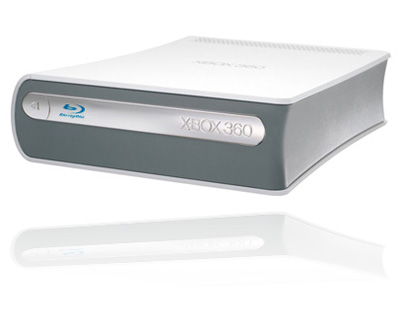
Microsoft Blu-ray Drive

After years of a rumored Blu-ray drive add-on for the Xbox 360, the next Xbox may finally get Blu-ray movie playback

To be honest, I never believed that ‘always-on’ DRM was on the cards. Sure, other leaked documents and rumors talk of an ‘always on, always-connected’ console, but it always sounded more like the description of a quick stand-by mode that also featured support for things like background updates. The truth of the matter is that console piracy isn’t so serious yet that ‘always-on’ DRM will be required at the expense of making gamers angry, certainly not for a new console whose actual copy protection system may take a while to be broken.

As a bonus, the leaked email also seem to confirm not just the use of Blu-ray discs for the Xbox 720, but the inclusion of Blu-ray movie playback, which would be a great upgrade to the Xbox 360’s media playback credentials. Unfortunately, another rumor suggests that this very inclusion is the reason the Xbox 720 will fail to meet its previously predicted 2013 launch date, instead being delayed until 2014 due to Blu-ray licensing troubles. Apparently, Sony has an exclusivity agreement in place for console based Blu-ray playback at the moment.

This could spell trouble for Microsoft, since timing is everything. Microsoft knows, that despite the Red Rings of Death problems with the early Xbox 360, the Xbox platform wouldn’t be anywhere near what it is now if Microsoft hadn’t released the console a year earlier than its competitors.

The same doesn’t look to be true for the Wii U unfortunately. Despite also releasing a year earlier compared to the PS4 and Xbox Infinity, I fear that when the three consoles are compared, the Wii U will look a lot more dated than just a year. I know graphics shouldn’t be that important, but it’s the easiest way to compare multi-platform titles, and the minor improvement that the Wii U has over existing consoles like the PS3 and Xbox 360 means its early release has no positive effect. At its time of release, the Xbox 360 was head and shoulders above the likes of the GameCube and the PS2, and Nintendo needed to do something similar if they really wanted to get back part of the hardcore gaming market.

And the sad part is that poor early sales will destroy any slim chance the Wii U has in going against the PS4 and Xbox Infinity. A low user-base will be enough to convince some developers to skip the Wii U entirely when it comes to developing multi-platform titles, which means a lack of new titles, which means even lower sales. This vicious circle is extremely dangerous, even with Nintendo’s good track record in terms of first-party titles, and the company needs to do everything it can to ensure developers continue to make stuff for the Wii U (even if it means big financial payoffs, a strategy that Sony and Microsoft are no strangers to).

That or dramatically cut prices.

And I think that’s it for the week. See you in seven.

Weekly News Roundup (28 April 2013)

Sunday, April 28th, 2013

As part of a new project I’m working on for our Australian readers, I’ve been testing out the various US based video streaming services. Man, you guys are really really spoiled in terms of content and price. Take Netflix for example – if it had been launched here first in Australia, the price would never have been $7.99 per month. More like $79 per month, probably with less content and more restrictions as well. And it’s not just content and price, it’s also quality. To put it into perspective, Netflix Super HD’s maximum quality is probably better than anything we see in broadcast here in Australia, and that includes the $100+ per month HD cable I’m paying for.

I just hope I have enough bandwidth. I thought 300GB per month would be more than enough when I switched a month ago, but having used 15GB per day for 3 out of the last 5 days, I’m not so sure now.

Despite the Netflix (and Hulu Plus) bingeing, I did manage to get some work done (plus the bingeing was part of work, um, yes), so here’s the WNR.

Copyright

Microsoft, maybe. But Google, the BBC and Netflix as bad guys? Most people won’t think that. But when it comes to adding DRM to HTML5, all of them are indeed on the wrong side of the issue.

The reason these companies all want to ditch Flash or even Microsoft’s own Silverlight is that with HTML5 and native support by modern browsers, it makes writing video applications for PCs (and tablets and smartphones) that much easier. Instead of maintaining a dozen different apps for different platforms, you can build a HTML5 based one and customize that for each platform.

No DRM

It’s still not too late to stop DRM being added to HTML5

But in order for the switch to HTML5 to happen, DRM must happen too. To be fair, the requirement for DRM doesn’t come from these tech companies, but from the media companies that supply them with content. So once again, the story becomes “Hollywood wants DRM”, which isn’t really isn’t news is it?

Still, adding DRM to HTML5, the first HTML standard to have it if Netflix and co get their wish, is bad news. Not only does it mean an expanded proliferation of DRM, it also endangers the free nature of the web itself.

But since everyone loves Netflix, and hates Silverlight and Flash, it’s gonna be hard to get people worked up about WWW DRM. This petition is probably the closest we’ll get to an Internet protest.

I don’t really get it though. Netflix’s $7.99 per month makes pirating anything that’s already on Netflix quite pointless. And releasers usually takes the paths of least resistance, which for movies would be via DVD/Blu-ray rips, and HDTV recordings for TV shows. The only time people will bother ripping a Netflix stream would be for exclusive shows like House of Cards (and only when another source isn’t available). But then again, for $7.99 per month, the only people who end up pirating would be those that you really can’t squeeze any money out of, so where’s the loss in profit?

——

If a government mandated filtering solution isn’t going to happen, and I hope it won’t, then the next best thing for Big Content may be a commercial solution. Up steps McAfee, as a new patent application filed by the company aims to add an anti-piracy filter to the company’s existing SiteAdvisor service.

SiteAdvisor is right now mainly used to blocks access to search engine result links for malicious or adult content, but this new patent seeks to expand the tool’s functionality to include copyright infringing content. So even if Google doesn’t filter out links to sites like The Pirate Bay, SiteAdvisor will step in and do it for them, although the system administrator will have to option to still allow visits to these sites (after the user is forced to read a warning message).

And if the companies behind the major security software tools can all be convinced to implement something like this, patent permitting, it would be like Christmas come early for the likes of the MPAA and RIAA. It won’t stop what I would like to call “persistent pirates” (they would have turned off SiteAdvisor or the equivalent feature in their security software from day one I suspect), but for the “casual pirates” that Hollywood and the music industry insists are prevalent, those that are unaware of their “seriousness” of their activities or lack the technical know-how to bypass these kind of filters, it might just be enough.

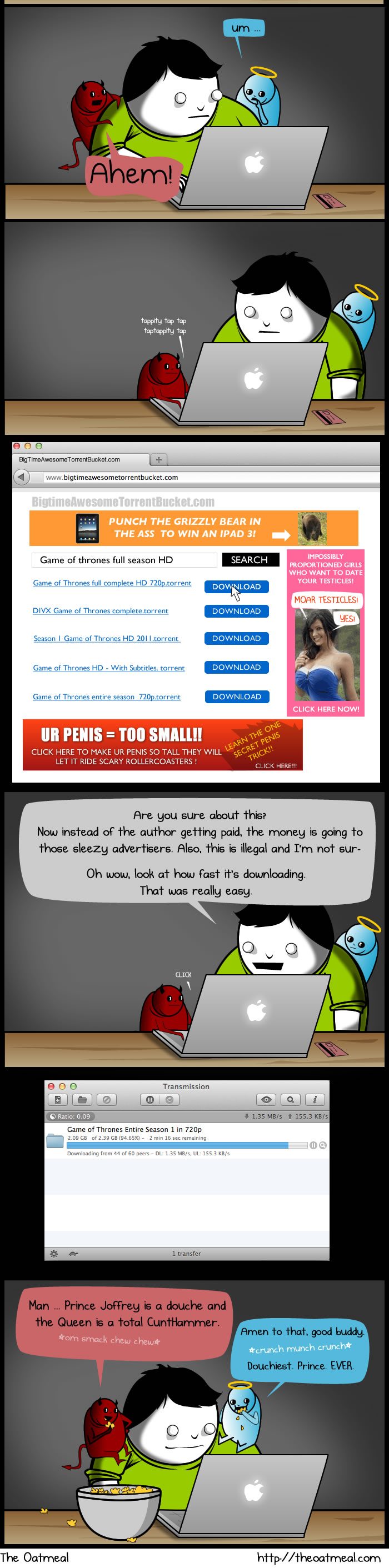
The Oatmeal: Game of Thrones

Watching Game of Thrones can be harder than actually winning the Game of Thrones

But I think most pirates know exactly what they’re doing, and why. Just like Australians who download Game of Thrones know the exact rationale behind their actions. Which is why it was fairly undiplomatic for US ambassador to Australia Jeffery Bleich to post a long-ish rant on Facebook calling Aussies that download GoT no good thieves, making Ambassador Jeffery just as popular as King Joffery in the process.

Once again the tired, and plainly wrong, analogy of theft was used, admittedly a very clumsy one involving stealing a book from your neighbour’s home that I’ve not seen before. Apparently, downloading a *copy* of a Game of Thrones episode is just the same as breaking in to your neighbour’s home and stealing a book. This analogy would only be true if Australians were actually going into other people’s homes and stealing hard-drives full of pirated GoT episodes, which ironically would actually make people think twice about piracy for fear of an unwanted home invasion. Or if Aussies broke into HBO headquarters and stole the original and only copy of GoT episodes.

The correct analogy of course is one that involves your neighbour taking the time and effort to photocopy all of his books and then leaving copies on the street for anyone to take. By taking a copy, you’ve committed copyright infringement. If the right (or wrong) people took copies, it may lead to lost sales and hurt the rights owners. It may even hurt them so much as to bankrupt them. But it’s not exactly home invasion and burglary, is it?

And what if one of the people who picked up a photocopied copy, a person that never intended to buy the book in the first place, love it so much that he went to the bookstore immediately and purchased a copy? Doesn’t this count as a gained sale? Hasn’t the publishers, only in this one isolated incident to be fair, benefited from piracy?

As for the rationale behind taking and not buying, what if the bookstore was located really far away, like in another country? Or that for no particularly good reason, you had to wait months in order to buy the book locally compared to other countries, and that when it does arrive, it’s only available in an expensive, leather-bound, big print edition that weighs a ton, instead of an edition that you might actually want? That photocopied copy might then start to look like the much better deal, even without considering the pricing differences.

But no, it’s much simpler to just trot out the tired out analogies about stealing, shoplifting, and burglary apparently, and the equally tired and frankly dishonest lines about job losses and billions being lost every year.

——

The Pirate Bay has moved home again this week. That’s twice (or three times, if you count the temporary move back to the .se domain) in two weeks. This time it’s Iceland that becomes The Pirate Bay’s new port, with the new .is domain name. Unlike the Greenland domain name authority’s self-censorship of The Pirate Bay, the Iceland equivalent says that a court would have to decide on the fate of the new .is domain name before they would be willing to take any action. And quite rightly so, because it’s not the place for a domain authority to be judge, jury and executioner.

Gaming

I said last week that I wanted to wait another week to comment on the March NPD results, to see if more hardware numbers roll in. They haven’t, unfortunately. So analysis turns to a game of educated guessing. Thanks a lot, NPD!

But if I had to guess, I’d have to say that the Wii U probably didn’t sell very well in March. If you asked me to tell you why the Wii U is struggling, then I’d probably have to say that it was down to several factors.

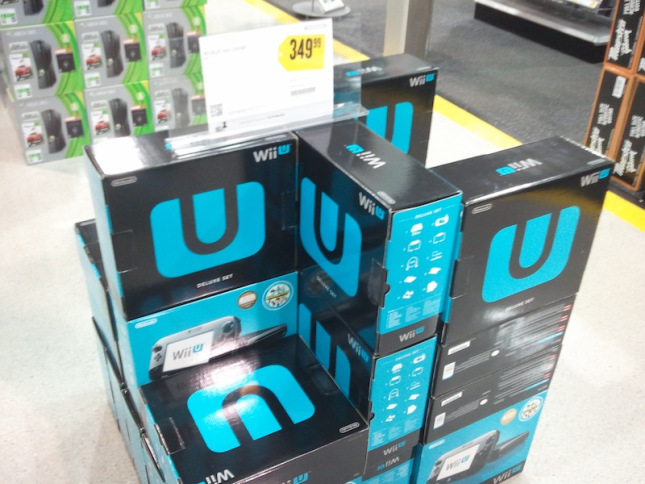
Wii U Boxes

Wii U sales remain sluggish because it isn’t a huge improvement on the 360/PS3, nor is it cheaper or a better media device

One, the Wii U’s hardware, while an improvement on the Wii, is barely an improvement on the more than half-a-decade old PS3 and Xbox 360. If Nintendo wanted to go after the hardcore gamers, the Wii U isn’t going to do it.

Two, casual gaming has moved on from the days of the Wii. Now, it’s all smartphones and tablets and really really cheap games. The Wii U has a tablet, but can it really do things, in a standalone fashion, that the iPad cannot? Plus, Wii U games are still expensive.

Three, the cost. With the PS3 and Xbox 360 getting to the end of their release cycles, the Wii U is just too expensive by comparison. It’s just not good value, as it doesn’t play Blu-ray like the PS3, and its media streaming capabilities aren’t better than the Xbox 360’s. The lack of game titles surely can’t help, even with the presence of first-party exclusives.

So while more first-party games will help the Wii U, but by holiday 2013, the much more impressive PS4 and Xbox 720 will be out and I suspect the the Wii U will look even more outdated by then. Which is a shame, because had the Wii U been here just a year earlier, it might have been a completely different story.

Speaking of stories, I must get back to mine on Netflix. So many things to watch, so little time. See you next week.

Weekly News Roundup (21 April 2013)

Sunday, April 21st, 2013

Plenty to go through in this downer of a week, so let’s not waste any time …

Copyright

Is it still going on? Apparently, yes. Viacom is still suing Google’s YouTube for copyright infringement, despite a 2010 court ruling throwing out the case via a summary judgement in favor of Google/YouTube. That decision was appealed, partially successfully, and the case was directed back to the lower courts. But once again, Judge Louis Stanton has ruled in favor of Google, arguing that YouTube was under the protection of the DMCA’s Safe Harbor provision. And guess what? Viacom is going to appeal this decision too.

It’s all getting quite boring now, to be honest. The two companies are actually working side by side these days, so only Viacom knows what the point of the lawsuit is at the moment. That Viacom is still not letting go is probably more face saving than an actual sense of feeling wronged, and whatever YouTube has done in the past, what it does now (in terms of what users do with the service, and what YouTube does for content holders) is so far removed from what went on before, it’s practically like suing a different website.

Just move on Viacom. Everybody’s bored already, including  the judges, and probably your shareholders as well. Concentrate on actually making content that people want to pay for, instead of blaming everyone else for your woes.

Speaking of things that people actually want to pay for, Netflix’s plan to fight off its old and new subscription-VOD competitors appears to be working, as its original programming has helped the company to gain new subscribers. But it’s Netflix’s old business, the DVD (and Blu-ray) rental one, that is now becoming a risk for the company, an analyst has warned.

Photo of Netflix on iPad

Netflix’s growth is dependent on revenue from its disc based business, but with that shrinking, Netflix may be at risk says analyst

While Netflix has over 29 million streaming subscribers, 64% of the company’s 2013 revenue is still expected to come from disc based subscribers. In other words, disc rentals are funding Netflix’s streaming expansion plans, and with disc revenue expected to continue to fall, it could endanger Netflix’s plan to expand to more locations around the world, as well as fund new original programs.

If anything, it seems Netflix’s current problem stem from the fact that it’s too good for its price of $7.99 per month. Compare to say HBO, who can get away with $15 per month for only a few hit shows, Netflix, now with original programming, offers much more (and an essential babysitting tool for any parent or guardian). The increasing cost of securing rights to shows and movies, and increasing competition from the likes of Amazon and Redbox, all means that Netflix is still over-reliant on its declining disc based business to keep the company profitable and in expansion mode.

Subscription VOD is currently stuck with the low cost model first pioneered by Netflix, but I suspect going forward, there will need to be tweaks to the pricing model. Perhaps we’ll see an introduction to a “premium” subscription tier that includes more fresh and original content than the “basic” $7.99 package, and that may be needed to offset the billions Netflix currently spends on licensing and production.

And who wouldn’t pay another $5 or even $10 per month if it meant they could watch new seasons of shows like House of Cards and Arrested Development?

——

It didn’t incite as much hatred as SOPA, but CISPA may be just as bad, and unfortunately, the US House of Reps passed it with an overwhelming majority on Thursday. The CISPA cybersecurity bill will enable private business to share all your most private information with any government agency that requests it, and allows warrant-less database searches. Emails, photos and even passwords could all be shared with government agencies against your will, and there’s nothing you can do about it – CISPA ensure this.

Typically, supporters of this overreaching bill says that it’s targeting terrorists not ordinary citizens, and Rep. McCaul of Texas drove home this point even more clearly by actually using the terrible events in Boston as justification for CISPA.

But unlike SOPA, there isn’t the united front against CISPA that can work together to kill it off before it becomes law. For one, the likes of Apple, Google and Yahoo are cautiously supporting CISPA, despite opposition from the likes of the EFF and the ACLU. At least this time, the White House seems to be on our side, with President Obama threatening to veto the bill in its current form, and the Senate, having already turned away a previous version of CISPA once before, may have something to say about it too.

Gaming

Sony says they’re not going to make the same mistakes they made with their PS3 launch, and will launch the PS4 at a good price.

A photo of the New Xbox 360

Could a cheaper Xbox 360 keep the console alive when the Xbox 720 and PS4 (also to be cheaper at launch) arrives?

The PS3 was launched at a price that was a lot higher than that of rival consoles at the time (in Australia, the launch price of the 60GB console was close to the $USD 900 mark). This was despite Sony still losing money on each console sold. The reason for the high price was the included Blu-ray drive, and Sony argued that since Blu-ray players were quite expensive at the time, the PS3 actually represented good value for those also looking for a Blu-ray player.

This move paid off by ensuring Blu-ray won the highly tedious HD wars, but the victory came at the cost of lost market share to the likes of Nintendo and Microsoft. It also ensured Sony lost a ton of money for the first few years of the PS3.

But with Blu-ray players worth almost nothing these days (saw one today advertised for $USD 40), there aren’t any reasons why the PS4’s price point should be any higher than that of its rivals.

Although it could still be a lot higher than that of the Xbox 360, as Microsoft may be releasing a $99 version of the console to be launched along with the Xbox 720. It may be a response to the Xbox 720’s lack of backwards compatibility, but it could also be a move on Microsoft’s part to add new customers for the console. It might target those that want it as a cheap media streamer, with the added bonus of heaps of games of all types, from the casual/family to the hardcore. The only thing better than it would be a $99 PS3 (hint, hint)!

The cheap Xbox 360 and the cheaper (on debut) PS4 should help lift video game sales, but for now, things are still stuck in the doldrums. The March 2013 NPD US video game sales data has been released, and Microsoft’s Xbox 360 was top of the consoles with 261,000 units solds, but still down nearly 30% compared to a year ago. I actually want to wait a bit to see if any more data emerges for the Wii U in particular before commenting further on March’s NPD results, so let’s talk about it next week.

And that’s it for this edition of the WNR. See you next week.

Weekly News Roundup (14 April 2013)

Sunday, April 14th, 2013

A mixture of boredom, creativity and a desire to play SimCity (the game has been so cruel to me, I guess it must be some kind of Stockholm Syndrome), I decided to start writing fake SimCity news and publishing it on my own fake online newspaper. Introducing The Simsville Bugle, reporting the latest news as told from the perspective of citizens of my very real SimCity city, Simsville, home of the Fighting Llamas. What do Simsvillians think of the recycling center bug, or the poor traffic algorithm in the game, that once you have an University, you no longer need to have a grade school or high school, or the fact that you have to put a water pumping station to suck in the outflow from the sewerage processing facility to have enough water for a large city? Read all about it in The Simsville Bugle!

Yep you guessed it, a slow week.

Copyright

Consumer rights took a blow this week as a New York federal court confirmed the notion that none of us owns the the digital content we buy. Or more precisely, what we buy in digital form is not the same as our purchases in physical form.

The case involved start-up ReDigi, who came up with the novel idea of allowing users to sell their iTunes collection. This did not go down well with record labels, and one of them, Capitol Records, sued ReDigi for copyright infringement. This week, the court sided with Capitol and basically confirmed what we have all suspected, that we don’t really own the stuff we buy, we merely license it.

Big DVD Collection

Buying a DVD or Blu-ray may not yield much resale value, but at least there is a resale value, unlike digital buys

To be fair, this has always been the case. Just because you purchased a Michael Jackson Thriller CD, it does not mean you actually own the music contained on it. You licensed it, but you did own the CD from a re-sale point of view, because of the first-sale doctrine that limits the rights of the copyright holder of the recording, Sony BMG in this case, from interfering with what you intended to do with the CD once you purchased it.

But first-sale has never applied to purely digital content, and so the court had to side with Capitol. Without the transfer an actual physical object, all you’re doing when you part with your hard earned 99 cents is buying the right to license the music for personal use, usually tied to the platform you purchased on or in the case of DRM, the actual digital copy of the file you purchased. You also normally get less rights in terms of returns and refunds, as many who “purchased” SimCity on Origin found out when they tried to get a refund (those who purchased via Amazon had better luck).

Which begs the question, if what I’m buying has no re-sale value, and usually cannot be returned for even a partial refund, then why do content holders continue to price digital content at the same or almost the same price point as physical purchases?

But I guess given the popularity of iTunes, Steam and other digital outlets, consumers don’t seem to mind too much. I’ve even read stories of people who sold their movie collection and converted it all to iTunes “purchases”. I guess the convenience of digital outweighs the reduced rights you would get as a consumer compared to physical buys. But we are getting less for our money, and so it only makes sense we should be parting with less of our money in the process. Much less!

——

Things did not go as planned for The Pirate Bay this week, as a switch to a new .gl domain name was halted and reversed by an uncooperative domain registrar, and for now, .se is still the home of TPB.

The switch came about due to fears of the .se domain names being seized, but a move to Greenland’s .gl was not happening either, as the company responsible for managing .gl domain names refused to get involved with the controversial company.

I guess we shouldn’t be surprised at this week’s events, since service providers have been scared to the point where they’re more than willing to do the dirty work of rights holders without much pressure.

The Pirate Bay

The Pirate Bay ship trying to find a friendly port to dock their domain name, but it’s not easy

The Pirate Bay says they still have plenty of domain names available for use if the .se domain gets seized, although the original .org one does still work, despite earlier fears that it might get seized too (that was a year ago, and the reason behind the initial switch to the .se domain name). Not that changing domain names would really affect The Pirate Bay that much – they could use the domain name ItchyMonkeyNuts.info and they would still be popular, and easily found!

In sort of related news, Google has bowed to pressure from the likes of the RIAA and will allow unlimited DMCA takedown request submissions for “trusted” participants, according to a report by TorrentFreak.

The RIAA has been critical of Google in the past, accusing the search giant of limiting the number of DMCA takedown notices. Google said at the time that this was a technical limitation, and also in place  to avoid abuse, but they will now allow trusted groups like the RIAA, MPAA and the BPI to circumvent these limitations.

The relaxation of these limits should see the number of takedown notices soar from the current high of around 20 million per month. In just over a year, the number of notices sent per week has increased from about 300,000 to nearly 4.5 million.

Gaming


Game publisher EA has been named The Worst Company in America, two years in a row. Coming after the whole ongoing SimCity fiasco, perhaps the title “worst company in America” might be a slight exaggeration, but the worst gaming company in the world might not be stretching things too much either.

The Simsville Bugle Logo

The Simsville Bugle has all the latest news from the SimCity city of Simsville

It’s not just SimCity though. Mass Effect 3’s rushed ending, selling FIFA 12 on the Wii as FIFA 13 with a few minor changes, the excessive use (or is that “abuse”) of DLCs, and the cynical milking of loyal gamer’s goodwill with mediocre sequels, have all added to EA’s bad reputation. This video tries to explain why EA’s actions are hurting the gaming industry as a whole, why we may be close to another gaming industry crash, and it’s worth a watch, despite its length.

Games are bigger and more expensive to make these days, and so this either means the risky move of taking more time to make a good game (like what Valve does), or the more cynical move to churn out as many games as possible in the shortest time possible and abuse a franchise to death, or incomplete and untested games that gets “fixed” via future DLCs. More and more companies are doing the latter and taking the gamer for granted, which is exactly what happened before the video game crashes of yesteryear.

And that’s it for the real news of the week, time for me to go away and write some fake news for The Bugle. See you next week.