Archive for the ‘Copyright’ Category

Weekly News Roundup (19 July 2009)

Sunday, July 19th, 2009

Welcome to another edition of the Weekly News Roundup. Come to think of it, I really should have numbered the WNR editions (for example, WNR #57), so I can easily refer to each. Yes, I could go and count each WNR and then start using edition numbers (there are 94 according to the WordPress category post count), but screw it.

A busy week this week, since I actually bothered to do some work. I started a new series called “The History of Digital Digest” to celebrate the 10th birthday of this website. Part 1 was posted this week, and it talks about how Digital Digest was launched, and some tidbits that have never been made public before. The June 2009 NPD figures came out and as usual, I have posted the full analysis. It marks another month in which the only happy party is Microsoft, as it was the only company yet again to have any sort of year-on-year growth. The Wii is still the best selling console (portables not included), but the PS3 is struggling, in hardware and software numbers. All could be fixed by the magical elixir known simply as “a price cut”, but it’s going to take a while for Sony to figure it out I suppose. Yes, they lose more money if they cut prices without cutting manufacturing cost, but how much money are they losing by being 3rd in the console race at the moment? And game sales, the stable of console manufacturer income, is very much dependant on hardware numbers – this is why most game console are sold at a loss. Just bite the damn bullet, Sony. Anyway, onto the WNR proper …

Copyright

Starting with Copyright news, continuing with The Pirate Bay coverage, or perhaps better expressed as “The Death of The Pirate Bay” coverage, the company that has bought TPB has hired a new man to helm the (in)famous website – step up Wayne Rosso, who is now courting the RIAA and MPAA and trying to make nice.

Wayne Rosso aims to destroy, I mean fix, The Pirate Bay by making it legal

Wayne Rosso aims to destroy, I mean fix, The Pirate Bay by making it legal

In a stomach churning interview, Rosso calls his best buddies at the RIAA and MPAA “unbelievably supportive” and vows to “turn over a legitimate new leaf” to make TPB completely legal. Rosso plans to do this by introducing some kind of fee, which will be used to pay the content owners – the fee can be reduced if users contribute P2P resources. I don’t see how this can work, because you cannot still offer pirated material even if you charge a fee and pass that on to the content owners, so the content would have to be legal and so will become limited by the content that content owners are willing to provide (so expect lots of DRM), which defeats the whole purpose of the website because there are already tons of sites offering the purchase of legal (and DRM infested) downloads. So if it wasn’t clear as to what will become of the TPB, it’s now pretty clear that TPB, as we know it, will end. At least if the intentions of the new owners are met – the only glimmer of hope is that often intentions give way to financial reality, and keeping TPB as it is might be more profitable.

The original founders of TPB have moved on it seems, and they’ve mentioned some political ambitions. The Swedish Pirate Party’s recent successes will no doubt fuel the political movement, with the Swiss Pirate Party being launched this week. There is already an Australia Pirate Party, although what Australia needs is an Internet Party. An Australian Internet Party is very much needed at the moment to help guide and oversee the government’s efforts to complete the National Broadband Network, as well as to keep them in line in terms of issues such as the Internet Filter Scheme. And such a party is needed even more so now that the government here has suggested that they might want to implement a three-strike anti-piracy system. A political voice is very much needed in Australia to fight the government on this issue, and a sizable number of votes in the next election could force the government into acting sensibly when it comes to these issues. And yes, I’m pointing my accusing fingers at you, Senator Conroy, recent winner of the Internet Villain of the Year award.

Continuing with the theme of posting people's pictures for this WNR, here's Stephen Fry

Continuing with the theme of posting people's pictures for this WNR, here's Stephen Fry

From politics to celebrities, noted Internet addict and actor Stephen Fry has launched an attack on the anti-piracy industry, specifically in relation to them going after TPB. The usual thing to do when celebrities speak is to wince, but Mr. Fry makes a lot of sense in his interview with the BBC and he’s Internet and real life celebrit-ism would be a good way to promote the injustices that are occurring all around us. One of the things that can quickly solve the piracy problem, as well as make users happy, would be an all-you-can-eat type music (and eventually, movies or games) download service. Charge $20 per month, sign up a couple of hundred million users worldwide, and let them download all the music they want. Would anybody still bother to pirate stuff? And if they can sign up hundreds of millions of users, which I think is not totally impossible, then that’s billions worth of revenue per month. With these kind of services, the users that download absolutely everything will be subsidized by the users that don’t download much, and because it’s all digital anyway, there’s no limit as to how many copies you sell, as opposed to selling CDs and physical content.

The alternative is to continue this fight against users, websites, and ISPs. While none of the actions actually solve the problem of piracy. All these legal and technological (DRM) measures have done is to force the implementation of new technologies that makes pirating easier, more private and harder to stop. With the imminent demise of TPB, public torrent trackers are the next big thing and the more public trackers there are, the harder it will be to shut down piracy. Meanwhile, the MPAA has vowed to attack and keep on attacking torrent websites, and for example, has vowed to chase isoHunt founder Gary Fung for the rest of his life, to try and claim the damages rewarded to the MPAA. So if Mr. Fung starts a new business, then the MPAA won’t be too far behind. If Mr. Fung gets a new job, then the MPAA will want a share. And so on, and so on.

High Definition

In HD news, there’s no much on Blu-ray that I found interesting, although there’s a bit about it that’s more to do with gaming and so it covered later on. All I know is that Blu-ray sales figures, as covered in this thread, shows that Blu-ray sales are fluctuating wildly between being excellent, and like last week, not being much better than the same time last year.

You will of course read more stories on how Blu-ray has grown a million percent in 2009 or something and compares that to drop in DVD sales and the come up with the conclusion that Blu-ray has won. But the fact is that Blu-ray has nowhere to go but up, and 2008 was a poor year for Blu-ray until the very end. DVD sales have nowhere to go but down, thanks largely not to Blu-ray but to increased spending on video games. And the increases in Blu-ray sales, as I’ve mentioned numerous times before, are nowhere near sufficient to make up for the loss in DVD income. Blu-ray wins when it reaches 51% market share compared to DVDs, and not a day sooner, in my books.

In slightly related news, Microsoft’s new version of the Silverlight platform now supports H.264 (and AAC), bringing it in line with the rest of the industry. There is no doubt now that H.264 is now the industry standard codec for video compression. Or is it? HTML 5 was supposed to anoint an official video codec, but due to pressure from various sides, it has backed down from naming such a format. Wikipedia wants to use Ogg Theora, Apple wants H.264, some of the browser makes prefer Ogg as well, but Google likes H.264 too and supports both in Chrome. Ogg Theora is open source and so it should be supported, but H.264 has so much industry support and it can’t be ignored. And I know what you’re going to say and “who cares” is not an acceptable solution to this puzzle.

Gaming

And finally in gaming, and yes we have some notable gaming news this week finally, of course it’s time and an appropriate place to plug my June 2009 NPD analysis again. Really, it’s good reading especially if you like graphs and stuff.

Microsoft guy Aaron Greenberg says Sony distracted by Blu-ray

Microsoft guy Aaron Greenberg says Sony distracted by Blu-ray

Responding to the positive news from the June 2009 NPD figures, Microsoft is claiming all sorts of victories, while saying that the reason the PS3 is behind at the moment is largely due to Blu-ray. Can’t really argue with that, because Sony turned one of the most successful gaming platforms (PS2), that also came with a DVD player, into one of the most successful Blu-ray players, that also came with gaming capabilities. The change in focus is what did them. Now this isn’t to say that there’s no way back for Sony, far from it. A temporary, and largely avoidable setback aside, the solution to the problem is very simple. And they could do it through the PS3 slim, if it is real. This video seem to suggest that it is. A PS3 Slim that costs less might be just what the doctor ordered for Sony.

In any case, Microsoft will try to ride on this wave of success for as long as possible, and with the much more welcomed Windows 7 coming soon, this could prove a strong period for Microsoft. And perhaps to tie together the two potential successes, Project Natal may make an appearance on the PC as well. Games for Windows Live has tried to tie together the Xbox 360 with the PC, and  something like Natal would definitely help. And not all applications for Natal will be for gaming, as even on the Xbox 360, Natal is being used for everything from video chatting to media navigation.

Okay, that’s all for this week. More “History of Digital Digest” next week, some kind of mid-week rant I suppose, and another issue of the WNR same time next week. See you then.

The History of Digital Digest Part 1: DVD Digest

Thursday, July 16th, 2009

While we’re celebrating the 10th Anniversary of Digital Digest, I thought it would be interesting if I wrote a brief history of the site. Some of what I will post will be common knowledge, some will be revealed for the first time.

The very first version of Digital Digest, note the Asus V3400 reference

The very first version of Digital Digest, note the Asus V3400 reference

It is worth noting again that Digital Digest is really a collection of many different websites that I have developed over the last 10 years. The very first of these websites was a Geocities (and Tripod) hosted website called DVDigest. It was still relatively early days for the Internet, and the boom was underway. Free web hosting was all the rage, and Geocities and Tripod were amongst the leaders. You get something like 15 MB of space and some unspecified bandwidth limit, for hosting static HTML pages and images, which was plentiful back then. And when you do go over the bandwidth limit, you can always open another free account – to solve the problem of ever changing URLs, you used redirect services like cjb.net (so you would have something like dvdigest.cjb.net, which would direct to whichever free account that was still active back then). Now, this was a time of venture capitalists going crazy and IPOs popping up all over the place, so in comparison, DVDigest was pretty amateur. Even for the amateurs.

But it was noob time for most people back then, before the word “noob” was even invented. My interests back then, being the nerd that I am, was to go to newsgroups and help people with their DVD playback problems. I was one of the few that jumped on to the doomed VCD bandwagon (having purchased a hardware MPEG-1 decoder card at great cost), and my interests naturally flowed onto this new format called DVD. Playing DVDs on your PC back then is  like trying to play games at 2560×1600 resolution today. With 8xAA and 16x AF. In other words, stutter city was the name of the game. That is unless you had some sort of graphics card that could accelerate DVD playback (or a dedicated hardware MPEG-2 decoder card). The graphics card I had back then was the  Asus V3400, part of Nvidia’s Riva TNT family. Despite the marketing, it did not have DVD acceleration and playback was, well, awful. Software based DVD decoders were still in their early days back then, and it took a great deal of tweaking before you could get acceptable framerates on an Intel Celeron 333a. The experience I gained from helping people play DVDs is what led me to write up a few webpages and open a site called DVDigest, which quickly became DVD Digest because people were a bit confused at the name (and they still are – “Digest” reads as in Reader’s Digest, and not as in “digest food”, BTW).

This went on, and more content was added. There were a few new things coming out back then that were quite exciting (for a nerd like me). Talks of doing the impossible and somehow copying the copy protected DVD to your hard-drive, that is if you had a hard-drive big enough. The very first “ripper”, if I can remember, was all about using PowerDVD’s screen capture facility and capturing everything frame by frame. People might as well have pointed a video camera at their TV for all the good that it did (no sound until further processing!) , but at least the process path was all digital. There as also this thing called DivX ; -) – which allowed you to make high quality videos (even better than VCD!) at maybe only a tenth of the space. It was an exciting time.

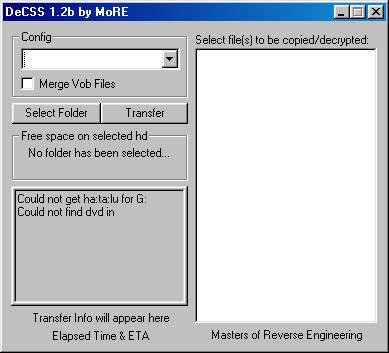
DeCSS: Who knew such a small program could cause so much trouble ...

DeCSS: Who knew such a small program could cause so much trouble ...

It was still late 1999 when I was approached by a company, which shall remain nameless (and actually I can’t remember their name anyway), that offered to help me host my fledgling website, which had already grown too p0pular to be hosted on a 15 MB free webspace deal (shocking, I know). I was to get a part of the advertising money, and they would do all the hosting. They even kindly purchased the domain name dvd-digest.com (don’t bother hurrying over to whois the name, it’s owned by different people now, I think), which was perhaps not as kind as I had believed, naive as I was. All went pretty smoothly until the said company received legal documents which suggested that the rippers I was hosting was not entirely legal. The infamous DVD CCA vs DeCSS case had started. It doesn’t really matter now that the court eventually ruled in favour of the defendants, but I’m sure it was scary for the company that hosted DVD Digest (and owned the domain name to boot). And they took what was in their eyes not only the right action, but the only action, which was to “Shut It Down!”. I was on vacation and away from the Internet at that time (hard to believe that being away from the Internet is actually possible these days, I know) and I did not find out until a week or two after the fact. It wasn’t good news for DVD Digest.

So I had to start from scratch again in the fake new millennium (2000), this time with the domain name digital-digest.com, even though the site was still called DVD Digest back then. And start again I did. The year 2000 was a great one for DVD Digest, despite the soon bursting of the Internet bubble. It was then that I turned what was really a hobby into a business of sorts, and of course, the DVD industry made huge strides in those few years which was helpful for a website that relied on more and more people wondering why they’re only getting 15 FPS from the DVDs on their PCs.

The DVD Digest name continued to be used for many years, with Digital Digest eventually taking over as the official name of the website, but by then there were other sites part of the Digital Digest network called DivX Digest and DVD±R Digest, but that’s a story for part 2 and 3 of The History of Digital Digest.

To be continued in part 2 …

Weekly News Roundup (5 July 2009)

Sunday, July 5th, 2009
Digital Digest is 10 Years Old!

Digital Digest is 10 Years Old!

Digital Digest is 10 years old! The actual birthday was yesterday, and I know it was 4th of July and that’s because I deliberately chose an easy to remember date to make public the very first version of Digital Digest (then known as DVDigest – you can see a screenshot of it here). My original thinking behind Digital Digest was that, as I was very active on newsgroups and forums back then answering people’s questions in regards to DVD playback (mainly focused on the Asus v3400 graphics card), that having a website where I can post all my answers and people can read that would save me time. After 10 years and countless hours of work later, I think my plan might have backfired just a little. Still, it’s been mostly enjoyable and I don’t think I would rather be doing anything else.

Anyway, to celebrate the 10th anniversary, I thought I would set up a competition where you can win some Amazon.com Gift Cards. There are 10 prizes in total (you know, for the 10 years and all), and entry is as simple as giving me your name and email address. No super easy or super hard questions to answer, or secret codes to hunt for on the website. I’ll randomly draw the winners at the end of the month, good luck to all those who enter.

Anyway, onto the news for the week, there’s a bit to cover.

Copyright

Let’s start with the copyright news. The Pirate Bay is still dominating the copyright news this week. There was a big announcement that caused a lot of stir, but it was preceded by some interesting news in regards to a new site that TPB wants to launch.

The new site in question is a YouTube style video sharing site, except there won’t be any copyright filters to contend with. It won’t make big media happy, but YouTube is only YouTube because people share copyright stuff, not in the sense of piracy, but using clips and music in their own videos. If you can really make YouTube 100% copyright compliant, then there won’t be many videos left at all.

The Pirate Bay changes owners: is this the end?

The Pirate Bay changes owners: is this the end?

So good news in that TPB is undeterred by the lawsuits and will continue with their crusade to “free” the Internet of the shackles of excessive copyright control. Then the news broke that The Pirate Bay has been sold to a new company, and that new company wants to focus on legalizing TPB. Confusion reigned, and we still don’t know what’s going on. On one hand, the statements made by the new owners seem to indicate that TPB would go legit, which basically means it’s going to turn into a completely different site, other than the domain name. On the other hand, there were statements made later on that suggested this won’t make much of a difference at all. The backlash was immediate, and not too dissimilar to the one after the Mininova content filter blog post made a couple of months ago. It does seem a bit ungrateful that this tremendously useful resource that people have been using, for free, for so many years and then the minute something changes (and we’re not even sure what the changes mean yet), it becomes torch and pitchfork time. But I guess that’s the nature of the business, in that people expect free stuff and they won’t like it when it’s taken away. Keep a close eye on this story and let’s give the benefit of the doubt to the TPB founders for the time being.

And let’s not forget that the bad guys in all of this is the RIAA, MPAA and all these other copyright groups that refuses to embrace the Internet for what it is, and accept that piracy is part of their business model now, and without it (and without the Internet “hype” effect, they’d be making much less money than they are right now). But it’s yet another victory for the RIAA in their lawsuit against Usenet.com. Well, at least the lawyers are happy, and people who pirate stuff are still pirating stuff, possibly more easily than before. But at least they’re not going after individuals in lawsuits anymore, although the three-strikes rubbish is not that much better. And if more proof was needed that going after individuals doesn’t work, then have a look at a new study by Which? computer magazine in the UK, which managed to easily find 20 users accused of piracy that are apparently innocent. There’s been lots of these kind of falsely accused stories in the past, and because IP addresses are not the best way to track down individuals. IP addresses can be easily faked, and even if they are genuine, it only proves that someone using a particular connection at that time was possibly downloading pirated material, it does not prove that which person did it or whether it was done with permission of the owners of the connection.

But this all assumes that illegal downloads are a bad bad thing, but the reality is that many people have no other alternative than to download, such as downloading TV shows. EngadgetHD looks at the top 10 reasons people download illegal TV shows. From my experience, especially here in Australia, people are almost forced to download because the traditional outlets such as TV stations or DVD are just too slow – some shows are shown years after they were originally broadcast in the US, and some (like The Sopranos) never shown properly at all. And because DVD releases have to be months after TV broadcasts, the shows that are purchased by the TV station but never shown might never make it onto DVD. The situation is a lot better now these days than just a few years ago, and I think online piracy is the reason for this improvement. So piracy is not always a bad thing, if it gives the right people a kick up the butt, for the right reasons. The simplest way to fight against piracy is to make legal alternatives available, that are better and not a total ripoff. Do this, and piracy will slow down. Don’t do it, and people will flock to what’s the best and fastest, which right now is clearly piracy.

High Definition

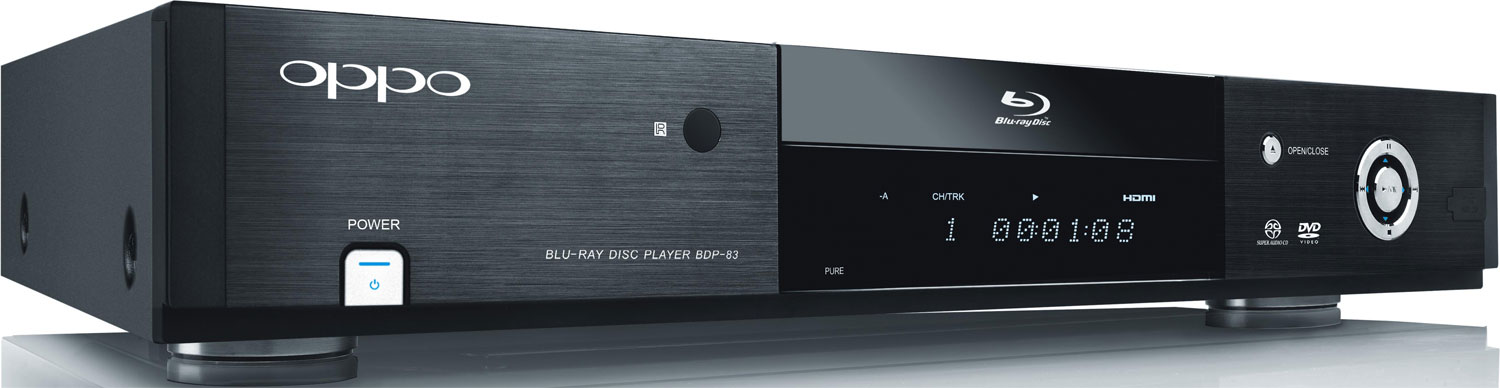
Let’s move on to HD news now. Oppo has released its new Blu-ray player. It features high-end features such as SACD and DVD-Audio playback, plus the superior video processing for both Blu-ray and DVD upscaling that Oppo is famous for.

Oppo BDP-83: The most fully featured Blu-ray player so far?

Oppo BDP-83: The most fully featured Blu-ray player so far?

Plus, there is the possibility of a region-free firmware (for both Blu-ray and DVD), and it could be the must-have Blu-ray player for the year. Elsewhere, it has all the features most Blu-ray players have, including Profile 2.0 compatibility – there’s not Netflix streaming though. And it’s not that expensive either, not for the amount of features you get. Those with huge DVD collections should really consider getting this player as it will seriously improve the longevity of your DVD collection with the superior upscaling capabilities, while allowing you to sample what Blu-ray can offer. It’s available for under $500 from Amazon right now.

Speaking of Netflix streaming on Blu-ray players, the Examiner looks at whether on demand content is going to replace physical media. I don’t see why both can’t co-exist together, like on the aforementioned Blu-ray player, but certainly on demand content is going to eat into the profit streams of physical media. I think physical media still has a place, for backup, and for those like me that still prefer something solid to represent my movie collection. The situation may be analogous to the one between snail mail  and emails. There was always the talk that email will replace traditional mail, but while the good old letter has suffered, it still has an important place in our new digital world. Just like physical media will have in the world of tomorrow.

Gaming

And finally in gaming, lots of rumours as usual. For the Xbox 360, the latest rumours suggest that the Pro pack is being phased out, and the Elite will become the new “pro”, with a Natal bundle being the new Elite. More rumours of PS3 price cuts, and the rumours regarding the PS3 slim still won’t go away. You can read about all of these rumours here.

Is PS2 compatibility coming to the PS3? Is this the end for the PS2?

Is PS2 compatibility coming to the PS3? Is this the end for the PS2?

The second rumour is about PS2 compatibility coming back to the PS3, either to all existing consoles, or to the PS3 slim. If Sony plans to phase out the PS2, and it’s about time they did, then this makes perfect sense. With software emulation more of a possibility than when the PS3 first launched (where PS2 compatibility required extra, and expensive, hardware), it won’t add to the cost of the PS3, while Sony can even sell the emulation software in the PS Store. Plus, they can then start selling PS2 games in digital form for PS3 owners, just like on the Xbox 360 or Wii. So this is one rumour that might be true, and if Sony isn’t even considering this option, then somebody should smack them in the back of the head.

And is Project Natal racist? The news broke that people with darker skin tones might have trouble playing Natal due to one person’s experience at the E3 demo. It’s an interesting headline, but I don’t think there’s an issue, because surely darker clothing would affect the accuracy of Natal much more than darker skin. A calibration tool might be what Natal needs, and users might have to calibrate the cameras (due to change in lighting) before usage to ensure accuracy is improved.

So that’s it for the week. Ten years, it’s gone by rather quickly I must say. Even this feature, the Weekly News Roundup, is nearly 2 years old (in September), even though it feels like I only started doing this last month. Or maybe it feels this way because I really don’t know what I’m doing, which is probably true. Anyway, see you next week as I incompetently try to produce another edition of the WNR. See you then.

Weekly News Roundup (28 June 2009)

Sunday, June 28th, 2009

Going to do a very quick WNR this week, as I’m still feeling under the weather. Had to do a bunch of tests at the clinic to see what’s wrong – having things inserted, extracted, and cables plugged in wasn’t a nice experience, but I now know how my DVD player feels. And no, it’s now Swine Flu, although everybody here in Melbourne, Australia seems to have it.

Copyright

In copyright news, more lawsuits, but this time in Ireland, where the record industry representatives are suing two Irish ISPs. It’s heartwarming to know that, despite the bad economy, that at least the lawyers are still finding excellent amounts of work available (at at $765 per hour as well).

Lawsuits, three-strikes, throttling – the industry’s favourite tactics, but not all government agree. The Spanish government’s strong dislike of the three-strikes rule has promoted their music industry to change tactics and abandon the three-strikes system. If only other government were as strong in their beliefs that due process is still something that needs to be protected.

And onto our favourite court case, you must have heard a lot about how The Pirate Bay case has been denied a retrial. This is true, but it is by no means the end of the road for the TPB guys. What happened, and as explained clearly a few weeks ago by Cynthia, our Swedish expert, a higher court has ruled that the judge in the original case was not biased. All this is means is that instead of having the retrial in the original court, the retrial will have to take place in a higher court. There are still a few more couts to go before it is all over. I don’t think we will find out anything definitive in 2009 in any case.

Real says RipGuard and ARccOS are not copy protection systems, and so do no fall under the DMCA

Real says RipGuard and ARccOS are not copy protection systems, and so do no fall under the DMCA

In my second favourite court case, the MPAA has filed new complaints against Real Networks, claiming they lied during the RealDVD trial. It all pertains to patent filings from a couple of years ago in which Real Networks claimed that ARccOS and RipGuard were copy protection systems, even though Real claimed in court they were not. The argument goes that Real thinks neither ArccOS or RipGuard can fully prevent the copying of a disc (only delay the process), and so they are not anti-copying features. The reason why the MPAA may be going after Real on these two additional anti DVD-copying measures, as opposed to CSS, is that Real does have a CSS license and it may be harder to argue that Real has ripped CSS, but in reality, it has left CSS intact in the copied file (and added a few other layers of its own DRM). The verdict is expected soon, but I don’t think Real will win if the argument is already on something as specific as whether ARccOS and RipGuard are copy protection methods – if the argument has been the higher issue of whether studios have the right to prevent usage that does not harm to them, which is the case when people make make digital copies of movies that they own and do not share with anyone else other than those that already have access to the original disc.

The American Society of Composers, Authors and Publishers say that your phone’s ringtone should be considered a public performance and they should receive royalty everything your phone rings. Yeah right.

High Definition

Onto HD news, rumours abound that Toshiba will jump on the Blu-ray bandwagon soon. Is there some truth to this news story, or is this the new “Blu-ray add-on drive coming to the Xbox 360” line of stories that will always pop up from time to time, only to be refuted almost immediately. There does seem to be more truth behind this story as it comes from statements from Toshiba’s President when he was speaking to shareholders. And since Toshiba owns the Cell processor, it would be interesting to see a Toshiba Blu-ray player with high quality DVD upscaling as seen in their HD DVD players, plus ultra-fast response times like the PS3.

The rest of the stories this week were about last week’s story about a poll that showed HD DVD being more popular than Blu-ray, and hardly anybody cares about Blu-ray. There is a reason why I only devoted two sentences to this poll last week, because polls are misleading by themselves, and when you are trying to poll actual ownership stats, rather than relying on hard data, then it’s even less useful. The Blu-ray people’s response is that the poll is unfair because most people think their upscaling DVD player is in fact a HD DVD player, which might be the case, although it’s still the Blu-ray people’s fault for not educating people better on what is real HD and what is upscaled. Start by calling it “Real HD” to differentiate Blu-ray from “Upscaled HD” might be a good marketing idea.

Gaming

And finally in gaming, a new PS3 firmware has been released. Firmware 2.8 doesn’t add anything major, but fixes a few things and improve some others, like a faster XMB, wireless controller auto-assign. Still a lot of people having bricked PS3s after each update, so read up the horror stories on the official PS3 board and see if you are willing to take the risk if your PS3 is already out of warranty.

Okay, the doctors are telling me to take it easy, so that’s what I will do. As if I needed encouragement to be lazy. See you next week, hopefully feeling a little bit better.

Weekly News Roundup (21 June 2009)

Sunday, June 21st, 2009

Sorry for this outrageously late WNR. Had a bit of a health situation that I needed to attend to. It’s a shame, since there’s lots of stuff to go through, so I will have to keep things short. And no, laziness is not the “health situation”. I wrote a mid-week blog about Nvidia’s Ion platform. An Ion is a charged atom, which makes the name so appropriate as that exactly what the platform does – it gives Intel Atom systems a much needed boost in the graphics department, particularly for HD video. It won’t be too long before you will see Blu-ray capable netbooks that can also double as a HTPC, I think.

Copyright

Let’s start with copyright news. The MPAA admits it is losing the PR war, to what they have dubbed the enemy of copyright. There are a few people who don’t like any sort of copyright, but I think the majority of people do respect copyright, it’s just that they don’t like the way that it is being enforced.

Personally, I buy lots of DVDs. All legitimate. I don’t buy music much, mainly because I don’t listen to it much apart from Net radios (also legal). I do buy games, not a lot, but I don’t have a lot of time to play them anymore. But I am one of the people that the MPAA says is an enemy of copyright, simply because I refuse to support their methods. I respect that they want to keep piracy under control, but I don’t respect the way they have gone about things, which has made piracy an even easier choice for those that can’t stand DRM and the sometimes ridiculous prices for digital content that the MPAA members want to charge. I believe the best way to fight piracy is to make it unnecessary, and this means tackling the difficult issue of how to make money in a digital world, and how to make it harder for people to share content they don’t own, but at the same time not seriously affecting their user experience. I think this is all possible, and the music industry has been forced down this road already. It is just a shame that their business is a declining one, even without piracy, and so it makes for a bad example. But even they can turn things around if they price music aggressively, and take advantage of the digital medium’s low cost of distribution, replication. There will be losers in this revolution, as there will always be, but it’s a necessity and fighting against the tide will only make things more difficult. Embrace the change!

It’s unfortunate that the music industry’s changed tactics of pursuing legal avenues to stop piracy is just as clumsy and overreaching as their attempts with DRM. They are lobbying governments and telling them scary scenarios about the end of music and movies, in an effort to scare them into passing laws which have no place in societies based on the rule of law. The so called 3-strikes is so against the nature of the Internet, and justice and civil rights in general, that it’s hard to believe people are taking it seriously, the latest call for it are in the UK. Japan has just tightened their copyright laws as well. Apart from having no due process, the method will also mean a lot of false positives, as the most used identification method, which is based on using the IP address, is in most cases insufficient to identify people a court has ruled. And in the end, all it will do is to force people serious about pirating stuff to get more serious about hiding their activities, which is possible through encrypted VPNs and other technologies.

Jammie Thomas-Rasse: Sharing 24 songs will cost her $1.92 million

Jammie Thomas-Rasse: Sharing 24 songs will cost her $1.92 million

So the only people that will be caught are those that haven’t done much pirating and don’t know how to avoid capture. But these are the people that will be made examples of, much like the single mother that has been successfully sued for $1.92m, to scare people into behaving. But it won’t work, everyone knows it. And to go so overboard with the lawsuit to demand a multi-million dollar settlement will be a PR disaster for copyright groups, because it just reinforces how much out of touch they are with reality. $80,000 per song, for 24 songs, is a ridiculous number. There is no proof of the exact number of people that have been able to obtain songs from Thomas-Rasset, the sacrificial pawn in this game, so the figure is largely for punitive damages. Does sharing 24 songs seem like a $1.92m crime to you? Well it does to groups like the RIAA, and they’re not going to stop – the next on the hit list is AM/FM radio stations, which has just been labeled as “A form of piracy”. Let’s just stop people playing, sharing, listening to all songs – that will surely help save the business, not to mention the money they are paying to lawyers to fight these cases which might have been better used to find alternative strategies to operate in this new digital world.

The US had its digital transition, and for all purposes, it went off pretty smoothly. It is just as well that plans to do this were set in motion many years ago, before the crazies took control of the copyright debate, as otherwise digital TV would be saddled with DRM, most notably the Digital Flag. This would have prevented people recording any TV show that has this flag set, so no TiVo or delayed viewing, just to make sure that if you can’t catch something on TV live, or want to watch it again, you’ll have to fork out bucks to do it. If these crazies had been in control far earlier, the tape recorder, the VCR and even the PC might not have been allowed to exist, and is this really what we want, or what’s good for the industry and economy in general?

High Definition

Onto HD news now. Another report which seem to indicate that while Blu-ray sales are up, DVD sales are down by much more. It’s going to be a while before Blu-ray can gain enough of a market share to really make a difference, but the decline in DVD sales probably has as much to do with the increase in gaming purchases as with anything seriously wrong with the industry it self.

The other piece of news is a poll which showed that Blu-ray standalone uptake is not quite increasing fast enough, and was even outpaced by the dead HD DVD format in the last year. Polls are interesting, but figures for uptake shouldn’t need to rely on polls, as there are real figures to be found.

Gaming

And finally in gaming, Activision’s CEO has joined the chorus of people to call for a PS3 price cut. There is a veiled threat in there about pulling support for the PS3 (and PSP) if action isn’t taken, but I wouldn’t take it all that seriously. Do game publishers want cheap consoles? Yes. Will they pull support for the PlayStation family? No. But hopefully, this will give Sony extra incentive to even just consider a price cut.

That’s it for this week. Short and sweet. Long and boring coming up next week.