Archive for the ‘Copyright’ Category

Weekly News Roundup (9 December 2012)

Sunday, December 9th, 2012

Well, not long to go until the end of the year/world. There certainly haven’t been any signs that the apocalypse is just around the corner, so if it does happen, it will be a total surprise. And at the same time, it won’t be. There doesn’t seem to be any geological or astronomical cues regarding what might happen, nor are there any biological signs (eg. outbreaks),so I’m going to go with alien invasion. With the Voyager 1 spacecraft just on the edge of interstellar space, and our nuclear invasion of Mars, it’s not as if we haven’t given potential malevolent alien races excuses to do what they do best. I’m still undecided if enslavement or total annihilation is the preferred outcome though.

A couple of things to go through news wise, including two followups, so let’s get started.

Copyright

DRM doesn’t work. You don’t need a degree in software engineering to know this, because you can simply observe what’s happening in the real world. But if you do have a engineering degree, and if you happen to work for a company like Microsoft, then you might have realised this a lot sooner, and might just publish a paper that predicts what happens when DRM meets people who don’t want DRM.
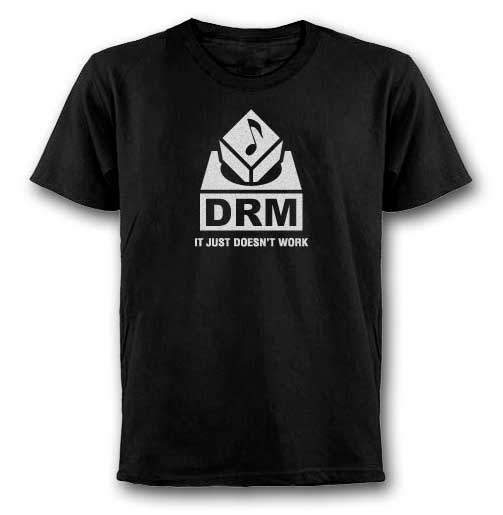
DRM Doesn't Work T-Shirt

Ordinary folks knew it. Engineers knew it. Even this t-shirt knows it – DRM doesn’t work!

But when Microsoft engineer Peter Biddle, and three others, authored a paper titled The Darknet and the Future of Content Distribution predicting that DRM would never work, what they didn’t expect was to nearly lose their jobs over it.

The paper, published in 2002, was designed to calm fears of a tech community that was at the time really worried about Microsoft’s push to have a hardware based secure platform for Windows, one that could really lock down the system and prevent it from being used for purposes not intended. One obvious application was DRM, any implementations of which on a secure platform would intrinsically be much more secure than compared to an implementation on a relatively open PC platform.

While working on the trusted computing platform, Biddle realised that even with a secure platform, DRM was never going to work in the long term. Because all it takes it one really clever guy to break the DRM, and the Internet (or the Darknet) would take care of the rest. So armed with the prediction, he and the others published a paper stating this, in the hopes of calming community fears about the next-generation of uber DRM. But instead of its intended effects, they ended up facing the wrath (or at least the bureaucratic paralysis) of the Redmond giant.

You see, stating that your secure platform won’t help to secure content doesn’t help you license the platform to content providers (DRM licensing and the money made from that is the main purposes behind companies who push DRM solutions – the piracy thing sometimes feels like just a convenient cover). Content providers also want the false security provided by DRM, and anyone injecting reality into their fantasy is also met with the same level of scorn. Biddle’s paper also failed to calm the nerves of the open computing community who still didn’t trust any technology that locked down the PC, especially one developed by Microsoft given the company’s history on these sort of things.

As for the paper, what was predicted in 2002 has almost all come true a decade later. The predicted technological arms race between DRM deployers and DRM destroyers continue, while the Darknet (which includes the likes of BitTorrent, Usenet, or even local file swapping) continues to exist and decentralise just as predicted. Even law enforcement’s attack on the most visible and centralised parts of the Darknet, your Megauploads for example, was predicted in the paper, and DRM continues to be completely useless.

The only time when most people don’t bother to crack DRM is when the service offered is better, or at least good enough, when compared to the illegal, and DRM-free alternatives. Your Steam, Netflix, basically, not that they can’t be cracked (or haven’t been), it’s just that, say for $7.99 per month, or $2.49 for a game, it may be simpler to just pay and play along, especially if the DRM is mostly transparent (and linked to value-added features).

So DRM will never work. Although it can still exist relatively untouched to give content creators their security blanket if the services that the DRM protects is good enough for most consumer. But should we all suffer just to allow some industry peeps to avoid facing reality?

The answer is apparently yes. Do you remember back to a couple of weeks ago, when a staffer at the RSC caucus group dared to inject a bit of reality into the copyright debate, and then was silenced shortly after? It seems simply shutting up Derek Khanna wasn’t enough, this week, Derek has been fired by the RSC.

It’s certainly an interesting move, coming just as the noise over the memo had died down. This will certainly bring attention to the issue again, and I’m sure that’s what the RSC (or the people behind them “lobbying” for this action) wants.

Following up on another recent story, Richard O’Dwyer’s copyright ordeal is all but over, after a U.S. court ordered the uni student to pay rights holder damages of £20,000. This was after O’Dwyer signed a deferred prosecution agreement in exchange for extradition being taken off the table. So perhaps not the outcome the rights holder had wanted, nor one that O’Dwyer thought was going to be the case when he first started his website, but perhaps one that both parties will be relatively satisfied with.

——

Giving an industry lobby group unlimited powers to censor what they judge to be piracy related websites – what could possibly go wrong? Oh yeah, it could start censoring websites that has nothing to do with piracy.

The Promo Bay

The Promo Bay, nothing to do with piracy at all, was still put on the ISP censorship list in the UK

This is exactly what happened when The Pirate Bay launched their new Promo Bay website, and it was subsequently put on the banned list by the UK music industry’s copyright lobby, the BPI. The Promo Bay website uses the popularity of The Pirate Bay to help promote indie content creators, including musicians, so just why it was deemed worthy of being banned, nobody knows.

ISPs, rights groups and the Internet in general were incensed by the ban, and immediately petitioned the BPI to reverse their decision. The BPI did do that, eventually, but questions remain just why it was added to the list in the first place, and why the BPI seems to now have unlimited power to ban any website it wants, with little or no repercussion.

The precise banning list is also a top kept secret between the BPI and participating ISPs, so while this snafu was a high profile one that got a lot of press attention, there may be countless other websites banned as a result of a court order which should not be as broad as the way the BPI is seemingly using it for.

Speaking of secret lists, the MPAA’s “notorious markets” list, which up until this year has been made public, has been leaked, and in it, the MPAA lauds the success of the Megaupload takedown. While accurately describing the impact the closure has had on the file hosting industry, some of it on very legitimate services, the MPAA seems to have avoided mentioning any revenue impact this major shakedown has had.

It could very well be that there has been no impact, nothing positive anyway, especially given the story about the research paper last week that seem to suggest a negative impact on revenue following Megaupload’s closure. The MPAA did respond to this one, but instead of releasing data of their own showing revenue rising due to the closure of Megaupload, all they did was to question the methodology behind the research. Given that purpose of the MPAA as a lobbying group, one would certainly expect that had there been even barely related circumstantial evidence of a positive revenue response from the Megaupload seizure, the MPAA would have jumped on that and let everyone know.

The pro copyright lobby certainly does like to play up the links between piracy and revenue losses, but only when they are lobbying for something to happen. When that thing actually does happen, it seems that piracy and revenue cannot be further apart. It was this way before and after the closure of LimeWire (remember the $72 trillion claim of damages that would have been derived if the RIAA’s method of calculating damages was extrapolated to actual LimeWire visitor numbers) , and it seems to be this way for Megaupload too.

I think that’s it for this week. Wait, let me check … nope, this is it. More in seven days!
Weekly News Roundup (2 December 2012)

Sunday, December 2nd, 2012

Welcome to another WNR. Hope you’ve had an uneventful week. Not that uneventful here at Digital Digest HQ (which consists of a room, a desk and a computer with a creaking fan), as server troubles meant some downtime, and some data loss (which, thankfully, wasn’t extensive). An uneventful week sometimes is a good thing, and I think we take it for granted, and even complain too much about it, too often these days.

The data loss nearly meant that I had to re-write a news story, but because I post a copy of all news articles in our forum, some copy/paste got me out of trouble this time. Finding interesting news is hard enough these days, losing one you’ve finally managed to write is a royal pain. Anyway, let’s get started before the server decides it needs to make things eventful again.

Copyright

If you get rid of a website that had a lot of pirated movie downloads, then this potential major blow against online piracy should lead to increased box office revenue, right?

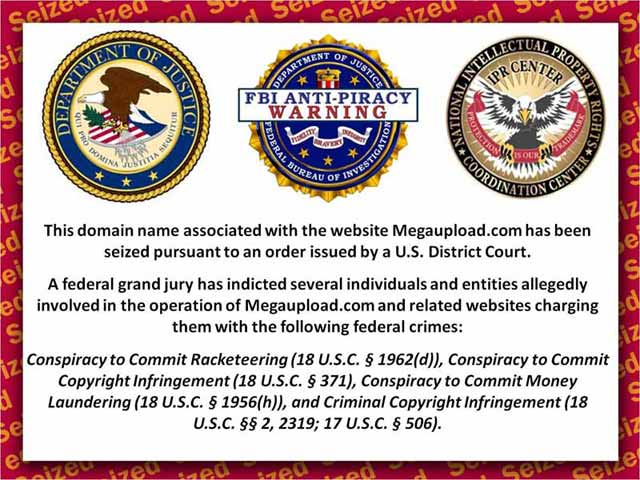
MegaUpload Seized

Did Megaupload’s seizure actually hurt the movie industry?

But what if piracy isn’t taking away money from the box office, but rather, it actually helps it? That is the surprising conclusion of a new research paper from the Munich School of Management and Copenhagen Business School, which found that after the closure of Megaupload, box office revenue actually shrank for certain movies as an indirect result. Using data for 1344 movies in 49 countries over a five-year period, the researchers specifically wanted to find out the financial gains for theatrical releases from the Megaupload closure, but instead, found that revenue shrank for all but the biggest movies.

The researchers attribute this “counter-intuitive finding” to the word-of-mouth and the discovery effect that piracy plays in today’s marketplace, with the findings confirming that small and medium budget movies do seem to benefit from this effect. Blockbusters, on the other hand, are already so well known that they don’t need or benefit from word-of-mouth (if anything, word-of-mouth can be detrimental for “bad” movies).

I find it hard to believe that the major Hollywood studios, via their own internal research, was not aware of this phenomenon. But hurting the smaller and independent studios, and at the same time helping out their own mega-blockbusters, isn’t exactly something you wouldn’t want, even if it had to be done under the guise of “anti-piracy”.

As expected, the MPAA have already replied by trying to debunk this study, and I’ll cover their response in full next week after I’ve gone through it in detail.

Before Hollywood lobbied the U.S. government to shut down Megaupload, it was busy trying to get the government to extradite the then 23 year-old Richard O’Dwyer, former admin of TV linking website TV Shack, to the U.S. to face criminal copyright charges. A very much one sided battle that involved Hollywood, the U.S. Department of Justice and even the Immigration and Customs wing of Homeland Security, against a uni student and his mother, was made a little bit less one sided when Internet heavyweight Jimmy Wales chimed in on the issue, launching an online appeal to try and stop the extradition.

The attention this move garnered seems to have worked wonders, as the U.S. government has agreed to take extradition off the table, in exchange for O’Dwyer agreeing to pay a small sum in compensation to rights holders. The details aren’t clear at the moment, but even though it will probably mean O’Dwyer admitting guilt, and paying that “small compensation”, it’s a far cry from the extradition, lengthy trial and possible prison sentence that the U.S. government (read the MPAA) originally wanted.

So you have to ask why this couldn’t have been the outcome from the get go. What was the U.S. government, and their movie studio allies, trying to prove by seeking extradition in the first place? To scare others into line  trying by making an example of O’Dwyer? Or perhaps they really did intend to prosecute (or is that persecute) to their full powers, but once again, the Internet and, well, public shaming, put an end to their plans.

Who knows. But at least Richard and his mother can finally breath a sigh of relieve.

——

Another week, another botched DRM, and this one hits pretty close to home for me as well. The makers of game making software GameMaker, a software package that has been widely pirated due to the high price of its full package (currently at $499), decided to add a new layer of DRM that replaces images in the game with pirate themed ones.

It’s not the worst DRM around, at least on paper – to annoy pirates but at the same time, being completely transparent to paying users. If there is such a thing as “good DRM”, this was probably it. It if worked as described. But DRM being DRM, and I think you’ve probably already guessed what happened next, legitimate customers started having their game sprites replaced too.

YoYo Games, the people behind GameMaker, was quick to release a patch, but time is money in game development, and any downtime, especially one that could have done permanent damage, is a costly one.

Sneak Peak

A very very sneaky peak screenshot of the upcoming iOS/Android game I’m making …

So why does this one hit close to home? It just happens that I’m actually currently making an Android/iOS game in GameMaker (having paid for the software, of course). And ironically, my game’s theme relates to pirates, piracy and the issue of copyright (there’s even a couple of anti-DRM messages in the game). Heh.

Luckily, I manage to skip the update that introduced this “bug”, and I also keep daily backups just to mitigate a potential disaster such as this one.

YoYo Game’s Mike Dailly did come forward and explain the rationale behind the DRM, which he acknowledges was never going to work to prevent piracy (only to “piss off” the pirates). While there’s probably room for funny DRM (I remember adventure games of old that killed off your character in hilarious fashion if the DRM check failed), but it will only remain funny if it can be guaranteed that only pirated users are affected. But that’s usually not possible. Or even if it’s possible, it never actually happens.

As for the game I’m making and when it will be available? Erm, “soon” is probably all that I can guarantee at the moment (and even then …).

High Definition

Another subscription VOD provider is about to join the marketplace, and while this isn’t really news per say, the fact that a few details about the new service being leaked online is. Redbox Instant by Verizon could cost a low $6 per month, if the leaked data (by accidentally making public help documents that was supposed to be part of a closed beta) is correct. For $8 per month, you not only get unlimited digital streaming, you also get 4 credits to use at any Redbox kiosk (credits that won’t roll over to the next month).

Redbox Instant by Verizon

Redbox Instant by Verizon will start competing with Netflix and Amazon in a couple of week’s time, by going down the same SVOD route, but bringing their network of kiosks into the equation too

While you may think that the market may not need another SVOD service, Redbox does bring something new to the table. While Netflix has disc rentals by mail, and Amazon has rental VOD along with free unlimited streaming, Redbox Instant brings its kiosk network into the equation. Redbox Instant will also have rental VODs for newer releases, thus offering three different ways to watch movies (and TV shows) via its services.

With the launch expected before the end of the year, current hardware partners lined up should see the Redbox Instant app available on iOS, Android, the Xbox 360 and selected Samsung mart TVs and Blu-ray players at launch. But without their own devices (à la Amazon), or the ubiquity of Netflix, Redbox Instant will definitely need more hardware partners, and more content, before it can be considered a real competitor to Amazon, let alone the behemoth that is Netflix.

While things are heating up in the US, here in Australia, it’s “not all roses”. Our only real subscription VOD provider is losing tons of money, because they can’t afford the content, and without content, very few people are signing up. Which is a shame, because the market is eager for something on the scale of Netflix here.

Alright folks, that’s it for this week. Have a good one!

Weekly News Roundup (25 November 2012)

Monday, November 26th, 2012

So despite saying that I’ve no interest in the Black Friday Blu-ray sales over at Amazon US and UK, some $400 later, I think I might have been wrong. I still maintain that the actual “lightning deals” put out by Amazon US this year has been fairly tame, with most of my buys coming via normal discounting. The Amazon UK sales were better, with some proper lightning discount (picked up the Prometheus to Alien evolution boxset, currently listed for $190 for pre-order on Amazon US, for only $43), and the Men In Black Trilogy. Plenty of stuff to tie me over well into the new year.

I didn’t just waste all of my time shopping for Blu-ray bargains. I actually did find some news this week!

Copyright

Should we really be surprised that the target of the latest anti-piracy police raid happens to be a 9-year-old Finnish girl? I don’t think so, because time and time again, anti-piracy agencies have shown that nothing is sacred in their pursuit of nasty, horrible web pirates.

Winnie the Pooh Laptop

The nerve center of a major piracy operation, according to the Finnish anti-piracy agency CIAPC

For the trouble of downloading a music album that did not work anyway, and for doing the right thing the very next day by buying the album in question, the reward is a police raid early in the morning, and the Winnie the Pooh laptop of the 9-year-old girl being confiscated for evidence. All because the father refused to pay a 600 euro “fine” and sign a non-disclosure agreement so the money grabbing remains a secret.

Normally, parents cannot be held liable for the actions of their children, but the shortcuts being taken by Finland’s copyright laws means that the Internet connection account holder, the father, would be liable for all authorized and unauthorized uses of the connection. Another shortcut? No need to prove anything, beyond a flimsy IP address, before police can search and seize (just what they expect to find on the laptop, a year after the fact, who knows). And that a legal copy of the album has already been purchased does not seem to matter, despite a loss of a sale being the most damaging thing a download can do (without considering the upload component, which may have been mere kBs in size, assuming the original download was even real or completed).

The worst part is that these anti-piracy agencies are so entrenched in their zealous believes (that what they’re doing is right and just), that they simply walk into controversies like this time and time again, with no shame at all.

The Department of Justice and the U.S. Immigration and Customs Enforcement’s (ICE) war on Internet piracy, through  “Operation In Our Sites”, has also been controversial to say the least. Not only has it not had any real effect on the web piracy problem, it did manage to seize domain names that is really shouldn’t have seized, mistakes that were magnified by the total lack of due process (which meant that the illegally taken domain names weren’t returned to its rightful owner until a full year after the seizure).

Unfortunately, there’s broad political support for this course of action, thanks to the liberal spraying of lobbying cash around in Congress and the Senate. But broad support does not equal unanimous support, and one congresswoman is trying to give website owners some extra protection against what she calls a new form of censorship (when domain seizures are accompanied by a total lack of due process). Rep. Zoe Lofgren (D-Calif.) is seeking help from reddit in writing a new bill to allow website owners advanced warning and the ability to mount a defence before any seizures occurs.

It’s exactly this kind of common sense bill that will no doubt be blocked by the usual suspects.

Derek Khanna

Derek Khanna, the RSC staffer thrown under the bus for having a sensible view on copyright

Across the isle, some Republicans haven’t been resting on their laurels either, although others may wish that they had. The Republican Study Committee (RSC), a caucus for conservative republicans, released an extremely sensible memo questioning the three major myths of copyright. One that copyright was created to help content creators monetize their works (actually, it was created for the greater public good, to encourage innovation and productivity), that copyright equals free-market capitalism (when it’s actually a government mandated entitlement system), and that the current copyright regime is working well to encourage productivity and innovation (when the reality is that copyright law is often used to smother innovation, and by legislating the protection of not only the right to earn revenue but the amount of revenue itself, this may lead to “rent-seeking” behaviour).

But just as the Internet woke up to probably the most sensible copyright statement made by any major party in who knows how long, the memo was unceremoniously pulled from the RSC website, and completely disavowed. Apparently, it had not been properly “reviewed” prior to publishing, and did not represent all opinions present within the RSC. Rumours of lobbyists (ie. the RIAA/MPAA) interfering persists, and really, would you be surprised?

Some have commented that this may be the Republican’s revenge for Hollywood’s pro Obama views, but while Hollywood stars, with the odd chair yelling exception, are all very much progressive-leaning, the industry itself has its money fairly evenly spread between the major parties, taking a leaf from the Wall Street playbook (or vice versa). But revenge or otherwise, what the memo represented was good, sound conservative principles, which in the light of day, doesn’t veer far away from the progressive view on the issue, even if the rationale may be very different. And this symbolizes exactly why US politics is so f***ed up at the moment, that both sides of politics can embrace the same point of view, and that it still can be easily dismissed because special interest has money invested.

High Definition

In Blu-ray news, Warner Archive Collection’s 2,000+ strong library of made to order titles will now start featuring Blu-ray titles, starting with just two this week. The collection features fairly rare and low demand titles that are made on demand, using recordable DVDs (and now Blu-ray discs) to fulfill each order. Discs are reasonably priced, usually under $20, with the two new Blu-ray movies (Gypsy and Deathtrap) being currently priced at $19.95.

To be honest, I had not been aware of Warner’s manufactured-on-demand store before, and it’s certainly an interesting take on the “video-on-demand” model. I do wonder whether the cost of producing new HD transfers for the Blu-ray films will be made back by sales, which I assume won’t be in huge numbers.

Gaming

With the Wii U release out of the way, time to shift the focus back on the Xbox 720 and the PS4. The latest Xbox 720 rumours still continue to re-iterate the same ones that have been making the rounds, including the obligatory Blu-ray drive, Kinect 2.0 and more CPU cores that you can shake a stick at.

Xbox World Jan 2013 Issue

The January 2013 issue of Xbox World has the latest Xbox 720 rumours, including a mock-up of what it could look like

The augmented reality glasses rumour isn’t new either, but they’ve been repeated again in this Xbox World magazine article, which is said to have been compiled by interviewing many “industry experts”. Somewhat new is the introduction of a toushscreen controller à la the Wii U controller, although with Microsoft actually having a tablet device of their own, perhaps integration is the wiser route to take.

Almost as quick as the Xbox 720 gets a Blu-ray drive, it’s set to lose it, and with it all support for optical media, when a “slim” version of the console is released 2 years into its life-cycle (which begins Christmas 2013, by the way). The “slim” will rely solely on streamed and downloaded games, the streaming perhaps coming from Microsoft’s own OnLive-like service, after the company had showed earlier interest in acquiring the gaming-on-demand service.

For CPU fans, the Xbox 720 may have a 4 hardware core CPU, each with 4 logical cores, for some serious 16-score gaming action.

Take what you read with a pinch, perhaps even a tbsp, of salt.

That’s it for the week. Time for me to take a rest and find a way to pay for the $400 worth of new Blu-rays that I really shouldn’t have bought. See you next week.

Weekly News Roundup (18 November 2012)

Sunday, November 18th, 2012

Welcome to the pre-Black-Friday-Deals-Week WNR. I went kind of crazy with last year’s Amazon BF Blu-ray sales, obsessively listing and updating the latest Blu-ray deals despite almost nobody, other than myself, actually reading what I was writing. This year’s discount calendar has already been leaked, but there’s almost nothing there that actually interests me, so I don’t think I’ll be as obsessed as I was last year. It also helped that most of the good Blu-ray deals last year happened at a good time zone for people here in Australia, and that most of the discs listed were region-free (this time, there seems to be quite a few Fox Blu-ray deals, which are all region-locked). Amazon UK is doing their BF thing as well and I’ll check them out, but stock seems to be quite limited last year, although this only makes it more exciting in my opinion.

News was a bit more plentiful this week, so let’s get started.

Copyright

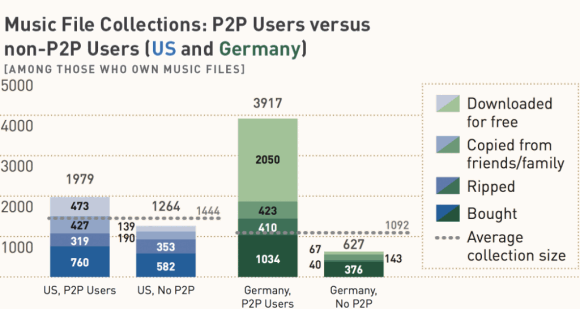
The RIAA has responded to a recent report that found P2P users, those that downloaded a lot of pirated music, were also bigger spenders generally. Instead of denying the link, something that’s hard to do when other studies back up the same assertions, the RIAA appears to have created their very own straw man argument, that P2P usage is not the *cause* of increased music spending.

American Assembly - Copy Culture Survey - Music File Collections: P2P Users vs non-P2P Users (US And Germany) Source: American Assembly

The RIAA responds to American Assembly’s Copy Culture Survey, claiming there’s no causation link between P2P usage and increased purchasing (not that a lot of people made those links)

I’ve read a few articles that reported on the issue, as well as writing and commenting on the story myself, but at no point did I find an article that seem to suggest P2P usage was the cause behind the same user’s bigger spends. What most correctly identified, and a point which the RIAA concedes, is that P2P users were more engaged users, bigger music fans, and so naturally, they also purchased more stuff. Or as I originally wrote when responding to the report, “people who download a lot of music actually love music, probably more so than people who don’t download as much. And music lovers buy more music.”

But now that the RIAA has mentioned it, maybe there is a causation link between piracy and spending. If we take piracy as a music discovery service, than perhaps it’s this unlimited access to music that creates more engaged users, rather than simply a case of piracy being more attractive to already engaged users. Perhaps people whose music experience is limited by their budget cannot ever become as big fans as those that choose to exceed this limit, even if it means doing things illegally.

Regardless of whether this is true or not, the fact is that pirates are also the music industry’s best customers, and marginalising and disregarding this core group might reduce piracy rates, but will not help you increase revenue. It might even do the opposite, especially when the industry is keen to kick these very same people offline.

But one iOS app developer is taking the whole notion of “attacking your customers” to a new level, with their range dictionary apps auto-tweeting to user’s Twitter accounts with a self-confession to pirating the app. The only problem? It’s doing it for users that paid for the app, as well as those that are using pirated versions!

Naming and shaming pirates it not a new thing, but for some reason, these attempts always seem to backfire spectacularly. I guess in the excitement (or anger) of adding this feature, testing the implementation wasn’t the top priority. A tip: if you’re going to name and shame, make sure you’re not the one that ends up feeling shameful.

Piracy is a big problem for app developers, although just like other forms of piracy, I’m not sure if every act of piracy equals a lost sale. But surely pissing off your loyal customers is as costly if not more so than piracy. And then there’s the issue of privacy. Would I trust a developer that developed a secret function to access my Twitter feed, even if it only does it when it detects a pirated copy? Competition is fierce in the app sector, so armed with the knowledge that one app has this privacy issue, and another app doesn’t, I know which one I would choose.

As a side point, that Apple allows this sort of thing to happen (maybe they don’t, and the app developer, Enfour, may get into further trouble for their app’s secret feature) is also slightly disturbing. At least with Android, apps have to list all permissions upfront, and users can choose to disregard any app simply based on the permission list.

——

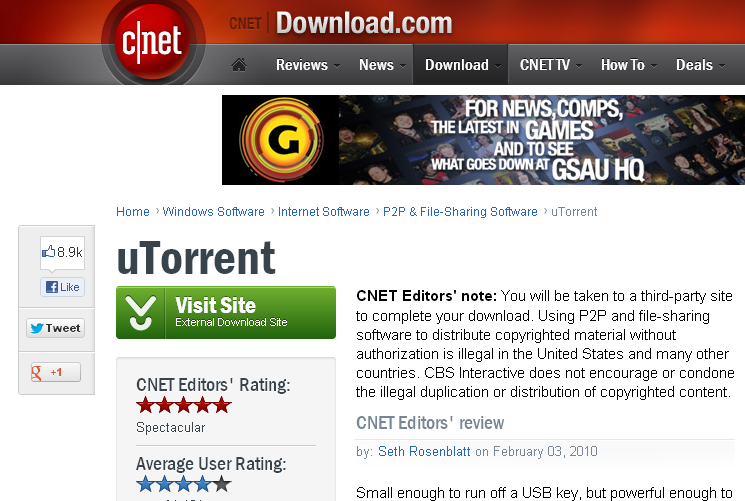
CNET Download.com uTorrent

Alki David’s lawsuit against Viacom/CBS/CNET for distributing LimeWire has now dragged uTorrent and other BitTorrent clients into it, by claiming CNET may be promoting infringing activities by promoting software like uTorrent

David Alki’s lawsuit against CBS/CNET has taken a nasty turn as Alki and his coalition of musicians decide to drag generic BitTorrent clients into the battle as well. In the latest filings, the plaintiffs alleges that CNET’s Download.com is still engaged in the same kind of wrongness as they did with LimeWire, this time by promoting and distributing BitTorrent clients like uTorrent. Even news articles talking up the legal aspect of BitTorrent are attacked for being propaganda pieces to help legitimize something Alki and co. says should be banned.

In the unlikely event that the judge agrees with the plaintiff’s position, this could very well spell the end for other file transfer protocols, including Usenet and FTP. Even HTTP, the backbone of the world wide web (it’s how web pages are transmitted) may be under threat, since I’m sure a significant percentage of HTTP traffic is also related to copyright infringement. In other words, I don’t think Alki and co. have a legitimate leg to stand on with this one.

In fact, when LimeWire was ruled to be illegal, the judgement did not extend to Gnutella or BitTorrent, both protocols that were part of the LimeWire network. Just like how Megaupload’s shutdown did not affect the status of HTTP, which Megaupload relied upon. So until a court rules against every and all BitTorrent clients, they remain perfectly legal.

Shortly after publishing the news article (and writing the above), I received an email from Alki David in which he linked to an interview he conducted with TorrentFreakin response to this latest development in the lawsuit. In the interview, David tries to explain the rationale behind this  latest move. David says that he isn’t against P2P software and software makers at all, but instead, he is against the way Viacom/CBS/CNET on one hand pursues the most heavy handed anti-piracy initiatives, and on the other hand “perpetuating file-sharing for their own gain”.

“Viacom is the same company that lobbied for SOPA and arrests, sues and fines kids like Joel Tenenbaum hundreds of thousand of dollars for downloading a handful of songs. The same people who want to have Richard O’Dwyer extradited from the UK for doing something that in the UK is not illegal!

Viacom is the same company that paid millions of dollars to companies like Media Defender and Artists Direct to monitor and police file-sharing whilst these companies profited from porn sites being exposed to young kids looking for other types of content,” David told TorrentFreak, before adding, “I do NOT think that torrent makers should be held liable. They can distribute but not promote the illegal use of their software.”

While David does make a good point, about the hypocritical stands that big content often takes towards copyright infringement (ie. they think it’s perfectly fine if it’s in their interest, or hoy Sony’s fervent use of DRM to protect CDs and DVDs, despite being one of the bigger manufacturers of blanks that pirates were using), I find it hard to believe that CNET would publish anything other than generic how-tos on BitTorrent, and that their legal department would allow the promotion of the illegal uses of BitTorrent. That BitTorrent clients do have legitimate uses, unlike say LimeWire, means that unless CNET wrote how-tos on how to find illegal music and movie torrents, they’re not really doing anything wrong.

His suggested solution to the piracy problem will surely cause more controversy as well. “I would send the ISP of the websites an invoice for a small fee (say 5 dollars) for each torrent download to give to the rights holders. The ISP would have to collect from the customer or pay it themselves,” explained David.

High Definition

It seems you don’t have to be a victim of piracy on a massive scale in order to lose a billion dollars every year – you can do it by playing to the rules too. According to rival Netflix, Amazon is losing up to $1 billion a year on content licensing. Netflix says they are aware of the losses because they’ve been competing with Amazon with quite a few content distribution deals. For the record, Netflix currently pay $2.1 billion for content every year. $2.1 billion divided by Netflix’s $7.99 x 12 annual fees equal 21,902,377, which kind of makes sense considering the service’s 20-30 million subscribers. Amazon has a lot fewer subscribers, but still have to license the same amount of content if they need to compete, hence the losses. Netflix had the luxury of allowing their content library to grow naturally, Amazon has the more difficult task of having to catch up in a very short period of time.

All of this seem to confirm that, despite their whining about the Internet, it’s boom times for Hollywood at the moment, thanks to competition between Amazon, Netflix and the other players, and some of them overpaying for content just to catch up or gain an advantage over the others.

That’s all folks for the week. Enjoy your Black Friday shopping if that’s your thing, and see you next week.

Weekly News Roundup (11 November 2012)

Sunday, November 11th, 2012

Another very quiet week, no doubt due to the focus on the election and the recriminations afterwards. I didn’t do too badly with my predictions though, 48 out of 50. Technically 49 out of 50, since I changed my mind just before the election and (literally) put my money on Colorado staying blue – so I only managed to get Florida wrong (mainly because I overestimated the Cuban vote for Republicans). I’m no Nate Silver, but considering I was mainly going with gut and educated guessing, I certainly did a lot better than most pundits out there.

Towards the end of the week, the October NPD results came in for video game sales in the US. Once again, not enough data to actually write a full analysis, so I’ll briefly cover it in this WNR. I’m hoping that the Wii U is successfully launched and Nintendo find it reasonable again to provide sales data, which assuming Microsoft continues to do the same, means we might have enough data for a full analysis again. I miss writing the NPD updates 🙁

Onto the news …

Copyright

Having started demoting websites that receive “too many” DMCA notices, you’d think that Google has finally gotten into rights holders’ good books. But as expected, they’re still not happy.

Their protest this time does seem to have some merit though, as a quick browse of some Google search results still show the “majors” (The Pirate Bay, isoHunt, KickassTorrents) still ranking relatively well, at least for certain terms, despite Google having promised that the major piracy sites (the ones receiving the most DMCA notices) would be demoted. Rights holders naturally sounded the alarm, and the first to their rescue has been the UK government, which has launched a review into Google’s latest anti-piracy attempt.

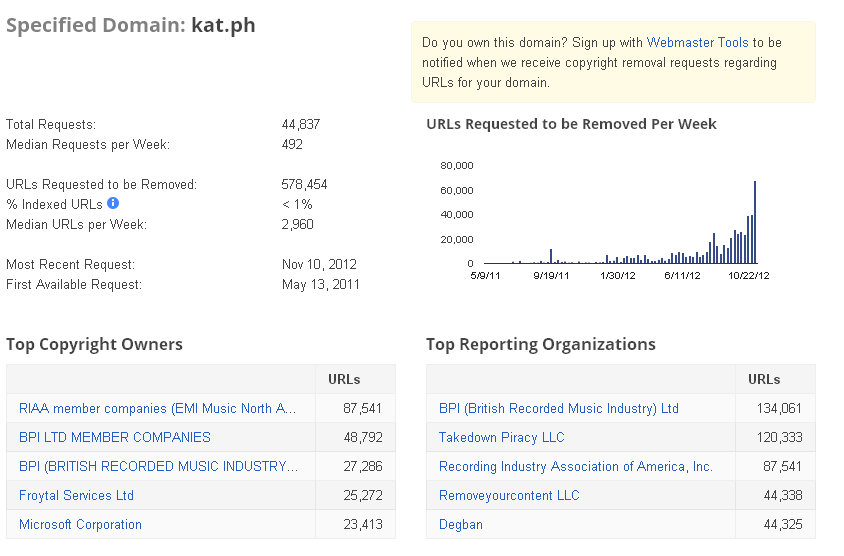
KickassTorrents' Google DMCA stats

KickassTorrents may have received more than half a million DMCA takedown requests, but it only represents less than 1% of their total indexed pages, which may or may not be enough to affect search results

Almost all webmasters will be familiar with the frustration of trying to work out how Google actually ranks search results, and how strange some of the results are, especially when it comes to websites that are clearly breaking Google’s rules and yet still rank highly. Google’s algorithm is so complicated, I doubt any single person working for the Mountain View company actually knows just how it all works. In the article I’ve linked above, I’ve tried to offer a brief overview of how a ranking for a webpage is derived, based on “good” and “bad” quality signals. I would guess that “DMCA notices” would fall into the “bad” quality signal, but it’s only one of possibly thousands of weighted signals, and just because a website has over 1 million DMCA notices, it doesn’t automatically mean that pages on the site will never rank. One of the most important “good quality” signals is user satisfaction, and people searching for pirated movies will be very satisfied by the “majors”, and these websites would also have a lot of relevant back-links, which is also another very important good quality signal. At the moment, it does look like Google may very well need to adjust just how important the DMCA signal is, to avoid torrent sites from still dominating certain search results. In fact, just doing a quick search today seems to reveal a totally new set of results for the same keywords, with the majors nowhere in the top 10 – maybe Google has responded already!

But even if Google does the impossible and removes every single piracy related torrent or streaming site from its index (note that is has never promised to remove sites, only demote them), I doubt rights holders would be fully satisfied. Because deep down they know that, as much as they want to make Google a scapegoat in all of this, Google and other search engines have never been a big contributor to the web piracy problem. Most traffic (probably upwards of 80-90%) to the majors are not search related traffic at all, but from people who already know of the site (called direct referrals).

Rights holders may be hoping that Google can do more to combat torrent sites, but for direct download sites like RapidShare, these site’s own policy of “self-harm” appears to be enough for now. This “self-harm” policy, implemented by many file hosting websites appears to be exactly what the rights holders had hoped would happen when it lobbied the US government to take action against Megaupload. RapidShare this week took the most drastic action yet, by implementing a daily download limit for shared files. For uploaders using free RS accounts, their uploads now have a daily download limit of 1GB, but even those on paid accounts cannot share more than 30GB of files in any given day. Private file sharing remains unlimited.

These changes comes after last week’s removal of the download speed cap, which has been in place since Megaupload’s demise as a way for RS to drive away the piracy related traffic that was looking for a new home. What this change effectively means is that RapidShare has now moved towards (or back to?) being more of a personal file sharing tool, rather than a public one, regardless of whether the content in question is pirated or not. If you need to share a largish PDF file, one that does not contain confidential information with a few people, then RapidShare still works great. But if you’re a software developer and you were using RapidShare to distribute your files, then you need to think again, even if you use a paid account. 1GB may sound like a lot, but for a typical 5MB download (which is actually the average size of downloads on Digital Digest), that’s only 200 downloads per day. If you’re an indie filmmaker distributing your own film … then forget about it!

Of course, RapidShare will argue that their service was never meant to replace proper file/download hosting, which can be quite expensive as the GBs really do add up. But the fact is that many indie content producers have relied on them in the past, and they will no longer be able to do so.

Disregarding the collateral damage, while the anti-piracy effect of this move may be exactly what rights holders wants, but this will only drive indie content developers towards BitTorrent, something that’s already happening. And the “mainstreaming” of BitTorrent is probably not what rights holders want at all.

——

Microsoft Kinect

Will Microsoft use the Kinect camera as a new form of insidious DRM?

An interesting/disturbing patent application emerged this week, one made by Microsoft, in which the company plans to use Kinect to enforce a new sinister form of DRM. The DRM would enforce a new kind of rights management under which users pay not just for a time limited usage of video content (ie. a rental), but would also have to pay for each additional user that watches the video. The patent suggest a way for Kinect to detect how many people are watching, and limit playback or charge the users more when a certain number is reached.

Now, patent applications are a dime a dozen, and most are for ideas that will never become reality, so it’s not really worth getting all worked up about this at all. But you just know that some suit somewhere in Hollywood actually thinks this is a great idea. As consumers, we have to be vigilant and we have to let rights holders know what is and isn’t acceptable – pay-per-viewer is definitely not an acceptable trend.

If anything, the trends has moved away from transaction based rental and purchasing, and towards the all-you-can-eat variety. Adding “viewer based transactions” will be a serious step backwards.

Gaming

As mentioned earlier, NPD has released October’s US video game sales report, and the Xbox 360 yet again was the most dominant console, having managed to grab 56% of the home based console market share.

Wii U ZombiU

Can the Wii U’s more “hardcore gamer” focus win back gamers from the Xbox 360 and PS3?

The Xbox 360 sales figures still represent a 31% decline compared to the same month last year. With the holiday period coming up, Microsoft will hope sales will start to pick up, because declines like this point to the need of a new console. I’m still hoping a good set of Wii U results, when it’s released in mid November, will prompt the company to start releasing hardware sales results again (I think they may do it if sales exceed that of the Xbox 360, but then perhaps if that happens, Microsoft will become less forthcoming with their own results).

But don’t discount the Xbox 360 just yet – the launch of Halo 4 might be at just the right time going into the holiday period, and none of the previews so far indicate that the Wii U is, graphically at least, that much more powerful than the 360 and PS3. So for the Wii U, it all depends on whether the tablet controller can be used to full effect, and whether that’s enough of a differentiator to make it stand out. Well at the very least, Nintendo’s flagship console will no longer be considered a technological throwback (not until the PS4 and Xbox 720 comes out anyway).

That’s all for this week. Have a good one, and see you in seven.