Archive for the ‘Copyright’ Category

Weekly News Roundup (13 October 2013)

Sunday, October 13th, 2013

A heads up to our Australian readers, you can win one of 3 Google Chromecast devices that my new website, streambly.com.au, is giving away. A Facebook like is required to access the entry form (I know, I know) – more details here. I’ve been playing around with the Chromecast, and it’s a nice little device. Very useful for those that prefer to watch YouTube videos on a big screen, or those invested in Google Play. The browser and desktop mirroring is also very useful.

On to the news …

Copyright

It didn’t take long, but the MPAA was never going to just ignore a report from the hugely influential London School of Economics (and Political Science) that attacked the biased and fervently ideological “debate” of the Internet piracy question, especially in the political arena. The MPAA’s rebuttal, on several key points in the report, unfortunately seems to have completely missed the point.

Instead of accepting the argument that data from the film and music industry are often one-sided, and that the industry as a whole was too defensive when it came to others (including scholars, like the ones from the LSE) making counter-arguments, the MPAA decided the best approach was to become way too defensive against the counter-arguments made by the LSE scholars.

As with most ideological crusades, there is no gray area. Either piracy is going to destroy the entertainment industries, or that it is completely harmless. I will gladly put my hand up and say that I am guilty of taking part in the crusade, making arguments and using facts that, while opposite of what the MPAA will try to tell you, may still be far too one-sided objectively speaking. I will argue that I have done what I have done as a response to the constant stream of bias that the other side comes up with, but that’s probably not an excuse.

Piracy is Stealing?

Piracy: stealing, perfectly alright, or somewhere in between?

The truth is that piracy does hurt the creative industry. Probably more so than the minor annoyance people on my side of the fence likes to think, and much less than the absolutely apocalyptic scenario that the MPAA and their ilk paints. But I’m a pragmatic man, and for me, what counts are solutions, not complaints. I believe the best way, and maybe the only way to fix the piracy problem (and yes, it is a problem that needs to be fixed) is to innovate. The MPAA, while frequently mouthing support for innovation, believe that technological and political solutions are the way forward. A biased scare campaign is simply the best means to an end for the former (I’ll let the actual batting record for technological solutions to speak for themselves), and that’s what the LSE media brief is warning against.

And it’s not just the piracy debate. Almost every debate these days lacks the nuance that’s needed to come up with any kind of consensus, let alone a solution. Some are guilty more than others, but we’re all guilty of it in some way. I guess we just don’t have the time and energy to come up with nuanced positions, or just don’t have the required knowledge (the media have to take some blame for this). Although in my opinion, unending and needless arguments wastes more time and energy and hurts all of us, regardless of which side of the debate we think we’re on.

London seems to be the center of controversy this week, as the City of London Police’s Operation Creative may have forced several domain registrars to breach ICANN policies and to open themselves up to lawsuits, when these registrars, at the request of the police, suspended and seized several Torrent related domain names. Among the best known websites caught in Operation Creative are SumoTorrent and ExtraTorrent, the latter is now threatening to sue their domain registrar.

Apparently, police acted without initiating any legal proceedings against these websites, and under ICANN rules, seizures cannot happen without due process. At the very least, these domain registrars should allow the rightful owners of these domains to transfer to another registrar, under ICANN policies.

While you can blame these registrars, who didn’t have to act if they did not want to, you also have to question the actions of the London Police. You can definitely argue that they used their position of authority to scare these registrars into acting, knowing full well that there is no legal basis for the domain seizures at all, as these websites have not been proven, in a court of law, to be acting illegally at all.  That the police were probably fed information by copyright lobby groups, and in essence, are acting like the entertainment industry’s private police force, makes this story all the more disturbing.

This incident also brings back bad memories for yours truly. If you can remember back to January when our domain name was similarly suspended, ironically happening around the one-year anniversary of the defeat of SOPA. Our domain was seized due to an IP address that used to allocated to our domain name, but one that no longer has any association with us, being used for suspected illegal activities. It was akin to getting arrested for the act of a total stranger, just because he now lives in a house that you once lived in. Many many years ago. We have yet to recover fully, and may never recover fully, from this particular incident.

Our registrar at that time could have simply contacted us for clarification, which would have resolved the issue without any disruptions, but instead chose to act first and ask questions later (or never, if I had not contacted them) to protect their own interests. The same rationale that the registrars targeted by the London Police were acting under, probably.

The moral of our story, and the story of these Torrent websites (and for any website owner, probably) is to find yourself a proper domain registrar, one that has enough strength to resist bullying tactics and are willing to defend their customers and stand up for their own legal rights. Like EasyDNS, who resisted London Police’s call to have TorrentPond’s domain name seized.

At the very least, find a registrar that has a good 24/7 support system and one that is willing to talk to its paying customers before bringing down the ban hammer.

High Definition

Well, someone had to ask. As an owner of Microsoft’s HD DVD add-on for the Xbox 360, one of the thousands of people that made in the investment in the heady days of the HD format wars, the inclusion of Blu-ray playback in the Xbox One does hurt a bit.

Xbox 360 HD DVD Add-on

No HD DVD support for the Xbox One, in case anyone was wondering

But what if you were to plug in the HD DVD add-on drive into the Xbox One console? Would Microsoft, feeling sorry for us losers and build in a little surprise and allow our dust collecting HD DVD discs to be playable (alongside our large collection of Blu-rays)? Someone did ask the question, and Microsoft’s Director of Product Planning Albert Penello was kind enough to offer a definitive answer.

No is the answer.

Oh well, someone had to ask.

Sick and tired of not being able to view your favorite YouTube funny cat videos when your smartphone or tablet is not connected online? Worry no more, as starting next month, you’ll be able to pre-download YouTube videos for offline viewing without having to resort to YouTube-policy-breaking tools.

Thanks to a DRM that YouTube has already been using to rent out content, users will soon be able to pre-download videos for offline viewing, with the DRM ensuring the 16 hours of fail compilations you have queued for later viewing will be viewable offline, and then automatically disappeared after the 48 hour viewing window.

Uploaders can opt out of the system, although they have little reason to do so because ad revenue will still be available via the pre-downloaded in-stream ads, and even view counts will be counted when offline viewing data uploads to the YouTube servers the next time the app connects online.

I guess this is a welcomed feature, although I’m not sure how I feel about DRM being applied to videos that were free to begin with (some of them free as in copyright free, or creative commons). And there may be legal issues as well. Now that YouTube is not only a video streaming service, but a video download service, what does this mean, from a legal point of view, for infringing videos that can now be downloaded and viewed offline?

But I guess anything that means more funny cat videos, more of the time, is a good thing.

On that note, I shall go check out some more funny cat videos (this link is neither a video, nor funny, but it is a cat, and it it awesome). See you next week.

Weekly News Roundup (6 October 2013)

Sunday, October 6th, 2013

A very very slow week, in which, instead of writing a WNR, I seriously contemplated going on a long rant about everything that annoys me right now. From un-skippable 15 second YouTube ads, to people who line up to buy phones, to people who don’t signal early enough before making a turn, to combo packs that make finding the Blu-ray disc a puzzle of some sort by making the disc type label so freakingly small. I mean, I didn’t even want the DVD or the Digital Copy anyway, and I only decided to buy the Blu-ray 3D combo version because it was $3 more expensive than the non 3D version. I don’t even like 3D. Which brings me to cinemas that only have 3D sessions of films. And don’t even get me started on Syria.

But I’m far too impressed by the Breaking Bad finale and GTA V this week to go this negative. Maybe next week.

Copyright

I’d like to think that part of the reason for the extra slow (and somewhat boring) week was due to people being too preoccupied with the finale of Breaking Bad. As expected, piracy records for the show were broken easily, with half a million having downloaded the final episode in the first 12 hours alone. I was patient enough to wait for the Netflix UK aired version, made available some 24 hours after the original US airing. The piracy stats seems to show that I was in the minority, and I have to admit I was tempted (it was the last episode, after all). But no spoilers from me, for those who are even more patient.

Breaking Bad Promo

Internet users were breaking bad, and breaking records, all over the place – swarming to illegal copies of the finale like a meth addict to blue meth

Australia was once against the piracy capital of the world, with 18% of downloaders coming from a country that has less people than Texas. Our limited and expensive legal viewing options might have been a contributor. Also interesting was that, despite the Netflix availability, UK was still the third most popular country for downloaders. The 24 hour wait, as I mentioned before, was not something everyone was willing to abide by.

I know I said no spoilers before, but still, you have to credit the bravery of the writers in making everything that has happened since episode one just a long daydream in Walter’s head (kind of like an uber version of J.D’s daydreams on Scrubs), with the final scene cutting back to Walter still sitting in the doctor’s office as he ponders what might have been. Oops, I think I’ve said too much!

——

Thousands of jobs will be lost. Entire industries in decline. New films and music will no longer be produced. These are the predictions the creative industries have made, and continues to make, in their lobbying efforts to get governments around the world to enact favorable protectionist policies. But despite making these dire predictions years ago, and with the piracy problem far from being solved, the expected economic and cultural meltdown has not yet materialized.

And a new policy brief released by the prestigious London School and Economics and Political Science makes the case that the government should stop listening to the Chicken Little tales from the creative industries, and instead, embrace piracy’s sharing culture, which actually benefits creativity and commerce.

The report criticizes the film and music industry’s predictions of doom and gloom, and shows that, far from being ravaged by piracy, these industries are actually doing pretty well. Hollywood is doing roaring business these days, and while the music industry is stagnating, it’s far from the apocalyptic decline that was forewarned.

The report’s authors even go as far as suggesting that the sharing culture embraced by the no good Internet pirates is something that these industries can exploit to find new ways to generate revenue. Something that Internet savvy content providers like Netflix and Spotify have known about since the beginning.

Consumers, tech companies, and now academia, have all embraced the Internet for what it is – both the good and the bad (and finding ways to take advantage of both). And there are now signs that the creative industries are finally getting it, now that they’re finally seeing the dollar signs in lucrative licensing deals with the likes of Netflix and the relative successes of platforms like iTunes and Spotify. All they need to do now is to let go of their obsession with piracy, and stop counting the losses from imaginary income that was never going to materialize anyway. If you’ve already got a barrel full of cash, stop fretting about the other barrels that may or may not still exist elsewhere, that’s all I’m saying.

High Definition

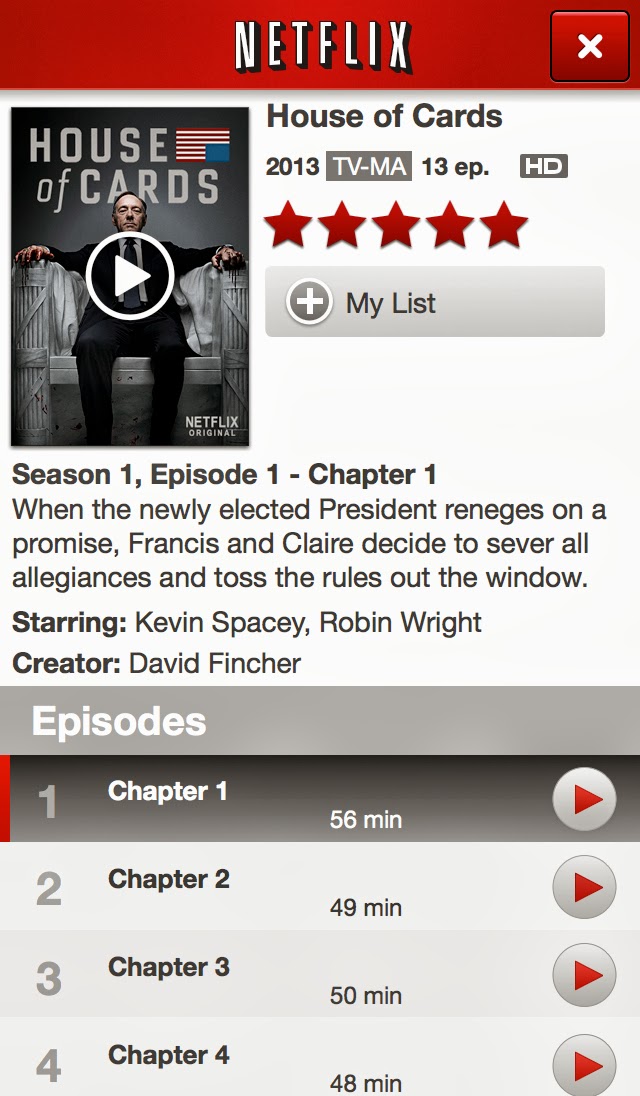
Netflix 5.0 on iOS 7

Netflix for iOS has been updated to support HD and AirPlay

It took a while, but HD is finally coming to Netflix for iOS – but only for iOS 7 users. With Super HD rolled out to all and sundry last week, the new app update couldn’t have come at a better time. Finally, users are able to take advantage of the better than 1080p resolution of the iPad (3rd and 4th gen), and watch their favorite shows and movies in glorious Super HD 1080p. Blue meth has never looked bluer, or in higher definition.

Also new in the app update is AirPlay support, finally allowing users of the iPod Touch/iPhone/iPad app to stream video to their Apple TV device and use the mobile devices as a remote control.

While the updated app is already available to download, the new features may take a week or two to roll out to all Netflix subscribers (as Netflix slowly update things on their end).

Believe it or not, that’s it for the week. A more news-ish next week awaits, I hope.

Weekly News Roundup (29 September 2013)

Sunday, September 29th, 2013

Welcome to another edition of the WNR. I’m still well immersed in the world of GTA V and Los Santos this week, and haven’t been so enamored with a game since the early days of Skyrim (before killing giants got boring). To those that criticize people like me for not embracing reality, and instead choosing to hide in the fantastic world of GTA V – well, if I could steal a blimp, skydive from it as I watch it crash and burn into a well populated area in the real world without danger or a lengthy prison sentence, then I would have done it already. GTA V is not about reality. It’s about hijacking someone’s car, running over them, and then getting out of the car to steal the money they just dropped.

Oh yes, the boring reality of “real” news. Oh well, let’s get started.

CopyrightGoogle must have been feeling generous this week when it removed the term “BitTorrent” from the list of blacklisted auto-complete keywords. Or maybe BitTorrent Inc’s recent PR campaign has had the intended effect in illustrating the fact that BitTorrent is in fact the legal name of a company that does completely legitimate business. Even Google, with its slew of lawyers, might have had a hard time arguing why the name of a well known company was being blacklisted, on purpose, in court.

Google Auto-complete BitTorrent

BitTorrent is no longer a dirty piracy word, according to Google

Of course, how most people use the term is very different to how BitTorrent Inc want people to use it, and allowing BitTorrent to grace the selection choices of auto-complete opens the door slightly again to piracy related search phrases. Type “Homeland bit” into Google, and you can see for yourself just what kind of suggested search terms Google is once again providing (most of these terms lead to pirated content, it has to be said).

The MPAA and their ilk will probably paint this as Google brazenly encouraging piracy. But I feel it is a bit of a stretch to suggest that people searching for “Homeland bit” would have otherwise not finished typing the “torrent” part of the search term had it not been for Google’s auto-complete suggestion. Or that not offering the suggestion somehow leads to less piracy.

High Definition

Should HBO offer an online-only subscription plan à la Netflix? Ask almost anyone on the Internet, and they will say yes. Ask anyone with a bit of authority at HBO, and they’ll tell you they’re not interested. At a Goldman Sachs conference this week, it was potential HBO competitor Netflix that made the suggestion again that HBO should look towards online if it wants to grow its customer base.

If HBO were to take Netflix’s suggestion on board, then viewers would be the obvious winners. It means many will no longer need to keep an expensive cable subscription just to watch Game of Thrones, and it will also have a hugely positive effect on piracy by offering people the opportunity to view HBO’s hit shows in the medium of their choice, possibly at a lower cost.

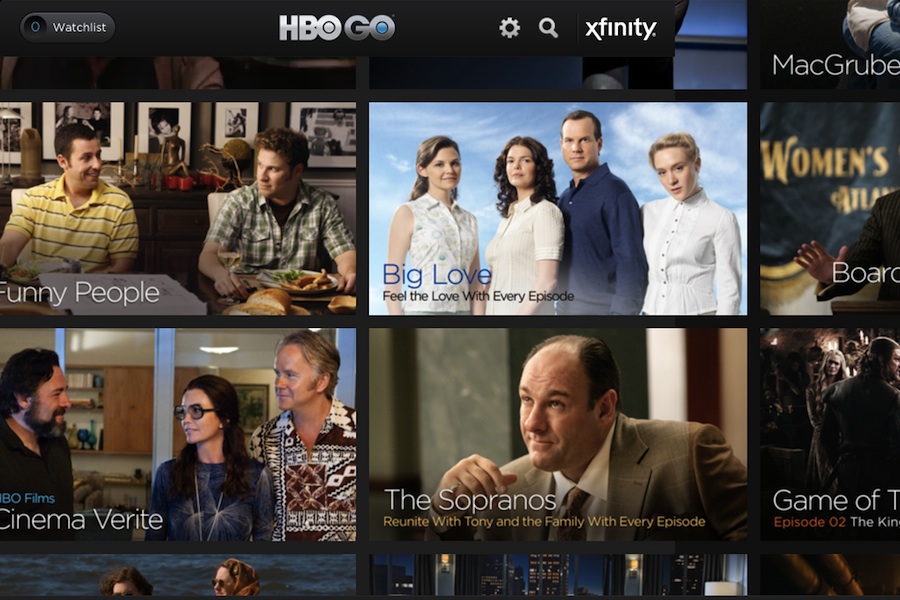
HBO Go

A standalone HBO Go subscription plan might bring in more customers for HBO, says Netflix

The obvious losers would be the cable networks, who are increasingly dependent on premium networks like HBO to keep them in business. And this is perhaps why Netflix wants HBO to compete in the same space as themselves, which at first doesn’t seem to be in Netflix’s own interests. If it happens, Netflix can then become the new basic cable to HBO’s premium online offerings, and both companies, while operating on the same medium, would not then be natural competitors.

In further Netflix news, the company announced this week that all US subscribers will now have access to Super HD and 3D content. Previously, Super HD and 3D content were only available with selected participating ISPs, those that had signed up to Netflix’s Open Connect Network (which is free for ISPs to join). Comcast, for example, did not support Super HD even though many smaller ISPs did. Now, all users will have access to Netflix’s best quality streams, regardless of their ISP. Although those using ISPs not on Open Connect may experience slow downs during peak usage times, something that Open Connect was designed to prevent.

In my experience, Netflix’s Super HD, while not quite Blu-ray quality, is definitely superior to their standard 1080p streams. At a distance of about 10 feet, staring at a 60″ TV, it can be hard at times to tell the difference between Netflix Super HD and Blu-ray. Netflix’s 1080p uses 5 Mbps, compared to Super HD’s 7 Mbps, and 3D’s 12 Mbps.

Obviously, you’ll also need a device capable of supporting Super HD streams. This should mean almost all devices capable of Netflix 1080p output, which covers most of the popular devices. The notable exception being the Xbox 360, which only supports 720p Netflix streams.

Gaming

Having started a new website about streaming recently (not so subtle plug, I know), I’ve been keeping an eye on all things streaming. But not just Netflix, but also game streaming. With both next-gen consoles promising game streaming of some kind, and has been the trend for this generation of the console war, Sony was the first to fill us in with juicy details of what their service could offer. And it also (sort of) solves another problem for potential PS4 owners – PS3 compatibility!

Gaikai

PS3 games can be played on the PS4 via the Gaikai cloud gaming service

Sony announced this week at the Tokyo Game Show that PS3 games will be playable on the PS4, but only via the Gaikai cloud game streaming platform. The same set of supported PS3 titles can also be streamed on the PS3 (it does makes sense if you think about it a bit more) and even the Vita. The game will be rendered on Gaikai’s servers and beamed to your PS4 as a video stream, and will be perfectly playable as long as your connection has low latency.

For this to become a true backwards compatible solution, Sony will have to think up a way to allow previously purchased PS3 games to be playable on Gaikai, on the PS4, without the need to fork over any more cash. One possible technical solution could be as simple as inserting your PS3 game disc into the PS4, which will be used purely for authentication purposes. But the hurdle for this to happen isn’t a technical one, but one of will on Sony’s part. If Sony finds the kindness in their heart to allow this to happen, that is to allow previously purchased PS3 games to be played on Gaikai for free, then this is the kind of thing that would tip the upcoming console war crushingly in Sony’s favor.

I think that’s it for the week. Back to GTA V for me. Hurray for escapism!

Weekly News Roundup (22 September 2013)

Sunday, September 22nd, 2013

Work. GTA V. More work. More GTA V.

That’s been pretty much my week so far. Not enough time with GTA V, and far too much work, unfortunately. And having an annoying cold didn’t help either.

It’s a fantastic game, the first really fun GTA game in a long time (after the bland and self-important GTA IV). I can’t recommend it enough, and if you have any inkling of interest in sandbox games, or driving around a real city, or gunning and running over people for no particular reason, then GTA V is the game for you. It’s mad fun, and here’s a gameplay video for the clueless gamers out there.

Oh yes, a WNR to go though. Here we go.

CopyrightWe now know, possibly, why Google decided to release a report on their anti-piracy efforts last week. Instead of the report being a fire across the bows of the copyright lobby, as I originally thought, that particular report now seems like a defensive move in anticipation of the MPAA’s own little report this week, which took center aim at Google for its role in “helping” Internet piracy.

Saucy stats in the report include the 74% of those surveyed that use Google or a search engine like it to discover websites that offers pirated content, even when some were not looking for it in the first place. Or that 58% of perfectly innocent search terms resulting in result pages that contain links to infringing content. And the study even dissects Google’s piracy downranking algorithm and finds that piracy sites are not being affected at all, traffic wise.

Of course it goes without saying that the MPAA were the ones that commissioned the report in the first place, befitting their usual M.O. I will refer you to the story I talked about last week, regarding a truly independent study that found a worrying bias in studies referred to or commissioned directly by rights holder groups.

Google DMCA Stats

Google’s anti-piracy efforts not enough, says MPAA as Hollywood’s trade lobby points accusing finger at Google over Internet piracy

Google, being the dominant search engine, was always going to have a role in linking to pirated content. Just like they have a big role in linking to legitimate content too. Would Hollywood be better off with or without Internet search engines, there to help them promote their latest shitty movie? That’s one of the many pertinent question the study doesn’t look at.

People who want to find pirated content, will find it, whether Google is there or not. There are forums, Facebook, Twitter. Hell, even the MPAA has done a pretty neat job at pointing to the best piracy places via their DMCA notices and frequent blog posts. Really, there’s nothing in the report that we didn’t know already.

So it’s hard to tell what publicizing facts which are already widely known will do towards reducing piracy. But the report is not really intended for you and me, or pirates, or even Google. It’s for those that sit on Capitol Hill, those that are funded by the MPAA, the ones needing something to be outraged about to justify their coziness to Hollywood’s cashed up lobbyists.

And then you have Netflix. Not only does Netflix helps to reduce piracy, it also uses piracy stats for its own advantage, according to Netflix’s VP of content acquisition Kelly Merryman. Merryman says that piracy stats are being used to judge a show or movie’s popularity in a particular region, and this then help form the decision whether to license that particular piece of content in the region. Merryman, who was being interviewed by the Netherlands based Tweakers website regarding Netflix’s recent launch in the country, noted that the TV show Prison Break was one of the shows whose licensing was determined by the popularity of the show on piracy networks.

It’s certainly an interesting and common sense approach. Piracy has always been a measure of demand, and unmet demand usually. And so it makes perfect sense for Netflix to tap into piracy stats to determine a show’s popularity. With Netflix less eager to make bulk licensing deals with studios, instead choosing to license specific content on a case-by-case basis, these stats could prove invaluable. At the very least, it’s cheaper than conducting market research.

In a separate interview, Netflix CEO Reed Hastings also confirmed that Netflix is having a big effect on piracy, stating that Canadian piracy related BitTorrent traffic dropped by 50% following the introduction of Netflix into the country. Hastings believes that the ease of use of Netflix is why it is beating piracy, even though pirated content comes at zero cost.

People have always been willing to pay for content, even if it is already available on the Internet for free. How much they’re willing to pay largely depends on the overall user experience, and people’s notions of value. There is no doubt that Netflix, with its $7.99 per month price point, offers both value and a better user experience thanks to the large number of supported devices. And this, not via legislation or DRM, or studies, is how you beat piracy.

High Definition

And the next battleground for Netflix may be in the 4K arena. The company’s CEO is already hinting at the technical aspect of Netflix’s 4K offering. Speaking in an interview conducted in Netherlands, Netflix CEO Reed Hastings said that Netflix’s 4K offering will “only” require a 15 Mbps connection per stream.

DVD vs Blu-ray vs 4K

4K will use more bandwidth than DVD or Blu-ray quality videos, but Netflix thinks 15 Mbps should be enough

Netflix currently uses eyeIOs compression technology to delivery its up-to 1080p videos. Sony’s recently launched Internet based 4K download service, incidentally, also uses the same firm’s platform. 4K movies on Sony’s service are 40 to 60 GB large at the moment, which is actually about 45 to 70 Mbps (but to be fair, Sony’s service is more download than streaming). eyeIO is also believed to be investigating adapting the HEVC codec into their platform in the future, offering possibly even better compression and/or quality.

Of course, 15 Mpbs would seem like the minimum requirement, and for only one stream. Given overhead, multiple streams, and the fact that people in the same household might use the Internet for other things while someone streams 4K content, a steady 30-50 Mbps connection would be ideal. That’s not really achievable on a mass scale right now, but Hastings says that the 4K take-up would be slow enough to allow ISPs enough time to ramp up their infrastructure.

I don’t know though. I think the people who are likely to be interested in 4K, the cinephiles, won’t want compromises on quality. Therefore, they’d want the highest possible quality 4K streams, and 15 Mbps (and Netflix in general) isn’t going to do it. Fiber connections or discs, I think, is where the majority of 4K content will be delivered across.

That’s it for the week. Back to GTA V for me, at least for a while until the work deadlines become a bit more serious. See you next week.

Weekly News Roundup (15 September 2013)

Sunday, September 15th, 2013

How are you on this fine Sunday. Most of this WNR was written ahead of time as I went sand crab catching on Saturday. [INSERT UPDATE ON HOW MANY CRABS WERE CAUGHT OR INSERT SOMETHING FUNNY IF NO CRABS WERE CAUGHT]. It was a very enjoyable, “and very rewarding”/”but not very fruitful” [DELETE AS APPROPRIATE], trip. So a short WNR, but still with a few interesting tidbits to go through. Let’s get started.

CopyrightCommon sense tells us that graduated response, or three-four-or-however-many strikes, hasn’t really worked as a piracy deterrent. Or as a way to promote the purchase of legitimate content. It’s common sense because many countries, like France, New Zealand, Taiwan, South Korea, have had their own regimes for a while now, and there doesn’t seem to be a lot of noise regarding their effectiveness, even from the most biased sources. It is also common sense to us because we’re not idiots.

At the same time, there has been many studies that point out the ineffectiveness of three-strikes. The latest one comes from Australia’s Monash University. A new paper by Dr Rebecca Giblin finds that graduated response has failed in the three key areas that it was designed to have an effect in. Namely, reduced infringement, to promote the purchase of legitimate content, and to promote the creation and distribution of new content. The study found little evidence, if any, that graduated response has had a positive effect in any of these three key areas.

Three Strikes

Three, or however many, strikes doesn’t work to stop piracy, encourage legal purchases, or the creation of new content, a new study finds

It doesn’t reduce infringement because people can simply use another method to download their movies and TV shows, one that is not monitored by three-strikes. It doesn’t promote the purchase of legitimate content because of the previous point, and also because it doesn’t really solve any of the issues that encourages people to pirate (namely price, availability, usability). This is all fairly obvious to anyone who just thinks a little bit about the problem with piracy. In that piracy isn’t a problem of enforcement, it’s an issue of convenience and pricing. And effective enforcement was never really going to be possible anyway, not without a herculean effort that would fail even the most optimistic cost/benefit analysis, and at the same time, shred our privacy rights.

Simply stated, graduated response doesn’t work. It’s a waste of money, and it unnecessarily reduces our right to privacy and due process. But it’s considered a panacea among the pro-copyright lobby, so expect more countries to adopt this in the near future.

The only thing more pointless than graduated response, and more dangerous, may be search engine censorship. And in an effort to hold the fort against the mounting pressure from copyright holders to start messing around with search results, Google has released a report detailing the company’s anti-piracy principles and the successes in fighting the good fight.

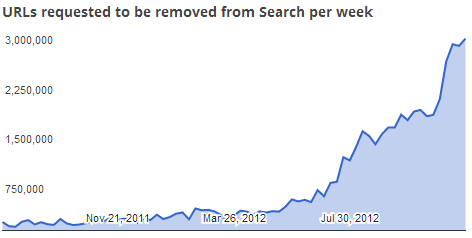
Other than the usual self propelled back patting, the report does state quite clearly what methods the search engine giants thinks is most effective in reducing online piracy. It starts with the perfectly reasonable call for better legitimate alternative to piracy, more of your Netflixes and Spotifys, and in a somewhat transparent gesture of self promotion, Google Play and YouTube. The rest of the report simply states Google’s anti-piracy efforts, including the 4 million DMCA takedown requests the company has to deal with every week, as well as efforts in shutting down revenue sources for pirates.

An interesting read, no doubt. But will it placate the copyright lobby and their political servants? Probably not, but it was worth a shot anyway.

High Definition

I mentioned a couple of months ago that the BDA (Blu-ray Disc Association) has been investigating the potential for 4K movies to be distributed via Blu-ray discs. New rumors suggest that a positive announcement from the BDA on this is not too far away. Adding fuel to the fire is this story about a German Blu-ray disc manufacturer announcing a new line of triple-layer 100GB Blu-ray discs, and their press release specifically mentions 4K as one of the intended uses.

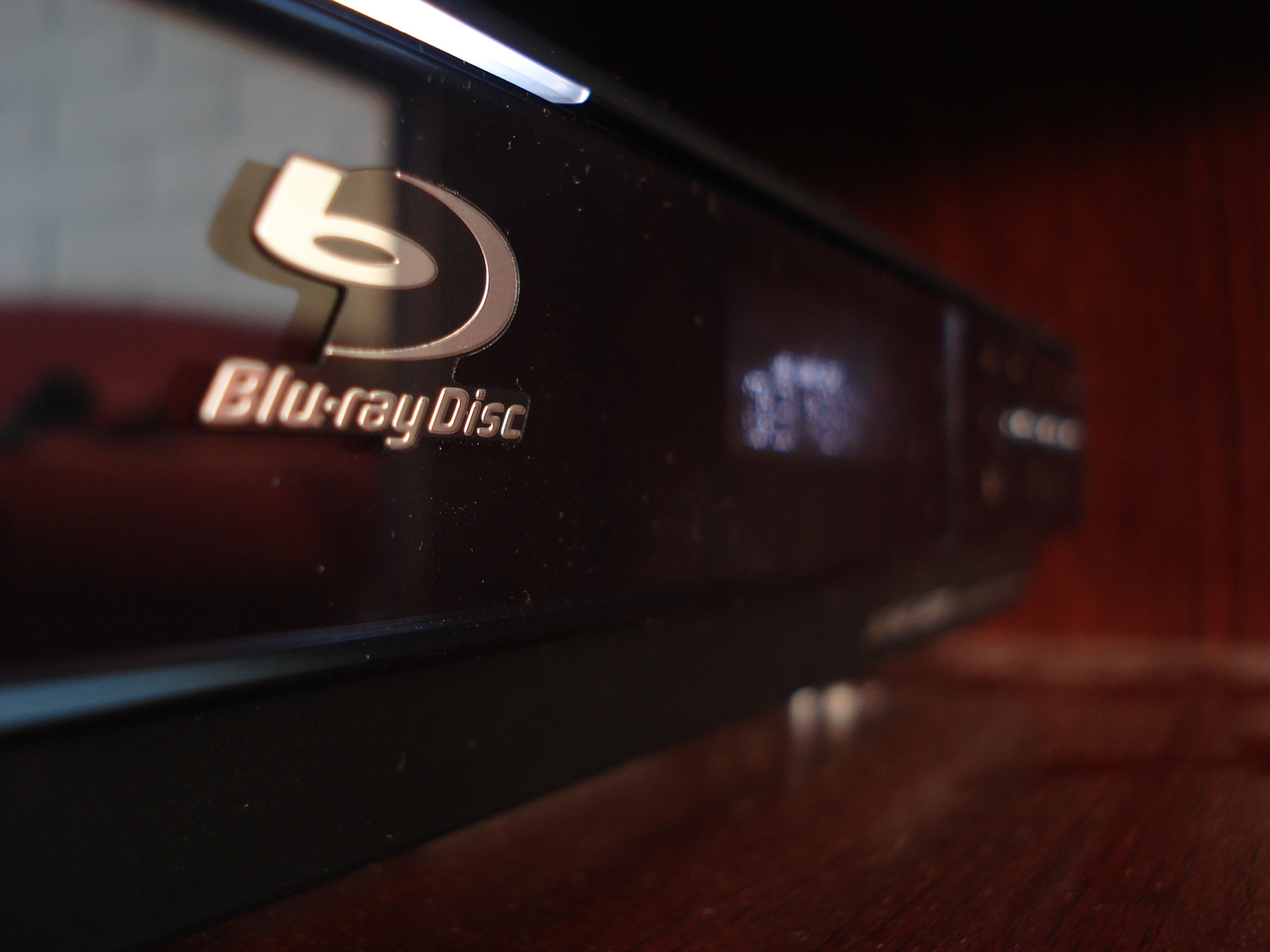
Blu-ray Player

Could existing Blu-ray players be made capable of reading 100GB triple-layer discs containing 4K content? Does it even matter, as these players may not be powerful enough to decode 4K content anyway …

100GB should be more than enough for 4K movies, especially if it uses the new H.265/HEVC codec (but even with H.264/AVC, 100GB should be enough). The big question is whether these new discs would be compatible with existing Blu-ray players, perhaps after an obligatory firmware update. However, new players will probably have to be produced to support 4K output and support for H.265/HEVC, and older players may lack the processing grunt to handle the decoding anyway; so having these discs be readable by older Blu-ray players may be somewhat pointless (although being able to downscale Blu-ray 4K content to 1080p would be a very nice feature to have for existing Blu-ray owners, and will no doubt help push Blu-ray 4K sales at a time when 4K TVs are still too expensive).

The other main advantage of backwards compatibility is that with the PS4 and Xbox One both having Blu-ray drives, and both capable of outputting at 4K resolutions, these would instantly become the Blu-ray 4K players of choice in the same way the PS3 was the Blu-ray player of choice back when Blu-ray first launched. Stay tuned to this space.

If any of this is true, it would definitely keep Blu-ray relevant in the 4K era. I know Sony, of all people, are going down the disc-less route in terms of 4K, but discs are still the most efficient way to transmit the large amounts of data required by 4K right now. That will change with the increase penetration of fiber based broadband, but this could take years. And we’ll probably have the bandwidth hogging holographic TV to worry about by then!

Gaming

The August NPD report has been released. The Xbox 360 was once again the most popular home based console for the month of August 2013 for the US market. This is the 32nd time in a row that Microsoft’s console has won the accolade.

GTA V Screenshot

GTA V will be occupying most of my free time over the next couple of weeks, I suspect

However, only 96,000 Xbox 360s were sold, only half of what it was a year ago. This is the first time in a long time that the Xbox 360 has sold less than 100,000 units in a given month, and the fact that it was still the best selling out of the other home based consoles, tells a rather unfortunate story. Still, with only months left before the Xbox One and PS4 are on the market, the low hardware sales are to be expected. GTA V’s release this month will boost hardware sales when the NPD releases its report this time next month though.

Speaking of GTA V, I’ve pre-ordered my copy (despite the fact that the pre-ordering phenomenon is directly incentivizing the video game industry’s many bad habits these days – but I just can’t say no to a GTA game). I doubt I’ll have time to play it until next weekend, so please do not expect a surprisingly wordly edition of the WNR next week. It ain’t gonna happen!

That’s it for the week. I’m off the enjoy a nice dinner that includes crabs/no crabs [DELETE AS APPROPRIATE]. See you next week.