
Archive for the ‘Copyright’ Category

Weekly News Roundup (16 March 2014)

Sunday, March 16th, 2014

Happy Birthday to Me, Happy Birthday to Me, Happy Birthday Dear Webmaster Dude, Happy Birthday to Me (not to the tune of that well known song, as I don’t want to pay royalties). I had to work through my birthday this year, which was no fun. Birthdays are definitely getting less fun as I get older, and the quantity of cake I can have before feeling guilty is also on the decrease. It’s an alarming trend!

News time!

Copyright

Google’s common sense submission to the Australian government is likely to fall on deaf years, as the search giant spells out quite clearly that they do not want harsher new copyright laws to try and solve the piracy puzzle. Instead, Google believes that piracy is an issue of availability and pricing that is best solved by investments in innovation, rather than legislation.

The then newly elected conservative government of Australia called on industry submissions for reducing communication regulations, and it was in Google’s submission that the company outlined their believes in regards to piracy.

Unfortunately, the pro big-business government is likely to ignore Google and side with Hollywood, as the country’s Attorney-General has already hinted at the introduction of a three-strikes regime as well as domain blocking via legislation, the type of actions that Google says will yield “little effect”.

What Google says makes a lot of sense. Despite the lack of availability and outrageous pricing here in Australia, which has led to high piracy rates, we are still one of the most eager consumers of digital content in the world. Recent data shows that digital film and TV spending rose 22.4% in the last year. If anything, the high piracy rate may simply be an indicator of huge unmet consumer demand, as hit shows like Game of Thrones are being locked away in exclusive deals that makes it harder and harder for fans to actually download or stream the show legally.

It seems to me that the only way that legislation and technical measures such as DRM and domain blocking can have an effect on piracy, not just in Australian but anywhere, is if it’s succeeds in reducing the enthusiasm people have for TV and movies, or music and games. And I’m not sure this is what rights holders actually want, to have a less enthusiastic customer base. People pirate because they like the content, and it does not mean they won’t pay for it when pricing and availability makes the legal option a viable one. As Google says, it’s not really an enforcement issue (not that you can successfully enforce it anyway, no matter how many laws you pass)

——-
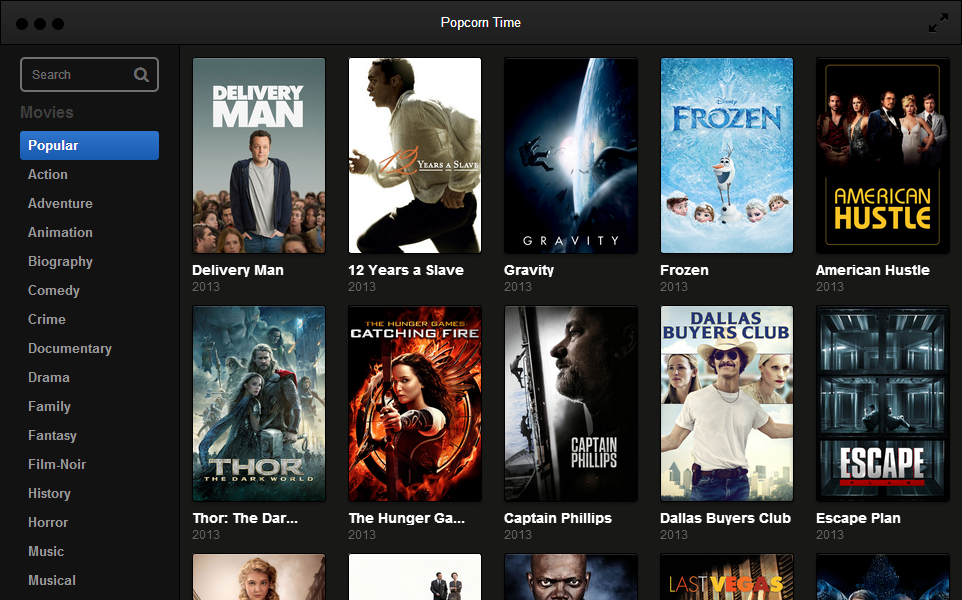
Popcorn Time

Popcorn Time in all of its past glory before it was taken offline

Well, that didn’t last long. Only a few hours after I wrote the original article on Popcorn Time, the BitTorrent powered consumer friendly movie streaming app (being called the Netflix of piracy), the official website has since been closed and the project shuttered. Well, as much as an open source project can be shuttered anyway.

The developers didn’t cite any specific reason (or threats) that was responsible for their decision, but it was pretty clear, reading between the lines and one particular sentence (“legal threats and the shady machinery that makes us feel in danger for doing what we love”), what had occurred.

So what was Popcorn Time? Think of it as the easiest way yet to watch movies online for free. By combining a super sleek user interface, designed specifically for watching movies, and using the power of BitTorrent and a few publicly available APIs, here is, no strike that, “was” an app that made finding movies to stream online easier than using Netflix. Of course, many of these free movies are pirated movies, but Popcorn Time’s simplicity meant that it was no more than a web browser with a BitTorrent client strapped to it.

No surprise then that the legality issue was the biggest one surrounding Popcorn Time in the short period it was actually live. The developers were adamant that it was legal. I mean, how could a web browser and a BitTorrent client not be legal? But then again, The Pirate Bay is just a search engine. And if even a megacorp like Google can get heat for copyright issues, Popcorn Time wasn’t going to be left out of the spotlight. It seems today the criteria for liability relating to inducement  or contributory copyright infringement is *anything* that makes piracy a tiny bit easier, even if it was just a heavily customized web browser. This is perhaps why Popcorn Time’s fate was sealed the second it made headlines.

But all is not lost. In their infinite wisdom, the developers of Popcorn Time decided to go open source from the get go. Once something is open source, it can never really be taken down. Given the hype and publicity, and the enthusiasm already shown by the open source community, I fully expect others to build and improve upon what was Popcorn Time.

Popcorn Time and its mascot Pochoclín – we hardly knew ye. But maybe we’ll get to know you better in your new reincarnated form.

DVDFab

DVDFab is under serious legal pressure, and others are taking note

This one did last a bit longer though. DVDFab, the company synonymous with DVD and Blu-ray ripping, has met with a major legal setback after a New York federal court ordered its domain names, social media account and funds to be seized and frozen. This comes after AACS LA, the licensing firm responsible for the copy protection schemes found on Blu-ray (and HD DVD – you shall not be forgotten), sued DVDFab, a Chinese company, in the U.S.

The only real surprise was that it took this long for some kind of legal action to be taken, to be fair. DVDFab has since relocated its website to a more hospitable .cn domain, started up a protest site, and offered absolutely zero legal defense of its legal position in the U.S (they did not even respond to the motion for a preliminary injunction, which led to the seizures).

Other companies, including the USTR “notorious piracy list” nominee Aiseesoft, have responded by removing their ripping products. May be too little, a little too late, from a legal perspective though.

Slysoft now leads the DVD and Blu-ray market, if they wasn’t head of the pack before. It too was named in the USTR list, so could legal action soon follow? Who knows.

Gaming

The February NPD results have been released. The PS4 was once again the winner, but the winning margin was pretty narrow for February. The PS4 is estimated to have sold around 280K to 286K units, compared to the Xbox One’s 258K.

With Titanfall to be included in March’s NPD results, next month could see the Xbox One regain its next-gen console throne, even if it’s just for one month.

The Wii U managed to sell 82.5K units, behind the Xbox 360’s 114K. No PS3 numbers this time, but you’d expect it to be somewhere between the Wii U’s and Xbox 360’s.

That’s it for this WNR. See you next week.

Weekly News Roundup (9 March 2014)

Sunday, March 9th, 2014

I don’t get to talk about coffee much here in the WNR, mainly because I’m not a huge consumer of it. I do have a Nespresso machine, one that I bought for a single cent during a sales event at an Australian daily sale website, and I have been buying “compatible” pods for it. I’ve always wondered why Nestle didn’t put DRM into their pods as to prevent the use of compatibles, but I suspect a fair segment of their customer base are far too pretentious to even think about using compatible pods. I’m looking at you George Clooney!

(just kidding, Clooney is awesome)

Copyright

I occasionally buy Blu-rays from the UK (and by occasionally, I mean all the time), and one thing I’ve noticed is that the anti-piracy message has softened a lot since the days of “you wouldn’t download a car” (I would if I could!). For example, Universal has a “Thank-you” message on its UK Blu-rays that thanks the viewer for not pirating. A nice and positive message that I think plays much better than accusations of criminal activity (and false accusations too, at people who have already paid for the movie).

So it turns out that this wasn’t accidental, but was the result of extensive research on having the most effective anti-piracy message. The same research may have also included the fact that some of the biggest pirates are also the movie industry’s best customers. And for the first time that I can remember, a British anti-piracy group has openly admitted this fact.

And its new anti-piracy will focus on the positive viewing experience of going to the movies and asks users to pay for a little bit more and pirate a little less, asking instead of demanding. I’ve always said that going to the movies has no equal experience wise, not even if you have an uber home theater set up, and so placing more focus on the uniqueness of going to the movies is a good idea. Not treating potential customers as criminals is also a bit more productive, I think.

Keurig 2.0

Keurig’s new coffeemaker will incorporate advanced tagging technology to prevent unlicensed compatible pods from being used

Not treating your customers like cash machines is also a good way to run a business, and as someone who just spent another $70 buying ink refills for a $200 printer, I can relate. Unfortunately, the coffee pod business, already using the same business model of cheap machines vs expensive refills, is borrowing another trick: DRM’d pods.

Well, it’s not strictly a DRM since there are no digital rights being managed. Instead, it’s your coffee drinking rights that is being messed around with, by denying cheap compatible pods from being used. But in the same way you can’t use non-official game discs in your Xbox 360, this system does the same with coffee pods, and so it is the same form of licensing control. Makers of compatible pods will call it anti-competitive, and consumers will be worse off because there will be less choice and higher prices, but this sounds like the kind of thing that will eventually end up in court, especially if a competitor tries to break the authentication.

The makers of this new coffee machine and pods explains the use of the authentication, which consists of a proprietary “taggant material” on the pods (something akin to an RFID tag, I suppose) and a camera that scans this in the machine, is “critical for performance and safety reasons”. The same reason why you should never use compatible ink cartridges because they’re lower in performance and could damage your printer – according to the printer companies, that is.

High Definition

In case you haven’t gotten sick of hearing me talk about  my new Australian website Streambly, I’m going to talk about it some more. With good reason this time, as it turns out I’m one of 200,000 that subscribes to Netflix here in Australia, courtesy of a geo-unblocker (but I’m guessing I’m one of the few who has created a website telling the 20,000 others who have read my Netflix guide so far on how to do it).

Netflix

Australians are enjoying Netflix in their homes without Netflix actually being available in Australia (and obviously also in not as nice homes, compared to the one in the picture above)

The apparent popularity of a service that isn’t technically available here has our TV networks, and local Netflix wannabes, in a twist. The “P” word (erm, “pirates”, in case you’re not sure) has already been used to describe those that sign up to Netflix here, despite our previous Attorney General specifically stating that using VPNs to access Netflix isn’t considered infringement under current copyright laws.

I can understand their fears and frustration. Here’s a $7.99 per month service that gives you thousands of movies and TV shows, and it’s up against local TV networks that often air new episodes a year after their original broadcast in the U.S (if they air them at all), and a local video streaming service that perhaps only has 10% of the content on offer from Netflix. With catch-up services ranging from non existent to poor, there’s no Hulu or Hulu Plus equivalent here either. All we have is a single cable TV provider that has a market monopoly and is willing to use its market position to get exclusivity to shows like Game of Thrones. No competition. No value. Sometimes just ‘no’, in terms of legal streaming or download options. Yep, I can understand why they fear Netflix.

Adapt, Evolve, Compete or Die. It’s their choice!

Finish, Writing, Play Games or Be Bored. That’s my choice. See you next week.

Weekly News Roundup (2 March 2014)

Sunday, March 2nd, 2014

Welcome to another WNR. Been having trouble sleeping lately, and the heavy workload for the week eventually culminated in a mild bout of the migraines. All but recovered now, but there’s nothing worse than having a deadly headache just short of a deadline.

It’s been a good week news wise, so no need for me to make excuses this time.

Copyright

Is six-strikes working? It’s been more than a year since the start of the voluntary industry-led six-strikes graduated response regime, and the people running says it’s been a success, despite the complete lack of any evidence to support the claim.

Other than revealing that “a large number of alerts” have been sent out, there has been very little information being released from the system which, in the past, has been accused of being lacking in transparency. The absence of good news, in terms of a piracy rate drop or an increase in sales as a direct result of the regime, most likely suggests that things are not going too well. Which is not all that surprising, considering the French version has already failed.

Indirectly, there are stats that indicate things are actually getting worse. U.S. traffic to sites like The Pirate Bay has actually increased since the introduction of six-strikes, and we all know that many people have signed up for proxies and VPNs to avoid detection (or to use another form of downloading that’s not monitored).

Roll of money

The MPAA has been throwing money in the direction of Republican groups recently

When we do see some stats, it will most likely paint a rosy picture that points to misleading conclusions. A ton of alerts will have been sent, BitTorrent traffic may drop, more likely due to Netflix than six-strikes, and the number of fifth or sixth strikes will be a lot less than the number of first and second strikes, which will be used as “evidence” that things are working as expected. But there will be no real drop in piracy, no real rise in revenue, and no real effect for a regime that was never really about real results, just imaginary safety.

And if industry-led action doesn’t work, there’s also government intervention. The MPAA has been busy spraying money around, and according to the Wall Street Journal (paywall) and The Hollywood Reporter, they’re spraying it in increasingly GOP directions. Both articles highlight the MPAA’s increasing lobbying payments to right wing political action groups including U.S. Chamber of Commerce ($100,000), Americans For Tax Reform ($200,000) and Let Freedom Ring, and also key appointments that have Republican ties. This is perhaps not surprising considering who controls Congress at the moment, so if that situation changes, expect the MPAA’s political leanings to change too. They’re far too smart to play politics, when spreading money to everyone seems to be the best strategy these days in the lobbying game.

High Definition

Netflix’s deal with Comcast has been discussed in the webosphere as the inevitable result of the death of net neutrality, but the actual deal has nothing to do with it. Whereas net neutrality is about ISPs messing around with last mile delivery of content, this deal is all about the interconnections between Netflix and ISPs, namely Comcast, which has been the real cause of performance issues in recent times.

Netflix

The Netflix/Comcast deal’s only real effect is a better viewing experience for viewers .. for now

Despite rumors suggesting Comcast has been throttling Netflix traffic, something they are now allowed to do with the death of net neutrality, the congestion has actually been occurring higher up the chain. This deal will see Comcast connect directly to Netflix’s servers, as opposed to through a third party network – in exchange, Netflix will pay Comcast for traffic that flows from their servers to user’s homes, money they would otherwise have paid to third parties like Cogent and L3. In essence, this is a peering agreement and is nothing new, and has nothing really to do with the net neutrality debate.

With that said, the sheer size of the likes of Netflix and Comcast (thanks to their planned absorption of Time Warner Cable) means these peering agreements may be something to worry about in the future. It’s all easy and good for the big guys to make big deals, but this will end up hurting content providers that don’t have the clout of Netflix when it comes to making deals with a behemoth like Comcast. So some of the very same issues that people are concerned about over net neutrality may apply to these kinds of increasingly secretive deals (had Comcast not announced their Netflix deal publicly, none of us would have ever known – just as we don’t really know what kind of deals Netflix has with others ISPs).

Gaming

The PS4’s Japanese launch was, as expected, a huge success. The PlayStation brand has always been well received in Japan, even when PS3 sales were disappointing elsewhere. But with the PS4 being an international hit already, the home islands weren’t going to offer up any surprises. Early data indicates that the PS4 is selling four times as many PS3s when comparing both console’s launch, so there we go.

PS4 with controller and PS Eye

The PS4 will remain stock limited until at least April, says Sony

The success of the PS4 in Japan isn’t good news for gamers still waiting for a console elsewhere though, as stock problems could continue well into April. It appears that Sony has severely underestimated the demand for the console, PlayStation UK managing director Fergal Gara even admitting that the company had a hard time believing the pre-order numbers were correct, even thinking they may have been faked for some reason, or that people were making pre-orders at multiple places in order to secure a launch day unit.

The PS4’s success is bad news for Microsoft though, and a price cut for their Xbox One has already been rolled out … in the UK. Gamers in the UK were already overpaying for the Xbox One, even compared to smaller markets like Australia, so this price cut is unsurprising, even if the timing is slightly surprising given how new the console is. But even with the price cut, the Xbox One (with Titanfall) is still $USD 80 more than the PS4 in the UK.

For all the differences between the consoles, and their different philosophies this generation round (almost a reverse of the last gen, where the PS3 concentrated on media capability, while the Xbox 360 focused on hardcore gaming), I think all things being equal (and the PS4 and Xbox One are equals, with the Wii U a step behind), pricing is probably the key factor. The Xbox 360 only surged ahead of the PS3 and the Wii in the U.S. after its price cut, for example.

So it’s time for Microsoft to rethink its strategy. Either go for broke (possibly literally) and drop the Xbox One’s price to equal that of the PS4, perhaps by repackaging the console to make Kinect an accessory again, or dramatically increase the value of the console bundle to entice buyers. Something needs to be done, and it needs to be done quickly to ensure the Xbox One remains competitive.

I think that’s it for the week. Hope you enjoy this March, my favorite month of the year and not just because it’s the month containing my birthday 🙂

Weekly News Roundup (23 February 2014)

Sunday, February 23rd, 2014

A very short WNR this week, and that’s partly my fault. I took part last night in Melbourne’s second annual White Night festival, and that and other distractions during the week meant that I just didn’t have time to scour the interwebs for interesting news stories. So as compensation, I present to you these creative commons licensed, rather common and uncreative photos of my own taking, of some scenes at White Night. This is probably the most interesting part of the WNR for this week, unfortunately.

IMG_20140223_001123 IMG_20140222_234614 IMG_20140222_213839

Here’s goes anyway.

Copyright

The Pirate Bay ship may soon sail unencumbered in the waters of the Netherlands, after the country’s second largest ISP forced anti-piracy agency BREIN to agree to a lifting of a ban on visits to the notorious piracy website. This comes after January’s ruling by The Court of The Hague which found that the banning was ineffective and anti-business.

The Pirate Bay

The Pirate Bay blocking may be about to become history in the Netherlands

Other ISPs will probably follow suit (nobody wants to be at a competitive disadvantage), and could be the clearest signal yet that Dutch anti-piracy BREIN may be throwing in the towel when it comes to its website banning ambitions.

The Court of The Hague’s ruling was based on a report that found website bannings to be ineffective in stopping piracy, and also unfairly restricts ISPs’ freedom to conduct business. BREIN has yet to decide to appeal the ruling, but even if they do, it could take years for a final decision. To continue to ban The Pirate Bay during this time, when a court has already ruled against the banning, would not be in the best interest of anyone involved, even BREIN, and perhaps this is why BREIN agreed to the lifting (even though this court decision did not apply to the ISP in question, UPC).

I’m hoping this court ruling sets the right precedent and forces anti-piracy groups to rethink their strategy on website bannings, but I suspect it won’t. It’s not the first time that these anti-piracy crusaders have ignored facts and common sense in their pursuit of a victory against piracy, and so I don’t expect anything different this time.

High Definition

You know it’s a slow news week when I have to talk about bacteria and other microorganisms in the HD/Blu-ray section. Ironically, this was actually the most interesting story of the week, as scientists have discovered a new way to use a Blu-ray player: for lab work!

Using a standard commercial Blu-ray disc and the Blu-ray player’s laser, scientist have found a way to use these to identify the type and concentration of bacteria, and to a degree of accuracy that matches much more expensive lab equipment.

I don’t know about you, this is one feature that I will demand to be part of my next Blu-ray player!

Well, that’s that for the week. I’ll try harder next week. I promise!

Weekly News Roundup (16 February 2014)

Sunday, February 16th, 2014

Welcome to the WNR. Hope Valentine’s Day was a nice one for you couples out there, and for you singles out there, I hope at the very least it was a decent Friday.

Let’s get started.

Copyright

Despite RapidShare’s appeasement policy towards rights holders, the file hosting site has been re-added back to the “notorious pirates” list by the USTR (United States Trade Representative). The new updated list also includes software firms Aiseesoft and SlySoft, two companies that both sell DVD and Blu-ray ripping software.

RapidSharre logo

RapidSharre no longer a friend of Hollywood and the music industry, despite its draconian anti-piracy measures

It appears sucking up the rights holders did not work as well as RapidShare had hoped. Neither the implementation of quite draconian anti-piracy methods, nor its infamous manifesto helped to prevent rights holders from dobbing in the file hosting website to the USTR for inclusion in this year’s list. You can’t win, really. So you probably shouldn’t try to.

The other new inclusions are interesting too. Despite their products being around for what seemed like a decade already, and with many other companies producing similar software, both Aiseesoft and SlySoft gets special treatment this time around by the USTR. Now I don’t have much personal love for Aiseesoft, having seen either their representatives, their marketing agency or just really really fanatical customers spamming my forum for ages (forcing me to implement a filter to automatically change all references in forum posts from ‘Aiseesoft’ to ‘Aispamforums’). But it’s just one of many, possibly hundreds of companies that are churning out software with the same functionalities, so why pick them out, I have no idea. The SlySoft listing is perhaps a little bit easier to understand, given the company’s higher profile.

Nobody likes being blacklisted, but it probably doesn’t mean much for these companies in the long run.

——

Well that didn’t take long. A week ago, in this news article on yet more viewing restrictions for Game of Thrones in Australia, I wrote “Given these new restrictions, it’s very likely that the piracy rate for the new season (of Game of Thrones) will be even higher, which may prompt the new conservative government of Australia to take action.”

Three Strikes

Three strikes and domain blocking may be coming to Australia

And just a few days later, Australia’s Attorney-General George Brandis has issued the clearest call yet for three-strikes and website censorship to be part of new copyright reforms aimed to modernising existing copyright laws.

This is despite mountains of evidence that graduated response does nothing to curb infringement activities, as well as a recent Dutch court ruling that found website censorship is disproportionate and ineffective – all of which conveniently ignored by the copyright lobby or dismissed as bias.

And none of it addresses the real cause of piracy, which is a problem with access. If users are not getting the choices they want, at the prices they want, then rightly or wrongly, they will seek alternatives. This may be grey imports or circumventing geo-blocking to access the likes of Netflix or Hulu Plus. Or it may be mean piracy. And until these problems are addressed, no technical or legal measure will do a damn thing to curb the piracy problem.

Gaming

A major development in US video games sales with the release of the January NPD results showing the PS4 having a big lead over the Xbox One, despite the former’s stock constraints.

While none of the consoles really sold in great number, not compared to December anyway, the PS4’s 271,000 (based on a pretty solid estimation) put the Xbox One’s 141,000 in the shade. Had PS4s been more widely available in stores, the gap would have been even greater.

Xbox One Forza 5

Xbox One struggling in sales already? Price tag probably main reason for gamers choosing the PS4.

To illustrate how poor the Xbox One numbers were for January, the first January since launch, we can compare it to previously generation consoles. For the PS3 and Xbox 360, their first Januarys meant between 240K and 250K in sales. The Wii U only managed 57K during its first January.

Multiplatform games also sold better on the PS4 than on the Xbox One, with the exception of CoD: Ghosts.

With the PS4 beating the Xbox One comfortably in other markets, and with the Japanese market expected to be dominated by the PS4, North America remains the only major marketplace where the Xbox One has a realistic chance of beating the PS4. On these figures, these chances seem less and less realistic.

Worryingly for Microsoft, it appears the PS3 outsold the Xbox 360 in January as well. In fact, even the Wii U may have done better (although still most likely below 50K).

While it’s far too early to eulogize the Xbox One, there are some pretty clear reasons as to why the Xbox One is not doing as well as it should. The extra $100 Microsoft expects gamers to pay for the largely useless included Kinect 2.0 is the main factor, as is the console’s perceived hardware disadvantages (which are not really showing up dramatically in games, but nevertheless is a factor for buyers).


It’s almost the same mistake Sony made with the PS3, having been released at a higher price with a feature (Blu-ray) not many people needed at the time. This time, Sony listened to gamers and gave them a console that did all the important things right, and it appears the company is reaping the rewards. Microsoft, on the other hand, tried to force excessive DRM onto users, then backtracked, but still ends up with a console that doesn’t do anything particularly better than the cheaper PS4. Only a price cut, and one that has to occur this year before the PS4’s lead grows by too much, can turn things around, in my opinion.

That’s it for the week. See you again in seven.