Archive for the ‘Xbox 360, Xbox One’ Category

Weekly News Roundup (12 May 2013)

Sunday, May 12th, 2013

Happy Mother’s Day! Not sure how I can segue the holiday into a WNR mostly about BitTorrent and streaming, but this and this may help.

[SEGUE COMPLETED]

Let’s start …

Copyright

BitTorrent Inc this week chose to launch a strange attack on Netflix’s claims last week that BitTorrent traffic drops whenever Netflix enters a new market.

It was strange to me because it was clear that Netflix’s Chief Content Officer Ted Sarandos was referring to piracy related BitTorrent traffic (responding to a question about piracy in an interview with Stuff magazine). That BitTorrent Inc chose to counter these claims seemed at first to me like they were inadvertently accepting the association between BitTorrent, the company, and piracy.

Sarandos said last week that “When we launch in a territory the Bittorrent traffic drops as the Netflix traffic grows”. BitTorrent’s VP of marketing Matt Mason this week criticized Sarandos’s statement for linking BitTorrent with piracy. Mason also disputed the relationship between BitTorrent and Netflix traffic, saying the latter was most likely due to a BitTorrent algorithm that reduces traffic flows during peak usage times, including during peak Netflix usage hours.

The first part of the criticism I can understand, although one would have to take Sarandos comments out of context for that confusion to arise, but the second part is a bit curious to say the least. Mason’s explanation seem to be talking about a BitTorrent traffic drop during peak usage hours, but surely whatever traffic pattern changes exists whether Netflix exists in the area or not, and even then, the algorithm will only manage to push traffic to non peak times. There would not be an overall traffic drop over a period of time, which seems to be what Netflix’s Sarandos is suggesting. To me, Sarandos is saying that less stuff gets transferred via BitTorrent once Netflix moves into a new area, and I fail to see how traffic management can lead to less stuff being downloaded. And since Sarandos was talking mainly about piracy related traffic, why is BitTorrent Inc injecting themselves right into the middle of this particular hornet’s nest?

Mason does agree with Sarandos’s suggestion that the best way to fight piracy is by giving people what they want. And if this were true, then piracy related BitTorrent traffic should drop. For Mason to suggest that it hasn’t would require you to completely disassociate piracy with the BitTorrent technology, and that isn’t reality no matter how you may want to spin it.

BitTorrent Logo

What’s in a name? BitTorrent the company, the protocol, or the acts of piracy?

Perhaps Sarandos’s statement was a bit clumsy, in that he chose to condense the phrase “piracy related BitTorrent traffic” to just “BitTorrent traffic”, and also offered nothing to back up his claimed relationship between Netflix and BitTorrent traffic. But it seemed like an off the cuffs kind of comment, that taken into context, shouldn’t really concern the likes of BitTorrent Inc.

It just seemed to me like BitTorrent Inc was budding into a conversation that wasn’t even about them, by loudly proclaiming that the conversation shouldn’t be about them. Mission un-accomplished?

While I understand the frustration of BitTorrent Inc in regards to the far too liberal use of the term BitTorrent (something I’m guilty of too here), which I talked about in the last issue of the WNR, I fear it may be too late at this stage to disassociate BitTorrent with piracy. It’s become a shorthand, rightly or wrongly.

But instead of taking on Netflix over a somewhat lazy use of words, and seemingly agreeing and disagreeing with Netflix’s anti-piracy credentials at the same time, BitTorrent Inc should just keep on pushing the “legal content via BitTorrent” agenda, and continue to support companies like Netflix in their attempt to fight piracy the right way. It’s too late in the game to be this oversensitive about wording.

Along with Netflix, Spotify has probably done the most to stop piracy. But a flaw in the Spotify web player was exploited last week to full effect when a Chrome browser add-on called Downloadify allowed every song in Spotify’s 20 million strong catalog to be downloaded without DRM.

The add-on was promptly removed by Google, and Spotify soon fixed the flaw, but not before more than 16,000 songs were downloaded.

The flaw, which apparently had cached songs being unencrypted, had been there for at least five or six months. I do wonder what it means when it took so long for the flaw to be exploited, and that the Spotify web player was essentially DRM free all this time with not a worry in the world.

Also note that for the hardcore pirates out there, it’s still possible to record what’s being played by Spotify and “rip” it that way. Only those most serious about pirating would probably attempt it though, because, I mean, why bother?

Gaming

As we get closer to the official May 21 launch event for the Xbox 720, codenamed ‘Durango’, and possibly actually named Xbox Infinity, more concrete information about the console is being leaked week by week. This week, we have the story of an internal Microsoft email sent to all employees working on the console that seem to allay fears that the console would feature a much hated ‘always-on’ DRM system.

The leaked email specifically addresses the issue and says that the console will be “tolerant” of today’s Internet connectivity issues, which means that activities such as “playing a Blu-ray disc, watching live TV, and yes playing a single player game” will not be subject to any Internet connection requirements.

Phew.
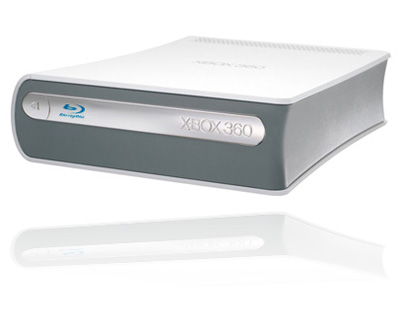
Microsoft Blu-ray Drive

After years of a rumored Blu-ray drive add-on for the Xbox 360, the next Xbox may finally get Blu-ray movie playback

To be honest, I never believed that ‘always-on’ DRM was on the cards. Sure, other leaked documents and rumors talk of an ‘always on, always-connected’ console, but it always sounded more like the description of a quick stand-by mode that also featured support for things like background updates. The truth of the matter is that console piracy isn’t so serious yet that ‘always-on’ DRM will be required at the expense of making gamers angry, certainly not for a new console whose actual copy protection system may take a while to be broken.

As a bonus, the leaked email also seem to confirm not just the use of Blu-ray discs for the Xbox 720, but the inclusion of Blu-ray movie playback, which would be a great upgrade to the Xbox 360’s media playback credentials. Unfortunately, another rumor suggests that this very inclusion is the reason the Xbox 720 will fail to meet its previously predicted 2013 launch date, instead being delayed until 2014 due to Blu-ray licensing troubles. Apparently, Sony has an exclusivity agreement in place for console based Blu-ray playback at the moment.

This could spell trouble for Microsoft, since timing is everything. Microsoft knows, that despite the Red Rings of Death problems with the early Xbox 360, the Xbox platform wouldn’t be anywhere near what it is now if Microsoft hadn’t released the console a year earlier than its competitors.

The same doesn’t look to be true for the Wii U unfortunately. Despite also releasing a year earlier compared to the PS4 and Xbox Infinity, I fear that when the three consoles are compared, the Wii U will look a lot more dated than just a year. I know graphics shouldn’t be that important, but it’s the easiest way to compare multi-platform titles, and the minor improvement that the Wii U has over existing consoles like the PS3 and Xbox 360 means its early release has no positive effect. At its time of release, the Xbox 360 was head and shoulders above the likes of the GameCube and the PS2, and Nintendo needed to do something similar if they really wanted to get back part of the hardcore gaming market.

And the sad part is that poor early sales will destroy any slim chance the Wii U has in going against the PS4 and Xbox Infinity. A low user-base will be enough to convince some developers to skip the Wii U entirely when it comes to developing multi-platform titles, which means a lack of new titles, which means even lower sales. This vicious circle is extremely dangerous, even with Nintendo’s good track record in terms of first-party titles, and the company needs to do everything it can to ensure developers continue to make stuff for the Wii U (even if it means big financial payoffs, a strategy that Sony and Microsoft are no strangers to).

That or dramatically cut prices.

And I think that’s it for the week. See you in seven.

Weekly News Roundup (28 April 2013)

Sunday, April 28th, 2013

As part of a new project I’m working on for our Australian readers, I’ve been testing out the various US based video streaming services. Man, you guys are really really spoiled in terms of content and price. Take Netflix for example – if it had been launched here first in Australia, the price would never have been $7.99 per month. More like $79 per month, probably with less content and more restrictions as well. And it’s not just content and price, it’s also quality. To put it into perspective, Netflix Super HD’s maximum quality is probably better than anything we see in broadcast here in Australia, and that includes the $100+ per month HD cable I’m paying for.

I just hope I have enough bandwidth. I thought 300GB per month would be more than enough when I switched a month ago, but having used 15GB per day for 3 out of the last 5 days, I’m not so sure now.

Despite the Netflix (and Hulu Plus) bingeing, I did manage to get some work done (plus the bingeing was part of work, um, yes), so here’s the WNR.

Copyright

Microsoft, maybe. But Google, the BBC and Netflix as bad guys? Most people won’t think that. But when it comes to adding DRM to HTML5, all of them are indeed on the wrong side of the issue.

The reason these companies all want to ditch Flash or even Microsoft’s own Silverlight is that with HTML5 and native support by modern browsers, it makes writing video applications for PCs (and tablets and smartphones) that much easier. Instead of maintaining a dozen different apps for different platforms, you can build a HTML5 based one and customize that for each platform.

No DRM

It’s still not too late to stop DRM being added to HTML5

But in order for the switch to HTML5 to happen, DRM must happen too. To be fair, the requirement for DRM doesn’t come from these tech companies, but from the media companies that supply them with content. So once again, the story becomes “Hollywood wants DRM”, which isn’t really isn’t news is it?

Still, adding DRM to HTML5, the first HTML standard to have it if Netflix and co get their wish, is bad news. Not only does it mean an expanded proliferation of DRM, it also endangers the free nature of the web itself.

But since everyone loves Netflix, and hates Silverlight and Flash, it’s gonna be hard to get people worked up about WWW DRM. This petition is probably the closest we’ll get to an Internet protest.

I don’t really get it though. Netflix’s $7.99 per month makes pirating anything that’s already on Netflix quite pointless. And releasers usually takes the paths of least resistance, which for movies would be via DVD/Blu-ray rips, and HDTV recordings for TV shows. The only time people will bother ripping a Netflix stream would be for exclusive shows like House of Cards (and only when another source isn’t available). But then again, for $7.99 per month, the only people who end up pirating would be those that you really can’t squeeze any money out of, so where’s the loss in profit?

——

If a government mandated filtering solution isn’t going to happen, and I hope it won’t, then the next best thing for Big Content may be a commercial solution. Up steps McAfee, as a new patent application filed by the company aims to add an anti-piracy filter to the company’s existing SiteAdvisor service.

SiteAdvisor is right now mainly used to blocks access to search engine result links for malicious or adult content, but this new patent seeks to expand the tool’s functionality to include copyright infringing content. So even if Google doesn’t filter out links to sites like The Pirate Bay, SiteAdvisor will step in and do it for them, although the system administrator will have to option to still allow visits to these sites (after the user is forced to read a warning message).

And if the companies behind the major security software tools can all be convinced to implement something like this, patent permitting, it would be like Christmas come early for the likes of the MPAA and RIAA. It won’t stop what I would like to call “persistent pirates” (they would have turned off SiteAdvisor or the equivalent feature in their security software from day one I suspect), but for the “casual pirates” that Hollywood and the music industry insists are prevalent, those that are unaware of their “seriousness” of their activities or lack the technical know-how to bypass these kind of filters, it might just be enough.

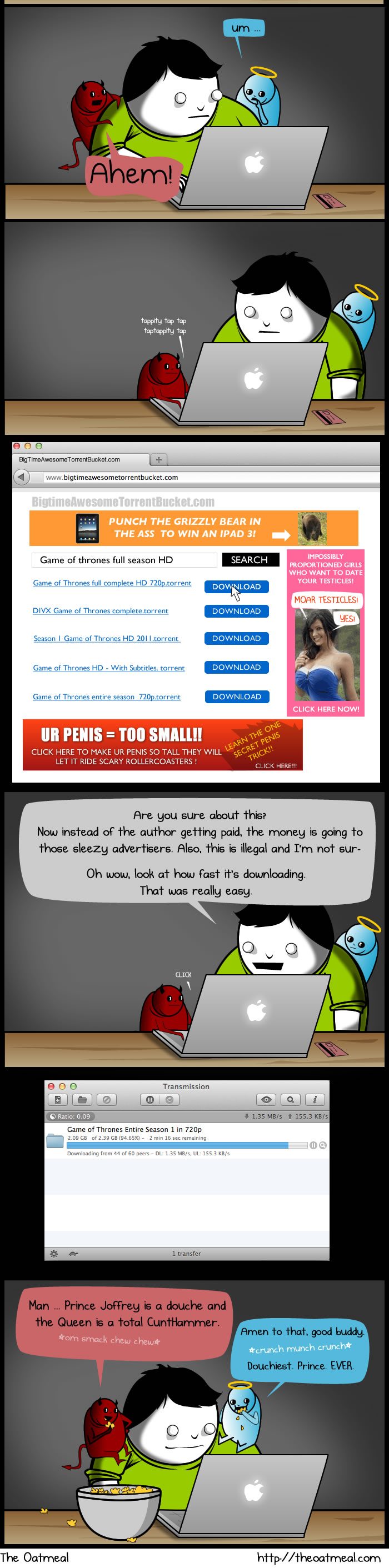
The Oatmeal: Game of Thrones

Watching Game of Thrones can be harder than actually winning the Game of Thrones

But I think most pirates know exactly what they’re doing, and why. Just like Australians who download Game of Thrones know the exact rationale behind their actions. Which is why it was fairly undiplomatic for US ambassador to Australia Jeffery Bleich to post a long-ish rant on Facebook calling Aussies that download GoT no good thieves, making Ambassador Jeffery just as popular as King Joffery in the process.

Once again the tired, and plainly wrong, analogy of theft was used, admittedly a very clumsy one involving stealing a book from your neighbour’s home that I’ve not seen before. Apparently, downloading a *copy* of a Game of Thrones episode is just the same as breaking in to your neighbour’s home and stealing a book. This analogy would only be true if Australians were actually going into other people’s homes and stealing hard-drives full of pirated GoT episodes, which ironically would actually make people think twice about piracy for fear of an unwanted home invasion. Or if Aussies broke into HBO headquarters and stole the original and only copy of GoT episodes.

The correct analogy of course is one that involves your neighbour taking the time and effort to photocopy all of his books and then leaving copies on the street for anyone to take. By taking a copy, you’ve committed copyright infringement. If the right (or wrong) people took copies, it may lead to lost sales and hurt the rights owners. It may even hurt them so much as to bankrupt them. But it’s not exactly home invasion and burglary, is it?

And what if one of the people who picked up a photocopied copy, a person that never intended to buy the book in the first place, love it so much that he went to the bookstore immediately and purchased a copy? Doesn’t this count as a gained sale? Hasn’t the publishers, only in this one isolated incident to be fair, benefited from piracy?

As for the rationale behind taking and not buying, what if the bookstore was located really far away, like in another country? Or that for no particularly good reason, you had to wait months in order to buy the book locally compared to other countries, and that when it does arrive, it’s only available in an expensive, leather-bound, big print edition that weighs a ton, instead of an edition that you might actually want? That photocopied copy might then start to look like the much better deal, even without considering the pricing differences.

But no, it’s much simpler to just trot out the tired out analogies about stealing, shoplifting, and burglary apparently, and the equally tired and frankly dishonest lines about job losses and billions being lost every year.

——

The Pirate Bay has moved home again this week. That’s twice (or three times, if you count the temporary move back to the .se domain) in two weeks. This time it’s Iceland that becomes The Pirate Bay’s new port, with the new .is domain name. Unlike the Greenland domain name authority’s self-censorship of The Pirate Bay, the Iceland equivalent says that a court would have to decide on the fate of the new .is domain name before they would be willing to take any action. And quite rightly so, because it’s not the place for a domain authority to be judge, jury and executioner.

Gaming

I said last week that I wanted to wait another week to comment on the March NPD results, to see if more hardware numbers roll in. They haven’t, unfortunately. So analysis turns to a game of educated guessing. Thanks a lot, NPD!

But if I had to guess, I’d have to say that the Wii U probably didn’t sell very well in March. If you asked me to tell you why the Wii U is struggling, then I’d probably have to say that it was down to several factors.

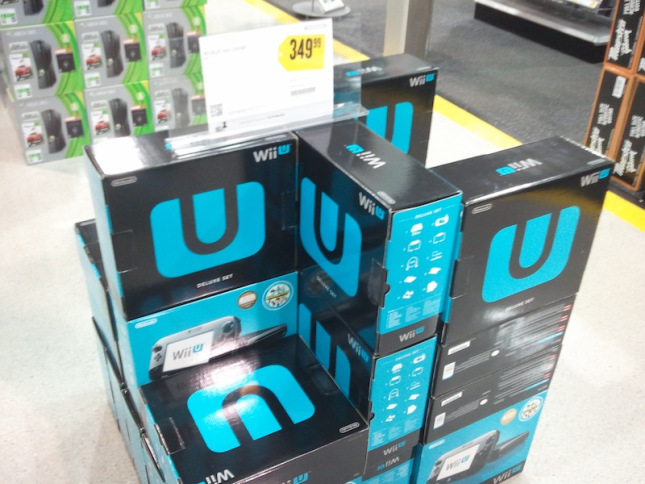
Wii U Boxes

Wii U sales remain sluggish because it isn’t a huge improvement on the 360/PS3, nor is it cheaper or a better media device

One, the Wii U’s hardware, while an improvement on the Wii, is barely an improvement on the more than half-a-decade old PS3 and Xbox 360. If Nintendo wanted to go after the hardcore gamers, the Wii U isn’t going to do it.

Two, casual gaming has moved on from the days of the Wii. Now, it’s all smartphones and tablets and really really cheap games. The Wii U has a tablet, but can it really do things, in a standalone fashion, that the iPad cannot? Plus, Wii U games are still expensive.

Three, the cost. With the PS3 and Xbox 360 getting to the end of their release cycles, the Wii U is just too expensive by comparison. It’s just not good value, as it doesn’t play Blu-ray like the PS3, and its media streaming capabilities aren’t better than the Xbox 360’s. The lack of game titles surely can’t help, even with the presence of first-party exclusives.

So while more first-party games will help the Wii U, but by holiday 2013, the much more impressive PS4 and Xbox 720 will be out and I suspect the the Wii U will look even more outdated by then. Which is a shame, because had the Wii U been here just a year earlier, it might have been a completely different story.

Speaking of stories, I must get back to mine on Netflix. So many things to watch, so little time. See you next week.

Weekly News Roundup (21 April 2013)

Sunday, April 21st, 2013

Plenty to go through in this downer of a week, so let’s not waste any time …

Copyright

Is it still going on? Apparently, yes. Viacom is still suing Google’s YouTube for copyright infringement, despite a 2010 court ruling throwing out the case via a summary judgement in favor of Google/YouTube. That decision was appealed, partially successfully, and the case was directed back to the lower courts. But once again, Judge Louis Stanton has ruled in favor of Google, arguing that YouTube was under the protection of the DMCA’s Safe Harbor provision. And guess what? Viacom is going to appeal this decision too.

It’s all getting quite boring now, to be honest. The two companies are actually working side by side these days, so only Viacom knows what the point of the lawsuit is at the moment. That Viacom is still not letting go is probably more face saving than an actual sense of feeling wronged, and whatever YouTube has done in the past, what it does now (in terms of what users do with the service, and what YouTube does for content holders) is so far removed from what went on before, it’s practically like suing a different website.

Just move on Viacom. Everybody’s bored already, including  the judges, and probably your shareholders as well. Concentrate on actually making content that people want to pay for, instead of blaming everyone else for your woes.

Speaking of things that people actually want to pay for, Netflix’s plan to fight off its old and new subscription-VOD competitors appears to be working, as its original programming has helped the company to gain new subscribers. But it’s Netflix’s old business, the DVD (and Blu-ray) rental one, that is now becoming a risk for the company, an analyst has warned.

Photo of Netflix on iPad

Netflix’s growth is dependent on revenue from its disc based business, but with that shrinking, Netflix may be at risk says analyst

While Netflix has over 29 million streaming subscribers, 64% of the company’s 2013 revenue is still expected to come from disc based subscribers. In other words, disc rentals are funding Netflix’s streaming expansion plans, and with disc revenue expected to continue to fall, it could endanger Netflix’s plan to expand to more locations around the world, as well as fund new original programs.

If anything, it seems Netflix’s current problem stem from the fact that it’s too good for its price of $7.99 per month. Compare to say HBO, who can get away with $15 per month for only a few hit shows, Netflix, now with original programming, offers much more (and an essential babysitting tool for any parent or guardian). The increasing cost of securing rights to shows and movies, and increasing competition from the likes of Amazon and Redbox, all means that Netflix is still over-reliant on its declining disc based business to keep the company profitable and in expansion mode.

Subscription VOD is currently stuck with the low cost model first pioneered by Netflix, but I suspect going forward, there will need to be tweaks to the pricing model. Perhaps we’ll see an introduction to a “premium” subscription tier that includes more fresh and original content than the “basic” $7.99 package, and that may be needed to offset the billions Netflix currently spends on licensing and production.

And who wouldn’t pay another $5 or even $10 per month if it meant they could watch new seasons of shows like House of Cards and Arrested Development?

——

It didn’t incite as much hatred as SOPA, but CISPA may be just as bad, and unfortunately, the US House of Reps passed it with an overwhelming majority on Thursday. The CISPA cybersecurity bill will enable private business to share all your most private information with any government agency that requests it, and allows warrant-less database searches. Emails, photos and even passwords could all be shared with government agencies against your will, and there’s nothing you can do about it – CISPA ensure this.

Typically, supporters of this overreaching bill says that it’s targeting terrorists not ordinary citizens, and Rep. McCaul of Texas drove home this point even more clearly by actually using the terrible events in Boston as justification for CISPA.

But unlike SOPA, there isn’t the united front against CISPA that can work together to kill it off before it becomes law. For one, the likes of Apple, Google and Yahoo are cautiously supporting CISPA, despite opposition from the likes of the EFF and the ACLU. At least this time, the White House seems to be on our side, with President Obama threatening to veto the bill in its current form, and the Senate, having already turned away a previous version of CISPA once before, may have something to say about it too.

Gaming

Sony says they’re not going to make the same mistakes they made with their PS3 launch, and will launch the PS4 at a good price.

A photo of the New Xbox 360

Could a cheaper Xbox 360 keep the console alive when the Xbox 720 and PS4 (also to be cheaper at launch) arrives?

The PS3 was launched at a price that was a lot higher than that of rival consoles at the time (in Australia, the launch price of the 60GB console was close to the $USD 900 mark). This was despite Sony still losing money on each console sold. The reason for the high price was the included Blu-ray drive, and Sony argued that since Blu-ray players were quite expensive at the time, the PS3 actually represented good value for those also looking for a Blu-ray player.

This move paid off by ensuring Blu-ray won the highly tedious HD wars, but the victory came at the cost of lost market share to the likes of Nintendo and Microsoft. It also ensured Sony lost a ton of money for the first few years of the PS3.

But with Blu-ray players worth almost nothing these days (saw one today advertised for $USD 40), there aren’t any reasons why the PS4’s price point should be any higher than that of its rivals.

Although it could still be a lot higher than that of the Xbox 360, as Microsoft may be releasing a $99 version of the console to be launched along with the Xbox 720. It may be a response to the Xbox 720’s lack of backwards compatibility, but it could also be a move on Microsoft’s part to add new customers for the console. It might target those that want it as a cheap media streamer, with the added bonus of heaps of games of all types, from the casual/family to the hardcore. The only thing better than it would be a $99 PS3 (hint, hint)!

The cheap Xbox 360 and the cheaper (on debut) PS4 should help lift video game sales, but for now, things are still stuck in the doldrums. The March 2013 NPD US video game sales data has been released, and Microsoft’s Xbox 360 was top of the consoles with 261,000 units solds, but still down nearly 30% compared to a year ago. I actually want to wait a bit to see if any more data emerges for the Wii U in particular before commenting further on March’s NPD results, so let’s talk about it next week.

And that’s it for this edition of the WNR. See you next week.

Weekly News Roundup (31 March 2013)

Sunday, March 31st, 2013

A blah of a week. By blah I mean it was just one of those weeks that, for whatever reason, seemed to go by pretty quickly, but not productively, nor that smoothly. Easter aside, the 6 (that’s SIX!!) hour disruption to my Internet connection on Thursday was a main blah catalyst. Not being able to choose from my preferred activities of work, video streaming or even SimCity gaming, all of which require the Internet, made the net disconnect feel almost as disorienting and disconcerting as a electrical blackout. Smartphone + 3G eventually saved the day, although there goes a large chunk of my monthly data allowance.

I need to get out more.

But not before I present to you this week’s WNR, of course.

Copyright

So what would you put on a billboard in Times Square if you were offered one for free for two weeks. Well, for Brooklyn based band Ghost Beach the decision was simple: promote a debate on the web piracy problem.

Piracy is Stealing?

Piracy: the good, the bad or the irrelevant?

With controversial slogans such as “Piracy is Robbery” and “Piracy is Freedom” adorning the billboard, the band hopes to get artists to pick a side in the piracy debate, to state whether they’re for or against piracy.

So far, most artists have chosen piracy over, um, not piracy, but you would probably expect that from any Internet based campaign, even if it is being advertised in the real world.

But I do think that I, like a lot of other people, aren’t for or against piracy. We simply deem it a nuisance that isn’t doing nearly as much damage as those on the “against” side suggest, and it’s nearly as harmless or to be accepted as those on the “for” side of the argument. Instead, it’s simply a phenomenon that exists, that can also be harnessed for the greater good. Piracy can be good, it can be bad, but efforts has to be made to try and make it irrelevant. And Ghost Beach, while nominally on the “against” side, is doing just this by making their album available as a free download for those choose not to buy it.

——

SimCity

Maybe the main reason I keep on writing SimCity stories is just so I can keep on showing off my cities

The SimCity DRM debacle continues to entertain, as EA Labels boss Frank Gibeau this week tried to talk down the controversy by suggesting that the “always-on” DRM isn’t a DRM at all. Gibeau says that in the same way we shouldn’t complain about MMOs being online only, we shouldn’t complain about SimCity’s DRM because, well, it’s just like a MMO really.

Except that it isn’t. And even if it is, it’s a crappy MMO that’s been very badly implemented.

While it’s true that Maxis, the developer of the game, tried to tie in a lot of online and social element into the core game mechanics, but the fact is that you spend most of the time in SimCity managing a city (surprise, surprise!) by yourself. And as far as the game is concerned, and very unlike a MMO, interacting with another human player is completely optional, possibly Maxis’s intention to cater to online hermits like myself. So if this option is given, the option to play offline should also be a given, but the fact that there is no offline mode or local servers is either just laziness, or as most seem to believe, a very cynical attempt at a DRM.

I mean just for the sake of efficiency, and for the sake of those that do have friends or chooses to play online, at the very least, social hermits like myself should not be using up valuable server resources when all we want to do is to sate our megalomania desires in the seclusion of our darkened gaming rooms.

If SimCity is a MMO, than it’s a pretty bad one. If it isn’t, then it’s got crappy DRM. EA/Maxis needs to choose which bed they want to lie in.

And as for Gibeau’a assertions about the unexpected success of SimCity being the cause of the server problems, and that the problems aren’t unique to EA, but sorry, these excuses don’t fly. With pre-orders for SimCity starting way back in 2012, there’s no excuse for underestimating the popularity the first new game in a series for over a decade (Diablo III anyone?). And as for other publishers having similar problems, this is true. And this is also why EA should have learned the lessons from Activision Blizzard, Steam and Ubisoft, because this is definitely not the first time something like this has happened, so why was EA so blindsided by it all? An honest series of f*&$-ups, or cynical attempt at putting in DRM, and then even more cynical bottom-line bullshit by not spending enough on servers? You decide.

Gaming

So it was probably bad timing for Microsoft that the latest leaked info for their upcoming Xbox 720 console used the phrasing “Always On, Always Connected”. You don’t need your own Jump to Conclusions mat to jump to the conclusion that this feature may be less of a feature, and more of a DRM for the Xbox 720.

But even assuming that the leaked info is real, and there’s already newly leaked stuff that seems to point to at least some of the info being wrong, the “Always On, Always Connected” feature has already been explained before, and it’s really just another way of saying “stand-by mode”, to allow the console to be quickly turned on, as well as to run background sync and updates. While this doesn’t rule out DRM and online based authentication, especially when combined with the rumour that Xbox 720 games will be run directly from the HDD, it’s kind of a reach to suggest “always-online” DRM will be used.

The other rumours aren’t that new either, what with Kinect 2.0, a Blu-ray drive (if the 720 is to have any kind of optical disc support, it would be kind of pointless to still use a DVD-ROM drive given the price difference between it and a Blu-ray reader drive), and larger HDDs. We’ll know more in two month’s time when E3 is upon us.

And that’s all for this blah of a week. Hoping next week runs a bit more smoothly!

Weekly News Roundup (24 March 2013)

Sunday, March 24th, 2013

SimCity. The game you love to hate. Or hate to love. I don’t know, one of those. I actually like the game and I find myself quite addicted to it. So it’s unfortunate that the game, in it’s current form, is a broken mess. Therefore, I’m treating it more like it’s an early beta version, and using it to learn how the game works, rather than be too emotionally attached to my metropolis creations (since I’ve already lost a city to one of the numerous city destroying bugs, I can’t afford to be too attached). My advice? Don’t pay full price for the game until most of the time wasting, soul crushing bugs have been fixed.

On to the news roundup …

Copyright

A major decision in the U.S. Supreme Court this week, and a win for “common sense”. The court upheld the “first-sale doctrine”, overruling previous lower court decisions that ruled this doctrine did not cover foreign based works. It all came about when a textbook maker sued a eBayer for buying cheaper textbooks from overseas and selling them on eBay. The lower court initially ruled in favour of the textbook maker, and awarded a ridiculous $600,000 in damages to them. But subsequent appeals ensured the case was heard in front of the highest court of the land, and finally a copyright ruling that makes sense.

Had the ruling, which had a 6-3 split, gone the other way, it would have meant that websites like eBay, game stores, and even libraries, would be under new scrutiny in regards to goods originally purchased from overseas. Even garage sales would have been under threat if “first-sale” did not apply to foreign based goods.

Rooting for such a radical new interpretation of the copyright law, that would severely limit the rights of consumers, were the RIAA, the MPAA and even the Obama administration, a reliable friend of the former two.

While the principle of first-sale is sound, and now reconfirmed, copyright holders have already found many ways to bypass this anyway. Through the use of complicated licensing terms, and DRM, game, movie and music publishers have found it easy so far to prevent the resale of digital goods. That’s why you can sell your iPod, but not the music collection contained within, and why game publishers go to extremes to discourage the sale of second hand games (using one time activation codes and whatnot). I would imagine the marketplace would be far more competitive, and consumer in a far better position, if “first-sale” was vigilantly applied to digital goods too, but that’s just me.

——

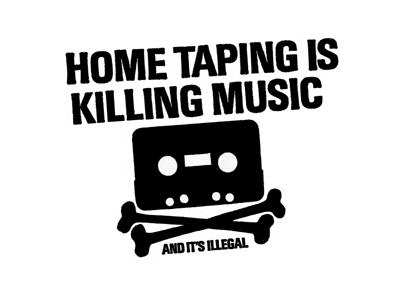
Home Taping is Killing Music

Web music piracy is just as dangerous as home taping was

Common sense would dictate that there isn’t a one-to-one correlation between piracy and lost sales. But what if there’s a correlation between piracy and a *gained* sale?

That’s one of the conclusions to come out of a new European Commission report into music piracy, and it finds that the links between piracy and lost sales are tenuous at best. The study was limited to only looking at website visits, and found that for every 10% increase in visits to websites offering illegal music downloads, there was a 2% – 4% increase in visits to legal music sale websites. The report did not have data on actual music transactions though, but these statistically significant results should not be ignored either.

Overall, the study found that in a hypothetical absence of illegal music downloads (not gonna happen!), people aren’t going to jump straight to buying music, something that’s plainly obvious to most people I would gather. So instead of being the big revenue killer that piracy has been thought of, it may well be a simple matter of “trespassing of private property rights”. As a content producer myself, I can see how, even without revenue loss, the “trespassing of private property rights” might otherwise make me extremely annoyed – nobody wants their private property rights to be violated – but I also understand how everything in the Internet age works, and that having my content pirated, while still annoying, is also a badge of honor of sorts. If my content wasn’t being distributed without my authorisation, it probably just means my content wasn’t good or popular enough in the first place. And if it gets pirated, then it’s up to me to leverage the popularity of my content and monetize it, and there are definitely ways to do this.

The Internet has democratized the natural selection process for content. Instead of publishers having a large hand in selecting what we should and shouldn’t be consuming, the Internet allows the consumer to make their choices directly, bypassing the publishing industry altogether if necessary. That’s what scares the companies that’s represented by the RIAA and the MPAA the most, because they don’t want to lose control. DRM, while being advertised as an anti-piracy tool, is really just a new way for Big Content to maintain control. That it doesn’t work to stop piracy isn’t an issue at all, not when it successfully forces consumers to use content only in the ways publishers want them to.

Just like how if you want to play SimCity, you have to buy it from Origin and play it via Origin. If you don’t like it, you can’t simply grab the Steam version because there is no Steam version.

I think I’ve played every Sim City game ever made, and I simply love the series, even the demented way SimCity 4 managed traffic, or the way you ended up with a city full of Arcologies (and police stations) in Sim City 2000. And this is why, despite the horrible DRM and the known issues with it, I, and many other SimCity fans, still went out and purchased the game. It’s this kind of loyalty that EA has exploited to their advantage, at the expense of everyone else, and not too dissimilar to the way Blizzard launched Diablo III.

SimCity Rollback Error

The dreaded SimCity “rollback” error, that could reset the city you’ve spent hours building

But what seemed like launch glitches with the DRM, now seem like a much bigger issue, as while servers are now widely available, the whole online based gaming experience still leaves much to be desired. Updating cities in the same region can be cumbersome, often taking minutes, even though the instantaneous change is what’s needed. Some sync fails to occur entirely, until one logs off and logs back on. Server still become unresponsive at times, forcing gamers to wait 10 or 15 minutes at the city loading screen, with no explanation for the wait. And for no reason, changes made to the city can be lost and you’re forced to rollback to an earlier version (or even lose the city and region entirely, in some case). And it seems that forcing some of the processing online is not only not helpful (and not an efficient way of doing things), it’s producing gameplay bugs in the game’s traffic and trading management systems.

EA and Maxis defended the use of always-on DRM by saying that some vital game functions had to be pushed online for processing. While this may be true for those playing the game with friends, hackers have shown that this statement is false when it comes to those playing single player games, by producing a hack that allows offline play. As a bonus, the mod also fixes many of the issues that plague the game.

But the hack also allows public cities to be taken over and destroyed, it seems, suggesting that EA and Maxis’s always-online DRM isn’t doing it main job of protecting the integrity of the system from hackers. Again, not too dissimilar to what happened to Diablo III.

As I said a couple of issues ago, a good DRM, or “always-online” implementation, has to be invisible. It should sit in the background and not ever have to make the gamer aware of its presence, while doing everything it is designed to do, including anti-piracy and anti-hacking, and if possible, should bring added value to the game. The SimCity always-online implementation does exactly the opposite in all of these areas.

That SimCity attempts to add an online component to single player gaming isn’t the problem, the problem is that SimCity doesn’t do this properly. Even if we call SimCity an online game, even though most of its gameplay elements can be done offline, the problem is that SimCity is still just a really bad online game. And that’s inexcusable.

While I’m pretty confident that there hasn’t been a lot of pirated versions of SimCity being used by people – the legit version is broken enough as it is, no one will bother with the pirated version, and with SimCity doing good business, does this all count as a financial success for EA and to a lesser extent, Maxis? Fellow game developer, and creator of the mega indie hit Super Meat Boy, Tommy Refenes, says that successful anti-piracy, if it meant ruining it for paying customers, doesn’t make financial sense at all.

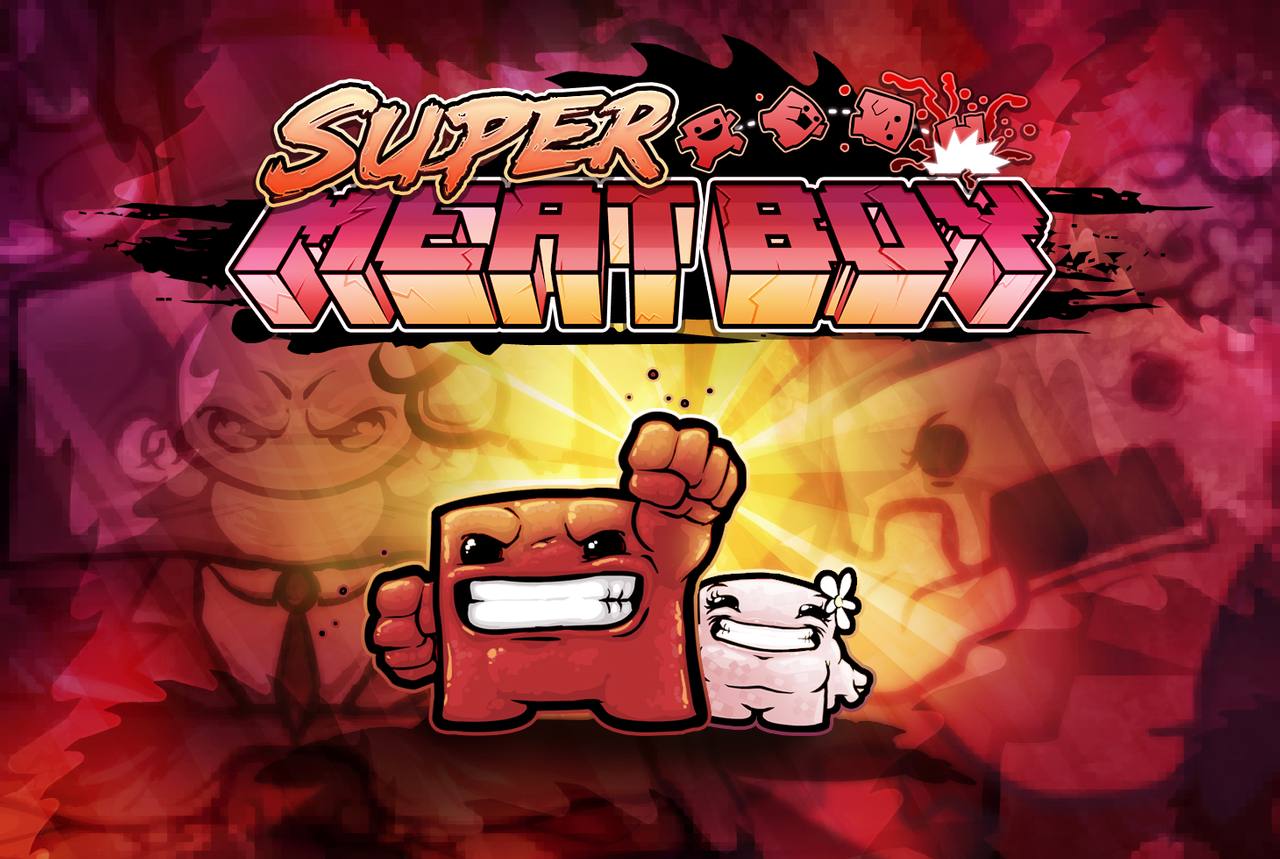
Super Meat Boy

Super Meat Boy has been pirated at least 200,000 times, but has sold millions of copies – the creator isn’t too fussed about those 200,000 “lost sales”

Speaking from his own experience with SimCity, a game he purchased but has subsequently requested a refund for, Refenes goes on to explain how losses due to piracy is not something a company can put onto the balance sheet, as it’s not something you can even calculate with any degree of accuracy. On the other hand, angry customers returning products is something that ends up written in red ink, and has long term repercussions that may be irreparable (see Ubisoft’s DRM Adventures).

Refenes also explains that because there are infinite copies of something digital, it is entirely different to say the theft of a physical copy of something. Stringent security measures at say KMart, where Refenes used to work, may help to stop the theft and return the stolen item back to store shelves, with a measurable loss prevented, the same cannot be said of digital piracy, he says. “Your game is infinitely replicable at a negligible or zero cost (the cost bandwidth off your own site or nothing if you’re on a portal like Steam, eShop, etc). Digital inventory has no value. Your company isn’t worth an infinite amount because you have infinite copies of your game. As such, calculating worth and loss based on infinite inventory is impossible. If you have infinite stock, and someone steals one unit from that stock, you still have infinite stock. If you have infinite stock and someone steals 1 trillion units from that stock , you still have infinite stock. There is no loss of stock when you have an infinite amount … it is potentially one less sale but that is irrelevant. Everyone in the world with an internet connection and a form of online payment is a potential buyer for your game but that doesn’t mean everyone in the world will buy your game.”

It’s something that I’ve mentioned before, but the way game publishers are using DRM these days goes beyond a simple comparison of physical versus digital. It’s not just that they are employing security measures, it’s that they’re employing really really bad and intrusive security measures. The equivalent of DRM isn’t a security guard at the entrance of the store, it’s the equivalent of a pat-down search for every customer that leaves the store (or a full body cavity search in the case of always-on DRM – a traumatic experience that will be relived in your head every time you use said product). No store would do that and risk losing their once loyal customers, so why do game publishers think that this is okay? The only reason I can think of is that unlike most stores, game publisher’s products are exclusives. You can’t simply go to a more customer friendly store and buy the same product, you’re stuck with SimCity from EA’s Origin.

Or maybe not. Maybe there *is* a more customer friendly store, and more than one actually, and not only do they not punish you for spending your hard earned money, they’re not even charging you for anything. That store’s name is piracy, and in the battle between free with a side helping of guilt and not free with a big chunk of frustration, the choice that doesn’t frustrate wins most of the time.

Gaming

It’s NPD time, this time for February 2013. Once again, the Xbox 360 was the most popular console in the U.S. market for the month of February, selling some 302,000 units. This beat the PS3’s 263,000. The Wii U languished at the bottom, selling only 66,000 units, 70% of which were the deluxe model of the console.

So once again, we have a double digit decline for retail sales, and both Microsoft and Sony will hope their new console will have a better start than the Wii U.

There’s a lot of talk about the casual gaming market, previously dominated by the Wii, now taken over by mobile apps. Most of the talk has been about how popular smartphones and tablets have gotten. The Wii U even tried to jump on the bandwagon by adding a tablet into the mix, but it doesn’t seem to have worked. But surely, it’s the value proposition that has had the most dramatic change. The choice is now between paying $50+ for a console game that you probably don’t even have time to play, versus a 99 cent game that you can enjoy at a moment’s notice in your spare time. It is comparing apple to oranges, but entertainment is entertainment. Just like how video games become a better value proposition than movies and music (and why it has necessitated the lowering of the price of these forms of entertainment), app gaming has become a better value proposition than console gaming. It may really be that simple.

But I’m sure someone will find a way to blame piracy for everything.

With the 2,000 word barrier broken according to WordPress’s word counter, it’s time to wrap things up. See you next week.