Archive for the ‘Nintendo Wii, Wii U, Switch’ Category

Weekly News Roundup (10 January 2010)

Sunday, January 10th, 2010

Now that’s more like it. A bit more news finally this week. In fact, there’s a lot of news mainly due to the CES 2010 currently happening in Vegas. Most of the news came out of the show, and most of it was about 3D, which was kind of predictable. While everyone was talking up 3D HD, I had to regress from HDMI back to component due to a broken TV, and then suffer the illogical copy protection system that’s present. Hollywood can be so freaking paranoid at times, and even if their fear is justified, they’re still fighting on the wrong front when it comes to online piracy. How is stopping someone from watching upscaled DVDs through component output going to help stop online piracy? I also took the time to update the MeGUI guides for Windows 7, which works quite well after some initial tweaking needed due to 7’s new built in codecs framework.

Copyright

Let’s start with the copyright news. The Pirate of the Week award goes to Sony, who managed to not only leak a “still at the cinemas” movie to the PlayStation store in perfect digital quality, but also managed to make it a free download for those quick enough to grab this very special offer. But at least the file was DRM protected so that it couldn’t have been leaked online, right? Um, not quite, and if you search the regular BitTorrent networks, you’ll find a “PSPRip” version of the film which came from this Sony gift. Or should that really be “SonyRip”?

Armored Movie Poster

Sony like the movie ‘Armored’ so much that it decided to give it away free on the PlayStation Store

I know the MPAA has been talking about wanting to release movies digitally while they’re still showing at the cinemas, something that cinema owners are vehemently against, but what Sony has done here is probably not what the MPAA had intended. Although the MPAA still had time to roll out a new DRM scheme, which basically “pirates” Disney’s Keychest initiative. Basically, it’s a purchase once, view everywhere scheme, and they intend to do this by adding DRM and online authentication to everything. It seems that the lesson the MPAA learned from the RIAA’s failed experiment with DRM was that it failed because interoperability, that is the ability to play the file everywhere, was not ensured. That’s a valid lesson, but online authentication means that if people are away from the Internet, then their entire movie library becomes useless. And I’m sure there will be device manufacturers that do not buy into the MPAA’s DRM licensing scheme, and hence, interoperability will still be an issue. I think the biggest lesson from the RIAA’s DRM fiasco should be that consumers just don’t like DRM, and that in the end, it wasn’t really necessary anyway since DRM free or easily ripped versions of the music (or movie) will still be widely available and ready to be pirated online regardless of how many layers of DRM you put on the music (or movie).

In fact, just this week, the “consumers don’t like DRM” argument was put forward to the courts in relation to the appeal of the Joel Tenenbaum verdict, the student fined $675,000 of downloading 30 songs. The argument is that because DRM limits choice, the only choice then becomes piracy. I’m not sure I agree with this argument, and I certainly don’t think it will hold up in court, because DRM free alternatives were available in the form of CDs, which can then be easily made into digital form legally (not falling foul of the DMCA because CDs are not DRM’d). The other argument that Tenenbaum’s lawyers will use is that the rewarded damages are just too excessive, which is harder to argue against. It wasn’t as shocking at the $1.92m verdict awarded against Jammie Thomas-Rasset for 6 songs less than Tenenbaum, but the RIAA did it to send a message.

Moon Poster

But Sony didn’t like ‘Moon’ at all and refused to support it for an Oscar in order to fight online piracy

While still stinging from the “SonyRip” incident, I guess the suits at Sony HQ decided to balance this kind gift out with something nasty, which came in the form of not supporting their own film, Moon, for an Oscar for which the film’s star Sam Rockwell actually has a chance of winning. The lack of support comes in the form of not releasing screeners to voters, which need to be watermarked to prevent piracy, but Sony doesn’t want to spend the money. Sony says they need the watermarking because the movie is yet to be released in the US, although even the Blu-ray version has been available in the UK since mid November, so there’s hardly a lack of a good source for the pirated version. Another quick check on the regular BitTorrent networks and a DVD rip of Moon is indeed available. The cost of issuing the watermarked screeners would probably be less than the cost of the PR campaign Sony now has to put out to counter criticism of this move from celebrities such as Iron Man Director Jon Favreau and Coraline writer Neil Gaiman. The next step for Sony would be to block the release of a film entirely from all channels, if it’s really that serious about piracy (although it might still get leaked online). Better to destroy the film just after it comes out of post production, than to suffer from piracy, right?

While not doing something as extreme, and for entirely different reasons, but Warner and a few other studios (surprisingly, not including Sony) put pressure on  DVD rental vending machine operator Redbox by refusing to give the right to distribute their movies through this cheaper and potentially revenue hurting new distribution method. Redbox even had to use made up cover art as the studios wouldn’t give permission to use the original artwork, but even the made up art work has come under legal pressure, although Redbox denies any wrongdoing. Warner then attacked Netflix and forced them to delay the rental of their DVDs, although they did offer as a compromise an extended range of movies that will be made available via Netflix’s digital service. All of this is about fighting new delivery methods that are cheaper and more efficient, to protect the dying business model that studios rely on. DVD rental revenue is actually up (cheap stuff sells more, wh0 would have thunk it?), but while the studios were busy fighting online piracy, they forgot that the Internet could also have been used to deliver new services and acts as a new distribution method for their content, and instead passed up the opportunity to the likes of Netflix and Redbox. Just like how the music industry passed up online music selling over to Apple’s iTunes, which is now making huge amounts of money that the music labels should have been making themselves if they had the vision to embrace the Internet, rather than not seeing anything good having come from the Internet at all (to paraphrase Sony Pictures CEO Michael Lynton).

Well if you can’t stop the piracy at the source, then perhaps you can go to the other end. The French government, now the symbolic head of a global crusade against online piracy, plans to put a piracy tax on Google which will be quite a little earner, as well as doing absolutely nothing to stop piracy just like every other initiative.

High Definition

Onto HD, or more accurately, 3D HD news. Let’s just go quickly through just a small selection of 3D related news items, most to have come out of the CES. ESPN is set to launch a 3D channel for sports programming, including the opening game of the FIFA 2010 World Cup.

Sony, Discovery and IMAX are set to do the same, but we’ll have to wait until 2011 for the new channel. After Toshiba’s first solid, but otherwise uninspiring Blu-ray player, the company’s next three Blu-ray players will be a little bit more feature packed, and yep you guessed it, 3D enabled. Well actually, only one model will be 3D enabled and it won’t be available until later in the year, but the two soon to arrive models will have Netflix, Vudu, CinemaNow and Pandora streaming support, and Wi-Fi connectivity on the more expensive of the two models. On the PC front, PowerDVD maker Cyberlink demonstrated 3D Blu-ray on a PC. The PC should have an easier path to 3D, since most have the processing power required to decode the “twice the information” Blu-ray video stream (one stream for each eye), and everything else can be done in software. Of course, you’ll still need a new monitor and a pair of glasses.

Panasonic 3DTV and 3D Blu-ray Player

Panasonic already has a range of 3D ready devices ready for release soon

Now there has been some confusion in regards to the requirement for 3D, and I’m still not 100% clear on all aspects of it, but basically, you’ll need a new TV or monitor. For the PC monitor, you’ll need one that can display 120 Hz, but most can only do 60Hz. The reason you need 120Hz is because due to the need to provide two separate pictures (one for each eye), a 60Hz monitor effectively only gives 30Hz to each eye, which is not nearly good enough to ensure a headache free experience. On the home theater front, there’s also some confusion as to whether HDMI 1.4 is needed for 3D Blu-ray. The answer is probably no, since the 3D Blu-ray specs say that the PS3 can be upgraded via firmware to support 3D Blu-ray, and PS3s don’t have HDMI 1.4 connectors. The part of the HDMI specs that provides for the higher bandwidth video transfer needed by 3D Blu-ray apparently already exists, but it was up to manufacturers whether they wanted to support it or not, and since there was no demand for it, most do not support it. HDMI 1.4 will mandate support, and so expect most new 3D ready HDTVs to use this version of the connector, although against it’s not strictly required. Panasonic’s 3D Blu-ray players will actually have both a 1.4 connector and a 1.3 connector for connecting to legacy equipment. And just because a HDTV displays at 120Hz (and even if it had HDMI 1.4), it doesn’t mean that it will be 3D ready. Most TVs display 120Hz by taking a the 60Hz input and then frame double, or even frame quadruple to 240Hz. However, 3D ready sets will need to be able to accept and process the true 120Hz signal that 3D Blu-ray players will output, and most can’t do that at the moment. That’s my take on it anyway, but basically, if the TV doesn’t say 3D ready, then it’s not 3D ready, probably. This information and the new logo for 3D Blu-ray can be found in this forum thread.

And it was a refreshing change to see LG announce a new Blu-ray player and it had nothing to do with 3D. Instead, it has a built in 250GB hard drive, not for storing managed copies (not yet anyway), but for storing downloads from VUDU as well as the user’s own content. Speaking of Managed Copy, there was hardly any mention of it at the CES, apart from Cyberlink demonstrating a jukebox system for Blu-ray which will utilize Managed Copy. Disappointing, but not surprising.

Gaming

And in gaming, not much other than more 3D stuff, with the PS3, Microsoft still showing off Project Natal, although it won’t be here until 10 month or so from now, so it’s hard to get excited over it yet. Nothing much for the Wii, except it may support Netflix at some stage.

The CES concludes today, so there will be more digestion of the news over the coming week I suppose, as well as any last minute announcements. I’m getting a bit tired of this 3D thing anyway, because I still can’t see past it as just another short lived gimmick, which 3D will always be until the type where you don’t need glasses becomes mainstream. See you next week.


Weekly News Roundup (27 December 2009), 2009 Year In Review (Sort of)

Sunday, December 27th, 2009

Welcome to the last WNR of 2009. As expected, news was extremely light during the height of the festive season, so this WNR will be a year in review of sorts, although it’s mostly based on memory, and a bad one at that. But first, we’ll go through the news that did manage to turn up this week.

IsoHunt Logo

MPAA wins against IsoHunt, and a trial wasn't even needed

The big one was isoHunt losing its lawsuit, but it wasn’t really much of a surprise. In fact, the judge didn’t even see the need for a full trial, giving Hollywood studios an Christmas present in terms of a summary judgement against isoHunt, based on past cases involving Napster and Grokster. isoHunt itself is happily running in Canada, but it is also now under pressure from the CRIA, the Canadian version of the MPAA. isoHunt’s argument that it was only a search engine did not really work, and evidence uncovered showed that the operators actively promoted pirated content, which is really just common sense when you consider torrent sites and what their main purpose is. Take Mininova for example, since it went legit just under a month ago, traffic to the site has dropped 60 to 70%, according to Alexa. The argument that torrent files are just text files won’t really work in court either, not when courts have been happily citing even just simple web links as being infringing content.

Speaking of pirated content, Torrent Freak has compiled data for the most pirated movies of 2009. Leading the chart is Star Trek, closely followed by Transformers: Revenge of the Fallen. Coincidentally, these two are the top selling Blu-ray titles of 2009. I don’t know if there’s any relations between the two set of numbers, other than the fact that these two movies are really popular, and that popular stuff get purchased, or pirated, a lot! The question of how much money has been lost to piracy is extremely hard to answer. There will always be people who, no matter what, will simply not pay for movies. There are those that downloaded the pirated version, liked it, and got the movie on DVD or Blu-ray. There are also those that went to watch it at the cinema and then downloaded the pirated version. How many people would have forked over cash if the pirated version didn’t exist is unknown. Perhaps the studios can try and focus their anti-piracy efforts on one particular movie, and basically go on a huge offensive, getting torrents removed as they are uploaded. I’m skeptical whether any action, even the most extreme, can prevent piracy, but it’s worth a try, even if it means spending 50 million dollars or something. Then see how the revenue of this movie compares to similar releases. Maybe they can then try to prevent a movie from being show on free to air TV or being rented, and see if it helps with DVD sales, and the music labels can get in on the act and prevent a single from being heard on radio, to see if it helps CD sales.

While the studios haven’t prevented a movie from being rented to increase DVD/Blu-ray sales, they have prevented movies from being rented in specific ways. Redbox, the new common enemy amongst several studios, has felt the brunt of the studio’s actions, which claim the DVD rental vending machine operator is hurting rental and sell through income for their movies and have barred Redbox from doing several things, including using box art in their digital displays. Fortunately for Redbox, the law still allows them to rent movies as long as they buy it from retail channels, and that’s what they’ve been doing with releases from Warner, Universal and Fox, and making up their own cover art at the same time. What I don’t understand is why these studios don’t simply do what the others (Disney, Sony, Paramount …) have done and work out a deal with Redbox that benefits all.

It’s this and new methods of viewing that the studios fear though, because they’re losing control. One in three Australians now use DVRs to watch TV, and that’s seen as hurting TV stations what with ad skipping, although our local version of TiVo has removed the ad skipping feature. If the studios (and TV networks) get their way, TiVo and other DVRs won’t exist, which is not good for the consumer (or the electronic firms that sell DVRs). But ads are important, as they are the main source of revenue for TV stations, so a compromise has to be found. The TV networks as we know it will have to change anyway, what with the emergence of TV on demand. Expect this to be yet another battle front in the digital wars.

Oppo BDP-83

A cheaper sibling to the Oppo BDP-83 will be available soon, but Oppo's are still hard to find outside of the US

And moving on to HD news, Oppo will release a cheaper version of their highly rated, but as yet unavailable world wide, Blu-ray player. It’s unknown what features will be cut in order to reduce the cost, but most likely it will be the DVD-Audio and SACD features, since most people don’t really need support for these formats. Will it also come with HDMI 1.4, which is also set to be released around January? HDMI 1.4 itself seems to be still in flux, as the HDMI consortium wants to add 3D broadcast support to the standard, along with the new two way audio support and built in Ethernet capabilities that are the headline features of the new version. I for one hope that there will be no more HDMI revisions in the future, because it’s ridiculous that all HD devices sold so far will become obsolete next month as a result of this HDMI change. Of course, most of the newly added HDMI features are not “must haves” that will force people to buy new TVs, and backwards compatibility is being maintained, but still.

And that’s the news for the week, so I guess the rest of the WNR will be for my brief and fairly incomplete year in review.

Copyright

Starting with copyright. It’s been a year of lawsuits. And most of them have brought success to the copyright holders. We’ve seen The Pirate Bay lose time and time again, and then sold, although it doesn’t seem to affect the website’s operation.

Mininova was probably the biggest casualty, having removed all of its illegal content last month, and as mentioned before, seeing a 60% traffic drop as a result. isoHunt is the latest casualty, having lost the lawsuit just last week, but the website is at least still operational. Expect more closures next year.

Sarkozy

Nicolas Sarkozy: Most hated figure in 2009, copyright wise

Then there’s the Australian lawsuit against ISP iiNet, dubbed the iiTrial. The case went over many of the issues in the piracy debate, specifically about responsibility of ISPs, and whether they should act as copyright cops. We’ll find out the answers to these questions early next year when the verdict is due. This trend of attacking ISPs isn’t just an down under thing, this has been the new strategy of the copyright holders in 2009. From the French introduction of the, albeit watered down, three-strikes legislation, to the MPAA asking for something similar to every government that’s willing to listen, we could see some big changes in 2010 when it comes to the relationship between the government, your ISP and you.

But that’s not to say that the copyright holders haven’t been attacking individuals. Two high profile trials concluded with unbelievable damages being awarded to record profit making  Hollywood, $1.92 million and $675,000 against a single mother and a student respectively. This was supposed to put the fear into downloaders, but the fact is that pirated downloads have actually increased during the year.

The positives of 2009 for copyright include the death of DRM for music, when iTunes went DRM free in April, which saw other online music stores doing the same before and after this date. DRM is still well and alive for everything else though and happily ruining user experiences and even movie previews. Several free music services popped up in 2009 as well, as an alternative to illegal downloads, but only time will tell if their business model works in the long term, and on a global scale. 2009 also saw the increasing popularity of Digital Copies, bundled with both DVD and Blu-ray packages. These DRM protected, time limited video files have at least provided a free alternative to DVD ripping, although Managed Copy for Blu-ray is set to do much more, if it ever gets implemented. But we can still say that 2009 saw the first Managed Copy Blu-ray being released.

High Definition

Which moves us neatly onto HD news for 2009. It was a very good year for Blu-ray, most noticeable in the last quarter thanks to some very high profile releases. The record breaking release of The Dark Knight during December 2008 was only recently shattered by Star Trek and the holiday sales period, but there is no denying the fact that Blu-ray sales have double or more in the year.

Most of this has been due to price cuts, which sees Blu-ray hardware and movies quickly approaching DVD levels, and at times, below that of new release DVDs. Consumers spent less as a result, although this may largely be due to the poor economic conditions, and the growth in Blu-ray revenue was not enough to cover up the losses on DVD, although the situation is not nearly as bad a year ago. Digital downloads and streaming, as well as rental, saw amazing growth during the year as well. Netflix, who offers both digital and traditional rentals, grew strongly thanks to integration with first the Xbox 360, and then the PS3. This is not to mention the increasing number of Blu-ray players that now come with some sort of online streaming support, and Blu-ray players are fast becoming replacements for set top boxes, which everyone always thought would have been necessary for a large scale rollout of digital services.

Blu-ray Sales Percentage - 4 May 2008 to 29 November 2009 - Click to see larger version

Blu-ray sales grew healthily in 2009

2009 also saw the HD format war loser, Toshiba, come out with their first, albeit modest, Blu-ray player offering, and thus officially end their ill fated HD DVD adventure. And although HD DVD has died, the innovations that the format provided still lives on in Blu-ray, with the mandatory Internet connectivity on HD DVD players now all but mandatory in name on Blu-ray in BD Live, which has allowed the aforementioned online streaming services to be used through Blu-ray players. And the emergence of Managed Copy, which was first made mandatory for HD DVD, is now coming to Blu-ray, albeit with some resistance. And even the good old double sided Combo is coming back through HD DVD backer Universal.

Most studios still prefer the separate disc combo method, and combo now usually means both the DVD and Digital Copy version of the movie. Digital Copy has made headway as well, now available not only on DRM’d WMV files, but also through iTunes on PCs and Macs, and thus, playability on iPods and iPhones. Digital Copy has been so popular, that it’s hard now to find a new hit release without it. And the general idea of Combos have been popular as well, with Warner recently announcing that all their major Blu-ray releases next year will be combos with both the DVD and Digital Copy included on separate discs. Blu-ray’s value for money has increased as a results, as the ever smaller premium you pay for movies over the DVD version is made up by the inclusion of the DVD version on a separate disc. Disney even made combos the first and only package available to buy for a few of their hit titles, and stats have shown that even after the exclusive period, people preferred to buy the better value combos.

Blu-ray on PCs are still somewhat of a disappointment, but GPU assisted decoding is now available in most systems, even some of the netbook offerings though Nvidia Ion. Will we see a mainstream PC game released exclusively on Blu-ray disc in 2010?

3D promises to be the studios’ next target in 2010, hoping to bring HD 3D to the home via the now finalized 3D Blu-ray specs. Only the tough set of requirements, such as a new TV, rule out the guaranteed success of 3D Blu-ray.

Gaming

And finally in gaming, 2009 unfortunately didn’t reach the highs of 2008 in terms of sales. The year started somewhat flat, and then soon saw Wii sales tumble along with most other consoles. Then Sony did what everyone wanted them to do and reduced the price of the PS3, and surprised many with the introduction of a brand new Slim version of the console. Both of these factors revived the fortunes of the PS3, taking it from last place amongst the home based consoles to nearly topping the monthly sales of the Wii. The holiday period, and the biggest release in the history of music, movies or gaming, Call of Duty: Modern Warfare 2, helped the Xbox 360 regain some of the lost momentum after the PS3 Slim/PS3 price cut. Even the Wii had a recovery of sorts during the holiday sales, but is still easily 30+% down compared to last year, although 2008 was crazy in terms of Wii sales.

The PSP Go largely flopped, while the DS, with the updated DSi, now completely dominates the handheld market.

Sony PS3 Slim

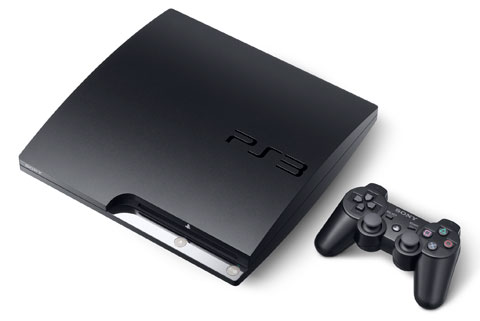
The PS3 Slim, and the price cuts, helped the PS3 to stage a brilliant comeback in 2009

In terms of games, Call of Duty: MW 2 was easily the best selling game of 2009, and of all time possibly, at least for the release figures. The PS3 had a couple of hit exclusive titles (Kill Zone 2, inFAMOUS, Uncharted 2) that did well enough, but there still aren’t enough consoles in the US to really make these sell. Game sales are down as well compared to 2008, even though the biggest hits of 2009 were bigger than the hits of 2008. But 2009 was still the best year outside of 2008 in the history of gaming, and things only look to improve as Sony and Microsoft both bring out their motion control systems next year, although in Microsoft’s case, it will be towards the end of 2010. You can vote for your game of the year here.

A more detailed 2009 roundup will be written up as soon as the December figures are released in the middle January.

And that’s pretty much 2009 in review, very brief I know and missing all of the crucial events that I’ve failed to remember. News is likely to be hard to find next week as well, and so if there’s nothing to write about and if I remember more stuff, then perhaps you’ll see part two of the 2009 year in review then.

But until then, I hope you’ve had a great 2009 and everyone here at Digital Digest wishes you a happy and prosperous 2010. HNYIA (Happy New Year In Advance)

2009 Game of the Year – Vote Now!

Friday, December 18th, 2009

Which game, console or PC based, do you think was the best game of 2009? There has been a lot of good games this year, and many deserve the title of “Game of the Year”, but there can only be one winner. I’ve tried to include all the likely candidates, but if I’ve missed any, please let me know through the comments.

You can vote for your game of the year here!

Game Consoles – November 2009 NPD Sales Figure Analysis

Saturday, December 12th, 2009

The second busiest month of the year for video games sales in November. And all eyes on this year’s figures to see if a late surge can improve the industry’s fortunes, which looked set to fail in beating 2008’s record year of profits. With the war between the Xbox 360 and PS3 finally heating up some, and the PS3 finally able to beat Xbox 360 sales, the important holiday period will be a key indicator of what’s to come in 2010. And having had a largely disappointing year, the Wii is also looking towards the holiday period, and some hit titles, to give it the boost it needs. And with the biggest game of the year, possibly in history (based on previous sales results), being released in November (Call of Duty: Modern Warfare 2), the figures this month are extremely interesting. You can read last month’s analysis here. The figures are from NPD, a marketing research firm that releases games console sale data every month.

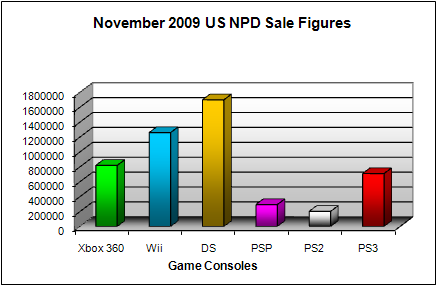
The figures for US sales in November 2009 are below, ranked in order of number of sales (November 2008 figures also shown, including percentage change):

  • DS: 1,700,000 (Total: 36.1 million; November 2008: 1,560,000 – up 9%)
  • Wii: 1,260,000 (Total: 23.3 million; November 2008: 2,040,000 – down 38%)
  • Xbox 360: 819,500 (Total: 17.3 million; November 2008: 836,000 – down 2%)
  • PS3: 710,400 (Total: 9.8 million; November 2008: 378,000 – up 88%)
  • PSP: 293,900 (Total: 16.2 million; November 2008: 421,000 – down 30%)
  • PS2: 203,100 (Total: 44.9 million; November 2008: 206,000 – down 1%)
NPD November 2009 Game Console US Sales Figures

NPD November 2009 Game Console US Sales Figures

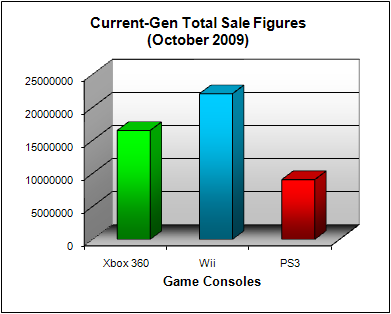
NPD Game Console Total US Sales Figures (as of November 2009)

NPD Game Console Total US Sales Figures (as of November 2009)

My prediction from last month was:

Sales will go up considerably compared to October, that’s for sure. The DS will be top, the number two spot will be closely fought between the PS3 and Wii, although I’m leaning towards the Wii winning that battle right now. The Xbox 360 is 4th, followed by the other two PlayStation consoles. Call of Duty: Modern Warfare 2 will be the number one selling game, and the controversial game will be a record seller if the hype is anything to go by. The Xbox 360 version of this multi-platform game should be the one occupying the top spot. Other titles that will do well for the Xbox 360 include Assassin’s Creed II and the console platform exclusive Left 4 Dead 2. For the Wii, a new Super Mario Bros game will always be a hit, and it could give CoD: MW2 some competition (although mainly for the PS3 version, one suspect). Dragon Age: Origins, from the same people that gave us Mass Effect, could make the top 10 as well, since I’ve been hearing a lot about this game recently.

I must admit that it’s easy to make a monthly prediction when, by the time you write it, half of the month has already gone by. But even then, I was wrong, although only about one thing. Most, including me, had predicted the Wii to struggle to beat the PS3, with the Xbox 360 4th overall, but it turned out that the Wii Manged to beat both the PS3 and Wii, and it was the PS3 that finished fourth. Every other thing I predicted came true, except that I thought the new Super Mario Bros Wii game would give at the very least the PS3 version of CoD: MW2 some competition, but the controversial Modern Warfare 2 managed to win handsomely in the software charts this month despite Mario, Luigi and co.

The DS had a huge month, especially when you compare it to the only other portable console, the PSP, and also as the PSP had a new version out recently that should have given it the momentum. Instead, the DS managed to be the number one selling console this month, and was able to beat last year’s record sales quite comfortably. The other piece of good news is that the Wii managed to hold on to second spot ahead of intense competition from the PS3 in the last couple of months, and it managed to do so quite comfortably as well. But even then, the Wii sold 38% less than the same time last year, and has been throughout the year. It was the single biggest drop in sales of all the consoles, but you have to take into consideration the record and unbelievable numbers that it was selling the year before. At the present rate and at the current stage of its release cycle, the Wii is still set to beat the PS2 as the most popular console ever, so Nintendo would not be worried, although they have less to be happy about than a year ago.

While almost everyone thought the PS3 would outsell the Xbox 360, especially given the results of the last two month, the actual result proved to be quite different. The Xbox 360 sold nearly 110,000 more units the than PS3, reversing the trend of the previous two month. There are many reasons for this. One is that because the Xbox 360 is cheaper, cheaper items tend to do better during the busy Thanksgiving holiday period, where the budget conscious buyers are out in force. DVDs had a similar surge in sales compared to the more expensive Blu-ray during the same period, for example. The one reason is simply Modern Warfare 2. While this game is a multi-platform release, the huge install base of the first game in the series on the Xbox 360 and the multi-player nature of the game, meant that many wanting to get the sequel *had* to get it on the Xbox 360, and the software charts will be further prove of this. Microsoft took advantage of this and had quite a few MW2 bundles out, which seems to have proved quite popular with gamers going by the hardware numbers. If not for MW2, I don’t think the Xbox 360 would have outsold the PS3. The Xbox 360 experienced a negligible 2% drop compared to the same month in 2008, so November 2009 sales were extremely positive considering how much of a record year 2008 was.

And so the PS3 came fourth, but had the single largest year on year improvement, with 88% better sales than the same time last year. Sony will claim, and have claimed, that the PS3 was the only home console to record year on year growth, and this is true. Except that the Xbox 360 only missed out on doing the same by a 20,000 units, and that PS3 sales were awful this time last year, it was hard for the PS3 not to improve. However, the PS3 didn’t get as much of a boost from a software release like the Xbox 360, and as I mentioned before, I think it would have beaten the Xbox 360 had MW 2 not been released. So these numbers are still extremely good, but the only real concern is that the gap between the Wii and PS3 seems to be widening again after that big bump in PS3 sales in September, thanks to the simultaneous release of the PS3 Slim and the price cut, seems to be dissipating. We’ll know more after the holiday period is over, and whether the PS3 can maintain its momentum, or whether it will need further price cuts to try and beat the Wii. To be honest, I think it’s already too late for the PS3 to win this generation, so the best it can do is to beat the Xbox 360, which seems likely. For Sony’s other consoles, I will be surprised if the PS2 is still around the same time next year, and the PSP is struggling badly even with the new PSP Go, dropping 30% in sales even with the new model. It’s too late now, but the PSP Go should really have been Sony’s response to the DS, which will now monopolise the portable gaming industry.

Overall, November 2009 did worse than November 2008. Some of it is due to the economic situation in the US. Quite a bit of it has to do with Wii sales dropping, although they were always going to drop at some stage (it’s better to think of the Wii’s first two years as simply extraordinary, and the current year’s sales as “normal”). 2008 was always going to be hard to beat, but 2009 is still the best year in sales outside of 2008, and that’s positive for the industry.

On to software sales now. The amazing figures for Call of Duty: Modern Warfare says it all really. Over 4 million copies of the game sold on the Xbox 360 alone, with 6 million combined for the two consoles, and not even counting the PC version and any console bundled versions. That’s amazing for any single game, and completely blows away all previous records, whether that was for GTA IV, or Halo 3 or the first Modern Warfare game. The Xbox 360 version easily outsold the PS3 version by more than a 2:1 margin, higher than the actual hardware ratio lead that the Xbox 360 enjoys, meaning that a higher percentage of Xbox 360 owners purchased this game compared to PS3 owners. The stats seem to show that one in four Xbox 360 owners purchased a copy of this game, and that’s only in the first month of release as well. Also contributing to this month’s amazing software sales figures is the new Super Mario Bros. game for the Wii, which managed to sell over a million copies as well. Assassin’s Creed II did well on both the Xbox 360 and PS3, with the Xbox 360’s lead less than 2:1, although still higher than many recent multi-platform releases which has seen the PS3 version almost sell on level terms with the Xbox 360 version, despite the lower hardware numbers. The Xbox 360 exclusive Left 4 Dead 2 also helped to improve the Xbox 360 software numbers. Overall, the Xbox 360 dominated the top 10, with 52.8% of all sales belonging to the platform. The Wii was second best with 27.1% of all top 10 sales, the PS3 with 20.1%.

Here’s the complete list of the top 10 software sales:

  1. Call of Duty: Modern Warfare 2 (Xbox 360, Activision) – 4,200,000
  2. Call of Duty: Modern Warfare 2 (PS3, Activision) – 1,870,000
  3. New Super Mario Bros. Wii (Wii, Nintendo) – 1,390,000
  4. Assassin’s Creed II (Xbox 360, Ubisoft) – 794,700
  5. Left 4 Dead 2 (Xbox 360, EA) – 744,000
  6. Wii Sports Resort (Wii, Nintendo) – 720,200
  7. Wii Fit Plus (Wii, Nintendo) – 697,000
  8. Assassin’s Creed II (PS3, Ubisoft) – 448,400
  9. Dragon Age: Origins (Xbox 360, EA) – 362,100
  10. Mario Kart w/ Wheel (Wii, Nintendo) – 315,000

Time to make a prediction. December hardware sales should be even higher than November’s based on past trend, but with MW 2 still selling in good numbers, it should help the Xbox 360. But I suspect it will be a closely fought race between the Xbox 360 and PS3 for the third place finish, behind the DS and Wii at first and second. Software wise, MW 2 should still be selling well, and should hold top spot, although Wii Fit Plus may make a surprise surge. But in all likelihood, both versions of MW 2 will probably beat New Super Mario Bros. Wii to furnish the top 3 spots. Overall software sales will be down, because it will be hard to beat this month’s figures.

See you next month.

Weekly News Roundup (15 November 2009)

Sunday, November 15th, 2009
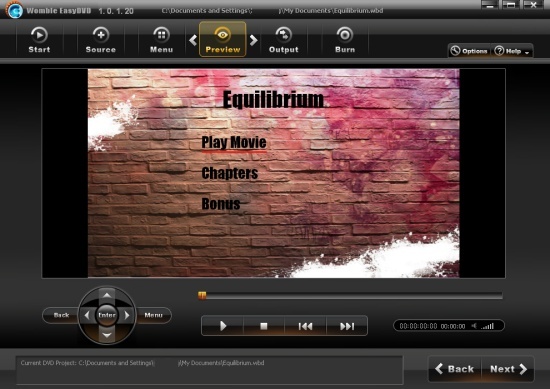
Making a DVD menu is made simpler by Womble EasyDVD

Making a DVD menu is made simpler by Womble EasyDVD

As expected, following last week’s news blitz, this week has been relatively quiet. Which is a good thing because I managed to fill the gap with a new DVD authoring guide for Womble EasyDVD. Having played with the software for a week, I can say that it’s very easy to use and mostly intuitive. There are a couple of missing features such as subtitle support and multiple audio support, which I hope Womble can fix in future releases (this being their first effort after all, so you can’t have everything), but it’s mostly what you would expect, and the menu creation offers a bit more flexibility than your average authoring suite, without ever going into the semi-pro territory (complete with the much steeper learning curve) of tools like DVD-lab Pro. The other thing that was available this week was the October NPD US video game sales stats, I wrote the analysis for it yesterday here. The PS3 didn’t manage to sell over the Wii as it had in September, but it’s the Xbox 360 that’s the loser in terms of the recent price wars it seems, although it’s doing fantastically in software (for now, thanks to its larger install base). The coming months should give us an even clearer picture of what’s in store for 2010, and Microsoft will be hoping to see similar scenes as last year this time as people enthusiastically grab their cheaper holiday bundles. But I wouldn’t bet on it. Anyway, onto this week’s news.

Copyright

In copyright related news, the BBC’s proposal for adding DRM to their HD broadcasts has been denied by the British Office of Communications. But the idea isn’t entirely dead and the proposed DRM scheme may appear later on, with existing hardware likely to support such a DRM scheme if it is ever introduced.

The MPAA are still of course campaigning vigorously in the US to try and get the FCC to allow them to introduce  Selectable Output Control. The old “pro consumer” argument was brought out, to argue for SOC’s use in bringing new release movies faster to the home if the studios were more confident of its resistance to piracy. Many studios are already doing this without the fake security blanket that is SOC. But SOC is just a trojan horse for the MPAA, because once you can control one aspect of how someone watches TV, you can then control all aspects of it eventually. If the MPAA and their cohorts can get away with banning all  TV recordings, then does anyone really doubt that this is exactly what they would do? Pro consumer indeed.

Further prove that movie studios really don’t give a crap about the people that are supposedly their customers – a free community Wi-Fi service that brings tremendous benefits to a huge number of people has been shut down all because of a single piracy complaint, from Sony (who else?). It’s a case of the studios exploiting people’s fear over lawsuits, and an innovation that helps the local economy, local law enforcement, small businesses and visitors is attacked and destroyed. Obviously the people who decided to shut down the network, as the cost of adding anti-piracy filters is excessive, must shoulder some of the blame for this over reaction, but the MPAA’s reaction to the story shows the depth of their arrogance. Instead of calling for a reasoned approach and balanced response, that a single movie download does not constitute a widespread piracy operation, they used the occasion to further spread their anti-piracy propaganda. But that’s what they are. They are an industry lobby group and they’re paid to say and do these things. What is really wrong is politicians and others in power taking their word as gospel, and acting without taking into consideration the serious consequences  for issues like privacy, and the economic damage that would occur if the MPAA’s wishes were turned into reality.

iiNet's freezone: damned if you do, damned if you don't

iiNet's freezone: damned if you do, damned if you don't

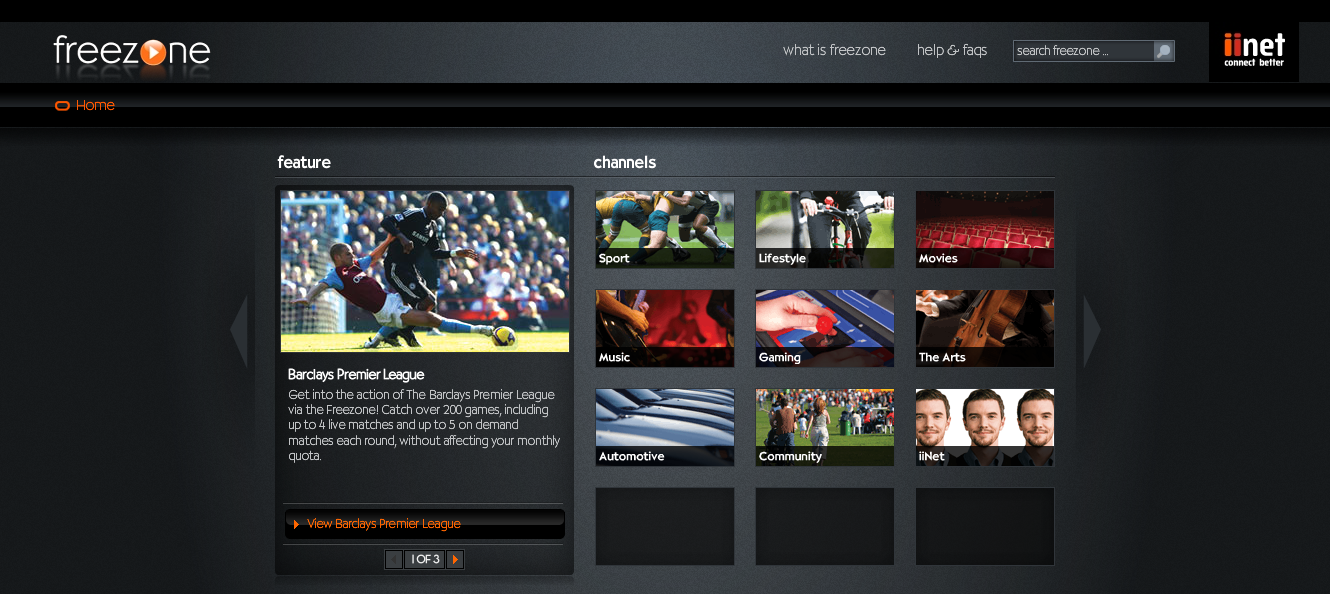
It’s week 4 of the Australian AFACT vs iiNet trial, and it was closing statements time.  Once again, you can check out a summary of the week’s events here, but the arguments from both side remain the same. The AFACT thinks iiNet is basically a piracy provider, even suggesting that  the ISP’s use of phrases such as “happy downloading” was in fact an encouragement for people to download the latest Harry Potter movie. And even iiNet’s attempt at promoting legal content, through their freezone service, was attacked. You would think the movie studios should be delighted that ISPs are providing quota-less downloads for legal content as a way to to provide further incentives to go the legal route, but you would be wrong. The argument is that because quota is not used, it leaves more free quota for downloading pirated movies. The same argument was made for iiNet increasing download quotas for their customers, as the AFACT assumes anyone who needs a large download quota must be a movie pirate. This “sky is falling” and “you’re a pirate until proven otherwise” attitude that these lobby groups have adopted is working wonders in their political lobbying activities and have proved useful in the legal arena as well in the past. Our only hope is the judge can see through these exaggerated truth to balance the need for anti-piracy and the need to protect consumer rights, and the rights of ISPs to operate without being burdened by the responsibility to prevent piracy. Surely the industry that profits, often in record amounts, from the movies and TV shows that are being pirated should be the ones responsible, at least financially, for the anti-piracy operations, not the ISP or its subscribers. Either put up, or shut up.

Most independent game developers say that piracy is not a significant problem, at least for now, according to the latest survey. While most fear that it can become a big problem in the future, only 10% felt that it was a serious problem at the moment. One thing to note about  piracy, including games and movies, is that people who do have the ability to pay for content will usually do so. It is only those that never had any intention to pay for anything, some because they don’t have the capability, that are the more dedicated when it comes to sourcing pirated content online, and these people were never likely to provide any sort of income for the content owners, now or in the future. So the key is to at the very least increase the number of people who have the capability to pay for content, and that can only be achieved through pricing changes. Digital distribution allows this to occur without the cost being a huge issue (certainly compared to physical media and the associated costs like packaging, shipping  …), and even more reasonable pricing can open up previously untapped markets, such as developing countries where piracy rates are even higher. Or the alternative is to fight against logic and try to stop all piracy through technology that has proved inconvenient at best, and completely unworkable at worst, or through ever harsher legislation that completely disregard some of society’s basic principles in relation to justice and human rights.

Microsoft banning 1 million Xbox 360 accounts over suspected system modding (which allows for piracy) may seem excessive, but console piracy is actually not a huge problem and that’s worth examining. The anti-piracy success is largely to do with technology, all games consoles carry some form of DRM for games and being closed systems, they are easier to enforce (unless somebody decides to mod their Xbox 360, that is). The DRM systems used are also fairly straight forward, usually just a DVD check, and with digital downloads being available, even the DVD check won’t be necessary anymore. There are still many aspects of the DRM system that are inconvenient, such as when one needs to move from one console to another, but there are at least solutions and workarounds. And I guess more reasonable pricing comes into it. Games are expensive, but given the number of hours of entertainment they provide, it’s still better value compared to your typical movie or MP3. Consoles are also now very good at providing demos for new games, thus eliminating the need for people to “play before they pay” (which I admit is often used as an excuse for piracy, and play doesn’t always lead to pay). They certainly aren’t going out there lobbying the government to throw people off the Internet for downloading games, or getting ISPs to work as their spies, or suing individuals for using pirated games.

High Definition

HD news now. Not much on Blu-ray to report, but the holiday season is upon us and there will be a steady stream of big releases to give the format a big boost. But HD is more than just Blu-ray, and the future of HD may be SD.

Blockbuster tries SD digital rental

Blockbuster tries SD digital rental

Not SD, as in standard definition, but SD as in the memory storage format. Blockbuster is trialling a new way to rent movies by allowing customers to download them to their SD memory cards. These movies expire after 30 days if unwatched, or 48 hours after the first viewing. Obviously DRM is involved, but further details are a bit sketchy. If compatibility with hardware players, then the DRM used may be the SD card’s own internal DRM system, CPRM. This would then allow the actual video file to be unencrypted, and playable in a wide variety of players, probably. The lack of DRM on your common USB stick may be why they didn’t go with the more common format.

The other path for HD is digital distribution. The main stumbling block has always been bandwidth, and also processing power (many of the Netbooks you see today will struggle with 1080p content). But YouTube is not waiting around for things to catch up, and will roll out 1080p playback support next week. The link to the left has a couple of further links to test videos that you can already use to see if your system is fast enough for 1080p. On my Intel C2D E8500, I recorded 40 to 50% CPU usage, which is reasonable, but you can see why some Netbooks will struggle. With GPU assisted decoding (unfortunately Flash does not yet support ATI based solutions), the CPU usage can be greatly reduced. This was proven when I downloaded the YouTube 1080p video (about 100 MB for 4 minutes worth) and used PowerDVD 9 to play it back (as it supports GPU assisted decoding). CPU usage dropped to below 10%, and my ATI Radeon HD 4850 was hardly worked (about 5% usage) despite the CPU savings. So it seems for 1080p video delivered through YouTube, most modern computers should be able to handle it, some better than others depending on whether GPU assist is available or not now or in the future. The bandwidth usage is reasonable, roughly the same as downloading a DVD movie (so the 1080p quality isn’t as good as say Blu-ray, not really close yet), but it will still use a large chunk of people’s quotas.

Gaming

And lastly in gaming, not much to link to, except for the NPD analysis, which I’ve already linked to above. I think we finally have a proper console war on now, where there’s not much between the three top consoles, the Wii, Xbox 360 and PS3. The Wii has the superior hardware numbers, but is weak on games, especially third party ones and ones that appeal to hardcore gamers. The PS3 has only started to do well to suggest it may take top spot eventually, but there’s still some catching up to do both in hardware and software. The Xbox 360 is enjoying software sales, at least in the US, for now, but it won’t last forever if it the last two months becomes a trend and they continue to sell less consoles than the PS3. But they have a great multi-player community and that counts for more and more these days. And of course, Natal, which may be beaten to the punch, innovative software wise, by PS3 Eye Pet (a new category of games, using the buzz word  “augmented reality”) . But if Eye Pet is a success, then that may actually bode well for Natal, since it plans to offer similar things but in a more mainstream, and technologically advanced fashion. The only problem is the late release date, now semi confirmed as November 2010, which may be too late to help if things stay the way they are.

See you next week.