Archive for the ‘Nintendo Wii, Wii U, Switch’ Category

Weekly News Roundup (19 September 2010)

Sunday, September 19th, 2010

And so another week is upon us. Not much news this week though, but there was one big breaking story, which we’ll get to soon enough. The PlayStation Move has been released since I last posted, and there’s a bit more on that in the gaming section, although I do plan on writing a short little comparison between the Move and Kinect, or rather, why a direct comparison between the two motion gaming accessories is a bit silly, and that one doesn’t necessarily have to lose in order for the other to win (unfortunately, the Wii loses in either scenario).

Copyright

In copyright news, the big news of the week I alluded to earlier is that HDCP, the copy protection scheme we’ve all learned to love, is dead.

HDMI Cable

HDCP, as found in the HDMI standard, is cracked

It was short lived, we hardly knew thee, but HDCP copy protection has been cracked, with the master key posted on Twitter of all places. People at first were sceptical, but a few days later, we had confirmation from Intel, the company that developed HDCP, that, yes, the posted key was in fact the legitimate master key. So what does the master key do? Well, it the way HDCP works, it allows legitimate source keys (keys for things like Blu-ray players) and sink keys (keys for receiving devices, mainly TVs and monitors) to be generated, and therefore it means that there is no way now to tell the difference between authorised devices, and unauthorised ones, thus killing HDCP as a viable DRM scheme. Well some articles screamed that “Blu-ray copy protection has been killed”, it isn’t quite that simple. Yes, Blu-ray players rely on HDMI and therefore HDCP copy protection, but the disc itself is still protected by several other layers of DRM, including AACS. However, it will now be possible to intercept the HDMI output and get access to the raw digital stream to make copies of the movie, although that will require a bit of hardware ingenuity, although something could be done in software too. Those around when DVD ripping first came onto the scene will remember Power Ripper, the tool that used PowerDVD’s screen capture tool to rip DVDs, frame by frame. Since then, many DRM schemes have protected this sort of ripping by disabling screen capture or encrypting the path from software to screen. But with HDCP out of the way, this kind of ripping may be possible again (and this time, since HDMI carries audio too, the whole stream can be riped). Of course the question is why would anyone want to do this when there are much easier ways to rip Blu-ray movies? But there are also other applications other than ripping, such as allowing movies to still be played via HDMI even when the TV’s HDCP chip has died.

But the most important aspect of this leak of the master key is that it confirms once again relying on technical measures to prevent piracy is an extremely naive strategy. There are people that crack HDCP for fun, and it doesn’t matter if it takes a month, or 5 years, they have the time! Now, Intel has hinted that since the technical protection is all but gone, they may rely on legal protection to keep HDCP viable. After all, it’s worked for DVD’s CSS, which has been cracked since 1999 and yet it’s still widely in use today, largely thanks to the legal protection it, and any DRM scheme (no matter how weak), offers (thanks to the DMCA). But even legal protection won’t stop people doing things that annoys rightsholders, once the technical barriers have been removed. So HDCP will still be around, and all your TVs and Blu-ray players will use it, but once again, you have to ask, what’s the point? Having some crappy DRM in there makes lawsuits simpler, but copyright infringement is copyright infringement, it doesn’t really matter to the court if DRM has been broken once, a hundred times, or that DRM didn’t exist at all. And when the DRM negatively impacts on legitimate customer’s user experience, then one should wonder if this is a fair deal, that legitimate customers have to pay dearly just to give rightsholders a false sense of security (but I guess a false sense of it is better than nothing, which is why companies are still paying a lot of money to license DVD’s CSS).

Technical, legal ways to fight piracy has obviously failed, and continues to demonstrate how it fails every single day, whether it’s HDCP, or France’s Three-Strikes, or multi-million dollar settlements being thrown out of court for being unconstitutional. The common sense approach would then to be to find another way to fight piracy, perhaps a way where rightsholders can get loyal customers to join their battle, no, not by paying out rewards for dobbing your friends and family, but by making sure that paying customers want to stay paying customers because they are treated right. So right that even those that aren’t paying would start to envy those that are paying, and would do so if they could afford it. Whether this means making the whole experience so much easier than going out and obtaining the pirated version, or if it means more exclusive content and experiences that cannot be pirated, or even just making the price so reasonable that, it makes it not worthwhile to pursue pirated content. I firmly believe such a solution is possible, and in the end, everyone will benefit.

4chan Anonymous

4chan DDoS attacks AiPlex and the MPAA, giving (AiPlex at least) a taste of their own medicine

Or you can just launch DDoS attacks on BitTorrent websites. But if you use less than ethical and possibly illegal tactics, then don’t be surprised if the response is of a similar nature. Last week, I mentioned the story of an Indian based anti-piracy firm, AiPlex, who appeared to have owned up to launching DDoS attacks on BitTorrent website. So this week, a group from 4chan, called Anonymous, have decided that the right response is to DDoS AiPlex’s website. And attack they did, bringing the entire website down for hours. And not only that, they decided to attack the MPAA website too, also bringing it down for several hours. Both websites appear to be back up again this afternoon, after having changed IP addresses, but it’s unknown at this point if the attacks will continue (both sites appear to be slowing down again, which could signal the start of a new attack, or just that I have a crappy Internet connection). Now, I don’t think many people will condone DDoS and similar attacks, but that’s exactly why people were shocked to discover that AiPlex had resorted to such actions in the first place.

Over to the UK, Internet users over there will soon have to pay to be spied on by their ISPs, so the profits of record companies and other rightsholders can be protected. The government has announced that ISPs will have to foot 25% of the cost of anti-piracy operations, with the rest of the 75% being the rightsholder’s responsibility. You would think that rightsholders, you know the multi-billion dollar music and movie industries, would be happy with this arrangement, but they’re not. They had wanted ISPs to foot all of the bill, to even pay for the investigation part of the operation, and so wanted to contribute nothing in order to gain all the benefits. I should be surprised, but I’m not, because these are industries that are out there blaming everyone else for problems of their own creation (by that I mean not moving quickly enough to satisfy user needs, so the users found something better, cheaper).

High Definition

Let’s move onto 3D/HD news. The good news is that the PS3 should be able to play 3D Blu-ray movies by this time next week, as apparently the “delayed” 3D Blu-ray firmware is now going to launch on time, on September 21st.

There’s very little detail about the exact implementation, so there’s all sorts of rumours on 3D Blu-ray being a bit more limited on the PS3 than compared to dedicated 3D Blu-ray players. One of the rumours suggest that when 3D is being played, BD-J/Java based menus can’t work at the same time. I find this highly unlikely though, since the PS3 has to still be the most powerful Blu-ray player out there (how many other Blu-ray players can do 1080p 3D rendering?). Another earlier rumour suggests that due to the older version HDMI on the PS3, especially the fat one, that 3D Blu-ray will not be full 1080p. This sounds more likely, but I think Sony has already refuted this suggestion. Anyway, we’ll know more in a few day’s time.

But while the update means the number of 3D Blu-ray players around the world has just jumped up quite a bit instantly, the number of 3D Blu-ray movies, on the other hand, is still barely above double digits. One problem many have noticed is that most of the movies released are tied to hardware, usually 3D TVs, and most are not available for general sale. Sometimes like 60% of the movies released or announced for release so far are this types of exclusives, including the big one, Avatar. And some say this will kill off the 3D Blu-ray format before it begins. I’m not sure I agree. Yes, the exclusive releases are an annoyance, it means many 3D Blu-ray owners, like myself, have access to a very limited number of movies (for me, I only have just the one). However, this is just the effect of the hardware-before-content model that 3D Blu-ray has adopted. And this causes the lack of content means manufacturers are even more protective of whatever content they can get their hands on, so they can make it an exclusive and sell more TVs. The alternative is to have content-before-hardware, but producing a 3D Blu-ray movie is quite costly possibly, as opposed to adding 3D to TVs, which isn’t costing manufacturers much at all (and in fact, they’re making more per TV because of the premium attached to 3D sets). In any case, Warner has just announced they will release 6 more 3D Blu-ray movies to general release for this holidays, including the “faux 3D” Clash of the Titans. Sony have also announced Open Season on 3D Blu-ray as well. But all eyes are on when Avatar is going to get a general release on 3D Blu-ray, and that will be the title to take the format to mainstream, I think.

Gaming

And finally in gaming, the PlayStation Move is out and I thought I should briefly talk about it. Most people are wondering if Move will beat Kinect or the opposite, but really, the battle people should be looking at is whether Move can hurt the Wii, and I think it will.

PS Move Gun

One annoying thing about still using motion controllers is all the accessories you need to buy for it, no matter how cool they look

The similarities between the Move and the Wii makes the Move both harder to market, and easier. Easier because people already know what it’s all about, harder because many thinks it’s just a Wii clone. However, those that have played it (not me though) will almost always say one things: it’s very very accurate. That doesn’t sound as sexy as Kinect’s “look Ma, no controllers” advantage, but super accuracy can give motion gaming a whole new dimension. For traditional gaming, accuracy already makes a huge difference (think controller versus keyboard/mouse for FPS games). With motion gaming, accuracy will draw users more into the action, without them wondering why their real world movement of the controller isn’t being translated into the virtual world. And accuracy means the Move controller can be used for games that are more simulations than just random waving of the wand. And of course, accuracy makes for better player, and allows for more complicated games that require more intricate movement. Now whether this makes for better games, I’m not totally convinced yet, but the potential is there. And by being similar the Wii, but better, the Move positions itself as a potential Wii killer.

Kinect is a totally different animal. It’s a lot riskier, but if it succeeds, then Microsoft will have a truly unique product that offers something completely different to the Wii and Move. And this difference could either make or break Kinect, but I’m already seeing lots of signs where people generally tend to think of Kinect are more innovative, more fun, and these are two very critical factors in determining what’s the must have item for this holiday season. And not having to buy controllers, and the endless list of accessories for them (from steering wheels, to guns, to tennis racquets …), might be a plus for some.

And as I mentioned before, I might just write a blog comparing the two new motion control systems, and also whether the Wii is doomed.

But that’s the news for this week. A bad week for DRM, which in my book, means a good week. I wonder which DRM will get broken next week!
Game Consoles – August 2010 NPD Sales Figure Analysis

Saturday, September 11th, 2010

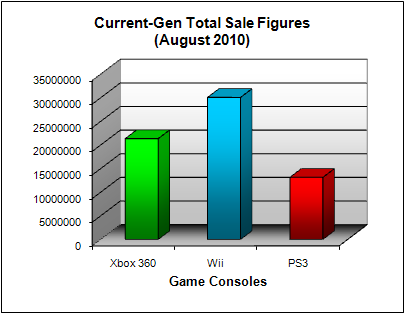
It’s August already, and we’re quickly approaching the holiday season. This holiday season is even more interesting because we have new motion gaming accessories from both Sony and Microsoft, both wanting to challenge Nintendo’s dominance in the casual gaming market. With the PlayStation Move being released in September, and Kinect in November, the months before is all about building enough momentum and hoping that the new accessories help one console get over the line, in terms of being the most popular console during the holiday season. And unlike last year, there are no signs pointing to a clear winner for this holiday season – any of the home consoles can win it – so it’s even more important to have a good August and September to lead up to the crucial October, November and December months. The figures are from NPD, a marketing research firm that releases games console sale data every month.

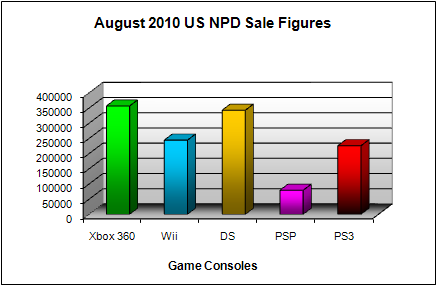
The figures for US sales in August 2010 are below, ranked in order of number of sales (August 2009 figures also shown, including percentage change):

  • Xbox 360: 356,700 (Total: 21.4 million; August 2009: 215,400 – up 66%)
  • DS: 342,700 (Total: 43.3 million; August 2009: 552,900 – down 38%)
  • Wii: 244,300  (Total: 30.1 million; August 2009: 277,400 – down 12%)
  • PS3: 226,000 (Total: 13.2 million; August 2009: 210,000 – up 8%)
  • PSP: 79,400 (Total: 17.5 million; August 2009: 140,300 – down 43%)
NPD August 2010 Game Console US Sales Figures

NPD August 2010 Game Console US Sales Figures

NPD Game Console Total US Sales Figures (as of August 2010)

NPD Game Console Total US Sales Figures (as of August 2010)

My prediction from last month was:

Looking at the Amazon charts, the new Xbox 360 4GB isn’t actually doing fantastically, and it’s being outsold by the 250GB. So while most people are predicting that it would be another month where the Xbox 360 rules, I’m not as certain. I think sales will do well, but it might be the case of things being very close, with the new 4GB probably just allowing the Xbox 360 to sneak to top spot. In games, NCAA Football is usually followed by Madden NFL, the 11th version, and that will always do well. But otherwise, it’s another slow month before the busy holiday period begins, so the top 10 should look pretty familiar.

Well, it was pretty close at the top, but the Xbox 360 still managed to beat the DS by 14,000 units, even as it recorded a month to month drop. And the top two were Madden NFL titles, but that wasn’t hard to predict (although there were some surprises here too, more on that later). And I was right too about it being another slow month, as sales dropped compared to July.

As mentioned above, the Xbox 360 was the most popular console for August, that’s two months in a row, and only the Wii or the DS has ever managed to do this. The new 4GB didn’t help the Xbox 360 record growth compared to July, but it did help to secure first spot. One should not underestimate the importance of these last two month’s victories for the Xbox 360, and of course the new form factor for the Xbox 360, which has finally allowed it to become as “sexy” an item as the PS3, possibly more so depending on who you ask. Plus the increased stability finally allowed Microsoft to put the whole RRoD business behind them. And all in time for Kinect too!

Last month, I mentioned that this month would be important for the PS3. For the first time, we can have a year on year comparison that compared the PS3 Slim to the PS3 Slim (and to the post price-cut PS3 sales figures). Of course, the Slim and price cut was launched in the middle for August last year, so we will have an even better comparison next month. But looking at the PS3 figures, while it still managed a year-on-year growth, but it was only 8%, compare and contrast to the 76% last month. And this could very well mean that PS3 sales would actually drop, year-on-year, next month, although that depends on whether the PS Move shifts any consoles along with it or not (bundles and otherwise). But a drop is not necessarily a bad result, it just means that it’s unfair to compare the post Slim/price cut bump to what is now a normal level of sale for the console. Just like it would be silly to compared  Xbox 360 sales 0f July 2011 with July 2010, due to the post Xbox 360 “Slim” sales bump. And the PS3 was the only console to manage a month to month growth in August, I guess largely thanks to the stock issue finally clearing up completely, so thing are still looking good for the console (and even better overseas, but that’s beyond the scope of this analysis). The less said about the PSP the better.

For Nintendo though, the news remains bad. The Wii is very close to dropping to the third most popular home console (that’s last place, btw), and DS sale has started to drop, perhaps reaching market saturation (although the 3DS will help, a lot, and its only competitor is the PSP, which is doing quite awfully). But with both Microsoft and Sony bringing out their motion gaming devices, it’s not looking good for Nintendo. The low tech nature of the console, which made it an affordable, profit making piece of hardware, and was largely fine for casual games, may finally have caught up with the console – so expect the Wii 2 sooner than later, as the Wii just doesn’t have the longevity of the other two home consoles. And regardless of which camp you’re in, whether you think Kinect will win, or the Move will, what is clear is that both seem better pieces of tech than the Wii. Whether their games will be as good as the best Wii games, remains to be seen, but you can’t argue that both are innovative enough (Kinect with the controller-less interface, Move with its super accuracy) to cause Nintendo concerns, at the very least.

Onto software now. As expected the Xbox 360 and PS3 version of Madden NFL 11 were the top selling titles, in the described order. What some commentators concentrated on was the surprising lack of a gap between the sales figures of the two versions, despite the advantage in hardware units the Xbox 360 enjoys (1.6:1). The actual software advantage was only 1.235:1. But this is actually up on last year’s 1.231:1 ratio. Another multi-platform release was Mafia II, and again the Xbox 360 version outsold the PS3 version, but by how much, we don’t really know because NPD no longer provides sales stats for anything other than the top 5 titles (Mafia II for the PS3 was 7th). Super Mario Galaxy 2 for the Wii was third, and fifth place was occupied by another Super Mario game, New Super Mario Bros. for the DS. The Wii version of New Super Mario Bros. was also in the top 10, with Wii Fit Plus making a return too. For the Xbox 360, Modern Warfare 2 stayed in the top 10 (related to the upcoming Black Ops game, perhaps), and last month’s top title, NCAA Football 11 also remained in the top 10.

Here’s the complete list of the top 10 software sales:

  1. Madden NFL 11 (Xbox 360, EA) – 368,000
  2. Madden NFL 11 (PS3, EA) – 298,000
  3. Super Mario Galaxy 2 (Wii, Nintendo) – 193,000
  4. Mafia II (Xbox 360, Take 2) – 121,600
  5. New Super Mario Bros. DS (DS, Nintendo) – 141,700
  6. New Super Mario Bros. Wii (Wii, Nintendo)
  7. Mafia II (PS3, Take 2)
  8. Call of Duty: Modern Warfare 2 (Xbox 360, Activision)
  9. NCAA Football 11 (Xbox 360, EA)
  10. Wii Fit Plus w/Balance Board (Wii, Nintendo)

Prediction time. September = Halo Reach. That’s what next month will be all about. The fact is that, as I type, the top four items in Amazon’s Video Games section are all Halo Reach related (standard, limited, legendary editions, plus the 360 Halo Reach console bundle), just shows how dominant it will be in September’s figures. So expect the Xbox 360 to remain on the top of the console pile hardware wise too, and possibly the best month since, well, the last Halo release. Halo Reach will overshadow Sony’s launch of the Move unfortunately, although it’s doing well to just hang in around 10th, or just outside of it. The Sports Champions bundle should be counted in the software charts (in the same way Wii Fit Plus is in there), so it should be in the top 10 (especially when the top 3 will be condensed into a single entry for Halo Reach). It will be a very interesting month, I feel.

See you next month.

Weekly News Roundup (15 August 2010)

Sunday, August 15th, 2010

Looks like I’ll be managing to bring you this week’s WNR on time. Again, it wasn’t a week bursting with news items, but the NPD folks were kind enough to release their July US video game sales reports, and I was able to get the analysis done yesterday. The Xbox 360’s big win in July has people talking, mostly those who think that the result won’t last. I agree, because just like when the PS3 Slim was released, the sales boost is all very temporary. But as I said at the beginning of the year, 2010 is about Microsoft trying to make sure the PS3 doesn’t run away with things until Kinect comes out, and thanks to Sony’s mistake of not providing enough stock to the market, and thanks to the “surprise” release of the Xbox 360 “Slim”, Microsoft has managed to do this. Now, all eyes on are Kinect and whether it will give Microsoft the boost to overtake the Wii as the most popular console, at least in the US, for this generation. I think it may be possible, but mainly because the Wii isn’t looking too healthy – it’s an ageing console in terms of hardware, with mostly sub-par games (especially if one looks at third party titles), and both Sony and Microsoft will soon be able to do what the Wii can do. The only thing in the Wii’s corner is Nintendo’s ability to make great games, and it’s these great games and accessories (Super Mario Bros, Mario Kart, Wii Sports Resort, Wii Fit …) that are keeping the Wii alive. For now. Anyway, on to the news.

Copyright

Let’s start with the copyright news for the week. We’ll start with Viacom’s appeal of the US District Court decision in June to throw out their copyright case against YouTube.

Let’s be honest here, this news isn’t any sort of surprise at all. It wasn’t as if Viacom would just give up, and it’s very likely this case will end up before the US Supreme Court before we have a final decision. Viacom still argues that YouTube, knowing that piracy was happening on their website, didn’t do nearly enough to stop it and profited from it as well. YouTube argues that the US District Court’s decision was correct, that the DMCA affords them some level of protection for user generated content, as long as they had an active policy in place. Whether that policy is good enough for the likes of Viacom, and whether the policy was effective at stopping piracy, that’s an entirely different matter. It’s very much like the AFACT vs iiNet appeal I mentioned last week here, in that the copyright holders are demanding an Internet service provider (YouTube providing a video upload service, iiNet being the more traditional service provider) to do more to fight piracy, when the service provider feels they’ve already done all they can. Viacom feels they’re the victims, and and party to profit most from these activities is in fact YouTube, not the uploader (who doesn’t get paid) nor the downloader (who, if we’re honest, has many other better places to get their piracy fix). This argument has some merit, but there is only so much YouTube can do, and in the end, it has to be the copyright holder’s responsibility to point out which pieces of content violates their copyright, as only the copyright holders can say for definite if this is the case, unless we want an automated system with a high degree of false positives, which isn’t good for anyone. And Google/YouTube rightly points out that Viacom and other copyright holders sometimes are more than happy to let a piece of content that violates their copyright stay on the network, since the hype and attention it generates outweighs what potential loss that could stem from the copyright infringement.

Viacom Logo

Copyright holders like Viacom must understand that certain acts of copyright infringement is actually good for them

And just because someone steals your copyrighted content, it doesn’t always mean you lose money. Someone using a copyrighted song in their home video that’s uploaded to YouTube would have otherwise used another song, perhaps a royalty free one, if they were prohibited from using the song, where’s the actual gain or loss for the copyright holder in this situation? Perhaps if there was a system in place where home users could pay a nominal amount, say $10, to use a song in their uploaded video, then the copyright holders could argue that there was an actual loss. But what if the video, with the illegal audio, became a hit and the song, as a result, becomes a hit too. Shouldn’t it work both ways too, that the copyright holder then have to pay the video uploader for their efforts in promoting the song? Or at the very least, allow the video to stay online, regardless of the copyright infringement. And this is why copyright holders should be the one responsible for signalling which content is okay, which isn’t – it’s more work for them, but it’s actually beneficial for them as well. YouTube’s only obligation is perhaps to make this process a bit easier, perhaps automatically help identify a list of potentially infringing videos, but they, like iiNet, should not be held responsible for determining whether an infringement has occurred or not. I know I like my analogies, but it’s like asking the bus driver to be responsible for something stolen on his or her bus, and not only responsible for the loss, but responsible for identifying the stolen object, the rightful owners, and to place guilt on the offender. I know Google are powerful, but legal authority is not something I would want them to have, no matter how easy it makes things for the copyright holders.

FBI Anti-Piracy Warning

Is the FBI prioritizing copyright infringement over missing persons and crimes like identities fraud?

But with the hysteria over Internet piracy, I wouldn’t bet against the government giving Google, and other corporations, just exactly this kind of authority. All’s fair in love and war right? Love for ridiculous copyright legislation in the war against online piracy. The huge lobbying efforts of Hollywood and music labels are paying big dividends, and it seems the political will has translated to actual action, when the FBI is concerned. Citing recent reports which point to cases like missing persons and identity fraud are no longer “priorities” for the FBI, and the recent noises made about special task forces dedicated to fighting the serious crime of movie and music piracy, website techdirt can only surmise that the FBI takes copyright infringement far more seriously than those other crimes. Those that have watched the excellent HBO show, The Wire, will have noted how it identified the quickly shifting focus of the FBI when 9/11 hit, and the War on Drugs was no longer a top priority. Now, I’m not saying that the FBI now takes terrorism less seriously than people downloading a cam copy of Inception (great movie, btw), but it’s certainly possible that things like identity fraud, hacking, and other online crimes are taking a back seat to the Crusade Against Piracy (CRAP, for short). With Vice President Biden pushing for his friends at the RIAA and MPAA, the lobbyist busy in DC, scary stories being told to governments all over the world about the impending collapse of the world as we know it if people download too much, it isn’t too big a leap to come to the conclusion that there must be political pressure on the FBI to take action. And I recently reported on the diabolical plans by the French when it comes to fighting online piracy, basically making computer wire taps legal without seeking a court order (and I did mention the comparison with the reaction to terrorism, and how even during the height of the scare, nothing like this was being proposed seriously), and so nothing is too outrageous any more, now when this thing has morphed into a moral crusade.

Village Cinema Gold Class

Premium cinema experiences, bigger screens, 3D and just better movies, all help to fight piracy more effectively

And all of this when box office receipts from around the world are showing record profits for the film industry. Even here in Australia, where there’s relatively little current government action to curb piracy (current, but of course the Great Internet Filter  of Australia proposed by the current government will see things turn nasty in the future, perhaps even more so than the proposed French model), and the courts haven’t given the film industry all they’ve wanted (referring back to the iiNet case), and by all accounts, Internet piracy is up – despite all of this, box office receipts for 2009 have just managed to break all records, and 2010 looks to be even better. So much so that even the traditional “piracy is ruining everything” brigade has to come out and admit that innovation at the cinema seems to be winning against piracy. Whether it’s bigger screens, budget Tuesdays, or 3D, or even just better, bigger films, a pirated video is not a substitute for the cinema experience. Are there people who would rather watch a poorly camcorded recording of a movie on their computer instead of going to a cinema to watch the same film on the big screen with friends? I actually don’t think these are the same set of people. I can understand why people with a quality home cinema set up may forgo going to the movies, price and comfort the key considerations, but people who are happy watching a slanted, cut off, inaudible version of the movie with someone’s head blocking half of the action, to me, just aren’t the kind of people who would pay $15 to watch a movie at the cinema. But I guess it also depends on the movies themselves. ‘The Dark Knight’, ‘Avatar’, ‘Inception’ – most people would gladly pay for the full experience (IMAX, 3D … and even popcorn). For movies like ‘Why Did I Get Married Too’, ‘The Tooth Fairy’ and ‘Furry Vengeance’, well, perhaps piracy is hurting these movies. And maybe that’s just it, that studios are concerned that the Internet makes filtering out bad movies too easily (both at the cinema, and when if gets released on home video), and so making good movies is all the more important these days. Maybe that’s why they hate piracy so much – it means they may actually have to produce better stuff!

High Definition

In 3D/HD news, for those in Australia that’s still wondering if we really need fast broadband (or just broadband) or not, here’s another application that’s will put further pressure on your bandwidth (or rather, throughput, but also bandwidth too).

Samsung will soon start to stream 3D content to their Internet equipped TVs and Blu-ray players. It will start with trailers, but move onto full movies, and games. 3D videos streams will be around 1.5 times larger in bitrate than their non 3D equivalents, and if we’re talking about Blu-ray 3D, then the peak bitrate is up at a high 60 Mbps. Let’s just for a moment imagine that Blu-ray quality 3D is to be streamed, IPTV style, then the 100 Mbps being offered by Australia’s National Broadband Network is just about enough. The only thing stopping someone from providing Blu-ray (or Blu-ray 3D) on demand right now is the lack of broadband speed, and bandwidth quota, and Australia has a great opportunity to catch up to the other countries that are already offering Gbps connections. We’ll find out this time next week whether the NBN will survive, when national elections will pitch one party that wants fibre to homes (but with the annoying Great Internet Filter of Australia), and another who think 12 Mbps, peak, is already good enough for most (but barely good enough to even stream proper 720p content, let alone 1080p or 3D). Generally speaking, if HD IPTV is to take off, ADSL2+ just won’t cut it, and considering there’s a huge percentage of Australian homes that can’t even get access to ADSL, let alone ADSL2+, money needs to be spent on infrastructure so Australia won’t get left out of the IPTV revolution.

It's official: Star Wars is coming to Blu-ray in 2011

It's official: Star Wars is coming to Blu-ray in 2011

Samsung also introduced a new portable Blu-ray 3D player. It doesn’t actually play 3D on the portable screen, you’ll still need a compatible 3D TV, so it’s not as innovative as it sounds. With the 3DS coming out, I think we’ll soon see portable Blu-ray players with autostereoscopic screens (that’s 3D screens without the need for glasses).

And good news for Star Wars fans, all six Star Wars movies will be available on Blu-ray sometime in 2011, George Lucas made the announcement at Star Wars Celebrations V. Of course, “real” fans will only want the first three, or is that the last three, movies. You know, the ones that didn’t suck. But real fanatics won’t care and will watch all 6 movies in one go while wearing their Jedi robes and swinging their hand built lightsabers. My only wish is that Lucasfilms include the original theatrical versions on the Blu-ray discs too, and pray that George doesn’t tamper with the films too much for yet another release (not much hope of this happening though, not with Star Wars 3D also in the works).

Gaming

And finally in gaming, the NPD analysis means there’s not much I want to talk about here, except some more Blu-ray news, but this time, it’s got to do with the Wii.

Rumours surrounding the Wii 2 is hotting up, with the latest rumour suggesting that the console’s new 1080p resolution will be coupled with a Blu-ray drive too. But knowing Nintendo, it will probably be the only Blu-ray equipped machine that doesn’t actually play Blu-ray movies, because if the rumours are to be believed, Blu-ray discs are being used for Wii games to help curb piracy. It is true that Blu-ray discs are harder and more expensive to copy, but if the Xbox 720, Wii 2, and PS3/PS4 all use Blu-ray discs, expect burner prices to drop (they’re already not that high), media prices to drop, and piracy to increase. I think Nintendo do need a new console though, since the Wii is looking pretty outdated compared to what the PS3 and Xbox 360 will be offering via Move and Kinect.

And that’s all the news for this week. I won’t promise “more next week”, because chances are, there will be less. Have a good one.

Game Consoles – July 2010 NPD Sales Figure Analysis

Saturday, August 14th, 2010

July figures are now available from NPD for US video game sales, and there are a couple of surprises, although probably only one good surprise for one company in particular. June figures showed some year on year improvement by the likes of the Wii, Xbox 360 and PS3, which offset the bad news about the decline for the DS and the worrying figures for the PSP. July is traditionally not as good a month as June, so all eyes will on which consoles can do the business this month, and which are in serious trouble. The figures are from NPD, a marketing research firm that releases games console sale data every month.

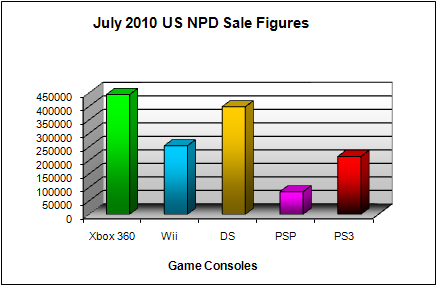
The figures for US sales in July 2010 are below, ranked in order of number of sales (July 2009 figures also shown, including percentage change):

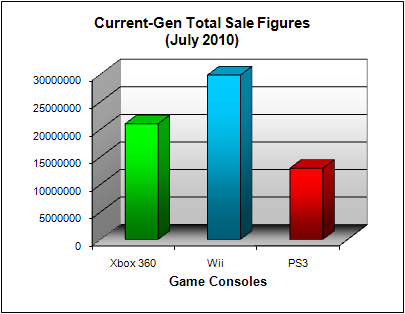
  • Xbox 360: 443,500 (Total: 21 million; July 2009: 202,900 – up 119%)
  • DS: 398,400 (Total: 43 million; July 2009: 538,900 – down 26%)
  • Wii: 253,900  (Total: 29.8 million; July 2009: 252,900 – up 0.4%)
  • PS3: 214,500 (Total: 12.9 million; July 2009: 121,800 – up 76%)
  • PSP: 84,000 (Total: 17.4 million; July 2009: 122,800 – down 32%)
NPD July 2010 Game Console US Sales Figures

NPD July 2010 Game Console US Sales Figures

NPD Game Console Total US Sales Figures (as of July 2010)

NPD Game Console Total US Sales Figures (as of July 2010)

My prediction from last month was:

Time to make a prediction. The new Xbox 360 Elite fever continues, and there’s a good chance it will outsell the Wii (and PS3) yet again. So my guess is that the order of the hardware sales will remain the same for July, but with hardware sales generally down a bit compared to June as historically has been the case. As for games, Super Mario Galaxy 2 to rule in the absence of any real quality new releases. NCAA Football 11 should make the top 10, the Xbox 360 version outselling the PS3 version. How can I forget Crackdown 2, the sequel to the very first Xbox 360 game I ever owned. It should do well, but topping the chart? I don’t know about that (it’s already 39th in the sales charts on Amazon, and that doesn’t look like a rank that belongs to a number one title).

I was I was close to the mark, but I just couldn’t see the Xbox 360 outselling the DS, not just the Wii, but that’s exactly what happened. Although the Xbox 360’s number one was earned with much help from decreasing DS sales, but when most consoles saw month to month drop in sales, the results were still remarkable. As for games, I think what I predicted mostly came true, but otherwise it was a slow month for game sales.

The Xbox 360, thanks to the new “Slim” or we’ll just refer to it as the Xbox 360 250GB, has done wonders for Xbox 360 sales, but that’s really not a surprise. The DSi, PS3 Slim all helped to post what proved fairly temporary sales increases, and the 250GB model may run out of steam next month. But of course, Microsoft has the new Arcade replacing 4GB, matte “Slim” version out in August, and so that might help keep hardware sales up. And then in September, Halo Reach is released, and a Halo title will always help push hardware sales, so it looks good for Microsoft until Kinect hits the market. Whether Kinect will prove a hit or not, that’s still too early to say, but early signs are encouraging.

For Nintendo though, decline in DS sales and an almost negligible year on year growth for the Wii is starting to look a bit worrying. Of course, with the 3DS on the horizon, Nintendo won’t be too concerned with the year on year comparison (which saw a 26% drop in sales), last year’s figure boosted by the DSi. The Wii numbers are slightly more worrying, since the numbers are starting to look like one for a console that’s running out of ideas. Price cuts can help, but with Sony and Microsoft’s own motion gaming systems on the way, the Wii looks quite last-gen in the face of the competition.

For Sony’s systems, the PS3 is still getting a healthy year on year result every month, but remember that the PS3 was doing extremely poorly this time last year (although next month’s figures for 2009 should start to reflect the Slim and price cut’s effects, at least partially), and large growth means nothing if you’re comparing it to a poor period. But compared to the Xbox 360 or the Wii, it still isn’t doing what it is capable of, and despite the poor Wii numbers this month, the PS3 numbers were still lower. And this is with the stock issues cleared up. The PS3 numbers for July 2010 are actually lower than the PS3 numbers for July 2008 (225,000), and that’s not a great sign despite price drops, new form factor, and many many more games being released since that time. The PSP, well, the less said about that the better. Pretty soon, the NPD will have to remove the PSP numbers just like they did with the PS2 numbers, because frankly, it’s just not competitive with the DS, even with the poorer than usual DS sales numbers.

Let’s move onto software. As expected, the two versions of NCAA Football 11 for the Xbox 360 and PS3 topped the sales charts, but the gap between the two console versions has narrowed considerable compared to last year. NCAA Football 11 sold slightly less than NCAA Football 10 on the Xbox 360, but the same comparison saw more PS3 sales. While the Xbox 360 holds a 1.6:1 sales ratio to the PS3, in terms of hardware, the software margin seems to be much closer. The Xbox 360 exclusive Crackdown 2 managed to get third place, while Super Mario Galaxy 2 is still the best selling Wii title for the month (New Super Mario Bros. was the only other Wii title in the top 10, at 9th). The DS version of Lego Harry Potter Year 1 – 4 managed to grab 5th place. For the Xbox 360, there were two more titles in the top 10, Red Dead Redemption (the PS3 version has dropped out of the top 10 for this title), and an oldie, but goodie, Call of Duty: MW2. Dragon Quest IX: Sentinels of the Starry Skies for the DS was the remaining title in the top 10, at 8th.

Here’s the complete list of the top 10 software sales:

  1. NCAA Football 11 (Xbox 360, EA) – 368,000
  2. NCAA Football 11 (PS3, EA) – 298,000
  3. Crackdown 2 (Xbox 360, Microsoft) – 208,800
  4. Super Mario Galaxy 2 (Wii, Nintendo) – 193,000
  5. LEGO Harry Potter: Years 1-4 (DS, Warner Bros.) – 141,700
  6. Red Dead Redemption (Xbox 360, Take-Two)
  7. LEGO Harry Potter: Years 1-4 (Wii, Warner Bros.)
  8. Dragon Quest IX: Sentinels of the Starry Skies (DS, Nintendo)
  9. New Super Mario Bros. Wii (Wii, Nintendo)
  10. Call of Duty: Modern Warfare 2 (Xbox 360, Activision)

It’s time to make the usual predictions. Looking at the Amazon charts, the new Xbox 360 4GB isn’t actually doing fantastically, and it’s being outsold by the 250GB. So while most people are predicting that it would be another month where the Xbox 360 rules, I’m not as certain. I think sales will do well, but it might be the case of things being very close, with the new 4GB probably just allowing the Xbox 360 to sneak to top spot. In games, NCAA Football is usually followed by Madden NFL, the 11th version, and that will always do well. But otherwise, it’s another slow month before the busy holiday period begins, so the top 10 should look pretty familiar.

See you next month.

Weekly News Roundup (25 July 2010)

Sunday, July 25th, 2010

Hello. I’ve finally completed moving house, by completed, I of course mean that there’s still tons of stuff that needs to be moved over. But this is the first WNR at the new place. But the roundup must go on, as they say, despite aching limbs and a sleep deprived brain. One good thing about the move was that I was finally able to test Blu-ray 3D playback via PowerDVD 10 Mark II to my Samsung 3D plasma. More on that later.

Copyright

Let’s start with copyright news. The US Copyright Group is in the news again this week as they step up their campaign targeting thousands of web users accused of downloading pirated movies.

The latest development sees the USCG hiring the services of smaller law firms signalling the next phase of their plans – going to court. It was always understood that firms like the USCG would avoid going to court whenever possible, since the costs are higher and so are the risk (of losing, and hence, setting a precedent that could hurt future business). But it appears the USCG is pressing ahead anyway, no doubt going after those that are easy to beat in court. It may also be their way of showing that they do intend to go to court, a criticism that critics have used in the past to attack similar actions, and if they can get a few easy victories under their belt, maybe a high profile one, then this can be used to scare more people  into paying up. And as for working with the EFF to draft a user friendlier notice to send to suspected pirates, it seems the two sides just can’t get along and both may have to go and see the judge again to see how they can get things moving. This isn’t the biggest surprise in the world, as one side wants to make the notices are serious as possible to get people to pay up, while the other want the notice to be informative enough to allow people to defend themselves – it was always difficult, if not impossible, to meet both objectives.

The Last Vegas Review-Journal

The Last Vegas Review-Journal is suing those that use its articles without permission

While the USCG aren’t winning friends with web users, ISPs and rights groups, they are making friends in other media circles, and at least one law firm is now copying their strategy, except going after those who pirate newspaper articles, rather than movies. Suing hundreds of websites and blogs is Las Vegas based Righthaven, representing the owners of the Las Vegas Review-Journal. While most newspapers use DMCA takedown notices to get their full articles removed from forums and blogs, there is no money that can be made by taking this approach. But if the threat of a lawsuit, and the request for a pre-trial settlement works for the USCG on movie downloaders, then the thinking is that website owners will do the same as well, even when the offending content was posted by one of its users, not the website itself. The recent Viacom versus YouTube action showed that user generated websites do have protection from the safe harbor provisions under the DMCA, as long as they have a clear anti copyright infringement policy in place and enforces this policy consistently. So one might think this would apply to forums where users have posted full articles against forum rules, or blogs where users have made the same post in the comments. But the fear of an expensive lawsuit means that many will simply pay the settlement fee to avoid the trouble, although others are willing to challenge the claims in court. If this model works, expect all other newspaper owners to follow suit, as most of them are struggling to keep profits from dropping in what many calls a dying industry.

UPC

Irish ISP UPC is going to court to fight three-strikes

Moving to Europe now, it appears ISPs in many countries are not happy at their respective government’s three-strikes policies, and are going to court to fight it. Three-Strikes, or similar laws, may appear to be aimed at users who download pirated content, but it is in fact aimed at ISPs, making them responsible for monitoring and “sentencing”, for want of a better word, their own subscribers. The cost of the operation will have to be absorbed by the ISP, and mistaken identifies or other errors could even see the ISPs sued. The ISPs argue that since the music labels and movie studios are the one that will supposedly benefit from piracy being reduced, they’re the ones that should play a more active role in enforcing three-strikes. The content owners, however, will argue that they’re the victims in this and that ISPs should just pass on the cost to subscribers. The big question is if this wasn’t about the Internet, would government, who are normally clueless about Cyberspace, be so willing to give in to the demands of copyright holders? If people were committing copyright infringement via the telelphone, let’s say something silly like reading out loud books or newspaper articles to the person on the other end, should the telephone company then be tasked with spying on users’ conversations so they can put a stop to this illegal practice? Should the government then help to make spying legal and part of the copyright laws? ISPs are nothing more than utility companies, like the gas, electricity or telephone companies, and making them responsible for what their subscribers do with the service just doesn’t seem right. And if there are any technical advantage that make ISP level “spying” easier, then it would still be unfair to make ISPs bare the entire cost of the operation. It’s forcing one industry, and tax payer money,  to protect another industry’s revenue stream for no reason other than it’s the easy thing to do.

The Swedish Pirate Party wants to do something about ISP snooping though, and they are planning to launch their “Pirate ISP”, which will ensure no data about users if kept, so that their privacy is protected. The idea is nice, but I can already see the lawsuits and search, arrest warranty being typed up, probably before the ISP is even launched.

And when Hollywood is finished getting the government and ISPs to do their bidding, for free, they will turn their targets on those that try to innovate too much. Because innovation could eventually lead content being published without having to be controlled by publishers, and that spells bad news for revenue. Google TV is next in Hollywood’s cross-hairs it seems, as the new proposed system which aims to present a common interface for viewing media, online and offline, on TVs may just be too innovative for Hollywood’s liking. In their submission to the FTC, Hollywood studios claims that Google TV could potentially allow users to interact with both legal and illegal media, in the same interface, and that’s will encourage users to all become pirates. Instead of seeing how such an innovation could revolutionize the way people buy content on the Internet, and instead of supporting Google, a company with a history of knowing how to get money out of the Internet and its users, they yet again focus on the piracy issue and the issue alone. Just like how music labels refused to work with digital music retailers and instead focused on more and more complicated layers of DRM, and then having the likes of Apple iTunes swallow up a huge chunk of Internet related profit that otherwise would have gone to the labels, Hollywood appears to be making the same mistake.

UltraViolet DRM

DECE has a new name and logo: it's now UltraViolet, but it's still an new, annoying DRM

Instead, their solutions is, you guessed it, more DRM. Hollywood’s new fairer DRM scheme, supported by pretty much all the studios expect Disney (who have their own proprietary system in the works), is now called UltraViolet. How is it friendlier? Well, it plans to make DRM protected files more portable, working in more players and systems, but it still has the stench of DRM all over it, and thus, all the same usual problems: lack of universal compatibility, the need for online authentication, and don’t expect the files to work forever as there is no guarantee whatsoever that any DRM system will be kept supported and updated (at high cost by the DRM operators) forever. The IEEE is also working on their own “fairer” DRM, which will make digital files more like physical objects, in that ownership can be transferred, so sharing something with a friend could mean that you lose the ability to use the file forever if your friend do not return ownership back to you. The scheme, called P1817, could even work in conjunction with the monster that is UltraViolet, to make everything a bit fairer you see. The funny thing is that by acknowledging the need to make things fairer, content owners have just acknowledged that DRM, at least in past forms, have not been fair to users. I would go one step further and say that DRM is always unfair to users, so if you want them to accept it, make sure you give them back something in return. Whether’s that lower prices, better services, or even just less hoops to jump through, it is needed. Content owners should not take users for granted, as they may just go elsewhere (and if there’s no legal alternative, guess where they will be, and have been, heading to?)

High Definition

In HD/3D news, as mentioned in the introduction, I managed to get PowerDVD 10 Ultra 3D with the Mark II patch to play a Blu-ray 3D movie and have it display as proper 3D on my new Samsung 3D plasma TV.

It took a bit of work trying to get it to work, but I’ve posted the instructions here for those that want to give it a go. The 3D effects are great, even if you’re not getting full 1080p resolution, but that will only be possible when updated drivers are available for my ATI Radeon HD card. For now, it means I can play Blu-ray 3D movies in 3D without a standalone Blu-ray 3D player (although my free bonus one, part of a promotion Samsung were running here in Australia, should be on its way from Samsung, hopefully arriving before the PS3 gets its Blu-ray 3D update).

BDXL Logo

And sticking with the theme of logos ... BDXL won't play on existing Blu-ray players

But while I wait for my Blu-ray 3D player to arrive, it may already be obsolete, thanks to the idea of “upgradeable hardware” introduced by the Blu-ray format. The idea says that, like software, there may be a new version out every year and you would need to pay to get the new version, if you want the latest features. We’ve already had Profile 1.0, 1.1 and 2.0 players, and I guess Blu-ray 3D counts as 2.5 or something. And when BDXL movie discs arrive (if they arrive), then we’ll all need new players again (4.0, since 3.0 is already taken by the fairly unused Blu-ray audio format). It’s nice having 128GB capacity, but not so nice when I have to yet again upgrade my Blu-ray player, despite how cheap players have become. Even the always versatile PS3 won’t be able to support BDXL, since the only thing that the PS3 can’t update through software, the Blu-ray drive itself, will need to be updated. And soon after Blu-ray 4.0, we’ll have Super-Blu-ray 1.0, with Sony promising a 1TB disc using an even more powerful laser. Downloads, streaming, storage lockers … if only everyone had the bandwidth to make download a Blu-ray quality movie a matter of minutes, rather than hours (or weeks, in certain Internet backwaters,  like Australia), then we could get rid of the disc altogether, or burn our own discs by only replacing the optical drive in your computer, as opposed to an entire standalone player. It’s bad for the environment, bad for our wallets, and it’s just annoying.

But at least one thing to do with Blu-ray is going disc-less. Netflix streaming on the PS3 will finally work without a Blu-ray disc, and it only took a year after Netflix was first available on the PS3, and several after the Netflix was originally launched on the Xbox 360 (which had disc-less streaming from the get go). Better late than never, I suppose.

Gaming

And finally in the ever rarer gaming section, Microsoft has finally revealed the official Kinect pricing. Which is exactly the same as the unofficial pricing all the retailers have been using for months.

The only surprise, and a good one, is that the $149.99 price includes a free game, Kinect Adventures. But it was Microsoft’s other announcement which were a bit more interesting, like the new “Arcade”, the Xbox 360 4GB, which is basically the same piece of hardware as the new “Slim” Xbox 360 250GB, except without the 250GB HDD of course. The price for this new console is $199, but if you buy it with Kinect in a bundle, it will be $299, so that’s another $50 off Kinect’s pricing if you buy it with the new console. Some will say that this attempt to compete with the Wii is doomed to failure, because the Wii will be much cheaper. But the Xbox 360 doesn’t need to be the same price as the Wii, since it’s a much better console (certainly plays more types of games than the Wii, in HD too). There’s no Xbox 360 250GB Kinect bundle, which is a shame because that’s the one I would like to buy. Kinect pre-orders on Amazon jumped back to the top 5 after the pricing announcement on Wednesday, but has since dropped down to 21. The Move bundle is at 49th.

And that’s the news I have for this week. Sorry about the rushed nature of this WNR, what with all the mistakes and mindless rambling, moving house takes a lot out of a person. You didn’t notice any differences? That’s good then. What do you mean “it’s same crap as usual”? Huh? Anyway, here’s to a less crappy WNR next week.